A guest post by Steven Goddard
One of the most widely discussed climate feedbacks is the albedo effect of polar sea ice loss. Ice has a relatively high albedo (reflectance) so a reduction in polar ice area has the effect of causing more shortwave radiation (sunlight) to be absorbed by the oceans, warming the water. Likewise, an increase in polar sea ice area causes more sunlight to be reflected, decreasing the warming of the ocean. The earths radiative balance is shown in the image below. It is believed that about 30% of the sunlight reaching the earth’s atmosphere is directly reflected – 20% by clouds, 6% by other components of the atmosphere, and 4% by the earth’s surface.

We all have heard many times that summer sea ice minimums have declined in the northern hemisphere over the last 30 years. As mentioned above, this causes more sunlight to reach the dark ocean water, and results in a warming of the water. What is not so widely discussed is that southern hemisphere sea ice has been increasing, causing a net cooling effect. This article explains why the cooling effect of excess Antarctic ice is significantly greater than the warming effect of missing Arctic ice.
Over the last 30 years Antarctic sea ice has been steadily increasing, as shown below.

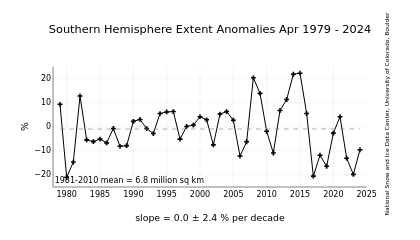
December is the month when the Antarctic sun is highest in the sky, and when the most sunlight reaches the surface. Thus an excess of ice in December has the maximum impact on the southern hemisphere’s radiative balance. In the Antarctic, the most important months are mid-October through mid-February, because those are months when the sun is closest to the zenith. The rest of the year there is almost no shortwave radiation to reflect, so the excess ice has little effect on the shortwave radiative (SW) balance.
This has been discussed in detail by Roger Pielke Sr. and others in several papers.
So how does this work? Below are the details of this article’s thesis.


1. As mentioned above, the Antarctic ice excess occurs near the December solstice when the sun is highest above the horizon. By contrast, the Arctic ice deficiency appears near the equinox – when the sun is low above the horizon. Note in the graph below, that Arctic ice reaches it’s minimum in mid-September – just when the sun is setting for the winter at the North Pole. While the September, 2008 ice minimum maps were dramatic, what they did not show is that there was little sunlight reaching the water that time of year. The deviation from normal did not begin in earnest until mid-August, so there were only a couple of weeks where the northern hemisphere SW radiative balance was significantly impacted. Thus the water in most of the ice-deficient areas did not warm significantly, allowing for the fast freeze-up we saw during the autumn.
The 2008 peak Arctic ice anomaly occurred near the equinox, when it had the minimum heating effect on the ocean.

By contrast, the peak Antarctic ice anomaly occurred at the December solstice, when it had a maximum cooling effect, as shown below.
2. The next factor to consider is the latitude of the ice, which has a strong effect on the amount of solar insolation received. Arctic sea ice is closer to the pole than Antarctic sea ice. This is because of the geography of the two regions, and can be seen in the NSIDC images below.
Antarctic sea ice forms at latitudes of about 55-75 degrees, whereas most Arctic ice forms closer to the pole at latitudes of 70-90 degrees. Because Antarctic ice is closer to the tropics than Arctic ice, and the sun there reaches a higher angle above the horizon, Antarctic sea ice receives significantly more solar radiation in summer than Arctic sea ice does in its’ summer. Thus the presence or absence of Antarctic ice has a larger impact on the SW radiative balance than does the presence or absence of Arctic ice.
At a latitude of -65 degrees, the sun is about 40 degrees below the zenith on the day of the solstice. Compare that to early September negative anomaly peak in the Arctic at a latitude of 80 degrees, when the sun is more than 70 degrees below the zenith. The amount of solar radiation hitting the ice surface at those maxima is approximately 2.2 times greater in the the Antarctic than it is in the Arctic = cos(70) / cos(40) .
The point being again, that due to the latitude and date, areas of excess Antarctic ice reflect a lot of SW radiation back out into space, whereas deficient Arctic ice areas allow a much smaller quantity of SW radiation to reach the dark surface of water. Furthermore, in September the angle of incidence of the sun above the water is below the critical angle, so little sunlight penetrates the surface, further compounding the effect. Thus the Antarctic positive anomaly has a significantly larger effect on the earth’s SW balance than does the Arctic negative anomaly.
3. The next point is an extension of 2. By definition, excess ice is further from the pole than missing ice. Thus a 10% positive anomaly has more impact on the earth’s SW balance than does a 10% negative anomaly.
4. Due to eccentricity of the earth’s orbit, the earth is 3% closer to the sun near the December solstice, than it is during the June solstice. This further compounds the importance of Antarctic ice excess relative to Arctic ice deficiency.
All of these points work together to support the idea that so far, polar ice albedo feedback has been opposite of what the models have predicted. To date, the effect of polar albedo change has most likely been negative, whereas all the models predicted it to be positive. There appears to be a tendency in the climate community to discount the importance of the Antarctic sea ice increase, and this may not be appropriate.
Pierre Gosselin (00:41:29) :
I’ll tell you right now that the biofuel proponents had the same hopes, dreams and visions – until they collided violently with reality. Today we all know the folly of biofuuels: deforestation, food shortages, absurd inefficiency and civil unrest, and that all caused by a biofuel industry that is only in its infancy!
There are some issue here, but first: I don’t think biofuels are the be-all and end-all. They ‘have issues’, but not as stated above.
1) Existence proof.
Brazil has a well done working biofuels program. 8:1 energy gain. Quite profitable. Fits well inside the ag sector. (Recent land conversions to ag use have had to do with the growth of soybean planting in Brazil for animal feed, not alcohol, so don’t hang deforestation on the wrong cause… It’s the COWS and their 10:1 feed conversion “efficiency”… )
2) Exactly what food shortages came from biofuels?
The rice shortage had nothing to do with biofuels. It had a great deal to do with the contamination of foundation seed stock used in America with a GMO gene from a Bayer test plot. That was not caught before the seeds were widely planted. THAT then resulted in the entire US crop being banned in many countries as an import. Take a major exporter off line, rice ‘shortage’… That then resulted in the civil unrest.
The corn used for biofuels is not human food, it’s field corn. The only one made ‘hungry’ by using it for alcohol would be a chicken somewhere, but in return a COW was fed more: they are fed the DDG – Dry Distillers Grain – after the fermentation. Yes, egg & chicken prices went up, DDG feed costs went down. Cherry picking your cost impacts? And at no time was there a shortage of chickens and eggs in the market… Don’t confound price impacts with supply quantities. (During this time I traded into CALM, the largest egg maker around. It has a seasonal component too, peaking at Easter… but stayed away from beef and pork – ticker COW.)
3) Corn efficiency is not biofuels efficiency.
While the use of corn kernels for biofuel is low efficiency (about 1.3:1 gain, though they don’t account for the DDG and other values well, so that gain is biased low) that is because it was a political decision not a technical one to support corn; it is not an indictment of biofuels. Look at sugar cane and biodiesel (especially from used cooking oil) as far better examples. Look at algae as a stunning one. Look at the high gain sorghum that is entering production. Look at the Rentech use of trash (i.e. old paper and yard waste) in a FT system. Look at the D1 Oils use of Jatropha in the tropics. The list goes on… Corn ethanol is a biofuel, but biofuels are not corn…
I could go on, but I won’t ( I HEARD that muttered ‘thank God’!!)
IMHO CTL, GTL, and nuclear are better choices, but biofuels (ex corn kernels) are OK.
crosspatch (15:43:13) :
Coal would be mined and burned. The CO2 absorbed by trees, turned into paper used in the economy and then buried back into the coal mine where the CO2 came from. That would give a positive use of the CO2 before it is sequestered.
Why bother? Grow the trees, make the paper, feed the waste paper to a ‘coal’ burning plant avoiding the new coal & CO2, grow the trees with that recycled CO2,…
This is what is being done today with trash burners & trash to liquids folks who have to make money on the deal. Much less digging, hauling, etc. costs.
Rick and Richard Sharpe, re wind-power, and renewables in general.
As a wind farm owner would look at the numbers, he generates perhaps 100,000 kwh on a given day, with his 20 MW installed capacity. He sells it to his local utility company for, let’s say, between 12 and 15 cents per kwh. The government pays him an additional 1.5 cents per kwh. After paying all his costs, labor, property taxes, maintenance, principal and interest on any loans, interest on bonds he may have had to issue to finance the project, and dividends he must pay to preferred stock holders, his costs add up to 7.5 cents per kwh. He paid absolutely zero for energy, as the wind is free.
Depending on whether he built and paid for connection lines to the utility or the utility did, he must add those costs in. So, let’s just say he gets the low end of the power price, at 12 cents. Government pays him 1.5, so his revenue is 13.5 cents, his costs are 7.5 cents, and he chalks up 6 cents per kwh as his earnings before income taxes. He pays his income taxes, likely 45 percent or so, and gets to keep around 3 cents per kwh.
For 100,000 kwh per day, that works out to $3,000 per day. Not too bad, considering he already paid the bank for his loans. He likely uses that to buy more wind turbines.
As I said, the wind is free. No charge for the energy input to the system.
From the utility standpoint, they pay the wind farm owner 12 cents for the power he produced. They back down their generating plants to compensate for his power, and save their incremental costs for fuel, chemicals, water, and less wear and tear on equipment. Those costs work out, depending on which plant is backed down, and the price of the fuel, to around 3 cents up to 8 cents per kwh. The utility will normally back down its most expensive power, perhaps a Rankine-cycle gas-fired power plant with an efficiency of around 45 percent.
So, using a 45 percent power plant efficiency, and $5 natural gas, the utility pays the wind farmer 12 cents, reduces his own costs by 4 cents, and re-sells the power to a customer for 12 cents. The utility just made a profit of around 4 cents per kwh, which after taxes is around 2 or 2.5 cents. That is around $2,000 per day, for doing nothing!
When natural gas was around $12 this last summer, the utility’s cost was around 9 or 10 cents for each kwh reduction. The utility’s profit in that scenario was around 5 to 6 cents for every kwh of wind power purchased.
It can get even higher, if the utility is backing down a peaking gas-turbine that has only about 20 percent efficiency. Then, the utility may be saving 20 cents per kwh, if natural gas is at $12.
Does this make it any clearer why MW of wind-generated power is growing by around 30 to 35 percent each year? Utilities pray for wind. Go, wind, go!
Notice that a utility will not (usually) back down a nuclear plant when wind power is purchased, because their incremental cost of nuclear power is about 2 or 3 cents per kwh. Why back down the nuke, when you can double or triple or quadruple your profits by backing down a gas-fired Rankine plant?
The same analysis holds true for solar, wave-power, geothermal power, or any other renewable power. The individual costs of production may be different, as I wrote earlier thin film PV is reported to generate power at around 5 cents per kwh.
Now, as to the Canadian darkness, and other more northerly regions where solar is not economic, or perhaps the wind does not blow, all I can say is that no country has an equal distribution of natural resources. Japan, for example, has very little natural resources except coastline. They have managed and are managing quite well.
Btw, there is a published study of installing massive wind turbines on the Aleutian Islands off Alaska, then transmitting the power to the lower 48 via new cryogenic underground transmission lines. Those guys are thinking big, as in Egyptian pyramids big, or Three Gorges Dam big. But the available wind power up there is awesome.
Roger E. Sowell
Marina del Rey, California
crosspatch (09:33:34) :
If I might be so bold to make a suggestion, an intercontinental high speed electric rail system rivaling the Interstate highway system and powered by nuclear energy would be a great asset to the country.
I fully agree, but I must point out the vast quantity of land, especially desert land, that would consume. Unless you re-use the existing RR right of ways, you are talking about a lot of land. 20,000 miles x (any usable width) is large. And therein lies the rub. Either you confiscate the existing right of way rights or you duplicate something very large and expensive.
The system should be initially designed for 100MPH travel with an eventual goal of 200MPH when fully completed.
Add 100 mph, please!
Planes might someday be able to operate on hydrogen which could be generated with excess power from nuclear plants.
Fuel tank is way too large. It’s much easier to make Jet-A from coal or even trash. Rentech has already done this and the fuel is provided to the USAF. They are in the middle of certifying all their aircraft to run on this synthetic fuel. The ‘problem’ is already solved. No fleet change issue either.
http://www.rentechinc.com/pdfs/Rentech+MSW+Release+3.11.08.pdf
Think of it as your paper idea, but with the paper turned into jet fuel… THIS is the kind of biofuels process that has no impact on land use (other than reducing land fills…)
Long haul trucks will probably remain fuel based […]
Um, you ought to look into ‘intermodal’. Most long haul freight is already put on trains with trucks for short haul. Watch a freight go by. See all those containers that get set back on a truck bed at the other end? It’s already a solved problem. Some long haul trucking still exists for special purposes, small volumes, or fast delivery.
Synthetic fuel production is easy enough that motor fuels will be with us for a long time to come.
We are going to need to preserve the land for food production.
The big issue in agriculture has been the need to restrict production to maintain prices. The notion that we are running out of land is broken.
I can grow tomatoes around an oil rig, I can graze cattle in an oil field. I can’t graze cattle in a field of these trees.
Have you ever lived on a farm? This sounds like city talk!
There is a nice isolation area around drilling rigs so that the crap from them doesn’t crap up the farm and the pesticides don’t poison the guys running the drill rig. And you don’t graze your cattle in a tomato field either. So? Cattle are cattle and vegetable fields and orchards have no cattle in them.
It is much better to pen the animals and feed lot them anyway (from a productivity point of view). And if you are worried about quantity of food (food shortages) you don’t want cattle anyway. They are horridly wasteful of land and feed. (10 lbs of feed per pound of beef. Chickens are 3:1)
To put cattle in the same breath with a desire to avoid food shortages is just backwards.
And what happens when the local animals try to eat a fallen nut from those trees and are poisoned but have nothing else to eat because the natural vegetation is now “weeds” and is destroyed? It just doesn’t seem to be environmentally friendly on an industrial scale.
NO farm is ‘environmentally friendly’. They look nice on post cards, but they are NOT a place for furry friends to make a home. That ‘local animal’ if found in a nice peach orchard will be killed so fast it won’t have time to cool off before it’s in the dinner pot or buried full of toxins. Do a google of ‘rodent control’ or ‘bird control’ on farms. Farms are intended to murder invading animals as fast as they can. (As a child, I did my share of ‘pest control’ on local farms… We had to be careful about when, though, since there were times when the dirt was lethal due to ‘fumigation’ with methyl chloride IIRC)
Please, if you are a city slicker, let go of the notion that farms are critter friendly non-toxic places. Their purpose (not always achieved) is to kill any competing species other than the crop.
How much energy will it take to fertilize, irrigate, harvest, and process that crop? Current crop biofuels are a net loss.
Nope. Corn is a 1.3:1 net gain. Not much, but a gain. Others are much better. Cane is 8:1 gain. Jatropha is a soil builder and that is one of it’s biggest features; “depleted’ over farmed land is recovered to a productive state by the nitrogen fixation and seed cake waste fertilization regime. Woody species can make up to 54 tons / acre. No way 54 tons of fuel are used on an acre of trees…
Please spend a bit more time looking at the agronomy pages from a decent ag school before making statements about farms and crops. Please.
http://vric.ucdavis.edu/
http://www.pfaf.org/index.php
http://www.hort.purdue.edu/newcrop/
http://www.jeffersoninstitute.org/pubs/amaranth.shtml
are samples of the kinds of things you ought to be looking at if you are interested in farms, farming, and crops.
Leif, Nobwainer’s (landscheidt) inertia theory is. Please criticise WHERE this is wrong.
A curve ball spinning (the sun) with a peanut (jupiter) attached it with a rubber band that is about to come to its furthest point from the baseball. This as you can clearly see reduces the speed of the spin because the vector is more away than round.
Thank-you factual friends. Don’t let them pressure truth its still there. Ed.
Roger,
Your analysis is great, but what happens when:
1. We need to add additional capacity? We actually have to build new base-load capacity, because we cannot rely on wind.
2. When the wind capacity out there exceeds that of all the less efficient stuff.
3. What are the risks? Say some large percentage of the wind operators get lazy? Are they regulated in the same way that the big power generation companies are? We lose 20% one day and the distribution company takes a long time to bring new power on-line?
Hmmm, Roger, aren’t you also double dipping, in the sense that the cost of electricity to the generating company includes depreciation on the equipment they have (because it has to be replaced sometime) and the labor costs of their employees.
Even though the equipment is idle, it still costs them something.
Pierre Gosselin (01:25:32) :
Again, solar and wind have to be backed up by gas-fired plants 1:1! FACT!
Why not just run them full time, do away with the ugly and expesnive wind and solar, thus saving us huge amounts in subsidies, and thus provide consumers with affordable power? I’m still waiting for an answer.
Gas: Capital costs low, fuel costs high
Wind: Capital costs high, fuel costs low
Optimized profit: Run wind when possible, gas when not.
Same reason we use gas as peak load and nuclear as base load instead of just running everything on gas or nuke. Just substitute “nuke” for “wind” in the above and you have what we do now (though the nuke variation has a cap on total nuke based on the need to run it as close to 100% capacity as possible.)
Standard linear programming optimization stuff. Econ 1B I think it was… or was it Econ 13?…
Edward Morgan (16:06:59) :
Leif, Nobwainer’s (landscheidt) inertia theory is. Please criticise WHERE this is wrong.
This has been done by many people. Particularly well and recently by De Jager: http://www.leif.org/research/jagerversteegh-20063.pdf
You request is like this: Aristole’s theory [heavier bodies fall faster than lighter bodies]. Please criticise WHERE it is wrong.
Pierre Gosselin (11:40:40) :
E.M. Smith
If biofuel is so great, then why are all the subsidies needed?
Not all biofuels are subsidized. But, to the point: The energy markets are not competitive. OPEC is a monopoly and the ‘oil majors’ are an oligopoly. Utilities are generally regulated monopolies (and often monopsonies as well). So you want just one player to be subject to competition from large government supported monopolies and oligopolies?
Any discussion of subsidies and supports in the energy business rapidly gets bogged down in the discussion of monopoly power, regulatory burden, and un-competitive markets. The theory is that the biofuels subsidy is a countervailing force to the monopoly / monopsony distortions. Personally, I’d rather address the monopoly power directly, but I’m not running for election and looking to get money…
Also, more than half of the energy yielded is needed to plant, transport, handle and process the raw material into an end-product. This does not include distribution and marketing the end product! More than half gets used to make it.
No such statements can be valid. You have some specific biofuel in mind to make these claims or you are making up numbers. Neither is a valid approach.
Each biofuel has vastly different production characteristics. They range from corn, at a 1.3:1 net gain (worse than your claim) to sugar cane at 8:1 (better than your claim) to trash-to-liquids that are, by definition, infinite:1 since you must PAY the site to take the trash (‘tiping fees”) and the energy to run the place comes from the trash. (The energy input to make the trash in the first place gets attributed to the first use, since the trash was headed to a land fill…)
And let’s not forget the massive use of fertilisers and the implications on global food prices with 800 million people go to bed hungry every day.
More broad generalizations that are out of touch with agronomy practices… Sigh. I grew up in farm country raising cows, rabbits, the odd chicken; working in peach orchards, walnut orchards, rice fields. Went to an ag school. Sometimes I forget that most people don’t have that background…
I can only assume that you are talking about US intensive corn culture. Yes, it uses lots of fertilizers. Fertilizers are available in infinite quantities. (Nitrogen is taken from the air. Phosphorus is mined, but never leaves the planet. Ditto potassium.) There is nothing wrong with using them. (There is a problem if so much is used that it runs off into the local water system wasting the money you spent to buy them…) So what? Make more.
The much better biofuels are based on different agronomy systems. My favorite example of a ‘green’ biofuel is Jatropha (already discussed, but I will repeat a bit). The oil is pressed from the seed. The seed meal is returned to the soil adding tilth, nitrogen, and other nutrients. The leaves are added to the soil. It fixes nitrogen from the air so no “nasty” synthetic nitrogen is needed. At the end of a couple of years some truly horrid degraded by prior bad farming practices land becomes very rich productive farm land. This can then be used to make more food for people, not less, and the jatropha gets replanted on the next degraded bit of land.
Think of it as a legume crop rotation to rebuild damaged soils where the cycle time is a couple of decades. It’s a good thing, both for the land and for food production.
World hunger has NOTHING to do with biofuels production (and very little to do with any agricultural production.)
The world can produce far more food than it does. The major issue in agriculture is over production leading to price collapse. (I had to spend more months studying price supports in Ag Econ than I care to remember…)
World hunger has EVERYTHING to do with political power, political manipulation, religious wars, and economic disenfranchisement.
If you try to solve the wrong problem you make things worse, not better. An example? In Darfur, the folks had stable food until the north decided to have a religion driven war on them. In Sudan, the same thing. Food is not allowed to reach the south since they are not of the chosen religion. And I would just love to see someone try to explain that it is a shortage of food production that leaves folks hungry in America…
UN Expert Jean Ziegler called biofuels, and rightly so: “a crime against humanity”.
I rest my case.
“UN Expert”? I rest my case … (If ever there were a poster child for political boondoggles leading to starvation… can you say “oil for food”…)
Leif, Nobwainer’s (landscheidt) inertia theory is. Please criticise WHERE this is wrong.
If I’m continually spinning on a computer chair and I set a horse off walking in one direction and unbeknown to him he has a rope tied to his waist the other end is attached to the chair pole. When the horse reaches the end of the rope I and the chair are pulled towards the horse and the spin slows down because the forces are more now towards the horse and not the spin direction than they were.
This is analagous to the sun (chair) spinning and jupiter and the centre of mass of the solar system (horse) lined up creating a peak for the sun in the centre of mass/jupiter direction leading to a minimum in its spin. Basically the force away is peaking at that point in the cycle creating the greatest slow down. These changes are in reality very small. This seems to coincide with enhanced activity. Faster rotation with decreased activity.
Thank-you factual listening friends. Don’t let them pressure truth its still there. Ed.
Leif, Tell me what bits are wrong and why, break its logic down. Ed
Nobwainer, Isn’t your name because you don’t need no brain to criticise Leif. Because even if we were all dead he’d still be wrong. Ed
Update today on CCNet from statistician Timo Niroma (see my above post of Jan 11 at 8:50 for his 2007 note):
Below is a modified excerpt of the report I sent in early January to climatesceptics at Yahoo. I have also renewed my alert on my website http://personal.inet.fi/tiede/tilmari/sunspots.html
The sunspot 1009 reigned from 10th to 12th December having a sunspot number between 12-14 and had a maximum area of 50 ppm. It just overrided the sunspot numbers of August and September, but were below of all other month’s sunspot number in 2008. It was only the fourth decent sunspot group from the cycle 24. The previous five ones from January 2008 had only been a 1-2 day specks and the previous cycle 23 reigned until July 2008. The Sun then hibernated in August-September.
The cycle 24 groups in October-November lasted 6 to 8 days each and had a ppm(max) of 70 or 80, so this show in December was very modest. Compare the 1799 numbers below, when Dalton had already begun. This is what to wait from 2009 to achieve at least Dalton level. If the Sun does not in 2009 achieve these levels we are on Penn-Livingston line (“sunspots will vanish in 2015”) that ultimately leads to a new Maunder Minimum, an ultimate cold in the 1600’s . The first part of January 2009 shows that the second solar hibernation during the on-going minimum is here.
But at the moment I still believe that the Dalton road (the minimum in 1800-1820) is more probable, but in a half year we will know. The course is still the 210 year cycle (a known solar cycle), but not for long, if the Sun will not awake. It also means, that the cycle 24 will be very low, that we can be sure about. So times will be colder regardless of the coming superminimum type. Gleissberg cycle hit bottom in 2005 which means lenghtening cycles, which in the past have ment colder times.
So it’s time again to make a comparison looking 210 years back just to the beginning of the Dalton minimum (month spotnumber / month spotnumber):
FULL TEXT at http://personal.inet.fi/tiede/tilmari/sunspots.html
Timo Niroma
Richard Sharpe (16:18:53) :
1. We need to add additional capacity? We actually have to build new base-load capacity, because we cannot rely on wind.
At the risk of actually bringing this alt-energy debate back to the topic of weather ;-0
We can rely on the wind. It’s a statistical reliance, but just as real as any other. There is no time when the wind is zero everywhere in the USA. It just isn’t. Yes, you overbuild the capacity to allow for wind outages, just like you overbuild nuclear and coal to allow for maintenance outages.
In some places, like west Texas, the probability of the wind stopping is far less than the probability that it is blowing (expecially if my Uncle is talking 😉 Does anyone have a link to a historical wind distribution and duration chart, site, data? (Hey! Real weather stuff!)
This is only a problem of inter-regional transmission, not wind reliability. It can be solved with good interties (like the Pacific DC Intertie)
http://en.wikipedia.org/wiki/Pacific_DC_Intertie
For places like England, wind outage it is a much stronger case. They would need to have an intertie to the continent (and cooperation from the French…)
I don’t know what the actual answer would be, but the analysis is fairly straightforward. I would guess that the overbuild needed is probably about 30% when all is built out. Maybe only 15% if much of it is in the wind corridor that is the east side of the Rockies.
2. When the wind capacity out there exceeds that of all the less efficient stuff.
I don’t see any problem here. Less efficient stuff regularly gets replaced with more efficient stuff.
3. What are the risks? Say some large percentage of the wind operators get lazy? Are they regulated in the same way that the big power generation companies are? We lose 20% one day and the distribution company takes a long time to bring new power on-line?
Fictional. When a nuke scrams today it is far worse. Loss of 1,000 MW instantly. Can you say ‘solved issue’? The wind dies down far more slowly than a nuke scrams. The peaking plant is brought on line for a while even if it’s not peak hours. The hydro plant gets a call to open the sluices …
Edward Morgan (17:40:05) :
Tell me what bits are wrong and why, break its logic down.
As you said yourself “These changes are in reality very small”. And indeed they are and that is where it breaks down. They are about 1000 times smaller than the other forces acting on parts of the Sun. The break in the ‘logic’ is the belief that a rabbit can stop a speeding truck. Perhaps it does take a certain amount of brain to realize that, so this may be a test of that.
Allan M R MacRae (18:10:01) :
So it’s time again to make a comparison looking 210 years back just to the beginning of the Dalton minimum (month spotnumber / month spotnumber)
With this 210-year cycle, and Jose’s 179-year, and Landscheidt’s 166-year cycle, there should be enough cyclomania to go around to fit anything at all.
Richard Sharpe (sorry, I don’t know how to make things in italics yet)
“What happens when 1. We need to add additional capacity? We actually have to build new base-load capacity, because we cannot rely on wind.”
Currently, that is a valid point, but not for long. Energy storage is a reality where pumped storage hydroelectric systems exist or can be built. Other systems are in R&D, including batteries, capacitors, compressed air, and flywheels. Sandia Labs has a good site on this, look for energy storage systems. Wind with storage will be base-load compatible within a few years, or it will be peak load on demand.
“2. When the wind capacity out there exceeds that of all the less efficient stuff.”
By this, I take it you mean when sufficient wind power is generated that the utility must reduce its highest cost (and least efficient) generating plants all the way down to zero, or off-line. Well, with energy storage, that is not a problem. Until then, there are studies that indicate a modern utility system can tolerate approximately 20 to 30 percent of its production as intermittent power, from solar, wind, or waves. We are currently around 1.5 percent wind energy in California, so there is a ways to go before the system starts to creak. But the time the wind reaches 25 percent of total, the energy storage will be solved. I can’t write much about how or when, as I am involved in that area and confidentiality rules apply to me.
In any event, a large utility has many power plants, and each can be reduced a little or a lot so not very many are actually brought to zero. Plus, there are some gas-turbine combined cycle plants that can be brought up to full capacity in a few minutes, some reports I read indicate 30 minutes.
Plus, the more wind power sites that exist, over a wide area, the less likelihood that it will all stop at once. So, more MW in more areas is a very good thing.
“3. What are the risks? Say some large percentage of the wind operators get lazy? Are they regulated in the same way that the big power generation companies are? We lose 20% one day and the distribution company takes a long time to bring new power on-line?”
It depends on which utility, and what state. Currently, California has almost all the generating plants separately owned and operated from the utilities, these are called IOUs or Investor Owned Utilities. These are private companies that own the power generating plants. The big regulated utilities also have some plants, for example the nukes, and the hydro.
Here is a site that likely will answer a lot of your questions:
http://www.calwea.org/bigPicture.html
“Hmmm, Roger, aren’t you also double dipping, in the sense that the cost of electricity to the generating company includes depreciation on the equipment they have (because it has to be replaced sometime) and the labor costs of their employees.
Even though the equipment is idle, it still costs them something.”
Well, the generating equipment will likely not be idle, see above as to only 1.5 percent wind power currently. The reduced operating load tends to extend its lifetime, so replacement date is stretched further out into the future. I think you actually mean wear and tear, not depreciation, as depreciation is a financial term and really has little to do with replacement decisions. Also, the labor cost is a fixed cost, and we don’t really foresee sending operators home while a big generating plant is shut down due to the windmills generating power. As I said, up until about 20 percent or so wind power, the utility just throttles back the high-cost plants.
All this is predicated on what happens during the day, as some utilities, like California, have about a 2:1 ratio for peak demand in the afternoon, compared to lowest demand each night. They do cycle some plants off at night, then start them up the next day.
Different power plant designs have shorter or longer startup times, with gas turbines very short, gas-fired steam plants (Rankine cycle) a bit longer, coal-fired plants a bit longer, and nukes, well, lets just say they don’t ever want to shut those down and restart. Major headaches. There are also life-expectancy issues with shutting down and restarting any thermal system that gets very hot, so when and if power plants are shut down temporarily while wind provides the power, there is some reduced life expectancy for the fossil-fired plant.
The California Energy Commission has lots of papers online that discusses much of this.
see http://www.energy.ca.gov/
Roger E. Sowell
Marina del Rey, California
Leif Svalgaard (18:29:59) :
Allan M R MacRae (18:10:01) :
So it’s time again to make a comparison looking 210 years back just to the beginning of the Dalton minimum (month spotnumber / month spotnumber)
With this 210-year cycle, and Jose’s 179-year, and Landscheidt’s 166-year cycle, there should be enough cyclomania to go around to fit anything at all.
Hi Leif, and Happy New Year!
With all the bases covered, one of these predictions might even be correct! Then we’ll have to decide whether it was just a random shot in the dark, or if there was a scientific basis.
Of course then same might be said of you and Hathaway re SC24 🙂 (Joke – Easy now!)
I asked Tim Patterson in 2002 when the next cooling cycle would start, and he guessed 2020-2030, based on his paleoclimatology research and the Gleissberg Cycle. Maybe we’re a few years late…
I’ve tried to make sense of these cyclical analyses, without much success. Others believe they have reached some understanding of the statistics and the processes involved – time will tell.
All this is of considerable academic interest to me, but my core conclusion remains unchanged: Climate change is naturaland cyclical and CO2 is an insignificant driver of global warming.
I think it is safe to conclude that the sensitivity of Earth’s temperature to CO2 is insignificant.
Further, we cannot even say for certain that humankind is causing the increase in atmospheric CO2 – it is possible that this too is largely natural.
The AIRS CO2 animation is worth watching, at
http://svs.gsfc.nasa.gov/vis/a000000/a003500/a003562/carbonDioxideSequence2002_2008_at15fps.mp4
Best, Allan
Allan M R MacRae (19:49:11) :
Climate change is natural and cyclical
I would not disagree with that, except for downplaying the ‘cyclic’ bit. I don’t think there is strict cyclicity, just that it ‘goes up and down’.
The Sea Ice extent is lining up with 2004 now.
Interesting to see if it passes the 2008 on the next month (Feb).
http://www.ijis.iarc.uaf.edu/seaice/extent/AMSRE_Sea_Ice_Extent.png
…
Edward Morgan (17:38:12) :
Did you check out the Jager report that is supposed disprove the angular momentum theory. If anything it supports the theory and is weak commentary at best.
some excerpts:
The acceleration, i.e. the force per gram of matter is then found to be a inert = 5 × 10⁻⁷ cm s−2, which is nearly 20 times the tidal acceleration. This result by itself justifies Jose’s approach, but it does not quantitatively address the mechanism of solar variability, nor the polarity reversals.
Jager fails to understand the mechanics of angular momentum and picks an average figure from Jose’s work, calculates the acceleration then compares it to the tachocline level, which he thinks is too small a magnitude to effect the Sun (how would he know). Was he cherry picking when he chose the tachocline and not the centre? and he assumes that acceleration is the only possible effect from angular momentum. The biggest effect on the Sun is when angular momentum is at its lowest.
The mechanism of solar variability IS addressed and my graph is one example. Others have addressed the polarity reversals through the highs and lows of angular momentum or most aligned days of J+V+E, but even it it was discovered to be a totally internal mechanism it should not exclude other actions that can control variability or grand minima.
They are too small by a very large factor to be able to cause the observed accelerations. Therefore they cannot significantly influence the solar dynamo unless a completely different hypothesis is forwarded that would, first, invalidate the present dynamo theory
So one theory has to be disproved before another can be right….poor logic.
Conversely, it must be noted that the present dynamo theories, although well
describing the periodicities and the polarity reversal of solar activity, are NOT yet able to quantitatively explain the 11- and 22-year cycles, nor the other observed quasicycles. Therefore quantitative explanations need to be found for the quasi-cyclic behavior of solar activity.
Nor can the dynamo theories explain the modulation flow of the sunspot cycles or get anywhere near predicting grand minima events or cycles like SC20. Jager fails to mention the perfect correlations of angular momentum with the Dalton, Maunder, Sporer, Wolf, Oort and also the Medieval Warm Period which was a period of low disturbance and also the perfect correlation in the actual grand minima modulation. I challenge anyone to disprove that fact.
If thats the best science can do to discredit planetary influence I would say we have a long way to go.
nobwainer (Geoff Sharp) (20:10:40) :
Was he cherry picking when he chose the tachocline and not the centre? and he assumes that acceleration is the only possible effect from angular momentum.
DeJager assumes that the reader knows a bit of physics. For anything to have effect there must be forces at work, and force is proportional to acceleration [Newton’s 2nd law]. The tachocline was picked because that is where the sunspot dynamo works, but he also shows that this choice is not critical. At the center the accelerations are zero anyway.
If thats the best science can do to discredit planetary influence I would say we have a long way to go.
there is some truth to that. 52% of Americans [or some number like that] do not understand or believe evolution or that the Earth is not just 6000 years old. Science also has a long way to go to reach these people. I fear that in all these cases, science may not get there.
Roger Sowell (18:47:54) :
Richard Sharpe (sorry, I don’t know how to make things in italics yet)
Easy. Put: OPENAGLE i CLOSEANGLE in front of what you want to italisize. To end the italic range put OPENANGLE SLASH i CLOSEANGLE. See the list of hypertext tags just above the text entry form for an example. You can also see how to make things bold with a ‘b’ or block quoted with a ‘blockquote’.
E.M. Smith
Thanks!