A guest post by Steven Goddard
One of the most widely discussed climate feedbacks is the albedo effect of polar sea ice loss. Ice has a relatively high albedo (reflectance) so a reduction in polar ice area has the effect of causing more shortwave radiation (sunlight) to be absorbed by the oceans, warming the water. Likewise, an increase in polar sea ice area causes more sunlight to be reflected, decreasing the warming of the ocean. The earths radiative balance is shown in the image below. It is believed that about 30% of the sunlight reaching the earth’s atmosphere is directly reflected – 20% by clouds, 6% by other components of the atmosphere, and 4% by the earth’s surface.

We all have heard many times that summer sea ice minimums have declined in the northern hemisphere over the last 30 years. As mentioned above, this causes more sunlight to reach the dark ocean water, and results in a warming of the water. What is not so widely discussed is that southern hemisphere sea ice has been increasing, causing a net cooling effect. This article explains why the cooling effect of excess Antarctic ice is significantly greater than the warming effect of missing Arctic ice.
Over the last 30 years Antarctic sea ice has been steadily increasing, as shown below.

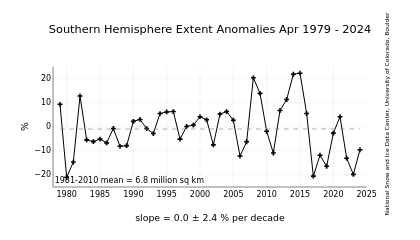
December is the month when the Antarctic sun is highest in the sky, and when the most sunlight reaches the surface. Thus an excess of ice in December has the maximum impact on the southern hemisphere’s radiative balance. In the Antarctic, the most important months are mid-October through mid-February, because those are months when the sun is closest to the zenith. The rest of the year there is almost no shortwave radiation to reflect, so the excess ice has little effect on the shortwave radiative (SW) balance.
This has been discussed in detail by Roger Pielke Sr. and others in several papers.
So how does this work? Below are the details of this article’s thesis.


1. As mentioned above, the Antarctic ice excess occurs near the December solstice when the sun is highest above the horizon. By contrast, the Arctic ice deficiency appears near the equinox – when the sun is low above the horizon. Note in the graph below, that Arctic ice reaches it’s minimum in mid-September – just when the sun is setting for the winter at the North Pole. While the September, 2008 ice minimum maps were dramatic, what they did not show is that there was little sunlight reaching the water that time of year. The deviation from normal did not begin in earnest until mid-August, so there were only a couple of weeks where the northern hemisphere SW radiative balance was significantly impacted. Thus the water in most of the ice-deficient areas did not warm significantly, allowing for the fast freeze-up we saw during the autumn.
The 2008 peak Arctic ice anomaly occurred near the equinox, when it had the minimum heating effect on the ocean.

By contrast, the peak Antarctic ice anomaly occurred at the December solstice, when it had a maximum cooling effect, as shown below.
2. The next factor to consider is the latitude of the ice, which has a strong effect on the amount of solar insolation received. Arctic sea ice is closer to the pole than Antarctic sea ice. This is because of the geography of the two regions, and can be seen in the NSIDC images below.
Antarctic sea ice forms at latitudes of about 55-75 degrees, whereas most Arctic ice forms closer to the pole at latitudes of 70-90 degrees. Because Antarctic ice is closer to the tropics than Arctic ice, and the sun there reaches a higher angle above the horizon, Antarctic sea ice receives significantly more solar radiation in summer than Arctic sea ice does in its’ summer. Thus the presence or absence of Antarctic ice has a larger impact on the SW radiative balance than does the presence or absence of Arctic ice.
At a latitude of -65 degrees, the sun is about 40 degrees below the zenith on the day of the solstice. Compare that to early September negative anomaly peak in the Arctic at a latitude of 80 degrees, when the sun is more than 70 degrees below the zenith. The amount of solar radiation hitting the ice surface at those maxima is approximately 2.2 times greater in the the Antarctic than it is in the Arctic = cos(70) / cos(40) .
The point being again, that due to the latitude and date, areas of excess Antarctic ice reflect a lot of SW radiation back out into space, whereas deficient Arctic ice areas allow a much smaller quantity of SW radiation to reach the dark surface of water. Furthermore, in September the angle of incidence of the sun above the water is below the critical angle, so little sunlight penetrates the surface, further compounding the effect. Thus the Antarctic positive anomaly has a significantly larger effect on the earth’s SW balance than does the Arctic negative anomaly.
3. The next point is an extension of 2. By definition, excess ice is further from the pole than missing ice. Thus a 10% positive anomaly has more impact on the earth’s SW balance than does a 10% negative anomaly.
4. Due to eccentricity of the earth’s orbit, the earth is 3% closer to the sun near the December solstice, than it is during the June solstice. This further compounds the importance of Antarctic ice excess relative to Arctic ice deficiency.
All of these points work together to support the idea that so far, polar ice albedo feedback has been opposite of what the models have predicted. To date, the effect of polar albedo change has most likely been negative, whereas all the models predicted it to be positive. There appears to be a tendency in the climate community to discount the importance of the Antarctic sea ice increase, and this may not be appropriate.
Roger Sowell (11:57:09) : wrote:
Alan Chappell — re wind power
I cannot comment on what Italy is doing and why. I worked there off and on on consulting assignments, from Milan down to Taranto and in Sicily. But from the above statement, and I have not confirmed its accuracy, 80 countries are in the wind-power game. Perhaps Italy has insufficient wind resources? Perhaps Italy has adequate base-load power and pumped-hydro resources? The geography of Italy is likely unique, with a mountain range running down the middle of the entire country, and the Alps across the northern portion.
My “engineers are on it” statement refers to the energy storage problem.
Roger E. Sowell
Marina del Rey, California
______________________________________________________
Interestingly Roger, although it is not my field,I can give you a very specific and up-to-date answer on that very question as it relates to Tuscany. I had the good fortune to be part of a U.S.-Tuscany Trade Mission to Pisa and Florence last month. I spoke with many decision makers over there regarding my own field (Biopharma) and the biofuel field, in which I’m also peripherally involved.
The decision-maker/dignitaries in government there told me specifically (and we actually had personal interpreters for the conversation, which was way cool) that their main focus is on geothermal, and they are not going to put up wind turbines in Tuscany because they do not want such ugliness in their countryside. Straight from the horses mouth so to speak.
philincalifornia — kinda what I suspected, given the incredible beauty and history of the landscape.
Leif Svalgaard (09:01:07) :
And I can answer: “I don’t understand the graph….
Thats a whole lot different to “just shows that there is no correlation at all. It stands as the clearest observational refutation of the angular momentum idea.”
But let me explain. The angular momentum trend is somewhat crudely constructed by taking the angular momentum figures from Carl’s graph at each peak and trough. I assumed 2.0E+47 as the centre point and calculated from that point. With angular momentum a high figure can be just as good as a low figure, its about the extremes and one reason why a scatter plot is difficult.
http://landscheidt.auditblogs.com/files/2009/01/ssbscmax2.jpg (ignore the dots for now)
What we are left with is a rough angular momentum plot (which could be improved) but none the less shows a trend we can match with sunspot cycles and their modulation. It shows a background “driver” and what must be kept in mind is the inertia involved which also makes a scatter plot difficult. SC21 & SC20 were less active than the angular momentum suggests because of the sudden drop in SC20 (inertia was lost) and is perhaps the same reason why a cycle directly after a “grand minima” cycle suffers very low activity, even though that cycle has very high angular momentum. This is observed in all grand minima.
SC12 was a victim of the reduced momentum happening at the tail end of SC11. But the general trend is stronger angular momentum around grand minima tailing off to a low point before rising to the next high point and more grand minima. J+S are the main engine with N+U providing boost as well as taking away momentum (critically at times of grand minimum, N+U can add or take away momentum in successive cycles). In the past you have criticized this theory saying the 14C records dont show a regular grand minima pattern every 179 yrs in the 11000 yr record. Angular momentum does not always have the same modulation strength every 179 yrs and is controlled by the positions of J+S as the meet N+U which change slightly on each occurrence but is not random and follows a trend.
There is new information on what possibly “triggers” a grand minimum event which can be read in Ian Wilson’s paper at http://landscheidt.auditblogs.com and I can explain that at another date if your interested.
http://landscheidt.auditblogs.com/files/2008/12/ultimate_graph2all.jpg
nobwainer (Geoff Sharp) (18:42:46)
SC21 & SC20 were less active than the angular momentum suggests
that should read “SC21 & SC22 were less active than the angular momentum suggests”
nobwainer, that’s very interesting stuff above thanks. What does your name mean if you don’t mind me asking I’ve never heard that before? Cheers, Ed.
nobwainer (Geoff Sharp) (18:42:46) :
“And I can answer: “I don’t understand the graph….”
Perhaps I should have said that I don’t understand why you think the graph shows any correlation. Even with your explanation, it makes no sense at all. F. ex. there are references to ‘inertia’ . could you explain what that means. Probably something else than http://en.wikipedia.org/wiki/Inertia
Edward Morgan (19:41:32) :
Hi Ed, nobwainer was just a silly name coming from the term “no brainer” meaning not having to think. But judging by Svalgaards response Even with your explanation, it makes no sense at all I might have to simplify my theory even further. If no one can understand it, its pointless.
Leif Svalgaard (20:20:56) :
“Inertia” could apply in many ways, the Sun during grand minima slows its production of sunspots (which is not understood yet). Some theories and observations suggest angular momentum can change the rotation speed of the Sun (Ian Wilson 2008 -Does a Spin–Orbit Coupling Between the Sun and the
Jovian Planets Govern the Solar Cycle? or Javaraiah 2003). What ever happens there is a slowdown of some form (i dont want to argue this position) which going on past sunspot history as well as proxy data it shows we do NOT get a sudden rise in sunspot activity coming out of grand minima , but a more gradual rise suggesting it takes time to recover.
nobwainer (Geoff Sharp) (22:23:03) :
“Inertia” could apply in many ways, the Sun during grand minima slows its production of sunspots (which is not understood yet).
It looks to me as simply meaning that the theory breaks down and you invent that term as a euphemism.
Roger Sowell,
Thanks for the reply.
You answered pretty much with “Everybody else does it! So why not wind and solar”. That’s as bad as an argument as one could possibly come up up with. You’ve lost the argument.
First of all, we are not talking about “some” subsidies for solar and wind and biofuel. They are massive. These subsidies mean only a very select few people will benefit, and the rest of us will have to pay forthe subsidies, and then pay more for energy. A total folly. The consumer gets nothing for the subsidy, except higher costs.
The subsidies for oil, gas and nuclear may exist, but they are nowhere near as much as those for renewables. And there are good reasons for supporting them::
1. They are much more competitive.
2. They deliver a nice even constant and reliable supply.
3. They are available in abundance.
4. They require very little space.
Concerning wind and solar, we all like to talk about “installed capacity”.
But the difference between installed capacity and actual output, when there is output, is huge. Do you know what percentage of installed capacity is actually put out?
You’d be surprised.
The wind and sun don’t always blow or shine. Rarely are they present in amounts that allow the turbines or panels to put out their “rated capacities”.
Often wind turbines are generating at only a small fraction of their “rated capacity”. And what about gas, oil, nuke or coal-fired plants? They routinely operate at 90+% of their rated capacity!
So please tell me the precentage for wind or solar. I wonder if you know.
And I am familiar with intellectual property rights. You’re suggesting they are uncompetitive? Sorry, but I think only a complete business fool would share such an opinion. Just think about it for a couple of moments, please.
Again, solar and wind have to be backed up by gas-fired plants 1:1! FACT!
Why not just run them full time, do away with the ugly and expesnive wind and solar, thus saving us huge amounts in subsidies, and thus provide consumers with affordable power? I’m still waiting for an answer.
Crosspatch:
“I haven’t seen anything that shows actual generation numbers….”
Some of these numbers will be publshed soon. And you are right…the numbers are truly embarassing. Only complete business fools (i.e. governments) could justify such investments. Well, actually they couldn’t, and so that’s why they ivented the AGW scare story. Buy it, or you’ll die!
That’s the only way they could sell this technology.
It’s the greatest Fraud in the history of human civilisation.
Leif Svalgaard (22:39:25) :
It looks to me as simply meaning that the theory breaks down and you invent that term as a euphemism.
Is that the best you can do? If you cant offer something reasonable why bother with a response. While its good to have someone to challenge your idea’s and keep you straight, sometimes that can also quash others and tends to become a one man show. Like others on this blog I find your continued negative comments and sometimes rude and personal attacks as a distraction from what this blog is about. Perhaps you could use your knowledge in more constructive ways and learn that there is more out there than what you have learned so far.
Btw. Even ExxonMobil, no fan of renewables, predicts that biodiesel will comprise 7 percent of transportation fuels in 2030. That is up from less than one percent today.
Roger E. Sowell
Just after some bright guy figured out that they could take animal and plant fats and oils and send them through the already existing hydrogenator or hydro-treater at the refineries, the oil companies discovered that biodiesel was a good thing 😉
They get a straight alkane + propane rather than the methylester + glycerine of the transesterfication process. More efficient in some ways. Better low temperature performance (basically it’s just regular Diesel).
Right after I read that I dumped my Biodiesel maker stock. How can a small company that needs special hardware compete with a giant guy that can just dump it through hardware they are already amortizing for something else…
“Scientists Refute Argument Of Climate Skeptics”: If you stay away from the cities, the rise from 1975 on becomes less than the previous rise. So . . . the problem is?
Regarding solar energy and the Arctic:
I surely have not had a chance to read all of the comments, but solar radiation appears to have little to do with Arctic melting and its energy balance. It has been long recognized that it is warm air from lower latitudes which causes the summer melt.
Solar radiation at its peak at 17% after traveling through the thickness of atmosphere due to its low angle and also due to its low angle its distribution is 17% of vertical sunlight per meter. That puts it a 2.9%. And if it hits water or ice, there is a significant reflection. If it hits water, the heat from the absorbed radiation is lost almost immediately to evaporative cooling. Most of the year the Sun is too low or missing all together to do anything. The numbers above are for the peak of the summer and represent the maximum. The idea that the Arctic will suddenly go balmy is balmy.
The big melt of 2007 was a perfect storm of wind patterns blowing sea ice OUT OF the Arctic where it melted elsewhere, a large bolus of warm water was pumped into the Arctic basin by the North Atlantic Oscillation and there was even sea floor volcanic and geothermal activity on the Arctic Ocean floor. The ice this Fall grew at about a 30% faster rate than the previous Fall.
The Sun has little to do with the Arctic directly. I read a report that the Arctic Rim land-based monitoring sites have found that the Arctic has done little, if not cooled, in the last several decades. Many do not know that the Northwest Passage was open a few years right after 1900 and several years in the 1940’s. In the former, they were able to take sailing ships through. 2007 was the first time since then that it was open.
crosspatch (15:39:31) :
“Have a look at the Jatropha tree. ”
The problem with growing any crop is that the amount of land available for cultivation of anything is limited. To increase the production of something, production of something else must decrease or habitat not currently being cultivated must be modified.
Yes but… In India, they are planting Jatropha along the railroad right of way. They figure they will get enough production from the right of way to power the rail road. They had to tend and weed the right of way any way, but did not grow crops on it, just weeds and weedkiller… Similar stories abound. It is also widely used as a fence. Cattle don’t like it. The farmer gets a second crop *and* a fence *and* keeps the sacred cows from eating his main crops. It works.
I saw a study of ‘depleted’ land in India that showed some large portion of their motor fuel needs could be met by planting Jatropha on land considered too poor and depleted for food crops. Over time this improves the soil enough to return it to food production(!). (Leaves & seed meal build tilth and roots fix nitrogen. Birds in trees add phosphate 😉 It was something like 20% of the crop land at the time…
Even if currently uncultivated land were placed into production of it, it would likely greatly change the natural habitats where it is planted.
Another ‘yes but’. It grows in low rain, depleted soils (nitrogen fixer) so often what is being ‘changed’ is pretty dismal land… There is no shortage of scrub foothills in California with an attempt at grass pasture scattered scrub oaks and one or two cows per hectare… Not exactly pristine wilderness.
Desert ecosystems are extremely vulnerable to even the slightest change because they exist on the margins of sustaining life in the first place.
IIRC it doesn’t produce well in hard desert. More like the low water scrub just before the desert.
We would soon see irrigation and fertilization and eventually complete change in the local ecosystem.
Not as much as you would think. It is a nitrogen fixer, so no added nitrogen. Drought tolerant plants often don’t like too much water added! And many places have not water for irrigation. But in all cases a plantation is decidedly NOT the same as a wild land.
If it proves very profitable, production would begin to move to more conventional crop locations where it would begin to displace food crops.
Not much, at least in the USA. It isn’t very cold hardy…tropical and semi-tropical only. And the high value crops in warm places like California are not at much risk. Parts of West Texas and New Mexico might be usable. The icky parts 😉
Exchanging food for a poisonous oil that can not be used for any other purpose seems somewhat dangerous.
It isn’t. The oil is not exactly lethal. The other name of the plant is the physic nut for its medicinal uses. One is eaten to clean the pipes… There are reputatedly some varieties that lack that property and are cooked and eaten in Mexico.
The oil can be used for many other purposes (soap, lamps), just not for cooking. Kind of like castor oil, the seeds of which are very lethal. The pressed seed cake is used for fertilzer. It’s risk is no more than rhubarb (poison leaves), parsnips (poison leaves), potatoes (toxic skin if left in the sun, toxic leaves), tomato (toxic leaves), etc. Heck, even kidney beans are toxic! Every Christmas a few people get slow cookers and decide to make chili with their tried and true recipe – then learn that kidney beans need to reach boiling to breakdown the toxin… off to the doctors…
I could see it replacing some of the paper tree plantations and sugar cane or cotton in the south. Maybe. But a more likely solution would be algae. Much more production per acre.
The reality is that each climate zone has a best fit crop, so any biofuels solution will involve many different plants, not just a single magic plant… And yes, there is enough land to do this. I ‘did the math’ once and it was something like a 100 mile high by 1000 mile stripe for the USA for cellulosic ethanol. Algae shrinks that to more like 100 x 100 miles. Much better.
And yes, I’d love to see the median and margins of our interstate planted with things other than weeds…
DOOIF or UK:DOO is the ticker for D1 Oils, plc. a company that is promoting Jatropha. They are based in the UK and are doing genetic improvement too. It’s more of a 3rd world tropical solution though.
http://www.d1plc.com/agronomyEnergy.php
(Sometimes I think you could mention anything, like even cattle carcasses, and I’d think of a stock ticker… Oh Dang! Darling DAR… I need to think up a better outrageous example… )
Roger Sowell (05:56:00) :
crosspatch:
I disagree with almost everything you wrote. Insufficient time now to go into details, but just a couple of thoughts: please explain how electric power from a nuke will provide energy for long-haul trucks, cross-country trains, and airplanes.
It’s doable, but not electric for the trucks and airplanes… For trains, we actually had a long haul train that was electric for quite a while. They were just about to electrify the final gap when someone decided to scrap it. It’s common in Europe. It would be expensive to electrify, but not hard.
Any carbon source can be turned into motor fuels. You can use nuclear process heat to do this. Then about 3/4 of the fuel energy comes from the nuke. VW engineers cooked this up after the ’70s oil embargo. They used coal, but one could just as easily use wood, trash, whatever as the carbon source. Make producer gas, run it to methanol. If you want gasoline, run that through the Mobil zeolite catalyst.
Yeah, the rest of crosspatch posting left me a bit glazed…
Crosspatch:
And why exactly do you want biofuel? For what purpose do we need it?
My primary interest is that it lets small rural communities become energy independent and lets individual farmers tell the whole world power structure to go get bent (oil company, haulers, government, you name it.) If I can grow my own oil, squeeze it in my own press, and use it in my own tractor, well, that’s a good thing. This is being done in rural India. You can even buy electric generators set up to run on such oils today for about $1500/kW.
A secondary interest is that it provides yet another lever to use against OPEC. (I’d rather use CTL, but hey, you use what you can…)
A minor point is that biodiesel actually burns cleaner and smells nicer.
And we couldn’t possibly grow enough of those trees to be a reasonable replacement for oil on anything more than a thimble full in an ocean. Do you know how much oil we consume in a day? 20,680,000 barrels per day in 2007. How many square miles of these trees would it take to put a measurable dent in 20+ million barrels *each day*?
http://www.jatrophacurcasplantations.com/?gclid=CO-bs6TpkJgCFRHxDAodC3jYnw
Claim a 10+ tonne / hectare oil yield. While D1 claims 192,000 ha headed for 300,000 real soon now planted.
http://www.d1plc.com/agronomyPlanting.php
I’ll let you go through all the hectares to acres and tons to bbl conversion because I’m feeling sleepy right now…
As to how much “we” can grow in the USA, I think the fact that it can only survive a light frost, and even then yields plunge, make it at best a niche crop in the USA (Especially if the “whole place is frozen” that we’ve been having holds up… a couple of weeks ago I lost 2 small avocado trees to unexpected cold… now freeze warnings in Florida? Maybe San Diego would work … )
Depends on if you are that farmer in Kenya, or Ceylon, or India, or… paying through the nose for OPEC oil in US dollars with crushing local taxes.
All this talk about the effect of the planets on the solar cycle, reminds me of the “Jupiter Effect”, predicting dire consequences from the planetary alignment of March 1982.
That was a pile of foetid Dingo’s kidneys, Wiki (OK, not the most reliable reference work ever) notes a source citing a tidal effect of 0.04mm on the Earth’s crust.
There were no major earthquakes, ‘Frisco didn’t get swallowed up as the San Andreas opened up and Yellowstone didn’t blow.
This whole theory has more akin to Astrology than any science and is best left to the inside back cover of the magazines abandonned in Drs’ surgery waiting rooms.
Wind power may have its place on a small scale, but as a viable way of producing siginifcant power on a commercial scale, it’s a non-starter, be it on land or sea.
One estimate of the electricity produced for the UK during the calm, very cold and dark New Year period, is 0.5%.
Our dear Prime Minister wants 20% of our electrical power to come from windmills built in the North Sea, by 2012, this is to comply with an EU directive.
The way this will be achieved isn’t explained. It will require the erection of 2 of these giants per day.
There’s only one vessel in the world that’s capable of transporting these devices.
Lets try this again, but with the italics right…
Crosspatch:
And why exactly do you want biofuel? For what purpose do we need it?
My primary interest is that it lets small rural communities become energy independent and lets individual farmers tell the whole world power structure to go get bent (oil company, haulers, government, you name it.) If I can grow my own oil, squeeze it in my own press, and use it in my own tractor, well, that’s a good thing. This is being done in rural India. You can even buy electric generators set up to run on such oils today for about $1500/kW.
A secondary interest is that it provides yet another lever to use against OPEC. (I’d rather use CTL, but hey, you use what you can…)
A minor point is that biodiesel actually burns cleaner and smells nicer.
And we couldn’t possibly grow enough of those trees to be a reasonable replacement for oil on anything more than a thimble full in an ocean. Do you know how much oil we consume in a day? 20,680,000 barrels per day in 2007. How many square miles of these trees would it take to put a measurable dent in 20+ million barrels *each day*?
http://www.jatrophacurcasplantations.com/?gclid=CO-bs6TpkJgCFRHxDAodC3jYnw
Claim a 10+ tonne / hectare oil yield. While D1 claims 192,000 ha headed for 300,000 real soon now planted.
http://www.d1plc.com/agronomyPlanting.php
I’ll let you go through all the hectares to acres and tons to bbl conversion because I’m feeling sleepy right now…
As to how much “we” can grow in the USA, I think the fact that it can only survive a light frost, and even then yields plunge, make it at best a niche crop in the USA (Especially if the “whole place is frozen” that we’ve been having holds up… a couple of weeks ago I lost 2 small avocado trees to unexpected cold… now freeze warnings in Florida? Maybe San Diego would work … )
Depends on if you are that farmer in Kenya, or Ceylon, or India, or… paying through the nose for OPEC oil in US dollars with crushing local taxes.
nobwainer (Geoff Sharp) (01:43:37) :
Perhaps you could use your knowledge in more constructive ways and learn that there is more out there than what you have learned so far.
I’m always willing to learn and I learn something every day, but I also have a good filter. And your ideas simply do not get past the filter. I often review scientific papers for various journals and I have reviewed your [and other’s] ideas as I would have reviewed such papers. If you were to write them up into a paper and submit the paper to a reputable journal, you would find similar [or harsher] criticism. A reviewer would often request a different or additional plot if one you supply is not clear enough. Refusal of such a request would often lead to rejection of the paper. The author sometimes feels the rejection as an attack, but forgets that the onus is on him to make his ideas clear. My request of a scatter plot falls in that category. Even if the relation is not simple, by using different colors or symbols, the ideas can be expressed graphically and analyzed statistically. If you send me a email with the values that go into your graph, I would be glad to make the plot for you.
Pierre Gosselin (01:25:32) :
“Roger Sowell,
Thanks for the reply.
You answered pretty much with “Everybody else does it! So why not wind and solar”. That’s as bad as an argument as one could possibly come up up with. You’ve lost the argument.”
Apologies if my answer was interpreted that way. Not at all my intent. Let me take another crack at it.
Firstly, not “everybody else does it.” Far from it. Only 80 countries, out of what, 190 something in the world (number keeps changing…) Less than half, I would say.
I cannot answer for, nor fully fathom, the reasons behind why governments invest their money in many ventures, including wind and solar. California mandated (I keep using California as example only because I live here and am more familiar with it) solar roofs on public buildings — with no requirement for an economic analysis. They could have a simple payout of 50 years and it would not matter. By decree, it shall be done.
Private investors have better things to do with their money than put it into a 50-year payout project. T-bills at 3 percent and sold at par are safer, and better than that.
Governments do try to use subsidies, tax credits, rebates, give-aways, to guide private investment to things that the government deems beneficial, but would otherwise not be done. The process is no doubt riddled with problems; I am not here to defend the government’s decisions. Sometimes the special interest group with the most funding, the best experts, and the most persuasive spokesman can obtain government funding — and it is all a sham.
But to the wind and solar, they are not all boondoggles. Have you ever spent time on a west Texas ranch, and watched the windmills (water pumps, not power-generating) turn for hour after hour, day after day? I have. We were bored as pre-teens, and spent summer after summer on a ranch like that. Those windmills never stopped spinning. Same on other trips, not just summers.
How about driving along I-15 north of San Diego, and look at the scrub trees along the freeway? Notice anything? There are no branches on one side of the trees, and the trees are bent in the opposite direction. What does that tell you? Perhaps the wind is fairly strong, and consistent?
Or, have you been sailing off the coast of Corpus Christi, in south Texas, and enjoyed the incredibly steady and stiff wind? One can drive to the beach in Corpus, enjoy a picnic on the sand, and watch the ultra-light gliders, some powered, hover motionless for hour after hour. What kind of wind allows them to do that? These are not one or two days per year, either. This is day after day after day.
I am sure others have similar eye-witness accounts of stable wind areas.
Now specifically to your question on wind efficiency, or generation as a fraction of nameplate capacity. I have seen numbers reported as 40 percent in Spain, 33 percent for West Texas, 25 percent in California, and hard numbers from California wind energy association for 2006 of 19.7 percent.
So, no, I am not at all surprised. I assist investors with the economics and legal aspects of their projects. The fact is, and this may surprise you, that no one designs a wind project for 100 percent utilization. What is done is to over-build the capacity so that when the wind is strong and stable, much power is generated (around 99 percent capacity for those few hours). Then, when the wind decreases, the generators drop off-line even though the blades are still spinning.
You seem to be under the impression that wind energy is a waste of time and money. As I have written before, many sober and serious people do not agree with you. Their money is invested, and that money is growing. You can join the game, too. There are no restrictions on who can invest, so it is not limited to just a few people as you state. You can also invest in stocks of companies in the wind energy business. There are plenty of green funds around.
You also wrote, “And I am familiar with intellectual property rights. You’re suggesting they are uncompetitive? Sorry, but I think only a complete business fool would share such an opinion. Just think about it for a couple of moments, please.”
I am not sure what you are getting at by that. Intellectual property is one of the areas in which I practice law. And yes, they are by design and by intent uncompetitive. They provide an exception to the anti-trust laws. Every lawyer knows this. The U.S. Constitution, Article I, Section 8, provides that “Congress shall have the power…To promote the progress of science and useful arts, by securing for limited times to authors and inventors the exclusive right to their respective writings and discoveries;” Note the words “exclusive rights.” And, the words “writings and discoveries.” These refer to copyrights (writings) and patents (discoveries). Anyone trying to exclude others without an appropriate copyright or patent, for example, would be in serious hot water.
You also wrote: “Why not just run them full time, do away with the ugly and expesnive wind and solar, thus saving us huge amounts in subsidies, and thus provide consumers with affordable power?” — referring to fossil and nuclear power plants.
Actually, nuclear power costs around 25 to 30 cents per kwh for a new nuke. Even the older ones in operation cost around 10 to 15 cents per kwh. Wind energy costs around 7.5 cents per kwh. Which would you prefer to pay? Some solar installations that use thin films are now producing power at around 5 cents per kwh. And, if you want to argue that my cited costs for nuclear are far too high, that their actual cost to produce power is 2 or 3 cents per kwh, be careful. That does not include their cost of capital. As cheap as nuclear fuel is, wind is cheaper. Wind is free. Have a look at Severance’s paper on nuclear power plant costs. And, even as cheap as coal is, or natural gas is, wind is cheaper.
And look at subsidies this way. The government pays a small amount up front, projects get installed with private money, and taxes flow to the government on several levels. Among these are sales taxes for the equipment, income taxes on the salaries for the jobs created, property taxes on the real estate with improvements, and state and federal income taxes on the profits from the enterprise. This flow of taxes reduces your taxes, or keeps them lower than what they would be otherwise.
Just one man’s opinion, with some facts thrown in for good measure. You are free of course to disagree.
Roger E. Sowell
Marina del Rey, California
E.M. Smith
If biofuel is so great, then why are all the subsidies needed?
Also, more than half of the energy yielded is needed to plant, transport, handle and process the raw material into an end-product. This does not include distribution and marketing the end product! More than half gets used to make it.
And let’s not forget the massive use of fertilisers and the implications on global food prices with 800 million people go to bed hungry every day.
UN Expert Jean Ziegler called biofuels, and rightly so: “a crime against humanity”.
I rest my case.
E.M. Smith,
“It’s doable, but not electric for the trucks and airplanes… For trains, we actually had a long haul train that was electric for quite a while. They were just about to electrify the final gap when someone decided to scrap it. It’s common in Europe. It would be expensive to electrify, but not hard.”
Agreement from me, as to the technical viability (no physics violated), just the cost/benefit is not there for long-haul trains electrified. A third-rail system would never be allowed due to liability concerns, (not that you said it would, but I think another commenter on one of these postings recommended it). The overhead system would work, but the costs are very high. The high-speed rail under consideration for California would use the overhead system, or catenary. But, replacing the entire U.S. rail structure with a catenary system would likely not be cost effective. I have not run the numbers, but it seems that with a likely ceiling on oil price of $80 (2008 dollars), and diesel fuel for trains never rising much above today’s levels, it just will not happen.
Physics first, then economics. As I read that you are an economist, you certainly know that alternatives are almost always available. As prices increase, other alternatives become viable. With oil, that is certainly true. Shallow oil wells, deeper oil formations, deep-sea oil formations, tar-sands, shale oil, coal-to-liquids, gas-to-liquids, organic waste-to-liquids, all have their break-even price. As I wrote earlier, the Saudis know all this and will do all in their power to keep selling their oil, and not allow these alternatives to become economically viable.
If the Russians ever get their game together on oil, as they appear to have done with natural gas, it will be even longer before we see alternatives or synthetic crude in wide use.
Roger E. Sowell
Marina del Rey, California
Wind is free? How bout the huge transmission problems/costs? Same with solar, but add the compicated, yet delcate constant cleaning required there. Neither has yet nor is likely to be profitable on their own in the near future.
Pierre Gosselin (11:40:40) :
E.M. Smith
If biofuel is so great, then why are all the subsidies needed?
Also, more than half of the energy yielded is needed to plant, transport, handle and process the raw material into an end-product. This does not include distribution and marketing the end product! More than half gets used to make it.
And let’s not forget the massive use of fertilisers and the implications on global food prices with 800 million people go to bed hungry every day.
UN Expert Jean Ziegler called biofuels, and rightly so: “a crime against humanity”.
I rest my case.
Your argument would be credible if one doesn’t consider that only 5% of the energy used to make electricity is actually utilized by the end producer due to conversion inefficiencies, grid/ substation heat loss, etc. Also, biofuels are efficiently manufactured from soybeans, which require very little fertility augmentation. As for the hungry masses, Lyndon Johnson stated in 1965 that “We will eliminate poverty in our lifetimes.” $12 Trillion later we have more poverty now than then.
Roger Sowell says:
Hmmm, does that include the cost of the storage facilities to store energy for those times when the sun is not shining and the wind is not blowing? How about places like Alaska and Northern Canada with vastly reduced sun shine periods during winter?
Otherwise the comparison is a little like selling snake oil, n’est pas?