One of the most popular global warming feedbacks is considered to be changes in the extent of polar ice. The story goes that as the ice melts, more heat gets absorbed in the ocean, leading to higher temperatures. Today we test that theory.
According to NSIDC, Antarctic ice extent is nearly 20% above normal, as seen in the graph and map below.
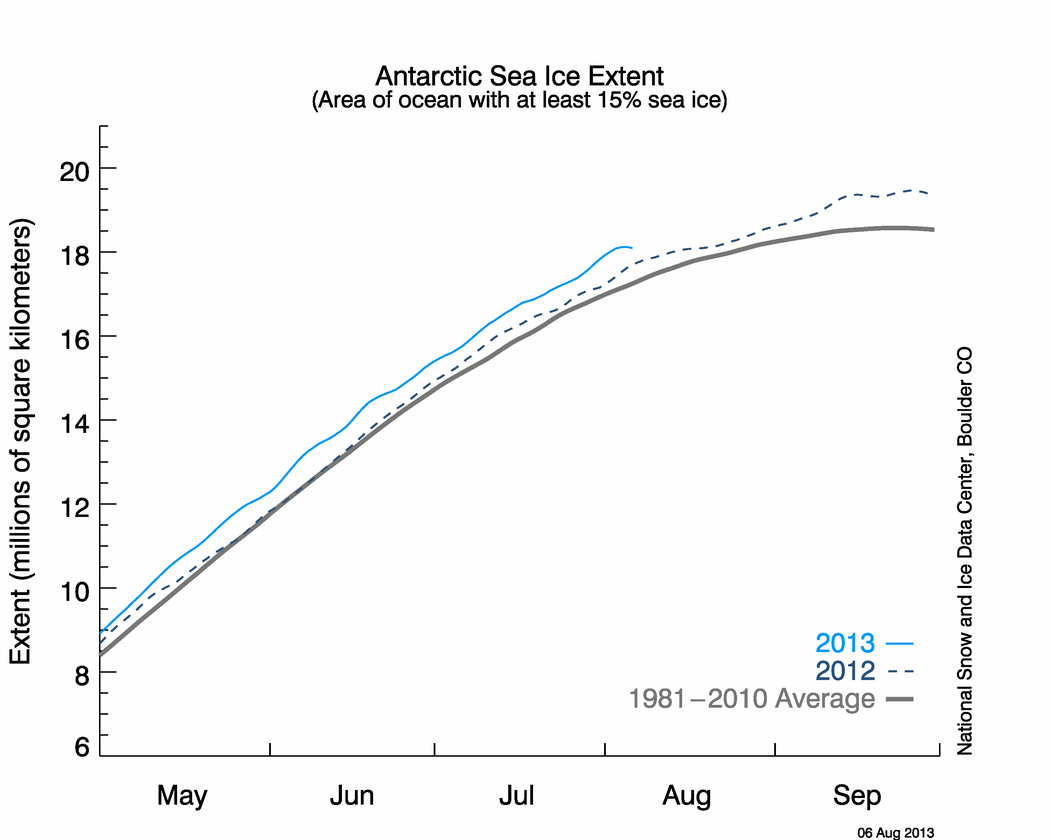


If the theory is correct, the large amount of excess ice should be cooling Antarctica – and that is exactly what we see happening. Temperatures in Antarctica have been running persistently below normal, as seen in the maps below.


There is just one problem with all this. The effect is exactly opposite of what has been predicted by global warming modelers. Antarctic ice is increasing and temperatures are cooling.
Neven,
There is no question that human activity is having an impact on Arctic ice. Hansen and others have published papers in the last few years attributing a significant part of Arctic warming to soot (as much as 94%) and the Arctic yellow ozone cloud (from pollution) is also known to be causing significant warming.
http://pubs.giss.nasa.gov/docs/2004/2004_Hansen_Nazarenko.pdf
http://www.physorg.com/news100354399.html
The point is that there is no substantive link to CO2 and Arctic ice, and people who claim so are basing their beliefs on the idea “the models predicted it.” However, the models were wrong about the other pole, so they are really no more valuable than a coin toss.
The point is that there is no substantive link to CO2 and Arctic ice,
Both the references you cite state that GHGs are the major source of warming, strange you should forget to mention that!
“The substantial role inferred for soot in global climate does not
alter the fact that greenhouse gases are the primary cause of global
warming in the past century and are expected to be the largest
climate forcing the rest of this century.”
“Greenhouse gases, which trap outgoing energy, are primarily responsible for the remaining temperature increase and are considered the Earth’s most important overall climate changing mechanism.”
However, the models were wrong about the other pole, so they are really no more valuable than a coin toss.
Care to justify this statement, references from this century preferred!
Phil:
Phil, here’s how it works: Steven Goddard need not justify anything about your putative AGW, or the always-inaccurate computer models that are its only real support. It is those who put forth the relatively new hypothesis of AGW / runaway global warming / climate catastrophe, who must justify their statements.
It’s called the Scientific Method: someone puts forth a new hypothesis – like AGW/runaway global warming – and if it withstands falsification, fine.
The problem is that AGW has been repeatedly falsified. Note also that as carbon dioxide levels rise, the globe continues to cool.
I understand that the latest convoluted meme is that global warming causes global cooling. But… please. Enough.
Smokey (17:27:03) :
Phil:
“Care to justify this statement, references from this century preferred!”
Phil, here’s how it works: Steven Goddard need not justify anything about your putative AGW, or the always-inaccurate computer models that are its only real support.
I’m asking him to justify his statement, with recent references, if he’s sure of his position that shouldn’t be difficult. Of course if he continues to refer to a paper published in 1984 that won’t cut it.
It is those who put forth the relatively new hypothesis of AGW / runaway global warming / climate catastrophe, who must justify their statements.
It’s called the Scientific Method: someone puts forth a new hypothesis – like AGW/runaway global warming – and if it withstands falsification, fine.
Hardly new and it has withstood falsification.
REPLY: Alright you two. I’m declaring a Christmas moratorium on this argument, knock it off. Stop being naughty, be nice.- Anthony
Merry Christmas, Phil!
HO HO HO!!!! Peace on Earth to Men of Goodwill…
“” E.M.Smith (21:03:58) :
As for the alleged irrefutable evidence that people caused the last century’s CO2 increase, the “smoking gun” invoked by one of my critics, Dr. Michael Mann, and his fellow fearmongers at realclimate.com, the claim is based on the idea that the normal ratio of heavy to light carbon–that is, the carbon-13 isotope to the lighter carbon-12 isotope, is roughly 1 to 90 in the atmosphere, but in plants there’s a 2 percent lower C13/C12 ratio. So, observing that C13 in the atmosphere has been declining steadily though very slightly since 1850, they claim that this is due to man’s burning of fossil fuels, which are generally believed to be derived from fossilized plant matter.
OK, so both C12 and C13 are stable and they are looking for a ‘plant’ signature in burned fuel, not a decay signature. One Small Problem… C4 metabolism plants absorb more C13 than do C3 metabolism plants. Over the last 100 years we’ve planted one heck of a lot more grasses world wide than ever before. Grasses are C4 metabolism…
Have they allowed for this? If so, how? I’m not sure how one would figure out the C4 vs C3 plant population ratio of the world, and certainly don’t see how you would figure out what it was 10,000,000 years ago. “”
So E.M. ,I’m not sure I deciphered who said what in this discussion i’ve excerpted; but it does lead me to as if you are expert in this C13/C12 isotopic business; which I gather is a biological science phenomenon. Somewhere else I saw the C3-C4 metabolism thing referenced and I confess it went in one ear and out the other and hit nothing living in between. I understand the C14 thing from my days as a nuclear/atomic physicist, and sometime student of cosmetic rays. But this bio thing is all alien to me.
But if I understand the concept, bio materials (at least some) are deficient in c13; ergo decline inC13 in the atmosphere suggests fossil fuel burning.
But that raises some probably ignorant questions in me.
Are not living plants deficient in C13; so doesn’t burning of forests and or grasslands also lead to C13 deficiency. Doesn’t biodegradation of plant materials 9rotting dead trees) also lead to C13 depletion. If in this recent period of warming, and for other reasons the total green biomass of the planet has increased (as is claimed); then doesn’t that increase in total plant matter and subsequent decay, lead to C13 depletion.
If C13 deficiency as well as C14 absence in coal deposits denotes biologiccal origins for coal deposits (no brainer and of course C13 only); is there data on isotopic abundance in petroleum deposits; that would indicate that petroleum is also a biological fossil fuel; rather than simply a liquid mineral of non-biological origin?
Now who is going to argue that increasing numbers of humans have not burnt up large quantities of biological or fossil materials that are deficient in C13; How does non-depleted carbon participate in the atmospheric carbon cycle; what is its origin, and what puts it in the atmosphere.
Then; suppose we discovered a large source of usable fossil fuel, say peroleum, and it happened to also contain a sizeable amount of Argon, which the petroleum industry decided to not extract; so as we start burning the stuff, we start enriching the argon in the atmosphere . The fact that the atmospheric argon concentration is increasing, can certaiinly be regarded as proof that we are burning some of this argon enriched petroleum; But that is a far cry from asserting, that that particular source of argon enriched carbon is selectively remaining in the atmosphere.
In other words, if primordial atmospheres contained a certain C13/C12 ratio, and then we start burnigng fuels depleted of C13, the Carbon in the atmosphere DOES NOT have to increase, in order for C13 depletion to occur; it merely points out that we have two sources (at least) of atmospheric CO2 and they have different C13 content, and our continued use of the depleted one, will continue to deplete the atsmospheric C13, even if it does not increase the total atmospheric CO2.
My carbon dioxide expert at Scripps could probably tell me, but I figure you probably can too..
I don’t see C13 or C14 depletion as being evidence of human increase in atmospheric CO2; just that we use a lot of Carbon that is deficient in both those heavy isotopes.
I also do not understand the O18/O16 temperature proxy either.
I don’t see how temperature can transmute one into the other