One of the most popular global warming feedbacks is considered to be changes in the extent of polar ice. The story goes that as the ice melts, more heat gets absorbed in the ocean, leading to higher temperatures. Today we test that theory.
According to NSIDC, Antarctic ice extent is nearly 20% above normal, as seen in the graph and map below.
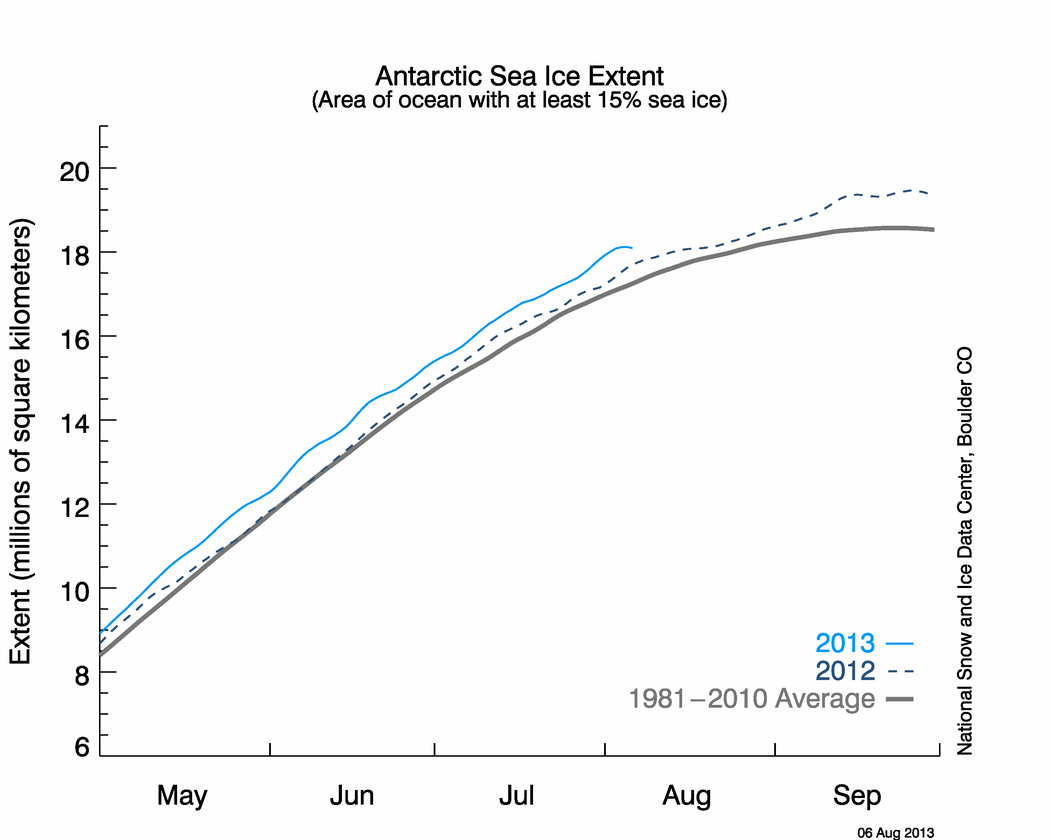


If the theory is correct, the large amount of excess ice should be cooling Antarctica – and that is exactly what we see happening. Temperatures in Antarctica have been running persistently below normal, as seen in the maps below.


There is just one problem with all this. The effect is exactly opposite of what has been predicted by global warming modelers. Antarctic ice is increasing and temperatures are cooling.
PeteM
“I’ve spent the afternoon enjoying a few (alcoholic) beverages with a relative who has spent 20 plus years in the area of biological research and foresty. When I asked then about whether there were significant changes indicating the world was warming (in line with MMGW) his unequivocal answer was yes.”
Just what evidence was offered during your imbibing that global warming is man-made other than exchanging anecdotes “over a few?” Global warming is only man-made in the sense that Algore/UN/IPCC/Pachauri have created it with bogus computer models and irrelevent anecdotes.
“But the idea that on average the world isn’t going to change due to increasing the concentrations of CO2 has any impact is really taking a step too far…..”
I have been searvhing for the data that shows that anthropogenic CO2 has any significant effect on the base temperature of the Earth, if there is such thing as a base temperature of the Earth other than averaging (guesstimating) the temperatures from regional and local climates. The CO2 concentration in parts per million is said to be increasing at a current rate of 2.18 ppm (Mauna Loa) and only 0.436 ppm is due to anjthropogenic sources (the DOE ratio of natural to man-made CO2 was 5.76 to 1 up to the year 2000). The idea that the total yearly increase in CO2 is due to man kind, certainly is a step to far.
Guy,
You are mistaken. Dr Svensmark’s GCR/cloud theory that predicts Antarctic cooling when the Arctic watms.
Neven,
I would make the argument that so far Antarctic ice gain has had a larger effect on the radiation budget of the earth, than has ice loss in the Arctic.
The reasons for this are:
1. Antarctic ice positive anomalies have occurred during times of year when the sun is high in the sky near the solstice (such as today) whereas Arctic negative anomalies peak near the equinox in September. Once the sun sets for the autumn in the Arctic, the absence of ice has no meaningful albedo effect. Thus the Arctic anomalies are less important to the radiation budget of the earth.
2. Antarctic sea ice is at higher latitudes than Arctic ice, so the sun over the Antarctic ice is up higher in the sky. This compounds the effect from 1. The “missing” ice in the Arctic is at very higher latitudes and the sun is lower, so the amount of solar radiation which can be absorbed is also reduced. Once again, this causes Antarctic ice gain to have a more significant effect on the earth’s radiation budget than does Arctic ice loss.
I’d like to point out again that Hansen predicted major albedo loss for Antarctica (Fig 2-4) and people who claim otherwise are perhaps misinformed.
http://www.epa.gov/climatechange/effects/downloads/Challenge_chapter2.pdf
Ellie in Belfast
“… there will always be biases and inaccuracies.”
This is one of the realities that angers me – paying for the biases and inaccuracies of the AGW cult’s unproven and bogus theory.
PeteM (12:25:56) :
“… you are repeatedly hearing a particular sceptical point of view on this forum . Very few comments here challange this view or express a view outside of that philosophy .”
Very observant of you. Perhaps it has something to do with the fact that challengers can’t support their views and either go away or stay quiet.
“…a relative who has spent 20 plus years in the area of biological research and foresty. When I asked then about whether there were significant changes indicating the world was warming (in line with MMGW) his unequivocal answer was yes.”
Did the biologist say “in line with MMGW” or was that you? Given that the earth has most certainly warmed a bit that would be in line with any theory that predicts warming. It would also be in line with a theory that says that the Earth warms because of Intra Planetary Friction Induced by Solar- Andromedan Teleconnection Wars (IPFIS-ATW).
The only time Antartctica rates a mention in the MSM is to report an ice shelf about the size of France or something breaking off owing to global warming (see a couple of examples below). Nary a mention of sea ice in the Antarctic reaching highest recorded levels in 2007, or anything else that would be considered to be “off-message” and therefore not to be brought to the public’s attention.
http://archives.cnn.com/2002/TECH/space/05/09/iceberg.satellite/index.html
http://www.timesonline.co.uk/tol/news/environment/article3621685.ece
Patrick
John P.’s address to the AAAS tells us who he is and for what he stands – social engineering. We have the prospect of seeing environmentalism up close and really personal as a primary policy of the incoming administration.
Obama’s Science Advisor [Yuval Levin]
“It looks like president-elect Obama will name John P. Holdren as his science advisor. Holdren is a professor of environmental policy at Harvard and former president of the American Association for the Advancement of Science. As Ron Bailey points out, he has been an activist on the ecological left and no friend of free markets. Perhaps more striking is his activism well beyond his own academic specialty, arguing, for instance, that scientists have a responsibility to advance the cause of the elimination of all nuclear weapons and seeking controls on population growth.”
PRESIDENTIAL ADDRESS:
Science and Technology for Sustainable Well-Being
John P. Holdren*
http://www.sciencemag.org/cgi/content/full/319/5862/424 (This links to the transcript of a very long speech)
“The American Association for the Advancement of Science (AAAS) is not about the advancement of science just for science’s sake. Rather, as indicated by the Association’s motto, “Advancing Science, Serving Society,” it is about advancing science in the context of a desire to improve the human condition. This mission necessarily entails attention to the social as well as natural sciences; attention to the embodiment of science in technology through engineering; and attention to the processes by which understandings from the natural sciences, the social sciences, and engineering influence–or fail to influence–public policy. All of these long-standing preoccupations of the AAAS are integral to the theme of the 2007 Annual Meeting and of this essay, “Science and Technology for Sustainable Well-Being.”
I forgot to mention one important point in my last post. The earth is closer to the sun during the Antarctic summer than during the Arctic summer. This further compounds the relative importance of a positive Antarctic ice anomaly to the earth’s radiation budget.
The Arctic as a whole is not below average. Only certain areas that are within known warm currents are below average. Other areas are above average. To state that the Arctic ice is behaving as predicted by GW models is an unfounded leap from the model to observations without understanding the nature of Arctic currents, winds, and fresh water sources.
gary gulrud:
NH snowcover is slightly over the 1996-2005 average at the moment:
http://moe.met.fsu.edu/snow/
crosspatch0:
Tropical ice has essentially zero effect on albedo, because there is so little of it (a couple of hundred square kilometers in all).
Sorry, one more correction. I meant to say –
2. Antarctic sea ice is at lowerlatitudes than Arctic ice,
Neven:
Re that methane release, why didn’t it happen during the last interglacial when temperatures in northern Siberia were about 10 degrees higher than now, and forest grew all the way to the arctic coast?
Well, no wonder the media’s focus is on the Arctic sea ice. The Antarctic sea ice doesn’t present the same foreboding image. Remember, it’s not about science but image with which to promote the AGW political movement.
Same way they play melting glacier stories. Focus on the fact they’re melting and the possible loss of the melt run-off but say little or nothing about the fact that the ground uncovered is littered with remnants of forests from several thousand years ago or man-made artifacts. All from a period well after the end of the last major ice age. To seriously consider such facts would suggest that current warming is not unusual but just another warm episode in a recurring cyle of such events.
When do the models predict that the permafrost will melt? It hasn’t yet. Still as cold as ever. Maybe when Hell freezes over?
By the way, NOAA has posted record low temperatures in Hell as of Dec. 16th. Records go back about 2000 years plus a few.
Today is a day of note in Antarctic. The sun has reached it’s highest point in the sky, and never sets.
You’re a day early, the solstice occurs at 12:04 on the 21st Dec (UTC). No matter. You also state (twice, three times if you include The Register) that Hansen predicted symmetrical warming of the poles, weeell he kinda did, but in a paper nearly a quarter-century old now and on a planet where atmospheric CO2 had doubled, which is a way off yet, Care to predict the Antarctic temperatures and ice extent two decades hence? Do you think its plausible that in the intervening years since 1984 the climate science community has refined its understanding and its models? Hansen certainly has, see
http://www.atmos-chem-phys.net/7/2287/2007/acp-7-2287-2007.pdf
for a discussion of recent developments in the mainstream scientific understanding of the Antarctic temperature trends.
Your article closes thus:The effect is exactly opposite of what has been predicted by global warming modelers. Antarctic ice is increasing and temperatures are cooling.
What exactly is a global warming modeler? Have you met one? Please could you cite a single study that your analysis has discredited? Or is this just another huge Straw Man exercise?
thanks
JP
Gary Gulrud and Anthony Watts, please email me your postal addresses as I would like to mail you a book I have just published. My email address is david.archibald @ur momisugly westnet.com.au
The Antarctic is not warming much because of an increase in the polar vortex. This is well known and reproduced by climate models. The impact on sea ice is to spread it further away from the continent – ie increase extent and decrease thickness due to enhanced Ekman drift.
I’ll take your word for it that an increase the Polar Vortex produces an increase in sea ice extent in the computer models, but is there any evidence in the real world that the Polar Vortex is increasing and this is thinning and spreading the sea ice? (with or without Ekman Drift).
BTW, you might care to read this study of satellite data which shows no significant link between the strength of the Antarctic Polar Vortex and temperatures.
http://cat.inist.fr/?aModele=afficheN&cpsidt=17380286
Steven,
Thanks for pointing out what what I should have caught the first time — that your emphasis is upon albedo.
Thanks to Ric for coming to my defense on those who think I chose the projection, or was intentionally making a point about how widespread the red was.
On this being a “model” run, that is (I think) just a reference to the fact that this is from a “reanalysis” dataset. On the point in question, I don’t see much difference using the operational dataset:
http://www.cdc.noaa.gov/map/images/fnl/sfctmpmer_365a.fnl.gif
I think Steven took my question better than some of you did. And he gave a good answer.
“Open ocean absorbs much of the the sunlight, whereas ice reflects it back out into space”
Does it make it to outer space, or does the teeny tiny amount of CO2 deflect it back to earth again?
John Philip (18:13:22) :
Today is a day of note in Antarctic. The sun has reached it’s highest point in the sky, and never sets.
You’re a day early, the solstice occurs at 12:04 on the 21st Dec (UTC). No matter. You also state (twice, three times if you include The Register) that Hansen predicted symmetrical warming of the poles, weeell he kinda did, but in a paper nearly a quarter-century old now and on a planet where atmospheric CO2 had doubled, which is a way off yet, Care to predict the Antarctic temperatures and ice extent two decades hence? Do you think its plausible that in the intervening years since 1984 the climate science community has refined its understanding and its models? Hansen certainly has, see
http://www.atmos-chem-phys.net/7/2287/2007/acp-7-2287-2007.pdf
for a discussion of recent developments in the mainstream scientific understanding of the Antarctic temperature trends.
Not least ’84 was before the discovery of the ozone hole, a significant factor for the Antarctic!
I am not a scientist and my understanding is that the AGW models are statistical. My simple question is, what is their degree of certainty? Can anyone point me to where this is stated or published?
So a day is an issue but 20 years isnt? So are you saying that the current doom and gloom by the AGW crowd for 100 years in the future should be ignored because its too far out and highly unpredictable! – therefore we should not make policy decisions on it either! Oh and what model did predict the current cooling – none – even Hansens cover all bases attempt still was way off, as for most on here we trust natural cycles of the sun and earth as opposed to agenda driven hypothesis.
Pamela Gray (15:35:33) :
The Arctic as a whole is not below average. Only certain areas that are within known warm currents are below average. Other areas are above average. To state that the Arctic ice is behaving as predicted by GW models is an unfounded leap from the model to observations without understanding the nature of Arctic currents, winds, and fresh water sources.
According to all the sources I’ve looked at the Arctic as a whole is below average, I don’t see any areas that are above average either. Care to elaborate?
John Philip:
Go to Reacclimate to talk with all the global climate modlers that you would want to. That is where I learned last year that they could pull out some GCMs that did not show antartic warming. If I recall properly in IPCC AR4 the average of the models showed warming at both poles. Of course MR Gavin advised the world at that time that the only accurate model was the one that showed what They wanted it to at any time all the others are wrong. I must say that you have been doing a very good job of twisting fact. Ring that bell!