From Steve Goddard: Thanks again to Dr. Meier from NSIDC for answering questions, and for offering to do a follow-up.
From Anthony: Responses from Dr. Meier are in italics. I’ve added a poll that you can answer after reading this. Note this poll only allows one vote per IP address. So shared IP systems at offices will only get one vote.
From Dr. Meier: Thank you to Mr. Goddard for presenting this and the previous set of questions. And thank you to Mr. Watts for providing the outlet to publish these. I don’t hope to change the opinion of every climate change skeptic who reads my responses, but hopefully I can provide some useful for information. My answers here and to the previous round of questions are my own and I am speaking for myself, not as a representative of the National Snow and Ice Data Center or the University of Colorado. Thanks to Stephanie Renfrow, Ted Scambos, Mark Serreze, and Oliver Frauenfeld of NSIDC for their input.
One thing I noticed in the comments on my previous answers was a desire for references to peer-reviewed journals. I originally chose not because I didn’t realize there might be an interest and also because a few journal articles doesn’t substantiate human-induced global warming (nor do one or a few articles refute it). It is the preponderance of evidence presented in thousands of articles that provides the foundation for the human-induced global warming theory. Nonetheless, below I provide a few selected references for those that might be interested.
There were lots of good questions from readers, and I have synthesized some of them into a few short ones here for the sake of brevity. There is no question that late-summer Arctic ice extent has declined considerably since the early 1980s, and if the current trend continues linearly – the sea ice will disappear completely at some point in the not too distant future. Most of the questions were along the lines of “how do we know the trend is non-cyclical, and how do we know what is causing it?”
1. Q: The image below shows the general GISS temperature distribution of the previous Arctic warming cycle in the 1920s and 1930s, for stations north of 60N. Turquoise dots had warming similar to the current warming. Red dots are significantly warmer now than they were 70 years ago. Looking at the map, it would be easy to come to the conclusion that the only difference between the current warming and the one 70 years ago, is that the PDO has been in it’s warm phase for the last 30 years – causing warmer temperatures around Alaska and Eastern Siberia. The PDO appears to have recently shifted to its cool phase, and temperatures across Alaska have dropped during the last two years. Why do you believe that the fundamentals of the current warming are so different? Perhaps the warming of the last 30 years was aggravated by a coincidental alignment of the PDO and AMO?
A: The warming of the last 30 years cannot be attributed primarily to the Pacific Decadal Oscillation (PDO) or the Atlantic Multidecadal Oscillation (AMO). The AMO does not have a significant influence on the Arctic. On the Atlantic, side, the North Atlantic Oscillation (NAO)-a regional expression of the Arctic Oscillation (AO)-is the most influential mode of variability in the Arctic. As I’ve mentioned previously, there are natural variations in climate that do indeed affect Arctic temperatures in the Arctic and the sea ice. The NAO/AO is a particularly prominent one and a substantial amount of the decline in the sea ice during the late 1980s and early 1990s could be attributed to a strong positive mode during winters because the positive mode favors the loss of thicker ice that is less likely to melt during summer. However, since about 1995, the AO has mainly been in a neutral or negative state. Under such conditions, the Arctic sea ice should have started to recover. Instead, sea ice extent has not only continued downward, but the decline rate has accelerated. The AO may have been a “trigger” for the precipitous decline, but we wouldn’t have the ongoing decline without the documented warming trend (Lindsay and Zhang, 2005).
The Pacific Decadal Oscillation (PDO) also can play role in temperatures in the Bering Sea region and to some extent in the Pacific side of the Arctic Ocean. The PDO was in a fairly persistent positive mode until the mid-1990s, but it also has shifted to a more neutral state and so cannot explain the decline of the Arctic sea ice since that time. (More details: Overland et al., 2004 and Overland and Wang, 2005).
Another important point is that these climate oscillations can themselves be affected by global warming. There are indications that the positive mode of the AO is more likely to be present under warmer conditions.
2. Q: Given that we don’t really understand what caused the earlier warming period, what evidence is there that the current warming is anthropogenic? How much of your viewpoint about the Arctic future is based on IPCC feedback predictions?
A: There is considerable evidence that the current warming is anthropogenic; this evidence is readily available in thousands of unrelated peer-reviewed scientific journals. You also ask how much of the evidence is “based on” IPCC predictions? In a way, the answer to that question is that none of the evidence is from the IPCC report-and yet all of it is. The reason is that the IPCC report isn’t a source of newly published information, but rather a compilation of evidence from a growing number of articles previously published in scientific journals. All of the information in the IPCC working group reports is referenced to original peer-reviewed journal articles citing researchers from around the world. Thus, the IPCC report is a convenient “one-stop shop” of the latest information, but the ultimate source is the thousands of individual international journal articles that are the basis of the report.
In the first part of your question, you suggest that a lack of understanding of earlier warming periods is a given, and that this casts doubt on our understanding of current warming. From this perspective, it might seem reasonable to assume that because previous change was natural, the current change must be too. Many natural explanations for the current observed warming have been suggested:”it’s just natural variability,” “it’s the sun,” “it’s cosmic rays,” etc. However, these have all been investigated and evidence is simply lacking.
On top of the lack of evidence for natural causes, such suggested explanations ignore the proverbial elephant in the room. Any natural-causes explanation must be accompanied by an argument for why and how human-caused greenhouse gases (GHGs) are not affecting climate in the same way that natural GHGs affect climate. This, again, has not been addressed in a reasonable way.
Here is what we know about greenhouse gases and their influence on climate:
1. Greenhouse gases absorb energy radiated by the earth that otherwise would escape to space, keeping the earth warmer than it would be without GHGs. This is a fact that has been well-known for over 100 years, described in a paper by Arrhenius (1896). GHGs are a necessary part of Earth’s natural “climate control.”
2. GHGs are increasing in the atmosphere. This is known from observations of carbon dioxide dating back to the 1950s from Mauna Loa and other stations, as well as paleo-records of GHG concentrations in ice cores.
3. The GHG increase is due to human-caused emissions. This is clear from the simple fact that we know we’re emitting GHGs through our use of fossil fuels. More scientifically, it is confirmed by a characteristic chemical signature of human-emitted GHGs found in the atmosphere.
4. GHG concentration and surface temperature are closely linked. This is clear from #1, but the relationship is confirmed in ice core records dating back several hundred thousand years. Some of your readers may have heard a suggestion that carbon dioxide lags temperature in the ice core records; that’s not relevant in this case. For more details, see here and here and here
5. The first studies of the effect of GHGs on Earth’s energy budget date back to the1950s (e.g., Revelle and Seuss, 1957). The increasing GHG emissions have already changed Earth’s energy balance. Human and natural changes have increased the radiative forcing (effectively increasing the energy, and thereby the temperature, of the Earth) by about 1.6 Watts per square meter. The largest factor by far is human GHG emissions. Changes in the sun play only a small role. This increased radiative forcing results in a warming of the planet. There is simply not enough uncertainty in these estimates to throw the overall conclusion into doubt: human-induced GHGs have changed Earth’s energy balance and increased temperatures.
FAQ 2.1 Figure 2 from IPCC Working Group I Fourth Assessment Report, 2007.
6. There are feedback mechanisms that can alter the impact of GHG emissions. These include: clouds, water vapor, ice/snow. Ice and snow are clearly positive feedbacks that will reinforce the GHG warming because as they melt, the average albedo (reflectivity) of the earth decreases and more energy is absorbed. The effect of other feedbacks is less certain-and may even counter the effects of GHG warming–but the evidence indicates that they nevertheless do not come close to offsetting the direct effect of GHG emissions.
So, before one can suggest that natural mechanisms explain everything, one has to first demonstrate that something in the above 6 points is wrong. Much of this evidence dates back to at least the 1950s; the theory of anthropogenic global warming is really nothing new. Also note that climate models only play a significant supporting role in the evidence for points 5 and 6. No serious scientific study has yet shown that any of the above 6 points are fundamentally wrong.
The only one of the 6 points still in play to any scientific extent whatsoever is the last point. There has been some interesting research in this area – Richard Lindzen’s Iris effect (a nice summary here) and more recently Roy Spencer’s “internal radiative forcing.”. Spencer’s work is quite new, and has therefore not yet been properly vetted through the peer-review process. (Some informal discussion: RealClimate.
3. Q: You mention the historical record of the Inuit. What do we know about the older historical record from the Vikings?
A: There is archaeological evidence, oral sagas, and some written records, none of which I’m an expert in. However, I can share with you what I know: The Vikings colonized Greenland during about 700-1300 AD, taking advantage of the medieval warm period (MWP). There was reduced ice cover compared to before and after that period that allowed easier sailing between Europe and Greenland. The warmer climate allowed enough farming and ranching to support the population. As climate cooled, crops failed and transport (trade) with Europe became difficult or impossible. There was clearly less sea ice during the MWP than the cool period that followed. It is not known how sea ice conditions compared to today, but ice extents comparable to the 1980s or 1990s would have been sufficient for the Vikings to have successfully sailed between Greenland, Iceland, and Scandinavia; ice would not have had to be at current low levels.
Greenland and northern Europe were clearly warm during the 700-1300 AD; much of the rest of the globe may have been as well. There is often quibbling about whether we’re warmer now than then-the Mann hockey stick plot, etc. But as I pointed out above, such “debate” is almost beside the point: it ignores the elephant in the room that is the GHG emissions produced by humans. We may not clearly know what caused the MWP, but we have a clear cause for the current warming: human-caused GHGs.
4. Q: Is there any hard data on permafrost losses during the last ten years?
A: There is clear evidence of increasing ground temperatures and thawing permafrost, consistent with the warming surface temperatures. Permafrost will respond more slowly to warming, but it is a potentially significant long-term feedback because large amounts of GHGs, particularly methane, are “locked” in the permafrost. As much GHGs are locked in the permafrost as currently resides in the atmosphere. At least some of these GHGs will be released as the permafrost thaws. There have been several papers discussing permafrost thaw and potential climate impacts (Zimov et al., 2006; Lawrence and Slater, 2005; Lawrence et al., 2008).
5. Q: Has there been a trend of the date of minimum Arctic sea ice coverage? Has there been a trend in the date of maximum Arctic sea ice coverage? If there has been warming over the ice (which is not sampled adequately), there should be an earlier maximum and later minimum.
A: There has been a trend toward later minimum dates, but there is substantial variability from year to year in the freeze-up date. A later freeze-up is not surprising because with lower summer ice extent, there is more ocean area to absorb heat that needs to be dissipated before freeze-up can begin. However, there is high variability because the timing of when the ice stops shrinking and begins growing has a lot to do with short-term weather. A late-season warm spell can extend melt, while a quick, early cold snap can cut melt short.
There is essentially no trend in the date of maximum extent. There is even greater variability from year to year in the maximum date than in the minimum date. This is also not surprising. At the time of maximum extent, the boundary of the ice edge is unconstrained and has extended into the north Atlantic and north Pacific. Ice at the ice edge is also thinner at the maximum. Most of it is less than 50 cm thick, because it is ice that has recently formed. This ice is prone to being broken up by winds, advected into warmer waters where it melts, or pushed northward. On the other hand, cold winds from the north can cool surface waters and allow more ice to form, at least temporarily, and extend the ice edge farther south. So, the ice edge location at the time of the maximum is fairly volatile and subject to sudden change. This variability can be seen in AMSR-E data graph, where you can see the bumpiness of the daily extent during the winter season. This is the ice edge “bouncing around” in response to winds, currents, storms, etc.

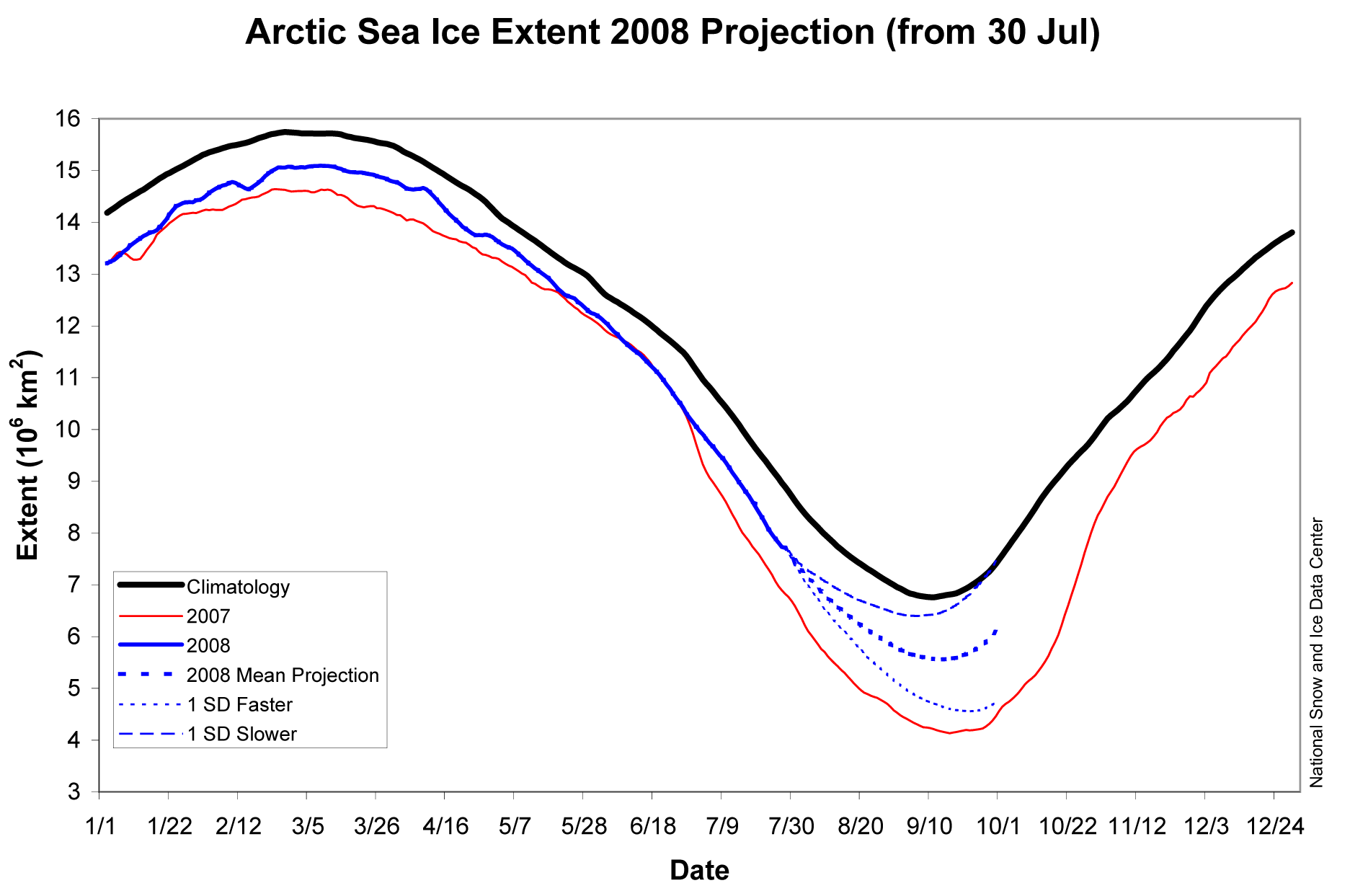
6. Q: Looking at the AMSR-E sea ice extent graph, I see an alternative description for recent behavior. Until the first week in August, 2008 extent was equal to or greater than 2005 – and NSIDC was even considering a possible return to normal as late as August 1. However, a series of strong storms broke up the ice and caused 2008 to drop below 2005 for a few weeks. As September ends, 2005 and 2008 appear to be converging again. Average daily ice extent in 2008 has been greater than 2005, and nearly every day in 2008 has been greater than 2007. What is wrong with this description?
A: The description is incomplete and lacks relevant context. First, all the recent years in the AMSR-E record have had anomalously low maximum extents compared to the 1980s and 1990s. Even the largest winter extent, in 2002, was 250,000 square kilometers lower than the 1979-2000 average. The years 2005-2008 have been 700,000 to 1,000,000 square kilometers below the average. As described above, there is considerable variability during the time around the maximum extent, so the difference between 2005 and 2008 is within what might be expected from natural variations, but both are lower than maximum extents during the 1980s.
While there is a lot of variability in the timing of when the maximum occurs (as mentioned in #5), the actual maximum extent has relatively low variability. This is because in winter it is cold and dark, and ice grows under those conditions. So you always see ice growth, although there is now a significant downward trend at the maximum. In comparing winter ice conditions, ice thickness is much more relevant than ice extent. Data for thickness is not as complete as it is for extent, but it is quite clear that ice is thinning at a rate even faster than the extent decline. During winter 2008, the Arctic was dominated by seasonal ice (ice that has grown since the previous summer) that is much thinner than multiyear ice (ice that has been around for at least a year). Thus, in 2008 the ice has generally been thinner than 2007, and much thinner than earlier years.
We are now seeing some rapid growth of sea ice in the Arctic as the large expanse of exposed ocean cools, but this will all be thin first-year ice. It will thicken over the winter, but by the end of the winter it will only be a half to a third as thick as the ice used to be.
Sea ice also moves with the winds and currents – it doesn’t just grow and melt in place – and thinner ice is generally more easily pushed around. Last year a lot of ice got pushed by winds across the Arctic and even less of the region was covered by thicker old ice at the end of the winter than at the beginning of the winter.
Finally NSIDC did not say that the Arctic sea ice extent would return to “normal” in 2008. The figure referenced in the question, does show one scenario where ice returns to normal, but as stated in the text, that scenario was for a slower than normal melt through the rest of the summer and was deemed highly unlikely. As we say in our August 1 entry: “Thin ice is much more vulnerable to melting completely during the summer; it seems likely that we will see a faster-than-normal rate of decline through the rest of the summer.”
7. Q: Why does NSIDC say that the 2008 minimum sea ice extent “reinforces” the long-term trend when the 2008 extent was clearly higher than 2007?
A: 2008 is in no way a “recovery” relative to the thirty-year trend-and since GHGs act over long time periods, scientists favor looking at change over a long period to detect the GHG signal. From 1979 through last year, the September monthly average extent was declining at a rate of about 72,000 square kilometers per year based on a linear trend. Calculating a linear trend of the data from 1979 through 2008, the decline is now 78,000 square kilometers per year. This may seem counterintuitive, but what happens to the trend each time you add new data depends on where the new data falls relative to the trend line. If a data point falls below the trend line, it will “pull” the trend line downward; a data point above “pulls” the trend line upward. The September 2008 extent, although a bit higher than 2007, was still well below the trend line, so the downward trend line steepened. This is what I mean when I say the trend has been reinforced. Those who attempt to claim that we’ve seen “global cooling” since 1998 may wish to bear in mind that until scientists see a change over a long period, we are skeptical of claims concerning a trend.
The key thing, whether discussing sea ice, temperatures, or any other environmental measure, is to consider long-term trends, not short-term variability.
September monthly sea ice extent and trends for 1979-2007 and 1979-2008.
References:
Arrhenius, S., 1896. On the influence of carbonic acid in the air upon the temperature of the ground, Philos Mag, 41, 237-276.
Lawrence, D. M., A. G. Slater, 2005. A projection of severe near-surface permafrost degradation during the 21st century, Geophys. Res. Lett., 32, L24401, doi:10.1029/2005GL025080.
Lawrence, D. M., A. G. Slater, R. A. Tomas, M. M. Holland, C. Deser, 2008. Accelerated Arctic land warming and permafrost degradation during rapid sea ice loss, Geophys. Res. Lett., 35, L11506, doi:10.1029/2008GL033985.
Lindsay, R.W., and J. Zhang, 2005. The thinning of Arctic sea ice, 1988-2003: Have we passed a tipping point, J. Climate, 18(22), 4879-4894, doi:10.1175/JCL13587.1.
Overland, J. E., M. C. Spillane, D. B. Percival, M. Wang, and H. O. Mofjeld, 2004. Seasonal and regional variation of pan-Arctic surface air temperature over the instrumental record, J. Climate, 17, 3263-3282.
Overland, J. E., M. Wang, 2005. The third Arctic climate pattern: 1930s and early 2000s, Geophys. Res. Lett., 32, L23808, doi:10.1029/2005GL024254.
Revelle, R., Seuss H.E., 1957. Carbon dioxide exchange between atmosphere and ocean and the question of an increase of atmospheric CO2 during past decades, Tellus, 9, 18-27.
Zimov, S.A., E.A.G. Schuur, and F.S. Chapin III, 2006. Permafrost and the global carbon budget, Science, 312, 1612-1613, doi:10.1126/science.1128908.
BTW, the poll is flawed — linear is not the same as man made, cyclical is not the same as natural.
Many natural explanations for the current observed warming have been suggested:”it’s just natural variability,” “it’s the sun,” “it’s cosmic rays,” etc. However, these have all been investigated and evidence is simply lacking.
Everyone is looking for causes, but what if there isn’t one? We’ve moved away from predestination, but we haven’t moved away from determinism yet. We cannot yet accept that seemingly random change is actually random variation. Chaos even…
In addition to these possibilities there is also the likelihood that oscillations of climate can occur even if there were absolutely no variations of external forcing of this kind, purely by internal oscillations involving feedbacks among all of the components of the Earth-air-sea system included within the main internal construct. That is, it is possible that the swings in climate are the consequence of a steady forcing of an inherently unstable system that never achieves a true equilibrium.
(Barry Saltzman, “Dynamical Paleoclimatology”, 2002, p.45)
This natural explanation has not been proved false.
Thanks to the AGW skeptics we are learning more and more about how the earth’s atmosphere,etc. behave. In my opinion, we don’t learn anything if the scientists just attribute everything to AGW.
By the way, it must be nice to do science in a climatically controlled environment instead of freezing your tail off actually doing research in the Arctic.Thank you scientists who actually do that work!
To say after observing only 30 years of data that the only trend possible is linear is nonsense. Why this old rock is several billion years old give or take a several hundred million years. Dang, if I didn’t loose my gardening records in a blizzard,possibly due to the dreaded global warming, I would have longer times series than that.
I think whoever stated that AGW alarmism bugs the mathematicians and statistician the most is correct.
anna v (11:54:01) :
show that the percentage error in the albedo can be fairly high.
Perhaps you mean ‘variation’ rather than ‘error’ …
Mr Tom in sunny & warm Florida said (10:10:36) :
“Apparently ALL AGW alarmists want the temp to stay where it was in the 80’s (otherwise they wouldn’t care about warming or cooling).”
I’ve always thought of most of them as being stuck in the 1960s-1970s hippy movement, but that is by-the-by.
A lot of comments on this thread have, I think, gone too far in their criticisms of Dr Meier’s approach. I do not claim to speak for him, but I do claim to detect an underlying compelling logic to his position. Indeed, I believe it is a line of argument many find utterly persuasive. It is this.
If we accept that gases in the atmosphere cause the greenhouse effect, it is entirely logical that a decrease in the overall volume of such gases might diminish the greenhouse effect and an increase the overall volume of such gases might enhance the greenhouse effect. Our cars, power stations and flatulent cows pump greenhouse gases into the atmosphere. Without our activities those greenhouse gases would not be created (OK, so maybe the tree I burn on my fire might be struck by lightning and burn anyway, but you know what I mean).
As a matter of simple logic there is nothing objectionable about the theory that additional greenhouse gases created by human activity are likely to enhance the greenhouse effect and, thereby, cause temperatures to rise somewhere on the surface of the plant by some amount.
I do not understand Dr Meier’s starting position to be anything other than a recognition of that (entirely rational) proposition. So, when he asserts that it is for those arguing against AGW to prove their case he is saying: “Look chaps, we know we are putting more of the heat-making stuff up there so you tell me why our extra heat-making stuff isn’t making extra heat.”
To (what I laughably call) my mind, that is an entirely rational, a-political, non-hysterical, commonsensical and logical position for anyone to adopt.
There might, for all I know, be reasons why the stuff we pump into the atmosphere makes absolutely no difference to anything, but I have always accepted that it probably does make a difference. The question is whether it makes a sufficient difference to justify claims that polar bears are eating each other to stay cold and demands that we must close down our industries.
This is not the first time comments here have conflated AGW with hysterical AGW Armageddon theories. It seems to me that it is just as difficult to make a case for a total absence of AGW as it is to make the case for imminent melt-down.
It may be that AGW is so small as to be insignificant, but that is a world away from saying it does not exist at all.
Methinks some have been keeping their eye on the ball with insufficient assiduity (that is usually my job and I guard it jealously).
Leif Svalgaard (04:17:40) You have written an extension here, Leif, in response to my STAY WARM, WORLD… Roger Carr « Stay Warm, World… (00:24:03) which appears to indicate you did not realise that by clicking on either my name or the title you would have gone to the full story?
Tom in sunny & warm Florida (10:10:36) writes: “Apparently ALL AGW alamists want the temp to stay where it was in the 80’s…”
I opt for the climate c.1952, Tom. Perfect!
Or is that just because I was young and fit then…
FatBigot (19:20:39) Well of course you are right, and I don’t think many skeptics argue that the primary forcing of CO2 is not real. The real question is the magnitude, and possibly even the sign, of the feedbacks which modify that intial forcing. You are correct, though, that most skeptics suspect that the total of CO2 forcings and the feedbacks should not be enough to stampede the herd into wrenching social change.
Then again, from the ice core data, a rise in CO2 always follows a rise in temperature, followed at a later date by falling temperatures. I’m waiting for the researcher to claim that the rise in CO2 halts the rise in temperature and helps cause the subsequent fall in temperature. Temporally, the correlation is there; we just need a mechanism.
===================================
Leif Svalgaard (16:36:51) :
” anna v (11:54:01) :
show that the percentage error in the albedo can be fairly high.
Perhaps you mean ‘variation’ rather than ‘error’ …”
True, he variation can be fairly high, but when a model uses a constant average albedo, this variation becomes a systematic error that has to be summed linearly , in computing total error. At least that is standard practice in high energy physics. though we usually give both errors, statistical and systematic.
Mike Byrant, I can’t wait to eat those delicious brownies.
I know this will be very simplistic, but I don’t understand the whole argument about “first year ice.”
Last year, a lot of ice melted. I think we all agree on that. But then a strange thing happened… a cold winter froze a lot of ice and ice levels recovered. The argument was that this “first year ice” would melt quicker and that this was a bad thing. Now, they were correct that it melted quicker. There was alarmism regarding the speed of melt early in the summer. But simple physics tells us that more ice takes more energy to melt, and thus will keep water temps cooler for a longer period of time and all that. So, even though 2007 ended up with a deep minimum by historical standards, it spent more time hanging about recent previous levels, stayed above 2008, and the water likely stayed cooler than 2007, which means that as soon as the energy dissipates, a quicker freeze is expected.
It’s simply unrealistic to expect an immediate leap to ice levels of 20 years ago, just like it’s unrealistic to expect an immediate severe drop in temperatures in the event of a trend to cooling. What we can expect, if indeed the cycle has turned, is a continuing overall increase from the 2007 minimum, where each year we have a little bit more multi-year ice and somewhat thicker “first-year” ice.
I just find the whole argument regarding the amount of “first-year” ice to be indicative of nothing more than the current state of things rather than any kind of reasonable argument or explanation either for or against future ice levels.
I fully understand the concern with putting too much credibility into short-term trends. But it’s somewhat maddening to constantly see recent reversals in data completely ignored because there is this unrelenting need to only compare to historical bases, with little to no recognition that if a reversal is afoot, it will take time to completely manifest itself in terms of those historical averages.
Stef (10:44:36) :
So CO2 lags by 800 years in the ice cores, and the current theory is:
Nice strawman!
1) Due to orbital changes and increased insolation, the temperature started to rise.
2) As the oceans warm up CO2 starts to outgas.
3) Due to orbital changes, the temperature rise stops, and CO2 continues the warming, which produces more CO2 (See 2) which scontinues warming.
4) Further orbital changes cause the temperature to drop, even while CO2 is high.
5) Obeying Henry’s Law the CO2 drops in response to the dropping temperature.
FatBigot (19:20:39) :
A lot of comments on this thread have, I think, gone too far in their criticisms of Dr Meier’s approach. I do not claim to speak for him, but I do claim to detect an underlying compelling logic to his position. Indeed, I believe it is a line of argument many find utterly persuasive. It is this.
If we accept that gases in the atmosphere cause the greenhouse effect, it is entirely logical that a decrease in the overall volume of such gases might diminish the greenhouse effect and an increase the overall volume of such gases might enhance the greenhouse effect.
Dr. Meier’s position assumes that our environment is static and that things like trees don’t respond to the increases in CO2.
Gilbert
Phil. (23:56:12) :
“3) Due to orbital changes, the temperature rise stops, and CO2 continues the warming, which produces more CO2 (See 2) which continues warming.”
4) Further orbital changes cause the temperature to drop, even while CO2 is high.”
A good use of what the ancients called “deus ex machina”. Not science though.
There is no proof that CO2 continues the warming. It is a hypothesis that there are further orbital changes. Any links to a study of orbital changes in addition to the ones that started the warming, and CO2? And why after 800 or 2000 years, when the AGW crowd is shouting about 30 years of CO2 tiny anthropogenic excess? 30 years would not show on the plots and CO2 would be concurrent with the rise in temperature.
Fatbigot – a nice summary of the theoretical case for AGW. However one could come away with the impression that the amount of expected warming is vague – we know we have increased GHGs and therefore expect some unquantified warming.
In fact Dr Meier will be well aware of estimates in the peer-reviewed literature of the size of the forcing effect e.g. (Myhre 1998) and the predicted temperature rise due to that forcing, summarised in IPCC AR4 WG1 Section 9.6 which give an expected increase in temperature, after a doubling of CO2e, in the range 2-4.5C. As this is consistent with recent observations, his point is that the onus is on those who propose a purely natural and alternative explanation to provide a mechanism (solar, ocean circulation changes, or Factor X) that would explain the warming, and explain why the radiative forcing of the increased GHGs is not having the predicted effect.
We await such an explanation.
Phil. (23:56:12) Speaking of straw, Phil., you don’t know how CO2 interacts with climate so stop pretending as if you do.
=========================================
Phil. (23:56:12) It’s just as likely if not more so, that orbital changes and insolation are the whole ball of wax, and CO2 only a trailing indicator. Stop making stuff up.
===========================================
John Philip (01:35:58) Consistent with recent observations? Please. That is the problem, recent observations are busily disconfirming the idea of high sensitivity of climate to CO2.
===========================================
anna v. (01:08:52) Thanks for the Deus ex Machina. I’ve been lying in wait for the chance to tell Phil. to ‘stop making stuff up’.
=======================================
Kim
I am using the climatological definition of ‘recent’. The IPCC projected that temperatures would rise at an average of around 0.175C / decade from 1990-2010. According to the UAH satellite record the actual rate was 0.174C /decade.
regards
JP.
I really liked the summary Phil. Now all we have to do is cause that “orbital change” thing to bring the temperatures back down! Of course when it gets too cold that orbital thing is ready to go again. Now I understand everything. Thank you.
John (08:07:47) And you still don’t see the problem with your definition?
lucia’s Blackboard at rankexploits.com for the truthseekers out there.
===============================================
kim (07:43:11) I might add I’ve been waiting for months because he doesn’t do it very often.
======================================
kim (10:25:08) Furthermore, he might be dead right. He’s just not convincing and isn’t very forthcoming about how speculative it is.
==========================================
It’s epicycles, Phil.
=============
(John Philip) “The IPCC projected that temperatures would rise at an average of around 0.175C / decade from 1990-2010. According to the UAH satellite record the actual rate was 0.174C /decade.”
Is that right?! According to UAH, global temperature from Jan 1990 to Jun 1991, i.e. the month Pinatubo erupted, averaged +0.12C. (Average Oceanic Nino Index +0.3)
Whereas temperature from Jan 2006 to Jun 2007 averaged +0.29C (Average Oceanic Nino Index +0.3)
http://vortex.nsstc.uah.edu/data/msu/t2lt/uahncdc.lt
http://www.cpc.noaa.gov/products/analysis_monitoring/lanina/enso_evolution-status-fcsts-web.pdf [ONI data on pages 25-6]
That’s 0.106C / decade. (Or would you prefer to skew the 1990-1991 starting point downwards by adding a couple of the ensuing Pinatubo cool years?)
Of course, this episode of global warming also coincided with an AMO shift to warm phase.
http://en.wikipedia.org/wiki/Image:Amo_timeseries_1856-present.svg
The onus is on you to explain why this 0.106C /decade should accelerate dramatically and imminently to a minimum of 0.3C /decade, which even if it happened from 2010 for the rest of the century would only produce a rise of 2.7C by 2100, still well below the mid-point of the IPCC range you quote.
The plot given in answer to Q7, “September Monthly Arctic Sea Ice Extent and Trend” is quite different from the plot I get when I use the data from http://www.ijis.iarc.uaf.edu/seaice/extent/plot.csv — my plot does not look nearly as alarming. It shows the minimums since 2002 have been rather consistent, except for 2007 and 2008. Moreover, it show the maximums slowing declining from 2003 to 2006 and then slowly increasing from 2006 to 2008. If anyone wanted to claim there was a trend for max ice, it would be up, not down.