From Steve Goddard: Thanks again to Dr. Meier from NSIDC for answering questions, and for offering to do a follow-up.
From Anthony: Responses from Dr. Meier are in italics. I’ve added a poll that you can answer after reading this. Note this poll only allows one vote per IP address. So shared IP systems at offices will only get one vote.
From Dr. Meier: Thank you to Mr. Goddard for presenting this and the previous set of questions. And thank you to Mr. Watts for providing the outlet to publish these. I don’t hope to change the opinion of every climate change skeptic who reads my responses, but hopefully I can provide some useful for information. My answers here and to the previous round of questions are my own and I am speaking for myself, not as a representative of the National Snow and Ice Data Center or the University of Colorado. Thanks to Stephanie Renfrow, Ted Scambos, Mark Serreze, and Oliver Frauenfeld of NSIDC for their input.
One thing I noticed in the comments on my previous answers was a desire for references to peer-reviewed journals. I originally chose not because I didn’t realize there might be an interest and also because a few journal articles doesn’t substantiate human-induced global warming (nor do one or a few articles refute it). It is the preponderance of evidence presented in thousands of articles that provides the foundation for the human-induced global warming theory. Nonetheless, below I provide a few selected references for those that might be interested.
There were lots of good questions from readers, and I have synthesized some of them into a few short ones here for the sake of brevity. There is no question that late-summer Arctic ice extent has declined considerably since the early 1980s, and if the current trend continues linearly – the sea ice will disappear completely at some point in the not too distant future. Most of the questions were along the lines of “how do we know the trend is non-cyclical, and how do we know what is causing it?”
1. Q: The image below shows the general GISS temperature distribution of the previous Arctic warming cycle in the 1920s and 1930s, for stations north of 60N. Turquoise dots had warming similar to the current warming. Red dots are significantly warmer now than they were 70 years ago. Looking at the map, it would be easy to come to the conclusion that the only difference between the current warming and the one 70 years ago, is that the PDO has been in it’s warm phase for the last 30 years – causing warmer temperatures around Alaska and Eastern Siberia. The PDO appears to have recently shifted to its cool phase, and temperatures across Alaska have dropped during the last two years. Why do you believe that the fundamentals of the current warming are so different? Perhaps the warming of the last 30 years was aggravated by a coincidental alignment of the PDO and AMO?
A: The warming of the last 30 years cannot be attributed primarily to the Pacific Decadal Oscillation (PDO) or the Atlantic Multidecadal Oscillation (AMO). The AMO does not have a significant influence on the Arctic. On the Atlantic, side, the North Atlantic Oscillation (NAO)-a regional expression of the Arctic Oscillation (AO)-is the most influential mode of variability in the Arctic. As I’ve mentioned previously, there are natural variations in climate that do indeed affect Arctic temperatures in the Arctic and the sea ice. The NAO/AO is a particularly prominent one and a substantial amount of the decline in the sea ice during the late 1980s and early 1990s could be attributed to a strong positive mode during winters because the positive mode favors the loss of thicker ice that is less likely to melt during summer. However, since about 1995, the AO has mainly been in a neutral or negative state. Under such conditions, the Arctic sea ice should have started to recover. Instead, sea ice extent has not only continued downward, but the decline rate has accelerated. The AO may have been a “trigger” for the precipitous decline, but we wouldn’t have the ongoing decline without the documented warming trend (Lindsay and Zhang, 2005).
The Pacific Decadal Oscillation (PDO) also can play role in temperatures in the Bering Sea region and to some extent in the Pacific side of the Arctic Ocean. The PDO was in a fairly persistent positive mode until the mid-1990s, but it also has shifted to a more neutral state and so cannot explain the decline of the Arctic sea ice since that time. (More details: Overland et al., 2004 and Overland and Wang, 2005).
Another important point is that these climate oscillations can themselves be affected by global warming. There are indications that the positive mode of the AO is more likely to be present under warmer conditions.
2. Q: Given that we don’t really understand what caused the earlier warming period, what evidence is there that the current warming is anthropogenic? How much of your viewpoint about the Arctic future is based on IPCC feedback predictions?
A: There is considerable evidence that the current warming is anthropogenic; this evidence is readily available in thousands of unrelated peer-reviewed scientific journals. You also ask how much of the evidence is “based on” IPCC predictions? In a way, the answer to that question is that none of the evidence is from the IPCC report-and yet all of it is. The reason is that the IPCC report isn’t a source of newly published information, but rather a compilation of evidence from a growing number of articles previously published in scientific journals. All of the information in the IPCC working group reports is referenced to original peer-reviewed journal articles citing researchers from around the world. Thus, the IPCC report is a convenient “one-stop shop” of the latest information, but the ultimate source is the thousands of individual international journal articles that are the basis of the report.
In the first part of your question, you suggest that a lack of understanding of earlier warming periods is a given, and that this casts doubt on our understanding of current warming. From this perspective, it might seem reasonable to assume that because previous change was natural, the current change must be too. Many natural explanations for the current observed warming have been suggested:”it’s just natural variability,” “it’s the sun,” “it’s cosmic rays,” etc. However, these have all been investigated and evidence is simply lacking.
On top of the lack of evidence for natural causes, such suggested explanations ignore the proverbial elephant in the room. Any natural-causes explanation must be accompanied by an argument for why and how human-caused greenhouse gases (GHGs) are not affecting climate in the same way that natural GHGs affect climate. This, again, has not been addressed in a reasonable way.
Here is what we know about greenhouse gases and their influence on climate:
1. Greenhouse gases absorb energy radiated by the earth that otherwise would escape to space, keeping the earth warmer than it would be without GHGs. This is a fact that has been well-known for over 100 years, described in a paper by Arrhenius (1896). GHGs are a necessary part of Earth’s natural “climate control.”
2. GHGs are increasing in the atmosphere. This is known from observations of carbon dioxide dating back to the 1950s from Mauna Loa and other stations, as well as paleo-records of GHG concentrations in ice cores.
3. The GHG increase is due to human-caused emissions. This is clear from the simple fact that we know we’re emitting GHGs through our use of fossil fuels. More scientifically, it is confirmed by a characteristic chemical signature of human-emitted GHGs found in the atmosphere.
4. GHG concentration and surface temperature are closely linked. This is clear from #1, but the relationship is confirmed in ice core records dating back several hundred thousand years. Some of your readers may have heard a suggestion that carbon dioxide lags temperature in the ice core records; that’s not relevant in this case. For more details, see here and here and here
5. The first studies of the effect of GHGs on Earth’s energy budget date back to the1950s (e.g., Revelle and Seuss, 1957). The increasing GHG emissions have already changed Earth’s energy balance. Human and natural changes have increased the radiative forcing (effectively increasing the energy, and thereby the temperature, of the Earth) by about 1.6 Watts per square meter. The largest factor by far is human GHG emissions. Changes in the sun play only a small role. This increased radiative forcing results in a warming of the planet. There is simply not enough uncertainty in these estimates to throw the overall conclusion into doubt: human-induced GHGs have changed Earth’s energy balance and increased temperatures.
FAQ 2.1 Figure 2 from IPCC Working Group I Fourth Assessment Report, 2007.
6. There are feedback mechanisms that can alter the impact of GHG emissions. These include: clouds, water vapor, ice/snow. Ice and snow are clearly positive feedbacks that will reinforce the GHG warming because as they melt, the average albedo (reflectivity) of the earth decreases and more energy is absorbed. The effect of other feedbacks is less certain-and may even counter the effects of GHG warming–but the evidence indicates that they nevertheless do not come close to offsetting the direct effect of GHG emissions.
So, before one can suggest that natural mechanisms explain everything, one has to first demonstrate that something in the above 6 points is wrong. Much of this evidence dates back to at least the 1950s; the theory of anthropogenic global warming is really nothing new. Also note that climate models only play a significant supporting role in the evidence for points 5 and 6. No serious scientific study has yet shown that any of the above 6 points are fundamentally wrong.
The only one of the 6 points still in play to any scientific extent whatsoever is the last point. There has been some interesting research in this area – Richard Lindzen’s Iris effect (a nice summary here) and more recently Roy Spencer’s “internal radiative forcing.”. Spencer’s work is quite new, and has therefore not yet been properly vetted through the peer-review process. (Some informal discussion: RealClimate.
3. Q: You mention the historical record of the Inuit. What do we know about the older historical record from the Vikings?
A: There is archaeological evidence, oral sagas, and some written records, none of which I’m an expert in. However, I can share with you what I know: The Vikings colonized Greenland during about 700-1300 AD, taking advantage of the medieval warm period (MWP). There was reduced ice cover compared to before and after that period that allowed easier sailing between Europe and Greenland. The warmer climate allowed enough farming and ranching to support the population. As climate cooled, crops failed and transport (trade) with Europe became difficult or impossible. There was clearly less sea ice during the MWP than the cool period that followed. It is not known how sea ice conditions compared to today, but ice extents comparable to the 1980s or 1990s would have been sufficient for the Vikings to have successfully sailed between Greenland, Iceland, and Scandinavia; ice would not have had to be at current low levels.
Greenland and northern Europe were clearly warm during the 700-1300 AD; much of the rest of the globe may have been as well. There is often quibbling about whether we’re warmer now than then-the Mann hockey stick plot, etc. But as I pointed out above, such “debate” is almost beside the point: it ignores the elephant in the room that is the GHG emissions produced by humans. We may not clearly know what caused the MWP, but we have a clear cause for the current warming: human-caused GHGs.
4. Q: Is there any hard data on permafrost losses during the last ten years?
A: There is clear evidence of increasing ground temperatures and thawing permafrost, consistent with the warming surface temperatures. Permafrost will respond more slowly to warming, but it is a potentially significant long-term feedback because large amounts of GHGs, particularly methane, are “locked” in the permafrost. As much GHGs are locked in the permafrost as currently resides in the atmosphere. At least some of these GHGs will be released as the permafrost thaws. There have been several papers discussing permafrost thaw and potential climate impacts (Zimov et al., 2006; Lawrence and Slater, 2005; Lawrence et al., 2008).
5. Q: Has there been a trend of the date of minimum Arctic sea ice coverage? Has there been a trend in the date of maximum Arctic sea ice coverage? If there has been warming over the ice (which is not sampled adequately), there should be an earlier maximum and later minimum.
A: There has been a trend toward later minimum dates, but there is substantial variability from year to year in the freeze-up date. A later freeze-up is not surprising because with lower summer ice extent, there is more ocean area to absorb heat that needs to be dissipated before freeze-up can begin. However, there is high variability because the timing of when the ice stops shrinking and begins growing has a lot to do with short-term weather. A late-season warm spell can extend melt, while a quick, early cold snap can cut melt short.
There is essentially no trend in the date of maximum extent. There is even greater variability from year to year in the maximum date than in the minimum date. This is also not surprising. At the time of maximum extent, the boundary of the ice edge is unconstrained and has extended into the north Atlantic and north Pacific. Ice at the ice edge is also thinner at the maximum. Most of it is less than 50 cm thick, because it is ice that has recently formed. This ice is prone to being broken up by winds, advected into warmer waters where it melts, or pushed northward. On the other hand, cold winds from the north can cool surface waters and allow more ice to form, at least temporarily, and extend the ice edge farther south. So, the ice edge location at the time of the maximum is fairly volatile and subject to sudden change. This variability can be seen in AMSR-E data graph, where you can see the bumpiness of the daily extent during the winter season. This is the ice edge “bouncing around” in response to winds, currents, storms, etc.

6. Q: Looking at the AMSR-E sea ice extent graph, I see an alternative description for recent behavior. Until the first week in August, 2008 extent was equal to or greater than 2005 – and NSIDC was even considering a possible return to normal as late as August 1. However, a series of strong storms broke up the ice and caused 2008 to drop below 2005 for a few weeks. As September ends, 2005 and 2008 appear to be converging again. Average daily ice extent in 2008 has been greater than 2005, and nearly every day in 2008 has been greater than 2007. What is wrong with this description?
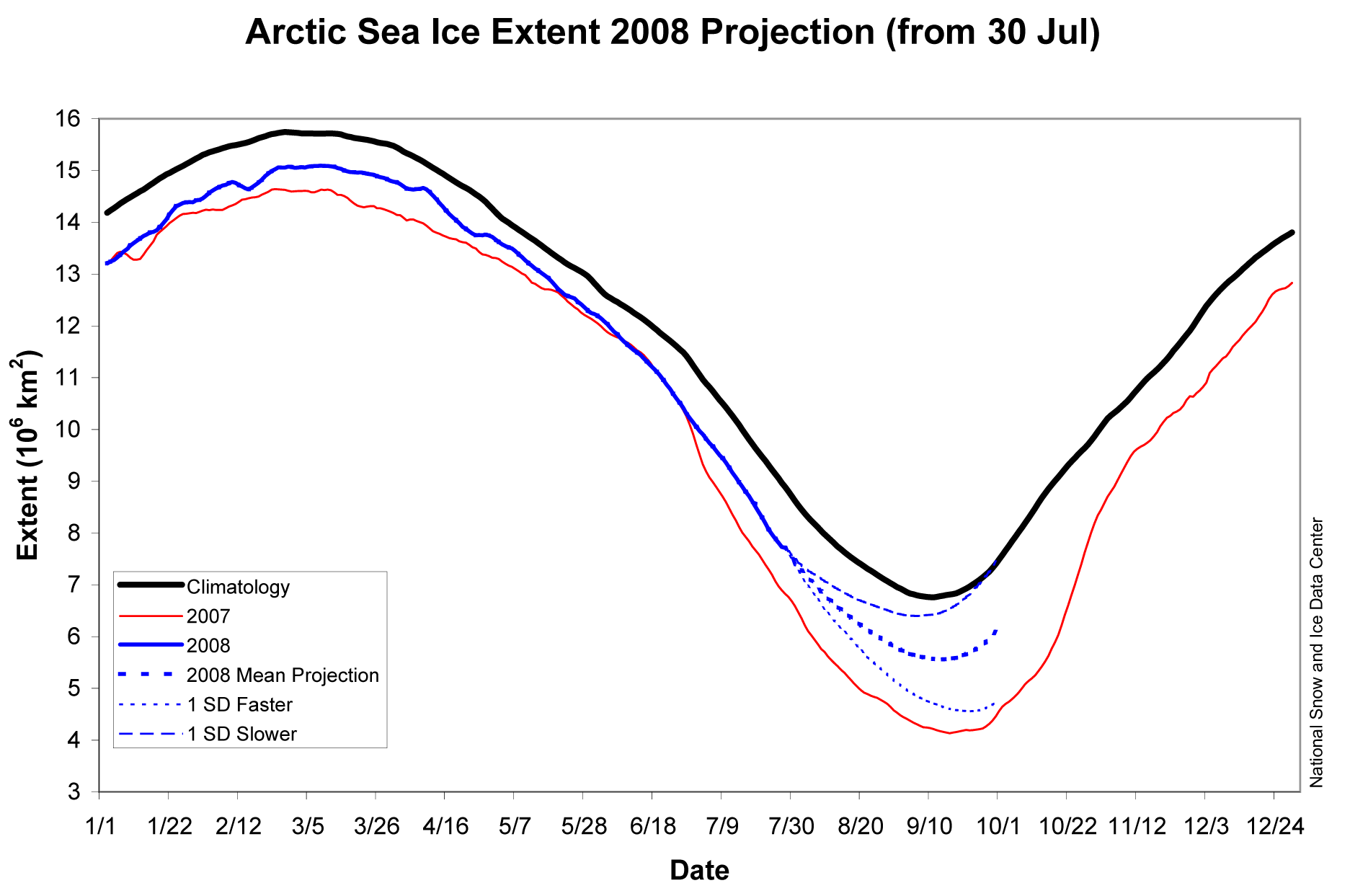
A: The description is incomplete and lacks relevant context. First, all the recent years in the AMSR-E record have had anomalously low maximum extents compared to the 1980s and 1990s. Even the largest winter extent, in 2002, was 250,000 square kilometers lower than the 1979-2000 average. The years 2005-2008 have been 700,000 to 1,000,000 square kilometers below the average. As described above, there is considerable variability during the time around the maximum extent, so the difference between 2005 and 2008 is within what might be expected from natural variations, but both are lower than maximum extents during the 1980s.
While there is a lot of variability in the timing of when the maximum occurs (as mentioned in #5), the actual maximum extent has relatively low variability. This is because in winter it is cold and dark, and ice grows under those conditions. So you always see ice growth, although there is now a significant downward trend at the maximum. In comparing winter ice conditions, ice thickness is much more relevant than ice extent. Data for thickness is not as complete as it is for extent, but it is quite clear that ice is thinning at a rate even faster than the extent decline. During winter 2008, the Arctic was dominated by seasonal ice (ice that has grown since the previous summer) that is much thinner than multiyear ice (ice that has been around for at least a year). Thus, in 2008 the ice has generally been thinner than 2007, and much thinner than earlier years.
We are now seeing some rapid growth of sea ice in the Arctic as the large expanse of exposed ocean cools, but this will all be thin first-year ice. It will thicken over the winter, but by the end of the winter it will only be a half to a third as thick as the ice used to be.
Sea ice also moves with the winds and currents – it doesn’t just grow and melt in place – and thinner ice is generally more easily pushed around. Last year a lot of ice got pushed by winds across the Arctic and even less of the region was covered by thicker old ice at the end of the winter than at the beginning of the winter.
Finally NSIDC did not say that the Arctic sea ice extent would return to “normal” in 2008. The figure referenced in the question, does show one scenario where ice returns to normal, but as stated in the text, that scenario was for a slower than normal melt through the rest of the summer and was deemed highly unlikely. As we say in our August 1 entry: “Thin ice is much more vulnerable to melting completely during the summer; it seems likely that we will see a faster-than-normal rate of decline through the rest of the summer.”
7. Q: Why does NSIDC say that the 2008 minimum sea ice extent “reinforces” the long-term trend when the 2008 extent was clearly higher than 2007?
A: 2008 is in no way a “recovery” relative to the thirty-year trend-and since GHGs act over long time periods, scientists favor looking at change over a long period to detect the GHG signal. From 1979 through last year, the September monthly average extent was declining at a rate of about 72,000 square kilometers per year based on a linear trend. Calculating a linear trend of the data from 1979 through 2008, the decline is now 78,000 square kilometers per year. This may seem counterintuitive, but what happens to the trend each time you add new data depends on where the new data falls relative to the trend line. If a data point falls below the trend line, it will “pull” the trend line downward; a data point above “pulls” the trend line upward. The September 2008 extent, although a bit higher than 2007, was still well below the trend line, so the downward trend line steepened. This is what I mean when I say the trend has been reinforced. Those who attempt to claim that we’ve seen “global cooling” since 1998 may wish to bear in mind that until scientists see a change over a long period, we are skeptical of claims concerning a trend.
The key thing, whether discussing sea ice, temperatures, or any other environmental measure, is to consider long-term trends, not short-term variability.
September monthly sea ice extent and trends for 1979-2007 and 1979-2008.
References:
Arrhenius, S., 1896. On the influence of carbonic acid in the air upon the temperature of the ground, Philos Mag, 41, 237-276.
Lawrence, D. M., A. G. Slater, 2005. A projection of severe near-surface permafrost degradation during the 21st century, Geophys. Res. Lett., 32, L24401, doi:10.1029/2005GL025080.
Lawrence, D. M., A. G. Slater, R. A. Tomas, M. M. Holland, C. Deser, 2008. Accelerated Arctic land warming and permafrost degradation during rapid sea ice loss, Geophys. Res. Lett., 35, L11506, doi:10.1029/2008GL033985.
Lindsay, R.W., and J. Zhang, 2005. The thinning of Arctic sea ice, 1988-2003: Have we passed a tipping point, J. Climate, 18(22), 4879-4894, doi:10.1175/JCL13587.1.
Overland, J. E., M. C. Spillane, D. B. Percival, M. Wang, and H. O. Mofjeld, 2004. Seasonal and regional variation of pan-Arctic surface air temperature over the instrumental record, J. Climate, 17, 3263-3282.
Overland, J. E., M. Wang, 2005. The third Arctic climate pattern: 1930s and early 2000s, Geophys. Res. Lett., 32, L23808, doi:10.1029/2005GL024254.
Revelle, R., Seuss H.E., 1957. Carbon dioxide exchange between atmosphere and ocean and the question of an increase of atmospheric CO2 during past decades, Tellus, 9, 18-27.
Zimov, S.A., E.A.G. Schuur, and F.S. Chapin III, 2006. Permafrost and the global carbon budget, Science, 312, 1612-1613, doi:10.1126/science.1128908.
Dr. Meier is to be commended for his willingness to walk into the lion’s den so to speak, as well as his respectful approach to addressing the skeptics that make up the majority of WUWT readers. Even so, the information he offers is nothing more than the arm waving “there’s a scientific consensus so shut up” babble that we’re all used to by now.
I read his responses and followed every link he offered:
Grist: It can… (waving arms in a threatening way)
CA: It’s got… (putting two fingers in front of the mouth like fangs)
Look at the bones Dr. Meier!
Sorry, I’ve got a teenager that can recite Monty Python and the Holy Grail verbatim 🙂
OA
“Jack Simmons (22:30:32) :
George E. Smith (14:52:55) :
Your comments as written as they are have made all the time I’ve spent on this blog well spent.
Thank you for a fine line of reasoning and concise summary of water’s role as a GHG.
Marvelous.
Thank you.”
I would like to second that one. A very well written and explicit explanation. I have a feeling that Mr. George Smith didn’t need a team to help him write it. Thanks Mr. Smith. I believe you may BE the elephant in the room.
Mike Bryant
Dr Meier, Anthony,
It is always desirable to rush to get comments in. However, I am sure you will read all comments, so I am adding a comment following further reflection of your answers, Dr Meier.
We are all scientist so we all undestand that the basis of science is the falsifiability of theory. So, looking at the two theories that we have:
Theory 1: Within the Holocene and previous interglacials of the current ice age, natural effects have caused the climate to be as warm as, or warmer than, the current climate.
This theory has not been falsified.
Theory 2: The current warming is not natural but is human-caused.
The two theories are mutually exclusive. Since Theory 1 has not been falsified, Theory 2 must be false. You need to falsify Theory 1 in order for Theory 2 not to be false.
Dr Meier, you have argued this the wrong way round when you state “Any natural-causes explanation must be accompanied by an argument for why and how human-caused greenhouse gases (GHGs) are not affecting climate in the same way that natural GHGs affect climate.” Natural causes of climate change are a fact; one therefore does not need to explain what the causes are (although one would like to know). On the other hand, it is human-caused climate change which is a theory which must be explained and accompanied by evidence (which can be falsified).
Thank you all for the polite discussions. A few additional points:
1. Long-term is a relative measure. Let us look at the last million years, consisting of 10 glaciations punctuated by regular, (relatively) short-lived interglacials. That pattern has been regular like clockwork, is correlated with orbital eccentricities, and most certainly has not been anthropogenic.
2. The warm periods have been the periods of the greatest biological production and diversity, whereas the glaciations have produced lifeless icesheets and nearly lifeless tundra over vast areas that are now green. Polar bears, whales, humans, trees, and various other animals and plants are more numerous, productive, and diverse when there is less ice in the Arctic and Boreal regions.
I don’t have a problem with a decline in Arctic ice. In fact, I’m in favor of it. I don’t care if it is human-induced or not. In fact, I hope it is.
The “debate,” such as it is, seems to hinge on questions of alleged warming, anthropogenesis, and the assumed travails of global warming. I find the first two interesting from an intellectual point-of-view, but I think the third question (more like an assumption) is kind of dumb-assed. I mean that in the politest way possible.
George – The result is that cosmic ray flux on earth varies with the sunspot numbers being least at sunspot maxima, and greatest at sunspot minima. the charged particle showers in the upper atmosphere dure to cosmic rays and solar particles are a significant source of cloud nucleation; the Wilson cloud chamber relies on that mechaism to display charged particle tracks in water droplets.
Except that cloud nucleation by cosmic rays has only been observed in the laboratory, and so far in a highly un-Earthlike atmosphere. The CLOUD experiment at CERN is investigating further but has yet to report. Also the correlation evidence that should support the cosmic ray hypothesis in fact contradicts it. For example, Professor Mike Lockwood examined the cosmic ray flux intensity over the period of recent rapid warming and found that the trend was actually the opposite of that required to support the hypothesis -the conclusion:-
‘There are many interesting palaeoclimate studies that suggest that solar variability had an influence on pre-industrial climate. There are also some detection–attribution studies using global climate models that suggest there was a detectable influence of solar variability in the first half of the twentieth century and that the solar radiative forcing variations were amplified by some mechanism that is, as yet, unknown. However, these findings are not relevant to any debates about modern climate change. Our results show that the observed rapid rise in global mean temperatures seen after 1985 cannot be ascribed to solar variability, whichever of the mechanisms is invoked and no matter how much the solar variation is amplified.’
So the cosmic ray influence on clouds is as yet unproven and if it exists is minor compared to other climatic influences. This is why the Royal Society labels it misleading argument No 7.
The idea that water vapour and clouds alone are the controller of climate bemuses me. Observations show that relative humidity tends to remain constant – at a given temperature, any increase in humidity simply precipitates out in a matter of days. This is why water vapour is a feedback and not a driver of climate – an increase in temperature increases the capacity of the atmosphere to hold water vapour, which gives a higher greenhouse effect and so forth. And indeed specific humidity does correlate well with surface temperature, particularly over the oceans. But we are left with the need for some external forcing to produce the initial warming.
Correction to my post of 00:36:03 of 18th Oct 2008.
Theory 1 should be:
“Theory 1: Within the Holocene and previous interglacials of the current ice age, natural effects have caused the climate to be as warm as, or warmer than, the current climate and thus natural effects can explain the current warm climate.”
Sorry for this error.
Phillip Bratby
I’m glad at least Anthony has been kind, respectful and gracious with Dr Meier.
As host, that’s his obligation.
No one else here has shown much respect for Dr Meier’s position here in this forum. What’s the reason for this?
It’s quite simple:
Taxpayers don’t enjoy paying their hard-earned money to an organisation that is bent on fooling the public, and working against what’s in their best interest.
John Philip (13:31:49) :
Lansner, Frank (14:40:52) :
I imagine that there can be a distinction between trends in local humidity and overall atmospheric humidity. With changes in land use patterns, we would expect to see increased local humidity – irrigation, lawns & golf courses, water features, and such. In fact, many years ago, John Christy pointed to temperature trends in a major California valley. In the valley where irrigation had been introduced, temperatures had increased (as well as humidity), but higher on the mountains – where GCMs would forecast increased temperatures – the temperatures had actually trended down.
Increased local surface humidity may indeed be anthropengic and it would not be surprising for such to contirubute to increased temperatures, but the cause of increased local surface humidity is NOT necessarily induced by more CO2. In many cases, we know the culprit is land use changes.
It occurs to me that every AGW proponent with credentials should be begging Anthony to let him/her participate in a post like this one. I believe that Dr. Meier has been treated well here. This type of discussion can only strengthen an AGW proponent. The weaknesses of the theory are exposed in excruciating detail, which can also help to sharpen their arguments. I look forward to posts from a long list of AGW proponents. Who will answer questions from the people? Al Gore, are you next?
An interesting comment from DeWitt Payne on Climate Audit:
“CT has (finally) updated their seasonal average extents through Summer 2008. Steve Mosher won that brownie bet. I’m now convinced that CT changed their extent algorithm at the end of 2006 in a way that makes the extent loss trend look much worse. Here’s my evidence, the year to year difference in extent for Summer average extent (July, August and September)
year… JAXA….. CT…. UH (km2)
2003 178104 157760 146137
2004 -21795 -137900 27088
2005 -543877 -383990 -544048
2006 106515 46030 134330
2007 -1003957 -2210700 -1072133
2008 615274 642400 549470
The difference in the CT extent from 2006 to 2007 is completely out of line with all the other data including the difference from 2007 to 2008, which is again comparable to the JAXA and Uni-Hamburg differences. You can see the same problem in the other CT seasonal averages as well as the annual average. There is a step change in 2007 that does not show up in JAXA or Uni-Hamburg data. For the Summer average, extent went from being about 1 Mm2 larger than JAXA in 2002 to 2006 to 0.22 Mm2 less than JAXA in 2007 and 2008.”
George:
“So long as we have oceans, we couldn’t change the temperature of this planet, either up or down, if we wanted to. Besides, what mean global temperature would you set it to, if you could.”
Thank you for this great post. I found it very educational, and very logical.
I particularly like the summary section, as it presents “the NEXT question”.
Stated a different way…
Let’s assume for a moment that everyone agrees that AGW exists. This then means that we CAN exert influence over the temperature, and therefor the environment, of the planet.
Who gets to choose the temperature?…the faction that says in order to support the global population, we NEED more warmth to increase crop production, etc?…
What a political hot potato THAT discussion point is.
This will be MUCH fun :*)
Thanks again, George.
Jim
Kum Dollison (21:06:25) :
Indeed you found a link, but look at the date:
“May 27, 2004 – (date of web publication)”.
This seems to be another story like the AIRS CO2, where information was stalled for many years. Note that it speaks of the great importance of clouds and albedo.
We have to search for a more recent work, and a plot of albedo as derived from the moon proxy.
George E. Smith (14:52:55) :
discount the effect of solar variance, since the peak to peak range of the solar constant only varies by about 0.1% with the solar sunspot cycles[…] The result is that cosmic ray flux on earth varies with the sunspot numbers being least at sunspot maxima, and greatest at sunspot minima. the charged particle showers in the upper atmosphere dure to cosmic rays and solar particles are a significant source of cloud nucleation[…]
So the effect of solar variance is much greater than the 0.1% change in the solar constant over sunspot cycles.
I caution against hitching anti-AGW arguments to the solar/cosmic rays. Should the cosmic ray connection be falsified, the AGW-crowd will take that as a significant boost for their ideas. And so far, the relation does not look good. There has been significant variation of cloud cover [ http://www.leif.org/research/cloud-cover.png ] and albedo [ http://www.leif.org/research/albedo.png ] since 1980, changes that match the temperature changes [as they must – flip the figures over to gauge the match]. However, the cosmic ray flux has not varied like this at all. For example there is no solar cycle signal in the cloud/albedo data.
[…]change in the solar constant over sunspot cycles.
I caution against hitching anti-AGW arguments to the […]
Re: Lag Between temperature rise and CO2.
Dr. Meier’s assertion that the lag between changes in temperature and changes in CO2 are irrelevant is a prime example of proving “facts ” by assertion rather than research. Since Jame’s Hanson’s assertion of high sensitivity to CO2 because of positive feedback is based on the 1984 state of knowledge about the Vostoc ice cores that suggested that temperature and CO2 rose together, the assumption of positive feed back and high sensitivity should have been re-examined as soon as the data about the CO2 levels following temperatures became known. Instead the AGW true believers came up with “something”starts the warming and then CO2 drives it. All three examples of proof given by Dr Meier’s are rationalizations that have never been subjected to the cold hard light of scientific research. When the question is asked “Why does CO2 stay high for up to 2000 years after temperatures go down”, the response is a thudding silence. Also the Greenland ice cores and Bond’s ocean cores show that warming is not a smooth 5000 year warm-up but a roller coaster that if anything, is based on a 1500 year cycle. The more I read the AGW literature, the more obvious that it mostly consists of computer models that can only respond to the suppositions that are fed into them, and “thought experiments” (like the 2005 Hanson, Reudy, Sato paper). What ever became of putting the suppositions and rationalizations to the test of scientific experiment? This has actually been done to test the feedback of water vapor (e.g. Douglass and Christy, Hu, Lindzen, Spencer) and in each case, water vapor and clouds were found to show a negative feedback or no feedback. Dr. Meier, why do the rationalizations about CO2 driving the warming trump the real world data that show either a negative feedback or no feedback?
Suzanne
Phillip Bratby (00:36:03) :
You are giving AGW a boost by faulty logic:
Theory 1: Within the Holocene and previous interglacials of the current ice age, natural effects have caused the climate to be as warm as, or warmer than, the current climate.
This theory has not been falsified.
Theory 2: The current warming is not natural but is human-caused.
The two theories are mutually exclusive. Since Theory 1 has not been falsified, Theory 2 must be false. You need to falsify Theory 1 in order for Theory 2 not to be false.
The two theories are not mutually exclusive. We could [hypothetically] right now have been at a later phase within the Milankovich cycle such that the temperature from that cause was already down quite a bit. It is not logically excluded that there at this point could be a temporary minor warming [that did not attain the much warmer temperatures of long before]. That warming could well be AGW without any logical inconsistency.
So, if we want to mount a credible attack on AGW, we should not stoop to their level and use faulty logic.
I’m still trying to get my head around:
“…Any natural-causes explanation must be accompanied by an argument for why and how human-caused greenhouse gases (GHGs) are not affecting climate in the same way that natural GHGs affect climate. This, again, has not been addressed in a reasonable way….”
As far as I know, no one ever spent a lot of time determining in detail how ‘natural’ CO2 affected climate. I have seen lots of simple Arrhenius-type statements of how it ‘keeps us hot’, but little detail, until the IPCC burst on the scene, with the ‘1.6 watts extra’ climate forcing figure.
Now, I understood that this figure was not proven from first principles, but rather taken from observation, and found to fit when used in computer models. Essentially the models said: the temperature is going up, CO2 is going up, and if the CO2 is the sole cause of the temperature rise, it must have ‘this’ forcing effect.
What Dr. Meier seems to be saying here is that this forcing is now assumed to be a priori correct, so anyone who suggests that something else is causing the warming must also explain how the CO2 isn’t causing it. I thought that the proposed forcing figure was still a matter for considerable debate – indeed papers are now coming out suggesting that the CO2 forcing contribution is very low. What is wrong with saying that the cause of the 1980-2000 warming trend was an unknown natural cyclic one, and that now we are back in a cooling trend, and that CO2 is of relatively minor importance?
George and Jim B:
You have pointed out an exciting next question.
Who gets to set the temperature?
Apparently ALL AGW alamists want the temp to stay where it was in the 80’s (otherwise they wouldn’t care about warming or cooling). I would suspect that those who live in norhern latitudes and are happy with colder temps would like it set to their liking. I and millions of others who have migrated to the warmer latitudes would like it a little warmer. I am pretty sure tropical islanders don’t want it any colder and perhaps all living animals in the tropics would rather be warm than cold. However, since there really is no “average temperatre” that can be set we must first learn to control local temperatures. Perhaps we could legislate that Florida must remain warm all year and Minnesota must remain cold. Each Country around the world could set their own temperature according to their desires. Perhaps we could force it to rain in the desert and not rain on sporting events. The UN could even erect and patrol barriers between countries that had different temperature settings. What a truly wonderful world this would be.
John Philip (02:49:39) :
[Attributed to Lockwood]: “Our results show that the observed rapid rise in global mean temperatures seen after 1985 cannot be ascribed to solar variability, whichever of the mechanisms is invoked and no matter how much the solar variation is amplified.’ ”
“So the cosmic ray influence on clouds is as yet unproven and if it exists is minor compared to other climatic influences. This is why the Royal Society labels it misleading argument No 7.”
Do you actually read the crap you put out?
From the Royal Society:
http://royalsociety.org/page.asp?tip=1&id=6234
“Even if cosmic rays were shown to have a more substantial impact, the level of solar activity has changed so little over the last few decades the process could not explain the recent rises in temperature that we have seen.”
Glenn (10:29:35) :
[Attributed to Lockwood]: “Our results show that the observed rapid rise in global mean temperatures seen after 1985 cannot be ascribed to solar variability, whichever of the mechanisms is invoked and no matter how much the solar variation is amplified.’
Do you actually read the crap you put out?
First, go and wash your mouth out with soap. Contrast your tone with the polite discourse that has characterized Dr. Meier’s contribution and the discussion so far.
Second, Lockwood’s analysis is almost certainly correct. Notice that this in no means support for AGW, as there could be so many other [specified 🙂 ] natural causes: PDO, ocean currents, etc.
Kim,
What a hoax this Arrhenius hatched. He thought it was a hummingbird and it’s been exaggerated into a condor.
Don’t be too hard on Arrhenius. As I understand it he thought increased CO2 would be a beneficial thing 🙂
Glenn
Your point escapes me. Please explain which part of my ‘crap’ is giving you a problem?
JP.
A preprint with the moonshine albedo, from 2004
http://solar.njit.edu/preprints/palle1266.pdf,
and also Leif’s link http://www.leif.org/research/albedo.png
show that the percentage error in the albedo can be fairly high. This, in my books, translates into a systematic error if the assumption in the models is that the albedo is fixed to its average value.
This means that the models, if they truly calculated their error bands correctly would be so wide as to be meaningless.
JimB (14:24:47) : “I, like several others on this site, am not a scientist. That being said, I am also not devoid of a somewhat logical thought process.”
You may not think it Jim but you ARE a scientist, you think & question, that is science!
Well done 🙂
Dave.
Glenn (10:29:35) :
Oh my giddy aunt. I just read that mess and now know why many of my closest associates claim that the RS is purely political, a spin machine and an arm of the UK government’s propaganda machine.
It is simply staggering that people claiming credentials can “endorse” the exact opposite of investigation, discovery and enlightenment.