From Steve Goddard: Thanks again to Dr. Meier from NSIDC for answering questions, and for offering to do a follow-up.
From Anthony: Responses from Dr. Meier are in italics. I’ve added a poll that you can answer after reading this. Note this poll only allows one vote per IP address. So shared IP systems at offices will only get one vote.
From Dr. Meier: Thank you to Mr. Goddard for presenting this and the previous set of questions. And thank you to Mr. Watts for providing the outlet to publish these. I don’t hope to change the opinion of every climate change skeptic who reads my responses, but hopefully I can provide some useful for information. My answers here and to the previous round of questions are my own and I am speaking for myself, not as a representative of the National Snow and Ice Data Center or the University of Colorado. Thanks to Stephanie Renfrow, Ted Scambos, Mark Serreze, and Oliver Frauenfeld of NSIDC for their input.
One thing I noticed in the comments on my previous answers was a desire for references to peer-reviewed journals. I originally chose not because I didn’t realize there might be an interest and also because a few journal articles doesn’t substantiate human-induced global warming (nor do one or a few articles refute it). It is the preponderance of evidence presented in thousands of articles that provides the foundation for the human-induced global warming theory. Nonetheless, below I provide a few selected references for those that might be interested.
There were lots of good questions from readers, and I have synthesized some of them into a few short ones here for the sake of brevity. There is no question that late-summer Arctic ice extent has declined considerably since the early 1980s, and if the current trend continues linearly – the sea ice will disappear completely at some point in the not too distant future. Most of the questions were along the lines of “how do we know the trend is non-cyclical, and how do we know what is causing it?”
1. Q: The image below shows the general GISS temperature distribution of the previous Arctic warming cycle in the 1920s and 1930s, for stations north of 60N. Turquoise dots had warming similar to the current warming. Red dots are significantly warmer now than they were 70 years ago. Looking at the map, it would be easy to come to the conclusion that the only difference between the current warming and the one 70 years ago, is that the PDO has been in it’s warm phase for the last 30 years – causing warmer temperatures around Alaska and Eastern Siberia. The PDO appears to have recently shifted to its cool phase, and temperatures across Alaska have dropped during the last two years. Why do you believe that the fundamentals of the current warming are so different? Perhaps the warming of the last 30 years was aggravated by a coincidental alignment of the PDO and AMO?
A: The warming of the last 30 years cannot be attributed primarily to the Pacific Decadal Oscillation (PDO) or the Atlantic Multidecadal Oscillation (AMO). The AMO does not have a significant influence on the Arctic. On the Atlantic, side, the North Atlantic Oscillation (NAO)-a regional expression of the Arctic Oscillation (AO)-is the most influential mode of variability in the Arctic. As I’ve mentioned previously, there are natural variations in climate that do indeed affect Arctic temperatures in the Arctic and the sea ice. The NAO/AO is a particularly prominent one and a substantial amount of the decline in the sea ice during the late 1980s and early 1990s could be attributed to a strong positive mode during winters because the positive mode favors the loss of thicker ice that is less likely to melt during summer. However, since about 1995, the AO has mainly been in a neutral or negative state. Under such conditions, the Arctic sea ice should have started to recover. Instead, sea ice extent has not only continued downward, but the decline rate has accelerated. The AO may have been a “trigger” for the precipitous decline, but we wouldn’t have the ongoing decline without the documented warming trend (Lindsay and Zhang, 2005).
The Pacific Decadal Oscillation (PDO) also can play role in temperatures in the Bering Sea region and to some extent in the Pacific side of the Arctic Ocean. The PDO was in a fairly persistent positive mode until the mid-1990s, but it also has shifted to a more neutral state and so cannot explain the decline of the Arctic sea ice since that time. (More details: Overland et al., 2004 and Overland and Wang, 2005).
Another important point is that these climate oscillations can themselves be affected by global warming. There are indications that the positive mode of the AO is more likely to be present under warmer conditions.
2. Q: Given that we don’t really understand what caused the earlier warming period, what evidence is there that the current warming is anthropogenic? How much of your viewpoint about the Arctic future is based on IPCC feedback predictions?
A: There is considerable evidence that the current warming is anthropogenic; this evidence is readily available in thousands of unrelated peer-reviewed scientific journals. You also ask how much of the evidence is “based on” IPCC predictions? In a way, the answer to that question is that none of the evidence is from the IPCC report-and yet all of it is. The reason is that the IPCC report isn’t a source of newly published information, but rather a compilation of evidence from a growing number of articles previously published in scientific journals. All of the information in the IPCC working group reports is referenced to original peer-reviewed journal articles citing researchers from around the world. Thus, the IPCC report is a convenient “one-stop shop” of the latest information, but the ultimate source is the thousands of individual international journal articles that are the basis of the report.
In the first part of your question, you suggest that a lack of understanding of earlier warming periods is a given, and that this casts doubt on our understanding of current warming. From this perspective, it might seem reasonable to assume that because previous change was natural, the current change must be too. Many natural explanations for the current observed warming have been suggested:”it’s just natural variability,” “it’s the sun,” “it’s cosmic rays,” etc. However, these have all been investigated and evidence is simply lacking.
On top of the lack of evidence for natural causes, such suggested explanations ignore the proverbial elephant in the room. Any natural-causes explanation must be accompanied by an argument for why and how human-caused greenhouse gases (GHGs) are not affecting climate in the same way that natural GHGs affect climate. This, again, has not been addressed in a reasonable way.
Here is what we know about greenhouse gases and their influence on climate:
1. Greenhouse gases absorb energy radiated by the earth that otherwise would escape to space, keeping the earth warmer than it would be without GHGs. This is a fact that has been well-known for over 100 years, described in a paper by Arrhenius (1896). GHGs are a necessary part of Earth’s natural “climate control.”
2. GHGs are increasing in the atmosphere. This is known from observations of carbon dioxide dating back to the 1950s from Mauna Loa and other stations, as well as paleo-records of GHG concentrations in ice cores.
3. The GHG increase is due to human-caused emissions. This is clear from the simple fact that we know we’re emitting GHGs through our use of fossil fuels. More scientifically, it is confirmed by a characteristic chemical signature of human-emitted GHGs found in the atmosphere.
4. GHG concentration and surface temperature are closely linked. This is clear from #1, but the relationship is confirmed in ice core records dating back several hundred thousand years. Some of your readers may have heard a suggestion that carbon dioxide lags temperature in the ice core records; that’s not relevant in this case. For more details, see here and here and here
5. The first studies of the effect of GHGs on Earth’s energy budget date back to the1950s (e.g., Revelle and Seuss, 1957). The increasing GHG emissions have already changed Earth’s energy balance. Human and natural changes have increased the radiative forcing (effectively increasing the energy, and thereby the temperature, of the Earth) by about 1.6 Watts per square meter. The largest factor by far is human GHG emissions. Changes in the sun play only a small role. This increased radiative forcing results in a warming of the planet. There is simply not enough uncertainty in these estimates to throw the overall conclusion into doubt: human-induced GHGs have changed Earth’s energy balance and increased temperatures.
FAQ 2.1 Figure 2 from IPCC Working Group I Fourth Assessment Report, 2007.
6. There are feedback mechanisms that can alter the impact of GHG emissions. These include: clouds, water vapor, ice/snow. Ice and snow are clearly positive feedbacks that will reinforce the GHG warming because as they melt, the average albedo (reflectivity) of the earth decreases and more energy is absorbed. The effect of other feedbacks is less certain-and may even counter the effects of GHG warming–but the evidence indicates that they nevertheless do not come close to offsetting the direct effect of GHG emissions.
So, before one can suggest that natural mechanisms explain everything, one has to first demonstrate that something in the above 6 points is wrong. Much of this evidence dates back to at least the 1950s; the theory of anthropogenic global warming is really nothing new. Also note that climate models only play a significant supporting role in the evidence for points 5 and 6. No serious scientific study has yet shown that any of the above 6 points are fundamentally wrong.
The only one of the 6 points still in play to any scientific extent whatsoever is the last point. There has been some interesting research in this area – Richard Lindzen’s Iris effect (a nice summary here) and more recently Roy Spencer’s “internal radiative forcing.”. Spencer’s work is quite new, and has therefore not yet been properly vetted through the peer-review process. (Some informal discussion: RealClimate.
3. Q: You mention the historical record of the Inuit. What do we know about the older historical record from the Vikings?
A: There is archaeological evidence, oral sagas, and some written records, none of which I’m an expert in. However, I can share with you what I know: The Vikings colonized Greenland during about 700-1300 AD, taking advantage of the medieval warm period (MWP). There was reduced ice cover compared to before and after that period that allowed easier sailing between Europe and Greenland. The warmer climate allowed enough farming and ranching to support the population. As climate cooled, crops failed and transport (trade) with Europe became difficult or impossible. There was clearly less sea ice during the MWP than the cool period that followed. It is not known how sea ice conditions compared to today, but ice extents comparable to the 1980s or 1990s would have been sufficient for the Vikings to have successfully sailed between Greenland, Iceland, and Scandinavia; ice would not have had to be at current low levels.
Greenland and northern Europe were clearly warm during the 700-1300 AD; much of the rest of the globe may have been as well. There is often quibbling about whether we’re warmer now than then-the Mann hockey stick plot, etc. But as I pointed out above, such “debate” is almost beside the point: it ignores the elephant in the room that is the GHG emissions produced by humans. We may not clearly know what caused the MWP, but we have a clear cause for the current warming: human-caused GHGs.
4. Q: Is there any hard data on permafrost losses during the last ten years?
A: There is clear evidence of increasing ground temperatures and thawing permafrost, consistent with the warming surface temperatures. Permafrost will respond more slowly to warming, but it is a potentially significant long-term feedback because large amounts of GHGs, particularly methane, are “locked” in the permafrost. As much GHGs are locked in the permafrost as currently resides in the atmosphere. At least some of these GHGs will be released as the permafrost thaws. There have been several papers discussing permafrost thaw and potential climate impacts (Zimov et al., 2006; Lawrence and Slater, 2005; Lawrence et al., 2008).
5. Q: Has there been a trend of the date of minimum Arctic sea ice coverage? Has there been a trend in the date of maximum Arctic sea ice coverage? If there has been warming over the ice (which is not sampled adequately), there should be an earlier maximum and later minimum.
A: There has been a trend toward later minimum dates, but there is substantial variability from year to year in the freeze-up date. A later freeze-up is not surprising because with lower summer ice extent, there is more ocean area to absorb heat that needs to be dissipated before freeze-up can begin. However, there is high variability because the timing of when the ice stops shrinking and begins growing has a lot to do with short-term weather. A late-season warm spell can extend melt, while a quick, early cold snap can cut melt short.
There is essentially no trend in the date of maximum extent. There is even greater variability from year to year in the maximum date than in the minimum date. This is also not surprising. At the time of maximum extent, the boundary of the ice edge is unconstrained and has extended into the north Atlantic and north Pacific. Ice at the ice edge is also thinner at the maximum. Most of it is less than 50 cm thick, because it is ice that has recently formed. This ice is prone to being broken up by winds, advected into warmer waters where it melts, or pushed northward. On the other hand, cold winds from the north can cool surface waters and allow more ice to form, at least temporarily, and extend the ice edge farther south. So, the ice edge location at the time of the maximum is fairly volatile and subject to sudden change. This variability can be seen in AMSR-E data graph, where you can see the bumpiness of the daily extent during the winter season. This is the ice edge “bouncing around” in response to winds, currents, storms, etc.

6. Q: Looking at the AMSR-E sea ice extent graph, I see an alternative description for recent behavior. Until the first week in August, 2008 extent was equal to or greater than 2005 – and NSIDC was even considering a possible return to normal as late as August 1. However, a series of strong storms broke up the ice and caused 2008 to drop below 2005 for a few weeks. As September ends, 2005 and 2008 appear to be converging again. Average daily ice extent in 2008 has been greater than 2005, and nearly every day in 2008 has been greater than 2007. What is wrong with this description?
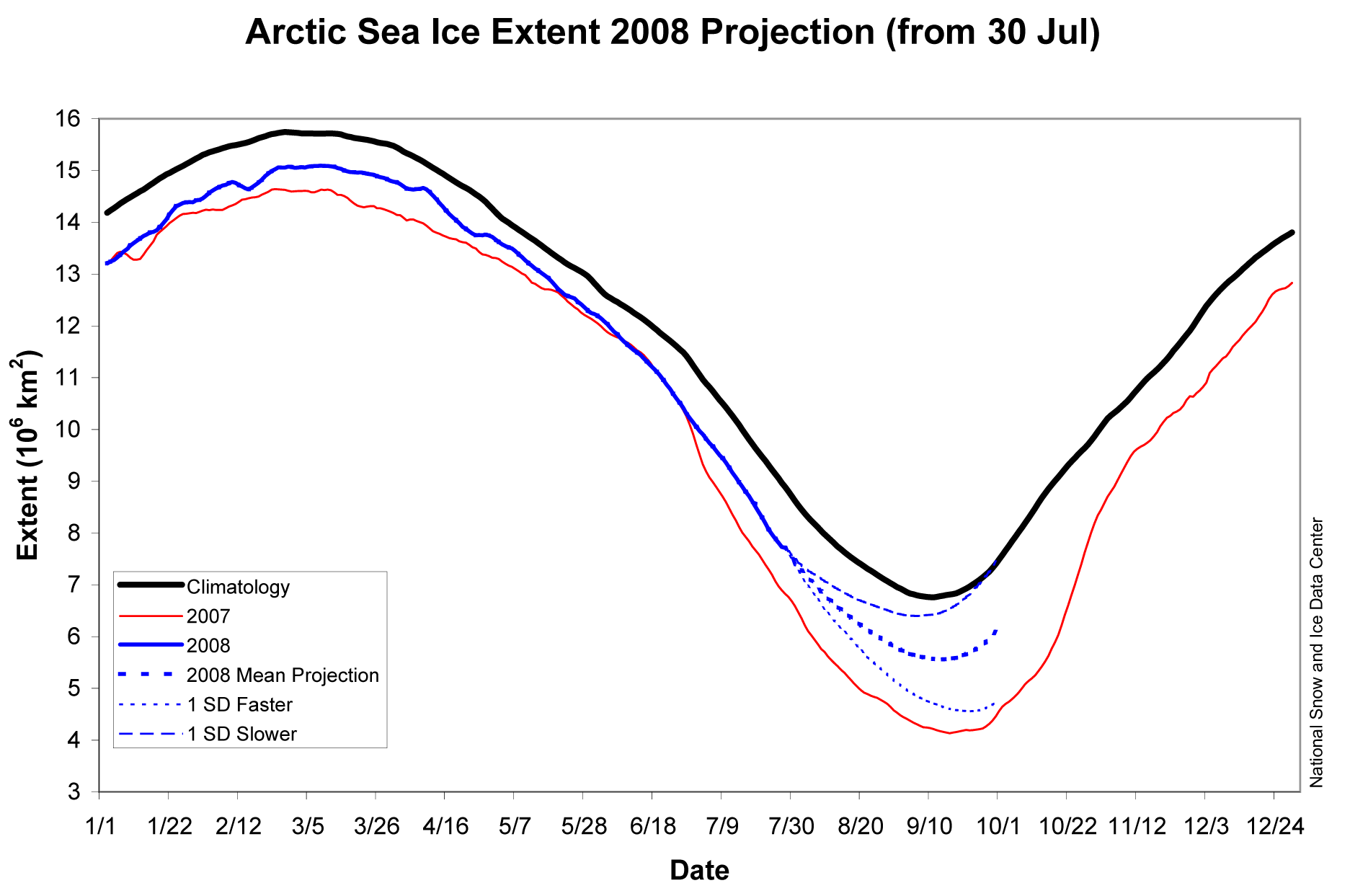
A: The description is incomplete and lacks relevant context. First, all the recent years in the AMSR-E record have had anomalously low maximum extents compared to the 1980s and 1990s. Even the largest winter extent, in 2002, was 250,000 square kilometers lower than the 1979-2000 average. The years 2005-2008 have been 700,000 to 1,000,000 square kilometers below the average. As described above, there is considerable variability during the time around the maximum extent, so the difference between 2005 and 2008 is within what might be expected from natural variations, but both are lower than maximum extents during the 1980s.
While there is a lot of variability in the timing of when the maximum occurs (as mentioned in #5), the actual maximum extent has relatively low variability. This is because in winter it is cold and dark, and ice grows under those conditions. So you always see ice growth, although there is now a significant downward trend at the maximum. In comparing winter ice conditions, ice thickness is much more relevant than ice extent. Data for thickness is not as complete as it is for extent, but it is quite clear that ice is thinning at a rate even faster than the extent decline. During winter 2008, the Arctic was dominated by seasonal ice (ice that has grown since the previous summer) that is much thinner than multiyear ice (ice that has been around for at least a year). Thus, in 2008 the ice has generally been thinner than 2007, and much thinner than earlier years.
We are now seeing some rapid growth of sea ice in the Arctic as the large expanse of exposed ocean cools, but this will all be thin first-year ice. It will thicken over the winter, but by the end of the winter it will only be a half to a third as thick as the ice used to be.
Sea ice also moves with the winds and currents – it doesn’t just grow and melt in place – and thinner ice is generally more easily pushed around. Last year a lot of ice got pushed by winds across the Arctic and even less of the region was covered by thicker old ice at the end of the winter than at the beginning of the winter.
Finally NSIDC did not say that the Arctic sea ice extent would return to “normal” in 2008. The figure referenced in the question, does show one scenario where ice returns to normal, but as stated in the text, that scenario was for a slower than normal melt through the rest of the summer and was deemed highly unlikely. As we say in our August 1 entry: “Thin ice is much more vulnerable to melting completely during the summer; it seems likely that we will see a faster-than-normal rate of decline through the rest of the summer.”
7. Q: Why does NSIDC say that the 2008 minimum sea ice extent “reinforces” the long-term trend when the 2008 extent was clearly higher than 2007?
A: 2008 is in no way a “recovery” relative to the thirty-year trend-and since GHGs act over long time periods, scientists favor looking at change over a long period to detect the GHG signal. From 1979 through last year, the September monthly average extent was declining at a rate of about 72,000 square kilometers per year based on a linear trend. Calculating a linear trend of the data from 1979 through 2008, the decline is now 78,000 square kilometers per year. This may seem counterintuitive, but what happens to the trend each time you add new data depends on where the new data falls relative to the trend line. If a data point falls below the trend line, it will “pull” the trend line downward; a data point above “pulls” the trend line upward. The September 2008 extent, although a bit higher than 2007, was still well below the trend line, so the downward trend line steepened. This is what I mean when I say the trend has been reinforced. Those who attempt to claim that we’ve seen “global cooling” since 1998 may wish to bear in mind that until scientists see a change over a long period, we are skeptical of claims concerning a trend.
The key thing, whether discussing sea ice, temperatures, or any other environmental measure, is to consider long-term trends, not short-term variability.
September monthly sea ice extent and trends for 1979-2007 and 1979-2008.
References:
Arrhenius, S., 1896. On the influence of carbonic acid in the air upon the temperature of the ground, Philos Mag, 41, 237-276.
Lawrence, D. M., A. G. Slater, 2005. A projection of severe near-surface permafrost degradation during the 21st century, Geophys. Res. Lett., 32, L24401, doi:10.1029/2005GL025080.
Lawrence, D. M., A. G. Slater, R. A. Tomas, M. M. Holland, C. Deser, 2008. Accelerated Arctic land warming and permafrost degradation during rapid sea ice loss, Geophys. Res. Lett., 35, L11506, doi:10.1029/2008GL033985.
Lindsay, R.W., and J. Zhang, 2005. The thinning of Arctic sea ice, 1988-2003: Have we passed a tipping point, J. Climate, 18(22), 4879-4894, doi:10.1175/JCL13587.1.
Overland, J. E., M. C. Spillane, D. B. Percival, M. Wang, and H. O. Mofjeld, 2004. Seasonal and regional variation of pan-Arctic surface air temperature over the instrumental record, J. Climate, 17, 3263-3282.
Overland, J. E., M. Wang, 2005. The third Arctic climate pattern: 1930s and early 2000s, Geophys. Res. Lett., 32, L23808, doi:10.1029/2005GL024254.
Revelle, R., Seuss H.E., 1957. Carbon dioxide exchange between atmosphere and ocean and the question of an increase of atmospheric CO2 during past decades, Tellus, 9, 18-27.
Zimov, S.A., E.A.G. Schuur, and F.S. Chapin III, 2006. Permafrost and the global carbon budget, Science, 312, 1612-1613, doi:10.1126/science.1128908.
John Philip:
A couple of responses. Isn’t one of the authors of “Attribution of observed surface humidity changes to human influence” also one of Mann’s co-authors; need one say more!!!
Disputing the 31,000 scientists is comparable to debunking claims made that 2,500 climate experts contribute to the IPCC. Only a handful are climate scientists, and most of these form an incestuous clique.
Furthermore, the summary of Lindzen’s work the professor refers us to just repeats the standard error of increased temperature magnifying the effect of water vapor by increasing the amount of vapor in the atmosphere. Isn’t this precisely where the theory is not being supported by data?
================================
I am of a mind with a lot of others. I thank Dr. Meier for his time and in seriously addressing the questions. He did discuss and grant some conclusions that, I feel, others who endorse the human-induced global warming hypothesis would not have done. Nonetheless, similar to Leif’s first (and only?) post, I think Dr. Meier does nothing to advance the debate beyond pointing out what we’re fairly sure are NOT the main causes behind the Arctic melting. But, as the Climate Skeptic says on his website, that doesn’t mean that scientists can automatically assume that their preferred reason must be the cause. It has also been my impression that global warming is top-down not bottom-up, and would begin with a warmer upper atmosphere where GHGs trap solar radiation. Satellite measurements show no positive trends for that for the past 7 years. If GHGs now heat the surface but not the atmosphere, I would like that explained as to why. There is also little information provided, perhaps because of the questions, about natural heat-transfer mechanisms, how they are operating, and what their effects are.
Either way the majority of Dr. Meier’s case seems to hang on the radiative forcing power of GHGs, which I have read enough about not to buy, insofar as their proposed catastrophic warming effects. I personally believe that mankind has to have some effect, but to what measure we shall see. Dr. Spencer’s work should be most informative on this matter as far as showing exactly how sensitive the climate is to man-made changes. I understand his work has not been peer-reviewed, but there is a lot of bunk out there that has been peer-reviewed, so I do not put a lot of stock in that process. James Mann’s HS was peer-reviewed, unless I am mistaken, and Steve McIntyre destroyed it after it was officially “approved” by peers AND included in the IPCCs reports.
If there have been some vehement reactions, unfair and uncalled for though they certainly are, it should simply go to illustrate the lack of trust that AGW advocates have among those of us less inclined to accept their explanations. There are very good reasons for this mistrust, not the least of which is the substantial political connections associated with AGW advocacy, though that may not apply to Dr. Meier himself directly. Also, since he cites Richard Lindzen, I should point out to Dr. Meier that Lindzen also wrote a paper asserting that climate science is very much ill-prepared at this point to answer the question of “is global warming being caused by man” either effectively or honestly. If he will read that paper, he will understand, I believe, the foundation of the rejection that is here elicited to the AGW hypothesis as well as the poor view of peer-reviewed research on this issue. That, taken along with so-called evidence such as Mann’s HS that was first trumpeted as proof and later brutally exposed, will go far in explaining the reluctance of many to accept his explanation wholeheartedly.
Several others have pointed out that the MWP was warmer than now and Dr Meier acknowledges that in his comments; however, the calculations on the catastrophic effects of human-emitted GHGs are calculated via computer models that have a significant positive feedback bias, and they are the ONLY reason why we would assume that increased warming of the planet (whatever the cause) would not be a good thing. They are because integral to their functions is the mathematics that is assumed to be operating the natural forces of Earth’s systems and its reactions to human-emitted GHGs. While these models are improving, they are still seriously flawed and prone to input biases. That the IPCC is an intergovernmental panel by definition also screams political involvement and interference.
To tie-in to current events, some Wall Street firms used computerized risk-assessment models to “prove” to regulatory bodies that they were in good shape. Yet it is clear to all today that those computer models, supposedly representing reality in their mathematics, failed or were biased so as not to point out significant errors. In regards to climate science, calling their role a “significant supporting” one is rather disingenous. They are supposed to represent the proof of the accuracy of AGW climate mathematics as relates to GHGs and all the interactions their effects are supposed to cause/enhance/inhibit. They may not represent all the research, but much like the IPCC reports they represent a great body of the peer-reviewed and published research which has been programmed into their modeling. And they are not presented as interesting finds in their results but as proof of the probable outcomes of human-induced global warming.
So, if he gives further explanations, I should encourage Dr. Meier to tackle the issues of: 1) trust, 2) political involvement/interference in scientific research and results, and then address 3) scientific findings. Without those first two his answers are entirely incomplete with respect to anything AGW is supposed to cause. I say this because not only do many disagree with his scientific findings, but they do not trust some of his sources (like RealClimate for instance), and the research involved with AGW is of such a politicized nature (Al Gore, James Hansen, Obama, EPA, IPCC, etc) that this subject absolutely must be satisfactorily addressed prior to results being discussed. It is that simple.
Leif Svalgaard:
Inverse baromter, Se evt denne:
http://ibis.grdl.noaa.gov/SAT/gdrs/geosat_handbook/docs/chap_4.htm
I think you have more routine (!) in getting the essence from this than I.
Now he wants to sneer at the last few years being a ‘trend’ while repeating the canard about 1998. If the climate cycles naturally, as it has forever, why can’t he see the last decade as the last warming cycle peaking and now turning downward. He is way too cavalier with the idea that natural cycles don’t still predominate. The elephant in the room is that he doesn’t understand natural cycles, and won’t admit it. And the same goes for all the people pushing the CO2=AGW paradigm. Well, the elephant is about to roll over on them. You’d think they’d at least have the sense to get out of the way.
==============================
It is becoming obvious that climate regulation is an extremely complex matter, beyond human understanding, yet. It is the height of arrogance to claim a trace gas is the main climate determinant, the elephant, so to speak, when he hasn’t a clue to what a real elephant looks like. To substitute a simple concept as an explanation when the real one is monstrously complex is not just arrogant, it is scientifically pitiable.
===========================================
I, like several others on this site, am not a scientist. That being said, I am also not devoid of a somewhat logical thought process.
I’d like to take the plane back up from the treetops to the “30,000ft” level, and point out a few of the things that I have not been able to reconcile in the AGW dispute, which ultimately make me sit on the skeptic/denier side of the pews. In order for me to change my mind, I need some clear, logical, concise answers regarding the same points that get discussed over and over and over, but never actually answered, at least not for folks like me.
1) I’ve read both here and over on CA that Mann and his fellow scientists refuse to release their methodology and data, which would allow other scientists to review/validate their work.
Why is that? Steve McIntyre seems to have found numerous errors along with failure to follow what would be termed “minimal acceptable practices” in other fields, so why does this road block approach continue? This makes no sense. Release the code, release the data, so that the research can be independently verified. Otherwise, people absolutely SHOULD be skeptical of what is being hidden. If nothing is being hidden, release it all, period.
Oh…and the “Why should I release it so you can try and poke holes in it?” argument is very simply answered…that’s what science consists of.
2) Why don’t AGW scientists admit it when there are errors or skewing in the data? Looking at the work that’s been done to “audit” the ground stations used to provide weather data, it’s obvious that there are a great many flaws. Stations have been moved, and no, “adjusting” the data for urbanization doesn’t fix it. All that does is create an argument regarding the proxy/adjustment formula. Stop arguing about the proxy formula being used to adjust data and go MOVE THE DAMNED THING to a site that meets the acceptable criteria for such stations.
3) Please explain why temperature trends are down, and C02 is up, and up in a very linear fashion. Answers like “We can’t find any other reason, so it must be C02.” are not sufficient for me to change my mind, and frankly, really diminish or eliminate any respect I may have had for you and your point of view.
There are more, but these would at least get me started.
Jim
John Phillips- you said “..the actual increase in concentrations is less than this would produce, so we can confidently attribute all the increase to human activity.”
I don’t follow.
If there are two sources of CO2, Human + Natural; and observations show change in concentration of CO2 <Human; How does it follow that ALL of the change in concentration of CO2 is Human?
Could it not be that the absorption of Human + Natural CO2 is in proportion to their relative concentrations?
It seems to me that the following argument should also be allowed –
Change in concentration of CO2 is <Natural therefore ALL the change in concentration is due to Natural.
Calling CO2 the main determinant of climate today is a lot like saying the sun revolves around the earth. It looks like it does, but it’s because our understanding is not sufficiently developed to know the real truth. What a hoax this Arrhenius hatched. He thought it was a hummingbird and it’s been exaggerated into a condor.
===========================================
John Philip
Your link “attribu…”
Yes, the relative humidity remains approx constant as the models predict, and then they find that humidity therefore increase with increasing temperature.
But how does this match the measured relative humudities:
http://bp3.blogger.com/_IiWf8u5z6NI/SFwxs7ZKd0I/AAAAAAAABLc/QtvIUbhMeo4/s400/GlobalRelativeHumidity300
Most interesting is of course the actual amount in the atmosphere
925 mbar: Here you see rise, but only to what already was present around 1940-50…
http://wattsupwiththat.files.wordpress.com/2008/06/925mbhumidity.gif
700 mbar: FALL
http://wattsupwiththat.files.wordpress.com/2008/06/700mbhumidity.gif
500 mbar: FALL
http://wattsupwiththat.files.wordpress.com/2008/06/500mbhumidity.gif
So overall there is no doubt, that theres is LESS water in the atmosphere today than in the 1940-50 íes.
And for most of the atmosphere, there is not even a rising tendensy today.
So again, it IS a problem to suggest POSSITVE FEEDBACK based on increasing water content, when there is not an increasing water content.
(Especially interesting is is that we today have lower water content than in the 1940´ies – 50´ies: If we link temperature to water content, then it should be colder today than 60 years ago? It seems possible with raobcore tropical balloon graphs, arctic graphs, USA RURAL graphs. It seems possible with many graphs where UHI is 100 % eliminated.)
Look, Walt, when even non-scientists can successfully deride your logic, isn’t it about time to start re-considering?
=========================================
“6. There are feedback mechanisms that can alter the impact of GHG emissions. These include: clouds, water vapor, ice/snow. Ice and snow are clearly positive feedbacks that will reinforce the GHG warming because as they melt, the average albedo (reflectivity) of the earth decreases and more energy is absorbed. The effect of other feedbacks is less certain-and may even counter the effects of GHG warming–but the evidence indicates that they nevertheless do not come close to offsetting the direct effect of GHG emissions. ”
Well I have some basic problems with Dr Meier’s #6 and with the IPCC’s fig2 “forcings budget” (I hate that word forcings).
The official NASA/NOAA earth energy budget shows a total of 390 W/m^2 emitted from the earth corresponding to a +15 deg C black body emission which peaks at 10.1 microns. Allegedly, only 40 W/m^2 of that passes directly through the atmosphric window, the rest being captured by GHGs the most prevalent by far being water vapor. Water vapor by itself is perfectly capable of generating all the positive feedback that Dr Meier would like, without the need for any CO2 or other trigegr. More water vapor, means more evaporation so more water vapor warming. Meier mentions the albedo effect of melting ice as a positive feedback; but realistically as any satellite or moon based picture of earth will show, the approximately 50% global cloud cover is the biggest factor in albedo, and the solar irradiance in the polar ice regions is substantially lower than in the tropical regions where water vapor and clouds exist in abundance. Also in the polar regions, especialy the Antarctic inland, the earth IR radiance can be an order of magnitude less than in the tropical deserts so IR emissions from the poles is not a big contributor to global cooling.
The IPCC chart mentions water vapor only as a minor stratospheric component which it says is a warming influence; but it makes no mention of real clouds which precipitate rain snow and ice on the planet and block large amounts of ground level solar insolation, as well as reflect solar radiation from the cloud tops as the principal component of the albedo.
As Wentz et al have shown (SCIENCE July 2007; How Much more Rain will Global warming Bring ?) global precipitation and gloabl evaporation must balance or else we would end up with the oceans overhead; and precipitation means dark clouds that block solar radiation from the ground.
So precipitable clouds are a strong negative feedback; and therein lies the power of water to regulate the global surace temperature. As a vapor it gives positive feedback to stop us from freezing, without the need of any help from CO2, and as a liquid or solid form in clouds, it gives a strong negative feedback capable of overpowering any CO2 inspired warming.
Nobody ever observed the surface to warm, when a cloud passes in front of the sun. The sun, being a 0.5 deg divergence source casts a relatively sharp shadow zone on the ground where the solar irradiance is lower. Inside that shadow zone, the cooler surface emits a lower IR radiant emittance; that unlike the solar source is at least Lambertian in angular distribution, or more likely, near isotropic due to surface roughness, and very little of that diffuse IR emission will be intercepted by that cloud, that directly blocks some fraction of the complete solar beam; and that is why it always gets colder in the shadow zone. In the polar regions, where the temperatures are lower, the incidence of water vapor and clouds is much lower than in the tropics, so even at the lower emittance levels, there is not much impediment to the radiative cooling.
Meier, and IPCC discount the effect of solar variance, since the peak to peak range of the solar constant only varies by about 0.1% with the solar sunspot cycles; but the effect of the sun cycle is more related to charged particle emissions form the sun, and cosmic rays, along with the variation of the solar magnetic fields over the sunspot cycle. The result is that cosmic ray flux on earth varies with the sunspot numbers being least at sunspot maxima, and greatest at sunspot minima. the charged particle showers in the upper atmosphere dure to cosmic rays and solar particles are a significant source of cloud nucleation; the Wilson cloud chamber relies on that mechaism to display charged particle tracks in water droplets.
So the effect of solar variance is much greater than the 0.1% change in the solar constant over sunspot cycles.
Another effect of the variable cosmic ray flux on earth as a result of changes in solar activity, is that the rate of production of radiocarbon 14 in the upper atmosphere changes with solar activity, and a drop in carbon 14 in the atmosphere, is exactly the same as the signature of fossil fuel burning, since fossil carbon is presumably so old as to be free of carbon 14. There is the Carbon 13 signature that relates presumably to burning of plant matter and forests.
So a good part of the signature of fossil carbon is the same as the signature of an active magnetic sun and the consequent reduction in water droplet nucleation (cloud formation) which has led to lower than normal cloud cover (precipitable) during the very active solar cylces that we have had ever since the IGY in 1957/8 when the all time maximum sunspot count maximum was recorded; and sunspot peaks have been historically high ever since, up to the demise of cycle 23 and the non appearance of cycle 24 sunspots. this is a far more plausible scenario for the last 50 years of global warming, and now a cooling trend.
One writer challenged my assertion that nobody ever experienced a surface warming when a cloud passes in front of the sun. he described a situation (which he said he had experienced in the arctic) where clouds moved in over his location and it got warmer due to radiation from the warmer clouds.
No argument from me; except that doesn’t meet the conditions. In the Arctic ice regions, the sun never gets high above the horizon, and a cloud that intercepts the direct sunlight is nowhere near overhead, but down low on the horizon, and many miles away from being overhead. The over head clouds that moved in on him were actually a warm air mass fullof moisture that moved in,and they likely didn’t even block the sun at all. The reflectance of snow that is more than a few hours old is grossly overestimated. Compared to snow that is about 14 hours old, 44 hour snow has from 40 to 80 percent rofh reflectance in the 0.9 to 2.5 micron band, and that drops as low as10 percent for 70 hour snow. At longer wavelengths, water is almost totally absorptive of long wave readition, with a corresponding low radiant emittance (Kirchoff’s Law), so the albedo contribution of arctic snow and ice is rather minor.
Polar orbit satellites have only been with us since 1979 or so, and they first gave us a glimpse of the total arctic ice pack (antarctic too), and you will recall that was a time of very advanced ice which led to threats of an imminent ice age. And it is those early images of an abnormally advanced Arctic ice that AGW fans like to compare with the 2007 extreme ice retreat; not the normal levels of that ice.
Also global cloud monitoring from polar satellites is equally young; and those measurments are somewhat limited, because they can reveal albedo effects, but are hardly a good measure of ground level insolation due to water laden clouds. Global measuremnts of effective cloud cover from the ground have to be considered to be very primitive, a there isn’t any simple way to continuously monitor the entire globe.
When such data becomes obtainable, I am quite confident, that we will find that the global balance between clear water vapor laden positive feedback air, and water/ice laden precipitable clouds, is all that is needed to explain the temperature regulation of the earth.
Anything like cosmic rays or other charged particles, aerosols, volcanic dust and other droplet nucleating sites, lower the equilibrium temperature needed to maintain the proper cloud balance, while very clean air, and low charged particle/cosmic ray flux, that inhibits cloud formation raises the required equilibrium temperature rquired to establish the ocrrect cloud level.
All that trace GHGs like CO2 et al do, is simply reset the cloud cover percentage to a different value; but that miracle substance Water in all three phases (the only GHG that exists in all phases in the atmosphere) is fully in control.
So long as we have oceans, we couldn’t change the temperature of this planet, either up or down, if we wanted to. Besides, what mean global temperature would you set it to, if you could.
George
Good stuff, George, at 914:52:55)
=============
A huge assumption. There’s no way to tell if the rise in water vapor is the cause of warming or a result, nor whether its increase is human-caused.
An interesting blog entry that seems to be relevant:
I’m curious about Canadian Archipelago sea ice area
[…] October 17, 2008 in Climate Science and Weather, Global Warming, Sea Ice, climate, climate change, environment I was rude to Antony Watts a while back for misinterpreting the differences between different Arctic Ice measurements. Now, I am going to praise him. Well done to you, whom I know as a ‘climate skeptic’ (though not the wing-nut variety), for following through on the suggestion and contacting Walt Meier. Even better done to publish his responses, in full, on your blog. […]
George E. Smith (14:52:55) :
Global measuremnts of effective cloud cover from the ground have to be considered to be very primitive, a there isn’t any simple way to continuously monitor the entire globe.
There is a program to monitor the albedo of the Earth by measuring the intensity of ‘Earthshine’ on the Moon. Data goes back more than a solar cycle and are continuing.
Actually, this one is even better:
Don’t Panic – The Arctic has survived warmer temperatures in the past
Talk about backwards. LACK of ice and snow might be considered a positive feedback, but the existence of ice and snow would be a negative feedback. Then again, Trees would be a positive feedback, since their tendency to be dark in color means they absorb more heat. And, if ice and snow were such large feedbacks towards cooling, we never would have recovered from the first ice age, but we seem to recover regularly. Clearly tells me there is little overall effect from albedo.
Dr Meier says –
1. “Many natural explanations for the current observed warming have been suggested… However, these have all been investigated and evidence is simply lacking. ” and,
2. “…it might seem reasonable to assume that because previous change was natural, the current change must be too.”
I have problems with these propositions as follows:
1. The fact that at any moment in time evidence for some proposition is lacking can in no way show that the proposition is false. (Of course, that applies equally to lack of evidence for AGW – lack of evidence doesn’t prove it false).
Informed opinion can make shrewd judgements about what is likely or not, but that remains opinion, albeit well informed opinion (or not 😉 ).
To falsify the theory that ‘global warming is natural’ one has to show that it is incompatible with some other theory which can be proven.
Such a theory might falsify directly some part of the original theory; or it might be another theory altogether that provides a sufficient explanation for the observed phenomena.
It seems to me that there are papers being published now which provide evidence for natural processes which might be candidates for causing or contributing to global warming; and
There is work being carried out and just beginning to be published which may generate changes in the parameters (read ‘assumptions’) used in the climate model calculations. Some such changes (e.g. in relation to feedbacks) would radically alter the outcomes of the model calculations.
2. In relation to the second proposition, I think that this is simply a verbal trick which neatly reverses the onus of proof for the argument which is actually being put.
It is undeniable that the cause(s) of ancient periods of warming were ‘natural’.
It is also the fact that we know even less about the evidence for the precise cause(s) of the ancient warming than we do about the present warming. But it simply does not follow that there must be some ‘other’ (?) cause. That is just a nonsensical argument.
So why would one be driven to make such an argument in relation to the present warming? If ‘natural’ causes are sufficient explanation for the ancient warming, why are they not sufficient for the present warming?
It seems to me that the only thing which would demand a different explanation would be evidence that the present warming was different either as to the quantum or as to the rate of the warming.
If modern warming is not different to ancient warming, then why would one demand a different explanation for it?
The onus is on Dr Meier and others to show –
a) that the modern warming is different from ancient warming; and
b) that therefore it requires a different explanation.
In my opinion neither he nor anyone else has shown either of these things.
And thanks to Dr Meier for giving us his time. I for one appreciate it.
Folks, over at my site, I regularly post (now up to the 3rd) ‘question place’ notes — places for people to ask specific questions about science, particularly if they relate to climate, oceanography, glaciology, and, even more so, sea ice. By specific, I mean something that can be answered at blog post length. A question like ‘what is the evidence for anthropogenic climate change’ is not a blog post length! Some that are, which I’ve taken from above:
How can CO2 matter if it lags Temperature in the climate record?
How are the sea ice concentration records spliced (David Smith: I believe you can find some answers to that at the NSIDC site itself, see data set 51; in any case, check papers from Claire Parkinson and Don Cavalieri and company from NASA GSFC — google scholar will get you there)
Vincent Guerrini Jr. — Area and extent are quite different things. I already have a note on this. See ‘sea ice packs’. In addition, JAXA relies on AMSR and UIUC (Bill Chapman) relies on SSMI. There are additional differences from that.
Chris Morris — I believe if you check out recent (last few months) news and scientific reports, you’ll find that methane is now being observed to be rising after a plateau.
Pierre Gosselin — “Surely he can give us a good ballpark figure.” (speaking of Walt Meier, regarding sea level rise). Why? Scientists are often accused of being a bunch of know-it-alls, and here you’re demanding it. Meier’s research (at least what I know him for) does not involve sea level change.
Leif Svalgaard — In barometers, high pressure makes for a high level in the barometer. In oceans, it works opposite: under high atmospheric pressure, the ocean is lowered (pressed down), and under low atmospheric pressure, it rises. Whether you want a correction for the inverse barometer depends on what, exactly, you’re studying.
In the near future (whether that translates to days or weeks depends on work life and private life) I should be assembling notes on:
Why CO2 matters even if it lagged temperature in the paleo-record
Relative contributions and importance of H2O and CO2 as greenhouse gases
Why we expected record minima in the Arctic sea ice at the same time as record maxima in the Antarctic sea ice
Leif Svalgaard (15:32:05
Leif, what did that “earthshine” look like back in 1998, 1999, and 2000?
I think I found it:
From 1997 to 2000, Earth continued to dim. The researchers suggest, during this time period, the decreases in Earth’s reflectance may be related to an observed accelerated increase in mean global surface temperatures. From 2001 to 2003, Earth brightened to pre-1995 values. The researchers attributed the brightening to changes in cloud properties.
“At the moment, the cause of these variations is not known, but they imply large shifts in Earth’s radiative budget,” said co-author Steven Koonin, a Caltech physicist. “Continued observations and modelling efforts will be necessary to learn their implications for climate.”
Item 5
Click on image to enlarge.
The research offers evidence Earth’s average albedo varies considerably from year to year, and from decade to decade. “Our most likely contribution to the global warming debate is to emphasize the role of clouds in climate change must be accounted for, illustrating that we still lack the detailed understanding of our present and past climate system to confidently model future changes,” said Enric Palle, a postdoctoral associate at NJIT, lead author of the paper. Pilar Montan~es-Rodriguez, a postdoctoral associate at NJIT, is another co-author.
http://www.nasa.gov/centers/goddard/news/topstory/2004/0528earthshine.html
George E. Smith (14:52:55) :
Your comments as written as they are have made all the time I’ve spent on this blog well spent.
Thank you for a fine line of reasoning and concise summary of water’s role as a GHG.
Marvelous.
Thank you.
Maybe the Earthshine Data can be made available to Resources and Wood For Trees.