From Steve Goddard: Thanks again to Dr. Meier from NSIDC for answering questions, and for offering to do a follow-up.
From Anthony: Responses from Dr. Meier are in italics. I’ve added a poll that you can answer after reading this. Note this poll only allows one vote per IP address. So shared IP systems at offices will only get one vote.
From Dr. Meier: Thank you to Mr. Goddard for presenting this and the previous set of questions. And thank you to Mr. Watts for providing the outlet to publish these. I don’t hope to change the opinion of every climate change skeptic who reads my responses, but hopefully I can provide some useful for information. My answers here and to the previous round of questions are my own and I am speaking for myself, not as a representative of the National Snow and Ice Data Center or the University of Colorado. Thanks to Stephanie Renfrow, Ted Scambos, Mark Serreze, and Oliver Frauenfeld of NSIDC for their input.
One thing I noticed in the comments on my previous answers was a desire for references to peer-reviewed journals. I originally chose not because I didn’t realize there might be an interest and also because a few journal articles doesn’t substantiate human-induced global warming (nor do one or a few articles refute it). It is the preponderance of evidence presented in thousands of articles that provides the foundation for the human-induced global warming theory. Nonetheless, below I provide a few selected references for those that might be interested.
There were lots of good questions from readers, and I have synthesized some of them into a few short ones here for the sake of brevity. There is no question that late-summer Arctic ice extent has declined considerably since the early 1980s, and if the current trend continues linearly – the sea ice will disappear completely at some point in the not too distant future. Most of the questions were along the lines of “how do we know the trend is non-cyclical, and how do we know what is causing it?”
1. Q: The image below shows the general GISS temperature distribution of the previous Arctic warming cycle in the 1920s and 1930s, for stations north of 60N. Turquoise dots had warming similar to the current warming. Red dots are significantly warmer now than they were 70 years ago. Looking at the map, it would be easy to come to the conclusion that the only difference between the current warming and the one 70 years ago, is that the PDO has been in it’s warm phase for the last 30 years – causing warmer temperatures around Alaska and Eastern Siberia. The PDO appears to have recently shifted to its cool phase, and temperatures across Alaska have dropped during the last two years. Why do you believe that the fundamentals of the current warming are so different? Perhaps the warming of the last 30 years was aggravated by a coincidental alignment of the PDO and AMO?
A: The warming of the last 30 years cannot be attributed primarily to the Pacific Decadal Oscillation (PDO) or the Atlantic Multidecadal Oscillation (AMO). The AMO does not have a significant influence on the Arctic. On the Atlantic, side, the North Atlantic Oscillation (NAO)-a regional expression of the Arctic Oscillation (AO)-is the most influential mode of variability in the Arctic. As I’ve mentioned previously, there are natural variations in climate that do indeed affect Arctic temperatures in the Arctic and the sea ice. The NAO/AO is a particularly prominent one and a substantial amount of the decline in the sea ice during the late 1980s and early 1990s could be attributed to a strong positive mode during winters because the positive mode favors the loss of thicker ice that is less likely to melt during summer. However, since about 1995, the AO has mainly been in a neutral or negative state. Under such conditions, the Arctic sea ice should have started to recover. Instead, sea ice extent has not only continued downward, but the decline rate has accelerated. The AO may have been a “trigger” for the precipitous decline, but we wouldn’t have the ongoing decline without the documented warming trend (Lindsay and Zhang, 2005).
The Pacific Decadal Oscillation (PDO) also can play role in temperatures in the Bering Sea region and to some extent in the Pacific side of the Arctic Ocean. The PDO was in a fairly persistent positive mode until the mid-1990s, but it also has shifted to a more neutral state and so cannot explain the decline of the Arctic sea ice since that time. (More details: Overland et al., 2004 and Overland and Wang, 2005).
Another important point is that these climate oscillations can themselves be affected by global warming. There are indications that the positive mode of the AO is more likely to be present under warmer conditions.
2. Q: Given that we don’t really understand what caused the earlier warming period, what evidence is there that the current warming is anthropogenic? How much of your viewpoint about the Arctic future is based on IPCC feedback predictions?
A: There is considerable evidence that the current warming is anthropogenic; this evidence is readily available in thousands of unrelated peer-reviewed scientific journals. You also ask how much of the evidence is “based on” IPCC predictions? In a way, the answer to that question is that none of the evidence is from the IPCC report-and yet all of it is. The reason is that the IPCC report isn’t a source of newly published information, but rather a compilation of evidence from a growing number of articles previously published in scientific journals. All of the information in the IPCC working group reports is referenced to original peer-reviewed journal articles citing researchers from around the world. Thus, the IPCC report is a convenient “one-stop shop” of the latest information, but the ultimate source is the thousands of individual international journal articles that are the basis of the report.
In the first part of your question, you suggest that a lack of understanding of earlier warming periods is a given, and that this casts doubt on our understanding of current warming. From this perspective, it might seem reasonable to assume that because previous change was natural, the current change must be too. Many natural explanations for the current observed warming have been suggested:”it’s just natural variability,” “it’s the sun,” “it’s cosmic rays,” etc. However, these have all been investigated and evidence is simply lacking.
On top of the lack of evidence for natural causes, such suggested explanations ignore the proverbial elephant in the room. Any natural-causes explanation must be accompanied by an argument for why and how human-caused greenhouse gases (GHGs) are not affecting climate in the same way that natural GHGs affect climate. This, again, has not been addressed in a reasonable way.
Here is what we know about greenhouse gases and their influence on climate:
1. Greenhouse gases absorb energy radiated by the earth that otherwise would escape to space, keeping the earth warmer than it would be without GHGs. This is a fact that has been well-known for over 100 years, described in a paper by Arrhenius (1896). GHGs are a necessary part of Earth’s natural “climate control.”
2. GHGs are increasing in the atmosphere. This is known from observations of carbon dioxide dating back to the 1950s from Mauna Loa and other stations, as well as paleo-records of GHG concentrations in ice cores.
3. The GHG increase is due to human-caused emissions. This is clear from the simple fact that we know we’re emitting GHGs through our use of fossil fuels. More scientifically, it is confirmed by a characteristic chemical signature of human-emitted GHGs found in the atmosphere.
4. GHG concentration and surface temperature are closely linked. This is clear from #1, but the relationship is confirmed in ice core records dating back several hundred thousand years. Some of your readers may have heard a suggestion that carbon dioxide lags temperature in the ice core records; that’s not relevant in this case. For more details, see here and here and here
5. The first studies of the effect of GHGs on Earth’s energy budget date back to the1950s (e.g., Revelle and Seuss, 1957). The increasing GHG emissions have already changed Earth’s energy balance. Human and natural changes have increased the radiative forcing (effectively increasing the energy, and thereby the temperature, of the Earth) by about 1.6 Watts per square meter. The largest factor by far is human GHG emissions. Changes in the sun play only a small role. This increased radiative forcing results in a warming of the planet. There is simply not enough uncertainty in these estimates to throw the overall conclusion into doubt: human-induced GHGs have changed Earth’s energy balance and increased temperatures.
FAQ 2.1 Figure 2 from IPCC Working Group I Fourth Assessment Report, 2007.
6. There are feedback mechanisms that can alter the impact of GHG emissions. These include: clouds, water vapor, ice/snow. Ice and snow are clearly positive feedbacks that will reinforce the GHG warming because as they melt, the average albedo (reflectivity) of the earth decreases and more energy is absorbed. The effect of other feedbacks is less certain-and may even counter the effects of GHG warming–but the evidence indicates that they nevertheless do not come close to offsetting the direct effect of GHG emissions.
So, before one can suggest that natural mechanisms explain everything, one has to first demonstrate that something in the above 6 points is wrong. Much of this evidence dates back to at least the 1950s; the theory of anthropogenic global warming is really nothing new. Also note that climate models only play a significant supporting role in the evidence for points 5 and 6. No serious scientific study has yet shown that any of the above 6 points are fundamentally wrong.
The only one of the 6 points still in play to any scientific extent whatsoever is the last point. There has been some interesting research in this area – Richard Lindzen’s Iris effect (a nice summary here) and more recently Roy Spencer’s “internal radiative forcing.”. Spencer’s work is quite new, and has therefore not yet been properly vetted through the peer-review process. (Some informal discussion: RealClimate.
3. Q: You mention the historical record of the Inuit. What do we know about the older historical record from the Vikings?
A: There is archaeological evidence, oral sagas, and some written records, none of which I’m an expert in. However, I can share with you what I know: The Vikings colonized Greenland during about 700-1300 AD, taking advantage of the medieval warm period (MWP). There was reduced ice cover compared to before and after that period that allowed easier sailing between Europe and Greenland. The warmer climate allowed enough farming and ranching to support the population. As climate cooled, crops failed and transport (trade) with Europe became difficult or impossible. There was clearly less sea ice during the MWP than the cool period that followed. It is not known how sea ice conditions compared to today, but ice extents comparable to the 1980s or 1990s would have been sufficient for the Vikings to have successfully sailed between Greenland, Iceland, and Scandinavia; ice would not have had to be at current low levels.
Greenland and northern Europe were clearly warm during the 700-1300 AD; much of the rest of the globe may have been as well. There is often quibbling about whether we’re warmer now than then-the Mann hockey stick plot, etc. But as I pointed out above, such “debate” is almost beside the point: it ignores the elephant in the room that is the GHG emissions produced by humans. We may not clearly know what caused the MWP, but we have a clear cause for the current warming: human-caused GHGs.
4. Q: Is there any hard data on permafrost losses during the last ten years?
A: There is clear evidence of increasing ground temperatures and thawing permafrost, consistent with the warming surface temperatures. Permafrost will respond more slowly to warming, but it is a potentially significant long-term feedback because large amounts of GHGs, particularly methane, are “locked” in the permafrost. As much GHGs are locked in the permafrost as currently resides in the atmosphere. At least some of these GHGs will be released as the permafrost thaws. There have been several papers discussing permafrost thaw and potential climate impacts (Zimov et al., 2006; Lawrence and Slater, 2005; Lawrence et al., 2008).
5. Q: Has there been a trend of the date of minimum Arctic sea ice coverage? Has there been a trend in the date of maximum Arctic sea ice coverage? If there has been warming over the ice (which is not sampled adequately), there should be an earlier maximum and later minimum.
A: There has been a trend toward later minimum dates, but there is substantial variability from year to year in the freeze-up date. A later freeze-up is not surprising because with lower summer ice extent, there is more ocean area to absorb heat that needs to be dissipated before freeze-up can begin. However, there is high variability because the timing of when the ice stops shrinking and begins growing has a lot to do with short-term weather. A late-season warm spell can extend melt, while a quick, early cold snap can cut melt short.
There is essentially no trend in the date of maximum extent. There is even greater variability from year to year in the maximum date than in the minimum date. This is also not surprising. At the time of maximum extent, the boundary of the ice edge is unconstrained and has extended into the north Atlantic and north Pacific. Ice at the ice edge is also thinner at the maximum. Most of it is less than 50 cm thick, because it is ice that has recently formed. This ice is prone to being broken up by winds, advected into warmer waters where it melts, or pushed northward. On the other hand, cold winds from the north can cool surface waters and allow more ice to form, at least temporarily, and extend the ice edge farther south. So, the ice edge location at the time of the maximum is fairly volatile and subject to sudden change. This variability can be seen in AMSR-E data graph, where you can see the bumpiness of the daily extent during the winter season. This is the ice edge “bouncing around” in response to winds, currents, storms, etc.

6. Q: Looking at the AMSR-E sea ice extent graph, I see an alternative description for recent behavior. Until the first week in August, 2008 extent was equal to or greater than 2005 – and NSIDC was even considering a possible return to normal as late as August 1. However, a series of strong storms broke up the ice and caused 2008 to drop below 2005 for a few weeks. As September ends, 2005 and 2008 appear to be converging again. Average daily ice extent in 2008 has been greater than 2005, and nearly every day in 2008 has been greater than 2007. What is wrong with this description?
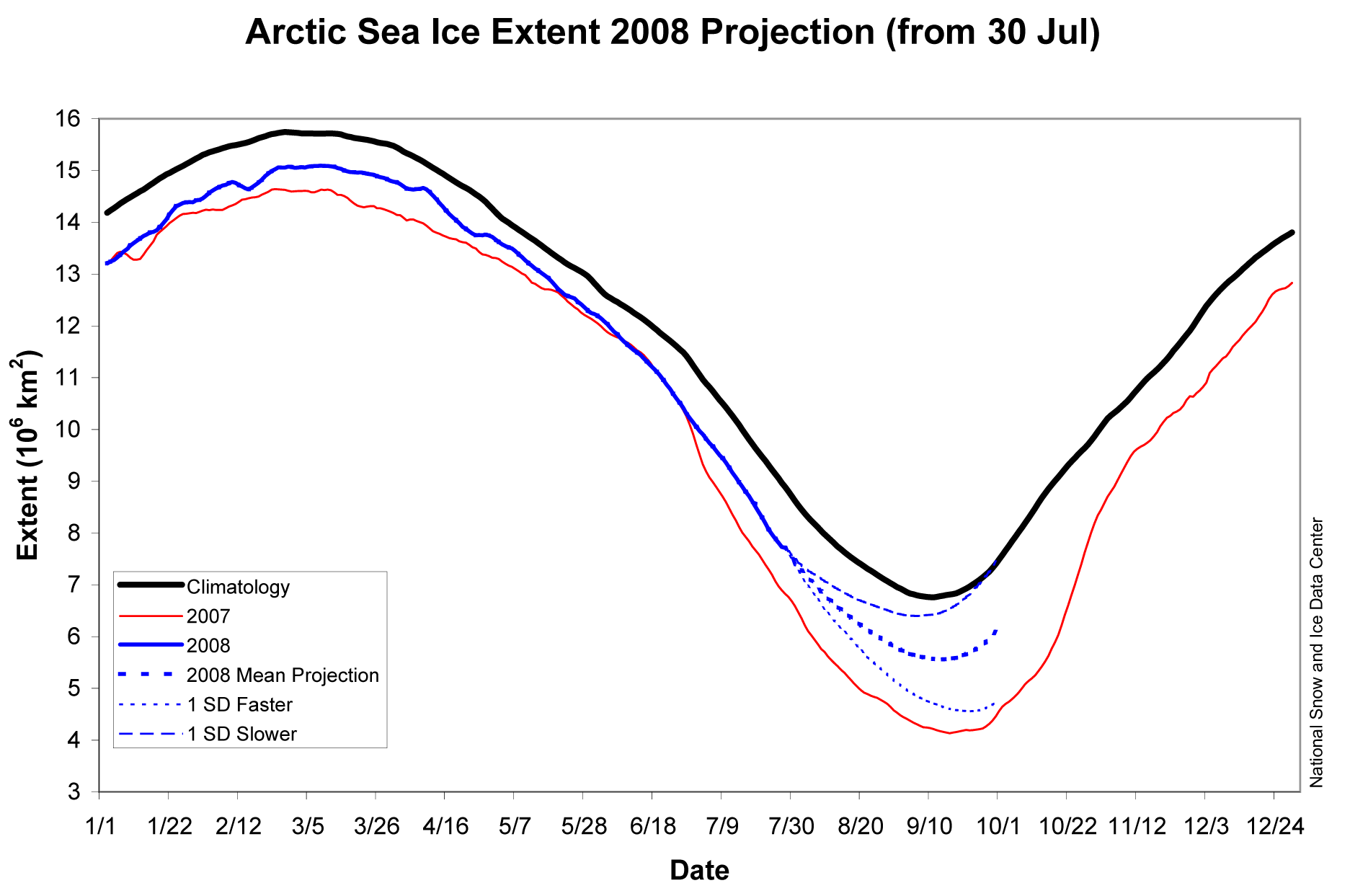
A: The description is incomplete and lacks relevant context. First, all the recent years in the AMSR-E record have had anomalously low maximum extents compared to the 1980s and 1990s. Even the largest winter extent, in 2002, was 250,000 square kilometers lower than the 1979-2000 average. The years 2005-2008 have been 700,000 to 1,000,000 square kilometers below the average. As described above, there is considerable variability during the time around the maximum extent, so the difference between 2005 and 2008 is within what might be expected from natural variations, but both are lower than maximum extents during the 1980s.
While there is a lot of variability in the timing of when the maximum occurs (as mentioned in #5), the actual maximum extent has relatively low variability. This is because in winter it is cold and dark, and ice grows under those conditions. So you always see ice growth, although there is now a significant downward trend at the maximum. In comparing winter ice conditions, ice thickness is much more relevant than ice extent. Data for thickness is not as complete as it is for extent, but it is quite clear that ice is thinning at a rate even faster than the extent decline. During winter 2008, the Arctic was dominated by seasonal ice (ice that has grown since the previous summer) that is much thinner than multiyear ice (ice that has been around for at least a year). Thus, in 2008 the ice has generally been thinner than 2007, and much thinner than earlier years.
We are now seeing some rapid growth of sea ice in the Arctic as the large expanse of exposed ocean cools, but this will all be thin first-year ice. It will thicken over the winter, but by the end of the winter it will only be a half to a third as thick as the ice used to be.
Sea ice also moves with the winds and currents – it doesn’t just grow and melt in place – and thinner ice is generally more easily pushed around. Last year a lot of ice got pushed by winds across the Arctic and even less of the region was covered by thicker old ice at the end of the winter than at the beginning of the winter.
Finally NSIDC did not say that the Arctic sea ice extent would return to “normal” in 2008. The figure referenced in the question, does show one scenario where ice returns to normal, but as stated in the text, that scenario was for a slower than normal melt through the rest of the summer and was deemed highly unlikely. As we say in our August 1 entry: “Thin ice is much more vulnerable to melting completely during the summer; it seems likely that we will see a faster-than-normal rate of decline through the rest of the summer.”
7. Q: Why does NSIDC say that the 2008 minimum sea ice extent “reinforces” the long-term trend when the 2008 extent was clearly higher than 2007?
A: 2008 is in no way a “recovery” relative to the thirty-year trend-and since GHGs act over long time periods, scientists favor looking at change over a long period to detect the GHG signal. From 1979 through last year, the September monthly average extent was declining at a rate of about 72,000 square kilometers per year based on a linear trend. Calculating a linear trend of the data from 1979 through 2008, the decline is now 78,000 square kilometers per year. This may seem counterintuitive, but what happens to the trend each time you add new data depends on where the new data falls relative to the trend line. If a data point falls below the trend line, it will “pull” the trend line downward; a data point above “pulls” the trend line upward. The September 2008 extent, although a bit higher than 2007, was still well below the trend line, so the downward trend line steepened. This is what I mean when I say the trend has been reinforced. Those who attempt to claim that we’ve seen “global cooling” since 1998 may wish to bear in mind that until scientists see a change over a long period, we are skeptical of claims concerning a trend.
The key thing, whether discussing sea ice, temperatures, or any other environmental measure, is to consider long-term trends, not short-term variability.
September monthly sea ice extent and trends for 1979-2007 and 1979-2008.
References:
Arrhenius, S., 1896. On the influence of carbonic acid in the air upon the temperature of the ground, Philos Mag, 41, 237-276.
Lawrence, D. M., A. G. Slater, 2005. A projection of severe near-surface permafrost degradation during the 21st century, Geophys. Res. Lett., 32, L24401, doi:10.1029/2005GL025080.
Lawrence, D. M., A. G. Slater, R. A. Tomas, M. M. Holland, C. Deser, 2008. Accelerated Arctic land warming and permafrost degradation during rapid sea ice loss, Geophys. Res. Lett., 35, L11506, doi:10.1029/2008GL033985.
Lindsay, R.W., and J. Zhang, 2005. The thinning of Arctic sea ice, 1988-2003: Have we passed a tipping point, J. Climate, 18(22), 4879-4894, doi:10.1175/JCL13587.1.
Overland, J. E., M. C. Spillane, D. B. Percival, M. Wang, and H. O. Mofjeld, 2004. Seasonal and regional variation of pan-Arctic surface air temperature over the instrumental record, J. Climate, 17, 3263-3282.
Overland, J. E., M. Wang, 2005. The third Arctic climate pattern: 1930s and early 2000s, Geophys. Res. Lett., 32, L23808, doi:10.1029/2005GL024254.
Revelle, R., Seuss H.E., 1957. Carbon dioxide exchange between atmosphere and ocean and the question of an increase of atmospheric CO2 during past decades, Tellus, 9, 18-27.
Zimov, S.A., E.A.G. Schuur, and F.S. Chapin III, 2006. Permafrost and the global carbon budget, Science, 312, 1612-1613, doi:10.1126/science.1128908.
Many natural explanations for the current observed warming have been suggested:”it’s just natural variability,” “it’s the sun,” “it’s cosmic rays,” etc. However, these have all been investigated and evidence is simply lacking.
I am not a scientist, but I spend a lot of time trying to come to terms with all the counter claims of scientists regarding AGW. At present, while trying to remain agnostic, I find the arguments against, very considerably more rational and less suspicious than those for.
The above is a case in point. Dr.Meier, quite clearly an intellectual academic is none the less I would suggest, rather prone to a relay of bald, flat denials of at least a number of arguments which counter his own considered position.
The para quoted at the top of my non-scientific post is a case in point. I have personally read a deal of evidence which supports the three arguments he puts in quote marks. Two of them are inter-linked anyway – the sun and cosmic rays – which makes me suspect that his intention here was to use the rhetorical “rule of three” to give his point more power, when in fact it is really on a rule of two.
Further, it looks suspiciously like ‘spin’ to put those three points in the way he did – there is a derogatory feeling to it when one says – suggested:”it’s just natural variability,” “it’s the sun,” “it’s cosmic rays,” etc.
This is disappointing. On the one hand Dr Meier presents himself as reasonable, rational, and academic. This posture is undermined by the flat denials of ‘proofs’ as he calls them. They are surely data? And they exist.
The good Dr. also refers to 30-year periods as lengthy and likely to provide meaningful trend lines. In a system as large, old, and constantly changing as the Earth, that seems to this non scientist as a pretty unlikely statement.
So while the door is not necessarily closed on this discussion, I continue to think that using his and others’ hypotheses as the basis for the monumental socio-political policies currently being meted out on us, is unacceptable.
Thank you Dr Meier for your answers.
I read your answers twice and was struck by the following:
1 Your answers could sound convincing to a layman, but you have an audience containing many scientists. Your answers are, however short of convincing evidence and are aimed at proving your theory, rather than looking at the evidence and all the possible explanations.
2 You state that there is a lack of evidence for natural causes and thus the elephant in the room has to be human-caused greenhouse gas emissions. This is not logical and is not a scientific argument. If the natural causes are not understood, then the first thing that should be done is to seek out the natural causes of the Medieval Warm Period, the Roman Warm Period, other warm periods in the Holocene and the much warmer periods in previous interglacials. Only when it is proven beyond doubt that the natural causes of previous warm periods cannot be the cause of the current warm period should human causes be examined. It is not good enough to try to sweep the warm periods under the carpet as Mann et al have tried to do. There have to be one or more natural causes for previous warm periods, any or all of which could account for the current and unexceptional warm period, and these have to be explained and discounted before human-caused greenhouse gas emissions can be accepted as the only explanation. The elephant in the room is unknown, but for certain, one elephant is a natural cause, and human-caused greenhouse gas emissions may turn out to be just a flea on the elephant’s back.
There are many other things in your answers that I would like to touch on, but I think the above two will suffice.
A report was published by the Danish Meterological Institute called ‘Multi-decadal variation of East Greenland sea ice extent: AD1500-2000’ at Their conclusion is that the change is solar and is natural.
Nick Yates (00:35:12) :
“The obvious elephant in the room is bikinis. Bikinis were invented in the 1940s and as they’ve become more popular, global temperatures have increased. There is clearly a strong link so bikinis should be banned immediately.”
No Sir! Bikinis should be Removed immediately!
Steve Carson that was a beautiful post.
Interstellar chat between the Sun and Earth.
Earth: Hey, Sun. Look, I just noticed a creature living on me that I can control more than the others. Check this out.
*Earth alters the ocean currents some*
Earth: Did you see it. They started to run around faster and seems puzzled.
Sun: Hehe Yeah. What are those?
Earth: Humans, been here for just a short time but they are very sensitive to changes.
Sun: Certainly.
Earth: I have another trick that makes them go crazy, watch this.
*Earth blows away som ice from Arctic*
Earth: Did you see? They went completley wild in a few weeks and started to run around preaching for each others. Ha ha ha!
Sun: Ha ha ha. They are funny!
Sun: Let me try some.
*Sun starts pulsating a bit stronger and faster*
Sun: Ha ha ha! Did you see that? I could make them run around puzzled also.
Earth: Stop that! They put up windmills all over me. I can hardly sleep from all the noice now!
Sun: Hmm, What if…
*Sun closes his eyes and start pulsating slower and slower and slower…*
*** To be continued . . . ***
This has been an interesting exchange, I hope Meier stays around.
Further questions I’d like to see answered:
. Why isn’t Antarctic Sea Ice retracting?
. Why is the Southern Hemisphere having (one of) the coldest year(s) since satellite measurements began?
. Why hasn’t Arctic Sea retracted as fast when temperatures in the Northern Hemisphere peaked in 1998, and is now accelerating when temperatures are declining?
. On the paleoclimate record: the references given point to CO2 having a warming effect during only the last 4200 years of the total 5000 years of transition to the inter-glacial periods. Why does CO2 stop warming the planet after 4200 years?
. If:
a) you don’t know what caused the Mediaeval Warm Period; and
b) you don’t know if the planet was warmer then;
how can you conclude that what caused warming back then isn’t causing it now?
Sorry Anthony. I couldn’t even get past the FIRST SENTENCE in Dr. Meier’s response where he completely dismisses the PDO and AMO effect on ice levels. Any 5th grade science student can see a direct correlation with PDO/AMO and the recovering Arctic ice.
I suppose then that Dr. Meier is not smarter than a 5th grader….
Dear Dr Meier,
you say, we know the man-made contribution to GHG, studies like http://icoads.cdc.noaa.gov/people/gilbert.p.compo/CompoSardeshmukh2007a.pdf suggest otherwise.
The “characteristic chemical signature ” is the same for all CO2, you are wrong with your statement under point 3. Another question related to the conclusion in the study, that IPCC models might underestimate natural reasons for the warming of the oceans: Where were more than 95% of all atmospheric CO2-molecules 20 years ago?
Best regards,
LoN
To say that arctic sea ice will behave linearly when it is influenced by a chaotic system is preposterous. Using this logic, one would have to conclude that the Dow Jones will eventually reach zero in near future.
The AMO and PDO do not explain it completely – solar cycles have to be factored in as well. What will Dr. Meier’s reaction be should the caps grow in the coming years? If that happens, will he be ready to throw the AGW theory in the rubbish?
Again, this morning on German radio, the PIKK scare scenario of sea levels rising 1 meter or more over the next 100 years is circulating.
Question:
What is Dr Meier’s estimate for SLR over the next 20 years?
Surely he can give us a good ballpark figure.
Please allow me to help Dr Meier in his 20 year SLR projection.
http://sealevel.colorado.edu/current/sl_noib_global.jpg
As a taxpayer, I demand to see an answer to this question from Hansen, Mann, Gore, Ramstorf, Meier, and the rest of the tax-payer money leaching authorities.
Give your estimate, and in few we’ll see if we are really headed that way.
Watch ’em dodge, duck and slither away.
And I’m not interested in a 100 year projection, where none of us will be around to check it.
Ooops
Give your estimate, and in few years we’ll see if we are really headed that way.
Gary (14:17:51) :
”
Assuming Dr. Meier will do this again, please ask him to address Dr. Stephen Schwartz’s (of BNL) “Heat Capacity…” report, published last December, which essentially says that doubling CO2 from current levels would likely increase global temps 1.5 Deg K.”
Could you please give more details of where to find this paper? A link would be nice. Thanks
I genuinely don’t get the remark “The AMO does not have a significant influence on the Arctic.” I’ve let Excel do a simple correlation for the 1979-2008 period between monthly AMO values and monthly sea ice extent values, and the value is higher (0,58) than the correlation between monthly sea ice extent and monthly temperatures for the North Pole zone from RSS (0,53) and UAH (0,54).
Doesn’t that mean that atmospheric temperatures also do not have a significant influence on the Arctic, or am I over-simplifying? Is there a reason why an influx of warmer water into the Artic could not be a contributing factor to current lows?
Glenn (01:14:16) :
Patently false and deceptive.
I think you rapidly are becoming an irrelevant minority [befitting your rantings], to wit:
Phillip Bratby (02:38:33) :
You state that there is a lack of evidence for natural causes and thus the elephant in the room has to be human-caused greenhouse gas emissions.
Steve Carson (02:26:56) :
“However, these have all been investigated and evidence is simply lacking.”
To me this summarizes the essence of the debate, […]
because we don’t have *another* explanation for this, CO2 is the only thing left”.
captdallas2 (17:52:36) :
“Evidence can only be lacking for specific causes, like ‘the sun’ or ‘cosmic rays’, but not for unspecified ‘natural variability’.”
well said
Roger Carr (00:24:03) :
Then read much expert comment following this on Watts Up With That? such as: Leif Svalgaard : (Meier) “Many natural explanations for the current observed […]
—————
It is plain that if there HAD been strong evidence for e.g. the sun or cosmic rays being causes of climate change, that Meier’s argument falls flat, so this is the crux of the matter: he can only maintain his stance because there is no such evidence [as he sees it].
I found the pdf with a yahoo search,
http://www.ecd.bnl.gov/steve/pubs/HeatCapacity.pdf
Sorry good doctor (Meier), but your comments verge on the disgraceful. I can see you have earned your degree at the IPCC university and read very well from their bible….you all speak the same lingo without backing it with facts.
Cant believe he quotes Arrhenius (1896) as proof of AGW….they are all reading from the same power point slides.
Lazlo (22:03:24) :
That’s only one piece. The full report is at
http://www.arctic.noaa.gov/reportcard/ArcticReportCard_full_report.pdf
Dr. Meier is one of the authors of the Sea Ice Cover section.
It may be a very good snapshot of the Arctic at the start of a negative PDO phase and might make for entertaining rereading in a few years.
Don Shaw (16:57:52) :
But Don, who are we supposed to believe? The folks who maintain the sea ice extent plots or an
AP reference with no data to back it up?
In other words, how do we know the temperatures referred to by your reference are accurate? Perhaps
we accept the sea ice extent plots as valid and proof the temperature records maintained are incorrect?
When did you start disbelieving the ice sea plots? And why? Do you know something we don’t know?
Please tell us if you do.
I saw many AGW advocates citing these sea ice extent plots when the graphs seemed to support the contention of a diminishing ice cap. No longer. Why?
“It is the preponderance of evidence presented in thousands of articles that provides the foundation for the human-induced global warming theory.”
As a lawyer I understand the concept of “preponderance of the evidence” in our legal system. I am unfamiliar with the scientific use of the concept. Does it mean that we discount evidence to the contrary of our theory based on the number of articles published? Do we need experiments any more to test a hypothesis? Has the scientific method evolved to mere advocacy? How much “evidence” do we need to falsify a theory?
I observe that all of the swans that I have seen are white. I advance the theory that all swans are white. Lots of articles are written about white swans. Along comes a skeptic with a picture of a black swan. No. Sorry. All swans are white because the preponderance of the evidence presented in the articles refers to white swans. Is this how science works now?
Thanks to Dr. Meier for his moderate and polite response to questions. I may not agree with the logic but I appreciate the moderate tone of the replies.
Unfortunately I find that general tenor of the AGW believers is stident, often decending to personal slights to any who have views different from their own.
Thanks too to Anthony for producing this site This site may yet have a greater impact on the understanding of Climate that all Gore’s propoganda.
Lazlo :
Yes. you are correct! Time after time you hear some “news” which is in fact old data, old news, especially in theese cooling days when there have to be som warming news
MORE EXAMPLES:
I feb 2008 we heard “news” that ALPE GLACIERS are shrinking “new results” – just after this record winter (!?), but these “news” where in fact from 2005 and back. Misleading indeed.
We OFTEN still hear that SEA LEVELS are rising. But the truth is, sea levels has not risen one milimeter since 2005 !
See this example, Nasa :
http://climate.jpl.nasa.gov/keyIndicators/index.cfm#SeaLevel
They specifically write that their graph is updated!
NASA: “Sea Level Last updated 09.16.08”
But they have NOT updated their graph. They stopped updating 2´nd quarter of 2007. Why are they not updating?
Heres the data they could have shown:
http://www.klimadebat.dk/forum/attachments/havstand.jpg
– its sooo hard for them to update for the moment…. Just when sea levels flattens out.
Ok! You could say that this sea level fall could be “random”. But you cannot say that there is not a fine match between temperature decline and sea level decline right now.
Lazlo :
Yes. you are correct! Time after time you hear some “news” which is in fact old data, old news, especially in theese cooling days when there have to be som warming news
MORE EXAMPLES:
I feb 2008 we heard “news” that ALPE GLACIERS are shrinking “new results” – just after this record winter (!?), but these “news” where in fact from 2005 and back. Misleading indeed.
We OFTEN still hear that SEA LEVELS are rising. But the truth is, sea levels has not risen one milimeter since 2005 !
See this example, Nasa :
http://climate.jpl.nasa.gov/keyIndicators/index.cfm#SeaLevel
They specifically write that their graph is updated!
NASA: “Sea Level Last updated 09.16.08”
But they have NOT updated their graph. They stopped updating 2´nd quarter of 2007. Why are they not updating?
Heres the data they could have shown:
http://www.klimadebat.dk/forum/attachments/havstand.jpg
– its sooo hard for them to update for the moment…. Just when sea levels flattens out.
Ok! You could say that this sea level fall could be “random”. But you cannot say that there is not a fine match between temperature decline and sea level decline right now.
That “Arctic Scorecard” press-release says among other things:
• Goose populations are increasing as they expand their range within the Arctic.
Now compare this with the original:
http://www.arctic.noaa.gov/reportcard/essay_loonen.html
Rather different eh? Only about a third of arctic goose populations are increasing, and a quarter are actually declining.
Actually this is a fair summary, which notes (correctly) that changing agricultural practices and decreased hunting in wintering areas are the main reason goose populations are growing.
However as usual all these complications gets filtered out in the press-release so as not to confuse the yokels.
It’s just sad sophistry. Why can’t these scientists re-examine basic assumptions in the face of data that does not support their hypotheses? That has been the road to progress in science since the beginning of time. Where will this mistaken road lead these poor deluded ones? Nowhere good, that’s for sure.
===============================================