From Steve Goddard: Thanks again to Dr. Meier from NSIDC for answering questions, and for offering to do a follow-up.
From Anthony: Responses from Dr. Meier are in italics. I’ve added a poll that you can answer after reading this. Note this poll only allows one vote per IP address. So shared IP systems at offices will only get one vote.
From Dr. Meier: Thank you to Mr. Goddard for presenting this and the previous set of questions. And thank you to Mr. Watts for providing the outlet to publish these. I don’t hope to change the opinion of every climate change skeptic who reads my responses, but hopefully I can provide some useful for information. My answers here and to the previous round of questions are my own and I am speaking for myself, not as a representative of the National Snow and Ice Data Center or the University of Colorado. Thanks to Stephanie Renfrow, Ted Scambos, Mark Serreze, and Oliver Frauenfeld of NSIDC for their input.
One thing I noticed in the comments on my previous answers was a desire for references to peer-reviewed journals. I originally chose not because I didn’t realize there might be an interest and also because a few journal articles doesn’t substantiate human-induced global warming (nor do one or a few articles refute it). It is the preponderance of evidence presented in thousands of articles that provides the foundation for the human-induced global warming theory. Nonetheless, below I provide a few selected references for those that might be interested.
There were lots of good questions from readers, and I have synthesized some of them into a few short ones here for the sake of brevity. There is no question that late-summer Arctic ice extent has declined considerably since the early 1980s, and if the current trend continues linearly – the sea ice will disappear completely at some point in the not too distant future. Most of the questions were along the lines of “how do we know the trend is non-cyclical, and how do we know what is causing it?”
1. Q: The image below shows the general GISS temperature distribution of the previous Arctic warming cycle in the 1920s and 1930s, for stations north of 60N. Turquoise dots had warming similar to the current warming. Red dots are significantly warmer now than they were 70 years ago. Looking at the map, it would be easy to come to the conclusion that the only difference between the current warming and the one 70 years ago, is that the PDO has been in it’s warm phase for the last 30 years – causing warmer temperatures around Alaska and Eastern Siberia. The PDO appears to have recently shifted to its cool phase, and temperatures across Alaska have dropped during the last two years. Why do you believe that the fundamentals of the current warming are so different? Perhaps the warming of the last 30 years was aggravated by a coincidental alignment of the PDO and AMO?
A: The warming of the last 30 years cannot be attributed primarily to the Pacific Decadal Oscillation (PDO) or the Atlantic Multidecadal Oscillation (AMO). The AMO does not have a significant influence on the Arctic. On the Atlantic, side, the North Atlantic Oscillation (NAO)-a regional expression of the Arctic Oscillation (AO)-is the most influential mode of variability in the Arctic. As I’ve mentioned previously, there are natural variations in climate that do indeed affect Arctic temperatures in the Arctic and the sea ice. The NAO/AO is a particularly prominent one and a substantial amount of the decline in the sea ice during the late 1980s and early 1990s could be attributed to a strong positive mode during winters because the positive mode favors the loss of thicker ice that is less likely to melt during summer. However, since about 1995, the AO has mainly been in a neutral or negative state. Under such conditions, the Arctic sea ice should have started to recover. Instead, sea ice extent has not only continued downward, but the decline rate has accelerated. The AO may have been a “trigger” for the precipitous decline, but we wouldn’t have the ongoing decline without the documented warming trend (Lindsay and Zhang, 2005).
The Pacific Decadal Oscillation (PDO) also can play role in temperatures in the Bering Sea region and to some extent in the Pacific side of the Arctic Ocean. The PDO was in a fairly persistent positive mode until the mid-1990s, but it also has shifted to a more neutral state and so cannot explain the decline of the Arctic sea ice since that time. (More details: Overland et al., 2004 and Overland and Wang, 2005).
Another important point is that these climate oscillations can themselves be affected by global warming. There are indications that the positive mode of the AO is more likely to be present under warmer conditions.
2. Q: Given that we don’t really understand what caused the earlier warming period, what evidence is there that the current warming is anthropogenic? How much of your viewpoint about the Arctic future is based on IPCC feedback predictions?
A: There is considerable evidence that the current warming is anthropogenic; this evidence is readily available in thousands of unrelated peer-reviewed scientific journals. You also ask how much of the evidence is “based on” IPCC predictions? In a way, the answer to that question is that none of the evidence is from the IPCC report-and yet all of it is. The reason is that the IPCC report isn’t a source of newly published information, but rather a compilation of evidence from a growing number of articles previously published in scientific journals. All of the information in the IPCC working group reports is referenced to original peer-reviewed journal articles citing researchers from around the world. Thus, the IPCC report is a convenient “one-stop shop” of the latest information, but the ultimate source is the thousands of individual international journal articles that are the basis of the report.
In the first part of your question, you suggest that a lack of understanding of earlier warming periods is a given, and that this casts doubt on our understanding of current warming. From this perspective, it might seem reasonable to assume that because previous change was natural, the current change must be too. Many natural explanations for the current observed warming have been suggested:”it’s just natural variability,” “it’s the sun,” “it’s cosmic rays,” etc. However, these have all been investigated and evidence is simply lacking.
On top of the lack of evidence for natural causes, such suggested explanations ignore the proverbial elephant in the room. Any natural-causes explanation must be accompanied by an argument for why and how human-caused greenhouse gases (GHGs) are not affecting climate in the same way that natural GHGs affect climate. This, again, has not been addressed in a reasonable way.
Here is what we know about greenhouse gases and their influence on climate:
1. Greenhouse gases absorb energy radiated by the earth that otherwise would escape to space, keeping the earth warmer than it would be without GHGs. This is a fact that has been well-known for over 100 years, described in a paper by Arrhenius (1896). GHGs are a necessary part of Earth’s natural “climate control.”
2. GHGs are increasing in the atmosphere. This is known from observations of carbon dioxide dating back to the 1950s from Mauna Loa and other stations, as well as paleo-records of GHG concentrations in ice cores.
3. The GHG increase is due to human-caused emissions. This is clear from the simple fact that we know we’re emitting GHGs through our use of fossil fuels. More scientifically, it is confirmed by a characteristic chemical signature of human-emitted GHGs found in the atmosphere.
4. GHG concentration and surface temperature are closely linked. This is clear from #1, but the relationship is confirmed in ice core records dating back several hundred thousand years. Some of your readers may have heard a suggestion that carbon dioxide lags temperature in the ice core records; that’s not relevant in this case. For more details, see here and here and here
5. The first studies of the effect of GHGs on Earth’s energy budget date back to the1950s (e.g., Revelle and Seuss, 1957). The increasing GHG emissions have already changed Earth’s energy balance. Human and natural changes have increased the radiative forcing (effectively increasing the energy, and thereby the temperature, of the Earth) by about 1.6 Watts per square meter. The largest factor by far is human GHG emissions. Changes in the sun play only a small role. This increased radiative forcing results in a warming of the planet. There is simply not enough uncertainty in these estimates to throw the overall conclusion into doubt: human-induced GHGs have changed Earth’s energy balance and increased temperatures.
FAQ 2.1 Figure 2 from IPCC Working Group I Fourth Assessment Report, 2007.
6. There are feedback mechanisms that can alter the impact of GHG emissions. These include: clouds, water vapor, ice/snow. Ice and snow are clearly positive feedbacks that will reinforce the GHG warming because as they melt, the average albedo (reflectivity) of the earth decreases and more energy is absorbed. The effect of other feedbacks is less certain-and may even counter the effects of GHG warming–but the evidence indicates that they nevertheless do not come close to offsetting the direct effect of GHG emissions.
So, before one can suggest that natural mechanisms explain everything, one has to first demonstrate that something in the above 6 points is wrong. Much of this evidence dates back to at least the 1950s; the theory of anthropogenic global warming is really nothing new. Also note that climate models only play a significant supporting role in the evidence for points 5 and 6. No serious scientific study has yet shown that any of the above 6 points are fundamentally wrong.
The only one of the 6 points still in play to any scientific extent whatsoever is the last point. There has been some interesting research in this area – Richard Lindzen’s Iris effect (a nice summary here) and more recently Roy Spencer’s “internal radiative forcing.”. Spencer’s work is quite new, and has therefore not yet been properly vetted through the peer-review process. (Some informal discussion: RealClimate.
3. Q: You mention the historical record of the Inuit. What do we know about the older historical record from the Vikings?
A: There is archaeological evidence, oral sagas, and some written records, none of which I’m an expert in. However, I can share with you what I know: The Vikings colonized Greenland during about 700-1300 AD, taking advantage of the medieval warm period (MWP). There was reduced ice cover compared to before and after that period that allowed easier sailing between Europe and Greenland. The warmer climate allowed enough farming and ranching to support the population. As climate cooled, crops failed and transport (trade) with Europe became difficult or impossible. There was clearly less sea ice during the MWP than the cool period that followed. It is not known how sea ice conditions compared to today, but ice extents comparable to the 1980s or 1990s would have been sufficient for the Vikings to have successfully sailed between Greenland, Iceland, and Scandinavia; ice would not have had to be at current low levels.
Greenland and northern Europe were clearly warm during the 700-1300 AD; much of the rest of the globe may have been as well. There is often quibbling about whether we’re warmer now than then-the Mann hockey stick plot, etc. But as I pointed out above, such “debate” is almost beside the point: it ignores the elephant in the room that is the GHG emissions produced by humans. We may not clearly know what caused the MWP, but we have a clear cause for the current warming: human-caused GHGs.
4. Q: Is there any hard data on permafrost losses during the last ten years?
A: There is clear evidence of increasing ground temperatures and thawing permafrost, consistent with the warming surface temperatures. Permafrost will respond more slowly to warming, but it is a potentially significant long-term feedback because large amounts of GHGs, particularly methane, are “locked” in the permafrost. As much GHGs are locked in the permafrost as currently resides in the atmosphere. At least some of these GHGs will be released as the permafrost thaws. There have been several papers discussing permafrost thaw and potential climate impacts (Zimov et al., 2006; Lawrence and Slater, 2005; Lawrence et al., 2008).
5. Q: Has there been a trend of the date of minimum Arctic sea ice coverage? Has there been a trend in the date of maximum Arctic sea ice coverage? If there has been warming over the ice (which is not sampled adequately), there should be an earlier maximum and later minimum.
A: There has been a trend toward later minimum dates, but there is substantial variability from year to year in the freeze-up date. A later freeze-up is not surprising because with lower summer ice extent, there is more ocean area to absorb heat that needs to be dissipated before freeze-up can begin. However, there is high variability because the timing of when the ice stops shrinking and begins growing has a lot to do with short-term weather. A late-season warm spell can extend melt, while a quick, early cold snap can cut melt short.
There is essentially no trend in the date of maximum extent. There is even greater variability from year to year in the maximum date than in the minimum date. This is also not surprising. At the time of maximum extent, the boundary of the ice edge is unconstrained and has extended into the north Atlantic and north Pacific. Ice at the ice edge is also thinner at the maximum. Most of it is less than 50 cm thick, because it is ice that has recently formed. This ice is prone to being broken up by winds, advected into warmer waters where it melts, or pushed northward. On the other hand, cold winds from the north can cool surface waters and allow more ice to form, at least temporarily, and extend the ice edge farther south. So, the ice edge location at the time of the maximum is fairly volatile and subject to sudden change. This variability can be seen in AMSR-E data graph, where you can see the bumpiness of the daily extent during the winter season. This is the ice edge “bouncing around” in response to winds, currents, storms, etc.

6. Q: Looking at the AMSR-E sea ice extent graph, I see an alternative description for recent behavior. Until the first week in August, 2008 extent was equal to or greater than 2005 – and NSIDC was even considering a possible return to normal as late as August 1. However, a series of strong storms broke up the ice and caused 2008 to drop below 2005 for a few weeks. As September ends, 2005 and 2008 appear to be converging again. Average daily ice extent in 2008 has been greater than 2005, and nearly every day in 2008 has been greater than 2007. What is wrong with this description?
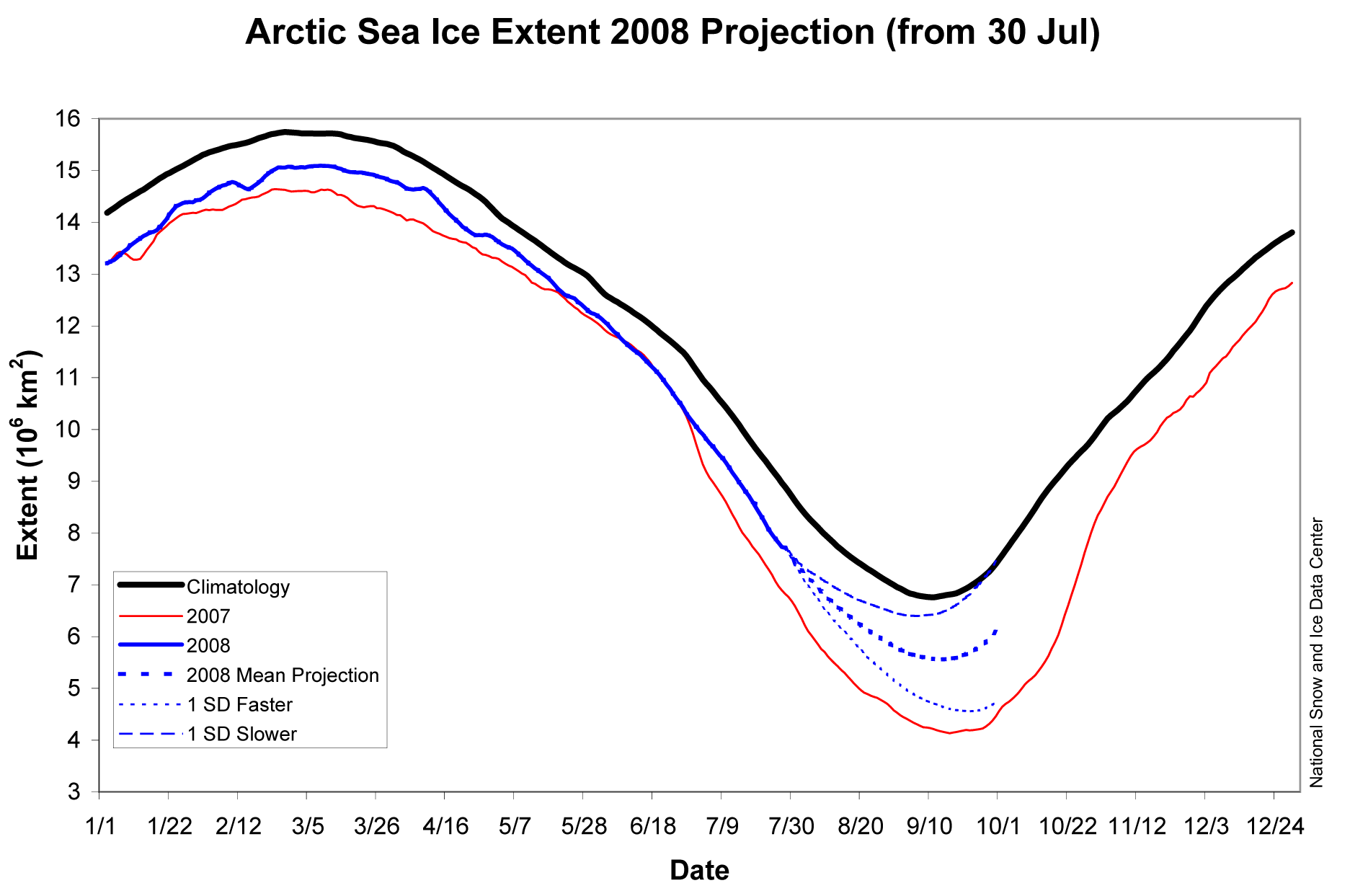
A: The description is incomplete and lacks relevant context. First, all the recent years in the AMSR-E record have had anomalously low maximum extents compared to the 1980s and 1990s. Even the largest winter extent, in 2002, was 250,000 square kilometers lower than the 1979-2000 average. The years 2005-2008 have been 700,000 to 1,000,000 square kilometers below the average. As described above, there is considerable variability during the time around the maximum extent, so the difference between 2005 and 2008 is within what might be expected from natural variations, but both are lower than maximum extents during the 1980s.
While there is a lot of variability in the timing of when the maximum occurs (as mentioned in #5), the actual maximum extent has relatively low variability. This is because in winter it is cold and dark, and ice grows under those conditions. So you always see ice growth, although there is now a significant downward trend at the maximum. In comparing winter ice conditions, ice thickness is much more relevant than ice extent. Data for thickness is not as complete as it is for extent, but it is quite clear that ice is thinning at a rate even faster than the extent decline. During winter 2008, the Arctic was dominated by seasonal ice (ice that has grown since the previous summer) that is much thinner than multiyear ice (ice that has been around for at least a year). Thus, in 2008 the ice has generally been thinner than 2007, and much thinner than earlier years.
We are now seeing some rapid growth of sea ice in the Arctic as the large expanse of exposed ocean cools, but this will all be thin first-year ice. It will thicken over the winter, but by the end of the winter it will only be a half to a third as thick as the ice used to be.
Sea ice also moves with the winds and currents – it doesn’t just grow and melt in place – and thinner ice is generally more easily pushed around. Last year a lot of ice got pushed by winds across the Arctic and even less of the region was covered by thicker old ice at the end of the winter than at the beginning of the winter.
Finally NSIDC did not say that the Arctic sea ice extent would return to “normal” in 2008. The figure referenced in the question, does show one scenario where ice returns to normal, but as stated in the text, that scenario was for a slower than normal melt through the rest of the summer and was deemed highly unlikely. As we say in our August 1 entry: “Thin ice is much more vulnerable to melting completely during the summer; it seems likely that we will see a faster-than-normal rate of decline through the rest of the summer.”
7. Q: Why does NSIDC say that the 2008 minimum sea ice extent “reinforces” the long-term trend when the 2008 extent was clearly higher than 2007?
A: 2008 is in no way a “recovery” relative to the thirty-year trend-and since GHGs act over long time periods, scientists favor looking at change over a long period to detect the GHG signal. From 1979 through last year, the September monthly average extent was declining at a rate of about 72,000 square kilometers per year based on a linear trend. Calculating a linear trend of the data from 1979 through 2008, the decline is now 78,000 square kilometers per year. This may seem counterintuitive, but what happens to the trend each time you add new data depends on where the new data falls relative to the trend line. If a data point falls below the trend line, it will “pull” the trend line downward; a data point above “pulls” the trend line upward. The September 2008 extent, although a bit higher than 2007, was still well below the trend line, so the downward trend line steepened. This is what I mean when I say the trend has been reinforced. Those who attempt to claim that we’ve seen “global cooling” since 1998 may wish to bear in mind that until scientists see a change over a long period, we are skeptical of claims concerning a trend.
The key thing, whether discussing sea ice, temperatures, or any other environmental measure, is to consider long-term trends, not short-term variability.
September monthly sea ice extent and trends for 1979-2007 and 1979-2008.
References:
Arrhenius, S., 1896. On the influence of carbonic acid in the air upon the temperature of the ground, Philos Mag, 41, 237-276.
Lawrence, D. M., A. G. Slater, 2005. A projection of severe near-surface permafrost degradation during the 21st century, Geophys. Res. Lett., 32, L24401, doi:10.1029/2005GL025080.
Lawrence, D. M., A. G. Slater, R. A. Tomas, M. M. Holland, C. Deser, 2008. Accelerated Arctic land warming and permafrost degradation during rapid sea ice loss, Geophys. Res. Lett., 35, L11506, doi:10.1029/2008GL033985.
Lindsay, R.W., and J. Zhang, 2005. The thinning of Arctic sea ice, 1988-2003: Have we passed a tipping point, J. Climate, 18(22), 4879-4894, doi:10.1175/JCL13587.1.
Overland, J. E., M. C. Spillane, D. B. Percival, M. Wang, and H. O. Mofjeld, 2004. Seasonal and regional variation of pan-Arctic surface air temperature over the instrumental record, J. Climate, 17, 3263-3282.
Overland, J. E., M. Wang, 2005. The third Arctic climate pattern: 1930s and early 2000s, Geophys. Res. Lett., 32, L23808, doi:10.1029/2005GL024254.
Revelle, R., Seuss H.E., 1957. Carbon dioxide exchange between atmosphere and ocean and the question of an increase of atmospheric CO2 during past decades, Tellus, 9, 18-27.
Zimov, S.A., E.A.G. Schuur, and F.S. Chapin III, 2006. Permafrost and the global carbon budget, Science, 312, 1612-1613, doi:10.1126/science.1128908.
Discover more from Watts Up With That?
Subscribe to get the latest posts sent to your email.
I seem to see Dr Meier’s elephant in the room however it seems to be demolished by my elephant in the room the cause of the M.W.P. (as others have pointed out).
Glenn (18:17:51) :
Out of all that Meier said, this is your best criticism
I’ll patiently try again: Fundamental to Meier’s view is that non-man-made causes have been investigated and evidence was found lacking, ergo AGW. While you can look for evidence of a specific cause, e.g. the sun, or cosmic rays, and find that lacking [and I’ll not disagree with Meier on those], you cannot credibly claim that evidence is lacking of natural variability from natural causes without specifying which ones among the infinitude of causes. This should be easy enough to grasp.
It is very hard to reconcile the comments made and articles like this (http://www.smh.com.au/news/environment/global-warming/arctic-on-thin-ice/2008/10/17/1223750286963.html) with the temperature and greenhouse gas data that other sites publish. Methane levels in the Arctic appear to be dropping, if the monitoring site data is correct. Alaska has had a miserable summer. Do we believe the data or the analysis?
If Dr Meier is right with his comments,
“But as I pointed out above, such “debate” is almost beside the point: it ignores the elephant in the room that is the GHG emissions produced by humans. We may not clearly know what caused the MWP, but we have a clear cause for the current warming: human-caused GHGs.”, what did cause the MWP and how have the models taken this into account.
Presumably we have less data on climatic conditions during the M.W.P than we do now, so that only ‘demolishes’ the AGW theory if one believes that AGW theory claims that it is the sole driver of climatic changes, which it does not. Sceptics also need to be sceptical of the conclusions they sometimes leap to.
Thanks Dr Meier – I appreciate the time and effort you spent for this.
I have 1 question and 1 comment.
Question: You’re right in point 2 of answer to question 2 that CO2 levels are rising in the atmosphere as measured at Mauna Loa [and I assume the other observatories, but I have not looked at their data] – but when I look at the CO2 charts, I do not see a correlation between human activity and CO2 level; there’s seasonal variation, but not a human activity correlation. The economic falloff in 2001 doesn’t appear – it, in fact, appears to be a linear annual increase. If CO2 level increase was anthropogenic, wouldn’t there be a correlation?
Comment: (I can only comment to #7, s the other areas are outside my experience…)
You’ve drawn a trendline from 1979-2007, and then drawn a trendline from 1979-2008, and used the fact that the second trendline has a sharper slope as proof of increasing global warming – proof of the trend. I disagree with this as proof. Hypothetically, Sept 2009 could show a 9% increase over Sept 2008, and Sept 2010 could show a 9% increase over Sept 2009, and a similar graph, comparing 1979-2009 vs 1979-2010 would, with a smaller magnitude, show the same effect. The melt of 2007 appears to have caused some major issues, but only time will tell as to what those issues will be. By using the change from 2007 to 2008 as proof, you’ve fallen into, at least, the same trap we skeptics have fallen into.
1979 – 1996 were good years for ice – I agree. 2007 was an extremely bad year for melt – absolutely – but, it does not correlate with global temps, nor does it correlate with global atmospheric CO2 levels. Statistically, correlation does not necessarily equal causation – however – a lack of correlation is typically a good indicator of lack of causation.
(It’s exceedingly rare to be treated with respect from those who push AGW – I’d like to extend a ‘Thank-you’ to you for the respect you have in your responses.)
CarlC states:
‘Do AGW-believing scientists really think that the tiny error bars for “long-lived greenhouse gasses” on the IPCC radiative forcing chart above are defensible? Given that the effect is more from feedbacks than from the direct impact of the gasses themselves, and that there is a laundry list of feedbacks both positive and negative, I do not find them credible. Reasonable, educated, intelligent people can debate AGW. I can’t imagine a reasonable, educated, intelligent person who would vouch for that chart.’
The radiative forcing chart is for the amount of heating provided by each factor before feedbacks are applied. To know the Co2 radiative forcing accurately we need to have an accurate measure of how much Co2 is in the air, where it is in the air, and how much radiation it blocks.
Will: What are the other drivers?
What is with this?? I just got it off Yahoo news.
Report says Arctic temperatures at record highs
By RANDOLPH E. SCHMID, AP Science Writer Randolph E. Schmid, Ap Science Writer – Thu Oct 16, 3:24 pm ET
WASHINGTON – Autumn temperatures in the Arctic are at record levels, the Arctic Ocean is getting warmer and less salty as sea ice melts, and reindeer herds appear to be declining, researchers reported Thursday.
“Obviously, the planet is interconnected, so what happens in the Arctic does matter” to the rest of the world, Jackie Richter-Menge of the Cold Regions Research and Engineering Laboratory in Hanover, N.H., said in releasing the third annual Arctic Report Card.
The report, compiled by 46 scientists from 10 countries, looks at a variety of conditions in the Arctic.
The region has long been expected to be among the first areas to show impacts from global warming, which the Intergovernmental Panel on Climate Change says is largely a result of human activities adding carbon dioxide and other gases to the atmosphere.
“Changes in the Arctic show a domino effect from multiple causes more clearly than in other regions,” said James Overland, an oceanographer at the National Oceanic and Atmospheric Administration’s Pacific Marine Environmental Laboratory in Seattle. “It’s a sensitive system and often reflects changes in relatively fast and dramatic ways.”
For example, autumn air temperatures in the Arctic are at a record 9 degrees Fahrenheit (5 Celsius) above normal.
The report noted that 2007 was the warmest year on record the Arctic, leading to a record loss of sea ice. This year’s sea ice melt was second only to 2007.
Rising temperatures help melt the ice, which in turn allows more solar heating of the ocean. That warming of the air and ocean affects land and marine life, and reduces the amount of winter sea ice that lasts into the following summer.
The study also noted a warming trend on Arctic land and increase in greenness as shrubs move north into areas that were formerly permafrost.
While the warming continues, the rate in this century is less than in the 1990s due to natural variability, the researchers said.
In addition to global warming there are natural cycles of warming and cooling, and a warm cycle in the 1990s added to the temperature rise. Now with a cooler cycles in some areas the rise in temperatures has slowed, but Overland said he expects that it will speed up again when the next natural warming cycle comes around.
Asked if an increase in radiation from the sun was having an effect on the Earth’s climate, Jason Box of the Byrd Polar Research Center in Columbus, Ohio, said while it’s important, increased solar output only accounts for about 10 percent of global warming.
“You can’t use solar to say that greenhouse gases are not a major factor,” Overland added.
Other findings from the report include:
• The Arctic Ocean continued to warm and freshen due to ice melt. This was accompanied by an “unprecedented” rate of sea level rise of nearly 0.1 inch per year.
• Warming has continued around Greenland in 2007 resulting in a record amount of ice melt. The Greenland ice sheet lost 24 cubic miles of ice, making it the largest single contributor to global sea level rise.
• Reindeer herds that had been increasing since the 1970s are now showing signs of leveling off or beginning to decline.
• Goose populations are increasing as they expand their range within the Arctic.
• Data on marine mammals is limited but they seem to have mixed trends. They are adapted to life in a region that is at least seasonally ice-covered. There is concern about the small numbers of polar bears in some regions, the status of many walrus groups is unknown, some whales are increasing and others declining.
“This is a very complicated system and we are still working diligently to sort out its mysteries,” said Richter-Menge.
In addition to Richter-Menge, Overland and Box, lead authors of the report included Michael Simpkin of NOAA, Silver Spring, Md. and Vladimir E. Romanovsky of the Geophysical Institute, Fairbanks, Alaska.
As a couple of posters have pointed out, the following report has appeared today
http://www.smh.com.au/news/environment/global-warming/arctic-on-thin-ice/2008/10/17/1223750286963.html
It claims to be a ‘.. third annual Arctic Report Card … compiled by 46 scientists from 10 countries..’. It contains claims such as ‘.. autumn air temperatures in the Arctic are at a record 5 degrees Celsius above normal.’ and ‘.. last year was the warmest year on record in the Arctic, leading to a record loss of sea ice.’ Can anyone point to the evidence for these temperature claims?
Solar radiation, other GHG’s (besides CO2), orbital position, albedo, etc.
http://www.smh.com.au/news/environment/global-warming/arctic-on-thin-ice/2008/10/17/1223750286963.html
SMH (Australia) article today saying the artic is melting!
Regards
Michael
The Arctic Report Card is on the NOAA site:
http://www.arctic.noaa.gov/reportcard/atmosphere.html
Some quick observations: it leads with the statement ‘Autumn temperatures are at a record 5º C above normal’. But it quickly becomes clear that they are referring to 2007 – a novel and expansive use of the present tense which has tricked many journalists world-wide (not a difficult thing to do though).
‘The year 2007 was the warmest on record for the Arctic’ is illustrated in Figure A1, and there is a link to the underlying CRU dataset for surface stations 60-90N. The first statement on the CRU page is ‘From the beginning of January 2006, we have replaced the various grid-box temperature anomaly (from the base period 1961-90) datasets with new versions, HadCRUT3 and CRUTEM3..’. The ‘unprecedented +5° C during October and November across the central Arctic ‘ claim is supported by Figure A2, but the supporting link to the data does not work. I have no expertise in all this and would greatly appreciate hearing from those who do.
Can someone explain to this no-nothing layman why the error bars on the net anthropogenic component are not equal to the sum of all the individual anthropogenic components? Presumably it’s a confidence thing, the chance of all the negative factors being at their maximum and the positive factors being at their minimum is small enough to be disregarded?
I also surprised that the negative error bar on the net anthropogenic component is smaller than the negative error bar on the cloud albedo effect of aerosols.
I look at that data and I see two different trends. One trend from 1979 to about 1997 or 1998 that is sloping slightly lower and then the trend turns down at more of an angle. 2007 is actually an outlier because of the wind pattern that blew so much ice out of the Arctic that year.
But this fits with what we already knew anyway. Temperatures too a step up in 1976, before the satellite ice data were available. This step up in temperatures corresponds nicely with a change in the PDO and NAO to more “warm” that “cool”. The PDO basically “switched” phase in 1976. Then around 1998 we had the mother of all El Nino events and this corresponds well to the change in trend to an even steeper angle down.
But 2007 saw a significant change in the PDO and NAO. Both went to “cool” phase but we had wind currents in 2007 that blew much ice out into the Atlantic and we lost a good deal of the “old ice”.
Temperatures continued to cool in 2008, the PDO remains in its deepest cool phase since the 1970’s. 2008 began a recovery of the ice. My prediction is that the drastic trend from 1998 is now reversed though it will take another season for the Arctic ice to fully recover with a more normal inventory of ice of various ages. That matters because ice of different age responds differently during the summer melt. Older ice is more durable.
In any case, my prediction range for ice extent in September of 2009 is that I am fairly certain we will have more than we had in 2008, and I believe it is probable we will have more than 2006 had. I believe the downward trend since 1976 is now reversed and we will see a recovery toward “normal” over the next few years.
We do not have satellite extent data for an entire cycle of the PDO through a full warm/cool phase. We only have data for a warm phase and the result is, in my opinion, what one would expect with the exception of the 2007 anomaly due to unusual wind patterns.
CO2 induced AGW is based on the IR signature of CO2 . The IR
signature of natural and man caused CO2 is the same –so how can nature possibly distinguish between natural or fossil
fuel induced CO2 ? In some ice score samples the CO2 has been as much as 20 times as our present CO2 levels and we have been in an Ice Age.
Bobprud
Does anyone else find it coincidental that as soon as we as a society developed the computing power to model climates (however inaccurately) that they, the climate modelers, discovered a major crisis that requires them to receive massive funding to further develop computer scenarios confirming their findings? Imagine then if the checks and balances on their results where being carried out by another mob who were also playing with new satelites and found a major crisis that required massive funding for more satelites to confirm their findings etc etc…and so it goes on and on.
[…] answers reader questions on sea ice… Then read much expert comment following this on Watts Up With That? such as: Leif Svalgaard : (Meier) “Many natural explanations for the current observed […]
The obvious elephant in the room is bikinis. Bikinis were invented in the 1940s and as they’ve become more popular, global temperatures have increased. There is clearly a strong link so bikinis should be banned immediately.
Don Shaw:
Your article introuduces telling about autumn 2008.
But when you read it you find out that they have studied 2007:
“The report noted that 2007 was the warmest year on record the Arctic, leading to a record loss of sea ice. This year’s sea ice melt was second only to 2007.”
We all know that 2007 was much warmer in the arctic than 2008:
FACTS:
http://www.klimadebat.dk/forum/attachments/arktemp2.jpg
Vincent Guerrini Jr
Cryosphere multiplies area with concentration. Therefore they het a lower number.
BUT
Even though this spring and summer there where periods where even when counting pixel for pixel and using concentration too, it was very hard to make things look correct on Cryosphere.
It seemed that the difference 2008 minus 2007 ice extend was bigger still than the numbers from Cryosphere reflected.
At one point the subject was taken up here at Antony Watts site, and we all got an explantation, i believe cryosphere said there was something wrong with the 2007 numbers or pictures… !?
so.. when everyone was looking at the ice extend in the summer 2007 something was wrong? I never found out where that ended, if it ended.
Will Nitschke (19:54:01) :
you write:
“Presumably we have less data on climatic conditions during the M.W.P than..”
Check out this super site where they have systematically garthered temperature studies of Medieval Warm Period, and they got these results:
http://www.co2science.org/data/mwp/images/mwpquantitative.gif
Here their site:
kilde: http://www.co2science.org/data/mwp/mwpp.php
They deserve attention.
Leif Svalgaard (19:33:29) :
Glenn (18:17:51) :
Out of all that Meier said, this is your best criticism
“I’ll patiently try again: Fundamental to Meier’s view is that non-man-made causes have been investigated and evidence was found lacking, ergo AGW.”
Patently false and deceptive. Meier’s view is AGW, and fundamental to that is clearly what he claims is evidence for AGW, what he calls the “elephant in the room”. I find it almost impossible to consider that you interpreted his view as being “so it isn’t an unspecified thing called natural variability so it has to be CO2”. It does no service to anyone to intentionally misrepresent another’s view and argument.
“While you can look for evidence of a specific cause, e.g. the sun, or cosmic rays, and find that lacking [and I’ll not disagree with Meier on those], you cannot credibly claim that evidence is lacking of natural variability from natural causes without specifying which ones among the infinitude of causes. This should be easy enough to grasp.”
Of course, and I’ll try again to explain to you that “the sun” and “cosmic rays” by themselves are not “causes”. And Meier did not claim that natural variability was not specified when considered. That should should have been very easy for you to grasp the first time.
Perhaps you are ignorant of the fact that claims of “the sun” and “cosmic rays” being responsible for warming are sometimes dependent on eachother, and that there may be an “infinitude” of causes attributable to the “sun” and “cosmic rays”, just as there is with “natural variability”. Your reasoning and complaint requires (besides the innuendo that natural variability was not specified when actually considered) “the sun” and “cosmic rays” only one causal relationship with warming, and that is simply not true.
Three strikes and you’re out.
Dr Meier has been gracious enough to debate this subject with us, in much the same way that Thomas Aquinas of the Roman Catholic church debated this. http://en.wikipedia.org/wiki/How_many_angels_can_stand_on_the_head_of_a_pin%3F
He is a believer in his faith and therefore is motivated to match our arguments, by quoting from the sacred writings of the IPCC. The parallels are obvious.
http://en.wikipedia.org/wiki/Christian_apologetics
As Dr Meier appears to be a nice person, I for one, hope that he does not suffer lasting psychological damage, when the foundations of his faith are sliced away during the realities of the coming months.
Overwhelming numbers of voters selected “It’s a cyclical natural pattern that has happened before, and may rebound 85% (768 votes), but 14% voted for “It is a combination of the above effects”. C’mon people. That’s worse than being ignorant like these clowns. “It is linear, due to man made changes, and may get worse 1% (13 votes)”
I am 65 and have yet to meet a watermelon I could not best, both mentally and physically, nor it it going to happen should I live to be 100. Never sit on a fence as one of those fence posts is going to find its way somewhere nobody should want it entering. 15% of the voters here are dunces or dithers. You should be ashamed of yourselves.
I would like again to point out that anybody who uses the IPCC error bars as if they are real error bars, is strongly deluded, and this detracts from any conclusions based on these plots.
I will repeat again the quote from the chapter of the ar4 IPCC report that tells clearly that the error bars are artist/modelers beliefs/feelings.
The AR4 waffles on the errors:
Let me repeat the direct quote from the AR literature, from chapter 8 that is supposed to evaluate the models:
” 8.1.2.2 Metrics of Model Reliability from the AR:
“The above studies show promise
that quantitative metrics for the likelihood of model projections
may be developed, but because the development of robust
metrics is still at an early stage, the model evaluations presented
in this chapter are based primarily on experience and physical
reasoning, as has been the norm in the past.””
It seems that “experience” and “physical reasoning” have “been the norm in the past” for what passes for science of climate, and since I found this quote, I look at the errors they give with this in mind.
Dr. Walt Meier has been patient in giving us his point of view, but it really is part of the chorus of AGW. It is a given that CO2 is the culprit in his explanation, and since it is, everything else follows.
Me thinks that he trusts too much the chorus.
Genuine thanks to Dr. Meier for posting, especially as he was surely aware that there would be a barrage of criticism. I’m one of the “cast of thousands” that almost always just watches the posting, really appreciating the hard work put in by many others, especially Mr. Watts. And I certainly appreciate it when someone from “another point of view” stands up and is counted.
Re-reading Dr. Meier’s post, it seems as though the point of difference between thoughtful AGW believers and thoughtful “skeptics” is on exactly the same point – quoting from Dr. Meier:
“From this perspective, it might seem reasonable to assume that because previous change was natural, the current change must be too. Many natural explanations for the current observed warming have been suggested:”it’s just natural variability,” “it’s the sun,” “it’s cosmic rays,” etc. However, these have all been investigated and evidence is simply lacking.”
To me this summarizes the essence of the debate, rehearsed many times before. One side interprets “simply lacking” as meaning that CO2 is the obvious explanation. And the theoretical grounds are strong. Add CO2 to the atmosphere and the basic physics (and classroom experiments) tells you there is an increase in warming.
The other side interprets “simply lacking” in a totally different way. It reinforces the view that climate is too complex to model. “Evidence is simply lacking” sounds like – and I don’t want to appear disrespectful to all the hard-working scientist who know way more than I ever will – “we understand it all and because we don’t have *another* explanation for this, CO2 is the only thing left”.
From my skeptic side, and rightly or wrongly I’ve become skeptical over the last 2 years by reading the blogs & sources on both sides (e.g. realclimate, climate audit, IPCC TAR).. from my skeptic side, exhibit A, there isn’t a climate model that explains the MWP, LIA, or why we came out of the ice age 18,000 years ago.
Exhibit B – ENSO and PDO. Lots of theories, but no one can predict with the climate models when they will occur or for how long.
So this is the essence of the disconnect – a skeptic says “of course you can’t come up with a good theory for the warming of the last 50 years, you can’t come up with a good theory for why the ice age finished, the MWP turned into the LIA, or even why the 1998 El Nino was like it was, or when the next big El Nino will occur, so why on earth do you think that you will be able to come up with a theory of the last 50 or 100 years.”
I think if the AGW people want to convert a significant proportion of the lurkers, doubters and skeptics, they need to present a better case. It’s the point of difference, and Dr. Meier you just glossed over it as if saying it would make it true.
Present a case that summarizes these 1000’s of peer reviewed papers into something that addresses the above points and 1000s if not 10,000s will move back into the AGW camp.