Yesterday I showed satellite imagery of the North Pole and areas into northern Canada. It was still quite icebound.
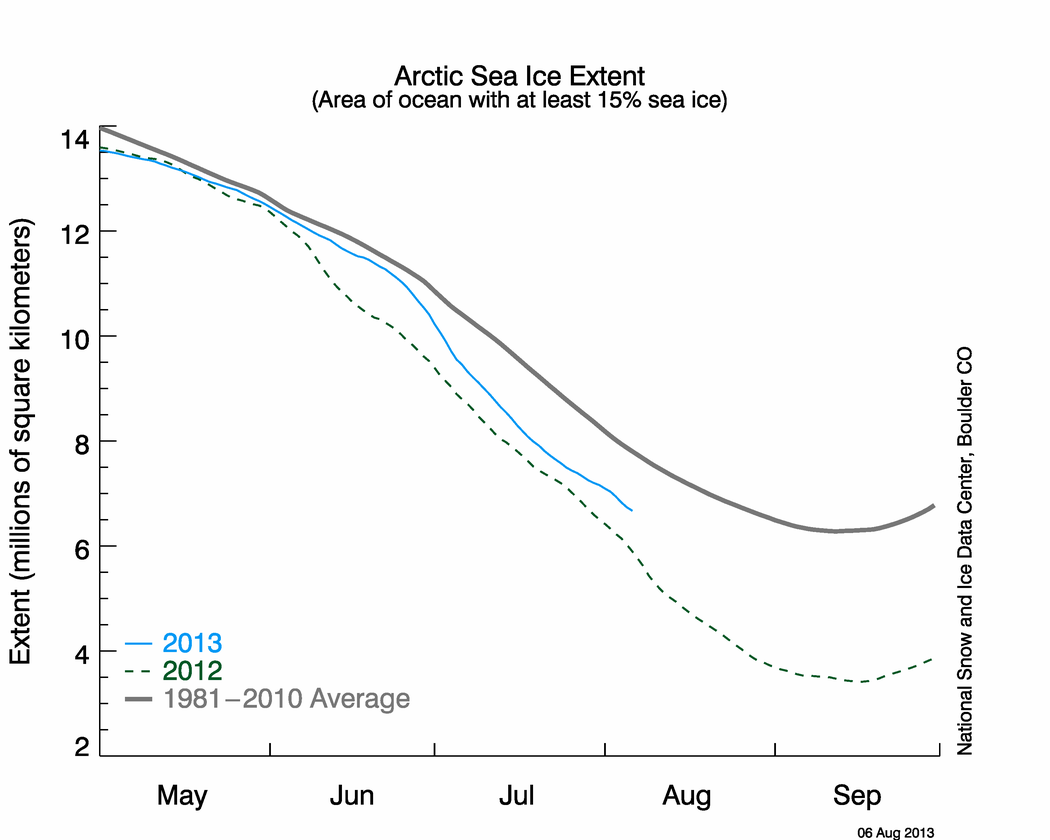
Today I offer this graph from the National Snow and Ice Data Center, which was oft cited back in early June with the phrase “if this trend continues…”.

Click for larger image – annotation added
You can see the source graph here, updated daily:
Nature is a kick in the pants, isn’t she?
Vincent: the July 2, 1954 value is likely to be ‘glitch’. There was one too on June 27th, 1954. In any event, these have nothing really to do with cycle 19.
Gary: cycle 20 was a long cycle and the minimum 20-21 lasted quite some time making that ‘minimum long’. Of course, all depends on how you eye-ball the duration. A rather objective way would be to measure the time between when cycle 20 had decreased to R20/n and cycle 21 to R21/n [both smoothed values], where R20 and R21 are the maximum values and ‘n’ is a parameter to be chosen. Setting n = 3 or 4 seems good choices. So by several measures 20-21 was rather ‘wide’ compared to e.g. 21-22 [clearly visible on the butterfly diagram], yet R21 and R22 were about the same, showing that the ‘width’ is a poor predictor.
Gary: clearly I meant: cycle 20 had decreased to R20/n and cycle 21 had increased to R21/n . One could use other methods as well, with not much difference.
Leif: Ok, I eye-ball 27 months the same as cycle 23 min. You are correct not terribly predictive of solar sunspot max. No doubt “strongly correlated” is off the mark.
But then, I at least implied I was trying to stay out of that game.
My original point was that any hope of an average to large cycle is now lost. I was not deriding any particular model, rather the current obsession with sun spots. Clearly I am not above the tendency but that should reinforce the issue.
The National Snow and Ice Data Center has a mid-month update where they explain why the ice is not melting as fast as expected:
http://nsidc.org/arcticseaicenews/
They’re also qualifying their statement with suggestions that the ice is so thin that significant melting could still occur. I doubt their objectivity in the way they suggest much melting could still happen since they think there is such a long melt period yet to go. With roughly six weeks to go to peak melt, I don’t see this as a very long time to go to reach peak melt, especially since we’re already 4½ months into the melt season and the melt rate seems to slow throughout August.
“27 months the same as cycle 23 min.” D’oh, 50% more than, rather.
[…] graph from the National Snow and Ice Data Center, I published with annotations on July 14th 2008, which was oft cited back in early June with the phrase “if this trend […]