Yesterday I showed satellite imagery of the North Pole and areas into northern Canada. It was still quite icebound.
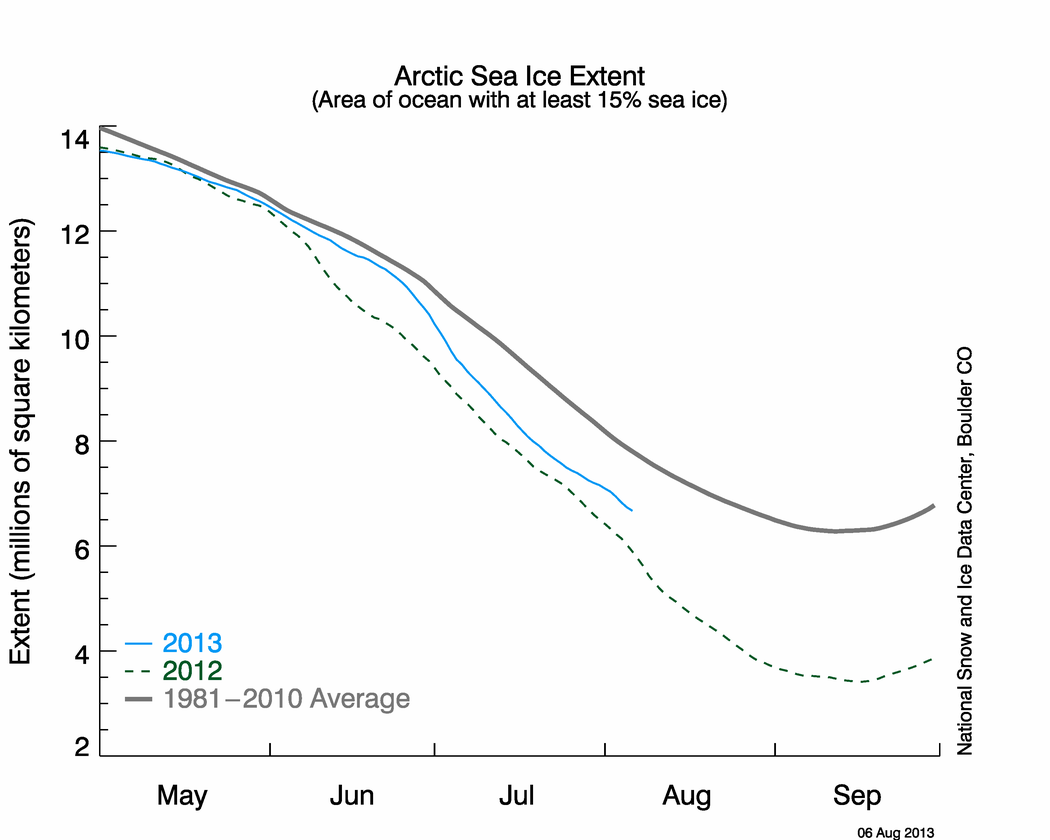
Today I offer this graph from the National Snow and Ice Data Center, which was oft cited back in early June with the phrase “if this trend continues…”.

Click for larger image – annotation added
You can see the source graph here, updated daily:
Nature is a kick in the pants, isn’t she?
I suppose if the sun was in a steady state (ie no flux, sunspot, geomagnetic changes ever), and the distance between the earth and the sun was always the same ect…could we assume that the earth’s own environment would predominate? Just speculating…..
I would have to say that Vulcanology is even less mature than Climatology as the sciences go.
vincent: keeping the sun constant is actually something one could run the current climate models with. Right now the models include the varying distance and an average solar cycle. It should be trivial to keep the distance constant and keep solar activity at zero [or some other constant value] and then run the models for a hundred years and see what we get. To my knowledge that has not been done, but maybe knows better and can tell us what the result was.
The “baseline” measurement for ice melt is an arbitrary 1979-2000 average ?
Our satellites have recorded data prior to 1979 (by a few years). Why is that dataset thrown out when establishing a baseline for ice melt ? In my physics class, we had a term for this manmade adjustment … we called it … “dry-labbing”. Whenever, your experiment didn’t fit the prediction of your hypothesis … you simply adjusted the numbers to make the hypothesis appear to be proven.
This is something akin to the “new-math” that the NEA devised to make children f-e-e-l inclusive …
You know … where there are no absolutes. 2+2 does not always have to equal 4 … if Johnny thinks it equals 5 … then it must be true for HIS reality.
I find very little HONEST data coming from the Global Warmists.
Nevertheless, their self-esteem is brimming !
Paul, given that so little is known about underwater volcanoes, I think it’s really premature to say that they cannot contribute to melting..
One or even several volcanic eruptions put out a tiny amount of heat compared with the heat fluxes on the Earth’s surface.
Probably more significant are the volcanic vents that line the mid-oceans. I have seen estimates there are as many as 3 million. We don’t know much about them, but they erupt continuously for long periods. They will put far more heat into the oceans than the occasional volcanic eruption. However, we have no reason to believe there is any trend to more eruptions from these vents. And good reason to think they have been a stable feature of the Earth for a very long time.
A mid-ocean ridge does cross the Arctic ocean, running from Iceland to the north coast of Russia.
If anyone is intrigued, Vincent’s comment at 22:28:40 :
“Tack själv Leif. Ursäkt igen. Skulle vi inte all vara i arbete?”
translates, according to Google, to:
“Thanks Leif. Apologies again. Would we not all be in labour?”
Presumably the last sentence should read: “Shouldn’t we be all working?” Nah, nah, this is much more fun than working!
This is “vincent the scientist”, right? “Ect”?? (snip by John Goetz – no goading please)
Leif, given the drift to the Sun and orbital movement, are you familiar with this paper by Professor Alexander?
http://nzclimatescience.net/images/PDFs/alexander2707.pdf
While personally left far behind by some of the detailed work, it seems to be a very interesting paper and it would be interesting to get an expert opinion.
REX (17:53:57) (AKA vincent) wrote: “… I ain’t going to divulge any more on a public forum such as this.. or will you provide your degrees publications ect?
Anyway this will be my last word on this chao and have a nice day”
Interesting. You come on the forum under the pseudonym of “vincent,” lambast a respected blog member whose name and CV are fully available to all (although we all don’t agree with him), STATE (claim) that you are a credentialed scientist, later (under pressure) provide the blog with your alleged, abbreviated CV, yet won’t provide your name even though it appears from what you provided you’re not even involved with climatology and shouldn’t fear retribution.
Uh huh.
By the way, my name is found at the bottom of every post and my abbreviated bio is available at many sites on the net including http://www.expertsources.org and http://www.climateclinic.com
Jack Koenig, Editor
The Mysterious Climate Project
http://www.climateclinic.com
My last post questioning the authenticity of Vincent was out of order… I hadn’t read any posts since early last night and should have before posting.
My bad.
As the liberals like to say (of which I’m not one) when they goof up, time to move on.
Jack Koenig, Editor
The Mysterious Climate Project
http://www.climateclinic.com
skippy (01:21:48) wrote: “(on fudging numbers) …Nevertheless, their self-esteem is brimming !”
It’s also dimming, Skippy!
Philip_B (02:52:50) wrote (on oceanic volcanic eruptions) : “…One or even several volcanic eruptions put out a tiny amount of heat compared with the heat fluxes on the Earth’s surface.”
Quite often, laboratory calculations (such as provided earlier by another blogger) don’t quite “cut it.” There’s an interesting article on the NASA website suggesting it’s not the initial eruption one has to be overly concerned with, but the after effects. In the case of Icelandic, under water volcanic eruptions, researchers found the eruptions could be explosive because as the magma moves to the surface it expands quite rapidly and shoots debris far into the atmosphere as it surfaces.
My take on the above is that if this indeed is the case, who’s to say it doesn’t also impact the undersides of surrounding ice by causing cracks and disintegration?
Just a thought. The article can be found at http://www.earthobservatory.nasa.gov/Newsroom/MediaAlerts/2008/2008071427114.html
Jack Koenig, Editor
The Mysterious Climate Project
http://www.climateclinic.com
Tony: the paper has recently been discussed at ClimateAudit. Instead of repeating the comments, can I just refer you to http://www.climateaudit.org/?p=3218#comment-276071 ?
Jack Simmons, vincen, bsneath, et al. on sun spot vagaries:
I take the following graphic to be all the butterflies we have,
http://solarscience.msfc.nasa.gov/images/bfly.gif
Unfortunately it doesn’t go back very far. The first sunspecks (Anthony’s internet-notable term) of 24, not-quite-spots exhibiting magnetic reversal, of cycle 24 date to 7/06 and first official spot to 1/08.
Against the graphic the new cycle begins to look unusual, and contra Leif’s assertion this minimum is no less active (by the measure of spotting), flaring is already unusual by its paucity (begun 2/07), which means the briefly elevated UV associated with them is missing.
While Leif and Janssens have recently on another thread cautioned against predicting a max on the preceding min, their arguments again appear to rely on spotting comparisons between cycles. Their hope is that March 08 still proves the 13 month minimum.
However, 10 cm radio flux continues to decline, last month establishing a new smoothed minimum following 9/07’s prior low. Spotting is insufficient to maintain the March 13 month minimum.
The Heliophysicists are plainly overplaying the sun spot counts as a proxy for solar activity. Looking at the ongoing graphs of data,
http://www.dxlc.com/solar/
one sees that radio flux, plantetary indicies, and sun spot count are not equivalent, mutually representative effects of the same underlying cause.
The hope of a cycle 24 minimum prior to 12/08 is long gone, and the 3/08 prediction was dead on arrival the day it was issued in 4/07. The length of the minimum is strongly correlated with the strength of the sun spot maximum and therefore 24 will be more like cycles 5 and 6 than any cycle since.
Mene, mene tekel upharsin.
McGrats
Point taken. I’m afraid I get a bit hot under the collar about this issue probably taking it FAR to seriously LOL…. . The Australian Goverment is spending 5 billion dollars on a “warming” world when in fact it appears to be cooling would you blame me??? BTW the statements in my previous posts re qualifications etc are all true.
Gary: The length of the minimum is strongly correlated with the strength of the sun spot maximum and therefore 24 will be more like cycles 5 and 6 than any cycle since.
What is ‘the length of the minimum’? If you just mean the length of the cycle, then cycle 20 was also long and yet cycle 21 was the second largest cycle ever. The cycle length is useless for prediction of the next cycle. I do agree that cycle 24 will be weak [a la cycle 14 or 15], but for better reasons [weak polar fields].
strongly correlated with the strength of the sun spot maximum this is true for the cycle for which you are measuring the length, but not for the following cycle. Which did you mean?
McGrats (07:37:01) :
Quite often, laboratory calculations (such as provided earlier by another blogger) don’t quite “cut it.”
My take on the above is that if this indeed is the case, who’s to say it doesn’t also impact the undersides of surrounding ice by causing cracks and disintegration?
Jack Koenig, Editor
The Mysterious Climate Project
http://www.climateclinic.com
I agree that the calcs are just that, calcs. Also we may have to take into account things such as these numbers in the link provided in my post are based on a land volcano. Under deep sea water, we would have to take into account things such as the surrounding water temperature (which could provide significant more cooling than atmosphere), salinity of the water (insulator/conductor?), pressure from the depth (pressure creating heat) etc etc. It would be difficult for us to say for sure if this eruption has any effect.
We also have to remember that this eruption occured in 2001 (within a 300 earthquake swarm). I doubt heated water would have lasted that long unless it was continually venting, for which there is no evidence for from the expeditions. Also, from what I can find, the explosion was equal to Vesuvius, but there is no real information about lava flows or superheated ash (to provide heat). Was this equal to Vesuvius also?
I would have to say McGrats, that cracking and disintegration could be caused by the shockwave of the initial eruption. a blast that large in water could send out a hefty pulse? Just speculating.
This ones not black or white, but a clear shade of grey me thinks! I’m still not to convinced at present, IMO.
Returning to topic, I’ve now finally found a way to get NSIDC monthly data (don’t ask; it involves merging 12 month-specific files and interpolating for missing values…).
Full monthly data (dominated by annual signal), plus annual rolling mean:
http://www.woodfortrees.org/plot/nsidc-seaice-n/mean:12/plot/nsidc-seaice-n
http://www.woodfortrees.org/plot/nsidc-seaice-s/mean:12/plot/nsidc-seaice-s
… and those all important (but sometimes misleading) trend-lines for each:
http://www.woodfortrees.org/plot/nsidc-seaice-n/mean:12/plot/nsidc-seaice-n/trend
http://www.woodfortrees.org/plot/nsidc-seaice-s/mean:12/plot/nsidc-seaice-s/trend
Note the scales are not the same!
Leif, the minimum of a cycle is taken to precede its maximum. I know you know that, can I demonstrate it? No, just eye-balling as usual. Can one take eye-balling to the bank? I should hope not!
Gary: you were talking about ‘the length of the minimum’. What is that?
Leif:
Your dear friend Dave Archibald is more conversant on that subject than I, so what follows is just reasoning by a rank amateur, meaning the duration of low solar activity appropriate to a minimum.
Remember 23’s minimum, the 13 month smoothed minimum came in May and the following Sept. the longest spotless period.
So we could call those 4 or 5 months the absolute trough and perhaps the minimum (9503 – 9709) 18 months in length. I don’t have numeric criteria to delimiting a minimum to recommend, but looking at the daily data for ’96 we can see the sun was at its local ebb in radio flux, sun spots, planetary indicies and flaring during the trough, with significant terminus in spotting at either end of the 18 month period.
Well this time around the decline seems to have been well begun by 3/07 and is yet to bottom. So the minimum, in this non-scientific, woolly thinking sort of way, should extend through all of 2009, i.e., end in being twice as long.
The current low-level is adequate for minimum as was the activity of a year ago. So lets just say the duration of solar activity of sufficient depression for official minimum.
Gary: so you do mean a kind of size of the ‘through’ around minimum. Nothing wrong with that. The problem comes in, when you say that the length of that flat plateau is strongly correlated with the size of the following maximum. It is not, David A, notwithstanding. The minimum between cycles 20 and 21 is a good counter example. But, hey, what are we quarreling about? We do gree, I think, that we are in for a low, low cycle 24.
Yet at Solar 24: By the sites owner: “Today the solar flux has dipped to a new low of 64.2. Just so you do not worry too much, on July 2, 1954 a value of 64.4 was observed. What followed was one of the strongest Cycles ever recorded (Solar Cycle 19)”. Was that event exceptional?
Leif: We are agreed on a low cycle 24.
The ‘plateau’ shape is a little too constricting. Establishing SDs from the maximum clearly won’t work for regime changes like 23 to 24.
I don’t get the 20-21 example, the min was over 10 leading into a max of 160. The coming max will be more like 50.