Yesterday I showed satellite imagery of the North Pole and areas into northern Canada. It was still quite icebound.
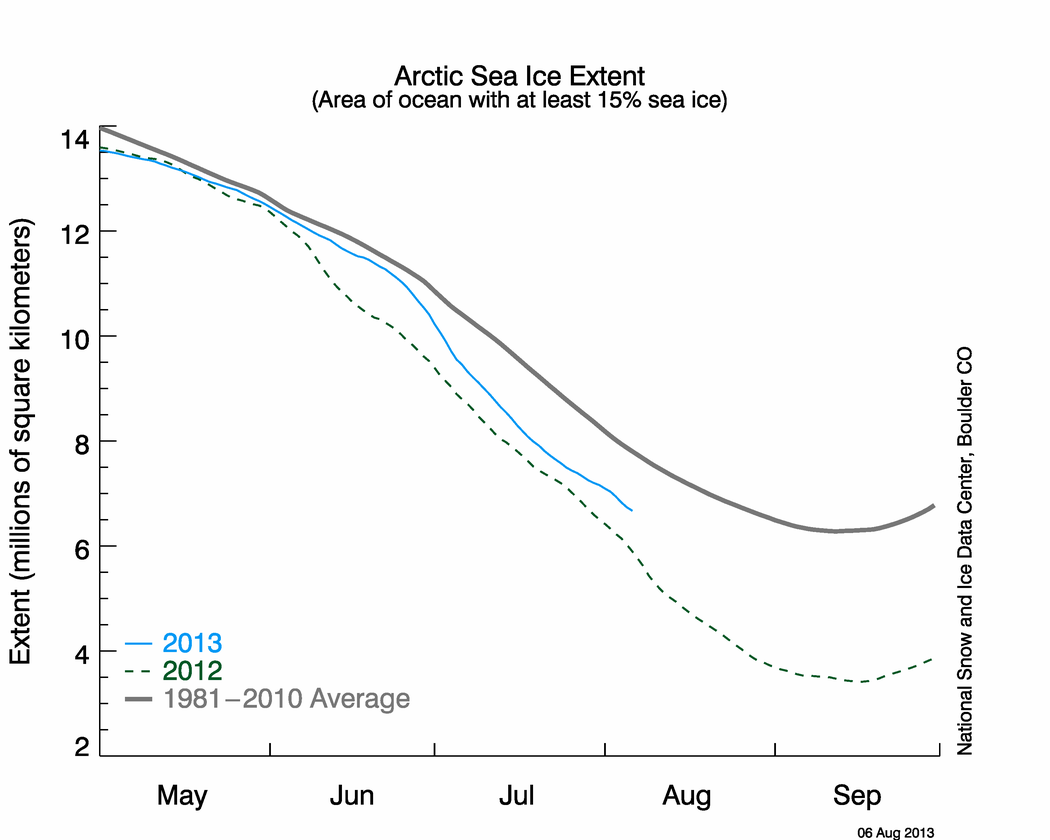
Today I offer this graph from the National Snow and Ice Data Center, which was oft cited back in early June with the phrase “if this trend continues…”.

Click for larger image – annotation added
You can see the source graph here, updated daily:
Nature is a kick in the pants, isn’t she?
Basil: There are many people that have noticed that every 100 years or so
[1700, 1800, 1900, 2010] solar activity seems to be low, and particularly low every 200 years. It is like noticing that South America ‘fits’ into West Africa. Without a reason for why that is, the observation doesn’t count for much. Volcanic activity was also low every 200 years or so, without anybody suggesting that volcanoes cause sunspots [or the other way around]. We only have a very low [like 4 or less] number of degrees of freedom to play with, so coincidences are bound to happen. Some of those may turn out to be real [like the fit of coast lines] once we identify the mechanism.
I just finished reading: http://www-pord.ucsd.edu/~ltalley/sio210/pickard_emery/
pdf of Chapter 12: Arctic Ocean (Version July 2006)
Enlightened and enlightening.
It took almost as long to download it (20+ Mb) as it did to speed read it (and it is probably copyright) so I Googled around for a précis and found this, courtesy of Rod Duke:
“….in Chapter 12: The Arctic and Northern Polar Oceans from the book Descriptive Physical Oceanography by William J. Emery, Lynne D. Talley and George L. Pickard, the complex interaction of forces that effect the ocean and sea ice are delineated.
It is difficult to efficiently summarize the sixty pages that comprise this chapter but the highlights are: … unlike tropical and subtropical waters where waters are layered by temperature and separated by thermoclines, the polar seas are stratified by the salt content of the water and separated by haloclines.
The salt concentration then governs the freezing point of the sea water once the temperature drops to 0 degrees Celsius; the higher the salt content, the lower the freezing point below 0 C.
The haloclines are formed by the summer melting of the ice, which is lower in salinity than the sea water, and layers over the top of the more dense sea water, but then it freezes more quickly when the temperature drops to 0 C.
The problem is that the surface haloclines have disappeared and more uniformly saline seawater is present. Unlike freshwater or even brackish water, the density of seawater is greatest at its freezing point. The result is that the seawater starts sinking before it freezes solid. When or if the seawater actually freezes it forms a much weaker sea ice because of the inclusions of salt and this ice requires about half the energy to melt when compared to regular halocline formed sea ice. As the sea ice forms it starts forcing the salt out of the crystalline structure. If the air temperature is abnormally cold it will form the weaker form of sea ice because it will not have the time necessary to expel the salt.”
Rod, whom I must thank for the concise encapsulation above, then goes on to say…
“Why have the surface haloclines disappeared?
It turns out that miscible liquids of different densities can exist in a layered state until there is a disturbance at the boundary layer. This will start an oscillation in the layers that is virtually impossible to dampen due to the entropy differences of the two layers.
The main culprits for this phenomenon are ICEBREAKERS. The vortices from the giant screws that propel these behemoths are incredibly large and propagate well beyond the 20-meter depth of the surface halocline. These ships force the mixing and provide a lane of broken ice that will be weaker and easier to melt when or if it refreezes.
NASA satellites show that the greatest loss of sea ice is on the Soviet side of the polar region. The Soviets have the largest ice breaking ships in the world and they use them to keep their northern shipping routes open. In fact they have converted several of their icebreakers into cruise ships and routinely ferry passengers to the North Pole.
If you want to save the Polar Ice Cap then stop the icebreakers!”
Perhaps if the actual data were used in the plot instead of the average data, then the trend would not be so misleading. Random process results are not predicted by biasing the average bases on last years average and the long time average. Piss poor analysis. The bastard that did this should be fired.
Leif Svalgaard (09:08:29) : “Some of those may turn out to be real [like the fit of coast lines] once we identify the mechanism.”
True, correlation isn’t cause but the more times an event happens it becomes a suspiciously genuine rule. The ancients noticed that the sun in certain positions forecast the beginning of planting season among other things. They were able to use this rule despite not knowing the mechanism. You have to start somewhere.
The fit between continents effectively was a one-time event — very good reason to consider it coincidental. Every 100 years with an imposed apparent 200 year cycle is quite a bit more events. Perhaps coincidence but with decreasing probability at every recurrence.
I knew I had seen a paper on this related subject and have just found it again.
http://www.eurekalert.org/pub_releases/2008-06/uoca-gic061808.php
“The ice core showed the Northern Hemisphere briefly emerged from the last ice age some 14,700 years ago with a 22-degree-Fahrenheit spike in just 50 years, then plunged back into icy conditions before abruptly warming again about 11,700 years ago. Startlingly, the Greenland ice core evidence showed that a massive “reorganization” of atmospheric circulation in the Northern Hemisphere coincided with each temperature spurt, with each reorganization taking just one or two years, said the study authors.”
We have come a long way and the road ahead is longer still. Much as we would like to know everything some things take time. I do have issues with ice core records (explosive decompression and diesel lubrication along with cold water’s large range of affinities for the different atmospheric gasses) but sometimes fire must be fought with ice 😉
“we can all breath a sigh of relief ….. and go buy a Prius. ”
Ergh! I’d rather walk!
Aaron Wells (08:44:09) said:
“I also check Cryosphere Today on a daily basis, and what I find most perplexing is the current graph for Antarctica. It would have us believe that in the very middle of their winter that sea ice area expansion has nearly stopped for the past 3 weeks. I find that hard to believe”
But it seems to be happening, and it has happened before. In 2001, at nearly this same ice area in the southern hemisphere, growth stopped fora bout 2 weeks. Look here – there are a couiple other possible examples in this trace as well:
http://arctic.atmos.uiuc.edu/cryosphere/IMAGES/current.area.south.jpg
The Wilkins Ice Shelf is continuing its breakup through the winter – something is happening down there:
http://www.sciencedaily.com/releases/2008/07/080710115142.htm
Leif doesn’t ‘believe in the sun..’ ! Jesus,man, what planet do you live on?!
[snip, let’s leave the ad homs out please. Leif has been most gracious here, and his opinion is based on what he has observed and studied, I’ll not have him insulted for stating his views. He puts his name to his words, something not everyone does, and for that I applaud him. -Anthony ]
Referring to another comment;
The sudden melting of polar ice may have been due to the volcanism of the Gakkel shelf.
vincent (01:20:11) wrote: “My impression is that Svalgaard (is he in fact a solar scientist?) tends to exaggerate the details of the science and overlooks the “big picture” (ie the hot sun). As a highly qualified scientist myself…”
Just out of curiosity Vincent, what type of scientist are you? What is your specialty? How long have you been a scientist? Where do you practice?
The curious would like to know!
I personally don’t agree to everything Leif has to say either, but he is a brilliant person and for that I give him a great deal of credit and respect. My personal leanings in the climate change debate involve a mix of Svensgard’s theories tied into the Equatorial Pacific Warm Pool’s (www.epwp.com) outcomes.
Jack Koenig, Editor
The Mysterious Climate Project
http://www.climateclinic.com
Ok, Anthony, sorry. It wasn’t meant as a personal attack, it was meant as a riposte to what seemed like beyond the pale comments with no evidence to back them, since he didn’t enclose any. In the physics wars over Special Relativity, the comments from the scientists are often very heated, this site is mild by comparison.
David Gladstone (10:17:28 ) :
Referring to another comment;
The sudden melting of polar ice may have been due to the volcanism of the Gakkel shelf.
It’s an interesting theory, but I read that the energy released would bearly cause a difference to the ocean temperatures, assuming that the heat went straight verticle and wasn’t swept away by the currents. This article also seems to suggest the same:
http://climatesanity.wordpress.com/2008/07/10/volcanos-in-gakkel-ridge-not-responsible-melting-the-arctic-ice/
“The Wilkins Ice Shelf is continuing its breakup through the winter – something is happening down there:”
The various ice shelves that form at the base of Antarctic glaciers grow only to a certain point before they break off and re-form. As the ice moves out over the ocean, it is subject to stresses from tidal action and even seismic action where the shelf meets land. Over time this stress causes cracks to form and they grow. Wind also plays a role. Winds blowing across the ice tends to “push”, “pull” and “twist” the interface with the glacier which also helps weaken it.
The ice is floating on water and so the winds and currents and any number of things eventually cause the shelf to break off. The larger the shelf gets, the more the shelf is subjected to these forces until they overcome the strength of the land boundary. The glacier on land doesn’t get pushed by the wind over the land, or get moved by “land currents”. So you have one part that wants to stay relatively stationary and another piece that wants to move around somewhat. Just the tides every day act to flex the shelf up and down day after day in addition to any wind, current, or seismic actions.
it doesn’t mean temperatures are any warmer.
Charles Vairin ( 09:36:44 )
Perhaps if the actual data were used in the plot instead of the average data, then the trend would not be so misleading.
Are you refering to the sea ice graph? That entire graph is based on “actual data”.
Random process results are not predicted by biasing the average bases (sic) on last years average and the long time average.
Take a look at the graph again. The average is based on 1979-2000 data.
Off topic, but does anyone know what phase the AMO is in currently? From what I can find, it is still in its warm phase. What effect would this have on the Arctic? Would it be significant?
This appears to be the latest I can find.
http://www.intellicast.com/Community/Content.aspx?ref=rss&a=127
Oh, er, someone also called Paul was posting so I put my full real name in…
Anthony,
Just wandering around AOL news and spotted this:
July 15) — Hurricane seasons have been getting longer over the past century and the big storms are coming earlier, LiveScience has learned. The trend has been particularly noticeable since 1995, some climate scientists say.
Further, the area of warm water able to support hurricanes is growing larger over time. The Atlantic Ocean is becoming more hurricane friendly, scientists say, and the shift is likely due to global warming.
Thot you’d be interested.
“but does anyone know what phase the AMO is in currently?”
I found this one showing a strong cold NAO as of June
http://www.cpc.ncep.noaa.gov/data/teledoc/nao.timeseries.gif
Mike,
I refer to my previous but one post. The previous 30 years were lower than average (in line with the AMO cool phase) and the years since 1995 are in line with the AMO warm phase by the looks of it. Wouldn’t bet my salary on AGW somehow.
“The various ice shelves that form at the base of Antarctic glaciers grow only to a certain point before they break off and re-form.”
This is not correct. The ice shelfs are long-lived, in stable equilibrium between ice addition at the continental edge,an calving at the ocean edge. For example, “The scientists analysed sediments from the bottom of a freshwater lake close to the edge of the present George VI Ice Shelf. The results revealed that about 9500 years ago the ice shelf retreated, allowing the sea to flood into the lake. The ice shelf didn’t reform until 1500 years later, and has been present ever since.” http://www.sciencedaily.com/releases/2005/02/050224115901.htm
The Larsen A and B shelves, and the Wilkins shelf, did not ‘crack fof’ the continental edge. They disintegrated, fell to pieces in a very short period of time. For the Larsen shelves, and in the earlier breakups of part fo teh Wilkins shelf, this appeared to be due to meltwater pools warming and eating rifts into the ice from the top down. For the current Wilkins breakup, ti appears to be war ocean waters eating the ice shelf from the bottom up, giving larger bergs rather than the ice fragments from the top-down disintegration.
Over on SolarCycle24.com, Leif has been somewhat more expansive on his “the sun isn’t the climate driver” comment. As a non-scientist, I understod his explanation like this:
1) Total Solar Irradience has not changed much in the last several hundred years, irrespective of the sunspot cycle.
2) Since TSI is essentially constant, the climate is driven by things other than the Sun.
3) Therefore, the Sun is NOT the climate driver.
4) Any warming / cooling noticed that correlates with the sunspot cycle is driven by something else. That “something else” has not been proven yet.
Mike Bentley (13:33:05) wrote: “Anthony, Just wandering around AOL news and spotted this: July 15) — Hurricane seasons have been getting longer over the past century and the big storms are coming earlier, LiveScience has learned. The trend has been particularly noticeable since 1995, some climate scientists say (etc, etc)”
Don’t bet your lunch money on anything coming out of Live Science. I read that article yesterday and like most articles written by “Super Pogie” Andrea Thompson, it is filled with inuendo, distortions, “if this happens” if that happens,” etc. Typical rot from Live Science. It is my understanding Live Science is affiliated with that character in Canada, Suzuki (sp).
Jack Koenig, Editor
The Mysterious Climate project
http://www.climateclinc.com
Paul, given that so little is known about underwater volcanoes, I think it’s really premature to say that they cannot contribute to melting. I read those posts and didn’t see anything definitive. My instinct says there is something there worth studying and I trust that more than anything else. Remember, the 1999 eruption was as large as that of Vesuvius circa 70 AD, and it is certain that it was not the only one.
Sorry, out of topic, but I wonder why the Metoffice anomaly is not discussed anywhere (not in this blog, not in any other…). Its June figure is higher than GISS (?!) – 0.314 to 0.26! Considering their base line difference, it’s quite remarkable. And, for the second month already it’s the only one rising while the others are falling. Could it be because GISS extrapolates for the Arctic, where there are no stations while Metoffice just ignores the Arctic? And the Arctic is getting colder?
PS. Jeez, its so funny you finding a colorful graph from 1922 being the graph for urban population in Estonia… That’s where I’m from…
Mcgrats & Paul,
Yes, I saw the article for what it is. I’m a skeptic on the warming issue. But I also value the diversity of opinion on this site (TNX Anthony). I hadn’t seen that discussed or heard of the site so decided to throw it into the discussion to see what came up. No lunch money is going out of my pocket on this article, (it’s all going for gas)
TNX all!
neilo: what you said is my argument. The ‘counter’ is: “so what? that just shows that it is not TSI that is important, but something else solar, UV, cosmic rays, solar wind, solar microwaves, voodoo, what else can it be?, etc, etc”. The counter-counter is that all of these other things energetically are so far down the list as to be insignificant. And if solar activity does not have an influence we can clearly see and agree on, then it is, indeed, insignificant.