Yesterday I showed satellite imagery of the North Pole and areas into northern Canada. It was still quite icebound.
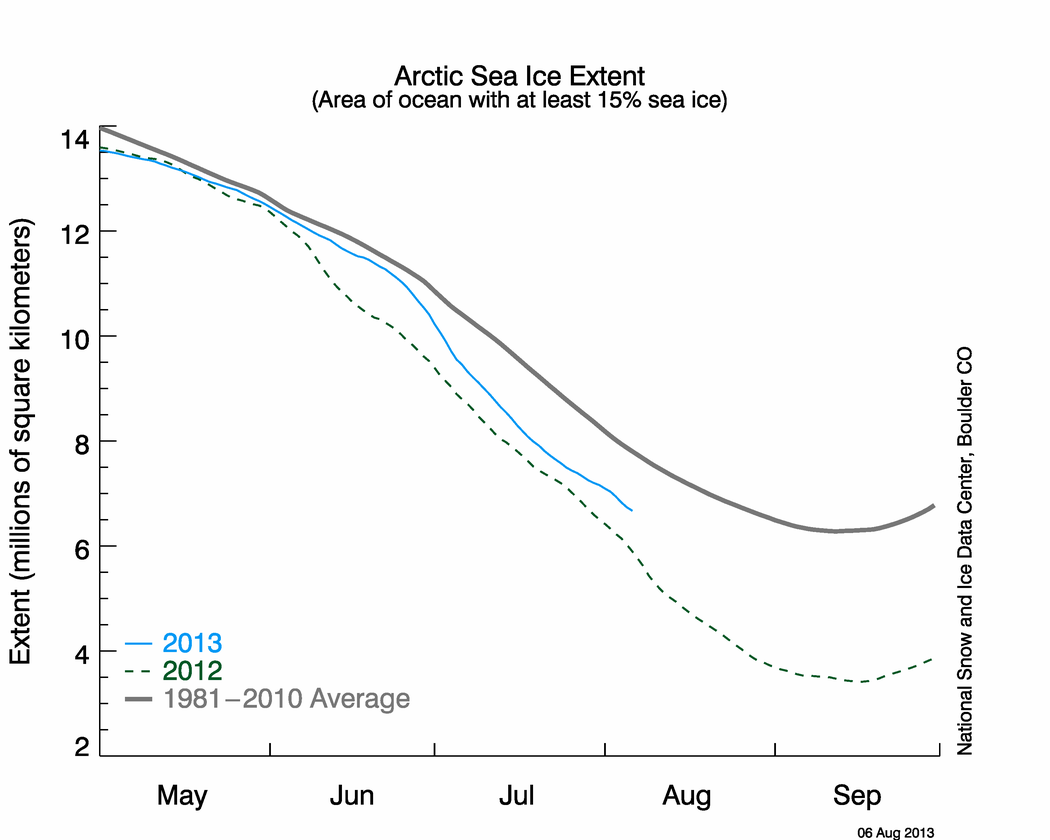
Today I offer this graph from the National Snow and Ice Data Center, which was oft cited back in early June with the phrase “if this trend continues…”.

Click for larger image – annotation added
You can see the source graph here, updated daily:
Nature is a kick in the pants, isn’t she?
“The numbers of sea ice extent in this site are estimates calculated by certain algorism.”
Thanks for a good laugh.
Lief,
The reason that sunspots are on everybody’s mind is that Svensmark predicted a cooling as sunspots dropped, the sunspot cycle is a bit abnormal from recent years, and lo and behold, here is a cooling. I don’t know that it is cause and effect, but he is a scientist and you are a scientist, and you disagree so we will just have to wait for the results.
There are lots of studies that show a correlation between variations in TSI and earthly weather. Sunspots too. So, while I am sure that you have your ducks in a row, and your partial differential equations or whatever you use all match out to the dot, you will have to forgive our lumpenprole curiosity as to whether there may indeed be an unaccounted factor in the climate debate.
We’re at a solar minima and so the Sun is on people’s minds. If it were a big El Nino then ocean currents would be on people’s minds and we still wouldn’t talk about Arctic Ice. As an interested nobody I would like to know what are the full list of factors that people can conceive of that (realistically) affect the climate. And then when they would be most or least significant. This may not allow us to build up a model of the the planet but it might of the blogosphere. Lets see; solar maxima, ocean currents, ocean flora, the moon and planetary alignments, trace atmospheric gas concentrations… There really might be some use to this.
OT
OMG! It’s, it’s, A HOCKEY STICK!!
http://icecap.us/images/uploads/ANTARCTICA71108.jpg
Extent of Antarctic ice cover continues to set records, yep, there’s that entire Antarctic ice sheet crashing into the sea raising global sea level by 300 feet.
I also see the Hollywood Vehicle effect. We’re not buying what they’re selling (lives and careers are at stake, yanno).
So they keep spinning the same yarn; its our taste they’re serving, after all. We won’t see the movies/shows we ask for. We really want what they’re pushing, and this week’s remake is better than the original!
A bit desperate I’d say.
Flowers,
I don’t believe solar is the ‘sieze-all’ driver of climate anymore than CO2 is. The earth’s climate is a complex, non-linear, probably chaotic system with so many variables affecting it I highly doubt any single one predominates (and I doubt that we will ever be able to successfully model its behavior).
I sincerely hope we don’t embark on an attempt to ‘terraform’ the planet over the next century, at least until we can determine what ‘global temperature’ is ‘optimal’ for us. Nobody, not even the IPCC can tell anyone how much temperatures will drop (if they do) per unit of CO2 removed from the atmosphere (which implies that they can’t tell us how much temps will rise per unit of CO2 added either beyond derivations using Stefan Boltzmann and the like – which don’t reflect reality either). Right now we haven’t a clue, nor do we have any idea if, through our efforts, we won’t make it ‘worse’ (warmer), or ‘better’ (cooler) or if warmer is worse or cooler is better or not.
So, how many Know Nothings are volunteering for the just-abandoned Arctic research station? You know, the one that’s melted down earlier than predicted?
http://tinyurl.com/653pzp
As you know, personally I don’t think the Sun is an important driver of the climate…
Golly gee, Leif, I guess it must be pixie dust then.
Hey Man …..
You guys back off the attacks on Lief!! He deserves more respect than that!!!
He is correct!! In the “context” of all solar minimums, solarcycle 24 is “within the range of normal”. This statement does not make an inference regarding the proposed association of longer vs shorter cylces and an impact on temperature, it merely states that similar minimums as we are seeing today have been noted in the record before.
Until the data come in for the next 5-10 years, none of us can say with certainty the associations. I personally think there is a lot of merit in the “hot water bottle theory”, and that global temp is governed by a combination of sun and ocean. These next years “may” allow us to explore that notion. As Wilde stated, if the Sun all of the sudden turns on the afterburners, and we have a hot sun, and temp warms, we’ll still be stuck in the dark. BUT … if the sun remains cool, the PDO stays negative, and temps go up …we can all breath a sigh of relief ….. and go buy a Prius.
Can we be absolutely certain that this solar cycle isn’t unusual compared to those in the early 20th and late 19th centuries? I am guessing that we can count sunspots much more accurately than they could 100 years ago. Their “spotless” periods might not have been spotless if they had the technology that we use now.
eideard – are you wilfully ignoring the graph this thread is named after or did you not read it? As well as the many comments above yours? Including the ones specifically addressing your point?
“As you know, personally I don’t think the Sun is an important driver of the climate”
Leif, would you agree with this?
“The solar contribution to the increase is variously estimated to be around 4-20% leaving greenhouse gases to make up the remaining 80%.”
“As noted by Intergovernmental Panel on Climate Change in the Third Assessment Report, published in 2001, anthropogenic emissions of greenhouse gases are highly likely to cause warming of the Earth, but factors such as solar variability could amplify or subdue the effect.”
http://www.antarctica.ac.uk/press/press_releases/press_release.php?id=29
re: Arctic Research Station. Awfully convenient they left out the fact that it’s drifted 1550 miles from where it started into warmer waters.
RE: eideard (05:54:48
So one sheet is a representation for the whole pack? Also that camp was set up only last year, not as if it has been there for multiple years. That is brilliant insight, thanks for playing.
I check the sea ice extent every day at
http://arctic.atmos.uiuc.edu/cryosphere/
I have noticed frequent short “blips” in the data such as the following:
1. The sudden dropout in May of 2008 for the Arctic basin, seen here:
http://arctic.atmos.uiuc.edu/cryosphere/IMAGES/recent365.anom.region.1.html
2. The sudden dropout in May of 2008 for the Laptev sea, seen here:
http://arctic.atmos.uiuc.edu/cryosphere/IMAGES/recent365.anom.region.8.html
3. The sudden dropout in December of 2008, and again in May and June for the Hudson Bay, seen here:
http://arctic.atmos.uiuc.edu/cryosphere/IMAGES/recent365.anom.region.13.html
I find it hard to believe that some or all of these are real. Does anybody know if these are simply artifacts of fuzzy satellite data? This makes me wonder how well resolved the data is when it looks “normal.”
If they are not real, the fact that they are not corrected implies to me that the data we see here are “raw” (which is not a pejorative). Does anybody know how to get tabular versions of these data? I sent email to William Chapman several months ago asking if this was possible – but he never replied.
Best regards,
Tom
http://climatesanity.wordpress.com/about/
Leif’s skepticism (of the Sun as an important driver of climate) is apparently born of all the failed attempts to correlate solar activity with climate. But I think he will be the first to admit that absence of evidence is not evidence of absence. Actually, I believe I’ve read Leif to acknowledge some relationship between the Sun and terrestrial climate on at least centennial scales (something like the Gleissberg cycle, maybe?). Given that…
Leif, are you familar with Shahinaz Yousef’s publications? He claims that we’re in a transition between Wolf-Gleissberg cycles and that this will lead to a period of reduced solar activity over the next couple of solar cycles, accompanied by cooler climate and enhanced drought conditions.
Here’s one of his papers:
http://articles.adsabs.harvard.edu/cgi-bin/nph-iarticle_query?2003ESASP.535..177Y&data_type=PDF_HIGH&whole_paper=YES&type=PRINTER&filetype=.pdf
Just a thought, Could it be that the large melt in 2007 actually cooled us down for 2008? I mean that is a lot more cold water migrating down into the rest of the surrounding oceans. Just a thought, does anyone know of any research done on this?
eideard
just so we are clear that is melting even by the bbc’s twisting of the story because it drifted into warmer water not due to any warming of the air temp.
(is he in fact a solar scientist?)
Um, yes.
One of those “he honors us with his presence”-types, not to put too fine a point on it.
My own impression is that the 11-year cycles don’t have a heck of a big effect, but the major minimums are probably a different story. Correlation does not prove causation, but it does raise the possibility.
visit us
http://try2listen.wordpress.com/
Tom Moriarity,
I also check Cryosphere Today on a daily basis, and what I find most perplexing is the current graph for Antarctica. It would have us believe that in the very middle of their winter that sea ice area expansion has nearly stopped for the past 3 weeks. I find that hard to believe.
Current Southern Hemisphere Sea Ice Area
“Glenn (01:11:07) :
With due respect to all, the most authoritative source I have found ….”
I think this is the most “authoritative one”
NOAA: Solar Cycle 24 Prediction Issued April 2007
http://www.swpc.noaa.gov/SolarCycle/SC24/index.html
and
Panel Releases Solar Cycle 24 Forecast
http://www.spacearchive.info/news-2007-04-26-noaa.htm
I certainly think the current situation is looking increasingly interesting, also wrt. climate. I also think the NOAA SC24 predictions illustrate how this area of science is in its infancy.
As far as I know, Leif’s argument is that the sun isn’t variable enough to be a major driver of climate beyond it’s initial power and effect it has on a daily basis. People keep twisting this such that they think he’s saying the sun has “no effect on climate”. Sometimes I wonder at people’s ability to read and comprehend, or willfully comprehend differently from the reality of what was said.
Aaron Wells (10:31:32) : “The numbers of sea ice extent in this site are estimates calculated by certain algorism. You can’t make this stuff up!”
FWIW: Algorism is one of the original words used to describe arithmetic processing. The Neo-Latin/Medieval-Latin word is algorismus. Its use is a bit archaic but not incorrect.
http://en.wikipedia.org/wiki/Algorism