Yesterday I showed satellite imagery of the North Pole and areas into northern Canada. It was still quite icebound.
Today I offer this graph from the National Snow and Ice Data Center, which was oft cited back in early June with the phrase “if this trend continues…”.

Click for larger image – annotation added
You can see the source graph here, updated daily:
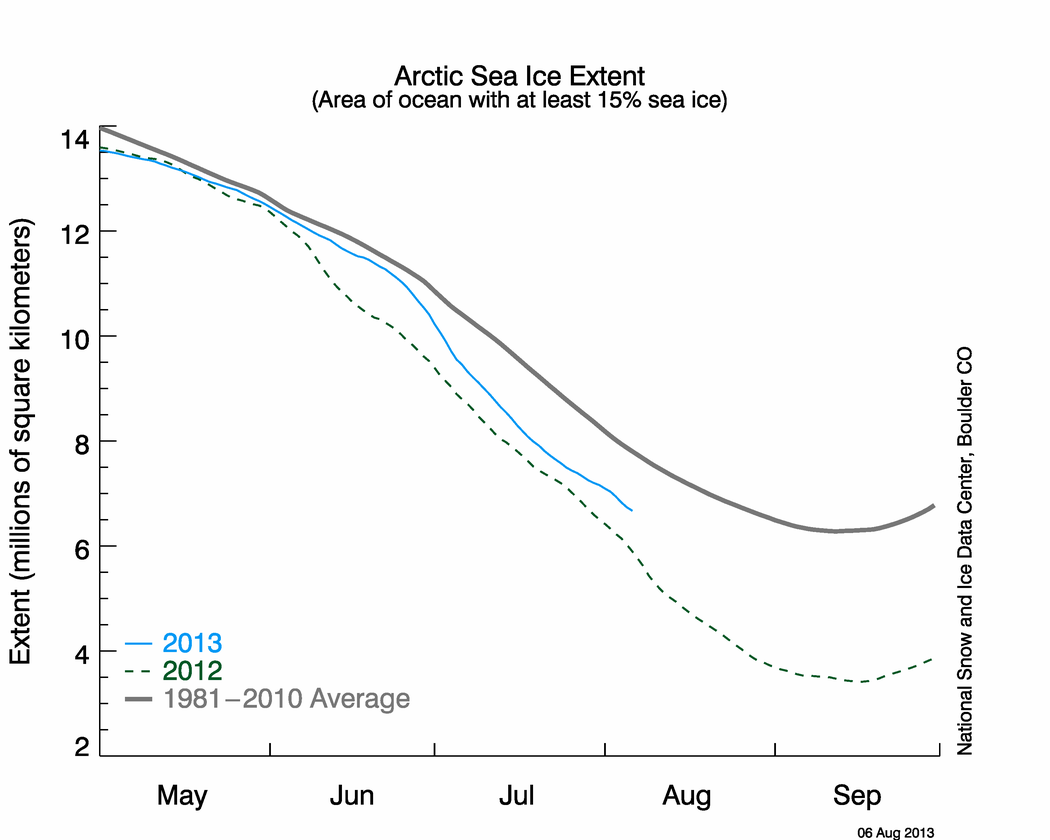
Nature is a kick in the pants, isn’t she?
Glenn posted a quote from Hathaway stating: “On January 4, 2008, a reversed-polarity sunspot appeared—and this signals the start of Solar Cycle 24,” says David Hathaway of the Marshall Space Flight Center.”
I was going to say “I can’t believe they even left that patently false statement on the ‘net.”
But after thinking about it a few seconds, I thought “What’s new!”
Jack Koenig, Editor
The Mysterious Climate Project
http://www.climateclinic.com
Well I’m confused. The NASA site in 2006:
“March 10, 2006: It’s official: Solar minimum has arrived.” and
“I expect to see the first sunspots of the next cycle appear in late 2006 or 2007…”
http://science.nasa.gov/headlines/y2006/10mar_stormwarning.htm
“What’s going on? NASA solar physicist David Hathaway explains: “Solar minimum has arrived.”
http://science.nasa.gov/headlines/y2006/06mar_solarminimum.htm
In May 2006 the NASA site, while not committing to any official start or stop date, shows a nifty graph with a little upturn at the end looking to be in the range of 2006-2007:
http://science.nasa.gov/headlines/y2006/10may_longrange.htm
Who determines the “official” start and stop dates? We’re now more than two years ahead of March 2006, and if sc24 hasn’t arrived yet it seems it would have to get going fast and drop fast to be another 11 year cycle. The graph in the May article shows 2008 predicted to be somewhere in the plus range of sunspots, between 50 and 100 by my straightedge.
Glenn:
Because of the erratic nature of sunspot quantity, a smoothed average is taken. This is usually 6 months long, so any published average is always 3 months behind.
One thing I have wondered and not seen a reference about, rogue sunspots. Have there been any reversed polarity sunspots observed during the middle of a cycle? I’m wondering if the January spot was actually a cycle 24 spot, or a rogue 23 spot? Maybe such don’t exist, but there have been a dozen or more cycle 23 spots since the one 24 spot, and until the 24 spots outnumber 23 spots in any 6 month period, the minimum hasn’t occurred. Very easy to see historically, very difficult to follow in real time.
I suspect NASA is quite annoyed at the sun by now, but attempts to whip it into line seem to have failed. ;-)/sarcasm off/
Since this thread has seemed to go off topic from Arctic warming, I thought this news today might be interesting to some readers…
“More Kidney Stone Disease Projected Due To Global Warming”
[…]
“Dr. Pearle and her colleagues plan to conduct future studies to understand the exact correlation of urine volume with environmental temperature.”
From the anecdotes of
http://www.sciencedaily.com/releases/2008/07/080714172158.htm
Global insolation measurements going back that far do not exist.
True.
I still stand by my statement,
“Insolation determines how much the Earth warms, not irradiance.
If he was using irradiance as a proxy for insolation, then he should have said so, with a brief explanation why.
And note the post by DR, immediately prior to my post about changes in cloud cover.
Anthony wrote:
Perhaps the way to phrase it is something like the following.
When talking about individual cycles, the start point is when the first spot of the new cycle appears and the end point is when the last disappears.
When talking about the sequence of cycles, the transition points are when the “6 month smoothed sunspot numbers” for the old cycle are exceeded by the new cycle.
Note that in both cases that some dates can be determined only in retrospect. So, it will be at least six months before we can say the transtion from cycle 23 to 24 has occurred. Of course, if cycle 24 cranks up in the next month or two, it will be pretty clear when the transition happens. If it starts very slowly, we may argue about the transition date for years. Or maybe it won’t start for years.
Glenn (19:50:31) :
Disregard, except as historical curiousities, any NASA sunspot articles about cycle 24. They, like most everyone else, are lost but I hope are watching and learning.
I forget who sets the start/stop dates. I think NASA, but there are minima where the date is actively being disputed by other researchers. It’s fairly immaterial to look at during a minimum since we’ll be well past the minimum before that’s obvious.
“Who determines the “official” start and stop dates?”
I believe this cycle is officially “over” when spots of the new polarity outnumber spots of the old polarity. In other words, if you look at a graph of the current cycle and also plot spots (monthly average sunspot number, I believe) in the new cycle in a different color, you will see one line falling while the other rises. Where the two lines cross is, I believe, the “official” start of the new cycle.
The thumbnail definition is that when the occurrence of new cycle spots outnumbers old cycle spots they new cycle has begun.
Right around now we seem to have NO cycle spots!
deanster: When I said ‘it is no different’ it, of course, means within the normal spread between cycles. Whatever we might think of Hathaway [and I have seen quite of number of disparaging comments here] he is quite correct that the current solar minimum is not particular unusual. [At this point I usually expect the standard nitpicks: ‘yeah, but the last couple of cycles were different’, ‘on June 13, 1996, there was one spot on the Sun, but on June 13, 2008 there were none, so clearly something is different’, etc, etc – spare the powder as I won’t comment on those]
Anthony: I have noticed that almost no matter what the topic is for a given posting, the comments eventually all begin to contain a high proportion of sunspot cycle related stuff. The Sun seems to be all over the map in many people’s mind. As you know, personally I don’t think the Sun is an important driver of the climate, so this dumping all on the Sun is quite a curious thing for me to watch. Maybe it is just “since it can’t be AGW, it must be the Sun”.
REPLY: The Maunder Minimum is highly correlative, and thus is held up as the cause/effect. Dalton minimum too also had some cold weather periods.
“As you know, personally I don’t think the Sun is an important driver of the climate” Well try turning it off for a few days and tell me if you think that 😉 -Anthony
hi all this site is looking nice…hope all r enjoying this site..
Leif Svalgaard:
All of this solar worshipping is because everyone here hates AGW propaganda, and want to firmly believe that the sun is the seize-all driver of the universe. The point is, if AGW propaganda didn’t exist, there would be much more openness and politeness as we discuss human impacts and solar impacts, and which is dominant over the other, and to what extent. That is the world I envision when I begin to take geology classes at the Scripps Institute of Oceanography, but that is wishful thinking as they are the worst AGW propagating college in America, or at least in the same league as Penn State with Michael Mann.
With due respect to all, the most authoritative source I have found so far as to an official why and when a new cycle begins is from Hathaway, and it makes sense that the first new cycle sunspot would be the beginning of the new cycle.
http://science.nasa.gov/headlines/y2006/15aug_backwards.htm
“A backward sunspot is a sign that the next solar cycle is beginning.”
That from August 2006, Hathaways’ prediction of earlier that year when the new cycle would begin:
“I expect to see the first sunspots of the next cycle appear in late 2006 or 2007”.
Of course, he made essentially the same claim almost two years later as to the start of the new cycle:
“On January 4, 2008, a reversed-polarity sunspot appeared—and this signals the start of Solar Cycle 24,” says David Hathaway of the Marshall Space Flight Center.”
It appears as if this minimum has upset the apple cart. So I wonder whether there really is nothing unusual about this minimum.
My impression is that Svalgaard (is he in fact a solar scientist?) tends to exaggerate the details of the science and overlooks the “big picture” (ie the hot sun). As a highly qualified scientist myself I have come across this routinely. re Excellent at detailed analysis ect or lab work but never discover anything. Putting Anthony’s perspective in another way… why Leif, do you think temperatures rise during the day?
the comments eventually all begin to contain a high proportion of sunspot cycle related stuff
Well, Leif, as it is the source of energy for the planet, I personally am not surprised. The Sun varies, the Earth’s albedo varies and convection varies. It is the fixation of the “scientific consensus” and governments on CO2 that is surprising.
Leif says “As you know, personally I don’t think the Sun is an important driver of the climate,”
I find this to be an incredible statement coming from a serious solar scientist (if he is one?). My credibility = 0
@Glenn Skankey
Now you know how Dr. Pearle and her colleagues got the grant money to do kidney stones research. Just mention global warming in the paperwork, and voila…money approved!
Leif
The problem with CO2 is that it correlates so poorly with temperature. There are a number of scientists (Mann, etc.) and politicians (e.g. Gore) who have bent over backwards trying to make the data fit. They all failed miserably. If you are a scientist, how can you not acknoledge this?
So, CO2 doesn’t correlate. So what do you do? You look at the obvious source -the big driver – the sun. Believe it or not, it changes. And the earth’s temperature happens to correlate with these changes very well. We know this now.
CO2 is quite a curious thing for me to watch. Maybe it is just “since it can’t be the sun, it must be CO2”.
Leif: Beware of the false prophets, who come to you in sheep’s clothing, behaving like the saviours of the world, and inwardly are ravening wolves.
I might add a simple statement to previous so that Leif can understand. The Sun influences daily temperatures therefore influences weather, weather then over time months/years ect becomes “climate”!
I was puzzled enough by the “official” start and stop dates of solar cycles to email one of the scientists involved with solar monitoring up in Boulder.
Here is a copy of our exchange:
Jack:
It turns out that the official start of the solar cycle is based the
minimum on the 13-month averaged smoothed sunspot number. However, there
is actually an overlap period when we see sunspots at high latitudes
associated with the new cycle and sunspots at lower latitudes associated
with the old cycle. This so-called butterfly diagram shows that we are
just beginning to see the tip of the wings of the butterfly for the new
cycle – but we can’t say the the new cycle has officially started until
we see what the sunspot number does.
Here are some links to sunspot data that should help clarify this:
This web page gives you a quick look at the sunspot graphics – in
particular you can see what a butterfly diagram looks like and how the
point in time where solar minimum is defined relative to the phasing out
of the old cycle and the phasing in of the new cycle:
http://sidc.oma.be/sunspot-index-graphics/sidc_graphics.php
This web page provides access to the actual sunspot numbers – the link
to ‘monthly smoothed sunspot number’ has the key parameter:
http://sidc.oma.be/sunspot-data/
The last year of data from this file:
yearmm ssn smoothed ssn
200701 2007.042 16.8 11.9
200702 2007.121 10.7 11.5
200703 2007.203 4.5 10.7
200704 2007.285 3.4 9.8 *
200705 2007.370 11.7 8.6 *
200706 2007.452 12.1 7.6 *
200707 2007.537 9.7 6.9 *
200708 2007.622 6.0 6.0 *
200709 2007.704 2.4
200710 2007.789 0.9 *
200711 2007.871 1.7 *
200712 2007.956 10.1 *
200801 2008.041 3.4 *
200802 2008.123 2.1 *
shows that the smoothed number keeps going down but has not indicated a
minimum at this time. We can say that it will be no earlier than August
2007.
Hope this helps – let me know if you have more questions –
jxxxxxxxx@comcast.net wrote:
> Xxxxx,
>
> Has the 24th solar cycle officially started yet?
>
> My reason for asking is the information found at
http://www.noaanews.noaa.gov/stories2008/20080104_sunspot.html
>
> The caption under the picture said “First official sunspot belonging to the
new Solar Cycle 24.”
>
> Based on the article, I assumed cycle 24 was underway. A friend suggested this
was not true; the new cycle has not started.
>
> I have a real interest in sunspot activity and check every chance I can at
Spaceweather.
>
> By the way, is there a website with the official sunspot counts?
>
> Thanks in advance.
>
> Jack Simmons
It would appear we have to wait for the smoothed 13 month minimum on Cycle 23 before the official start of Cycle 24.
The first robin of spring type of analogy holds up well. There have been many times we have seen the first robins of spring, only to be covered with fierce snowstorms later on. Robins are only one of the indications of spring.
Regards
As this post topic has now become a sunspot topic, I might just post a few interesting snippets here about why some of us should hope that we last long enough to see the outcome of warmers vs coolers!
The Sun determines human longevity: teratogenic effects of chaotic solar radiation . Medical Hypotheses , Volume 63 , Issue 4 , Pages 574 – 581 G . Davis , W . Lowell
Correlation of Human Longevity Oscillations with Sunspot Cycles
David A. Juckett and Barnett Rosenberg
Radiation Research, Vol. 133, No. 3 (Mar., 1993), pp. 312-320 (article consists of 9 pages)
Published by: Radiation Research Society
I’m just a lurker but WOW! Vincent are you sure you want to go down that path? I realize it’s good sport to make fun of Hathaway but he’s just a man standing by his prediction (however weak at this point).
You’re calling Leif a deadbeat theorist, an underhanded way of saying he’s an idiot in his chosed field even though you don’t even know if he’s a solar scientist.
Once again, WOW! Anyone like a cup of hubris with their inanity.
Leif,
For now, I’d lief as not depend upon your idea that you don’t think the Sun is an important driver of the climate. Where did you get that idea, the IPCC? You should read some Easterbrook.
http://icecap.us/images/uploads/DonEasterbrookInterviewTranscript.pdf
errraaaa: chosed=chosen in the above post
Solar Cycle 24 Prediction Issued April 2007
Presented by the NOAA Space Weather Prediction Center (SWPC)
June 27, 2008 During the annual Space Weather Workshop held in Boulder, CO in May, 2008, the Solar Cycle 24 Prediction Panel released an update to the prediction for the next solar cycle. In short, the update is that the panel has not yet made any changes to the prediction issued in April, 2007. The panel expects solar minimum to occur in March, 2008. The panel expects the solar cycle to reach a peak sunspot number of 140 in October, 2011 or a peak of 90 in August, 2012.
That’s a pretty big betting spread. A difference of 50 sunspots within 11 months. How much will that affect the warmth of the sun falling on our planet. I must see a bookie.