Yesterday I showed satellite imagery of the North Pole and areas into northern Canada. It was still quite icebound.
Today I offer this graph from the National Snow and Ice Data Center, which was oft cited back in early June with the phrase “if this trend continues…”.

Click for larger image – annotation added
You can see the source graph here, updated daily:
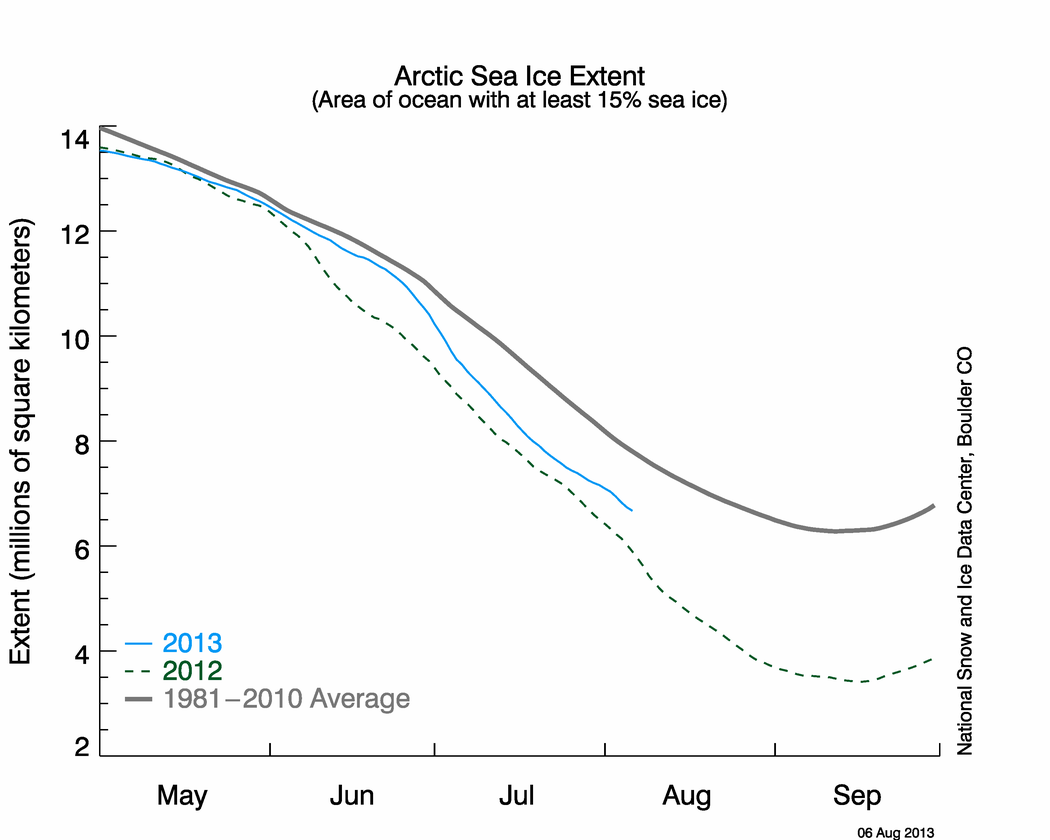
Nature is a kick in the pants, isn’t she?
Evan wrote:
Pierre Gosselin (11:16:06) :
“bsneath
According to Hathaway and NASA, this spotless period is normal.
http://science.nasa.gov/headlines/y2008/11jul_solarcycleupdate.htm
If I’m not mistaken, cycle 23 is now about 12 years long – which is long, but not abnormally long.”
Interesting that NASA (in your link) is coming out with this now. Also its interesting that they go back to the Solar minimum of 1933 for a reference to the last time we saw a significant number of spotless days to what we are currently seeing.
But what happened following the solar minimum 1933?
35 years of cooling!
Could it be some type of and indicator of some sort of a cycle on the Sun that it is switching from a warm phase to now a cooler phase?
(While I’ll be the first to admit that coincidence doesn’t always mean cause and effect, but it is interesting that even NASA goes clear back to the 30’s to find a solar minimum that they claim was similar to what we are seeing now.)
That didn’t come out right. I can’t seem to get the block quotes right. Let’s try it this way:
They, if you squint real hard, you’ll notice the article DOES say that the whole reason this is happening is the berg drifted into warm currents! (Squint! Then force yourself to ignore the deliberate misdirection. There you go! Are the boyz at the beeb the ReMasters of Deeesaster or, like, what?)
But if you check the official data for that drifting station, (click on the link, then click on the upper-left graph under “operative meteorology” ) you will see that the temperature they experienced has barely reached the 0 deg C.
Drifting station North Pole 35
For the record Nansen’s Fram (1893-96) which intentionally allowed itself to be frozen into the Arctic icepack (Sept 29th 1893, 135 deg E, 78 1/2 deg. N) after drifting in the pack to a ‘Farthest North’ at 86 deg. N was finally released on 11th Aug 1896 a little N of Svaalbad at approx. 14 deg E, 81 deg. N.
The BBC story has all the hallmarks of ‘spin’. Anyway why was the ice island ‘expected to last longer’ The article of course implies GW, but a slower drift rate would fit just fine.
Jeez, something a little more on topic? Jeez! 🙂
Gary Gulrud – thank you for the web site reference. I added it to my bookmarks. If I can count (questionable), the current spotless period will make the “top 50” in about two more days.
Re the Beeb story,
Shukman goofed up big time a few years back in relation to a story abouta diamond mining company in the Congo being linked to Al Qaeda, IIRC. Beeb ended up paying large amount of compensation.
Shukman is probably now grateful for the work and will not go against ‘official’ BBC policy that the science of climate change is settled
bsneath:
I like his comment that 1822 (or 23) probably cycle 5, would have had a consecutive spotless stretch of 140 days but for a single missing observation.
Also that (by his method) fitting 24’s progress to the bifurcated spotless cycle patterns, 24 by rights reaches minimum in mid-2009, but he can’t bring himself to believe it.
Here we go again with a graph that uses 1979-2000 as the base period. What happened to 2001- 2007 ????? Could it be that those 7 years would lower the average so that there is no significant anomaly? I am sure it does. More cherry picking, more GIGO.
bill: I took the ‘current’ minimum to reasonably include the last year or so, not just the last three weeks. My point was that, so far, this minimum has not been quieter than the previous minimum.
Anthony – sorry I am going to be OT again (I sincerely hope you and your family are well given what I have seen of the troubles in California).
I came across an article by Stephen Wilde today on CO2 Sceptics, he has been a Fellow of the Royal Meteriological Society for a while, I do not know if you know of him – and please forgive me if you have read everything he has written – but my search on your blog did not reveal anything from him.
The article to which I refer is headlined “The Death Blow to Anthropenic Global Warming” seemed to make sense.
I wonder – have the learned readers on your blog seen this and to those with scientific expertise does it stand up? I recall a rather interesting debate on the Livinston and Penn paper and this seems to add something to it?
But if you check the official data for that drifting station, (click on the link, then click on the upper-left graph under “operative meteorology” 😉 you will see that the temperature they experienced has barely reached the 0 deg C.
I can’t take credit for that. (I did make some other comments.)
philw1776 (12:21:13) :
Phil, you are so right. Compare this chart with that usual scary Mauna Loa chart that shows CO2 levels rising at about a 45-degree upward slope: click
Since this is an article about graphs, here is an interesting gif showing last year’s sea ice changes [N.H]: click
“If I’m not mistaken, cycle 23 is now about 12 years long – which is long, but not abnormally long.”
http://science.nasa.gov/headlines/y2008/10jan_solarcycle24.htm
“On January 4, 2008, a reversed-polarity sunspot appeared—and this signals the start of Solar Cycle 24,” says David Hathaway of the Marshall Space Flight Center.”
REPLY: Thats not quite technically correct. It’s not the beginning of cycle 24 that ends cycle 23, there is overlap. Cycle 23 officially ends when there are no longer any cycle 23 sunspots seen, and for the past few months, near equatorial cycle 23 spots have outnumbered the lone cycle 24 spot aboiut 10 to 1. -Anthony
Tom Klein (13:35:12) :
The “bludgeon” is not intended for the industrial society (The AGWs are not too concerned about the CO2 from the developing countries). The bludgeon is for Western Civilization. The AGWs are the latest reincarnation of the communists of the previous generation and this is the latest strategy in their ultimate objective.
Some amusing reading from Glenn’s link above…
“Doug Biesecker of NOAA’s Space Weather Prediction Center in Boulder, Colorado, likens sunspot 981 “to the first robin of spring. There’s still snow on the ground, but the seasons are changing.” Last year, Biesecker chaired the Solar Cycle 24 Prediction Panel, an international group of experts from many universities and government agencies. “We predicted that Solar Cycle 24 would begin around March 2008 and it looks like we weren’t far off,” he says.”
So where are all the robins? Anyone?
Reduction in cloud cover?
http://www.arm.gov/science/research/pdf/R00143.pdf
In comparing sunspot activity and global temperature measurements, there appears to be a very strong correlation between the two with the exception of the years 1878 & 1879. These years had many 20+ day periods of no sunspot activity and yet global temperatures rose significantly. Sure it could be el-nino, pacific oscillation, etc. , but it is just enough to keep me in the “I’m from MIssouri” camp until global temperature anomalies show otherwise.
I wonder – have the learned readers on your blog seen this and to those with scientific expertise does it stand up?
It’s basically an exposition of the main alternative theory to CO2 driven warming.
Otherwise, he appears to confuse Total Solar Irradiance, with Total Solar Insolation (which unfortunately have the same acronym). This is a fairly common mistake, but means this is a flawed argument IMO.
Irradiance will determine insolation, as long as the albedo of the atmosphere doesn’t change. When it does, due to more or less clouds, they will not be the same.
Insolation determines how much the Earth warms, not irradiance.
http://www.enotes.com/earth-science/insolation-total-solar-irradiance
Thanx Philip_B for that interesting link. My specialty being temp/humidity, I know too little about the Sun. Now I know the difference between irradiance and insolation.
Lief ….
You have to admit .. when I look at the graphic on Solarcycle 24, comparing the spotless days per month from June 96-97 to the spotless days per month June 2007-2008 … there is a difinite difference.
Of course, I can’t see the data that bracket this year’s period, so I can’t say what happened before or after 96-97, but the point blank comparison shows the solar minimum of 96-97 peaking, and then declining. 07-08 is peaked in Oct 07, but seems to be stretching for a second peak. At the very least, the number of spotless days per month for 07-08 does not seem to be regressing as it did for 96-97.
Thoughts??
Philip B.: The author did not make a mistake… he clearly stated irradiance. He’s looking at irradiance over many decades. Global insolation measurements going back that far do not exist.
Further, if there’s no irradiance, there’s no insolation… so your statement “Insolation determines how much the Earth warms, not irradiance.”, is a false dichotomy. The total output of the sun most certainlydoes have something to do with how warm Earth is!
“If this trend continues….”
….the Arctic ice will be back to 1979-2000 average by beginning of September….
My point was that, so far, this minimum has not been quieter than the previous minimum.
Well, yeah, but hasn’t the noise pretty much all been Cycle 23 noise? Where’s 24? We got that one teeny spot back in January, but what since? If we’re worried about 24, why would residual tail-off from 23 reassure us?