From OREGON STATE UNIVERSITY
CORVALLIS, Ore. – The ocean chemistry along the West Coast of North America is changing rapidly because of global carbon dioxide emissions, and the governments of Oregon, California, Washington and British Columbia can take actions now to offset and mitigate the effects of these changes.
That is the conclusion of a 20-member panel of leading West Coast ocean scientists, who presented a comprehensive report on Monday outlining a series of recommendations to address the increase in ocean acidification and hypoxia, or extremely low oxygen levels.
“Ocean acidification is a global problem that is having a disproportionate impact on productive West Coast ecosystems,” said Francis Chan, an Oregon State University marine ecologist and co-chair of the West Coast Ocean Acidification and Hypoxia Science Panel. “There has been an attitude that there is not much we can do about this locally, but that just isn’t true. A lot of the solutions will come locally and through coordinated regional efforts.”
Ocean acidification and hypoxia are distinct phenomena that trigger a wide range of effects on marine ecosystems. They frequently occur together and represent two important facets of global ocean changes that have important implications for Oregon’s coastal oceans.
Among the panel’s recommendations:
- Develop new benchmarks for near-shore water quality as existing criteria were not developed to protect marine organisms from acidification;
- Improve methods of removing carbon dioxide from seawater through the use of kelp beds, eel grass and other plants;
- Enhance coastal ecosystems’ ability to adapt to changing ocean chemistry through better resource management, including marine reserves, adaptive breeding techniques for shellfish, and other methods.
“Communities around the country are increasingly vulnerable to ocean acidification and long-term environmental changes,” said Richard Spinrad, chief scientist for the National Oceanic and Atmospheric Administration, and former OSU vice president for research. “It is crucial that we comprehend how ocean chemistry is changing in different places, so we applaud the steps the West Coast Ocean Acidification and Hypoxia Science Panel has put forward in understanding and addressing this issue. We continue to look to the West Coast as a leader on understanding ocean acidification.” Chan said regional awareness of the impact of changing ocean chemistry started in Oregon. Some of the first impacts were seen about 15 years ago when the state began experiencing seasonal hypoxia, or low-oxygen water, leading to some marine organism die-offs. Then the oyster industry was confronted with high mortality rates of juvenile oysters because of increasingly acidified water. It turns out that Oregon was on the leading edge of a much larger problem.
“It was a wakeup call for the region, which since has spread up and down the coast,” said Chan, an associate professor in the Department of Integrative Biology in OSU’s College of Science.
California responded to this call, and in partnership with Oregon, Washington and British Columbia, convened a panel of scientific experts to provide advice on the issue. The panel worked with federal and state agencies, local organizations and higher education institutions to identify concerns about ocean acidification and hypoxia, then developed a series of recommendations and actions that can be taken today.
“One of the things all of the scientists agree on is the need for better ocean monitoring or ‘listening posts,’ up and down the West Coast,” said Jack Barth, a professor and associate dean in OSU’s College of Earth, Ocean, and Atmospheric Sciences and a member of the panel. “It is a unifying issue that will require participation from state and federal agencies, as well as universities, ports, local governments and NGOs.”
Barth said one such “listening post” has been the Whiskey Creek Shellfish Hatchery in Netarts Bay, Oregon, which was able to solve the die-off of juvenile oysters with the help of OSU scientists George Waldbusser and Burke Hales, who both served on the 20-member panel. Together, they determined that the ocean chemistry changed throughout the day and by taking in seawater in the afternoon, when photosynthesis peaked and CO2 levels were lower, juvenile oysters could survive.
The West Coast is a hotspot for acidification because of coastal upwelling, which brings nutrient-rich, low-oxygen and high carbon dioxide water from deep in the water column to the surface near the coast. These nutrients fertilize the water column, trigger phytoplankton blooms that die and sink to the bottom, producing even more carbon dioxide and lowering oxygen further.
“We’re just starting to see the impacts now, and we need to accelerate what we know about how increasingly acidified water will impact our ecosystems,” said panel member Waldo Wakefield, a research fisheries biologist with NOAA Fisheries in Newport and courtesy associate professor in OSU’s College of Earth, Ocean, and Atmospheric Sciences.
“There’s a lot at stake. West Coast fisheries are economic drivers of many coastal communities, and the seafood we enjoy depends on a food web that is likely to be affected by more corrosive water.”
Last year, OSU researchers completed the deployment of moorings, buoys and gliders as part of the Endurance Array – a component of the $386 million National Science Foundation-funded Ocean Observatories Initiative, created to address ocean issues including acidification.
These and other ocean-monitoring efforts will be important to inform policy-makers about where to best focus their adaptation and mitigation strategies.
“The panel’s findings provide a road map to help us prepare for the changes ahead,” said Gabriela Goldfarb, natural resource policy adviser to Oregon Gov. Kate Brown. “How Oregon and the West Coast address ocean acidification will inform those confronting this issue around the country and world.”
“With the best scientific recommendations in hand from the science panel, we now have the information on which to base our future management decisions,” added Caren Braby, marine resource manager at the Oregon Department of Fish and Wildlife. “These are practical recommendations natural resource managers and communities can use to ensure we continue to have the rich and productive ecosystem Oregonians depend on for healthy fisheries, our coastal culture and economy.”
###
except that there is no empirical evidence that ocean acidification is related to fossil fuel emissions
http://papers.ssrn.com/sol3/papers.cfm?abstract_id=2669930
If there is global warming, the historical CO2 versus sea temperature presents temperature change is causing CO2 balance and vice versa is not true [which is global warming theory] and thus increasing temperature releases CO2 and thus it counteracts with acidification theory. Changes in temperature of ocean water is not new. The natural cyclic variations over different oceans changes the CO2 balance.
Dr. S. Jeevananda Reddy
Thanks for the explanation Dr. Reddy:))
chaamjamal.
Ocean warming and acidification are working counter each other as Dr. S. Jeevananda Reddy already said. If the oceans are warming, more CO2 is released and DIC (=CO2 + -bi-carbonates) goes down, thus getting less basic. What is observed is the other way out: DIC increases, despite some increase in (overall) ocean temperature. That means that CO2 is going from the atmosphere into the oceans, not reverse and human emissions are to blame. Not much to worry, as al human emissions until now are good for a drop of about 0.1 pH unit in the ocean surface layer, hardly measurable and no (shell)fish that has problems with that.
What is at stake in this story is from a complete different cause: deep ocean upwelling has far more CO2 and less oxygen than surface waters and is not (yet) much affected by human emissions. Upwelling is a matter of off coastal winds which pull deep ocean waters near the coasts to the surface. These may be lethal for juvenile oysters, but that has nothing to do with human emissions or human induced climate change – be it that wind direction/speed may be influenced by climate change, whatever the cause of the latter.
BTW, the paper by Munshi is not really smart: he first removed the trends and then declares that there is no correlation. But the correlation is in the trends, not in the (temperature caused) remaining variability around the trends…
Of course…
thus getting less basic
must be:
thus getting less “acidic”, or more basic
Instead of the word “basic” we should use the word “CAUSTIC” to describe the current pH .
A slight drop in pH makes the ocean LESS CAUSTIC.
Or even better: more alkaline…
I have to agree. This is conflation of two very different issues, local sea bed issues due to upwelling (and possibly affected by effluent, though this isn’t stated) with the global CO2 effects. The global effects aren’t really applicable, as the local effects clearly outweigh them by orders of magnitude. If the effluent effect is strong, then that’s something that can be addressed with proper wastewater treatment. However, if it’s natural, then it’s just a matter of adjusting for it.
The former, seemingly endless, supply has been overfished and no longer exists. So we need hatcheries to provide baby oysters. The actual ecology was never really studied and now we find that we barely understand what was going on. So now we have to reduce our production of CO2 because we don’t understand the ocean circulation.
Oh what a tangled web we weave, when first we practice to deceive- and base research on the political outcomes we want to achieve.
The solution, for the oysters at least, is to stop doing anything. When the fishery goes away the oysters will come back naturally and then they can start testing what the actual level of fishing is sustainable.
Doesn’t anyone remember Cannery Row? The bountiful supply of sardines that supported it had moved up and down the west coast from Chile to northern California following the food supply from ocean upwelling. It was just long enough, 50-75 years, for people to think it was a permanent resource, until it wasn’t. I don’t remember Cannery Row because it was gone long before I was born. But I am able to read the history and learn something.
The empirical evidence is that ocean pH has remained at between 7.6 and 8.4 for 500Ma and continues to vary between those figures. Average CO2 atmospheric content was 2500ppmv over the same period. Volcanic CO2 output is far more than anthropogenic CO2. Most volcanogenic CO2 is from under sea vents.
Johnmarshall,
Land based volcanoes emit about 1/100th of human emissions, estimated from large emitting fields around e.g. the Mount Etna in Sicily, Italy. Underwater volcano CO2 is largely absorbed by the deep oceans and add to the increased CO2 there, together with the decomposition of organics and inorganics from the remains of bio-life dropping out from the ocean surface… Thus while that certainly adds to the huge deep ocean reservoir, that has little effect on the ocean-atmosphere equilibrium.
Even the largest volcanic eruption of the past century, the 1991 Pinatubo, larger than all other volcanic eruptions of that century together, didn’t give any extra increase in the CO2 data. To the contrary, the effect of the drop in temperature and of light scattering on extra photosynthesis was stronger than of the extra CO2 release…
You see that makes more sense then CO2 from the air as there has been a uptick of earthquake s around Vancouver Island last year and a 4.7m just week’s ago South East of Victoria .
Ferdinand Algebeen: please give us a citation for that 1/100 figure. If the human component of CO2 concentrations is only 5% of the current 400ppm concentration, as even warmistas argue, you are arguing that land-based volcanoes account for only 1/100 of 20 ppm. Where’s your evidence?
Please explain further why CO2 concentrations have been rising long before human output supposedly became a measurable component.
And, where’s your evidence that ALL the 1/100 of 2ppm annually goes into the oceans?
Finally, how about an analysis showing the effects on pH of all that CO2 going into (supposedly) warming oceans.
Have at it!
Anna Keppa,
A lot of questions, which need pages of answers…
Human component of the current atmosphere is about 8%, but that has nothing to do with the cause of the increase: human emissions were twice the measured increase and are responsible for ~90% of the increase, 10% is from warming oceans. That the remaining human component is much less is a matter of exchange between atmosphere and deep oceans, which replaces low-13C human CO2 with high-13C natural CO2, but that doesn’t change quantities, as long as ins and outs are equal. That cycle even removes more CO2 than it adds.
Thus your 5% is a little low, but nevertheless irrelevant for the cause of the increase.
About volcanoes, see e.g.:
http://hvo.wr.usgs.gov/volcanowatch/archive/2007/07_02_15.html
that is based on worldwide inventories of a part of active and passive volcanoes, by far not all, but even with some 10% monitored, it gives a good idea of the ratio. That the Pinatubo was not even giving a spike in the CO2 rise says it all…
have been rising long before human output
Not that I know. Ice cores CO2, CH4, N2O and δ13C and several proxies all show increases directly linked to human activity…
The oceans are monitored for pCO2 (partial pressure of CO2 at equilibrium with the atmosphere) of the ocean waters. If the pCO2 is lower than in the atmosphere, CO2 enters the oceans and reverse. The flux is directly proportional to the pCO2 difference. The area weighted average pCO2 in the ocean surface is 7 μatm less than in the atmosphere. Thus while huge amounts of CO2 (~90 GtC/year) are exchanged between the oceans and the atmosphere, the net result is that the oceans are slightly more sink than source for CO2. See Feely e.a.:
http://www.pmel.noaa.gov/pubs/outstand/feel2331/exchange.shtml and following sections.
Anna Keppa,
Forgot to add the pH monitoring stations. Currently there are 6 stations where ocean pH was monitored over a longer period: Bermuda and Hawaii are the longest series, others are shorter. There was a nice overview of all these stations, but that link is gone…
Here the graph for Hawaii:
http://www.pnas.org/content/106/30/12235.full.pdf
and here for Bermuda:
http://www.biogeosciences.net/9/2509/2012/bg-9-2509-2012.pdf
Your tax dollars at work!
Or, an emotional appeal on the urgent need for even more bureaucrats.
Assuming this is true, “The West Coast is a hotspot for acidification because of coastal upwelling, which brings nutrient-rich, low-oxygen and high carbon dioxide water from deep in the water column to the surface near the coast.” What on Earth are the governments of British Columbia, Oregon and California supposed to do about it – nuke the ocean depths?
They have one useful option:
Ocean Iron Fertilization. It was illegally demonstrated there and was a wild success. Plankton are nutrient constrained, so adding a little iron leads to lots of plankton growth. Plankton consume CO2 and are consumed by fish. Some CO2 ends up sequestered in the deep ocean, some becomes salmon.
http://russgeorge.net/2014/06/23/worlds-first-commercial-scale-ocean-pasture-restoration/
Unfortunately, it deals with CO2 too cheaply. So, it is illegal.
If legalized, the multibillion dollar climate panic industry wouldn’t have an excuse to exist anymore.
I would prefer to do so without mass pollution and creation of oxygen-deprived oceanic dead zones as those things die off.
There’s a reason it’s illegal. It’s dumping.
Wait a minute, when I went to school they told me 2/3 of our globe was covered by the oceans, oh, wrong science, that was 75 years ago.
What a load of hockey, last I looked Henry’s law decides what the dissolved gas levels are. If water is deoxygenated then its actually likely that the gas sinks, eg algae and other micro-biota are the culprit perhaps driven by nutrient loaded runoff. Global Warming will have very little to do with it, can’t, Henry said so!
That’s correct.
Interestingly enough, it looks like they got the science part right – deep ocean upwelling as the primary driver of both pH change and plankton blooming, which causes oxygen depletion.
It’s the PR part that makes these folks sound foolish. Seems pretty obvious they are trying to drum up support for additional funding. But upwelling currents doesn’t grab one’s attention like ocean acidification does.
Yup, nicely said bobl.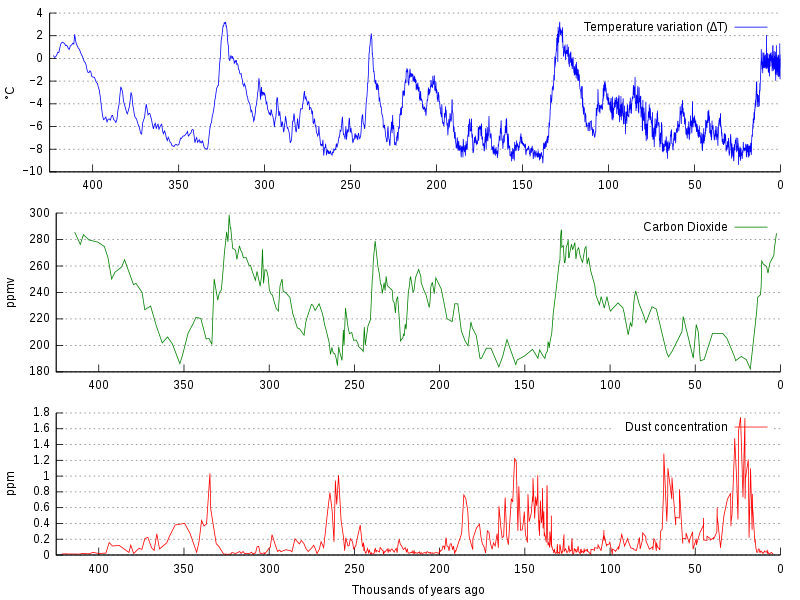
Not to mention CO2 has been as high or higher than now, many times, somehow the planet and biota survived and the paleo record does not record a global marine biotic collapse or discontinuity each time it occurs. Rather, it records a marine biotic bloom and abundance! Apparently oceanic life likes it.
I would also like to highlight in those graphs that each glaciation period is getting dustier (confirmed by ocean cores btw, not just ice) and indicates they’re getting progressively dryer and windier.
And the temp peaks of the interglacials are lower, with the current Holocene interglacial warm phase being the coldest in the series – and it’s even more obvious when you look further back in Quaternary.
https://upload.wikimedia.org/wikipedia/commons/f/f7/Five_Myr_Climate_Change.svg
So earth is clearly getting colder, and even the warmer periods are getting colder as well. So we could actually use some excess warming capacity. Because life loves warmth and CO2, and it dies back when one or both begin to fall again.
But we must perpetually panic and kack-our-panties about C02 movements, because some delusional academics want some more public money handouts to misallocate into useless areas of ‘research’, to create more self-seeking ‘citations’ lists (how about they lobby the private sector for money, instead, huh? Then they might actually have to become productive and accurate contributors to useful knowledge?)
And in blind ignorance, of the actual climate context that we actually exist?
A context that oceanic critters have evolved in and from, and survived easily, repeatedly, for millions of years?
I can’t imagine why we’d be skeptical about their endless global doom bleating.
Unmentionable,
The CO2 levels were maximum ~300 ppmv at the height of the interglacials, where several were warmer than today. We are now at around 400 ppmv, way beyond Henry’s law for the ocean-atmosphere steady state over the past 800 kyear (even a few million years in sediments).
Some CO2 peaks in the past may be hidden in the low resolution (~560 years) of the longest ice cores, but the current 110 peak would be measurable (as a smaller peak) in every ice core back in time…
The 110 ppmv over steady state is caused by humans. That is giving the panic with the warmistas, even if it is clear with the length of the “pause” (except for the current El Niño) that the effect of that extra CO2 is minimal…
That’s fine Ferdinand (I liked your site’s detailed CO2 documents and graphs btw), but we have a bit of thermal wiggle room to play with as we have a long way to go to match the medieval warming period, or any of the past 4 interglacials for T level.
If it were excess CO2 that makes a defining difference to >T, I can’t see where it got hotter each time prior with less of it about … and also the lagging warming and overshooting of the cooling onset each time.
Most people (in here) expect cooling to occur, and it may, though when I look at the data it’s clear we could easily end up in another 2 century long climate optimum. Though I would not and could not attribute that to CO2 effects, given what we know, now even with higher human contributed components and higher level over all.
It appears to be evaporated atmospheric water that makes the far more consequential difference in terms of gh effect, and also the inevitable moderating flip-side of atmospheric water’s several cooling mechanisms.
Net effect? Thankfully, nothing too bad.
“It was a wakeup call for the region, which since has spread up and down the coast,” said Chan, an associate professor in the Department of Integrative Biology in OSU’s College of Science”.
So what spread up and down the coast?
The wake up call?
The acidification?
or this message:
Guys get ready for more funding?
Someone correct my ignorance if it is so: At 400ppm, surely it’s either in the atmosphere (and causing warming) or in the oceans (and causing a very slight change in alkalinity). At 400ppm, surely it cannot be doing both? I understood that CO2 stays in the atmosphere (according to the theory) and causes the troposphere to warm…which causes the surface to warm. It doesn’t wash out for a few decades. Do I have the theory wrong?
Baz, in principle it can do a bit of both if some of it goeas into the ocean and some stays in the atmosphere.
But, as the article notes, in regions of ocean upwelling higher concentrations may actually be coming from the ocean depths. tAlso, the chemistry of coastal regions tend to be much more strongly affected by run-off from the land. And the effects are small and possibly net beneficial. The list goes on.
If I was being kind, I’d say these alarmists are making it up as they go along, as usual. In reality, many of them know the case for alarm about CO2 has more holes in it than a Swiss cheese but just don’t care. When I was a Chemist on the West Coast, there was a lot more honesty.
michael hart: appropriate analogy. The holes in Swiss cheese are caused by CO2. I thought I understood CO2-carbonate equilibria and really didn’t think the principles had changed much in the 50 years since undergrad analytical chemistry. Seems that climate science rewrites even basic stuff like that.
It absorbs in water proportionally to the concentration in air. This is found via Henry’s law
Cair * Pressure = Cwater * Henry’s Constant.
If all the emitted CO2 stayed in the atmosphere, we’d have far higher concentrations than we do. Some gets into the air, some gets into the water, other gets into the biosphere.
However, don’t get confused by this article. The article deliberately conflates different issues to try and apply global warming to issues caused by local geology and ocean upwelling.
It’s like they are complaining about lightning that caused a forest fire and then warning us about electricity usage…
Successful grant applications require the h/t to CO2 and usual appeal for jobs for the boys in perpetuity. Hardly surprising when one learns that the CENTENNIAL VARIABILITY OF GLOBAL TEMPERATURES of the Holocene ice core records up to 8000 years before present lies within the average standard deviation of 0.98±0.27C observed. Consequently, “it seems difficult to estimate the magnitude of the [present centennial warming] in the face of a likely natural variation of the order of 1C. The signal of anthropogenic global warming may not yet have emerged from the natural background.”
Shy and pesky thing, isn’t it?
Lloyd PJ. (2015) An estimate of the centennial variability of global temperatures. Energy & Environment · Vol. 26, No. 3: 417.
All will be well so long as they do not try to fix it. Can you imagine the damage they could do?
My feeling exactly. Keep these people away from the ocean at all costs. It isn’t theirs to play with.
Where is the data that shows the ocean chemistry is changing?
And it better go back 100 or more years so natural cycles can be excluded.
Surely not in a “model” ? !!!
Most rivers are sub pH7 as the flow into the oceans. even as low as pH5.5
All those rivers flowing into the ocean for MILLIONS of years, and still the pH is around 8
Anyone that thinks a minor change in atmospheric CO2 is going to make one iota of difference is off their rocker. !
Canadian Water Quality
Guidelines for the Protection
of Aquatic Life
pH
(Marine)
“The pH of marine waters is usually quite stable (between
7.5 and 8.5 worldwide) and is similar to that of estuarine
waters because of the buffering capacity provided by the
abundance of strong basic cations such as sodium,
potassium, and calcium and of weak acid anions such as
carbonates and borates (Wetzel 1983). Higher pHs are
usually found in near-surface waters because of solar
radiationBiological Effects”
The Market Failure
“While ocean acidification is well documented in a few temperate ocean waters, little is known in high latitudes, coastal areas and the deep sea, and most current pH sensor technologies are too costly, imprecise, or unstable to allow for sufficient knowledge on the state of ocean acidification”
How is that a market failure? If you go down that logic then the fact that we die of old age because current technologies do not allow for sufficient longevity is a market failure. Please distinguish between the market and the constraints of reality. If government was in charge of pretty much all of these ‘market failure’ cases we would get the same result but remarkably few people go around screaming ‘government failure’ at every perceived and invented inefficiency.
“A complete market failure exists when free markets are unable to allocate scarce resources to the satisfaction of a need or want”
“The Wendy Schmidt Ocean Health XPRIZE is a $2 million global competition that challenges teams of engineers, scientists and innovators from all over the world to create pH sensor technology that will affordably, accurately and efficiently measure ocean chemistry from its shallowest waters… to its deepest depths”
Is anyone else tired of hearing trained monkeys in the pay of Big Government
[Please do not insult the integrity, research results, nor compassion of trained monkeys by comparing them to government-paid climate propagandists. .mod]
How refreshing to have a mod with a sense of humour 🙂
“One of the things all of the scientists agree on is the need for better ocean monitoring or ‘listening posts,’ up and down the West Coast,” said Jack Barth, a professor and associate dean in OSU’s College of Earth, Ocean, and Atmospheric Sciences and a member of the panel. “It is a unifying issue that will require participation from state and federal agencies, as well as universities, ports, local governments and NGOs.””
Send more money and make more regulations and send more money and make more regulation . Keep it going, we scientists need the jobs.
Wait, so we don’t have “listening posts” up-and-down the coast? What have we been paying these people for?
We’ve come to an immediate consensus that the acidification and hypoxia is worse than we thought so naturally we need better listening posts up and down the coast.
I communicated with Dr. Cooley on this subject. The action is in the biota, which exudes carbonic acid. Increased CO2 does contribute to this, but that alone correlates poorly with the issue, which is believed to have arisen as early as 1750, whereas CO2 increase is not even measurable until 1850 at the earliest.
But the main culprits appear to be the 3 Ds: Dredging, Dumping and Drainage. That also stimulates the biota to release carbonic acid, and correlates much better with the historical record, such as it is.
The oysters they mention are an invasive species grown in hatcheries, originally from the west side of the pacific which has less upwelling. This is not a new issue.
This is quite literally, insane nonsense. Is it really being taken seriously by anyone?
As Fukushima dumps endless nuclear pollution into the ocean, our rulers tell us we need more nuclear power plants and worry about CO2 levels in the Pacific Ocean.
Insane.
The issue with nuclear power risks lies entirely in the way plants have been designed. Any plant that stores spent fuel in a way that requires active cooling carries continual risk that such cooling cannot be maintained. We have a number of plants in the US with the same design weakness. There is no excuse for failing to mount a crash program to eliminate this danger. Government has a large burden of responsibility here for failing to make such a change possible, and to then require that all plant operators work towards the solution.
Ditto that for EMP grid protection.
An easily solved problem which could be done at very low cost.
Not fixing it would bring civilization back to the stone age for decades.
A press release full of Oh Noes, about something We Must Fret About, but no space for a single number to substantiate the worry words.
When Global Warming goes the way of Acid Rain, this will be the new hideout of Alarmism.
So if your panel is tasked with finding ocean “acidification” and doesn’t then you would be out of business. Yes, I said business because that is what it is, the business of receiving government money.
Isn’t it the west coast of the US that will (or already is?) catch the air and water fallout from Fukushima? Might be a dim question, but would that affect ocean acidification?
The ocean is big, very, very big. Any Fukushima radiation has been long since diluted to an almost imperceptible level, as in homeopathy.
Spit in the ocean.
Wow. The ‘West Coast Ocean Acidification and Hypoxia Science Panel’ has spoken. They wouldn’t be the least bit biased in their reporting would they? After all, no problems would mean dissolution of the ‘Panel’ and cessation of the research dollars funding it…
The chemistry is changing due to all the opioids in the water emanating from Oregon.
Even NOAA admits that there is no abnormal pH changes happening anywhere. pH values all over are all with the normal range for the oceans. Furthermore, photosynthesis is an alkalizing process and can alter an area’s pH by more than 2 pH units on a sunny day. Marine life is much more resilient than they would want us to think.
This is all fear-mongering and most of their observations are perfectly normal for upwelling cold waters along the West Coast. Nothing unusual in any way.