This year the solstice occurs on Tuesday December 22nd at 04:49 GMT, about 15 hours from the time of this posting. This thought provoking article highlights what the ancient people in what we now call Ireland knew 3200 years ago.
One Moment in Time: The Solstice Seen from Newgrange

Deep inside the world’s oldest known building, every year, for only as much as 17 minutes, the sun — at the exact moment of the winter solstice — shines directly down a long corridor of stone and illuminates the inner chamber at Newgrange.
Newgrange was built 1,000 years before Stonehenge and also predates the pyramids by more than 500 years.
Lost and forgotten along with the civilization that built it, the site was been rediscovered in 1699. Excavation began in the late 1800s and continued in fits and starts, until it was undertaken in earnest in 1962. It was completed in 1975.
Seen as a tomb, the function of Newgrange in regards to the solstice wasn’t known until 1967 — and then by happenstance acting on a hunch. It was in December of 1967 that the astronomical alignment was witnessed and understood:
Michael O’Kelly drove from his home in Cork to Newgrange. Before the sun came up he was at the tomb, ready to test his theory.’I was there entirely alone. Not a soul stood even on the road below. When I came into the tomb I knew there was a possibility of seeing the sunrise because the sky had been clear during the morning.’
He was, however, quite unprepared for what followed. As the first rays of the sun appeared above the ridge on the far bank of the River Boyne, a bright shaft of orange light struck directly through the roofbox into the heart of the tomb.
‘I was literally astounded. The light began as a thin pencil and widened to a band of about 6 in. There was so much light reflected from the floor that I could walk around inside without a lamp and avoid bumping off the stones. It was so bright I could see the roof 20ft above me.
‘I expected to hear a voice, or perhaps feel a cold hand resting on my shoulder, but there was silence. And then, after a few minutes, the shaft of light narrowed as the sun appeared to pass westward across the slit, and total darkness came once more.’
Since that time, people from all over the world have made the pilgrimage to Newgrange to bear witness to this ancient ritual begun over 5,000 years ago and only brought back into the light for the last 40.
The unknown makers built well. And they built for a very long time:
Five thousand years ago, the people who farmed in the lush pastures of the Boyne Valley hauled 200,000 tons of stone from the river bank a mile away and began to build Newgrange. At the foot of the mound, they set ninety-seven massive kerbstones and carved many of them with intricate patterns. Inside, with 450 slabs, they built a passage leading to a vaulted tomb, and placed a shallow basin of golden stone in each of its three side chambers.
Like so much else from the Age of Myth the “why” of it all at Newgrange will never be known. The people who took 20 years to move 200,000 tons of rock left us no clues beyond the spiraling runes cut into the rock. Like all the mysteries that emerge from time with no footnotes, it is left to us to make what meaning we can from them. But perhaps this one monument from the Age of Myth gives us, every year, one small hint.
No matter what time and the universe can throw at us, we still go on. To remind ourselves that we have and shall endure and prevail, we still mark our small planet’s turn around our home star. We mark it with ceremonies every year when, at this moment in time, the sun begins to rise higher to warm us again in our small patch of heaven. And we are still here to bear witness, no matter how shrill the Acolytes of Zero, to the mystery and the gift. We’re a tough race and a rough species. It will take more than a few degrees centigrade, one way or another, to finish us.
The light of the solstice pierces to the heart of the tomb at Newgrange, and then, soon after, the Light of World arrives. Two moments that remind us of the many manifest miracles of God. Reminders that no winter is without end and that The Gift is given to us again. If we can but receive it.
Posted by Vanderleun at American Digest h/t to dbstealey
Discover more from Watts Up With That?
Subscribe to get the latest posts sent to your email.
It is a real shame that most children growing up today don’t see the night stars due to light pollution or watch the Sun’s shadow change over the seasons.
I grew up in a very rural area and on cold, clear winter nights would go outside and watch the planets, stars and the milky way and it has left a lasting impression. Now when I go outside, the best I can see are a few stars, planets and the occasional ISS coming across.
I’ve taken my children offshore on our sailboat just to see the stars, and they were totally amazed. And for me to go to the tropics to see some of the southern constellations was also fascinating.
I can see how the ancient people put so much in astronomy as it was a constant show as the stars and planets slowly changed over the seasons.
I can remember the same on the South coast of UK near Pevensey in the 50’s. Lying looking at the stars. And my father saying “There is no up or down in space. So you may be looking down at the stars, what is holding us up here?’. How to start an interest in science.
Lovely! I am lucky enough to still live in a part of West Sussex that is quite dark. I hope you don’t mind if I use your father’s line on my son.
Ironically, I just finished reading a novel about, for choice of a better word a nonbeliever, a hard bitten writer who specializes in debunking myths, old wives tales, folklore, and such.
At a particular point in the story he considers the Big Bag theory, where everything currently existing in the known universe was a ball of energy which exploded; for some reason this same individual experiences a situation affecting his life and those that he loves, and finds himself praying to God for their safety.
Suddenly he realizes that though he’s always believed that all phenomena could be explained naturally, the concept of a God is no more ridiculous than a 13 billion year old tennis ball of energy exploding to form the immense, ordered universe we know today.
I agree seeing the stars on a clear dark night is great. It is therefore encouraging that several places in the UK have now been granted Dark Sky status as they strive to prserve the darkness. So, for example, if you visit the island of Sark (in the Btitish Channel Islands) TAKE A TORCH. .
if the greens get their way, all of the UK will have Dark Sky status.
What I find remarkable is that if these people e don’t know build this place 3200 years ago, based on their astronomical observations, and the geometry still works today, doesn’t that indicate that the earth’s axis has not moved appreciably in that 3200 years, so axis shift cannot have influenced climate change in historical times.
g
ps I thought the pyramids and the Sphynx were much older than 3200 years.
Humm yes the pyramidae are older than 3200 years there is the liitle bit of c.a. 2000 extra years you need to add to any date marked as sometime BC.
>>so axis shift cannot have influenced climate change in historical times.
The angle of obliquity, which would effect the solstice angle, has a 40 kyr cycle. So no, the last 5 kyrs would not change the angle much. And the pyramids are more like 4.5 kyrs old, than 3.2.
The article says that Newgrange was built 5,000 years ago, and predates the pyramids by “more than 500 years”. 5000-500= 4.5k Where did you get 3200 from?
In actuality, they don’t have a clue as to actually how old the Great Pyramid of Giza or the Sphinx is.
The Egyptians never had the technology, the mathematics or the tools that were required for the construction of the Great Pyramid.
Samuel,
Actually the pyramids are well dated and clearly the ancient Egyptians did have the technology and tools needed to build them.
For example, carbon dating of wood remains at the Old and Middle Kingdom sites:
http://archive.archaeology.org/9909/abstracts/pyramids.html
“Actually the pyramids are well dated and clearly the ancient Egyptians did have the technology and tools needed to build them.”
Two words: Space Aliens.
One name: Erich von Daniken.
’nuff said.
I mean, what is this guy doing, anyways:
http://www.allmystery.de/i/tgjRnYk_mayan_rocket.jpg
If that is not an ancient Mayan driving a rocket ship, I do not know what would be.
It’s an early bidet…
Hard to find a contractor who will do that kind of quality work these days…
The picture is upside down and it’s not a guy.
It is 5000 years ago, built 3200 BC. It is of the same vintage as the Ulster Cycle, reckoned to be the oldest surviving mythology in Europe. ‘S Ultach a th’annam agus tha mise pròiseil. ( I am proud to be an Ulsterman!(
Gloateus Maximus,
Your mimicry of what you have been told does not impress me any. There are no records, references or artifacts that denote, define or describe the technology and/or tools that were REQUIRED for the construction of the Great Pyramid. The Egyptians just “laid claim” to it after they migrated there from the western Sahara region.
First of all, the Egyptian Pharaohs never dictated the construction of much of anything, especially something personal, that they did not also dictate that their name, their deeds, their “picture” and/or statues of themselves … were to be, per se, “plastered” all over the structure, both inside and outside. The Great Pyramid contains no said “signatures”.
And 2ndly, the Great Pyramid was originally “surfaced” with pure white limestone, bottom to top, all four (4) sides …. resulting in a perfectly smooth “white” surface no matter the direction it was viewed. (HA, it could have been used as a “reflecting telescope” for measuring the movement of celestial objects – Sun, Moon, stars, etc.) The Egyptians were not capable of performing that “surfacing” task. As a matter of fact, that “surfacing” task would be a great challenge for present day architects and/or construction engineers.
And 3rdly, the precision of alignment and dimension are daunting factors of the Great Pyramid that “beg” for an intelligently reasoned explanation.
Cheers
Yes, George, it does indicate that. If current precession theory were correct, then the time of seasonal transition marks should change about one season every three thousand years.
Hum, did you know that astronomers do not make an ajustment for objects inside our solar system.
Perhaps the solar system is curving through space?
…and George, contrary to a comment above yours, precession is a 24 thusamd year cycle. Curiousely it was thought to be 25 thousand years, but it is accelerating for no explainable reason.
So, to correct my above post we should observe a three month shift every six thousand years if current precession theory is correct.
The saddest aspect is that here in the western US, even in light-polluted Central California, you only have to drive a couple of hours along judiciously chosen routes to let your kids see the stars. In Oregon, Washington and Nevada the trip is even shorter.
If you can’t see the stars, you should move.
Well said, Ed
It was important to mark the return of the light, to have the promise of another year to live.
I have to agree. The flora and fauna of the planet share the return of spring as the awakening and rebirth of life itself. Why wouldn’t the first civilizations have marked this occasion as a start of the new year and used this structure as an annual clock, having realised and studied the cyclicality of the seasons?
It wasn’t “important” – it was ESSENTIAL !! If the sun continued to fall below the horizon – they were dead… Someone had to tell the people living then that – Yes, the sun has turned, it is coming back from its descending trend. “We will be able to survive another year…”
I never heard of that site before. I worked at a building with long halls and picture windows that frame the setting sun during New Hampshire’s foliage season. Very colorful for a few days.
One site in New Hampshire used to be called Mystery Hill but was renamed America’s Stonehenge after its seasonal standing stones were found. Not much is well understood about it, but it’s worth a visit. Their web site is, http://stonehengeusa.com/ is uninformative, http://www.unmuseum.org/mysthill.htm has more about the standing stones and what may be a sacrificial slab.
http://www.unmuseum.org/as_summe.jpg
Ric, the links are interesting. One sad reality is that archaeology, like climate science is split into camps about what is, and what is not possible. Not infrequently sites that carry incredible information will be waved off as mistakes, incompetence, or even hoaxes by the more dogmatic and entrenched members of the field. Place like Mystery Hill tend to fall into a “no man’s land” between the camps because their very existence excites controversy and challenges “useful” existing models (not mathematical in this case). One important influence on American archaeology was the “isolation” of the continents from the rest of the planet. Another is that where archaeology in Europe derived from a mixed bag of paleotologists, classicists art historians, and religious studies, in the Americas the majority of archaeologists come through Anthropology. The “isolation” offered the possibility that the Americas could be regarded as a “test tube” where regularities in cultural evolution – apparently consistent patterns of changes from early small group foragers to high, literate, agricultural civilizations – could help understand humanity in a global sense. Any suggestion that the isolation was not total, or even non existent, threatened an immense body of evolutionary theory that had elevated these observed regularities into “laws” of cultural change.
And I never heard of the following before about a week ago:
http://www.historic-scotland.gov.uk/propertyresults/propertydetail.htm?PropID=PL_233
Maeshowe,
Skara Brae,
the Stones of Stenness and adjacent standing stones and
the Ring of Brodgar together with adjacent standing stones and burial mounds.
John, if you ever get to visit the Orkney Isles, as I was fortunate to do for a whole week, also visit the Tomb of the Eagles, which you slide in and out of on a large skateboard:
http://www.megalithic.co.uk/a558/a312/gallery/scotland/Orkney/ExitingTombEagles.jpg
Reading the history of this area (in literature prior to the current propaganda), and understanding the vegetation, it was clearly considerably warmer than current times.
I was more surprised though that if you walk across the fields and moors of this isolated outpost of the UK, there are some multi-thousand year old dwellings that have been partially excavated (sometimes by the local farmers), but there are also quite prominent mounds that have yet to be even studied.
[If my memories aren’t quite correct, it could be due to the fact that there are two superb single malt scotch distilleries on the main island – Highland Park, the most Northerly on the planet, and Scapa].
http://www.tomboftheeagles.co.uk
http://www.goodreads.com/book/show/129736.Tomb_of_the_Eagles
Also look into the Callanish Standing Stones, on the Outer Hebrides. They predate Stonehenge and are aligned with a lunar event that occurs only once every 18.6 years. I find it literally unbelievable that they could be arranged so precisely without some sort of written instructions, as this event only occurred once or twice in the lifetimes of people alive then.
It ought to engender a little humility in us. We don’t really know that much more about the mystery of life and the universe than the ancients did. We ought to be more respectful and less dismissive of things they held to be true. It might save us learning lessons the hard way. We ask science to answer a lot of questions it can never answer. Science can observe and measure… and it can repeat its observations and measurements. The conclusions are the fruit of human imagination. We ought to be humble when we observe historical evidence that man has always engaged in science thoughtfully.
+1
Very well said sir…. and too often ignored.
Will,
Like Aphan – I’ll plus one.
Your point: –
“We don’t really know that much more about the mystery of life and the universe than the ancients did.” is very well made.
And I’d add that we do not know rather a lot about our own history; know some, and we interpret [or view through a glass darkly] some more.
We do have ideas, some/much of which are about right.
Yet Newgrange [3,200 BC]; Easter Island statues; the Volkerwanderung; even King Arthur [Myth or Man?] of Camelot.
What do we k n o w – against guess, surmise, believe, hold as the popular view, etc.?
I think that then, like now, there were some people who were very curious by their nature, very patent and observant, and loved to tell people all about the things they knew.
And people in general were always ready to do things in some easier way, or copy a good idea when they saw it, and brag about stuff they knew.
So knowledge was gathered and passed around and readily learned by others.
Just like now.
It may be that the tendency of other sorts of people to hoard knowledge and information, and use it to hold onto power rather than disseminating it freely, has held us back a great deal.
I have read plausible accounts detailing how the ancient Romans came within a hairs breadth or inventing a steam engine and thus starting an industrial revolution a few thousand years earlier than it did start.
Yes, agreed, and it is sad that so much of “science” today is corrupted for profit or power over people.
Yeah but if we just took what they knew and modelled it on a really big computer….
Early science to support a belief. Did they think a God was signaling them that their summer was returning, and that they were being rewarded for being chaste? No doubt they had priests to tell them so.(Do as I say and you shall prosper).
What difference does the why make? It’s obvious that no matter what they believed, they understood much about the planet’s behavior and that of the star system it exists in. They were mechanical and mathematical geniuses, and whatever drove them, drove them to accomplish incredible physical feats. A calendar that is so geographically accurate, even today, demonstrates high intelligence no matter what inspired it’s creators.
Early science to support a belief….
So, the clock on the wall and the calendar next to it are there to support your belief? Was the USHCN established to support a belief? Or was it instead established to aid farmers in planning when to plant, shipping on when, and how, and by what means or route to ship? It is worth remembering that would be leaders (chiefs, ceos, etc.) tend to score higher in sociopathy. They’re useful, but they can’t help taking advantage of people who rely on them to do things that others don’t have time for.
There must be a belief in time in order to proceed accordingly.. Keeping the mind tuned to the passage of time so that we are aware of what we must do and what to expect in the future. Accurate timing and the awareness of longer periods than day and night are, I believe, only a human trait and not observed in other species. We have more control of our environment and the conditions in which we live with the keen awareness of time we possess. This awareness of time is one of our talents that give us our huge advantages over other species considering civilization.
Birds caribou and other animals, and even insects like monarch butterflies, begin their migrations long before they must do so in order to survive in the short term.
Not sure what this indicates, but for the birds, we have good data to indicate that they are capable of planning ahead in several steps.
Until we can ask them, we must wonder.
I know some believe that only humans have complex emotions and thought processes, but we really do not know that, and I for one doubt it.
Some animals have been shown to have a well developed theory of mind.
Farming and herding of animals began in the Neolithic, or New Stone Age, about 11,500 years ago. Members of the clan, tribe or family were assigned the job of “herder” which meant some of them had to spend night after night “watching the flock” to prevent predation or from straying off. Thus those herders had plenty of free time to observe the night sky and the “motion” of the Moon, visible planets, the stars and the rising and setting of the Sun. And surely, after a few hundred years of “observations” those herders knew quite a bit about the repetitive “movements” (equinoxes, solstices, etc.) of the earth and other celestial objects.
So “Yes”, they knew when “summer was returning” and “winter was approaching” ….. and that “spring planting was just around the corner” ….. by simply counting the days from when the solstice occurred (beam of light thru an apeture or a shadow cast on a rock face.)
I would tend to disagree with you. Early science, just like it is now, was most likely intended to demystify life and move it from dogma to reality – thus it would have flown in the face of religion as it always has. Why would you ever think that it would have been intended to support religious beliefs? Your position is beyond my ability to comprehend.
“I would tend to disagree with you. Early science, just like it is now, was most likely intended to demystify life and move it from dogma to reality – thus it would have flown in the face of religion as it always has. Why would you ever think that it would have been intended to support religious beliefs? Your position is beyond my ability to comprehend.”
Do you even history? Modern science exists because people took the premise of religion (God is logical, constant and understandable), applied it to the universe (God’s creation is logical, constant and understandable), and then observed the world around them, testing it, all for the purpose of understanding /how/ God made the universe work.
I think you mean 3200 BC.
You beat me to it. Yes, Newgrange is 5,000+ years old. But it still isn’t the oldest building humans made that still stands. Göbekli Tepe holds that record at a whopping 10,000 BC timeframe. Thanks to the people that buried it in sand and dirt when they left it for good the site has been preserved in great condition.
I am not too sure that the date for Stonehenge is correct. Since you cannot date stone, archaeologists have relied upon carbon dating of intrusive burials and detritus. But is detritus coincident with the construction of the site? It is clear that Stonehenge was a sacred site, rather than a graveyard, so the one or two burials are likely to be from a period when the site was abandoned.
Funnily enough, the only true dateable artifacts were some large ‘totem poles’ in the Stonehenge car park, and they were dated to 8,000 yrs BC.
It is clear that Stonehenge was a sacred site, …
I don’t think it is necessarily clear at all. It is a common -place, and probably the best explanation, but any assertion about “ceremony” begs questions. What we really know is that you can use a “complete” version to predict eclipses, seasons, and if you want to stand around all day, it will operate as a glorified sundial, so you always know “Stonehenge standard time.” We know that cremations, and there are more than 60, were placed in the original Aubrey holes, and that the knuckle head who first excavated them in the 1920s reinterred them in a single hole without bothering to analyze them – why archaeologists often hate archaeologists. The date is probably more secure than you might imagine, but the purpose? Beyond that, every thing is, at best, educated guesses, and sometimes the education may be lacking; at worst arm waving. There’s a running joke in archaeology that if you can’t identify a function, call an object a ritual item. The same goes for sites. See:
http://sultanaeducation.org/wp-content/uploads/2014/06/Motel-of-the-Mysteries-Macaulay.pdf
if only for the humour. If you are familiar with the history of archaeology, you will enjoy the not-so-veiled allusions.
If you can’t identify a function for an artifact, you don’t give it a definition. You simply say “I don’t know”, until you know.
But is unlikely that Aubrey holes were designed as cremation holes, because they are precisely aligned with the orientation of the site, and therefore alligned with its astronomical layout. In which case we are back to the original question of whether Aubrey hole ‘burials’ are truly are part of the functioning Stonehenge site. And these burials are certainly not coincident with its construction. So how do we know when the site was constructed?
Funnily?
Darwinist said “If you can’t identify a function for an artifact, you don’t give it a definition. You simply say “I don’t know”, until you know.”
You’d think so, but not really. Some “expert” will start theorizing and comparing and correlating and declare that they “believe” that object 1 was some kind of utensil, or jewelry or whatever and if every person afterwards is too lazy to investigate further than the “expert” did, eventually all of them “believe” that object 1 is what someone once assumed it was. Whether or not it actually was a spoon or a bracelet is rarely proven.
And that is the whole problem with science today. 🙂
Such nonsense as “salt causes high blood pressure” was invented by one guy who was completely wrong, and passed around and became “common knowledge” with absolutely no empirical studies ever showing it to be true, and in fact zero evidence to indicate it is so.
Such things become so entrenched that even after being debunked and disproven, such people as organizations of medical professionals will still hang onto it and use it as a basis for medical advice.
The more of this sort of thing ones learns, the more surprising it may be that we ever rose above living lives of rank superstition.
Here is a just announced example of the expertise of the Antiquities “experts”.
http://www.foxnews.com/science/2015/12/23/facebook-user-identifies-mysterious-gold-object-found-in-israel-cemetery.html?intcmp=hplnws
Iffen the majority of archeologists would just “rid their mind” of their nurtured Religious beliefs then they could do a whole lot better job at what they like doing.
Unlike modern Europeans, that believe a few degrees of warming will result in Armageddon, primitive Europeans recognized that cooling was the great enemy.
To the northern hemisphere ancients, the most important day of the year was the winter solstice. The day upon which the sun stopped moving south and began its climb in the sky to return warmth to the North. The warmth upon which all life depends.
Very likely this custom goes back tens or even hundreds of thousands of years, to Ice Age humans, who fully recognized that cold meant death and warmth meant life. Who first learned to chart the path of the sun in the sky, and time their annual migrations to follow the path of the sun, and the plants and animals which rely on its warmth.
Correct. All religions sprang from this fear of no sun reappearing. Magical spells had to be performed to prevent the death of the sun. A new sun (‘son’) is born this day, a new Apollo must arise with the dawn.
I hope that is irony, like the irony that lead to Apollo, originally a mouse god, supplanting Helios as the sun god in Greek religion.
Not just in 3200 BC but before 32,000 BC people observed the night sky:
http://sservi.nasa.gov/articles/oldest-lunar-calendars/
That the cave art at Lascaux and other such Paleolithic sites depicts constellations is a defensible hypothesis.
In the Gulf of Morbihan, near Carnac in Bretagne, France there’s the island of the Gavrinis, with a similar though much smaller building, called ‘Cairn de Gavrinis’ or colloquially ‘Tumulus du Soleil’, where the Sun aligns with the entrance tunnel at the summer solstice.
Long ago they were terrified that the sun would not ‘come back’ from its descent into Hades (winter). All of our present festivals revolve around this sun business. The sun controls the climate more than any other factor. It is the thing that warms us all.
By the way, the humans who moved into Europe during the glacial melt worried greatly about another Ice Age and for good reason.
What I see today is total denial of Ice Ages. Instead of looking at the obvious information showing brief interglacials that suddenly descend into full ice ages, the ‘scientists’ and our rulers look at very slight warming with alarm which I think is totally fake.
That is, all of these creeps use energy very energetically and tool around burning fossil fuels like madmen while screaming we will roast to death because of burning fossil fuels. Not sack cloth and ashes for them all. They want to consume and consume some more. I say we need a Nuremberg Trial for these criminals who scream about CO2 all the time while grinding out mountains of this CO2 gas, goofing around playing golf in Hawaii.
We might think it funny that in winter as the sun descended lower in the sky, people were scared that it would not rise again. Unless a ritual was performed.
It s just as cute that people now see that climate warming and are filled with a numinous dread that – unless we perform a ritual – the climate will go on warming and not cool again.
Interesting perspective.
Okay. Made me look it up. “Numinous” is “spiritual, airy, etc awe-inspiring.” I learn more words from these posts!!
@philsalmon
I was thinking along the same lines. The IPCC and UNFCCC are constantly promoting the idea that we need to erect a governmental edifice to control the maximum concentration of CO2, a gas that is essential for more than 90% the biomass on this planet by weight. A governmental structure that will consume comparatively as much of our labor as Newgrange consumed of its community — and be just as effective.
I wonder if the vast majority of the people who built the Newgrange and beheld its first winter solstice sunrise, turned as said to its designers, “Is that ALL it does?”
And the ritual is called ” Raise taxes” or the planet will burn.
As of today, being a hypocritical moron is not a crime. I would examine myself and the lives of everyone I love and determine that all are above such behavior before attempting to sway public support for court trials against it.
I’m not above such behavior. Let’s do it!
…true, but is demanding other people’s money, and taking it by force in conjunction with hypocritica moronic behaviour worthy of , say at least far and feathers?
People in those ancient days KNEW the earth, by personal observation and the life-and-death lessons of exposure to all the elements. They realized the extent to which all life on earth depends on the whims of Nature, and they remained humble in the face of Nature’s miracles.
Today most think we’re somehow separate and apart from Nature, have grown beyond it and can rule it. How wrong-headed THAT notion is! Nattering monkeys, newly down from the trees!
Happy Solstice Day!
Actually, nothing has changed. We still have witch doctors pretending they control the sun via magic spells. In the present case, pretending CO2 warms the planet, not the sun. And pretending the sun never shifts or changes the output of energy! That is really bizarre and can only be explained by the need to have religious powers.
Note how our priests and rulers screaming about CO2 are cheerfully churning out mega-tons of CO2 with their private palaces, jets, yachts, etc. etc.
The observational capabilities of ancient people is often ignored. Their ability to link (sometimes correctly – sometimes not) events that were often considerably separated in time is, when you look back, remarkable.
Not only to notice, but to measure and record data to a 17 minute window out of 525,600 minute time period. And how many diverse cultures did the same or similar thing.
I find it humorous when people talk about the Mayan calender not having or knowing a ‘Leap Year”. So they build pyramids to catch the solar and earth rotation effects, have great celebrations, but did not notice the date change after 4 years?
And possibly to not notice the ‘culture change’ that happened when we moved from a world governed by solar time to something more mechanical. Perhaps we should look at this through different eyes.
It takes more than one four year period for things to get obviously out of whack.
Does that mean we are slightly wrong 3 out of 4 years?
“Does that mean we are slightly wrong 3 out of 4 years?”
It is always wrong, but they attempt to keep up by adding leap seconds here and there.
DD More:
The Mayan calendar corrects in other ways, and the Long Count is more accurate than the Gregorian calendar we use today.
http://www.infinitelymystical.com/essays/maya-year.html
Ancient people were quite meticulous in these things. You tended to lose your head if your predictions were not close to the outcomes.
Gold
Absolutely.
The lack of awareness of the world – weather, seasons, climate, stars, trees, even biting insects or stinging nettles, is so disappointing.
I am constantly telling my ships’ watch officers – “Look out of the Window!”, because what you see out there is real.
[Better yet – get out on the Bridge wing, where there is not even a double thickness of glass between you and another ship that may be likely to smash into you (because they, too, are not looking out of the window . . . . . . .)]
Now – what your screens show you is an electronic analogue, which – if you understand it – may be close to the real thing. Very close.
But it’s not the real thing.
It may help you interpret the real thing.
But it’s not the real thing.
It will – operated well – help you place yourself in relation to the real world of points, headlands, buoys, shallows, lightships and the rest.
But it’s not the real thing.
There is a beautiful world out there.
I do not appreciate it – let alone know it – enough.
But the millenials – do they know it is there?
Auto – obviously showing his own antiquity!
Look out the window.
This is, IMO, the gist of it.
Back then, people lived outdoors.
These days, some people rarely spend even a single entire day out of doors, and even fewer do so out in a place that is still in a natural state…such as going camping or even just on a day hike away from civilization.
“You can observe a lot just by watching.”
-Y. Berra
Ahhh … the powers of those ancient priests, with their mysterious wisdom and knowledge, that made it possible for them to have massive structures built by a society that lived a precarious daily existence and surrendered so much to those very priests.
Fortunately, here we are thousands of years later and have moved beyond things such as listening to the ramblings of mystical priests … oh, wait … there are those papal encyclicals that still haunt us …
The spirals are not “Runes” they are perhaps Glyphs.
Newgrange does not predate Stonehenge, in may predate the currently arrangement of remains there.
As with Stonehenge, correlation or coincidence is not causality and the fact that Solstices coincide with certain alignments is only that, all else is conjecture.
The temptation to re-write history to suit our current perspectives is always with us.
If all the statements and even hints of the date of the birth of Jesus as stated in the Gospels are compiled, it could not have been at the end of December. For example, the shepherds did not keep their flocks in the fields that late in the years. Any attempt to place the birth of Jesus on December 25 is far more an attempt to connect it to the solstice than to scripture. And yes it does matter given the importance of the solstice to sun worship.
To ensure that the non-Christians followed Christianity it was necessary to match the Christian festivals to those of other religions particularly those where bacchanalian celebrations took place. So Christmas magically became the Solstice celebrations of which there were many. The crucifixion and associated celebrations were moved to the fertility festival of Eostre. A ‘Christian’ festival linked to the phase of the Moon. (Also read of Emperor Constantine and the way the ‘conversion’ to Christianity from Mithras occured.) Churches were built on old holy sites for the same reason.
>>an attempt to connect to the solstice…..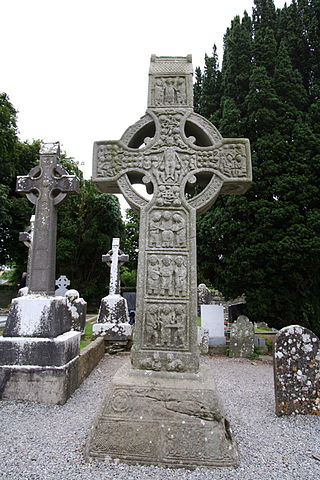
And the little oddity that while Jesus was said to have been born at the winter solstice, John the Baptist was born at the summer solstice. So Xianity was based upon an astrological cult, much the same as all the Sabaean religions of the East.
And so was original Judaism. All of the very early synagogues in Judaea, Syria and Jordan have a zodiac on the floor. Perhaps the best of these is the 3rd century Hamat zodiac on the Sea of Galilee. The same is true of the early Irish crosses with a circle around them. Rather than being based upon a Roman instrument of torture, they are actually the circle and cross of the zodiac.
Based on the clues in the Bible, Jesus was born in the Spring, and thus Easter is the celebration that occurs closer to the actual time of year. If Jesus was born in the Spring, then John the Baptist would have been born near the Winter solstice prior, because Elizabeth was well into her pregnancy when Mary visits her in scripture.
There are amazing correlations in the Bible between the 12 tribes of Israel and the zodiac signs, but they occur before the Israelites were captured (and thus influenced by) the Babylonians…to whom many scholars attribute the origin of the zodiac. Interesting stuff.
https://youtu.be/AjHk9nKUNNs
http://www.stellarhousepublishing.com/zeitgeistsourcebook.pdf
The Orthodox Christmas, and the original date of christmas is January 6th. Catholics changed the date to suit what Ian W references above.
Ok. Correction. January 7th is Orthodox Christmas. 6th is the Eve.
Not so. The Orthodox Church just refused to move the celebration date, when the Gregorian calandar was introduced. So their date was effectively moved by 12 or so days into January.
Orthodox Christmas is 25th of December, but on the old Julian calendar. The 25th of December in Julian is the 7th of January on the Gregorian calendar.
So the day of celebration remains the same for Orthodox churches. Catholics and other denominations moved the day of celebration to align with the date on the then-newly-adopted calendar. Same goes with Easter, which is determined based on the alignment of the moon at a certain date. This means that at times Orthodox/other Easter is on the same days, but most years it differs.
It’s an enchanting site and worth a visit if you’re anywhere nearby (and in such a small country it’s all nearby). You can actually go to watch the solstice sunrise, but attendance is determined by lottery because of high demand and the limiting small size and fragility of the structure.
At least as interesting a few miles to the south, unsigned and unsung, is a hawthorn tree standing alone near the edge of a field and festooned with ribbons and yarn and candy wrappers. The aos sí (primeval fairy folk) and the spirit world are still very close at hand in that part of the world.
But you can go much more easily on the days close to the solstice. And there is little solar movement, right at the solstice, so you will not notice the difference.
Aren’t the buildings at Göbekli Tepe thousands of years older?
I don’t know but perhaps ‘oldest known functional building which was not reconstructed’, would be more accurate? I can’t think of another building 5,000 years old which is in-tact and as functionable as when it was first built.
Well, not quite. It had all fallen down, and had to be rebuilt in the ’60s. However, the real oddity was when they got to the bottom of the material, they found that it had fallen onto bare earth, not onto grass. Which rather suggests that it had been deliberately destroyed.
One of the buildings at Göbekli Tepe:
http://image.b4in.net/resources/2013/09/18/1379537027-gobekli+tepe+4.PNG
The unique method used for the preservation of Gobeklitepe has really been the key to the survival of this amazing site. Whoever built this magnificent monument, made sure of its survival along thousands of years, by simply backfilling the various sites and burying them deep under, by using an incredible amount of material and all these led to an excellent preservation.
http://gobeklitepe.info/
Well, at least those people understood that they could not control the weather AND that cold was the greatest threat !!!
Was built around 5,000 years ago – 3,200 yrs BC. Given temperature proxies available for the time, it was built when the planet was wormer than today. The people obviously enjoyed a great climate with long reliable growing seasons and good rainfall. So they had the time to focus on both science, and the extravagance of building such a long lasting monument.
and robins ruled the earth.
CommieBob — You are a sick man — Eugene WR Gallun
Surely there is a correlation between a warmer earth and more earth worms? Maybe I should apply for a grant, if only I can prove that earth worms are bad for the planet. 🙂
The Lambton Worm
One Sunday morn young Lambton went
A-fishing’ in the Wear;
An’ catched a fish upon he’s heuk,
He thowt leuk’t varry queer.
But whatt’n a kind of fish it was
Young Lambton cuddent tell.
He waddn’t fash te carry’d hyem,
So he hoyed it doon a well.
cho: Whisht! Lads, haad yor gobs,
An Aa’ll tell ye’s aall an aaful story
Whisht! Lads, haad yor gobs,
An’ Aa’ll tell ye ‘boot the worm.
This feorful worm was almost as frightening as manbearpig
Many may not realize that earthworms were absent from soil in the northern US prior to the arrival of Europeans. The glaciers killed them all it seems.
I wonder if Ireland was not similarly wormless?
Menicholas…
If there weren’t worms, then how did they fish? Come on!
Good point. People had to be more clever back then I think.
Must have had to use maggots.
If you think it is hard to get a girl to put a work on a hook, try getting her to do it with a nice juicy maggot!
There is a lot of disagreement over whether earthworms were just rare, or totally absent form North America, and whether it was all of them, or only certain types, and whether it was the whole continent, or just the northern parts.
it is a very interesting subject, especially for people like myself who love studying soils types, biomes, and other aspects of physical geography.
Physical geography is indeed a very complex and interesting tapestry of knowledge.
In 3200 BC there was a sudden shift (colder) in the climate of that region. Farming ceased for centuries. The civilisation farming the land between Wales and Ireland was drowned – the stone walls can still be seen leading into the water in W Wales and from the air on the sea bottom. It is likely the axis of the Earth shifted about half a degree. There is a book on Britain’s lost megalithic civilisation.
Jaymez said:
…the planet was wormer than today.
————
Global worming.
One of the claims the Egyptians made to Plato was that they were the oldest continuous civilization on earth and that their ancient records recorded the rise and fall of many great civilizations that flourished for centuries and then disappeared — with all the knowledge they had discovered. Time and time again civilization had to start over (except in Egypt).
Lately much has been in the news about ancient structures that needed a flourishing culture to support their construction — civilizations that arose, expanded and then fell.
How many times was the length of the solar year discovered and forgotten? These old structures suggest that many of the secrets of the skies were unlocked in many places and then lost.
The Phaistos Disc of ancient Crete was probably a solar calendar indicating a solar year of 366 days divided into 6 months of 30 days alternating with 6 months of 31 days. But in a largely illiterate society a lunar calendar was probably of more practical use. Much easier to keep track of moons than of days.
Eugene WR Gallun
“The Phaistos Disc of ancient Crete was probably a solar calendar indicating a solar year of 366 days divided into 6 months of 30 days alternating with 6 months of 31 days. But in a largely illiterate society a lunar calendar was probably of more practical use. Much easier to keep track of moons than of days.”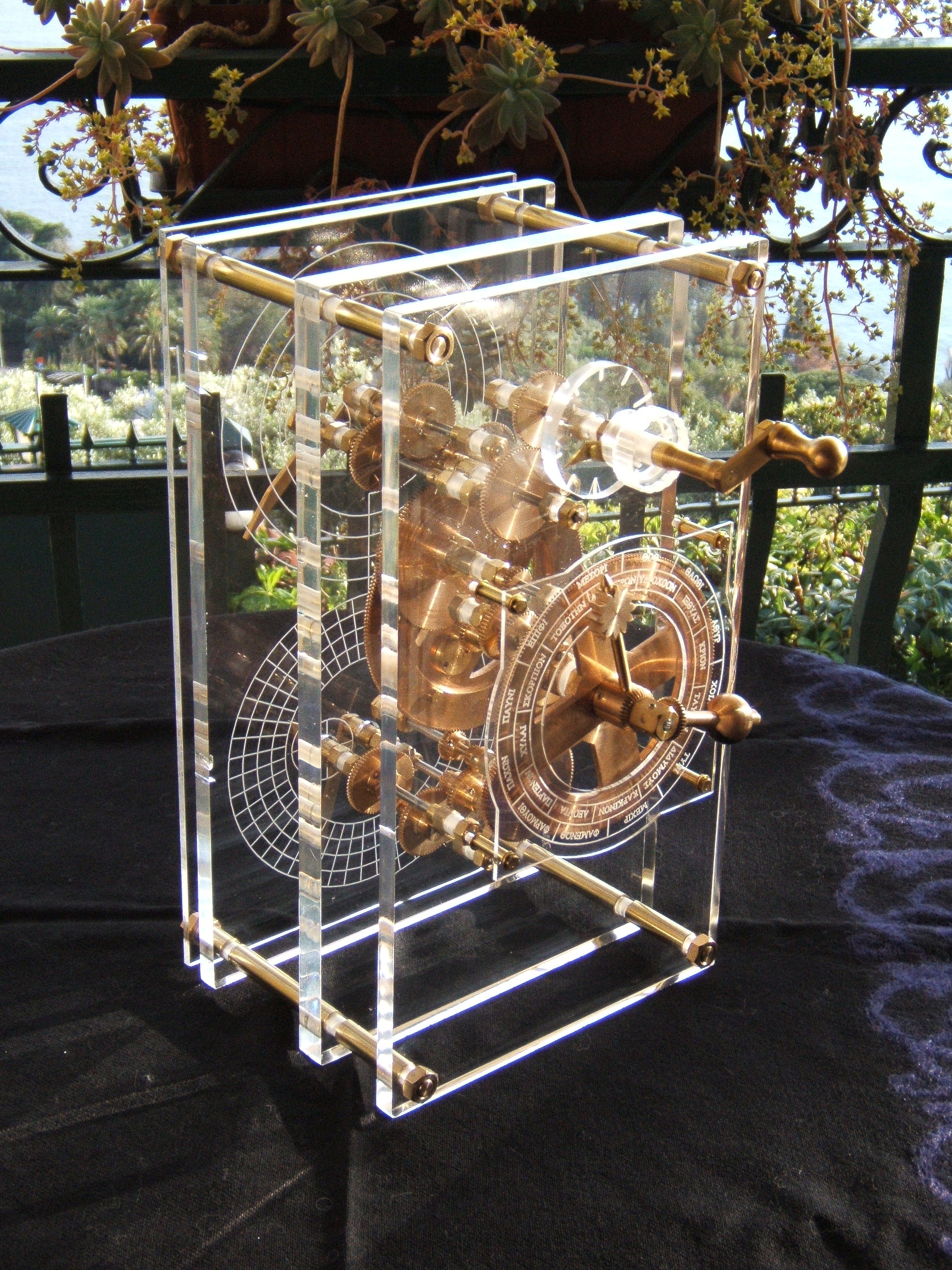
And how about that Antikythera mechanism?
it was made over 2000 years ago.
Here is a reproduction:
We have this skewed perception because we are blessed with SO much information available it is very easy to indulge in scanning it. Life was very different for the folks who built that roundhouse, the folks who built the Stonehenge, and the folks who built the pyramids, and much earlier “menhirs”. All of these efforts can be linked to reverence for the sky. The pyramids have apertures to the heavens.
For them, sitting was not the new smoking, it was a death sentence. They moved or died.
An entirely different kind of focus. A busted knuckle practicality. Aliens did not build those structures. Our forbears did. Like ants.
But it would seem the crop circle aliens are always making sure that the lunar knowledge is not lost for long:
http://www.twanight.org/newTWAN/photos/3003707.jpg
http://s67.photobucket.com/user/spiritz27/media/southkorea2008c.jpg.html
What, alien N@zis? 🙂
Nazis?
That one went right over my *zoom* head.
They also must have got a lot more sunshine to go to that much trouble and expect the sky to be clear on the 21st dec. , cos, it sure don’t happen much these days!!!
Crowds there this morning. Cold, wet and windy!!
Amateur home video of Irish Knowth and Newgrange grave mounds by YouTube poster, Leisha Camden, with some narration from a Park Ranger and some annoying wind noise in the audio. Newgrange appears at the 7:10 mark: https://www.youtube.com/watch?v=fOZ7loIAWEY
Irish band Clannad’s haunting “Newgrange” song: https://www.youtube.com/watch?v=XFWqMYand18
I think the description, “the world’s oldest known building, every year, for only as much as 17 minutes, the sun — at the exact moment of the winter solstice — shines directly down a long corridor”, is a bit dramatic. What happens when the exact moment of the winter solstice is at nighttime in Newgrange? No sunlight in the corridor at all? In many years the solstice falls at night making this a pretty useless marker of the solstice if the sun shines in only for 17 minutes “at the exact moment of the winter solstice”. More likely the sun shines down the hallway for a few minutes on each of a few days on either side of the winter solstice.
I agree. “The dawn of the day of winter solstice” would be more correct.
But would the dawn of the day before, or the dawn of the day after winter solstice be much different?
What is the azimuth change over the next couple of days?
http://www.timeanddate.com/sun/ireland/navan
the dawn azimuth is 131 degrees from Dec 18-26.
I made my comments below after reading the article and about two comments.
I should have realized I would not be the only one to instantly think of these facts.
Oh my word people. The word Solstice refers to the Sun-sol. It doesn’t happen at night because solstice is defined as :
“either of the two times in the year, the summer solstice and the winter solstice, when the sun reaches its highest or lowest point in the sky at noon, marked by the longest and shortest days”
The position of the earth will be close for a few days before and after the solstice, so you can still observe the light in such places, but the solstice isn’t just about a light in a hole. It’s about that light being perfectly aligned in that place, (completely and directly centered) at sunrise, on the exact day that is also either the shortest or longest day of the year. That the ancients even knew that there were two exact days in a year that could be calculated as being the longest and the shortest is remarkable. That they also figured out how to build something permanent that accurately marked those days over and over again is breathtaking.
Putting a stick in the ground and measuring the extent of its shadow daily would work to determine solstices.
““either of the two times in the year, the summer solstice and the winter solstice, when the sun reaches its highest or lowest point in the sky at noon, marked by the longest and shortest days””
That is one definition, but we all know that words have more than one definition.
If you looked it up, you may have noted this alternate definition, that of the astronomical definition:
“Solstice
A solstice is an astronomical event that occurs twice each year (in June and December) as the Sun reaches its highest or lowest excursion relative to the celestial equator on the celestial sphere. Both the solstices and the equinoxes are directly connected with the seasons of the year.”
By the second definition, the solstice is a moment in time, not a day.
“That they also figured out how to build something permanent that accurately marked those days over and over again is breathtaking.”
I do not know what the “over and over again” means.
If you mark the spot on the horizon that the sun rises, and keep track of it, it will be seen to reach a certain point and then start going back the other way.
Nothing complicated needs to be done to learn this…just observation and marking spots by some fixed object.
Since they had buildings back then, it would not be unreasonable to guess that they had windows, and that they noted that sun shone into windows.
So, it is not some giant leap of science to construct a building with a tunnel that faces the specific direction seen to be the furthest extent of the rising sun.
It only takes patience and careful observation.
Peoples lives depended a great deal more surely back then on such qualities.
Nowadays, any airhead can stay alive with little trouble.
Further back in time, such was likely not the case.
Menicholas- Said “A solstice is an astronomical event that occurs twice each year (in June and December) as the Sun reaches its highest or lowest excursion relative to the celestial equator on the celestial sphere. Both the solstices and the equinoxes are directly connected with the seasons of the year.”
“By the second definition, the solstice is a moment in time, not a day.”
I agree. But I never SAID that an equinox was related to a specific date. I said it referred to a “moment in time” that takes place twice a year DURING DAYLIGHT HOURS-and that they marked the days (of the year) in which the Sun’s light shines the least, and the longest. I never said those days always occurred on the same date.
That DATE changes every year, but based on the calculations of how the earth rotates and tilts, we can determine where the Sun was in relationship to the earth thousands of years ago, and calculate whether or not the Sun’s light would have aligned a little, a lot, perfectly, or not at all with the various dates of the Solstices of the past.
A solstice and an equinox are two different things.
Equinox- “the time or date (twice each year) at which the sun crosses the celestial equator, when day and night are of equal length (about September 22 and March 20).”
Fact, all “days” are 24 hours long. A solstice-relates to just TWO days (not dates) out of any given year-the one with the shortest amount of sunlight-which would then logically precede the LONGEST night of the year, and the one with the longest amount of sunshine- which then logically precedes the SHORTEST night of the year.
The equinoxes relate to the two days a year in which the amount of sunlight and the amount of darkness in a 24 period are of equal length. Equinoxes mark equality between night and day, solstices mark the extremities between the two. Neither one always falls on the same date every year.
How about them Cardinals?
Aphan,
As i am sure we both know, in order to understand these subjects in any sort of organized or precise way, one must be aware of terminology, and in order to communicate effectively, one must be aware of what others are referring to in their use of terminology.
If I use the word “month” in one context, it refers to a specific period of time, and some months are 30 days long, some are 31, and one is either 28 or 29 days long.
But none of these coincide precisely with the many different sorts of months that exist in the astronomic lexicon, such as tropical month, synodic month, sidereal month, draconic month, or anomalistic month.
Similarly, what is being referred to when one says “day” may be different depending on context.
If one is referring to a solar day, meaning the period of time from noon on one day to noon on the next day in the same location, then a day is not 24 hours, except on a few specific dates (which may vary from place to place and year to year.
Further confusing things is that a particular moment in time occurs on two separate dates depending on where one is on the Earth, given that we have 24 time zones (except when it is noon at the international date line…at that moment everyplace on Earth has the same date. I think…it may be that some do not since some places are on a different daylight time standard).
So, if one looks up this years ” Winter Solstice”, one will get different answers depending on where one looks.
If I look it up for Drogheda, for example, it is reported as ” Tuesday, December 22, 2015 at 4:49 AM”.
It is not listed as noon.
If I look it up Fort Myers, it is listed as “Monday, December 21, 2015 at 11:49 PM”.
Same event, same moment in time, different times and dates.
Such references are describing the moment that the sun reaches the Tropic Of Capricorn and reverses direction, similar to when the sun crosses the equator (which is itself subject to a specific definition, given the width of the Sun and the equator being an imaginary line).
In any case, I am not intending to argue with you or anyone, just make a point to clarify what I saw as something which may be confusing to some readers, as well as to attempt to inform and educate, since I find the entire subject very interesting and have studied and read about such things since I was a kid (back around the time that this structure was built).
Plus I just love a good argument.
“Equinox- “the time or date (twice each year) at which the sun crosses the celestial equator, when day and night are of equal length (about September 22 and March 20).” ”
A good arguer can even dispute this, as it is for sure that the sun is not crossing the celestial equator, but the Earth reaching a specific point in it’s orbit.
After all, the sun is regarded as fixed and the Earth revolving around it.
Of course, at the terrestrial equator, every day is of equal length.
But even such statements as “day and night are of equal length” must be qualified, as daytime is regarded as when the sun is above the horizon. Is sunrise when the center of the sun crosses the horizon? The earth is not a sphere, so what about topography and the shape of the geoid? Do they count? Mostly not…sunrise is not when the sun gets above a mountain to a locales east.
Actually, sunrise is regarded as the moment that the upper edge of the sun gets above the horizon, and sunset the moment the last bit disappears.
But these are not the same as Dan and dusk, which according to the law is the time when a day begins.
There are three distinct definitions of “twilight”, and if the law says I must have my headlights on at night, i cannot get a ticket unless it is before dawn or after dusk. A cop cannot slap me with a fine because the sun has not risen yet.
So, I do not think that the definition of something like the “equinox” should include words like day or night.
At the equinox, day is longer because the sun is not a point but a disc.
OK, I will stop now.
🙂
See:
http://www.universetoday.com/14700/how-long-is-a-day-on-earth/
“One complete rotation actually takes 23 hours, 56 minutes and 4.1 seconds.
The length of a solar day varies throughout the year, and the accumulated effect of these variations (equation of time) produces seasonal deviations of up to 16 minutes.”
My bad…correction….calendar days are 24 hours long.
So 5200 years ago these guys were arguing… “The sun ALWAYS stops there and turns back!” says one, “on the same day!” says the other, “no way” says the third. “Look, I’m going to pile some rocks here, and bet it’s the same! “Next year, if I’m right, you have to build a room and window to demonstrate it forever. If I’m wrong, I build the demonstration of my mistake. Deal?”
Like all Scottish cuisine, Celtic science is based on a dare…
🙂
As others have pointed out, the structure is more than 3200 years old.
It is stated that: .
However, that may be controversial. It appears that it was built during the Neolithic period around 3000 BC to 2500 BC. So the precise date is not known and spans a wide period of 500 years, and this is critical.
So for example, the Step Pyramid in Egypt was built during the 27th century BC for the Pharaoh Djoser. So that pyramid is smack within the period when Newgrange is thought to have been built. There are older predynastic period tombs in Abydos dating back to about 3100BC, but of course, not well preserved.
Obviously, Newgrange is one of the oldest manmade buildings, but whether it is the oldest is a matter of debate amongst archaeologist.
.
Depends upon what counts as a building. Even in the British Isles, there are the Orkney structures dating from c. 3700 BC.
To say nothing of Jericho or Çatal Höyük.
I couldn’t agree more that it depends upon how a building is defined.
The Step Pyramid is, of course, a very large building. Whether that predates Newgrange or Newgrange predates the Step Pyramid is a matter of some conjecture.
Of course, Newgrange is a remarkable building and appears well preserved.
“There are older predynastic period tombs in Abydos dating back to about 3100BC”
So the space aliens that visited and gave this knowledge showed up more than once?
So the Irish might still have bragging rights over the Egyptians and the English.
Here’s an Irish tribute to the alarmist crowd. It’s their official poem:
SAID HANRAHAN
by John O’Brien
“We’ll all be rooned,” said Hanrahan,
In accents most forlorn,
Outside the church, ere Mass began,
One frosty Sunday morn.
The congregation stood about,
Coat-collars to the ears,
And talked of stock, and crops, and drought,
As it had done for years.
“It’s looking crook,” said Daniel Croke;
“Bedad, it’s cruke, me lad,
For never since the banks went broke
Has seasons been so bad.”
“It’s dry, all right,” said young O’Neil,
With which astute remark
He squatted down upon his heel
And chewed a piece of bark.
And so around the chorus ran
“It’s keepin’ dry, no doubt.”
“We’ll all be rooned,” said Hanrahan,
“Before the year is out.”
“The crops are done; ye’ll have your work
To save one bag of grain;
From here way out to Back-o’-Bourke
They’re singin’ out for rain.
“They’re singin’ out for rain,” he said,
“And all the tanks are dry.”
The congregation scratched its head,
And gazed around the sky.
“There won’t be grass, in any case,
Enough to feed an ass;
There’s not a blade on Casey’s place
As I came down to Mass.”
“If rain don’t come this month,” said Dan,
And cleared his throat to speak –
“We’ll all be rooned,” said Hanrahan,
“If rain don’t come this week.”
A heavy silence seemed to steal
On all at this remark;
And each man squatted on his heel,
And chewed a piece of bark.
“We want an inch of rain, we do,”
O’Neil observed at last;
But Croke “maintained” we wanted two
To put the danger past.
“If we don’t get three inches, man,
Or four to break this drought,
We’ll all be rooned,” said Hanrahan,
“Before the year is out.”
In God’s good time down came the rain;
And all the afternoon
On iron roof and window-pane
It drummed a homely tune.
And through the night it pattered still,
And lightsome, gladsome elves
On dripping spout and window-sill
Kept talking to themselves.
It pelted, pelted all day long,
A-singing at its work,
Till every heart took up the song
Way out to Back-o’-Bourke.
And every creek a banker ran,
And dams filled overtop;
“We’ll all be rooned,” said Hanrahan,
“If this rain don’t stop.”
And stop it did, in God’s good time;
And spring came in to fold
A mantle o’er the hills sublime
Of green and pink and gold.
And days went by on dancing feet,
With harvest-hopes immense,
And laughing eyes beheld the wheat
Nid-nodding o’er the fence.
And, oh, the smiles on every face,
As happy lad and lass
Through grass knee-deep on Casey’s place
Went riding down to Mass.
While round the church in clothes genteel
Discoursed the men of mark,
And each man squatted on his heel,
And chewed his piece of bark.
“There’ll be bush-fires for sure, me man,
There will, without a doubt;
We’ll all be rooned,” said Hanrahan,
“Before the year is out.”
great piece! db,,,,but I think the Irish don’t have a monopoly on myopia.
Its Australian. 1880’s a country of extreme weather.
The day Ireland is warm enough for the grass to catch fire will be a day we might have to take warming seriously. It won’t happen.
Daniel,
IIRC, the author was an Irish-Australian priest, writing about Ireland. But I could be misteaken and I’m not taking the time to look it up. It’s still the perfect alarmist poem, no?
‘John O’Brien’ was Monsignor Hartigan, the Parish Priest of Hay in NSW.
This is an Australian poem about predictions, wheat fields and drought.
I was married by his Literary Executor, Fr Frank Meecham.
Many Catholic schools had this as part of an anthology of Australian poetry, which made my generation skeptical of predictions in a changeable climate.
The other poem was by Dorothea MacKellar
Official Dorothea Mackellar Website
My Country
The love of field and coppice,
Of green and shaded lanes.
Of ordered woods and gardens
Is running in your veins,
Strong love of grey-blue distance
Brown streams and soft dim skies
I know but cannot share it,
My love is otherwise.
I love a sunburnt country,
A land of sweeping plains,
Of ragged mountain ranges,
Of droughts and flooding rains.
I love her far horizons,
I love her jewel-sea,
Her beauty and her terror –
The wide brown land for me!
A stark white ring-barked forest
All tragic to the moon,
The sapphire-misted mountains,
The hot gold hush of noon.
Green tangle of the brushes,
Where lithe lianas coil,
And orchids deck the tree-tops
And ferns the warm dark soil.
Core of my heart, my country!
Her pitiless blue sky,
When sick at heart, around us,
We see the cattle die –
But then the grey clouds gather,
And we can bless again
The drumming of an army,
The steady, soaking rain.
Core of my heart, my country!
Land of the Rainbow Gold,
For flood and fire and famine,
She pays us back threefold –
Over the thirsty paddocks,
Watch, after many days,
The filmy veil of greenness
That thickens as we gaze.
An opal-hearted country,
A wilful, lavish land –
All you who have not loved her,
You will not understand –
Though earth holds many splendours,
Wherever I may die,
I know to what brown country
My homing thoughts will fly.
Dorothea Mackellar
Lewis B, Daniel, ntesdorf,
Well, I stand thoroughly corrected! That’s what I get for being too lazy to look up O’Brien’s name.
But it’s still the perfect climate alarmist poem, no? ☺
Back-o’-Bourke identifies the writer as being west of Bourke in New South Wales, a bleak, parched, dry area with only the remains of the Darling River to drink from nearby.
IF Newgrange is 3200 years ago, this is much younger than the Pyramids.
3200 BC!
Sorry if I am missing something, but ” 04:49 GMT”? Sunrise is way after I get to work (north UK) at 08:00.
Or does the term “Solstice” mean something other than daybreak to dayend?
That is the astronomical solstice. At Newgrange, they just mark the dawn solstice, which will be about 08:00 ish in Ireland. And since the solstice angle does not change much over that period, you can go a couple of days before or after and see the same effect.
Indeed Ralfellis.
Many days before and after I would wager.
The equation of time and the Analemma is nearly flat horizontal at this time of year:
http://www.pikespeakphoto.com/images/sun/winter-analemma.jpg
The solstice is the solstice. It’s always astronomical, because it’s always determined by the position of two astronomical bodies-Earth and Sun- in relation to each other. I think you meant that specifically, Newgrange only has a mark for sunrise on the Winter Solstice, it does not have a mark for sundown on the Winter Solstice, nor marks for either event on the day of Summer solstice.
Rockyspears-solstice does not mean “daybreak to day end”. It means Sun-stand still-or the point during the day in which the Sun appears to stop moving in the sky-between it daily assent and its daily descent. The mid point, the zenith, noon. It marks the “mid point” of the day of the year in which the least amount of sunshine is seen, and the midpoint of the day of the year in which the longest amount of sunshine can be seen. Period.
Solstice means literally (when the Sun stands still) and it applies to the position of the Sun, at noon, on both the shortest and longest days of the year. A day is a 24 hour period, always. But Sol means Sun, so it’s only referring to the hours in which the Sun shines.
The word “noon” in any location correlates with the Sun’s mid day position- it’s zenith in the sky-the point where it stops rising, and begins to fall. This is how someone without a watch can determine the approximate time using sundial principles. If you place a straight stick directly perpendicular to the earth on a sunny day, when the shadow of that stick falls only directly over itself, that marks “noon” or the Sun’s zenith in the sky.
On the Winter solstice, the Sun’s zenith (at mid day) is at the LOWEST point it ever is all year long- marking the day with the shortest amount of sunlight of the entire year. On the Summer solstice, the Sun’s zenith (at mid day) is the highest it ever gets all year-marking the day with the longest amount of sunlight of the year.
Interesting to note that back in the mid 1800s, every town and locality kept time the way you mention…they noted the time of local noon and set the town clock accordingly.
But marking the time by using the sun leads to ever single place having a different time. This was fine when people got around on horseback, as one could just set one’s watch by the town clock upon arriving at your destination.
There were no time zones back then, and no standard times.
This all changes with the advent of the transcontinental railroad.
One could not run a train and keep a consistent schedule when every town had their own local time.
So, we have the trains and the people who needed to keep them on schedule to thank for our present systems of ordered and standardized time zones.
BTW, if I use the method of noting the sun at noon to estimate what time it is here in Ft Myers, I will be way off, as will someone in Bar Harbor, Maine. Being that both locales are in the same time zone, with northern coastal Maine being on the Eastern margin, and Western parts of Florida being on the Western margin of the Eastern Time Zone.
http://www.statsagogo.com/timezone/timezone16.gif
Thanks all for the enlightenment; by this reckoning then, there is in fact a Solstice everyday, we just don’t care so much about them.
“Thanks all for the enlightenment; by this reckoning then, there is in fact a Solstice everyday, we just don’t care so much about them.”
Thanks for playing, but um…nope. There is a NOON every day, but by this reckoning a Solstice happens twice a year AND is specific to where the sun is at noon on JUST those two days out of the year…the day with the longest amount of sunlight, and the day with the shortest amount of sunlight. Period.