Guest Opinion: Dr. Tim Ball
Sometimes people ask how we know what the temperature was thousands of years ago? The answer is we estimate temperature from proxy data or secondary indicators of the climate conditions at the time. Phenology is an important form of proxy research. It is, “the study of cyclic and seasonal natural phenomena, especially in relation to climate and plant and animal life.” Palynology is one of the least known phenologic techniques used for reconstructing past climate conditions.
It involves taking cores in depositional environments, such as bogs or lake sediments then identifying the pollen in each layer. Pollen is the reproductive seed annually spread from a plant and is remarkably hardy, especially in low oxygen environments. It is also unique for each species (Figure 1).

Figure 1: Colorized images

Pollen counts are done in specialized labs with stainless steel surfaces and a negative airflow to preclude contamination. Results show pollen counts against time that reveal changing plant populations. Figure 2 shows a clear format from a bog in Illinois covering 14,000 years of change.

Figure 2
Changing pollen percentages in each layer reflect changing environmental conditions over time. However, just like tree rings, care is required in identifying the cause of the change. Regardless of the method it is critical in historic reconstructions to obtain as many non-correlated indicators as possible.
I was seeking such proxy indicators for climate conditions during the death of Otzi the Iceman on an Alpine Mountain. His frozen body, discovered in 1991, lay preserved at 3,210 meters. Radiocarbon dates placed his demise between 3239 and 3105 BCE (5254 – 5120 before 2015). The climate pattern assumed he was later covered in ice and exposed by modern warming. Pollen became part of the investigation but only after being discovered in his stomach and clothing. There is one comment of interest.
“The pollen found in his intestines indicates that he hiked through “a coniferous forest at mid-elevation.”
Figure 3 shows the Greenland ice core temperature record, which reflects hemispheric conditions. Cores are further north than Otzi’s location but likely approximate general conditions. A black arrow marks the time of Otzi’s demise and suggests 1.5°C warmer than today.
 Figure 3 (Black Arrow; estimated Otzi demise)
My research and reconstruction of historic treeline movements triggered an interest in the treeline position Otzi knew.[1] The question about why he was so high in the mountains may be less important if it was not far above the treeline.
The climatic similarities between changing altitude and latitude reflect the change of switching the first two letters. Climate zones change in the same sequence moving to the Poles or going up a mountain. The span of each change is greater for latitude than altitude.
The width of the transitional zone separating closed forests from treeless plant communities is not uniform: polar treelines and drought-caused treelines can form very broad transition zones such as parklands with widely spaced trees (Amo and Hammerly, 1993). Conversely, mountain treelines have rather narrow transitional zones (i.e., 100-200 m of vertical extent).
In Otzi’s case (altitude) the distance appears large regardless of the period. Figure 4 shows a map of the location and assumed route, but does not clarify the treeline issue.

A photograph (Figure 5) of the area shows that considerable movement is necessary for the treeline movement in Otzi’s day to be significant.

Figure 5: Red shows Otzi’s location. Scale given by four people on glacier bottom left.
Palynological studies provide indicators of climate change but lack precision because of slow response. The most effective measure is a comparison with today’s situation as a study of “Holocene Treeline Fluctuations” observes.
To assess the magnitude of past climate changes, reconstructions of Holocene treeline fluctuations must be related to modern treeline positions. For estimations of past temperature changes it is assumed that today’s occurrence of trees is in equilibrium with the climate of the past few decades.
An Arctic treeline commentator notes,
Treeline encroachments and retractions can provide global-scale feedbacks to the climate system, and treeline dynamics are therefore of great relevance for understanding global climate variability.
It is clear that the palynological record was too coarse to determine precise location of the treeline, especially since the date of his death was only accurate within 100 years. The following comment is a bizarre mix of material confirming that the IPCC assessment is either wrong or inadequate, yet still buying into the IPCC warming narrative. The almost obligatory plea for funding colors the quote.
It is clear that the position and composition of the timberline ecotone has been sensitive to Holocene climate change. The millennial-scale trends generally reflect gradual decline in Northern Hemisphere insolation from approximately 11% higher-than-present in the early Holocene. Superimposed on this long-term trend are higher-frequency fluctuations related to changes in oceanic circulation, volcanic activity, and solar irradiance or a combination of these factors. It is also clear that anthropogenic climate forcing over the next 100 years is likely to rival or exceed the warmest conditions of the Holocene. Concerns about global warming involve adjustments, collapses, migrations, or extinctions of boreal and alpine life. Surprisingly, relatively few studies have addressed past responses of ecosystems such as treeline communities to climatic change. One of the reasons for avoiding this topic is that accurate studies require independent climatic proxies and very high temporal resolution «10-20 years/sample). To assess how treelines could respond to global change, high resolution studies including macrofossil analysis are urgently needed.
Determination of what was going on 5000 years ago is further complicated because it was clearly a period of significant change.
Figure 6 shows an amalgamated plot of the sequence derived from various sources. It includes a distinction between treeline, (trees 2m tall) and timberline (8m). The interesting change after 5000 BP is the widening altitude difference to the present.

This change after 5000 was evident in a study in the nearby Piora Valley (Figure 7). That study reports the change, labeled the Piora Oscillation was global.
Piora oscillation, named after Piora Valley in Europe where climatic irregularities were first noted. A major break in the climatic regime which resulted in a readvance of Alpine glaciers, a retreat of forests. Elms and linden trees declined in Europe and North America. In northern Europe the oak and hazel declined or disappeared. Changes occurred as far away as the Andes, Alaska, and the Kenyan highlands, so the disturbance was evidently of global magnitude extended throughout the world. 3500 to 3000 BC.

Figure 7
Many attribute this climate change to the development of more organized civilizations.
Lamb notes that this is the time of the rapid spread of New Stone Age cultures in Europe; meanwhile there seems to have been a sudden stimulus to the growth of organized civilization, to deliberate cultivation along with development of the tools necessary for such activities.
This seems contradictory because it occurs when the Earth is cooling as evidenced by the treeline and timberline drop of about 300m (Figure 6).
Then a stunning claim appears about the cause of the retreat that,
The regression of densely forested areas (timberline) in the Alps during the past 5,000 years was primarily caused by human impact, whereas the course of treeline gives a more realistic estimation of the climatic influence (Figure H9) (Figure 6 in this article).
Maybe it was the new technology copper-bladed axe Otzi carried that allowed such massive early human deforestation (Figure 8)?

Figure 8
As one authority notes,
Archaeological experiments have shown that the copper axe was an ideal tool for felling trees and could fell a yew tree in 35 minutes without sharpening.
Otzi undoubtedly cut some yew trees to fashion his bow. However, he and his few fellow axemen must have been very busy lowering the timberline across the entire Alps. Pollen diagrams (Figure 9) the authors use show a decline in all species. The fires they built to keep warm during the period also seem to have influenced glacier length.

Apparently the explanation for the author’s claims of such early and massive human influence is given in their conclusion. First they acknowledge some natural causes
It is clear that the position and composition of the timberline ecotone has been sensitive to Holocene climate change. The millennial-scale trends generally reflect gradual decline in Northern Hemisphere insolation from approximately 11% higher-than-present in the early Holocene. Superimposed on this long-term trend are higher-frequency fluctuations related to changes in oceanic circulation, volcanic activity, and solar irradiance or a combination of these factors.
But then, just like the IPCC CO2 claims, the human impact takes over from all natural causes and is predicted to continue.
It is also clear that anthropogenic climate forcing over the next 100 years is likely to rival or exceed the warmest conditions of the Holocene.
It is possible Otzi was fleeing from political persecution, but he learned, as we have, that there is no safe altitude.
[1] “Historical Evidence and Climatic Implications of a Shift in the Boreal Forest Tundra Transition in Central Canada”, Climatic Change 1986, Vol. 7, pp. 218-229
I’m sure palynology is a lot more fun than I think it is.
Suggestion for future research project: attempt to determine extent of tongue depression in Ötzi’s cheek at time of death, using proxies or otherwise.
It absolutely is.
My thanks to Dr. Ball for taking the time to post on the subject. These types of articles are always interesting.
So it was significantly warmer for thousands of years before the LIA, and we’ve only just begun to approach ideal interglacial temperatures. Who in their right mind wouldn’t welcome another few degrees of warming???
Really. Warmists want it to warm so they can prove their theory that warming will be disastrous. If it turns out to be benign, will they wish for disastrous cooling, instead?
Well for my money, Otzi was simply a mountain climber trying to conquer a new peak.
His lumberjack copper axe is far more functional as an ice axe, than for tree felling.
Why would he climb up there to cut some firewood ?? Plenty of it lower down.
My BS meter is buzzing loudly. Not at the Palynology, which I am sure is reliable for telling what the Temperature was the day that Otzi fell off the mountain and died, but only a fool would climb to above the tree line to get some firewood, instead of harvesting it much closer to home.
So remind me again, how the palynology tells us where Otzi came from in order to follow that putative route up the mountain he was climbing ??
Just my opinion of course.
George,
I wouldn’t go mountain climbing for fun with a fresh arrow wound.
There is IMO good reason to imagine that Oetzi was from the Italian valley below:
http://www.nbcnews.com/id/3341648/ns/technology_and_science-science/t/scientists-reconstruct-life-iceman/#.VVkHn_BultA
This post omits the fact that an ‘altar’ was found near the body, making his placement deliberate, likely a ceremonial burial.
CCCCC (@TheCaz64) May 17, 2015 at 6:21 pm
Downstream, I note it would be unlikely any ceremonial burial would leave the deceased in a face-down position.
http://wattsupwiththat.com/2015/05/17/palynology-a-proxy-indicator-of-climate-used-to-make-remarkable-claim/#comment-1937447
I remember reading the book about the discovery that claimed Ozti was covered by ice from soon after he died until he was exposed by warming in the late 20th century, but I don’t remember their reasoning. I think it was based on an assumption there was no MWP, as usual. Might like to re-check that.
Some obvious reasons for being covered in ice soon after his death until recently exposed, is that his body was quite well preserved – preserved from decay, predators, and being found by humans at an earlier date.
Some interesting digi books on glaciation science done with real science before models it’s worth searching this site as there are a lot of meteorological books and 2 with world weather records.
https://archive.org/details/glaciervariation032833mbp
https://archive.org/details/worldweatherreco033416mbp
https://archive.org/details/worldweatherreco031950mbp
lt certainly looks like it was warmer in Western Scotland around the time of Otzi.
Because during that time the Hazel nut was a important food source to the people living there at the time. Now you would have to be in southern England/mainland europe to find Hazel nuts in any large numbers.
This is just my own thinking and evidence free.
If hazel nuts were an important food source that implies that fewer hazel nuts were left on the ground to start the growth of new trees. Eventually the hazel nut trees will disappear. Even in natural conditions there is a low probability that any single nut will ever sprout and grow into a mature tree capable of renewing the cycle. That is why each tree produces so many.
Allowing hogs to feed on fallen acorns produces the same result. In a hundred years no oaks.
The above seems reasonable to me.
Eugene WR Gallun
Hazel also spreads by root suckering.
A bit like global warming nuts.
Haha – just remembered something. i do Old Testament translation. When Adam gets his butt tossed from the garden God says to him —
3,17And to Adam I will say — Because [standing silently by] you listened to the conversation of your mate, you eating out of the tree that I had commanded of you to say — From out of it not will you eat! — is the bane of the soil. By your work of toil all must eat all the days of your life. 3,18)The soil will grow thistles and thorns against you after you have eaten the seed grains of the field.
So Adam is to be a gatherer ever on the move because from where he takes the seed grains of the field for food no new grain plants will grow. Thistles and thorns will move in instead.
Hey, what I said above in my other post the ancients knew two thousand years ago.
To those who have any interest — God in his little speeches to Adam and Eve is not heaping punishment on them. He is merely telling them what life is going to be like outside the garden. Only the snake gets punished.
The garden is a nursery and the outside world was created for and awaits Adam and Eve. Eventually they must enter it. “The Fall” of Adam and Eve has nothing to do with sin. Rather the word is correctly translated as “premature birth”. The snake causes Adam and Eve to be prematurely expelled from the Garden.
Thus neither Adam nor Eve nor any other human being is tainted by “Original Sin”. (We do very nicely sinning on our own without some predetermining blot upon us, thank you.)
Is that screaming or laughter I am hearing?
Eugene WR Gallun
Eugene, you’re just hearing my cervical vertebrae grinding as I nod in agreement.
The concept of original sin arose from Augustine’s mistranslation.
Eugene, do you have a website or place where I could contact you personally? 🙂 Thanks in advance.
Nut and fruit trees drop considerable fertile seeds. Many critters love eating the nutritious embryos but no group or combination of critters manages to find every one.
Man never beats the critters the nuts and seeds and even with modern harvesting techniques never achieves 100% harvest.
Critters storing food for the upcoming winter invariably puts seeds into ideal sprouting positions.
Mankind during those periods eagerly took advantage of better and quality plants spreading their progeny far and wide. Leaving parental plants and promising offspring for future crops.
Thistle plants and many other invasive plants sprout in disturbed soil. Digging and planting involve soil disturbance that enables the invasive weeds to sprout.
Dean,
There is a similar word in Greek from the same Indo-European root, but Paul is originally a Latin name, rendered in NT Greek as Paulos (transliterated from the Greek alphabet).
The concept of original sin didn’t originate with Paul but with Augustine, based upon a hint by Irenaeus. In formulating his concept, Augustine relied in part on the writings of Paul, but also on the Old Testament. However Paul himself never formulated the doctrine of ancestral or original sin. Unfortunately, Augustine’s command of Greek was limited, as he himself admitted, since he didn’t like his Greek teacher, so the doctrine ultimately rests upon mistranslation.
Nevertheless, IMO the idea that all people are inherently sinful holds some theological attraction, however poorly supported by biblical texts.
Eugene its known that they found hazel nuts a useful food source due to the amount of hazel nuts shells found in there rubbish tips.The nuts would have been a useful food source during the leaner winter months because they can be stored for many weeks. lts highly unlikely that they would of taken all the nuts also hazel bushes can live for many years.
Acorns were extremely important food to the California Indians. So they planted oaks in all the vales and gullies of Southern California. Where , being a long lived species, they are only dying off now.,
i mouthed off about hazel nuts and acorns and quite frankly, you guys are crushing my nuts. I had a literal nut theory and now it is figurative. “Sometimes you feel like a nut and sometimes you don’t” and i most certainly now do. This nut has been shelled.
Eugene WR Gallun
Oh I don’t know … I thought you came across as having work experience in macadamia.
“Wherefore, as by one man sin entered into the world, and death by sin; and so death passed upon all men, for that all have sinned…” Epistle of Paul to the Romans, Chapter 5, verse 12, KJV
Sounds pretty original to me.
Dean and Programmer,
I like the idea of heritable sin, but not for Augustine’s reasons. Unfortunately, when adopted as Church doctrine, it came in handy to run a protection racket by absolving adherents of their sins.
Augustine’s interpretation of Paul in Romans was influenced not only by mistranslation but by his exposure to pagan philosophy and, it is argued, his youthful sexual “excess”. These factors led him to, if not invent, then spread and extend the idea of ancestral sin, passed on biologically through sexual intercourse. This doctrine, when adopted by the Church, led to its practice of infant baptism.
This doctrine goes far beyond, if not indeed against, Paul’s intent in the passage cited. So that we don’t end up discussing theology and biblical exegesis on a science site, let alone in 1st century Greek, I’d recommend reading any of the many books on the topic. Here’s a recent one, along with a review:
http://rbecs.org/2013/12/10/tos/
That ax doesn’t look like a tree felling tool. The chisel-like narrowness of the blade suggests more of a wood working tool, possibly for mortising timbers. The amount of copper behind the tip shows the blade could have been made wider, more useful in felling. The thickness profile of the blade is close to modern ax tapers, so these folks would know what and why they would make an ax of a particular shape.
You were thinking Modern and talking early Neolithic.
Early Neolithic no. Copper Age yes. Just because people lived a long time ago does not mean they were stupid. In fact they were probably smarter because they were not having their minds destroyed by Marxist educators! The tool in question demonstrates considerable skill in manufacturing. It is just the thing needed for processing firewood, much needed on extended journeys far from civilization.
Copper Age? Sorry, but no such thing. It was the Bronze Age – and that, in itself, shows a great deal of cultural sophistication. Bronze is made from Copper and Tin, which rarely appear near each other in any quantity, and by analysing the origin of the tin and copper in the Bronze artefacts, an extensive trade network has been shown to exist – Central and Southern Europe, Ireland, England and parts of Germany were all trading with each other and possibly also for Amber with Eastern Europe/Russia and Southern Scandinavia. So, probably a great deal more sophisticated than we commonly think of today.
The Copper Age (3500 – 2300 BC)
The most recent phase of the Central European Neolithic period is also known as the Copper age to distinguish it from the older phases of the Neolithic
http://www.iceman.it/en/copperage
Cheers
Dick,
The Bronze Age was preceded by the Chalcolithic or Copper Age, which may be regarded as the last stage of the Neolithic. People had to get to know copper before making bronze.
I agree. “Ideal”?? Did they take video of that experiment? Call me from MO, I’ll believe it when I SEE someone actually fell a mature yew tree with such a lightweight tool fitted with a blade of such a soft metal as copper.
Copper isn’t all that soft. The pyramids of Giza were made using copper chisels. Menkaure’s pyramid even has a dozen or so rows of granite facing done with copper chisels. Of course, chisel sharpening must have been the most secure job in Egypt.
Right. That tool is worthless for chopping.
Theo, too light for felling trees, but just the thing for preparing wood for a camp fire.
Mike McMillan “Copper isn’t all that soft. The pyramids of Giza were made using copper chisels.”
You are mistaken, chisels do not “cut” stone, Even today’s steel chisels are not sharp and are made of low carbon steel. A stone chisel imparts a high hertzian stress to initiate fracture in the stone as opposed to cutting which is by a hard material cleaving a softer one.
Re comments of where copper for copper and bronze age. Copper for Europe appears to have been mined in Michigan. So much for primitive.
Max
Otzi was not exactly equipped as a woodsman. I would say that the axe would have been more useful as a weapon against whoever was chasing him, or as a hunting tool to dispatch larger game.
“against whoever was chasing him” Would that have included wolves?
Well one thing is certain: academics speculating on how a tribesman hunts or what a tool might have been used for without some childhood experience at the knee of somebody who grew up hunting and using hand tools can get pretty far afield from reality. Otzi’s relatives on this side of the pond where busy expanding the ranger of buffalo by burning down the prairie every fall and this served to limit the spread of forest at the same time (full grown trees can make it through a fire but saplings not so well) The “weapon of choice” among that crowd was stampede a batch off a sufficiently high cliff! All that dangerous hand to horn avoided as much as possible!
Mike M May 17, 2015 at 9:29 am
Whether or not wolves were chasing him cannot be determined, but Otzi was killed by an arrow in the back.
In addition to his axe, the iceman also carried an unfinished bow, and several arrows in various stages of completion, and a flint dagger.
Beyond its obvious utility as a weapon and tool, the axe no doubt conferred certain status, and may have been useful as well in finishing the bow and arrows.
fossilsage May 17, 2015 at 10:59 am
The “weapon of choice” among that crowd was stampede a batch off a sufficiently high cliff!
I know this is a popular idea, but European accounts make clear that most of the native people did not need cliffs to kill large numbers of buffalo for the simple reason that there are not that many suitable cliffs in the territories of deer and buffalo hunting tribes. Travel around the Midwest and Great Plains, you’ll find very few suitable cliffs for such a maneuver.
So if some assailant shot Otzi in the back, why on earth did they not claim his exquisite copper axe, that supposedly is a piece of skilled craftsmanship, and thus not likely to be left for somebody else to take.
Not saying he wasn’t killed thusly; maybe when he fell off the cliff, he accidently impaled himself on one of the arrows in his quiver.
Well my guess is as good as theirs.
Mike, Otzi could not have gotten to were he was without help. A likely scenario that fits a of the facts, is that Otzi was the victim of a hunting accident. His companions helped him to a safe location well above the tree line and they provisioned him. Then they went to get help, but an unseasonably early storm prevented their return. The location would lessen the likelihood of wolf attack.
DesertYote May 17, 2015 at 2:32 pm
“Otzi was the victim of a hunting accident.”
Oops! Didn’t know my bow was loaded…
Oops! Thought you were a bear
Oops! Never step in front of me when I’m shooting arrows
Accidentally shooting someone in the back with an arrow is about as likely as a homework-eating dog, although it is true that a dog will eat just about anything, including that !
●♪☻♫◦
There could be any number of reasons why the axe wasn’t retrieved. Apparently Otzi had been bashed in the head before he died, in addition to being shot in the back, so that hunting accident must have been a dilly.
Seriously, my guess is he was in some sort of battle, fued or fight, and crawled off after being mortally wounded. Perhaps the engagement took place at night. Perhaps his killer was himself killed in the action. Perhaps the killer would not retrieve Otzi’s belongings to avoid incriminating himself. Perhaps what was taken was much more valuable than what was left behind. There are any number of possibilities, but I think the unfinished bow is very interesting, and suggests to me a situation where Otzi may have left somewhere on the run, under duress, and with his life in peril.
Steve P., you don’t know very much about hunting, nor do you now anything about the late copper age. Otrzi WAS provisioned! Your comment bespeaks of breath taking ignorance.
Or ceremonial. His placement was a burial, not an accident.
Well, I stand corrected. According to that font of knowledge Wikipedia, it is now thought that Otzi died from a blow to the head:
Further research found that the arrow’s shaft had been removed before death, and close examination of the body found bruises and cuts to the hands, wrists and chest and cerebral trauma indicative of a blow to the head. One of the cuts was to the base of his thumb that reached down to the bone but had no time to heal before his death.
Currently, it is believed that the cause of death was a blow to the head, however researchers are unsure of what inflicted the fatal injury.Unpublished and thus unconfirmed DNA analyses claim they revealed traces of blood from four other people on his gear: one from his knife, two from the same arrowhead, and a fourth from his coat.
Interpretations of these findings were that Ötzi killed two people with the same arrow, and was able to retrieve it on both occasions, and the blood on his coat was from a wounded comrade he may have carried over his back.
Ötzi’s unnatural posture in death (frozen body, face down, left arm bent across the chest) suggests that the theory of a solitary death from blood loss, hunger, cold and weakness is untenable. Rather, before death occurred and rigor mortis set in, the Iceman was turned on to his stomach in the effort to remove the arrow shaft.
(my edit)
http://en.wikipedia.org/wiki/%C3%96tzi
So, he was running around with an arrow in his back before being killed by a blow to the head. I guess he could have fallen after being shot in the back, and bashed his head on a rock, or his attackers tried to retrieve the arrow when he was down. In any event, those trying to extract the arrow may have bled on Otzi’s coat, rather than a wounded comrade. We must assume the arrow extractors succeeded, and then just left Otzi lying there face down, valuable copper axe at hand.
If it evolved into a ceremonial burial, they wouldn’t have positioned him face down like that. If it wasn’t a ceremonial burial, and if in fact he had been aided by comrades, there must be some other explanation for the axe being left behind.
Steve P.
“If it evolved into a ceremonial burial, they wouldn’t have positioned him face down like that.”
Defiantly not. Copper age burial in Europe was generally in a fetal position, but sometimes paced laying on their back. I seem to remember a case of some individuals placed in a sitting position. But I am not clear on this, as it is from research I did 30 years ago while writing a paper on late copper age, early bronze age trade.
The strike on the head could (notice the uncertainty) have been a mercy dispatch because his companions had to move on quickly.
I’ve got it! He was accidentally shot by an errant arrow (loose fletching or banana shaft could explain that) which put him in a lot of pain. So obviously the blow to his head was for … medicinal purposes!. (The medical consensus highly endorsed the analgesic properties of patients being rendered unconscious to alleviate pain because it ALWAYS stopped the moaning and complaining.)
Agreed. Just look at the range of Bronze axe-heads that have been found and it’s clear that there were different tools for different jobs: a Bronze Age woodworker would probably use 1 (broad) axe for felling, a narrower one for trimming and finishing. Incidentally, a similar range of sizes have been found for stone axes, so the basic technology was developed over a long time-frame, several thousands of years at least. The ‘modern’ axe is just an extension of this.
Yes, but it’s unlikely that mortising timbers would have been very high on Otzi’s agenda, judging by what we can make of his circumstances, but defending himself from his attackers, and finishing out his bow and arrows would have been.
How about he used it in exactly the same way that a modern woodsman uses his ax? Form follows function. The needs of a woodsman have not changed. We just use steel instead of copper alloy. The tool is the same.
It looks more like a multipurpose weapon & tool to me, not really heavy enough, nor shaped properly for serious tree felling, but good for breaking bones and splitting heads in any deadly hand-to-hand combat, and for small scale chopping & finishing tasks, like making bows and arrows, small shelters, traps, staffs, and such.
It would be a very desirable weapon and tool. A heavier (than a knife) hand weapon or light axe of some kind like this was, probably essential for self-defense and survival over the long pages of mankind’s unrecorded history.
Maybe his finished bow, and a heavier axe were taken, to say nothing of gold, jewels, potions, secrets…they left the junk.
The arrow in the back speaks of human perfidy. It’s a crime scene.
Oetzi’s ax is similar in construction to Neolithic stone implements used for woodwork or chopping that I’d be surprised if he didn’t use it in that way, as well as for a weapon and status symbol.
From the Langdale industry:
http://en.wikipedia.org/wiki/File:Neolithic_stone_axe_with_handle_ehenside_tarn_british_museum.JPG
But what do I know?
Sorry, the link didn’t work, but you can see the ax by clicking on the frame.
I should have said design rather than construction, since the stone ax is hafted differently.
The climate driver was not a few humans lighting fires to keep warm rather a human response to climate becomming cooler.
A bit of tail wagging dog.
Phrenology?
There are many indicators in Cornwall on the moors that climate was warmer around 3,000 years ago. The high moors were actively farmed. The theory being that vegetation was so dense in the valleys that it was simpler to clear from the tree line downwards. The beaker people arrived in Cornwall around 2500 years ago and farmed the moors. These farms were not fully abandoned until the little ice age, in spite of the many variations in climate since. Suggesting that there is some magical warmth in the air now is farcical. Trees do not grow on the moor now; the soil has eroded; farmers have moved down slope. The only problem now is fighting off the turbine junkies and their tame green “fan”atics.
Thank you Dr Ball. Always interesting to read your articles and to compare them with the excessively wordy pseudo intellectual ramblings of the average climate paper. I sometimes think they get their penchant for obscure wording from the English dictionary of phrases for Union Leaders.
God’s own County Ivor.
‘Sometimes people ask how we know what the temperature was thousands of years ago? The answer is we estimate temperature from proxy data or secondary indicators of the climate conditions at the time.’
In other words it is a ‘guess ‘ based on other things we look at .
Take for instance the ‘magic tree rings ‘ , now tree growth can be effected by a number of things , of these temperature may be one , but this importance of these compared to other factors is far from clear , in addition if ‘tree rings ‘ are a problem when it comes to measuring past temperatures, there no better at measures all the other factors involved. All they can suggest that at certain times the tree growth was higher than at other times for ‘some reasons ‘
Although on the surface past temperature measurements, land or sea , would seem a good source, there remain problems , for example the means to collect the data and how the data was collected have both evolved over the years , sea temperatures where at one stage taken by throwing a bucket over the side then measuring the collected water, hardly a precision measurements. While historic thermometers can show real craftsmanship in design they show a lot less ability for accuracy. and no where near the to two to three decimal places claimed for them by climate ‘sciences’ , that type of ability is fairly recent.
And they there is the real killer , and one that remains a problem , that is coverage .
The actual number of available sources it not even close to number that is needed if your actual going to come up with some world average that has meaning in the scientific sense. What we see is the same as looking at one grain of sand on one beach and then claiming that tells us about all grains of sand on all beaches. In other words it all very much ‘better than nothing ‘ but no where near what should have to make the great claims of accuracy , reliability and authority that are being made. The short fall is is made up for the the application of ‘models and the short fall of ‘models’ is seen in their frailer to accurately predict the very things they are supposed to represent ., but they are ‘better than nothing ‘ .
Climate ‘science’ is full of this type of ‘better than nothing data ‘ which has real draws backs if you doing science but some real advantages if you take ‘head I win tails you lose’ approach to research because has you can always interpreter in the ‘right way ‘ .
‘
And on this mole hill of quick sand has been built a mountain of ‘settled science’ that is the real wonder of it all , that when you come down to it CAGW and those pushing it have built high mountain on frankly nothing , so they are not without skill even if they are without honesty, honour, or good science.
Proxy data of this sort does seem like high precision about guessed numbers, but I’m just repeating what you wrote.
That was the best commentary I have read on WUWT.
Thank you Dr. Ball.
I especially like your Figure 6 graph, treeline verses altitude between 10,000 BP and 3,000 BP, because it correlates with this study which defines ….. treeline verses latitude between 10,000 BP and 3,000 BP, …. to wit:
Holocene Treeline History and Climate Change Across Northern Eurasia
http://www.sciencedirect.com/science/article/pii/S0033589499921233
I notice that the Greenland GISP2 Ice Core studies tell us that the Minoan Warming was warmer than the Roman Warming and that was warmer than the Medieval Warming which was warmer than our modern warming if such can be said to exist. Looks like a 10,000 year record of cooling on planet earth to me. I wonder why so many people think there is any chance that earth is going to get too hot?
Did the Minoan Warming cause great human suffering? Did the Romans all die of the heat? Was medieval times one of great migrations to the poles to get cool? My memory of world history contains none of these things, and even tells me that humanity did better during warm periods than during cold periods like the Little Ice Age.
I have heard that since these warming epochs are inconvenient to the alarmist’s message that they say that Greenland is not the whole earth. That sounds pretty thin as an excuse to my ears, especially since many historical records corroborate the findings.
Yet paradoxically Greenland is where we are supposed to fear glaciers melting and sliding into the sea to drown us all in massive rises in sea levels.
True, and the fact that it is called greenland, which might give us a hint that sometime in the past it wasn’t white!
The Vikings inhabited Greenland for 400 years, grew wheat, oats and traised cattle and sheep. That land is now icelocked.
Mark, ‘our modern warming period’ is not on that graph, something many people don’t seem to realise. The last data point in the GISP2 record is for 95 years before 2000AD. So, the GISP record says nothing about present day warming.
Mike, yes we agree on the end point of the ice core data. However, there is said to be a modern warming by other measurements. At least from the depths of the little ice age we have seen warming. And, it looks like this warming is even less warm than the last one … if we do have one at all.
The take home message is that the warmings have all been colder than the one before them. That is not good if you like a nice climate.
OK, the warming this century is said to be about 0.8 deg.C. So splice that on to the end of the plot (Michael Mann fashion) and you get up towards the medieval warm period peak. But 0.8 is a global average and arctic temperatures are ‘amplified’ by a factor of about 2. So splice on 1.6 deg.C instead and it appears we are now warmer than the medieval period, with a near vertical rise occurring last century.
Well, that’s the argument that is made anyhow; you should be aware of it.
Yes, this is it precisely. The entire Catastrophic Warming meme is based on special pleading because there is no evidence of any harmful warm period in the past, let alone a catastrophe. .
I must improve my reading skills. I thought it said “Phrenology is an important part of proxy research”. But maybe I was right first time…
Having a recent blow to the head can cause reading comprehension problems and memory loss about recent blows to the head – feel around on your skull for bumps (evidence of recent blows to the head).
Thanks Tim.
I watched a TV programme last week about Otzi and felt that their theory of what might have happened was only put together because they needed a TV programme made; rather than having any scientific or historical merit. I’m even sceptical of Otzi coming from a village in the nearby valley.
Scratched my head a while over Figure 3’s reference to the Younger Dryas (nominally dated around 11,500-12,000 BP). Finally figured you must have truncated the left side of the chart. Remember, some of us are easily confused. : > )
You are right to be confused, Juan. The Younger Dryas is not shown on Tim’s plot and it would be better to remove the title. The title ‘The Younger Dryas cold interval as viewed from central Greenland’ is the title of Alley’s paper published in
Quaternary Science Reviews
Volume 19, Issues 1-5, 1 January 2000, Pages 213-226.
Since the Younger Dryas has been clipped from the graph shown, the title is inappropriate.
Here is Alley’s original graph
http://s2.postimg.org/41zgveazt/GISP2_Plot.png
News flash! Michael Mann found in Alaska seen at night with a copper axe chopping at ancient tree stumps uncovered by the recession of the Mendenhall glacier. http://frontierscientists.com/2013/09/forest-revealed-under-glacial-ice/
And add in the fact that Glacier Bay was meadowland prior to 1600AD. The Bay as we know it know was formed by glaciers advancing after 1600AD, the retreating circa 1800.
I wonder if that copper axe would be suitable to cut down that Charlie Brown Christmas tree in Yamal, so that Mikey could count the rings.
Can you count the rings on a chopped down tree ??
That tree has been transplanted to the Maldives to replace the one that the greenies chopped down.
Well obviously, with the temp. 1.5C hotter than today, the reason Otzi was so high in the mountains was that he was escaping climate change.
Caused by the hot fires (CO2) to melt the metals to make his ax AND his labored breathing at high altitudes!
The idea that humans felled entire forests, sufficent to lower the regional timberline, seems only weakly supported. Perhaps in a single valley there was a reason for hiking up to chop the trees and hauling the timber back down to the village. But a global/regional effect? Indeed, the linked comment appears to limit the evidence of such human impact to Alpine regions.
It is known that, at least in North America, forests were “managed” by fire. But evidence for widespread fire management in the Alpine context is not mentioned. And other than harvesting the wood, there was no reason to clear the timber since farming would not be practical in those locations.
However, a global trend is evident from treeline studies correlated to temperature reconstructions. From this it is clear that global temperatures were uniformly higher thousands of years ago.
opluso,
Good point. Why travel up to the treeline to get trees that grow much closer to home?
I was reading through the comments first. I had planned to leave some near identical thinking as to yours.
That research thought that humans lowered the treeline is absurd; a major reason for it’s absurdity is apparent when one asks the researchers your question.
Other reasons are related. Consider that treelines follow good growing conditions, altitude and reasonable weather exposures which are not easy to traverse terrain. Standing on a high elevation steep slope at upper treeline swinging an axe is certainly a way to prove Darwin correct and benefit mankind’s gene pool.
At those elevated altitudes, harvesting wood is only possible when avalanches are not possible. Unless one is seeking to determine avalanche causal impact thresholds when pounding on trees; another brilliant Darwin test.
Then there is that comment about a man with that axe copper being able to cut down a yew tree. I got the strong impression from that comment that they never tested the theory. The best bows are made with straight grain harvested from mature yew trees, often very old mature trees. Young trees have a higher percentage of soft sapwood and are better suited for walking sticks, (quite light, flexible yet stiff, very good walking stick.).
I was also going add some contrarian thinking towards the pollen in his stomach and on his person.
Otzi had day’s old injuries and could possibly have been feverish. My thoughts regarding his pollen ingestion was that he drank some medicinal infusions, and yes, possibly pine branch/flower infusions. The same goes for Otzi using applied poultices with pine sap binders. Ingredients that Otzi could have obtained down in the valley.
As an alpine logger in my younger years, I can testify that the last 100 or 200 m before the tree line is populated with very poor quality trees, very unlikely to be chosen as any kind of building material. As for the fire wood, it would obviously be taken from the better accessible areas.
That’s called the Krummholz (twisted wood) Zone.
Reblogged this on Centinel2012 and commented:
A lot of good science mixed with a lot of assumptions, albeit most are logical unlike today where politics always comes first.
Why do people come here to WUWT to get stuff to re-blog ??
Isn’t that plagiarism ??
Well, I enjoyed reading this. Nice correlation between palynology and climate change 🙂
Question —
If temperature at various altitudes remains constant do higher carbon dioxide levels increase the altitude at which trees can grow? Can they endure cold better? Certainly plants can grow in more arid regions if carbon dioxide levels increase. (Less water is lost through their pores.) Does higher carbon dioxide somehow shield plants from the cold? Does it make some process more efficient that allows trees to extend their range upward where it is colder?
To put it another way — In a greenhouse if you increase CO2 but lower temperature what happens to plant growth vs. keeping CO2 constant and lowering temperature?
Eugene WR Gallun
That is an excellent question!
I don’t know the answer to your question.
But I do know that when greenhouses fortify with CO2, they also significantly raise the temperature.
Mauna Loa is at 4,170 m (13,680 ft) altitude and there is plenty of CO2 there to be measuring.
The treeline is determined by both altitude and latitude because the near-surface temperatures decrease in both directions, ….. going up or going north …… but the CO2 ppm will remain fairly constant in either direction.
Concerning plant growth, temperature, H2O and CO2 are all important (and Sunshine of course) …. with temperature being the most important..
If temperature is the most important why do I have to water in August?
Max
Max,
Iffen you were growing cacti ….. you wouldn’t have to water in August.
Try growing coffee or olives in upstate NY ….. and it would matter how much wtering ya done.
“massive early human deforestation” = beyond your average vanilla climate bunk… So when and why did it stop? Here we are still building with wood thousands of years later for a population enormously larger than back then. Interpolation says that trees ought to be as scare as white rhino horns by now. And we know it couldn’t have been used for for fuel because coal didn’t begin saving forests until, relatively, very recently.
What was the human population 5,200 years ago, about 15 million?
Busy little beggars, weren’t we?
That’s about 4 sq mi, or 10 km sq, of terra firma for each man, woman and kid. What a job, and no fossil fuel for chain saws!
There’s about, conservatively, 20 cubic feet of solid deadwood generated per year per acre in a mature temperate forest. So just assuming half the area you mentioned is forested to allow for rock faces and rivers we’re talking over 1000 cubic feet of deadwood available per person per year. Fires and shelters were shared by several people at once such as a family or tribe. For a family of four that’s 4000 cubic feet of deadwood per year. At ~40 Lbs per CF that’s 160,000 Lbs per year! Assuming mommy is “home” nursing and defending the children, to use up all that deadwood, daddy would be busy chopping up deadwood to haul well over 400 pounds of it every day an average of about a mile in a forest – an IMPOSSIBILITY – before there could even BEGIN to be a shortage of deadwood to require cutting down live trees which is a much more difficult and dangerous task and for wood that is poor as firewood anyway.
It sure looks like this “massive early human deforestation” claim is in the realm of lunacy.
Part and parcel of modern CAGW belief is total denial of climate history before 1850.
Along with adjustment of temps from 1850 til the satellite era.
That is a necessity if you are going to predicate that the greenhouse effect controls global climate and that ‘anthropological presence’ has accidently set the greenhouse “out of control”. This brand of pseudo-science preys on the general ignorance and disinterest which the western public has in science in general, along with a desire to be spoon-fed “all they need to know” by the media in an entertaining manner. People I talk to usually have no conception of the political and economic implications of following this detour of policy justified only by “erring on the side of caution”.
Phlogiston,
Curious claim given that the data from Alley (2000) cited herein spans the interval from 47,053 BCE – 1855 CE: ftp://ftp.ncdc.noaa.gov/pub/data/paleo/icecore/greenland/summit/gisp2/isotopes/gisp2_temp_accum_alley2000.txt
The Abstract leads: https://www.ncdc.noaa.gov/paleo/pubs/alley2000/alley2000.html
Greenland ice-core records provide an exceptionally clear picture of many aspects of abrupt climate changes, and particularly of those associated with the Younger Dryas event, as reviewed here.
Even more curious, Alley (2003) leads: http://www.sciencemag.org/content/299/5615/2005.abstract
Large, abrupt, and widespread climate changes with major impacts have occurred repeatedly in the past, when the Earth system was forced across thresholds.
Why, NOAA has a portion of their website devoted to providing public access to hundreds of paleoclimate datasets: https://www.ncdc.noaa.gov/data-access/paleoclimatology-data/datasets
Wikipedia has this to say:
Paleoclimatology (in British spelling, palaeoclimatology) is the study of changes in climate taken on the scale of the entire history of Earth. It uses a variety of proxy methods from the Earth and life sciences to obtain data previously preserved within (e.g.) rocks, sediments, ice sheets, tree rings, corals, shells and microfossils; it then uses these records to determine the past states of the Earth’s various climate regions and its atmospheric system. Studies of past changes in the environment and biodiversity often reflect on the current situation, and specifically the impact of climate on mass extinctions and biotic recovery.
I’m thinking “entire history of Earth” includes events which occurred prior to 1850. You may wish to update your own beliefs accordingly.
Brandon,
CACCA advocates fail to draw the proper and obvious conclusion from paleoclimatology, ie that what has happened in the 70 years is in no way the least bit unusual, so the null hypothesis of natural fluctuations in climatic parameters cannot be rejected.
Climate models predicting worrisome amounts of future warming have been shown laughably, absurdly wrong, for equally obvious reasons, such as totally unjustifiably high assumptions about ECS.
Hence, nothing about which to worry, so that “mitigation” efforts are not just wasted, but a gigantic mistake costing trillions in treasure and at least hundreds of thousands of lives so far. Higher CO2 is better, not a threat.
sturgishooper,
Phlogiston claimed … Part and parcel of modern CAGW belief is total denial of climate history before 1850.
Based on the substantive evidence I provided, do you think Phlogiston’s statement is correct or not?
The CACCA industry doesn’t ignore earlier times. They try to change history, like the good Marxists they are. Exhibit A: the Mann-made HS, trying “to get rid of the MWP”.
sturgishooper,
Thank you for addressing my point directly. It’s difficult to discuss literature conclusions about climate when the scope of study is wrongly represented by one side of the debate.
We can impute motive and appeal to scary ideologies until the cows come home. I defy either of us to produce objective verifiable evidence of what goes on inside of one Dr. Michael E. Mann’s head. However I can refer you back to my initial post for an Exhibit B:
Alley (2000) leads: https://www.ncdc.noaa.gov/paleo/pubs/alley2000/alley2000.html
Greenland ice-core records provide an exceptionally clear picture of many aspects of abrupt climate changes, and particularly of those associated with the Younger Dryas event, as reviewed here.
Alley (2003) leads: http://www.sciencemag.org/content/299/5615/2005.abstract
Large, abrupt, and widespread climate changes with major impacts have occurred repeatedly in the past, when the Earth system was forced across thresholds.
Those statements are at least superficially consistent with yours: … what has happened in the 70 years is in no way the least bit unusual …
At the very least, it appears to me that we’re not dealing with an “industry”-wide effort to downplay past climate volatility. Quite the opposite: the very reason you know about it is because the “industry” has been the one telling you about it.
Your argument requires you to provide an Exhibit C: how warm was the MWP, and more importantly, why. Simply noting that changes have happened in the past is not sufficient in and of itself to declare that recent changes are within bounds of expected natural variability.
sturgishooper says:
Climate models predicting worrisome amounts of future warming have been shown laughably, absurdly wrong… Higher CO2 is better, not a threat.
The overwhelming scientific evidence strongly supports those two statements. As it has turned out, the unintentional rise in CO2 due to fossil fuel use has been an unmitigated benefit — as has fossil fuel use itself. There is no downside to the rise in CO2, and for the fraction of humanity subsisting on $2 a day or less, the rise in CO2 has brought down the cost of food due to the concomitant rise in agricultural productivity.
There has never been any global harm identified due to increased CO2, which has caused a measurable greening of our planet. Yet faced with those facts, the climate alarmist crowd continues to demonize “carbon”. That is incredible. What is even more incredible is the preposterous suggestion to reduce CO2 to 350 ppm or less. That would certainly result in mass starvation due to the reduction in agricultural output.
The climate alarmist clique has decisively lost the science debate. There is no question about that: the ultimate Authority, Planet Earth, is showing that the CO2=cAGW argument is nonsense (I personally think AGW exists, but it is too small to matter). At current and projected concentrations, the trace gas CO2 can be completely disregarded for all practical purposes.
Since the alarmist side has lost the science debate, the only reasons they keep arguing must be anti-science: politics, religious conviction, or a combination of the two. They are such unreasonable fanatics that they do not propose any serious cost/benefit analysis. The reason is because any “CO2 mitigation” cost is too much, since there would be no benefit to the general public. The only benefit would be for those using the carbon scare to promote their self-serving agenda.
The worst part in the alarmist argument by far is that they would be happy to see mass starvation, if it meant getting their way. I can’t make a comment regarding what I think of that without it getting deleted. But we should keep that in mind when skeptics are equated with the small handful of reprobates denying the Holocaust ever happened. Alarmists would be quite happy with a holocaust caused by drastically reducing “carbon”. As usual, their arguments in that regard consist of psychological projection: imputing their own faults onto others.
dbstealey,
Careful now, concomitant has been known to hang out with correlation and wreak heresy.
I guess that makes me not an alarmist then.
I was replying specifically to the comment by sturgishooper that I cut and pasted, and I was speaking in generalities. But some folks are just like the guy in a restaurant who takes a hat from the hat rack, puts it on, and says, “This hat fits me perfectly! Therefore, it must be my hat!”
dbstealey,
Also known as stereotyping, especially when there’s some nominal level of truth to it. Negative stereotypes which are largely false are a form of vilification popular with propagandists.
Generally speaking, of course.
What can I say, you wear it well.
Brandon,
But Mann has indeed let us inside his head via his emails. He has d*nied us a further glimpse by not releasing his publicly paid for emails from his previous infestation of UVA.
All the evidence in the world shows that the MWP was warmer than the Modern Warm Period so far. The HS was a farcical travesty aiming to provide cover for the lying fake “scientists” trying to hoodwink the public.
sturgishooper,
That’s not exactly how I remember the sequence of events, but who needs such details when telling tales out of school?
Point me to UAH’s voluntarily made public e-mail archives and we’ll have ourselves a discussion.
Nobody on this end of the discussion disputes it. I have, however, asked you to quantify it and include plausible physical mechanisms which explain it. This you have failed twice now to do.
You keep side-stepping the matter that Mann’s proxy reconstructions are not the only ones extant, and that the only reason why you know the past has been warmer than the present all the way back to the end of the Younger Dryas is because apparently the entire “industry” is NOT in on Mann’s alleged attempts to alter the known past.
How you know what actually happened in the past is a salient point you also continue to dodge. So-called climate “skeptics” are supposed to be the premier standard-bearers of good scientific practice. It’s past time for you to start acting like it by making evidence-based, physically plausible, logical arguments.
Why do I need to provide a mechanism? I have my thoughts, but they’re beside the point.
What matters is the fact that the Minoan Warm Period was globally warmer than the Roman, which was warmer than the Medieval, which was warmer than now, with cold periods in between at about 1000 year intervals.
Hence, while it would be nice to know what caused those quasi-regular cycles, the fact is that the present is still cooler than past warm periods, so there is no scientific basis for imagining that man-made CO2 is the primary cause of the Modern Warm Period.
I don’t need to provide you the abundant evidence supporting these observations. They were made both before and during the past few decades of climatic insanity and mendacity, in spite of the latter. Much of the evidence comes from countries which have not bought into the Big Lie.
I should add that we might know more about Bond Cycles now if so many hundreds of billions had not been wasted upon computer games and other CACCA hijinks over the past thirty years.
One of the most frequently made claims from the climate fearosphere is that “recent X month or Y year was the warmest ever recorded“.
Any statement which alludes to the fact that warmists typically fail to mention that “ever recorded” means “since the 1850’s” has considerable merit.
Alan,
True, and I’d add that with books so thoroughly cooked to a crisp, any such claim is highly questionable at best.
Gates will ‘say anything’ just to post something. But he helps to raise the site traffic here, so he’s not a total loss. But he has yet to convince any scientific skeptic of his alarmist nonsense. Maybe with another million impotent words he might change one mind. But I doubt it.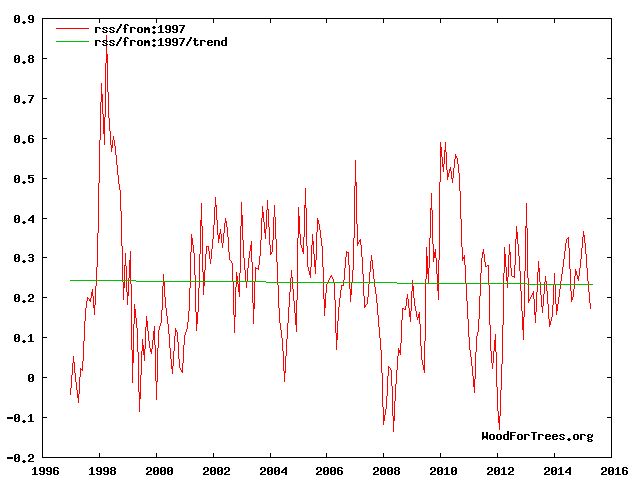
In the mean time, Planet Earth is still making fun of him:
sturgishooper,
In physical sciences, without a plausible physical mechanism all the correlations in the world are only good for hypothesis formation and do little for forming sound theory.
I’d be the last person in the world to discount thinking.
I keep telling you I don’t dispute that. I’m asking you why the absolute temperatures used to be higher today, and by how much. The fluctuations are of interest as well, but first things first.
It’s essential to know what causes the cycles, otherwise it becomes nothing more than random noise. Deterministic physical system here; there’s a chain causality which is, in principle, able to be observed and measured. That needs to be understood before making any claims about what CO2 is or is not doing at any point in the record, then and now.
Which is exactly why climatologists very much do not ignore the past and why so much paleo research has been done and continues to be done.
I’m afraid you do. Your claim is: … what has happened in the 70 years is in no way the least bit unusual. That’s a very strong claim requiring very strong, quantified evidence in support. Anything with Mann’s name on it is obviously out, so it’s doubly up to you to submit evidence which you deem reliable. I’m seriously not interested in trying to guess which research you trust and which you don’t.
I’m also beginning to suspect that you really don’t know much about anything except that you don’t like Michael Mann because you think he’s a Marxist for some unspecified reason.
Which countries are those? How many papers? When?
I’m not sure you understand that critical thinking requires me to ask for such details. It’s part and parcel of being properly skeptical.
I’m also not sure you understand the difference between an evidence-based scientific discussion and evidence-free political screeds. Here’s what Bond et al. (1997) has to say: http://rivernet.ncsu.edu/courselocker/PaleoClimate/Bond%20et%20al.,%201997%20Millenial%20Scale%20Holocene%20Change.pdf
More than 20 years ago, Denton and Karlen (1) made two provocative suggestions about the climate of our present interglacial or Holocene period. Having found what appeared to be synchronous advances of mountain glaciers in North America and Europe, they concluded that Holocene climate was much more variable than implied by broad trends in pollen and marine records. On the basis of radiocarbon chronologies of the glacial advances, they further suggested that the climate variations were part of a regular millennial-scale pattern, which when projected backward coincided with climate shifts of the preceding glaciation and when projected forward predicted a progressive warming over the next few centuries. Despite its important implications, Denton and Karlen’s concept of a predictable, millennial-scale climate rhythm has not been widely accepted, partly because it has been difficult to find corroborating evidence in other climate records.
Nothing troubling here. None of this stuff is easy to find or understand, which is why so much work continues to be done on it.
dbstealey,
Oh irony:
Alan Robertson writes, One of the most frequently made claims from the climate fearosphere is that “recent X month or Y year was the warmest ever recorded“.
sturgishooper replies, True, and I’d add that with books so thoroughly cooked to a crisp, any such claim is highly questionable at best.
Into that mix you respond, In the mean time, Planet Earth is still making fun of him:
… which is the mother of all cherry-picks. The three of you have the combined attention span of a single goldfish and more red herring than a Tokyo fish market. I mean seriously. Just above, sturgis wrote: What matters is the fact that the Minoan Warm Period was globally warmer than the Roman, which was warmer than the Medieval, which was warmer than now, with cold periods in between at about 1000 year intervals.
Now you want to talk about 17 year variability in the lower troposphere? Is there a mind to make up here, or is randomly flinging pasta at the wall to see what sticks about all you’re capable of?
I take it that asking for royalties would be yet another fool’s errand.
Tsk. Last I checked, I wasn’t the one fretting about Marxist takeovers and intentional mass starvation. Apparently there’s some confusion about what constitutes rational, evidence-based scientific debate and hyperoblic political fear-mongering. Pretty sure I’m not the one getting those two things mixed up.
Of course not. You know your way around 17 years of RSS. Case closed, end of story, no other data from anywhere else need apply. Amirite?
I’m right.
sturgishooper says:
what has happened in the 70 years is in no way the least bit unusual.
Gates responds:
That’s a very strong claim requiring very strong, quantified evidence in support.
Sturgis, the guy is trying to paint you into a corner by attempting to frame the debate as if he’s the skeptic and you’re the alarmist. That is typically devious rhetoric, because skeptics have nothing to prove. You do not have to prove that the current climate is normal. They have to prove it is abnormal — and that human emissions are the primary reason. They have failed on both counts.
Dr. Roy Spencer has written that the climate Null Hypothesis has never been falsified. Therefore, climate parameters over the past century have all been exceeded in the past, before human emissions mattered. So you are absolutely correct.
The alarmist crowd is always trying to tap-dance around that fact. They lost the science debate a long time ago: Planet Earth is confirming that fact every year that global warming does not start up again. In fact, every alarming prediction they made was wrong.
So now their arguments have morphed into politics and religion. Because they flat out lost the science debate: global warming has stopped. That central fact is decisive. Everything else is just backing and filling.
dbstealey,
He did it all by himself, Mr. Hat Rack. I wonder where he gets such ideas.
I follow a different standard of proof: (s)he who makes a claim in a given discussion assumes the burden of substantiating it. Period. Doesn’t matter to which “camp” they belong. Good faith debate demands this.
True Skeptics don’t appeal to authority, DB. Practice what you preach is typically good advice.
Gates says: I’m right.
LOLOL!!
Planet Earth says you’re wrong.
Who should we believe, you or Gaia? ‘Cuz you can’t both be right.
Well, I personally won’t invest a grain of salt on any actual live measured climate history earlier than 1980. That’s when the ocean buoys started recording that oceanic near surface water Temperature from arbitrary depths are not a good proxy for oceanic near surface lower tropospheric air Temperatures; and they are not even correlated. That’s also about the start of the satellite record, which is far more reliable.
Having re-read the article still have no idea where this conclusion comes from, that part of the conclusion is bizarrely disconnected from the study. It was like saying, “By having a bagel for breakfast last week, over the next month tractor sales is likely to exceed expectations.”
Using proxy data is an interesting concept. Police use this to solve crimes when reliable witnesses or video of the crime do not exist. But there are limits to proxy data. Fingerprints and DNA can be pretty damning but if stolen property is found in a house and 12 people live in the house, the stolen property alone will not find the guilty party. More proxy data is needed, perhaps a pawn stub in a bedroom, suggestive text messages on a phone, or a parking ticket near the site of a burglary.
In any case it seems to me proxy data is at times validated by the conclusions made from the proxy data. A weird kind circular logic. For example, Having used tree ring data to demonstrate warmer temperatures we can conclude tree ring data is a good indicator of warmer temperatures. This approach happily downplays or ignores other factors, such as insect and mammal populations, changes in soil quality, soil moisture retention and underground stream patterns, disease, rain fall, amount of cloudiness, etc. because much of that is difficult to know if not unknowable. However not knowing will not win the day in a courtroom, why in the court of science it does win the day is a puzzle.
As I read that (and re-read) that quote came from the UN’s IPCC statement (in italics) half way through Dr Ball’s comments.
Alx,
” Perhaps a pawn stub…”
Got it! The killer is… Magnus Carlson in the tournament hall with the chess pieces.
According to the South Tyrol Museum of Archeology pollen and other botanical studies suggest that Otzi died in spring or early summer.
His body was found virtually intact indicating that it was not disturbed by scavengers.
If scavengers did not find his body it must have been concealed quickly…….buried by snow.
Now that’s climate change.
One afternoon it’s spring or early summer.
The next day you are covered in snow/ice and stay that way for 5000 years.