No mention though of the possibility that this is all part of a natural pattern, and of course no mention of Ms. Stroeve’s Greenpeace connections to her research, which brings her scientific objectivity into question. UPDATE: A graph submitted by a commenter suggests otherwise as does recently published paper. See below. UPDATE2: data source has been added.
From NSIDC and UCL:
New data confirms Arctic ice trends: sea ice being lost at a rate of five days per decade
The ice-free season across the Arctic is getting longer by five days per decade, according to new research from a team including Prof Julienne Stroeve (Professor of Polar Observation and Modelling at UCL Earth Sciences). New analysis of satellite data shows the Arctic Ocean absorbing ever more of the sun’s energy in summer, leading to an ever later appearance of sea ice in the autumn. In some regions, autumn freeze-up is occurring up to 11 days per decade later than it used to.
The research, published in a forthcoming issue of the journal Geophysical Research Letters, has implications for tracking climate change, as well as having practical applications for shipping and the resource industry in the arctic regions.
“The extent of sea ice in the Arctic has been declining for the last four decades,” says Julienne Stroeve, “and the timing of when melt begins and ends has a large impact on the amount if ice lost each summer. With the Arctic region becoming more accessible for long periods of time, there is a growing need for improved prediction of when the ice retreats and reforms in winter .”
While temperatures have been increasing during all calendar months, trends in melt onset are considerably smaller than that of autumn freeze-up. Nevertheless, the timing of melt onset strongly influences how much of the Sun’s energy gets absorbed by the ice and sea. This in turn is affected by how reflective the surface is. Highly reflective surfaces, such as ice, are said to have a high albedo, as they reflect most of the incoming heat back into space. Less reflective surfaces like liquid water have a low albedo, and absorb most of the heat that is directed at them.
This means that even a small change in the extent of sea ice in spring can lead to vastly more heat being absorbed over the summer, leading to substantially later onset of ice in the autumn. There is also a second effect, in that multi-year ice (which survives through the summer without melting) has a higher albedo than single-year ice that only covers the sea in winter. Since the 1980s, the proportion of the Arctic winter ice that is made up of multi-year ice has dropped from around 70% to about 20% today, so the changes are quite substantial
These feedback effects, in which small changes in atmospheric temperature and sea ice lead to large changes in heat absorption, was what the team set out to study.
Stroeve’s team analysed satellite imagery of the Arctic region, dating back over 30 years. The data breaks down the whole region into 25x25km squares, and the team analysed the albedo of each of these for each month for which they had data. This allowed them to update trends and add an extra 6 years onto the most recent analysis of its kind. The new data continues the trend towards longer ice-free periods previously observed.
“The headline figure of five days per decade hides a lot of variability. From year to year, the onset and freeze-up of sea ice can vary by about a week. There are also strong variations in the total length of the melt season from region to region: up to 13 days per decade in the Chukchi Sea, while in one, the Sea of Okhotsk, the melt season is actually getting shorter.”
The amounts of energy involved in these changes are enormous – hundreds of megajoules of extra energy accumulated in every square metre of sea. This is equivalent to several times the energy released by the atom bomb at Hiroshima for every square kilometre of the Arctic ocean.
For organisations such as oil drillers operating in the Arctic region, a sophisticated understanding of when the sea will freeze up is essential. For climate scientists, this type of study helps them better understand the feedback mechanisms inherent in the Arctic climate. The results from this study are closely in line with previous work and therefore give added confidence that models of the complex Arctic climate are broadly correct.
Notes
- The research appears in a paper entitled “Changes in Arctic melt season and implications for sea ice loss”, to be published in a forthcoming issue of the journal Geophysical Research Letters. An online pre-print is available now on the journal website.
- Julienne Stroeve is a recent appointment to UCL Earth Sciences, joining the department from the National Snow and Ice Data Centre in Colorado, USA.
Related links
- Article in Geophysical Research Letters
- UCL Earth Sciences
- National Snow & Ice Data Center
- Centre for Polar Observation and Modelling
High-resolution images
Satellite view of sea ice
This image may be reproduced freely as it is in the public domain
Map of changing melt seasons in the Arctic
This image is available under a Creative Commons Attribution Non-commercial No-derivatives licence. It may additionally be reproduced for the purpose of news reporting.
Researcher profile
=================================================================
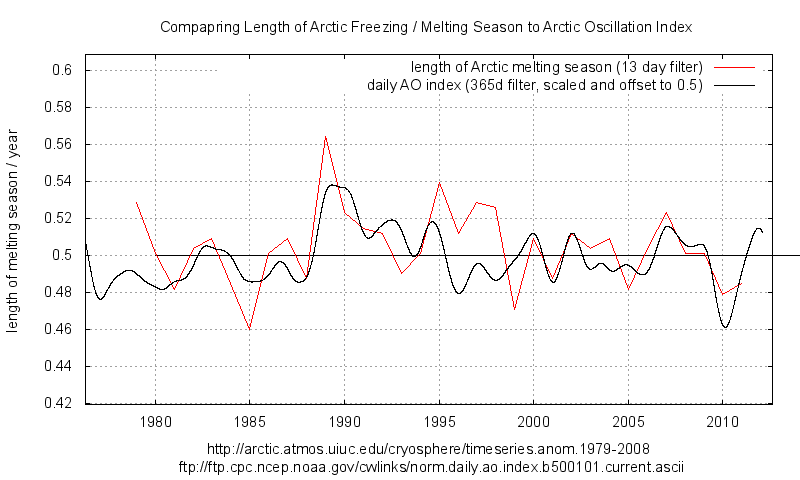
UPDATE: Gail Combs offers this graph in comments which suggests that there is no long term trend for the data back to 1979, only a recent drop. FTP Data source listed below.

UPDATE2: Les Johnson Sends over his spreadsheet with data. He writes:
This is my spreadsheet on arctic ice max/min. The data is taken from the link in the sheet. I apologize as its not user friendly, nor fully automated. I did not expect to share it. I filter by year, and take the max/min and the respective dates. That’s it. The assumption is that after max, the ice is melting, until minimum is reached.
1979-2011 arctic melt season (XLSX)
Also Greg of “climategrog” says he thinks the graph needs more context. So, here it is with his links:
The data source listed on that graph is the original data source from which it is derived. It is not the data which is shown in the plot. I know because it’s my processing of that data.
Taken out of context it is rather misleading. Indeed you seem to have (not unreasonably) misunderstood it be the data in the FTP link that is plotted directly. It would seem more appropriate to provide a link to my documentation of how it was derived.

==============================================================
By way of explaining the recent drop in days, we have this recently published paper Via the Hockeyschtick:
New paper finds lows of Arctic sea ice in 2007 and 2012 were due to storms
A new paper published in The Cryosphere finds that the 2 recent lows in Arctic sea ice over the past decade during 2007 and 2012 were strongly related to storm activity, rather than a long-term effect of climate change. According to the authors, “Strong summer storms on the Siberian side of the Arctic Ocean may have been important contributions to the recent [Arctic sea ice minimums] in 2007 and 2012.” Arctic sea ice strongly rebounded in 2013 by up to 78% in comparison to 2012, suggesting the 2007 and 2012 lows were just natural variation.
The paper adds to many other peer-reviewed publications finding Arctic sea ice extent is due to natural variability from winds and storms, not AGW.
The Cryosphere, 8, 303-317, 2014
http://www.the-cryosphere.net/8/303/2014/tc-8-303-2014.html
Cyclone impact on sea ice in the central Arctic Ocean: a statistical study
A. Kriegsmann1,* and B. Brümmer1
1Meteorological Institute, University of Hamburg, Hamburg, Germany
*now at: Climate Service Center, Hamburg, Germany
Abstract.
This study investigates the impact of cyclones on the Arctic Ocean sea ice for the first time in a statistical manner. We apply the coupled ice–ocean model NAOSIM which is forced by the ECMWF analyses for the period 2006–2008. Cyclone position and radius detected in the ECMWF data are used to extract fields of wind, ice drift, and concentration from the ice–ocean model. Composite fields around the cyclone centre are calculated for different cyclone intensities, the four seasons, and different sub-regions of the Arctic Ocean. In total about 3500 cyclone events are analyzed. In general, cyclones reduce the ice concentration in the order of a few percent increasing towards the cyclone centre. This is confirmed by independent AMSR-E satellite data. The reduction increases with cyclone intensity and is most pronounced in summer and on the Siberian side of the Arctic Ocean. For the Arctic ice cover the cumulative impact of cyclones has climatologic consequences. In winter, the cyclone-induced openings refreeze so that the ice mass is increased. In summer, the openings remain open and the ice melt is accelerated via the positive albedo feedback. Strong summer storms on the Siberian side of the Arctic Ocean may have been important contributions to the recent ice extent minima in 2007 and 2012.
Sea ice used to be stable, same with sea level, temperature, snow cover, precipitation, insolation, ocean currents, wind, cloud cover, etc. Those were the days.
New analysis of satellite data
remind us again of how many years of this date they have and how long a period we have to wait before we can say ‘climate doom is off’ ?
Its easy to forget now that such images we take for granted were simply no possible until the last few years and that weather elements , such as the very existence of the Jet Stream, where simply unknown until the last centenary.
When people make claims based on long term trends its always useful to ask how if at all this data was collected in the past or are we just really looking at proxies or model guesswork with all the problems that involves.
Harold Ambler says:
March 4, 2014 at 9:58 am
> Sea ice used to be stable, same with sea level, temperature, snow cover, precipitation, insolation, ocean currents, wind, cloud cover, etc. Those were the days.
Then we got the resources to measure it. 🙂
No mention of the inverse in the Antarctic.
If AGW is in fact a “G” (global) issue, then sea ice concerns should factor both poles into the calculations. And sea ice is a concern from an “impacts” standpoint because it is a proxy for the glacial ice masses on land that, as they melt, create a rise in sea levels, right?
Narrowest of perspectives taken to produce maximum alarm, then extrapolated to “global”.
Tell this to the guys whose yachts are stuck in the Arctic after believing that the Northwest passage would be open last summer. It will be interesting to see how many survived the winter.
“The amounts of energy involved in these changes are enormous – hundreds of megajoules of extra energy accumulated in every square metre of sea. This is equivalent to several times the energy released by the atom bomb at Hiroshima for every square kilometre of the Arctic ocean.”
They used Hiroshima bomb equivalents (HBE) – argument over!
Look. nothing is more un scientific than attacking a person because of their politics or religion.
Folks rightly object when they are called oil shills or when their connections to repubican or libertarian think tanks are cited as a reason to doubt them. Skeptics who disbelieve in evolution routinely have their science questioned because of their religious beliefs. Skeptics who are doubted merely because they have no formal education are also subject to this nonsense.
They did a study. look at the data. Noting a persons gender, or orientation or race or politics or religion or activism as a reason to doubt them is anti scientific bull crap. Doubt them because you doubt EVERYTHING until its checked. Avoid personalizing and politicizing the debate even if others behave badly. get the data, get the code. do the science of checking rather than the smearing of politics.
REPLY: Nothing was said about gender, or orientation, or race, or religion, that’s all you Mr. Mosher. What was demonstrated was that there’s an obvious connection to Greenpeace during Ms. Stroeve’s Arctic research, and given Greenpeace’s history of activism, and in some cases illegal actions in the name of that activism, I say it is fair game. A researcher that poses for a political picture in an activism setting, much like Hansen has done, reduces their perceived objectivity, especially while it is on a research trip.
NOAA has Arctic capable research vessels, and connections to other scientific agencies that have such vessels, if Ms. Stroeve wanted to avoid such criticism, she should have arranged to use one of those rather than use a political attack ship.
Imagine if you decided to join a climate protest group at Berkeley, and had your research funded/abetted by that group and had a photo of you protesting with them. I think it would be fair game to point it out and note that this likely would reduce your scientific objectivity.
[added: also, see the update for a competing paper and graph]
– Anthony
Given the low angle of solar irradiation, how much of the meltback
is the responsibility of the sun and how much the responsibility of
the Gulf Stream current, which originates in the Caribbean?
The dramatic freezing of the Northern Hemisphere over the last five
winters suggests changes can’t be far away.
You’re right. Now stop it …
GRAPH: Length of Arctic Melt Season (from ice extent)
Seems the NOAA data does not agree.
@Steve Egbert
I wonder how many negative Hiroshima Bomb Equivalents are represented by additional Antarctic ice in the same period.
“The amounts of energy involved in these changes are enormous – hundreds of megajoules of extra energy accumulated in every square metre of sea. This is equivalent to several times the energy released by the atom bomb at Hiroshima for every square kilometre of the Arctic ocean.”
Maybe we should test this by actually dropping an atom bomb on every square kilometer of the Arctic ocean and measure the loss of sea ice. Sounds reasonable to me.
‘Less days’ jars a bit.
” In some regions, autumn freeze-up is occurring up to 11 days per decade later than it used to. ”
Great start, sounds like a newspaper report. Science by press release.
“The extent of sea ice in the Arctic has been declining for the last four decades,” says Julienne Stroeve, “and the timing of when melt begins and ends has a large impact on the amount if ice lost each summer.
Well if you dice it small enough you’ll always be able say “some regions….” and ” up to xxxx more than it used to”.
However, looked at as a whole Arctic melting season has been getting steadily shorter since 1990.
http://climategrog.wordpress.com/?attachment_id=210
BTW – the cited “growing need for improved prediction of when the ice retreats and reforms in winter” sure would have helped in the Antarctic this last year. Right Chris Turney?
Sounds like Stroeve’s study should be reproduced there as well.
http://climategrog.wordpress.com/?attachment_id=206
…
The ice-free season across the Arctic is getting longer by five days per decade, according to new research from a team including Prof Julienne Stroeve (Professor of Polar Observation and Modelling at UCL Earth Sciences). New analysis of satellite data shows the Arctic Ocean absorbing ever more of the sun’s energy in summer,
Re: my bold above: That’s GOT to really be minimal at that latitude, compared to say, 20 deg N …
How does that compare to natural circulation from waters outside the arctic?
.
“The ice-free season across the Arctic is getting longer by five days per decade” ??
I’m unaware that there is ever an ‘ice free season’ in either the Arctic or Antarctic. How on earth can a ‘scientist’ use this kind of imprecise, emotion laden terminology (along with the now apparently obligatory ‘Hiroshima Bomb’ equivalence reference) in a paper they wish anyone to take seriously?
And she has “a sophisticated understanding.” Scientists don’t say “sophisticated.” Add it to the Hiroshima Bomb pile.
She needs to look across an entire sixty year cycle to get the full picture. We lack data from the first twenty years.
Currently the AMO is warm but the the PDO has shifted to cold. Ice on the Atlantic side remains below normal while on the Pacific side during the past few years maximum extent has shifted to above-normal, and this year is at normal despite a slow start. The multi-year-ice ice against the Canadian coast in the Beaufort Gyre is much thicker than it has been, and that thick ice has extended west, north of Alaska, towards Bering Strait. If the ice can recover so swiftly when the PDO flips, what do you imagine will happen when the AMO flips? Only after twenty years will we have reasonably good data for a full sixty year cycle.
Arctic sea ice has turned the corner.
http://climategrog.wordpress.com/?attachment_id=783
It will become evident fairly soon whether this model of the “death spiral” best fits the data.
“The ice-free season across the Arctic is getting longer by five days per decade” ??
That makes exactly no sense at all. There has never been an ice-free season across the Arctic.
Derivation of the adaptive anomaly is detailed here, This was also posted and discussed on Judith Curry’s Climate Etc.
http://climategrog.wordpress.com/2013/09/16/on-identifying-inter-decadal-variation-in-nh-sea-ice/
Gulf Stream doesn’t care about CAGW:
“URI oceanographer refutes claims that climate change is slowing pace of Gulf Stream”
http://www.uri.edu/news/releases/?id=6965
“I wonder how many negative Hiroshima Bomb Equivalents are represented by additional Antarctic ice in the same period”
talking of bombs-
the 15-megatonne Bravo test on 1 March 1954, at Bikini Atoll, was a thousand times more powerful than the atomic bomb dropped on Hiroshima.
it vaporized vaporized 3 islands ,
several decades on the coral is doing quite well.
“Coral flourishing at Bikini Atoll nuclear test site – because humans have been driven away”