The following link is to a Tweet from Peter Gleick regarding Typhoon Haiyan. It includes a map of the subsurface temperature anomalies at depths of 100 meters in the northwest tropical Pacific for October 2013. Overlaid on it is the storm track of Typhoon Haiyan. The map was included in Jeff Masters blog post here at the WeatherUnderground.
http://twitter.com/PeterGleick/status/400701313593270272/photo/1
The source of the map is the JMA webpage here. My figure 1 is the full map JMA presents for the depth of 100 meters. The JMA also presents temperature anomalies at 3 other depths: 50, 200 and 400 meters. Why didn’t Gleick and Masters present the temperatures at those depths as well?

Figure 1
I’ll let you decide. See Figures 2, 3 and 4.

Figure 2
###

Figure 3
###

Figure 4
And Figure 5 is the JMA map of sea SURFACE temperatures for October 2013.

Figure 5
Animation 1 is of the temperature anomaly maps at 100 meters from the JMA, from their start month in January 2011 to October 2013. The October 2013 conditions do not look “remarkable” when compared to the anomalies since January 2011.

Animation 1
Animation 2 is of the temperature anomaly maps at 100 50 meters from the JMA, from their start month in January 2011 to October 2013. The October map in the area of Haiyan doesn’t appear remarkable either.

Animation 2
Jeff Masters refers to Tropical Cyclone Heat Potential (TCHP) in his blog post, but fails to illustrate it. Animation 3 is an animation of Tropical Cyclone Heat Potential from NOAA here. At best, the Tropical Cyclone Heat Potential was low-to-mid scale at the time of Haiyan.
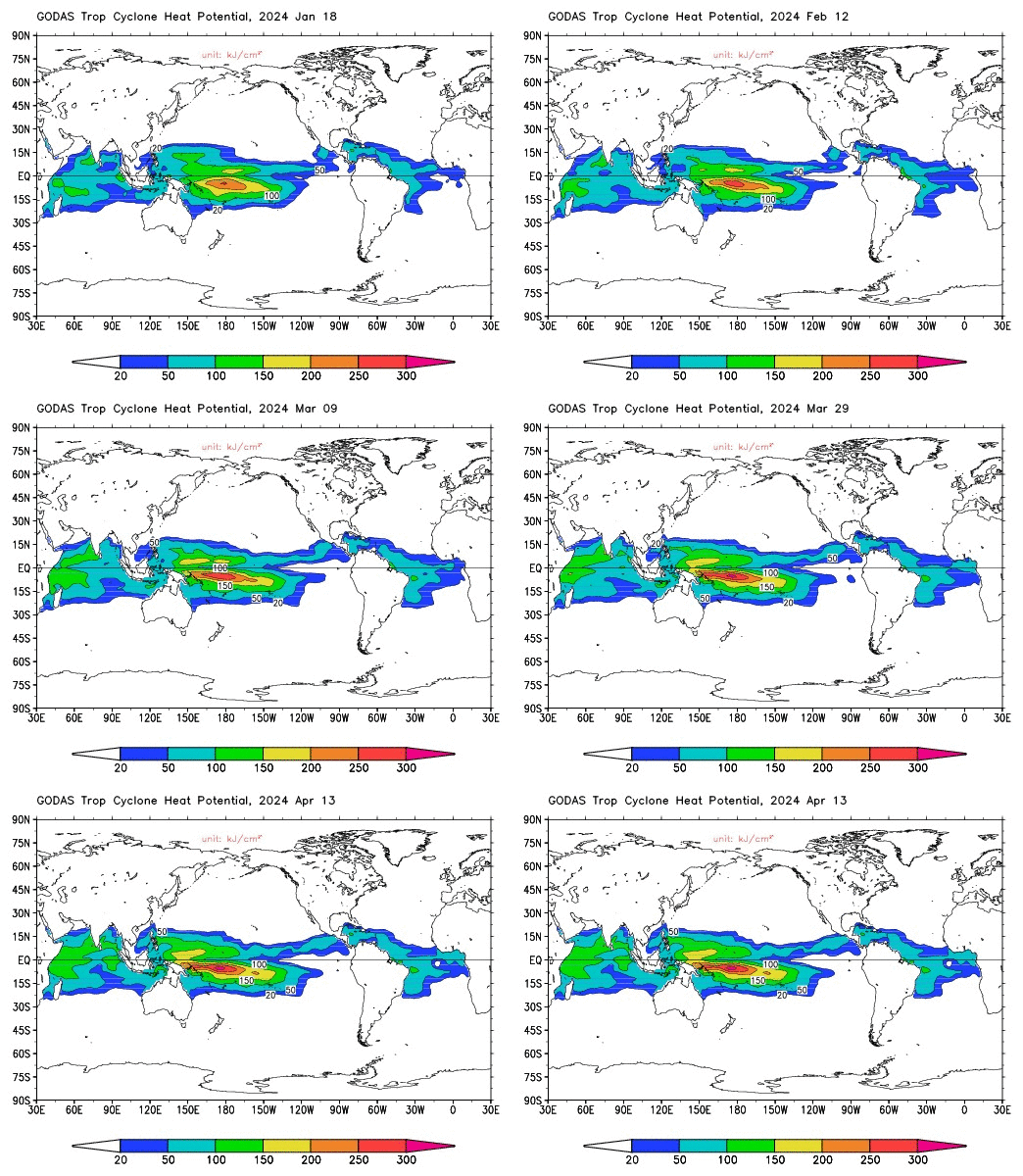
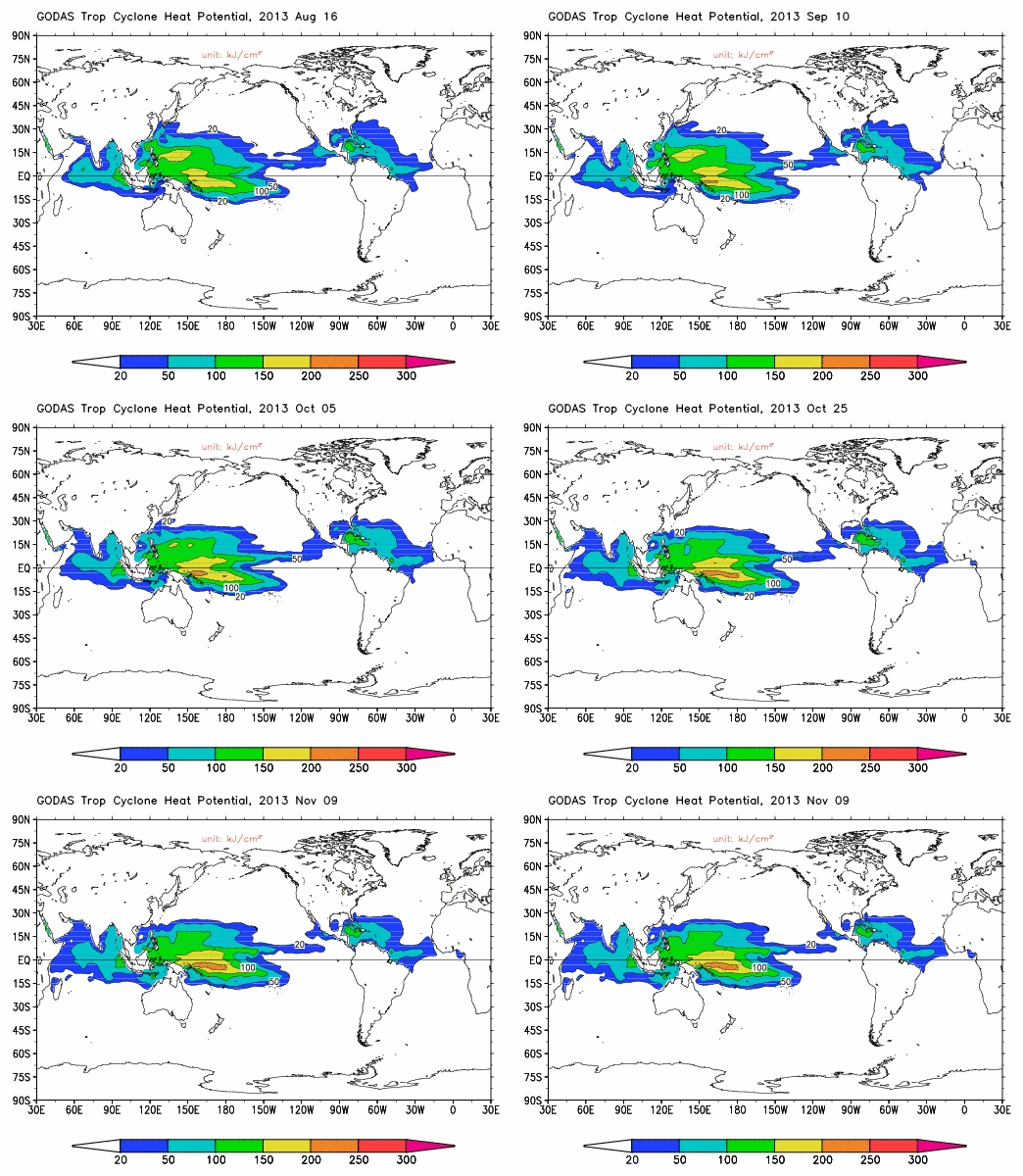
Animation 3
Now, I’m not disagreeing with Jeff Masters that a typhoon stirs subsurface waters and that the band of warm water at depths of 100 meters COULD have contributed to Haiyan. But Masters’s blog post was speculation. His use of the word “could” in his opening sentence is the indicator (my boldface).
A remarkable warming of the sub-surface Pacific waters east of the Philippines in recent decades, due to a shift in atmospheric circulation patterns and ocean currents that began in the early 1990s, could be responsible for the rapid intensification of Super Typhoon Haiyan.
Masters did not state the subsurface waters at depths of 100 meters WERE responsible, but “could be responsible”. He was speculating.
But Gleick presented it as fact, without showing that sea surface temperature anomalies and the temperature at 50 meters were not unusually warm.
One alarmist speculates and another presents it as fact. Why doesn’t this sound unusual to me?
Gleick is just following his own lead. After all, his fraud was predicated on his belief that the Heartland “COULD” have written such a document, so he said they did.
One alarmist speculates and another presents it as fact. Why doesn’t this sound unusual to me?
Doesn’t sound unprecedented either.
modus operandi
Am not sure where Gleick said it did contribute to strengthening. Not that he didn’t say it. I just don’t see it. Was it in another tweet? He clearly mentioned the two events in the same sentence but I can’t see a cause and effect connector in the tweet you linked to.
Lovely maps. Look at all those vertical, horizontal and temporal temperature gradients. Calculating the Ocean Heat Content accurately must be a challenge.
That crook shouldn’t be doing anything except watchin’ the walls of his cell.
Does anyone actually think that cyclones do not draw on energy from deeper than a few meters?
Cyclone energy is on the order of megatons per minute. Do AGW fanatics think that cyclones have not always drawn on all the potential energy available?
It is mind boggling that it is even an issue.
This typhoon was not unique, not behaving in any sort of new way from the millions of years of cyclones that have occurred. AGW believers seem more and more to be the sort of people who would travel across the country to see the Blessed Mother in a tortilla.
Pamela Grey: “Am not sure where Gleick said it did contribute to strengthening…”
He implied it:
“Here is (HT to @wunderground) the abnormally high ocean temps and the track of Typhoon Haiyan.”
Never let a good tragedy go to waste.
hunter says: “Does anyone actually think that cyclones do not draw on energy from deeper than a few meters?”
My recall is that “they” say the top 60 meters have to be above 26 deg C in order to support a tropical cyclone. Otherwise the subsurface turbulence will mix too much cool subsurface water.
The difference between a scientist and an activist: a scientist surveys the trail of evidence and follows it to the cause; the activist follows the cause and gathers anecdotal evidence on the way.
hunter says:
November 14, 2013 at 5:45 am
Oh absolutely. However, it’s the surface temps that lead to storm formation, once the storm gets going wind can mix in the the water below. However, I have no idea how deep the mixed column can be. 100m seems too much in open ocean, I’ll defer to Ryan Maue for that answer.
The longer we keep records, the more likely those records will be broken. It doesn’t mean that nature is changing. It means we have been keeping records longer.
As a rule of thumb, a once in a lifetime storm can be expected once in a lifetime – AT YOUR LOCATION. If you only keep records for 10 years you are much less likely to see such a storm, than if you keep records for 100 years.
However, due to the nature of global communications, when a typhoon happens in PI, our minds make believe that we have “seen” the typhoon, so our minds create the illusion that typhoons are increasing. They are not increasing.
What is happening is that 100 years ago, you would have learned about the typhoon in PI only as a small article in page 6 of the newspaper. Now today, you learn about the typhoon on TV and the internet, as it happens, as though the storm was right outside your door threatening your house.
Did we have storms and bad weather before people started driving SUV’s? If not, then why did humans domesticate fire long before they learned to drive? Without fire humans would be still be confined to a narrow band of tropical rain forests along the equator. Everywhere else is too cold for us to survive for long otherwise.
In fact, the domestication of Fire is the only truly unique trait of human beings. And with fire comes CO2. So in many respects, the survival of the human race is directly tied to the production of CO2.
Joe Bastardi called Gleick or should that be gLIEck out on this on his Twitter page.
Gleick tried to push it as another sure sign of “climate change”
Seems these warminsta’s do not read IPCC reports ,where it states “no one weather event can be attributed to AGW”.
fred berple: “It doesn’t mean that nature is changing. It means we have been keeping records longer.”
Or changing how we measure things,
Nobody knows better how to commit perfectly legal fraud than Gleick.
Remember that not only Gleick, but almost our entire government today operates on the George Costanza principle: “It’s not a lie if you BELIEVE it to be true!”
TCHP methodology for new and old data.
http://www.aoml.noaa.gov/phod/cyclone/data/method.html
The words synthetic, linearly regressed, and interpolated stand out in version 2.1, which has been in use since 2008. Reminiscent of GISS data processing?
Misrepresentation is the evil twin of speculation.
Bob, where do the pre-ARGO subsurface temperature anomalies come from? On what baseline are they derived?
It seems to me that publishing such high spatial resolution anomalies when any data close to that resolution has only been around since 2005 is a flat out lie.
Slacko: Thanks. I corrected the typo.
scarletmacaw says: “Bob, where do the pre-ARGO subsurface temperature anomalies come from? On what baseline are they derived?”
Sorry. I don’t know enough about the JMA datasets to answer your question. The TAO project buoys have been in place since the early 1990s, but they only extend to about 9N and as far west as 135E.
Bob, you show anomalies in degrees C, but is a +2 at surface the same temp as a +2 at 100m – I don’t think so. In fact, the actual temp at 100m, if it were raised to surface would cool the surface and not contribute much to the hurricane, especially since the hurricane would have already passed by. This use of anomalies is bad enough for them being fictitious, but surely they are not very useful where we want comparative actual heat content. Anomalies are really an instrument of deception.
When engineers design a structure, they usually allow it to withstand a 100, 200, or 500 year weather event.
Although this cyclone was a tragedy, a similar one happens in the region every 100, 200, or 500 years.
As the whole global warming hoax starts winding down with the planet’s temperature refusing to co-operate and even the polar ice expanding, then in desperation the alarmists flail around seeking new ‘proof’, such as perfectly natural extreme weather events and supposed ocean acidification.