
From ChicoEr.com
Flying close enough to Earth that in astronomic terms one could feel the breeze as it passed, a small asteroid flashed by just after midnight today.
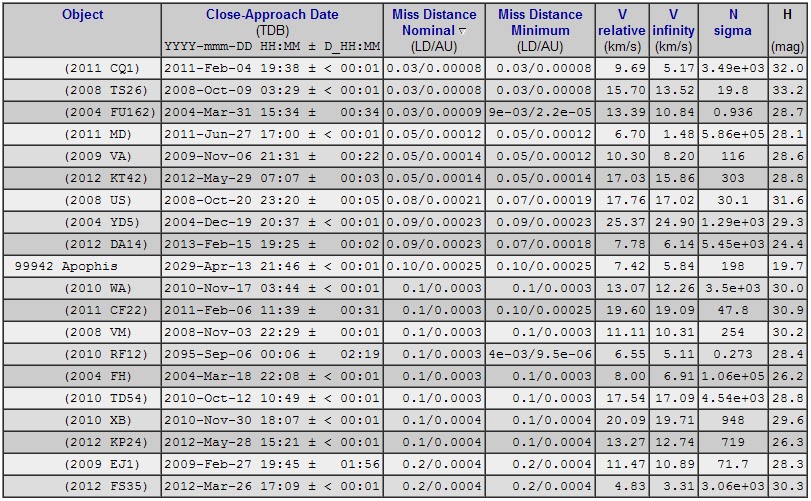
NASA reported the space rock, with the unimaginative name of 2012 KT42, was just 8,700 miles above the atmosphere when it went by.
While the asteroid’s approach is actually within the orbit’s geosynchronous satellites, it is not of the sort to inspire fears of global destruction.
NASA estimates the object is roughly 10 to 30 feet in diameter. It is still not tiny. The fireball that flashed over California earlier this year and dropped fragments of itself over the Sierra Nevada, was said to be abut the size of a mini-van.
From Spaceweather.com
SMALL ASTEROID BUZZES EARTH: Newly-discovered asteroid 2012 KT42 is flying past Earth today (May 29th) only ~14,000 km above the planet’s surface. This means 2012 KT42 will actually fly inside the Clark Belt of geosynchronous satellites. The 3- to 10-meter wide asteroid ranks # 6 on the top 20 list of closest-approachers to Earth. According to the asteroid’s orbit, there is no danger of a collision. Even if it did hit, this space rock is too small to cause significant damage. It would likely disintegrate almost entirely in the atmosphere, peppering the ground below with relatively small meteorites.


How much is spent every year on asteroid protection compared to climate monitoring and mitigation?
An astroid with the name 2012 KT42 ? Oooh I don’t like the sound of that!
It is sobering to realize that one of these rocks can plow through 150 km of atmosphere in as little time as it takes to say, “Late Cretaceous Extinction Event.”
Some see a threat. Some see $100,000,000 of precious metals hurtling by.
It may not pose a risk to earth but if it were to play cosmic pinball with a few geosynchronous satellites then it may pose more of a problem then is foreseen.
In the future we can look forward to more asteroids passing closer to Earth, or even crashing due to Global Warming caused by our emissions of CO2.
/sarc
But seriously, the last large impact from space was Tunguska in 1909, and I remember reading it was once a 100 years event. Does it mean we are overdue an impact? Tunguska meteorite was as powerful as a large hydrogen bomb explosion, destroying an area 90×90 miles (or 800 sq m)….
if it was solid iron ore would it really breakup upon hitting the atmo ?
Fascinating – Dr Spock
Cool but not concerning.
Astronomy is becoming more sensitive.
Beware becoming excited by previously invisible signals, masked by noise.
This is what happened when the ECD was invented. (Think about it).
@ur momisugly Garry Stotel says:
May 29, 2012 at 2:19 pm
In the future we can look forward to more asteroids passing closer to Earth, or even crashing due to Global Warming caused by our emissions of CO2.
/sarc
But seriously, the last large impact from space was Tunguska in 1909, and I remember reading it was once a 100 years event. Does it mean we are overdue an impact? Tunguska meteorite was as powerful as a large hydrogen bomb explosion, destroying an area 90×90 miles (or 800 sq m)….
***************************************************************************
There have been several others, tho not quite as large as Tunguska, since then. One in the Indian ocean around the late 70’s if I recall. Military message traffic at the time thought it was a nuke at first. Still no conclusive proof either way. The Vela Incident.
Probability says that most meteor’s etc. will land in the oceans, or uninhabited areas, so quite a few impacts would have been missed before 1965 or so.
According to the Royal Astronomical Society, anything less than 10 metres in diameter is a meteoroid.
ZZZzzzz
That’s nothing. In 1883, the world came a lot closer to ending: Interpretation of the observations made in 1883 in Zacatecas (Mexico): A fragmented Comet that nearly hits the Earth, Manterola, et al 2011:
I was sky watching last night.
I’ve never seen a scientific paper use Comic Sans before. Seems more appropriate to papers from The Team, somehow…
There is evidence that marine impacts are larger and more frequent than generally believed.
Along 2500 km of the Western Australian coast, prehistoric ephemeral marine inundations (storm surges or tsunamis)
were much larger than those that occurred since European settlement. The evidence is in the form of shell and coral
deposits atop 30-m-high headlands, sand deposits containing large boulders, shell and coral several kilometers inland,
and fields of large imbricated boulders across shore platforms. The size of transported boulders and the altitude of
these deposits suggest that tsunamis were responsible, not large storm waves. The orientation of boulders reveals
paleowave directions. Radiocarbon dating of the deposits suggest three very large tsunamis along this coast during
the past millennium.
http://www.tesag.jcu.edu.au/staff/jnott/abstracts/Jour%20Geol%20(WA%20tsunamis).pdf
Info like this always makes me smile and then I get mad. For all the ‘I lov Gaia’ crap I see on the internet, not one of them ejits seems to realise how fragile our planet/biosphere really is.
We have zero redundancy, none, nada. We need to get ourselves off this rock asap and colonise other planets and eventually other solar systems when the tech allows.Hell maybe teraforming is possible so we can take the rest of the flora and fauna with us.
/rant off, opening a beer and enjoying WUWT !
Heggs.
When I first saw the article on spaceweather (one of my favorite sites, along with WUWT and ICECAP), I thought it was about previous day’s 2012 KP24 flyby (yep, two flybys in two days). But when I read the article, I changed my bedtime plans. Conditions were great here in Colorado – a clear if chilly night, with the asteroid high in the southern sky. So I quickly set up the 12-inch reflector and tracked the little rock for 42 minutes, from 0612 to 0654 UTC, as it swept across 45 degrees of sky and set into the trees to my west. Along the way it brightened from magnitude 11.5 to 10.5, a whole magnitude brighter than predicted. Aside from some meteorites I’ve held in my hands and other meteors flashing though the upper atmosphere, this is the closest astronomical object I’ve ever seen. According to NASA Horizons, 2012 KP24 was just 19158 km from my house when I last saw it, about the same as a plane flight to Australia. AT 3 to 10 meters, the “dwarf planet” is about the size of my living room, or even one of the bathrooms. It would be fun to stand on a world that size and carefully jump into orbit.
Any notion of how close this rock came to any of the geo-synch satellites?
Thanks for this story Anthony. Interesting! And while this one was small, the part that bugs me is that the Asteroid was discovered only 1 DAY before it flew buy – INSIDE of our belt of geosynchronous satellites. Yipes!
If one wants something ‘environmental’ to be concerned about – and spend some money to avoid a bad outcome – asteroid detection is at the top of my list. An impact from a big one (albeit highly unlikely) will produce a well-agreed negative outcome. As opposed to having to manage an average temperature increase of a few degrees (against a diurnal range of 10’s of degrees).
I would sign up for NASA spending some $ to increase our detection and mitigation of such near-earth objects.
Heggs says: @ur momisugly May 29, 2012 at 4:18 pm
…… We need to get ourselves off this rock asap and colonise other planets….
____________________________
One of the hopes of my youth as I avidly devoured Asimov, Heinlein, et al. I could cry when I think of the depths that NASA has descended to. It must really stick in the craw of the retired Astronauts and Engineers that saw us into space.
“The asteroid was discovered by Mt. Lemmon Survey with a 1.5-m reflector + CCD on May 28, 2012 at magnitude ~18.1.”
The Mt Lemmon website says that they use binary asteroid systems to determine the density of the astroids. Their calculations show densities of .8, and 1.7…Apparently asteroids are made of sugar and spice and everything nice.
They only look like rocks.
Correction… 2012 KT42, not 2012 KP24, was just 19158 km from my house when I last saw it
Don’t know how I could have ever confused the two.
omnologos says:
May 29, 2012 at 2:07 pm
How much is spent every year on asteroid protection compared to climate monitoring and mitigation?
————————————
A recent documentary put it at the cost of running a McDonalds. Not the whole company, just one restaurant. I think it may actually be up into the low tens of millions now. So much for the vaunted Precautionary Principle.
NOW THAT’S COOL!
Don’t go into the biz; math is not your forte.
90×90 = 8100, not 800.
P.S. to above note to Garry Stotel;
And I’m fairly sure the area destroyed was circular, not square, so the area would have been
π x 45^2 = ~6362 sq. mi.