Guest Post by Thomas Fuller
This is a great time to talk about energy use worldwide. Not because it’s topical, or politically important, or anything like that. It’s a great time because the math is easier now than ever before, and easier than it ever will be again.
It’s similar to a time a few years ago when there were almost exactly 100 million households in the United States. It made a lot of calculations really easy to do. And this year, the United States Department of Energy calculates that the world used 500 quads of energy. Ah, the symmetry.
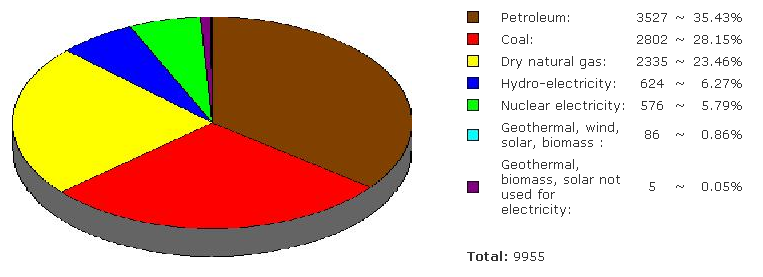
Even more conveniently, the United States and China will each use roughly 100 quads. Comparisons, contrasts–you don’t even need a calculator! A quad is a quadrillion British Thermal Units, and is roughly equivalent to the energy liberated from 36 million tons of coal. It’s a lot of energy, and 500 of those quads is really a mind stretcher. (For those of you who are counting, about 52 of those quads came from renewable energy. Of those 52 quads, about 50 came from hydroelectric power… urkk…)
In 2035, the DOE figures the world will consume about 683 quads, give or take. The UN, more ambitiously, thinks it’ll come in at about 703 quads. Either way, they anticipate a 40% growth in energy requirements. Is it okay if I say I think they’re both wrong?
Here’s why: The UN (and pretty much everybody else) believes that the world’s population will be at or around 8 billion in 2035. The UN (and pretty much everybody else) believes that world GDP will grow by about 3% per year between now and then–which is pretty much what it has been doing for quite a while. But most of that growth is projected to occur in the developing world. And most of that growth will be very energy intensive.
Here in the U.S., our energy consumption per person has been declining for a while, now. We’re down from 337 million btu’s per person to 323 mbtu’s per capita. But it’s going in the other direction in the developing world. They need the energy to actually, well, develop. And then they want the energy to enjoy the fruits of their development. Makes sense–that’s exactly what we did here.
Price Waterhouse Coopers has projected GDP growth to 2050 for major economies. For the U.S., they predict per capita growth in GDP from $40,339 in 2005 to $88,443 in 2050. Most of the very well developed countries show the same level of growth–a bit better than doubling.
The Department of Energy has energy use per person for many of the same countries. So let’s look at China. Before I start, remember that China has doubled its energy use since 2000. And they’re not done yet.
Their 2005 GDP per capita was $1,664 and their energy usage per capita was 58.8 mbtu’s. Their 2050 GDP per capita is projected to be $23,534, similar to Spain’s present GDP per person. Spain’s energy use is 164 mbtu’s. So who wants to predict China’s energy use per person in 2050? In 2035?
We’re always picking on China, and we don’t need to. The scary part is we can do the exact same thing for Indonesia, Brazil, Mexico, Turkey and India. The developing world is developing. They are going to be energy-sucking monsters for the next 80 years–just like we were.
My calculations show that, if we succeed in persuading the developing world to use energy efficient technologies wherever possible, switching from coal to natural gas, adopting wind and solar, buying best of breed turbines, etc., the world’s energy consumption in 2035 will be about 1,100 quads. However, if they proceed as they are (mostly) doing now, throwing up dirty coal to avoid blackouts and brownouts, cobbling together solutions however they can, world energy use in 2035 might well approach 2,000 quads–or even surpass it.
Imagine a world of 8.1 billion people, 7 billion of whom are using energy at the same rate as we do here in America–323 million btu’s per head. (3.23 x 7, for Joe Romm). That’s over 2,100 quads. It is at this point that some ugly questions appear. If we burn coal to obtain this energy, that’s 2,100 x 36 million tons of coal. If we withhold energy from these people, we condemn them to lives of starvation and poverty. If we subsidize clean energy solutions for them, we are spending our hard earned tax money on the poorest of the poor, many of whom live in countries that are not friendly to us. Oh, wait… we’re already doing that, aren’t we?
I favor the third solution. Using your and my tax dollars to help the poor afford electricity that comes from natural gas, nuclear and other cleaner solutions, so they can afford to buy our video games and see our movies (and, well, pay for them…). I do not expect my idea of the best solution to be very popular. Not with climate alarmists, who already don’t like natural gas or nuclear, and want to limit energy consumption by everybody except for themselves. Probably not with many readers here, who have seen taxpayer money go up in smoke on so many poorly-designed projects. But I think it’s our duty to ourselves, as well as the poorest of the poor.
It is at this point that some ugly questions appear. If we burn coal to obtain this energy, that’s 2,100 x 36 million tons of coal. If we withhold energy from these people, we condemn them to lives of starvation and poverty. If we subsidize clean energy solutions for them, we are spending our hard earned tax money on the poorest of the poor, many of whom live in countries that are not friendly to us.
Are you asking for a “them or us” vote? Cause if you are, I vote for us. The history of life (all life, not just people ) is one of violent conflict – mostly over resources of one kind or another. Why should this be any different?
2,000 quads in 25 years is impossible. Pain and suffering (e.g., war) is inevitable.
No. It is not he duty of American taxpayers to subsidize hostile, corrupt, disfunctional, despotic (the list goes on) thirld world governments.
Using natural gas for electrical generation, versus direct heating, is so inefficient it could be considered immoral.
A very sensible and practical suggestion, Mr.Fuller. it’s time the world Governments understood reality and act practically, instead of wasting quadrillions on silly non-issues.
The author is firmly in la-la land if he thinks that he can write a credible post on energy and not mention a word about Peak Oil/Gas/Coal/Uranium, not mention a word about the capability of renewables to provide for an industrial civilization the size of ours, let alone one 3 or 4 times bigger, while talking about growth in consumption all the time.
The world will most definitely not be using 2000 quads of energy in 2035, it will in fact never use 2000 quads of energy because simply there won’t that much energy available. In fact, it is highly doubtful that even the projected 40% growth will happen, for the same reason. It is also highly doubtful that population will level off at 9 billion, because that assumes economic development in the Third world followed by the demographic transition we’ve seen in other places, which, again, isn’t going to happen because the resources aren’t there.
But when you are blinded by your ideological commitments, it is all too easy to miss such obvious, if unfortunate, realities of the world we live in
I can agree with Tom’s opinion up to the very last sentence. No Tom, it’s not our duty, nor our moral obligation, nor anything else a liberal will conjure up to make a case for taking action for an unsolvable problem. Simply put, no American should feel guilty about the piss-poor conditions that multiple countries and cultures find themselves in, ever.
Like many others, I feel sympathy for those without. And the best thing we can do is to keep fighting for them to have the opportunity to have cheap, reliable sources of energy, including fossil fuels. This objective can be pursued without the usual liberal/leftist emotional-guilt nonsense that always drives practical solutions into the nearest ditch of UN incompetence and corruption.
Just my 2 cents.
You realize that those words describe very well the US government too, right?
If by “wasting trillions on silly non-issues” you mean stimulus packages aiming at sustaining the unsustainable, which we don’t even need to sustain, then I think we can all agree it is time to stop that
It hardly matters. Efficiency is measured on a linear scale from 0 to 100/0 to 1. In contrast, growth is exponential. 20% efficiency vs 40% efficiency, or whatever the numbers are, doesn’t really matter when you’re trying to beat exponential growth; you have no chance either way.
And did I mention that natural gas is a non-renewable resource?
There’s two views: resources will run out, resources won’t run out.
I never understand how people are so sure of either position. It is just a big unknown?
GM, you sound just like an academic with zero real world experience. There is plenty of energy available. The Universe is awash in energy. Human ingenuity, guided by the free market [as one type of energy becomes too expensive, other types will replace it] will provide plenty of energy. Hand-wringing is pointless.
There is no such thing as “sustainability.” If a system is unsustainable, it will be replaced. Really, get with the program: Malthusian thought is dead. Quit flogging that particular horse.
Every country, including the developed world, should use the cheapest fuel available to them. These fuels will be carbon fuels with a huge growth potential for shale gas.
And we should deliver the technology to burn this fuel in the most efficient and clean way in regards to particle and SO2 emissions to prevent the dirty air we had in the sixties and seventies. But we shouldn’t move a finger to reduce CO2.
The so called “Green, renewable energies are all based on carbon fuels and I bet the carbon fuel needed to produce wind mills and solar panels are not calculated into
the equation. Bio fuels are in need of huge amounts of water, not available in many development countries. They will need every drop for food production.
So it’s nice to have the math available to make the energy calculations and project a policy based on the “feel good principle” but it only works if you combine the calculations it with common sense.
And that is what I miss in this article.
Tom,
You wrote: “Imagine a world of 8.1 billion people, 7 billion of whom are using energy at the same rate as we do here in America–323 million btu’s per head. (3.23 x 7, for Joe Romm). That’s over 2,100 quads. ”
– What about the other 1.1 billion?
– In Europe the per capita energy consumption is a bit more than half that of the US, whereas our GDP is in a similar ballpark. Why do you think that the vast majority of the world population will follow the energy intensity of the US rather than that of Europe? I think the reverse is more likely: It’s cheaper.
“GM says:
September 1, 2010 at 5:20 am”
Yes, there will be a peak with known reserves. 7/10ths of the planet haven’t been explored yet.
Australia alone has enough coal, at current consumption rates, to supply coal for 500 years. Not sure about gas, but I know LNG is being shipped to China at rediculous cheap prices and high volumes. I understand too, Australia has the worlds largest uranium reserves.
Mind you, the Australian military are training to deal with conflict with a major neighbour. Hummmm….
GM,
If breeder technology is used, and thorium technology is developed and used, there is a huge potential for nuclear energy production. The real limitation for nuclear power is political will. A few thousand nuclear plants would meet the short term (2050) demand for energy.
Do I think that will happen? I am not sure. I hope eventually it will, but Galileo did not recant until he was shown the rack, and the public will not accept widespread use of breeder nuclear power until there are serious shortages of power.
@GM says: September 1, 2010 at 5:20 am
“The author is firmly in la-la land if he thinks that he can write a credible post on energy and not mention a word about Peak Oil/Gas/Coal/Uranium, not mention a word about the capability of renewables to provide for an industrial civilization the size of ours, let alone one 3 or 4 times bigger, while talking about growth in consumption all the time.”
Sorry, GM. The one firmly in la-la land is you.
If any of the so-called renewables (other than Hydro, or in a few lucky countries Geothermal) was remotely capable of “provid[ing] for an industrial civilization the size of ours” then how come they only exist when massively subsidised and how come the actual output achieved is absolutely derisory? Have you bothered to look at the actual figures?
Statements like this reveal the hard to conceal anti-intellectualism of their authors. But let’s not go into that
Yes, there is plenty of energy in the Universe (although at the present 3% growth rate we will have consumed to WHOLE GALAXY in less than 5 million years, not that’s going to happen, but something to think about). How much of it is available to humans to do work is a completely different matter, something that free market believers refuse to understand, either because they thought that it was better to take one more economics class than to take thermodynamics, or if they took it (and understood something in it, which isn’t at all certain), as true believers, they put ideology before science and ignore it completely
We’ve heard that nonsense before, and every time it has been thoroughly debunked. Why bring it up again? It takes a person completely detached from reality (how ironic given that those are the same people telling other that they need to stop doing that sciency stuff and look at how the “real world” of jobs and money works) to make such a statement. You can’t beat the laws of physics, no matter how hard you try or how smart you are. And we aren’t particularly smart, nor are we trying…
.
Our whole socioeconomical system is totally unsustainable. Yet keeping BAU going at all costs is what you want us to do. Either take your words back or don’t talk complete nonsense again.
So what exactly is the “Malthusian program” if it is not a secret? I never knew I had anything to do with such a thing. That limits to growth exist and they will cause the collapse of any civilization that refuse to acknowledge their existence is a semiaxiomatic conclusion following from the finiteness of the planet and the exponential and supraexponential nature of our growth. Malthus had very little to do with that conclusion, so I don’t know why you’re bringing him up. The reality is that the Limits to Growth study projections from 1972 have been holding up quite well against the actual course of events, so I don’t understand why anyone would claim that the limits to growth have been falsified (as if you could falsify the exponential function)
The article assumes that the developing world will use the same amount of energy per head as in North America. This is far too pessimistic. Western Europe uses much less energy per head than the United States and I expect the third world to approach this level of energy use in Europe rather than North America’s level.
Since coal is by far the most abundant resource, particularly in China and Africa, how about addressing its real problems, which to a certain extent we have here in the US, too:
* Increased mine safety — casualties have greatly decreased in the US over the last decades, but only because mechanization has reduced the number of miners; the per-man casualty rate has remained about the same. Mine safety in China is terrible, of course.
* REAL pollution: Particulates, NOx, and sulfur compounds — largely fixed in the US through scrubbers and advanced burner design, both of which are relatively expensive. Reduce the expense and watch the brown haze over East Asia dissipate.
The “dirty coal” epithet reminds me of the old Woody Allen line about sex: “Of course it’s dirty, if you do it right.”
If you throw a stone in the air with your hand (no rocket propulsion involved), there are three options:
1) it stays suspended there
2) it continues going up indefinitely
3) it falls down
How certain are you that 3) is what is going to happen?
It is the same thing with resources – it is not a wild guess that resources will eventually run out, it follows from the basic nature of reality and the laws of physics. How exactly they will run out is a more complicated question, but we have a pretty good idea based on historical data
Which 7/10th haven’t been explored???? The polar regions definitely aren’t 7/10th of the planet. And it’s like you’re going to find oil in the Himalayas
You sound like someone completely ignorant of the geology involved…
I was about to reply when I discovered that Smokey had already said it. There is an inexhaustible supply of energy and a very small, but potent, supply of ingenuity.
One other thing; Mr. Fullers post smacks of “noblesse oblige”. Which has never gone down very well with the “poor masses”.
Also, many of the comments so far reflect the views of “us rich folks”. I suspect the reaction of the average 3rd world “poor savage” to this topic would be quite different than what I’ve read so far.
That’s correct with respect to energy. But it would require a WWII-type of mobilization effort to build those on time to meet the shortfalls due to Peak Oil (which is already here). And a WWII-mobilization is politically impossible. However, breeder reactors aren’t going to solve all the other crises we’re facing – topsoil loss, fossil aquifer depletion, general ecosystem collapse, depletion of various minerals (phosphorus being the most important), etc. And they definitely aren’t going to help if we continue insisting on growth at all costs.