By Steve Goddard and Anthony Watts
The Navy requires accurate sea ice information for their operations, and has spent a lot of effort over the years studying, measuring, and operating in Arctic ice both above and below, such as they did in the ICEX 2009 exercise.

So, if you are planning on bringing a $900 million Los Angeles class submarine through the ice, as the captain might say to the analyst after receiving an ice report: “you’d better be damn sure of the ice thickness before I risk the boat and the crew”.
Below is a blink comparator of U.S. Navy PIPS sea ice forecast data, zoomed to show the primary Arctic ice zone.

The blink map above shows the change in ice thickness from May 27, 2008 to May 27, 2010. As you can see, there has been a large increase in the area of ice more than two metres thick – turquoise, green, yellow and red. Much of the thin (blue and purple) ice has been replaced by thicker ice.
Source images for the blink comparator:
http://www7320.nrlssc.navy.mil/pips2/archive/pips2_thick/2008/pips2_thick.2008052700.gif

http://www7320.nrlssc.navy.mil/pips2/archive/pips2_thick/2010/pips2_thick.2010052700.gif

This was quantified by measuring the area percentage in the Arctic Basin of the 0-1, 1-2, 2-3, 3-4, and 4-5 metre ranges. The graph below shows the results. This technique assumes an equal area projection, which should be fairly accurate north of 70N.
In 2008, less than half of the ice (47%) was greater than two metres thick. Now, more than 75% of the ice is greater than two metres thick. In 2008, 18% of the ice was more than three metres thick. This year that number has increased to 28%. There has been nearly across the board ice thickening since 2008. There was slightly more 4-5 metre ice in 2008, due to the big crunch in the summer of 2007.

Now on to calculating the volume. That calculation is straightforward :
volume = (A1 * 0.5) + (A2 * 1.5) + (A3 * 2.5) + (A4 * 3.5) + (A5 * 4.5)
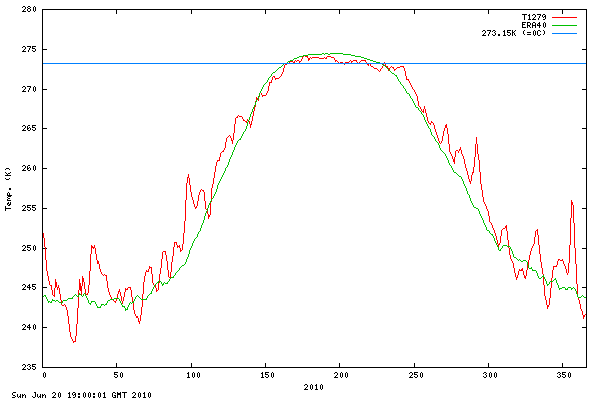
Where A1 is the area of ice less than one metre, A2 is the area of ice less than two metres, etc. The 2010/2008 volume ratio came out to 1.24, which means there has been approximately a 25% increase in volume over the last two years. The average thickness has increased from about 2.0 metres to 2.5 metres. That means an extra 20 inches of ice will have to melt this summer. So far, this seems unlikely with the cold Arctic temperatures over the last couple of weeks.

http://ocean.dmi.dk/arctic/plots/meanTarchive/meanT_2010.png
Now let’s look at the volume percentages. In 2010, 87% of the ice (by volume) is greater than two metres thick. But in 2008, only 64% of the ice (by volume) was greater than two metres thick.

A few weeks ago, when extent was highest in the JAXA record, our friends were asking for “volume, not extent.” Their wishes have been answered. Ice volume has increased by 25% in the last two years, and those looking for a big melt are likely going to be disappointed.

Here is the measured data:

Do you think it odd that this increase isn’t prominently mentioned on the PIOMAS site? It seems very relevant.
———————————————–
If a man will begin with certainties, he shall end in doubts; but if he will be content to begin with doubts he shall end in certainties.
– Sir Francis Bacon
Sponsored IT training links:
If your are looking for quick success in 350-018 exam then join today to explore useful 642-974 resources and pass EX0-101 on first try guaranteed.
Again, Steve, Thank you for endulging us with your interesting posts!
We are approaching interesting times.
Volume is everything.
I should mention that I measured this just inside the Arctic Basin – excluding the Greenland Sea, Baffin Bay, Hudson Bay and anywhere south of 70N. When the entire Arctic is included, the increase in volume is close to 40% since 2008.
So the numbers presented here are quite conservative.
I await July 1 with great interest to see many theories begin to be confirmed or exploded (including my own).
The models contradict this. The Navy are not qualified Climate Scientists. Will you believe peer reviewed models or will you deny science?
Gosh, there is even MORE rotten ice, if it rots anymore, icebreakers and submarines will not get through in late August!! Did Al Gore visit Southern Alberta these last few days…i have recorded over 30 cm of ‘rotten’ global warming here (from the department of weather is not climate)….
Uh-oh!
This looks worse than a Maunder minimum – it is coming on too fast. The world is not prepared, at all, thanks to the warm-earthers.
Gentlemen,
As you have both demonstrated, countless times in the past, no matter how much data, number crunching, and observed empirical evidence you present…there are those who will vehemently argue that 1+1 = 3. New math in a post-normal science world.
Keep up the great work.
This is the base for the PIOMAS anomaly : http://psc.apl.washington.edu/ArcticSeaiceVolume/images/PIOMAS_daily_mean.png
if PIPS is correct then the volume anomaly is near zero.
Has anyone produced papers from the Arctic ice data which was declassified by Al Gore’s request in about 1996 or 1997?
mack520 says:
May 29, 2010 at 10:32 am
The models contradict this. The Navy are not qualified Climate Scientists. Will you believe peer reviewed models or will you deny science?
I’m not sure if you are being sarcastic with this comment…if not, your statement underscores the problem with what you are interpreting as “science”.
kwik
Yes, this week’s Sea Ice News is going to be very interesting ;^)
excellent article Anthony and Steve, although I suspect that you will soon have critics at the gates. the United States Navy continues its proud tradition of serving the American people.
Meanwhile there is no apparent connection between CO2 and Ice levels in the Arctic.Here is a neat chart showing the divergent lines on the chart:
http://www.globalwarmingskeptics.info/forums/thread-188-post-3137.html#pid3137
Then we have this Greenland temperature chart of the last 15,000 years showing that for the last 10,000 of those years.It has been oscillating in a narrow band of temperature range.Suggesting that there is very little warming UPWARD on the chart left to work with.
http://www.globalwarmingskeptics.info/forums/thread-188-post-3130.html#pid3130
Since it is apparent that there is only a short time in the summer that it is above freezing and that even in high noon,the sun is still low on the horizon.Thus not a whole lot of melting is from the air or sun.
That leaves winds and water temperature changes.
I think you may be falling into the same trap as the AGW crowd. Your figures, though accurately, and conservatively, calculated are ultimately based on a model – PIPS2. I’d be more cautious – dare I say skeptical.
On page 3 here, there is a hilarious photo of alarmist polar bears destroying a US Navy ice measuring buoy in the Arctic. Do you think Al Gore put them up to it?
http://www.google.co.uk/url?sa=t&source=web&ct=res&cd=1&ved=0CBQQFjAA&url=http%3A%2F%2Fwww.tos.org%2Foceanography%2Fissues%2Fissue_archive%2Fissue_pdfs%2F15_1%2F15_1_preller_et_al.pdf&ei=oVUBTI7kHpTW4gaYjNXLDg&usg=AFQjCNEu0l7q_2i2zySw4QxH1mXbbUPamw
Cold arctic? It seems to be about normal for this time according to that graph. The temp at this time in 2007 was lower than it is now as well and yet we set a new low “record” that year.
mack520 says:
May 29, 2010 at 10:32 am
The models contradict this. The Navy are not qualified Climate Scientists. Will you believe peer reviewed models or will you deny science?
Models vs observed results…
Facts vs computer models
USN says facts win…
Hockeystickler
I’m sure you are correct that people will criticize, but looking at the PIPS images there can be little doubt that there is widespread thickening over the last two years.
So I guess people will just have to set up strawmen, change the subject, engage in ad homs, appeal to authority, etc.
Other than the interest in questioning the validity of the CAGW models, does the Arctic ice really matter to anyone except the polar bears who are not land based? Would the climate of the rest of the world be impacted by ice free water at the North Pole in August or September, even presuming that it was to happen during this cycle?
If you look back you will find a year where the ice volume is larger or smaller than today. Instead one could do science:
http://psc.apl.washington.edu/ArcticSeaiceVolume/images/BPIOMASIceVolumeAnomalyCurrent.png
http://psc.apl.washington.edu/ArcticSeaiceVolume/IceVolume.php
tommy
I tend to think of -5C on Memorial Day weekend as being cold.
http://www.esrl.noaa.gov/psd/map/ANIM/sfctmpmer_01a.fnl.29.gif
Billy Liar
The PIPS model is constantly updated with real time information. So it does not suffer from long-term compounded errors like a climate model.
stevengoddard says:
May 29, 2010 at 10:29 am
I should mention that I measured this just inside the Arctic Basin – excluding the Greenland Sea, Baffin Bay, Hudson Bay and anywhere south of 70N. When the entire Arctic is included, the increase in volume is close to 40% since 2008.
So the numbers presented here are quite conservative.
Gosh! its much worse than we expected… /sarcasm off
AGW-Skeptic99 says:
May 29, 2010 at 11:10 am
“Other than the interest in questioning the validity of the CAGW models, does the Arctic ice really matter to anyone except the polar bears who are not land based? Would the climate of the rest of the world be impacted by ice free water at the North Pole in August or September, even presuming that it was to happen during this cycle?”
There is a lot info on this topic here:
http://www.acia.uaf.edu/
I have not read much on of their 140 page report and no expert but think it should address your question. I also found this:
“The polar bear has become the poster child of global warming, but there’s more to the Arctic than ice and polar bears. Beyond these two famous and prominent features of the Arctic environment, there is an entire intricate ecosystem of wildlife and plant life that will be profoundly affected by a prolonged warming trend in the Arctic.”
http://www.pbs.org/wnet/nature/episodes/arctic-bears/arctic-bears-the-melting-arctics-impact-on-its-ecosystem/780/
This study is a bit old but may be of interest:
East Asian winter monsoon and Arctic Oscillation,
Geophysical Research Letter, Vol 28, No., May 15 2001
http://climate.eas.gatech.edu/dai/daigroup/staff/gongdaoyi/doc/East%20Asian%20winter%20monsoon%20and%20Arctic%20Oscillation.pdf
Finally here is an alarmist article, IMHO. Notice how different the tone is than in the science papers. I include it so readers with learn not to lump all who are concerned about AGW into one camp.
http://www.countercurrents.org/pearce310309.htm