UPDATE 4/23 4PM: I’ve been in contact with the Eureka Weather Station manager, and despite the incredible nature of the temperature jumps that are outside of normal experiences, such as July 14 2009, they do appear to be real. The METAR coding errors are another issue. I have many pictures now, plus a plan map, and a better meteorological insight than what can be gained from the meager online metadata. I’ll have an updated post later tonight or tomorrow – Anthony
Ecotretas find more cases of missing “M”s and mangled data in METAR reports making it into climatic temperature data. I’ve reposted his findings below and added some of my own notes [in brackets] to strengthen his findings. This time it’s Eureka, Nunavut, Canada. From “Up Here” magazine:
The first High Arctic Weather Station in history, Eureka was established in April 1947 at 80-degrees north latitude in the vicinity of two rivers, which provided fresh water to the six-man United States Army Air Force team that parachuted in. They erected Jamesway huts to shelter themselves and their equipment until August, when an icebreaker reached Eureka – as it has every year since – and brought permanent buildings and supplies. For decades after that, small, all-male crews would hunker down for entire winters, going a little stir-crazy from the isolation.

As I pointed out last Saturday there’s a common reporting flaw in world meteorological stations that use the METAR weather data format to report their hourly temperatures. Just one bad report in a cold location in the Arctic or Antarctic is enough to throw off the whole month’s worth of data when averaged. And it is monthly data that is used for climate. The all time high temperature error identified below has found it’s way into Wikipedia as “factual” when it is clearly wrong.
Some METAR and other kinds of unidentified errors also seem to be finding their way into official Environment Canada data. I’ve made screencaps. Given the importance of this weather station as the last surviving GHCN station that far north, also used in GISS, you’d think better quality control would be done, particularly when EC has a statement about data quality on each data page. What has been found seems to point to a corrupted dataset there.
– Anthony
=======================================
Eureka by Ecotretas


[Images above from GISS – click to enlarge]
Eureka, in Nunavut Canada, is a very special meteorological station. As can be seen in the first image above, it is responsible for the very big stripe on the very top of Canada. As can be seen on the second image, the data from only one station is responsible for a very big percentage of global temperatures… Both graphs can be obtained here.
So, one would imagine that data for this station is quality proof. We found two sources for temperature data: at Weather Underground and at the National Climate Data and Information Archive.
The first interesting data about this station is its record high temperature, which according to Wikipedia was reached on July 14, 2009, with 20ºC. [image below added by Anthony]

[UPDATE: Wikipedia editor removed the sentence above within 8 hours of this posting. See discussion here]
On Weather Underground, the monthly page for that day does say that 20ºC was the maximum temperature. But when you check the METAR data, the maximum temperature was 14ºC.
[Here is where it really gets strange, I’ve added two screencaps from Environment Canada, on for the monthly data, another for the daily data from July 14th, 2009. They don’t match! The 20.9C value never appears in the July 14th hourly data. Click images below to enlarge, EC’s July 2009 Monthly report on the left, July 14th, 2009 daily/hourly data on the right. Perhaps EC corrected the error in the daily/hourly data, but missed the monthly? – Anthony]


[click images above to enlarge]
[It also shows up as 20.9C on the EC yearly report for 2009, shown below]

Checking the Environment Canada page, the maximum for the date was 14.4ºC.
Things were different on the day before, July 13th. Maximum temperature for Weather Underground was also 20ºC, while at Environment Canada was 19.6ºC. But if you check the graphs below, some special heat occurred at 10PM, when temperatures soared some 15ºC!
(click images to enlarge)


[Image below added by Anthony. Here is the METAR report for Eureka, via Weather Underground, the error is highlighted in yellow, note the jump in temperature followed by a fall the next hour]

[In the image below added by Anthony, note the implausible temperature jump in the Environment Canada data for July 13th, 2009 at 22:00 where it was 5.9C at 21:00, jumping to 19.6C at 22:00, then back down to 4.1C at 23:00. Looking at the weather conditions of clear sky and moderate sustained winds from the North ~ 24 km/hr, there does not appear to be a meteorological explanation. Looking at the METAR data above, it appears the temperature was rounded up by the observer to 20C from 19.6. This makes me wonder if the event could be caused by something like a plane, truck, or snow-cat parked briefly near the sensor. In the Arctic, vehicles are left to idle, as turning them off allows them to freeze up, sometimes never to be restarted. ]

As Anthony Watts pointed out at Watts Up With That, the Eureka station registered the biggest rise in temperature probably seen on the Earth’s surface: 86ºC in one hour, on March 3, 2007! Now this data is available on Weather Underground, but seems not to exist in Environment Canada. The graph differences are clear below:


But that seems not to be the case in other examples. Take January 1st, 2007, for instance. Both Weather Underground and Environment Canada agree: there was a mighty spike at noon. Seems like the “M” problem affects both:


[Here’s the METAR data with the missing “M”, note at 11AM the M reappears]

There are times where differences are not so big, but the “M” problem is still there. Check the images from Weather Underground and Environment Canada for September 26, 2006:


Other times, changes are so significant, that something must be wrong. Check out the temperature rise on June 20, 2005. On the left, the weekly graph from Weather Underground shows a great surge in temperatures, confirmed by the Environment Canada graph for the day.


=====================================
Thanks to Ecotretas for his sleuthing, I’m sure there are many more like this yet to be discovered. It seems with Eureka, more is going on than METAR errors. The temperature rises reported seem impossible given the meteorological conditions, and because they seem to be automated, suggest sensor error or perhaps sensor environment contamination (like a vehicle or other heat source). If you look at this 1997 image from Wikipedia (and click it to get the super hi-res version and pan around) you’ll see a number of vehicles near buildings. Where is the temperature sensor? – I don’t know, but if someone can find out it might shed some light on this mystery.
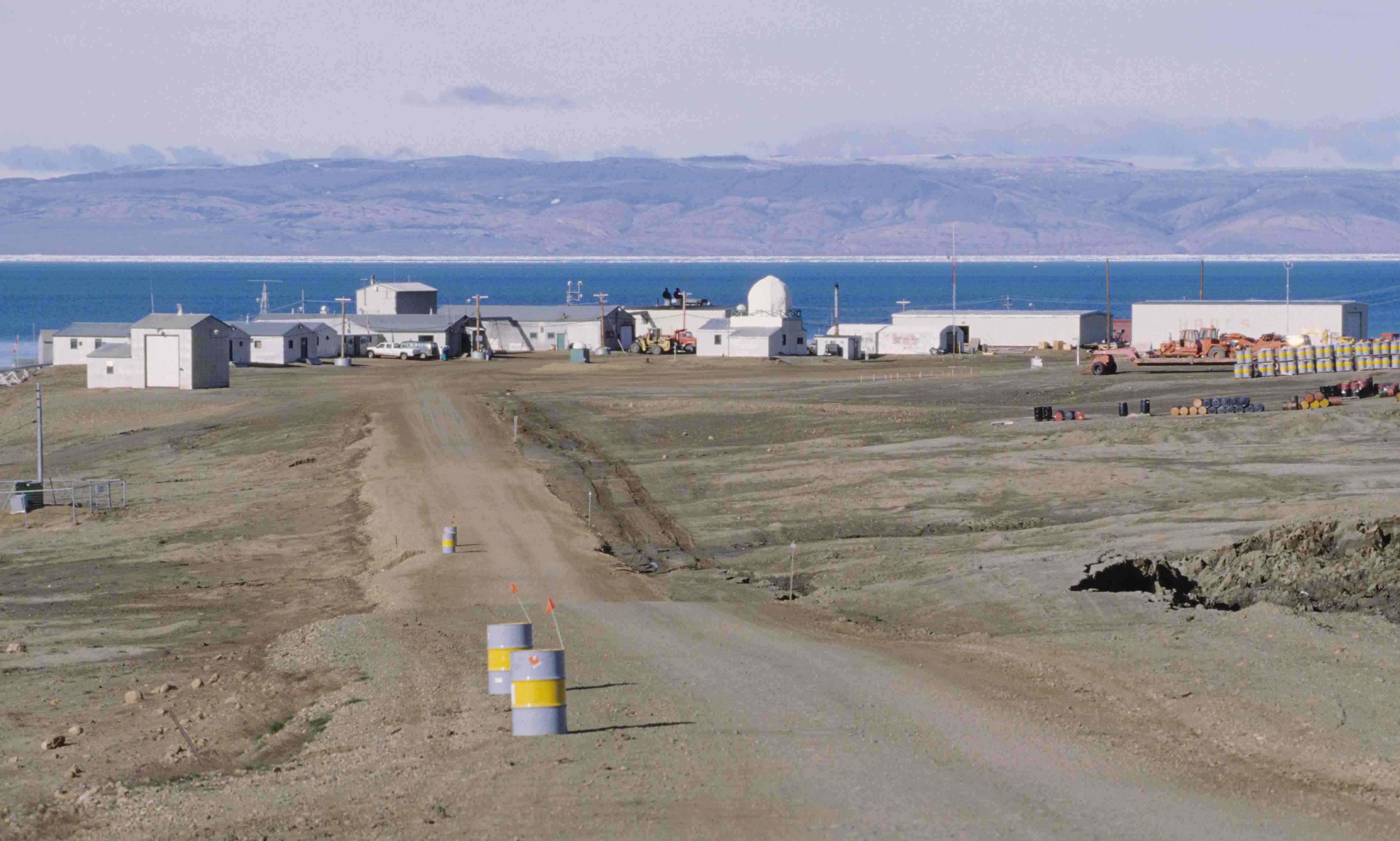
The fact that the obvious error on July 14th is now cited in Wikipedia as an “all time record high”, when it doesn’t appear in the EC hourly data, is troubling. – Anthony
Sudden water vapor outgassing (maybe a researcher cooked himself an egg), leading to a rapid localized feedback and runaway warming is the only possible answer within the framework of physical laws. 😉
seems like maybe someone is opening closing doors …. (and hence warming of thermometers) proping open doors for an afternoon in summer or having door open for a few minutes during winter??
I’m confused why you feel the need to conflate this with Metar. This can’t be a missing sign, right?
Not saying it isn’t wrong, but it can’t be a Metar missing negative sign from what I can see.
REPLY: See the January 1st, 2007 example with a missing M. Yes not all cases have missing M’s but we also have what appears to be meteorologically impossible values in the METAR reports. I can’t tell you if this is a manual coding error, an instrument error, or a local heat bias. More investigation is needed. Clearly there are data problems of all kinds here -A
Just for the record.
Carol Browner, former Clinton administration EPA head and current “Obama White House climate czar, instructed auto industry execs “to put nothing in writing, ever” regarding secret negotiations she orchestrated regarding a deal to increase federal Corporate Average Fuel Economy (CAFE) standards. Rep. James Sensenbrenner, R-WI, is demanding a congressional investigation of Browner’s conduct in the CAFE talks, saying in a letter to Rep. Henry Waxman, D-CA, that Browner “intended to leave little or no documentation of the deliberations that lead to stringent new CAFE standards.”
..So why do we keep complete and accurate records?
As Lord Nelson famously said, ” I see no ships”.
Although great pains were made by Anthony to suggest that it could be human error, evidently the quality control of the body who aggregates this data is either lacking or biased.
Take your pick viewers.
Any reasons why the GHCN and GISS data should differ so much from the Environment Canada data?
http://diggingintheclay.blogspot.com/2010/04/canada-2-ghcngiss-comparisons-with.html
REPLY: I wish I knew. Which one is the “correct” temperature. Who knows? – Anthony
It is all about The Narrative.
the data is inconsequential.
the measuring process is inconsequential.
The Narrative is all. Disturb not the Narrative, lest ye be Judged!
(in canadian civil court, apparently)
Mysteries of modern climatological ‘science’.
1. Mistakes are always found by non-climatologists.
2. Mistakes are found to have been erroneously increasing the temperature.
3. People who find the mistakes are reviled by climatologists.
But don’t forget – the ‘science’ is settled.
I believe there are statistical methods which could be used on the entire temperature record from eureka which would identify outliers like the readings in question on this post. I don’t have the skills myself but I wonder whether the various algorithms used by the likes of GISS identify and discard such anomalies?
wws –
yes, the narrative is all and if u disturb it?
22 April: Guardian:Michael White: Leaders’ TV debate: Nick Clegg: Score 9/10
Best moment: When he accused Dave of working with “nutters, anti-Semites, people who deny climate change exists, homophobes”.
http://www.guardian.co.uk/politics/2010/apr/22/tv-leaders-debate-nick-clegg
22 April: BusinessWeek: Brown Attacks Clegg on Trident, Slams Cameron on EU (Update2)
Clegg described the Conservatives’ allies as “a bunch of nutters, anti-Semites, people who deny climate change exists, homophobes.”..
http://www.businessweek.com/news/2010-04-22/cameron-clegg-brown-clash-on-europe-in-tv-election-debate.html
22 April: Financial Times: Matthew Engel: Surreal spot from well-worn comedy trio
Mr Clegg – predictably enough in a foreign affairs debate – called the Tories’ new allies in the European parliament “nutters, homophobes, anti-Semites and climate change deniers”. ..
http://www.ft.com/cms/s/0/f4fceed4-4e5c-11df-b48d-00144feab49a.html
As Lord Nelson famously said, ” I see no ships” followed by “only hardships” for some
They had a barbecue that day or burned their trash
Hi Anthony,
has any official agency confirmed those reporting errors yet ?
Or has any acknowledged there could be a problem ?
Where is the thermometer? Look just to the left of the “low-boy” trailer. That white block looks like an intrument shelter. I think the building just to the left of the radome is the generator building.
Anthony, the July 13th data also is very close to the 20 deg.
Anthony–
You should get some kind of award for discovering the “Missing M” in the METARS. Thanks.
The temperature spikes at Eureka are obviously exhaust from UFOs that visit the station! 🙂
@ur momisugly Henry chance (15:55:43) : IMHO, every person in the Obama Admin. including Senate & Congress, the Supreme court, and every dept and regulatory agency, should have a video recorder & RFID/GPS surgically implanted to capture every sound, gesture, email, phone con, writing, sign language, and movement (bowel or otherwise) they ( and whoever else is present in person or via any technology ) make, with a live feed to the web, and 50 year storage of it.
The july 13 data with the big jump to 19.6 at 22:00 hrs also has some interest jumps at 10:00 hrs and 17:00 hrs. The temperature jumps from 6.9 to 13.0 and back to 7.4 at 10:00 hrs and again 9.5 to 13.7 and back to 7.2 at 17:00 hrs. Looks weird like running equipment parked near the sensor.
They have all these super accurate models that are so good they can predict the climate 100 years into the future. Surely they can use some of this predictive ability to determine the maximum temperature change for any station for any given hour and then throw out any temperature that exceeds this maximum. As anybody who has done the smallest bit of programming can tell you, it is a trivial matter to either discard or flag temperature changes that exceed a maximum possible change.
Gee, I wonder when they change the group posted to the station? Could a newbie just posted to the station be the answer to the data jumps in the July 13 record?
Is this a case of GISS saying that when it comes to quality control…
“We;ll have Nunavut” ?
CO2MIC SPRITES? A very rare and unusual meterillogic event in the Arctic. Only a vew UN Environmentalists, Ecologists, Economists, Climatologists, Historians, Biologists, Arms Reduction Negotiators, and Socialogists have been able to study them up close. I imagine from what we’re seeing in these official reports that they’re very hot, sometimes, and not very hot sometimes. Isn’t this just wierd? The Universe is a mighty wonderous and very strange place, and here we are just spoiling everything. I for one intend to stop breathing for Lent, next year, if it gets hot, in Canada, and all the snow and ice melts, and the oceans rise more than 3 feet, before Ash Wednesday.
Anthony:
I’ve been recording Alert’s monthly average for a number of years now. Have it broken down by month as well so that can be trended. Kapuskasing as well for obscure work reasons. If you wish, I can send you the excell file. For days with missing data, I’ve substituted the mean from the day before and the day after. In some cases, the day is missing from the monthly record, but can be reconstructed by using daily data. Not a huge number of data points. As I was doing this for personal reasons, I didn’t keep careful track of which months were adjusted. I would put it at less than 1% though.
JE
geo (Anthony’s reply) (15:54:35) :
Ah, okay, so we’re broadening the METAR critique here beyond the M issue. Got it.
This also appears to me to be an obvious and compelling argument for doing some outlier testing and rejection during QA of these kind of “edge of the world” sites that are used to represent vast areas of the globe all by themselves without other averaging available to smooth out temporary issues.
That’s probably worthy of its own focus, outside of whatever METAR contributes to that problem.