by Steven Goddard and Anthony Watts
In late 2009, Anthony forecast that Arctic sea ice would continue to recover in 2010. Last month Steve Goddard did an analysis explaining why that was likely to happen and yesterday NSIDC confirmed the analysis.
The pattern of winds associated with a strongly negative AO tends to reduce export of ice out of the Arctic through the Fram Strait. This helps keep more of the older, thicker ice within the Arctic. While little old ice remains, sequestering what is left may help keep the September extent from dropping as low as it did in the last few years.
The wording of NSIDC press releases usually highlight the negative (this one being no exception) but the message is clear. This summer is likely to continue the trend since 2007 of increasing summer minimums.
So how is Arctic sea ice looking at this point, near the winter maximum? NSIDC shows ice extent within 1 million km2 of normal and increasing.

http://nsidc.org/data/seaice_index/images/daily_images/N_timeseries.png
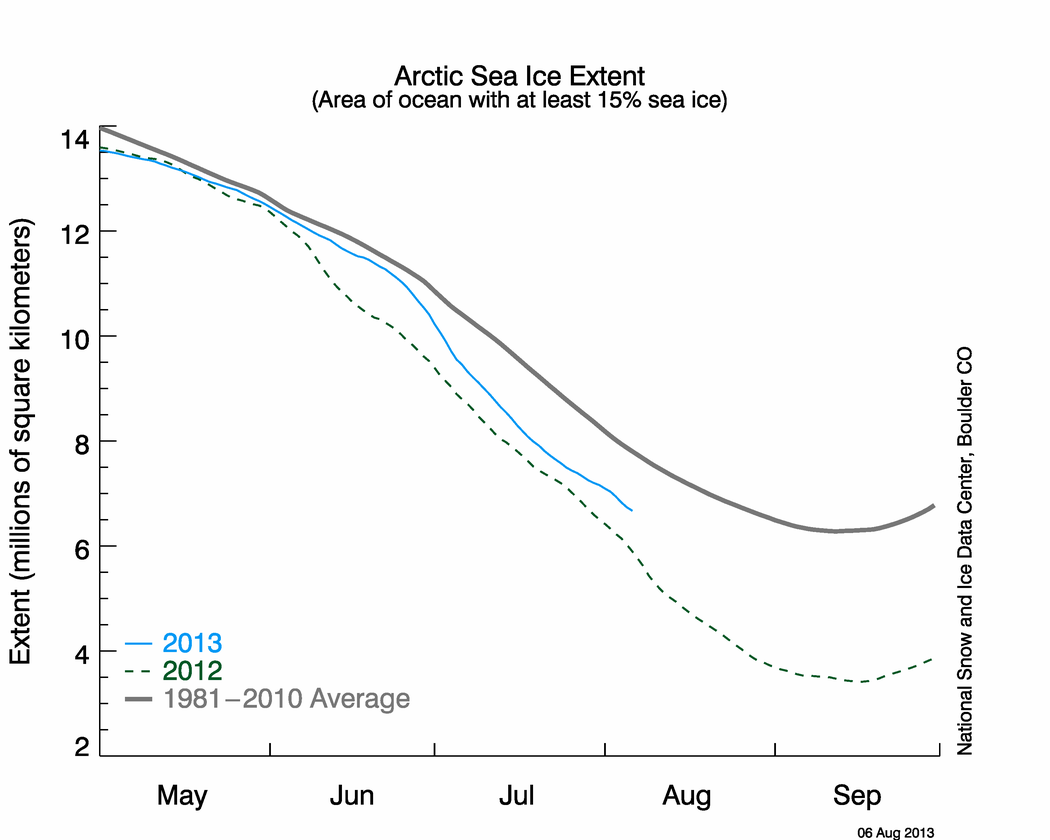
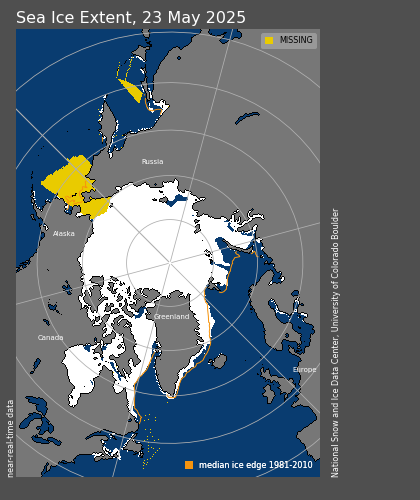
The Baltic and Bering Sea have slightly above normal ice. Eastern Canada and The Sea of Okhotsk have slightly below normal ice.

http://nsidc.org/data/seaice_index/images/daily_images/N_daily_extent.png
DMI shows sea ice extent at nearly the highest in their six year record.

Sea ice extent for the past 5 years (in million km2) for the northern hemisphere, as a function of date.
http://ocean.dmi.dk/arctic/icecover.uk.php
NORSEX shows ice area just outside one standard deviation (i.e. almost normal.)

http://arctic-roos.org/observations/satellite-data/sea-ice/observation_images/ssmi1_ice_area.png

There’s also some interesting comparisons to be made at Cryosphere Today. When you compare the current images in recent days with the same period in years past, you notice how “solid” the ice has become. For example compare March 3rd 2010 to March 3rd 2008, when we saw the first year of recovery:

Note that there’s no “fuzziness” in the signal return that creates this image on the right. A fuzzy return would indicate less than solid ice, such as we see on the left. The CT image from March 3rd is “deep purple” through and through. The edges of the ice are very sharp also, particularly near Greenland and also in the Bering sea. These two visual cues imply a solid, and perhaps thicker ice pack, rather than one that has been described by Dr. Barber as “rotten ice”.
I wish I could compare to March 3 2009, but the CT images were offline last spring then while both they and NSIDC dealt with issues of SSMI sensor dropout that was originally brought to their attention by WUWT, but was deemed “not worth blogging about“.
According to JAXA, 2003 was a good year for Arctic sea ice. Note the blue line.

So how does that year on March 3rd compare to our current year using CT’s imagery?

Compared to the best year for Arctic sea ice in the past decade, March 3rd this year looks quite solid. The setup for 2010 having more ice looks good.
You can do your own side by side comparisons here with CT’s interactive Arctic sea ice comparator.
The Arctic continues to recover, and one of the last CAGW talking points continues to look weaker and weaker. It wasn’t very long ago when experts were forecasting the demise of Arctic ice somewhere between 2008 and 2013. And it is not the first time that experts have done this – they were claiming the same nonsense in 1969, right before the ice age scare.

Note the column at the right. Even back then, skeptics got the short shrift on headlines because as we know: “all is well, don’t panic” doesn’t sell newspapers.
UPDATE: And then there’s this:
AROUND 50 ships, including large ferries reportedly carrying thousands, were stuck in the ice in the Baltic Sea today and many were not likely to be freed for hours, Swedish maritime authorities said.
You might be interested in my study of Arctic sea ice extent. I put most of it together some time back when it made a guest post on Air Vent. I finally managed to revisit it adding some of the things that should have been there first time around. The data sources have not been updated since I wrote it originally.
It now contains calculations of difference between the satellites. Whilst the difference trend is a little on the high side, probably due to the apparent more rapid decline in the overlapping time frame, it does suggest that all the apparent Arctic sea ice extent decline might be accounted for by measurement drift.
http://www.trevoole.co.uk/Questioning_Climate/userfiles/How_Fast_is_Arctic_Sea_Ice_Declining_v2.pdf
I don’t understand how the talk about the polar ice cap melting away to nothing continues to have traction. The AMSR-E Sea Ice Extent chart on the right makes it clear that nothing really unusual is happening at the north pole with regards to ice.
How can the claim that all the ice will dissappear continue to be made with a straight face? The “rotten ice” gambit?
Rumor has it that Pen Hadow thinks it’s all bunkum. After all, he’s been there and measured the ice and ‘it’s worse than we thought!’ ;o)
Aside: will Catlin Insurance ever again associate their name with such an expedition? I’m guessing they won’t.
Thanks, Anthony! Being somewhat obsessive-compulsive, I’ve checked that website every day for the past year or so, to see what is transpiring in the Arctic Ocean.
I agree with your analysis, the loss of ice in 2007 seems more likely related to wind and current patterns than anything to do with global temperature.
Well, then again, there is the issue of all that “rotten, honey-combed” ice that has been reported….LOL!
Meanwhile, I notice that Mr. Sun is still struggling to awaken from a rather deep minimum. The brief sunspot activity observed over the past few months has decreased rather dramatically. I’m expecting the sun to slip back into a very quiet minimum, we’ll see.
It was that record short melting season as we saw in the DMI last summer.
Might be that the feeble warming up there was just enough to consolidate the ice (fill in the air gaps/bubbles), so it’s not quite as ‘rotten’.
So the concern is not with the Arctic Ice, which is doing quite well, but with the cold air that is blowing, and continues to blow, down upon the temperate areas of the N. Hemsiphere.
Thanks to both of you for pulling together these images (and adding cogent commentary) for those of us deeply interested, but less skilled.
I would question the word “normal”
As the article from 1969 shows (and similar alarmism in the late thirties) thin ice is not unusual. The peak ice extent probably occurred in the 70s and early 80s when we had all the scares about a coming ice age. So it is extremely unlikely that the reference period of 1976 to 2000 is representative of the long term norm. I would suggest that the period of 1976 to 2006 would make a much better norm given that the PDO/AMO seems to work on this sort of timescale. Using a half cycle period would be perfect. How would today’s extent compare with that norm?
Personally I am thinking this story is at least 15 days too early , before the northern hemiphere icecap is reaching its maximum size . Having this winter a fairly low jetstream , more near to the equator , a lot of the cold air was transported from the arctic into more moderate temperatured areas . This is most likely going to change by the end of next week , when the jetstream is expected to return to a more normal pattern higher in the northern hemisphere and the cold arctic will stay more insulated . As a result more arctic ice is likely to appear on the satellite images and the small minus of this winters calculations may change into a robust plus . Although the science is set mother nature is always good for a pleasant surprise.
CRS, Dr.P.H. (09:55:21) :
The sunspot cycle ramp seems to have developed a slipping clutch when it comes to the size and contrast of the spots.
I’ll bet Leif has his eye on that, and Bill Livingston is continuing to see the progress of it in his measurements.
Sorry I should have suggested 1979 to 2009 given that we did not have satelite data until ’79.
In addition, I think we can expect a later maximum this year, due to the extensive snow cover throughout the northern hemisphere, keeping heat reflection high in the surrounding areas. So there might still be room for further growth.
By the way: Al Gore is in town (Oslo) today, selling his new book. The main point of his speech was that it is still not too late to act, and that fortunately – politicians are a renewable resource, meaning of course that politicians who don’t ACT are replaceable. A cleverly concealed threat to the Norwegian political establishment. But the threat was wasted. They all love Gore anyway. They were the ones who gave him a Nobel.
Coincidentally there was a climate debate (!) at our parliament at the same time, where a left-wing radical complained that he actually had to be at parliament debating such settled issues while he instead could be listening to Al Gore!
At the same time, our foreign minister Jonas Gahr Støre (who co-presented the infamous report “Melting snow and ice” at Copenhagen) said that there now is a organized, coordinated attack on science, orchestrated by “strong and well funded interests”.
Hm. Sounds almost like CRU!
Støre also managed to state: “The way Al Gore operates, which is very thorough and well-documented, is an important contribution to open eyes to the fact that we have to do something about it and take it seriously”.
Well documented?
I am looking forward to the last chapters of this saga. It could be both bloody and Gory.
Of course Man made Arctic Ice Breakup as per Anthony’s previous Thread may also prevent the Ice returning as quickly as it would if they stopped driving their ships through it. LOL
The UK met office/BBC/ HMG gov & oppostion parties/chief scientific adviser should have a look at the above graphs. The anthropogenic global warming as promised by governments around the world has turned out to be as false and contrived as the Y2K scare but on a vastly bigger scale.
It seems that mother nature has not read the AAM script and is going on her own multi billion year journey regardless of the antics of our woeful political leaders.
The question of tipping point armageddon and carbon dioxide invoked doom has been answered and now all that remains is where is all the money, who has the vast amounts of money so far squandered on a fools errand?
Those that have peddled the ultimate Brooklyn Bridge scam should be shown the evidence so they can no longer deny the reality.
Icebreakers in the Baltic:
http://www.thelocal.se/25334/20100304/
04Mar2010 18:20 AFP reporting 50 ships stuck in serious ice in the Baltic Sea
Ho hum
On the second figure (the graphic which shows sea ice extent on 03/03/2010) is the orange line really the median?
Around Newfoundland the median line is very far out from the shore. Did sea ice extend twice that distance into the Atlantic?
Mike.
Ahhh, the fine art of the cherry-pick.
From the same site you link above (“Arctic Sea Ice News & Analysis“):
Even though the extent of Arctic sea ice has not returned to the record low of 2007, the data show that it is not recovering. To recover would mean returning to within its previous, long-term range. Arctic sea ice in September 2008 remained 34 percent below the average extent from 1979 to 2000, and in September 2009, it was 24 percent below the long term average. In addition, sea ice remains much thinner than in the past, and so is more vulnerable to further decline. The data suggest that the ice reached a record low volume in 2008, and has thinned even more in 2009. Sea ice extent normally varies from year to year, much like the weather changes from day to day. But just as one warm day in October does not negate a cooling trend toward winter, a slight annual gain in sea ice extent over a record low does not negate the long-term decline.
In addition, ice extent is only one measure of sea ice. Satellite measurements from NASA show that in 2008, Arctic sea ice was thinner than 2007, and likely reached a record low volume.
So, what would scientists call a recovery in sea ice? First, a true recovery would continue over a longer time period than two years. Second, scientists would expect to see a series of minimum sea ice extents that not only exceed the previous year, but also return to within the range of natural variation. In a recovery, scientists would also expect to see a return to an Arctic sea ice cover dominated by thicker, multiyear ice.
Returning to a question I’ve posted here a few times before: on what scientific basis are individual reports that confirm your preconceptions touted while numerous studies that contradict it are discarded.
Slightly OT but Catlin is at it again!
http://www.catlinarcticsurvey.com/
REPLY: I note they have no “live” biotelemetry this time. – A
Talking about ICE; THOUSANDS of passengers, 50 VESSELS is
fozen in, in the Baltic Sea!!
And this happens while Al Gore is in Noway spreading the AGW Carbon Cult Gospel !! LOL !!
http://translate.google.no/translate?hl=no&sl=no&tl=en&u=http%3A%2F%2Fwww.vg.no%2Fnyheter%2Futenriks%2Fartikkel.php%3Fartid%3D597977
fozen=>frozen
Noway=>Norway
hehe!
At http://climaterealists.com/http://www.trevoole.co.uk/Questioning_Climate/userfiles/How_Fast_is_Arctic_Sea_Ice_Declining_v2.pdf
there are several charts showing how “Satellite” observations show a very significant decline from previous “Climatic & Observational” & “Hemispheric Observations. These charts show the above C&O and HO observations cease at the moment Satellite observations are available. Is more recent C&O and HO information available for comparison? Or, is it, “It doesn’t match our model again”.
rbateman (10:04:35) :
It was that record short melting season as we saw in the DMI last summer.
Might be that the feeble warming up there was just enough to consolidate the ice (fill in the air gaps/bubbles), so it’s not quite as ‘rotten’.
A C Osborn (10:15:21) :
Of course Man made Arctic Ice Breakup as per Anthony’s previous Thread may also prevent the Ice returning as quickly as it would if they stopped driving their ships through it. LOL
“[ZOMG look behind us… behind the ice breaker… it’s GLOBAL WARMING!!!!!!]”
😛
Jeezze that’s three beers I owe the mods – sorry! One of these days I’ll figure out how to bookend my bold formatting, I swear it!
Yes, but the referenced NSIDC site also reports monthly February ice extent for 1979 to 2010 shows a decline of 2.9% per decade(see Figure 3).
OT but released just yesterday regarding cyclone predictions (fiction) by the IPCC:
http://mensnewsdaily.com/2010/03/03/climategate-more-science-fiction-from-the-ipcc/comment-page-1/