January 2010 UAH Global Temperature Update +0.72 Deg. C
by Roy W. Spencer, Ph. D.
UPDATE (4:00 p.m. Jan. 4): I’ve determined that the warm January 2010 anomaly IS consistent with AMSR-E sea surface temperatures from NASA’s Aqua satellite…I will post details later tonight or in the a.m. – Roy
YR MON GLOBE NH SH TROPICS
2009 01 +0.304 +0.443 +0.165 -0.036
2009 02 +0.347 +0.678 +0.016 +0.051
2009 03 +0.206 +0.310 +0.103 -0.149
2009 04 +0.090 +0.124 +0.056 -0.014
2009 05 +0.045 +0.046 +0.044 -0.166
2009 06 +0.003 +0.031 -0.025 -0.003
2009 07 +0.411 +0.212 +0.610 +0.427
2009 08 +0.229 +0.282 +0.177 +0.456
2009 09 +0.422 +0.549 +0.294 +0.511
2009 10 +0.286 +0.274 +0.297 +0.326
2009 11 +0.497 +0.422 +0.572 +0.495
2009 12 +0.288 +0.329 +0.246 +0.510
2010 01 +0.724 +0.841 +0.607 +0.757
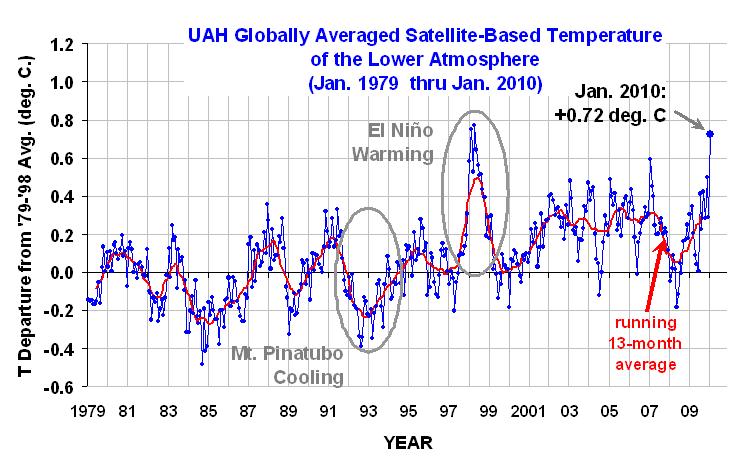
The global-average lower tropospheric temperature anomaly soared to +0.72 deg. C in January, 2010. This is the warmest January in the 32-year satellite-based data record.
The tropics and Northern and Southern Hemispheres were all well above normal, especially the tropics where El Nino conditions persist. Note the global-average warmth is approaching the warmth reached during the 1997-98 El Nino, which peaked in February of 1998.
This record warmth will seem strange to those who have experienced an unusually cold winter. While I have not checked into this, my first guess is that the atmospheric general circulation this winter has become unusually land-locked, allowing cold air masses to intensify over the major Northern Hemispheric land masses more than usual. Note this ALSO means that not as much cold air is flowing over and cooling the ocean surface compared to normal. Nevertheless, we will double check our calculations to make sure we have not make some sort of Y2.01K error (insert smiley). I will also check the AMSR-E sea surface temperatures, which have also been running unusually warm.
After last month’s accusations that I’ve been ‘hiding the incline’ in temperatures, I’ve gone back to also plotting the running 13-month averages, rather than 25-month averages, to smooth out some of the month-to-month variability.
We don’t hide the data or use tricks, folks…it is what it is.
[NOTE: These satellite measurements are not calibrated to surface thermometer data in any way, but instead use on-board redundant precision platinum resistance thermometers (PRTs) carried on the satellite radiometers. The PRT’s are individually calibrated in a laboratory before being installed in the instruments.]
===============================
NOTE: Entire UAH dataset is here, not yet updated for Jan 2010 as of this posting
Sponsored IT training links:
We guarantee 100% success in real exam with help of 642-384 prep materials including 70-643 dumps and 70-536 practice exam.
Congratulations, everyone!
This goes to show how limited the value of a “global temperature” metric is. Given the unusual cold across many large land masses this January, a map and physical explanation of the temperature distribution is imperative.
Will GISS show this large spike? Probably not.
It looks like we might be in the grips of another 1998 style El-Nino event. I can testify that the California Storm abundance and rainfall ammounts are similar to that time so El-Nino is a very likely cause.
Looks like El Nino really matters, even with the cold winter in the US. This temperature measurement shouldn’t be subject to UHI effect (obviously), since its from satellite.
Largest anomaly is in the NH? Sea temps in NH must be very high to balance this out. I must go away and do some more research.
It looks like it was warmer in 1998, but maybe that wasn’t January. It’s hard to tell given the resolution of the chart.
REPLY: Here’s the raw dataset, not yet updated for Jan 10
http://vortex.nsstc.uah.edu/public/msu/t2lt/tltglhmam_5.2
April 98 global was 0.77, the peak then
– Anthony
Do these satellites produce some kind of thermal map of globe? It would be interesting to see what regions have been measured to be warm and which cold. Especially on NH.
Hmmm … would not agree given experiences here in del Norte Tejas this winter …
.
.
I’m excited! I can’t wait for the forthcoming temperature readings over the next months/years. Will we see a continuation of the rise in monitored temperatures yet the world freezes over as the world continues to cool? If so the longer this goes on the more fun we will have when even AGW alarmists start to realize something is crook in the way temperatures are monitored and processed. NASA and others will then fall into disrepute and disappear from the scientific arena, which is a shame given what they have achieved during the moon landings. Hopefully by then we will finally see some of the clowns behind bars, although it should be happening right now since there’s more than enough evidence to prove in a court of law that data is being deliberately corrupted.
This may have been asked before, but what is the data path from satellite to UAH and what steps that includes?
Well ,
Stockholm Sweden, has had the coldest January for 23 years. and that’s Official.
http://www.smhi.se/klimatdata/arets-januari-blev-kallast-sedan-1987-i-soder-1.9423
//Lars
It would certainly be interesting to see what really drives the El Nino events like these. Some warmists will put the blame on anthropogenic CO2 but how could a few ppm of CO2 drive such a massive hot water pump?
I can vouch for the effect on the West Coast of Canada. Definitely the evil El Nino at work. The Olympics being held in Vancouver BC are having to truck in snow for the event. We are spared the ravages of the cold winters of the Eastern Seaboard.
Kind of refreshing to see a graph showing some periodic warming where you don’t have to wonder what kind of biased data manipulation was involved.
Does anyone know exactly where we are in the current El Nino cycle?
Agree with others here – we’re at the peak of the current El Nino event. JAMSTEC who seem to be more accurate in their forecasting than any other agency are predicting a rapid decline in El Nino in the Boreal Autumn (SH fall). In fact they predict a possible return to La Nina conditions by late 2010.
According to WXmaps, they’re showing an increasing amount of land area in negative temp. anomalies when checking on the climate outlooks since sometime last month, depending on how the outlooks shift there could be a drop in anomalies over land this month.
The only big blood red area they have in the projections is over Canada and Greenland.
OT:
Today’s Daily Mail climate article featuring the comic turn of Windsor C. along with a few scientists who sternly admonish the sceptic community:
“…. those who questioned the conclusions drawn by climate researchers had to ‘expose’ their evidence, rather than just their beliefs.”
(And there was me thinking it was the warmists who refuse to expose their evidence.)
http://www.dailymail.co.uk/news/article-1248513/Prince-Charles-hits-climate-change-sceptics-scientist-calls-critics-provide-evidence-views.html#ixzz0ebodKvkN
Balanced by this earlier piece:
Scientists broke the law by hiding climate change data: But legal loophole means they won’t be prosecuted
Read more: http://www.dailymail.co.uk/news/article-1246661/New-scandal-Climate-Gate-scientists-accused-hiding-data-global-warming-sceptics.html#ixzz0ebppJ1bD
[quote JP (14:21:47) :]
Do these satellites produce some kind of thermal map of globe? [/quote]
They produce geo-located brightness readings, which can be converted to a image map. I plan on doing this for the raw temperatures in the near future.
I’ll do it for the adjusted temperature anomalies as well if Dr. Spencer decides to make his computer code available to the public.
“[NOTE: These satellite measurements are not calibrated to surface thermometer data in any way”
Ok, there are known problems with surface measurements, (UHI, dubious adjustments, etc.), but, shoudn’t be done this exercise? plotting difference from surface temps vs satelital data, I think it would be very interesting.
A dumb question.
Did I not read that the Satellite data does not do ICE covered areas?
What impact would the ICE and Snow cover land and ocean in the Northern Hemisphere have on the satellite average temperature?
Could it possibly be that the surface sea temperature (SST) and radiance long-wave satallite readings (AMSR), not total ocean heat content (OHC), are telling us of an unusual relation of energy flux if radiance balances between the sun’s temperture (TSI related) and global LW average output shifts?
TSI is near a low so OHC hold abnormally high amount of heat compared to that held, such as in the pre-1700, when we know TSI was also low. As this excess heat moves not deeper but back out of the oceans depths, could that actually cause a “surface” warming (Low altitude AMSR and SST)? I’m curious.
Most land showing record lows but oceans (the mass holding most of the earths heat) are showing record highs. Layers above tropopause showing record lows too. What’s going on?
[quote Thindad (14:37:55) :]
Did I not read that the Satellite data does not do ICE covered areas?
[/quote]
Satellites do ice, including the AMSU used to develop UAH data.
You can read about their coverage, both in space and time, here:
http://magicjava.blogspot.com/2010/01/how-uah-and-rss-temperatures-are.html
Have any of those PRT’s placed in satellites ever been recovered after use and shown to hold their calibration?
I know the Shuttle was used to place some satellites. I don’t know if it was used to recover any and bring them back to the ground. However it would take either that or a similar space capsule mission to properly obtain them for rechecking. The normal method of satellite re-entry adds uncertainty to the process. Also some shuttle missions serviced satellites, so perhaps they might have brought back some used PRT’s that had been replaced.
The land in the northern hemisphere is mostly cold and the ocean surfaces are warm ; does this mean that the oceans are getting warmer or that they are giving up heat ? it should be an interesting year.