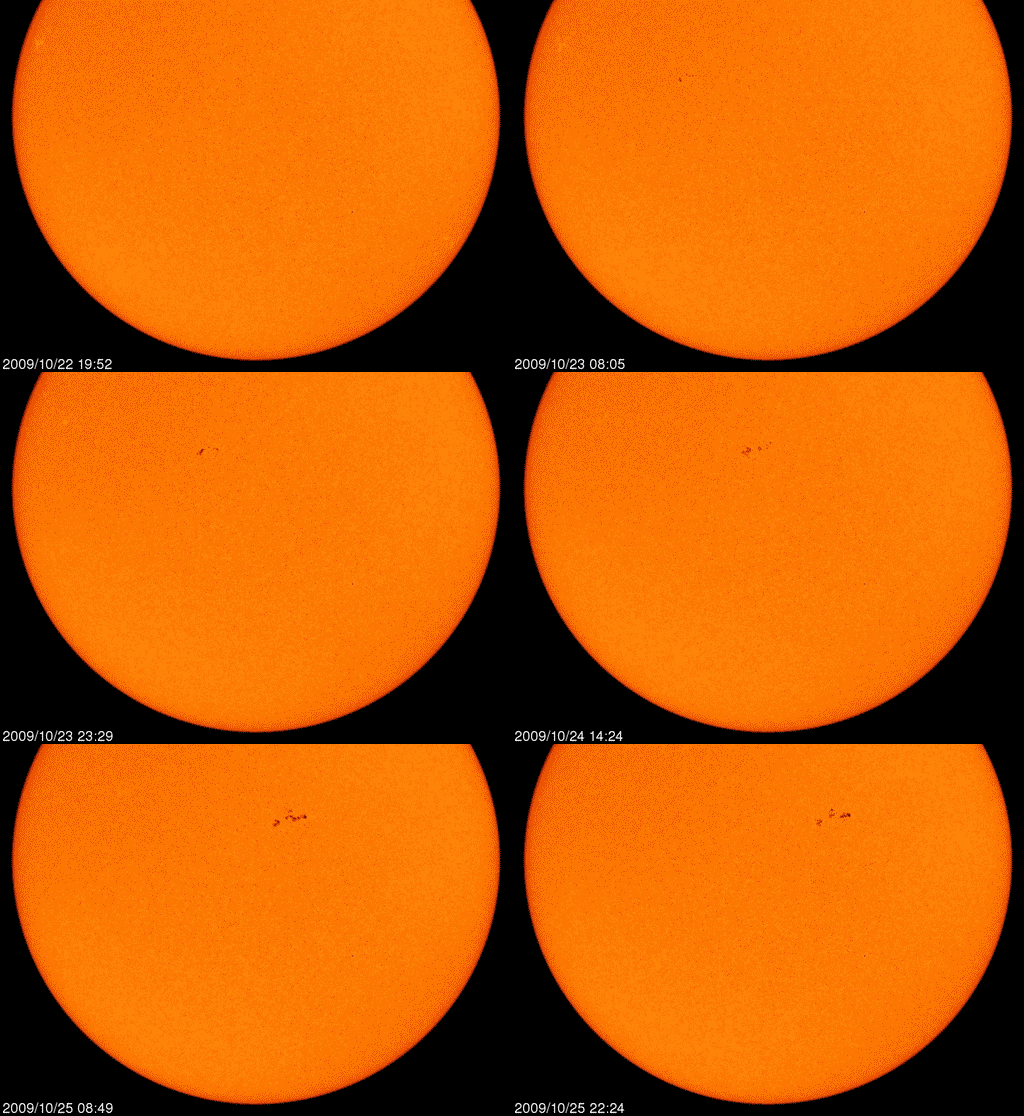
After months of malaise and anemic sunspecks, the sun finally creates a respectable spot.While lower towards the equator than expected, it has been identified as a cycle 24 spot.

From SpaceWeather.com: The sun is showing signs of life. Over the weekend, sunspot 1029 emerged and it is crackling with B- and C-class solar flares. Amateur astronomer Gianluca Valentini of Rimini, Italy, took this picture just hours ago:

“Incredible size and structure for this sunspot after such a long time of mini-events–maybe the sun really means business this time!” says Valentini.
In Ocean Beach, California, Michael Buxton made a movie of the active region: play it. “My girlfriend and I watched the magnetic fibrils around the sunspot as they surged and swirled,” he says. “It was a wonderful area of activity.”
The sunspot’s magnetic polarity identifies it as a member of new Solar Cycle 24. If it continues to grow at this rate, sunspot 1029 could soon become the biggest sunspot of 2009. Readers with solar telescopes are encouraged to monitor developments.
Here’s some solar indices from SWPC

According to solarcycle24.com here are the “records” for cycle24 so far:
SOLAR FLUX – 76 (9/23/2009 – bested today with 81, SWPC confirms)
SUNSPOT # – 32 (9/24/2009)
FLARE – C2.7 (7/5/2009)
DAYS IN A ROW WITH A SUNSPOT – 11 (10/1/2009)
Question to those who know about these matters: If this spot is so near to the equator does it mean that solar cycle 24 is near its end?
Or is it perhaps a losen v-belt running the solar dynamo? 🙂
In before the Leif?
The low latitude was my first question today when I saw this image.
Looks like sunspot activity will be back on the upswing and temperatures will be climbing again. Gavin Schmidt predicts that the cooling is over and that 2010 will be warmer.
Where’s the GOALPOST now?
I haven’t seen anything about M-Class or X-Class flares discussed. I wonder when the last M-Class flare occurred and how this frequency compares to more typical sunspot minimums.
Does one sunpot a summer make however?
Will it be like last time the sun showed a decent sunspot… after giving such show it went back in the coma for a very long time. It’s like it’s giving all it has to fall even lower… hummm, just like excitation electronic transition mechanism.
It’s alive, it’s a live!
OK, who charged the defibrillator? Or was it a lightning …
Reminds me of what someone posted and reposted to me on a forum…
http://www.predictweather.co.nz/assets/articles/article_resources.php?id=89
“Cycle 24 is a while off. From July 2007 to 25/3/2008 the situation is that cycle 23 that began in 1996 still reigns and has for the moment really caught a blossoming. From Cycle 24 there is a single tiny signature in 4.1.2008 and then nothing. Through March 2008 we have had 16 spotless days, one spot group from cycle 23 (southern hemisphere) on 7 days thus far, two spot groups from cycle 23 (SH) on 2 days thus far (24.3.-), three spot groups from cycle 23 (SH) on 1 day thus far (25.3.-) and no spots from cycle 24 thus far. Cycle 24 will take a while and there is a transition period. The orbits of the two gas giants Jupiter and Saturn but mainly Jupiter, dominate sunspot production. The relevant points of orbit are opposition (Jupiter and Saturn 180deg apart, or on opposite sides of the sun) and conjunction (Jupiter and Saturn in line with and on same side as the sun). Jupiter is now in the same position as in March 1996, which was a month in which cycle 23 had not yet kicked in.
Consider this:
the peak of SS20 was 1969/70, and the nearest J/S opposition was 1971-72
the peak of SS21 was 1980/82, and the nearest J/S conjunction was 1981
the peak of SS22 was 1984/92, and the nearest J/S opposition was 1991
the peak of SS23 was 1999/02, and the nearest J/S conjunction was 2000-01
the peak of SS24 should be 2010, and the nearest J/S opposition will be 2011.
A sunspot is said usually underway about 1-2 years before peak.
[b]Our calculation therefore is that SS24 should not begin before Sept 09.”[/b]
I posted this Fri May 15, 2009
I guess the ‘moon man’ Ken Ring was right, certainly more accurate than a lot of the ‘experts.
If the “Watts Effect” is a reciprocating mechanism, we may not see another sunspot until March.
“One swallow does not make a summer, …” Aristotle (384 BC – 322 BC).
Let’s wait for more evidence before we call off the “inconvenient” minimum.
Oh, joy! Maybe we finally have solar maximum!
STEREO shows nothing but blank sun on the “behind” picture that shows what is due to rotate into view over the next several days.
As stated already, lets see what the next months bring…..
tokyoboy (18:37:09) :
Goalpost??
That depends on what the Sun does from here on out, not on what it does in 1 day.
Our own Dr. Leif Svalgaard predicts the cycle based on Active Region count, not sunspots.
There is also the observations of Livingston & Penn to account for.
It’s more like a tug-o-war between the Irresistable Force and the Immovable Object. Which will prevail?
@ur momisugly william (18:36:38) :
Gavin Schmidt predicts that the cooling is over and that 2010 will be warmer.
I didn’t know that Gavin had even admitted that it had been cooling for the last 10 years.
Today’s (10/26/2009 22:24) measurements of SSN 1029:
Whole spot = 368 x 10E6
Umbra = 45.6 x 10E6
Previous record SSN 1024:
Whole spot = 343.9 x 10E6
Umbra = 26.2 x 10E6
All measurements corrected for foreshortening.
Adolfo Giurfa (18:22:25) :
Question to those who know about these matters: If this spot is so near to the equator does it mean that solar cycle 24 is near its end?
No, the spread in latitude is not unusual, once the cycle has started for good.
Eddie Murphy (18:50:17) :
the peak of SS24 should be 2010, and the nearest J/S opposition will be 2011.
This seems already to be off the mark.
rbateman (19:15:55) :
There is also the observations of Livingston & Penn to account for.
Bill Livingston reports tha he got some good readings on the group. It will take a couple of days the work up the results. Considering that the spot is large, one might ‘predict’ a magnetic field of 2300 Gauss. Let’s see how it comes out.
Two (barely) C-class flares in a 48-hour period is “crackling” with them?
Look for another extended length of time to pass before another sunspot group. The pattern has been in my opinion that when these spots occur, accrued energy is released thereby providing a period of quiet. We’ll see.
Next, this group is located much closer to the equator of the sun which indicates a mature period of cycle 24. If the next spot group appears at or below this latitude then we should expect a peak to the cycle soon and then a long transition into the end of cycle 24. This brings into question the validity of predictions by Leif of a max cycle sunspot peak of 75 give or take and warrants a closer look at predictions made of a max cycle sunspot number of 45 by Archibald and others.
If this cycle peaks at 45 or less then a serious relook at what is in store for a cooling climate will be the next order of prediction. In other words the expected Dalton type cooling resulting from a 45 max sunspot number could be revised down due to a lower max sunspot number of less than 45 will be something to consider.
For everyone who has been following closely the posts of this sight over the last 2 years, closing arguements can be made about who was correct and who was wrong about predicting cycle 24 sunspot activity. I expect when the peak is realized then those who were correct in their prediction can then claim the high ground for their prediction of climate effects in the future. After all “nothing new here but building on the good work of those who preceded us” wouldn’t you say?
Beware of the solar flux value. Is is quoted at Noon to be 81 sfu, but was actually only 80 sfu, as we are moving closer to the Sun. Had this been early January, the values would have been 85 observed and 80 adjusted for distance.
At least they put in the word ‘maybe’.
Forgive me if I don’t hold my breath in anticipation.
Leif Svalgaard (19:37:42) :
“Beware of the solar flux value. Is is quoted at Noon to be 81 sfu, but was actually only 80 sfu, as we are moving closer to the Sun. Had this been early January, the values would have been 85 observed and 80 adjusted for distance.”
I don’t understand why the “official” flux reading is not the corrected one, Leif.
It would certainly save some confusion. Why do they continue to report the unadjusted number?
Chris
Norfolk, VA, USA
There’s also other magnetic areas on the Sun, I guess SC24 had to start up sooner or later.
Tallbloke has said the quiet Sun has been causing the oceans to go into heat-release mode, I like to ask him this, if the Sun gets and stays active will SST’s go down as the oceans go back to heat-retain mode?
savethesharks (19:57:14) :
I don’t understand why the “official” flux reading is not the corrected one, Leif.
It would certainly save some confusion. Why do they continue to report the unadjusted number?
It is because both numbers are useful. The observed number governs the actual conductivity of the ionosphere important for radio communication. The adjusted one is useful as a purely solar index. What is amazing is that people can be continually confused about this. There is a similar situation with TSI.