As we’ve seen in this report from John Goetz, GISS: worlds airports continue to run warmer than ROW a significant portion of the GHCN (Global Historical Climate Network) surface temperature record is measured in airports, not rural open fields. Airports, airport expansion, and air travel frequency tend to be linked with the population, growth, and wealth trends of a city. It stands to reason that since the majority of thermometers in the GHCN record are at airports, they’d have a broad application of UHI. Joe tries out a simple method of approximating what the signal might look like with a UHI removal. – Anthony
Chasing a More Accurate Global Century Scale Temperature Trend
By Joseph D’Aleo, CCM, AMS Fellow

Hadley Center Annual Mean Temperature since 1895 shows a warming of about 1C since 1895. – Click for larger image
The long term global temperature trends have been shown by numerous peer review papers to be exaggerated by 30%, 50% and in some cases much more by issues such as urbanization, land use changes, bad siting, bad instrumentation, and ocean measurement techniques that changed over time. NOAA made matters worse by removing the satellite ocean temperature measurement which provide more complete coverage and was not subject to the local issues except near the coastlines and islands. The result has been the absurd and bogus claims by NOAA and the alarmists that we are in the warmest decade in 100 or even a 1000 years or more and our oceans are warmest ever. See this earlier story that summarizes the issues.
No one disputes the cyclical warming from 1979 to 1998 that is shown in all the data sets including the satellite, only the cause. These 60-70 year cycles tie in lock step with the ocean temperature cycles and solar Total Solar Irradiance. The annual mean USHCN temperatures are shown below along with the annual TSI and PDO+AMO.
 Click for larger image
One needs simply to look at the record highs for the United States and globe to see that the warmest years are not all in the last two decades (although some were to be expected given it is one of two peaks in the cycles). The first image below shows the decadal state record all-time highs. The 1930s still clearly dominates (24 state all time records) with only one state (South Dakota) in the 2000s tying a 1930s all-time heat record.
 Click for a larger image
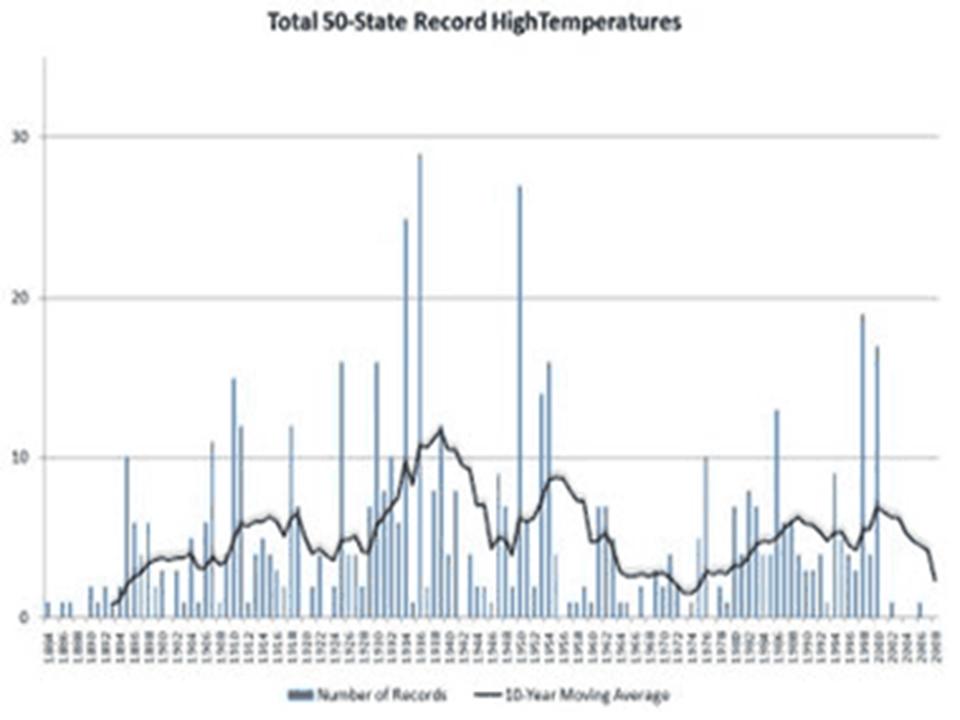
The following image (enlarged here) shows the record monthly highs by individual year. Note the 1930s and 1950s dominate and this decade showing the least record highs than any decade since the 1800s.

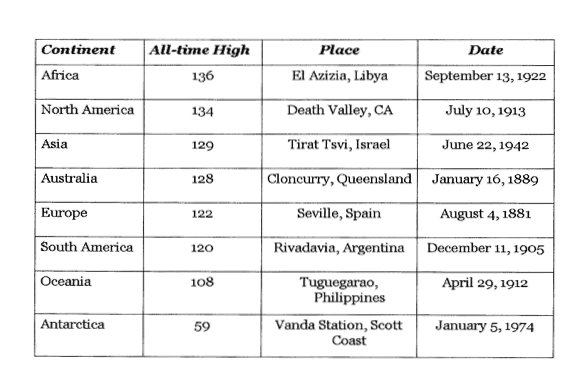
Here is the NCDC compilation of the continental all-time records (enlarged here), note for all the populated continents, the records were in the 1800s and early 1900s.

TRYING TO GET AT A BETTER LONG TERM TREND
NCDC removed the UHI effect for the US in 2007 in version 2 of the USHCN. GISS maintains their version of a UHI adjustment of this NCDC USHCN data. By differencing the two, I found the following (enlarged here):
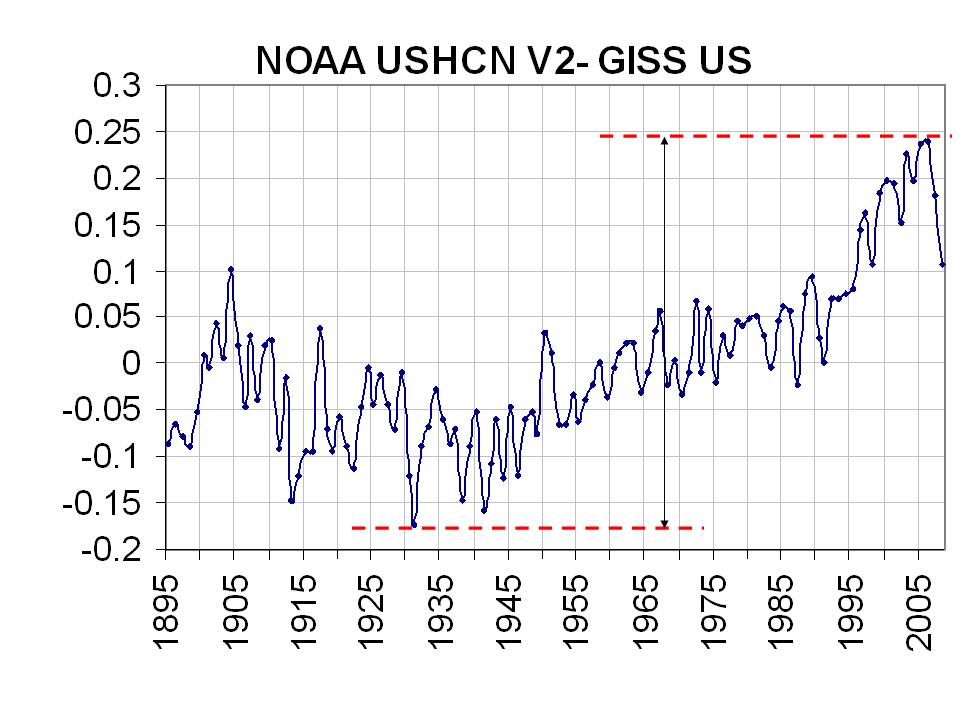
 NOAA USHCNV2 -vs- GISS – click for larger image
It shows an artificial warming of about 0.45 C or 0.75F for the NOAA data for removal of the urbanization adjustment. Phil Jones of the Hadley Center, co-authored a paper that showed the UHI contamination of China was 1 degree Celsius (1.8F) for the century, so this contamination appears not to be unreasonable, in fact it may be conservative.
I then took that UHI adjustment for the United States and applied to the global data. The Hadley center data is dominated by land areas with their ocean temperatures mainly coming from ships and in the northern hemisphere. Here’s what Hadley says about marine data “For marine regions sea surface temperature (SST) measurements taken on board merchant and some naval vessels are used. As the majority come from the voluntary observing fleet, coverage is reduced away from the main shipping lanes and is minimal over the Southern Oceans.”
I subtracted the UHI annual contamination from the annual Hadley CRUT3v global temperatures. I got the following (enlarged here):
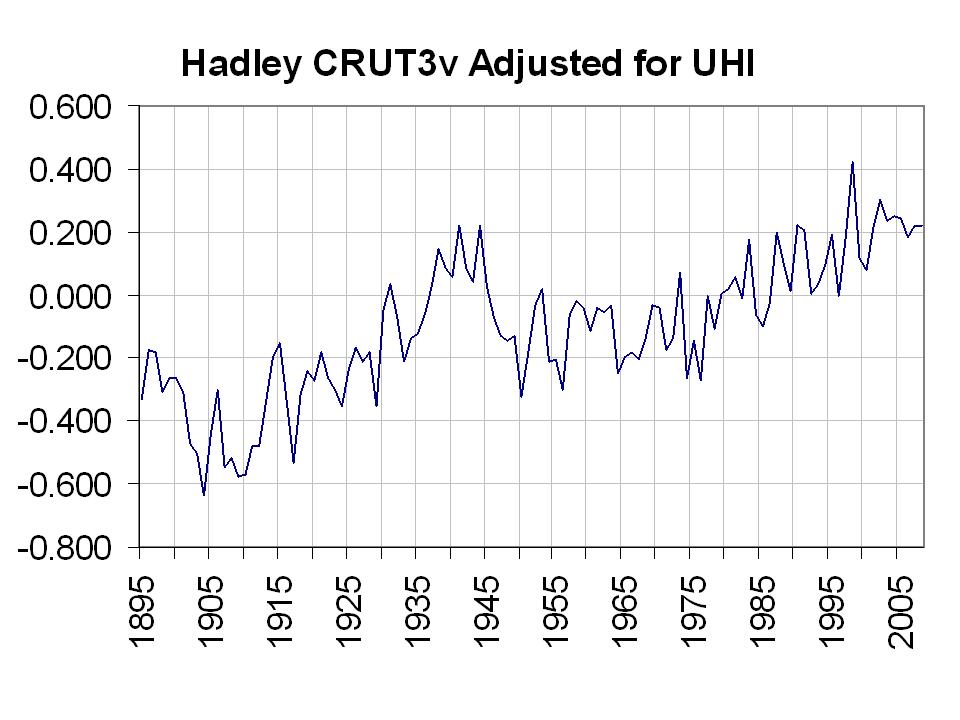

This gives a much more believable view of global temperatures, consistent with the natural forcings and more in line with records shown. The greatest warming was in the early 20th Century. The warming since 1930s and 1940s was negligible (0.2C). It suggests much to do about nothing in DC and Copenhagen. See PDF here.
UPDATE: This post has been changed to include a raw Hadley CRUT3v global plot, a NOAA-GISS difference plot and a corrected adjusted Hadley plot now all in Celsius. This is a work in progress and an attempt to see what Hadley plot might look like with an adjustment for UHI that numerous peer review papers suggest is necessary. Your suggestions are welcome (jsdaleo at yahoo.com).
Did you convert from F to C first? Why would you apply the effect to land and ocean? Why not estimate the global warm bias directly using satellite data for the last 30 years?
I agree that the temperature datasets probably overstate the warming, but there is no way that extreme corrections like this are right, IMAO.
Whoops. Note the temp for 24/9/09 on the UAH satellite site – 40.13F above this time last year. What’s up?
He talks about big UHI effect in China, that is believable when you look at the sheer size of some urban areas in that country complete with rapid growth.
It’s not CO2 that creates a possible decent chunk man-made warming in some areas, it’s global urbanization, look at the year 1900 and determine how much less land back then was paved over and urbanized.
Also, the Farmer’s Almamac outlook for Fall, you see they’re thinking more towards a chilly Fall season than a warm one unless you’re in the Southern U.S
http://www.farmersalmanac.com/weather/a/farmers-almanac-fall-forecast
Joseph D’Aleo: “I then took that UHI adjustment for the United States and made the leap of faith that it applied to the global data.”
A “leap of faith” that the Urban Heat Island effect applies globally? Like for the sea surface temperatures that represent 70% of the earth’s surface as well as all the non-urban land areas? A “leap of faith” based on just the United States figures, which cover less than two per cent of the earth’s surface?
A “leap of faith” that just happens to provide you with a graph that tells you what you want to see?
Gosh. This is an easy way to do science! When the results don’t tell you what you want to see, just take a leap of faith and hey presto! everything is hunky dory.
Leap of faith? More like a fall into darkness.
REPLY: If you’ll put your snark rifle aside for a moment, bear in mind that the majority of the GHCN surface temperature record is measured in airports, not rural open fields. Airports, airport expansion, and air travel frequency are closely linked with the population, growth, and wealth trends of a city. It stands to reason that since the majority of thermometers in the GHCN record are at airports, they’d have a broad application of UHI.
See: http://wattsupwiththat.com/2009/07/15/giss-worlds-airports-continue-to-run-warmer-than-row/
Joe could have worded that better, I agree. I’ve added a foreword to remind readers of the airport issue and asked Joe to clarify. – Anthony
UPDATE: Joe agreed with the poor choice of words, and has clarified his paragraph. Also some commentators suggested he made an error in F to C conversion or skipped it, he did indeed, and the graph has been updated. – A
Ian George (15:32:57) :
40.13F above this time last year. What’s up?
You are trying to say that Sept. 2009 is more than 40 degrees higher than Sept. 2008 ?
Gee…. Earth has not seen temps like that in about 50 Million years. What a MAJOR rapid temperature change. Historic.
Should have provided the link. It will probably be adjusted soon.
http://discover.itsc.uah.edu/amsutemps/execute.csh?amsutemps+001
“A “leap of faith” that the Urban Heat Island effect applies globally? Like for the sea surface temperatures …?”
Let’s hope he meant to say “to the land-based global data.”
I’ve suspected after we legitimately remove poor siting effects and UHI, we would likely find we never achieved the highs of the 30’s/40’s at any time since. A full blown audit of all records, and corrections for these factors might reveal no net warming at all since that era. A huge task, but, Complete destruction of the AGW theory as a result.
interesting data, interesting times.
Joe D’Aleo: Your graph suggests that the temperature trend between 1979 and 2009 is a rise of ~0.1 C. However, the UAH satellite dataset would say the trend was about 0.125 C/decade, for a total rise of ~0.38 C…and the trend for the RSS analysis is even higher! Doesn’t that perhaps suggest to you that there might be something wrong with your analysis?
Still another correction has to be made. What would the temperature record look like if we were to account for the dense smog of the 19th and early 20th century which blocked a lot more sunlight than the latter half of the 20th century. I reason without that smog temperatures would have been higher in the past. The major climate change therefore is our air has become cleaner, more transparent and more sunlight is reaching ground level.
Slioch (15:43:57) : et al….
Your point begs the question- Since continental land masses are a small portion of the surface, for periods preceding the satellite record, and periods following it where the satellite record is not exclusively used, are not those land mass records then the basis from which vast ocean surface temps must have been calculated? And as was clearly shown here in other work, much of that record is tainted with UHI.
Joel Shore (16:09:35) : There is something wrong. I got distinctly larger trends, although still reduced, with a very simple method. But the issue is not quite as large as you could suggest:
http://www.climateaudit.org/phpBB3/viewtopic.php?f=3&t=740
And RSS has a spurious warm shift in the early nineties. Let’s not drag that into this.
The main issue as far as I can see is that Joe has applied an “UHI correction” to the entire globe, including the oceans. I’m also still not clear whether he converted from F to C.
Joel Shore (16:09:35) :
you forgot to consider that climate models estimate trends at 600 mbar (UAH satellite) to be roughly 2 times higher than on the ground. D’aleo’s estimate is in much much better agreement, than the agencies’ surface temperature data sets.
(if climate models are good for anything, it is contradicting other agw conjecture.)
http://www.climateaudit.org/wp-content/uploads/2008/06/hadat43.gif
The data are very interesting, especially the overlay of the PDO, AMO and TSI on the global temperature track.
However, applying the domestic UHI correction to the HadCRUT global temperature has two major problems which will tend to counter each other:
1. The UHI correction applies to land data only. This will tend to reduce the global UHI effect and increase the apparent warming trend over that shown in your last figure.
2. The US actually appears to have less unaccounted-for UHI effects than land-based measurements for the rest of world, at least since 1980 (see McKitrick and Michaels, JGR 2007). This will tend to decrease the apparent warming trend below your last figure.
I still haven’t found a good thermostat for my house that will allow me to set the temperature to the hundredths degree. Does anyone know where I can get one? I like my house temperature to be 71.68 degrees Fahrenheit. Anything more or less than that is just plain uncomfortable.
Joel Shore (16:09:35) :
Joe D’Aleo: Your graph suggests that the temperature trend between 1979 and 2009 is a rise of ~0.1 C. However, the UAH satellite dataset would say the trend was about 0.125 C/decade, for a total rise of ~0.38 C…and the trend for the RSS analysis is even higher! Doesn’t that perhaps suggest to you that there might be something wrong with your analysis?
Yep, I’m with you on this. We’ve disagreed on other issues, but it doesn’t look as though this analysis has been properly thought through. The “amplification factor” in the troposphere is something like 1.2, so that doesn’t explain the discrepancy between satellite and the “adjusted” Hadley records. This looks to be a case of torturing the data to get a result we like.
What would the temperature record look like if we were to account for the dense smog of the 19th and early 20th century which blocked a lot more sunlight than the latter half of the 20th century.
Indeed the smog, smoke and particulate pollution did block sunlight from reaching the surface. However, the surface temperatures are compiled from just 2 values, minimum temperature and maximum temperatures for the day.
The minimum temperature for the day typically occurs after dawn when the first sunlight of the day overcomes the effect of radiative cooling.
Smoke and smog is mostly close to the surface and would have it’s maximum effect in blocking sunlight when the sun has just risen and sunlight travels at a low angle through the atmosphere to reach the surface.
Most of the observed warming has been in the minimum temperature (about 70%) and reduced smog and smoke would (and probably does) account for the warming from the mid-1970s to the mid-1990s due to clear air legislation in the developing world.
It also accounts for the discrepancy between Joe’s maximum temperature distribution and the compiled surface temperature records (Hadcru. GISS).
Thanks Joseph D’Aleo for the publication and Anthony for posting this.
Despite the remarks, the method and the final graph makes sense to me and it’s a hell of a lot better than the “consensus” based on a hockey stick graph and a bunch of blatant lies.
“Consensus” is all that’s left and it won’t hold.
The 2nd graph, the one with the big red bars, that looks like the records for where I live.
1933 , they don’t make ’em like that anymore.
The 2007-2008 global cooling event, evidence for clouds as the cause!
http://www.drroyspencer.com/2009/09/the-2007-2008-global-cooling-event-evidence-for-clouds-as-the-cause/
Manfred says:
The 2X factor is at one specific height and in the tropics. If you average over the whole globe and consider the fact that the T_2LT effectively averages (in a weighted way) over a large portion of the troposphere (and, maybe even into the stratosphere a bit in the tail), then the expected amplification factor is much smaller. John Finn quotes a value of 1.2, which sounds about right.
If you want to study the sun, go to the moon!
http://omniclimate.wordpress.com/2009/09/25/to-study-the-sun-go-to-the-moon/
Layne Blanchard says:
No…I believe that most of the ocean temperature data are from sea surface temperatures measured by ships.
Not to pile on… but that first graph of PDO+AMO with TSI and temps is simply egregious… Why would you plot US temps when trying to argue ocean cycles/TSI influence on GLOBAL temps? Why not just plot the global temps? Also, the TSI plotted is from the severely outdated Hoyt-Schatten data which Leif describes as “worse than useless”. Its pretty hard to take the rest of the “essay” seriously when you copy and paste that as your first plot… No wonder icecap doesn’t allow comments!
REPLY:I agree it started out a bit confusing. Criticism helped. All of the graphs have been updated. Joe points out that the solar data has been calibrated for Willson’s ACRIM. – A