Foreword: I give thanks to Steve McIntyre for this analysis. Steve came to a conclusion similar to what I alluded to in my initial rebuttal where I said:
“For all I know, they could be comparing homogenized data from CRN1 and 2 (best stations) to homogenized data from CRN 345 (the worst stations), which of course would show nearly no difference.“
Steve does a superb job of deconstructing the memo’s undocumented results. Perhaps someday Dr. Thomas Peterson of NCDC will tell us how he did his analysis and show supporting data and methods. – Anthony
The NOAA Talking Points memo falls well short of a “full, true and plain disclosure” standard – aside from the failure to appropriately credit Watts (2009).
They presented the following graphic that purported to show that NOAA’s negligent administration of the USHCN station network did not “matter”, describing the stations as follows:
Two national time series were made using the same gridding and area averaging technique. One analysis was for the full data set. The other used only the 70 stations that surfacestations.org classified as good or best… the two time series, shown below as both annual data and smooth data, are remarkably similar. Clearly there is no indication for this analysis that poor current siting is imparting a bias in the U.S. temperature trends.
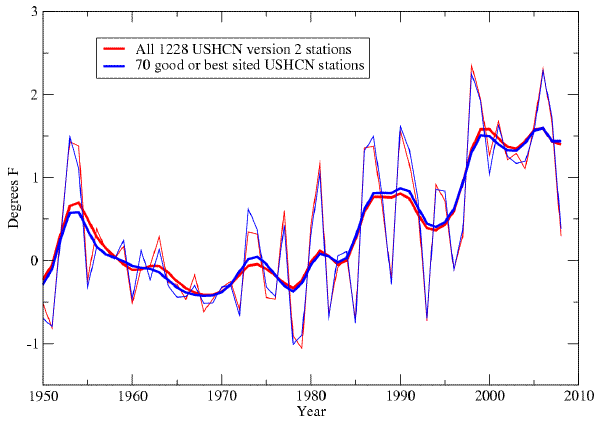
Figure 1. From Talking Points Memo.
Beyond the above sentence, there was no further information on the provenance of the two data sets. NOAA did not archive either data set nor provide source code for reconciliation.
The red graphic for the “full data set” had, using the preferred terminology of climate science, a “remarkable similarity” to the NOAA 48 data set that I’d previously compared to the corresponding GISS data set here (which showed a strong trend of NOAA relative to GISS). Here’s a replot of that data – there are some key telltales evidencing that this has a common provenance to the red series in the Talking Points graphic.

Figure 2. Plot of US data from www1.ncdc.noaa.gov/pub/data/cirs/drd964x.tmpst.txt
An obvious question is whether the Talking Points starting point of 1950 is relevant. Here’s the corresponding graphic with the 1895 starting point used in USHCN v2. Has the truncation of the graphic start at 1950 “enhanced” the visual impression of an increasing trend? I think so.
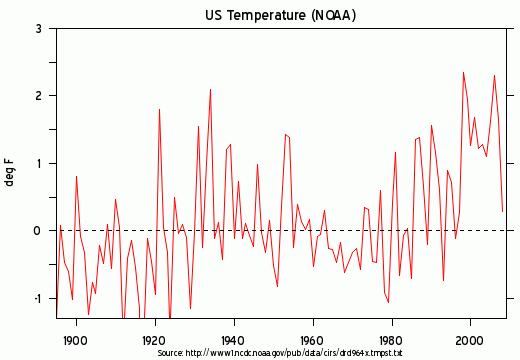
Figure 3. As Figure 2, but to USHCN v2 start
The Talking Points’ main point is its purported demonstration that UHI-type impacts don’t “matter”. To show one flaw in their arm-waving, here is a comparison of the NOAA U.S. temperature data set and the NASA GISS US temperature data set over the same period – a comparison that I’ve made on several occasions, including most recently here. NASA GISS adjusts US temperatures for UHI using nightlights information, coercing the low-frequency data to the higher-quality stations. The trend difference between NOAA and NASA GISS is approximately 0.7 deg F/century in the 1950-2008 period in question: obviously not a small proportion of the total reported increase.

Figure 4. Difference between NOAA and NASA in the 1950-2008 period. In def F following NOAA (rather than deg C)
As has been discussed at considerable length, the NASA GISS adjusted version runs fairly close to “good” CRN1-2 stations – a point which Team superfans have used in a bait-and-switch to supposedly vindicate entirely different NASA GISS adjustments in the ROW, (adjustments which appear to me to be no more than random permutations of the data, a point discussed at considerable length on other occasions.)
For present purposes, we need only focus on the observation that there is a substantial trend difference between NOAA and GISS trends.
Given that, when NOAA’s Talking Points claim that there is a supposedly negligible difference between the average of their “good” stations and the NOAA average (which we know to run hot relative to GISS), then arguably this raises issues about the new USHCN procedures.
Y’see, while NOAA doesn’t actually bother saying how it did the calculations, here’s my guess as to what they did. The new USHCN data sets (as I’ll discuss in a future post) ONLY show adjusted data. No more inconvenient data trails with unadjusted and TOBS versions.
When I looked at SHAP and FILNET adjustments a couple of years ago, one of my principal objections to these methods was that they adjusted “good” stations. After FILNET adjustment, stations looked a lot more similar than they did before. I’ll bet that the new USHCN adjustments have a similar effect and that the Talking Points memo compares adjusted versions of “good” stations to the overall average.
So what they are probably saying is this: after the new USHCN “adjustments” (about which little is known as the ink is barely dry on the journal article describing the new method and code for which is unavailable), there isn’t much difference between the average of good stations and the average of all stations.
If the NASA GISS adjustment procedure in the US is justified (and most Team advocates have supported the NASA GISS adjustment in the US), then the Talking Points memo merely demonstrates that there is something wrong with the new USHCN adjustments.
this would be a breathtaking manipulation by noaa and would raise questions about their data sets in general, such as sea level data.
Intentional alteration of data tells us we have to reject models and forcasts based on their studies. One of the keys in peer review is the ability to “replicate” a study. How can you “replicate” twisting or cheating on the data? Bernie Madoff can shed some light on puffing up data and reports.
Well now, if you compare adjusted data for a few stations against adjusted data for all stations and find that they’re similar, all that tells you is that your adjustment method works. It doesn’t tell you all that much about what’s really happening.
I would think that a researcher would welcome finding problems in the raw data; this is how problems are revealed. But then that might call for investigative field work rather than working up a computer algorithm to massage data into pleasing conformity. How about, instead of adjusting the data, getting out from behind the desk and fix the problems with station siting. Damn – there I go again, trying to use common sense.
So, they’ve got an agenda. Well demonstrated and freely communicated. Legislation to control climate change through CO2 reduction.
They’ve been caught and freely admit they adjust (manipulate) the data. That is not in dispute.
They refuse to provide the methodology and supporting data.
Those manipulations ALL seems to be in favor of their hypothesis (and agenda). They are currently engaged in suppressing those in their organization with dissenting opinions. They seem to be brave enough to threaten such disenters openly in emails.
Motive, method, opportunity, confession of the acts and coersion. All that’s really missing is proof of intent to deceive . . . which I would think would be somewhat covered by their unwillingness to share the methodology.
What specific act would these people need to engage in before the word ‘fraud’ would begin to pertain, Anthony.
I am not calling you out, I am just asking.
How interesting. NOAA claims poorly sited stations don’t influence the analysis of temperature trends. Why then did someone find it prudent to dismiss one of the offending places?
http://wattsupwiththat.com/2009/06/10/an-old-friend-put-out-to-pasture-marysville-is-no-longer-a-climate-station-of-record/#more-8349
Furthermore, they can’t keep their own facts straight, can’t tell what they did or who did it, can’t ask for up-to-date information because they won’t acknowledge the source, and can’t produce a useful comparison.
Someone tell Obama that no harm will be done and the government can save a lot of money by closing this agency down.
Is there any integrity left in the u.s. gov. scientific community or is all thats left of a once great org. all just lies and misinformation.
They were “mistaken”.
I’d like to suggest that we simply refer to the NOAA data, as having been madoff’d. Madoffing of data is nothing new, but Bernie took it to a whole new level. He should go down in history.
Watch it, son. You, too, can be “adjusted”.
The longer they go without realizing that Steve is a heck of a lot smarter than they are, the more they are going to reveal the chicanery, and the deliberate deceit behind their work. Making a list and checking it twice. Uh huh.
============================================
I know this should go on the earlier thread about the EPA, but it’s way down the stack. Anyway, Sen. Inhofe is calling for a inquiry into the Carlin report/EPA business. http://www.foxnews.com/politics/2009/06/29/gop-senator-calls-inquiry-supressed-climate-change-report/ . Hope it gets some traction.
I could understand why the UK gov took the AGW bait ,but not the USA.
Thanks to this site i am now informed..
Many thanks to Anthony and the other contributers here.
Anthony, with do respect of your professionalism, you have to call a spade what it is. I still maintain my hunch/conspiracy/innuendo theorem regard of the hippie
generation got into power and started making changes. Maybe with a help of foreign power help, for political reason. For the russkies the tree hugger/green/antinuclear agenda just suited fine.
They are the useful idiot.
If I’m out of line please delete my entry.
Best Regards from OZ.
Mick.
Steve Briggs (14:34:03) : Apply Hanlon’s Razor. It’s not malice (fraud) it’s stupidity (incompetence).
They have no time to joust with us jesters, but we must jest with these adjusters.
Top analysis from a top statistician. Thanks Steve and Anthony for this clear demonstration of they way these publicly funded agencies work.
Are we now to this point?
NOAA = Noticeable Observation Alteration Activity
NCDC = National Center for Data Corruption
You know, there is a public law covering data quality, accuracy and analysis …
http://www.sec.gov/about/dataqualityguide.htm
It was passed bcak in 2001 when the hoax was heating up.
So, if I take my daily temp record for January & February 1913, calcualte the daily average temp (Hi+Lo/2), add them up, divide by days in month, subtract 32, *5/9 and compare to GiSSmonthly series, I should find them the same.
When I do this, I see the GISSmonthly has been upped.
Jan 1913 av. is -0.07 GiSS is -0.7
Feb 1913 av is 2.19 GISS is 3.1
So they haven’t stomped the real data…yet.
Would that be a correct conclusion?
If the analysis can’t be replicated from the raw data, then it’s not science; it’s ideology. Since these organizations are entirely taxpayer-funded, it should not be hard to develop a Freedom-of-Information-Act demand, and put them on the spot to put up or shut up.
I wonder if Mark Levin’s Landmark Legal Foundation could be enlisted. . .
Senator Inhofe should also attempt to get an inquiry into suppression of data and methods going, though being in the minority he may have little ability to set the agenda of his subcommittee.
/Mr Lynn
Just wanted to point out….
Figure 4 is in deg. F and the trend appears to be about 0.7 deg. F/century, but the text just above it says 0.7 Deg C/century .
Also, the caption has a typo – def F.
Nice article though.
MikeEE
Shirley, you jest;-)
“The Greenhouse Effect in Central North America: If Not Now, When?” This paper was written by Thomas Karl, Richard Heim and Robert Quayle for the AAAS Science Magazine March 1991. This shows that Karl and Quayle wrote the articles defining all but one of the current adjustments to NOAA temperature data: TOBS, MMTS, SHAP and Urban; only FILNET’s write-up is not mentioned. NCDC is currently developing another step in the processing, described in Peterson and Easterling (1994) and Easterling and Peterson (1995).
Global Change Research Information Office (GCRIO) published “Consequences” Vol. 1, No. 1 in Spring 1995: “The Authors all serve on the scientific staff of the National Oceanic and Atmospheric Administration’s [NOAA’s] National Climatic Data Center (NCDC), in Asheville, North Carolina. Thomas Karl, who has also been active in defining an international Global Climate Observing System, serves as the Center’s Senior Scientist. Robert Quayle is Chief of the NCDC Global Climate Laboratory and David Easterling and Richard Knight are staff meteorologists…” In 2004, operational responsibility for GCRIO shifted to the U.S. Climate Change Science Program (USCCP).
The adjustments are now apparently made without the raw data ever being visible; moreover it looks as if the adjustments now used were never explained transparently, in a way that would allow open duplication and checking. Yet the total effect of all the adjustments causes NOAA an upward trend of 0.7ºC/century more than GISS, in the years 1950-2000, and obviously this is not a small proportion of the total upward trend.
Tom Karl is a well-known warmist with an unusual qualification constituting his doctorate. Karl, Quayle and Easterling have worked closely together. So have Easterling and Peterson. And Peterson is the undeclared author of the recent NOAA “Talking Points Memo” that dismissively discusses Anthony Watts’ Surface Stations work without ever mentioning his name or acknowledging his source material.
It seems a very small world, and reminds me of nothing so much as Wegman’s social analysis of the paleoclimatologists, where the whole community is involved in mutual peer-reviewing and flea-scratching.
This piece is a fine illustration of the difference between those who apply technical knowledge and those who apply their own version of common sense.
When I read an assertion that the siting of a large proportion of measuring stations next to sources of heat and/or heat retention makes no significant difference to anything that matters, my answer is an unequivocal: “nonsense”. It simply makes no sense.
We are dealing with physical measurements here. And let’s be clear about what is intended to be measured. There aren’t all that many measuring loci. Each one covers the area between it and the mid-point between it and the nearest measuring device in each direction. The measurement it gives is the “official” measurement of air temperature for an area covered by the mid-points between it and the nearest measuring points in each direction, it can be many square miles.
And, as I understand it, the measurements are intended to reflect the air temperature as determined by atmospheric phenomena, unaffected by ground level elements of human wibble.
To suggest that a measurement taken next to an air conditioning vent and a measurement taken in the middle of a field produce results of equal merit is simply absurd. You can apply any formula of adjustment you wish, it will not be accurate unless it is tailored to the individual siting problems of each poorly placed measuring device.
There is no way around this. Either you adjust individually (an impossible task in the real world) or you apply a general formula that is necessarily defective.
You science and statistics chaps reach the same conclusion using computers and all sorts of other things we plebes simply don’t understand. We both understand nonsense when we read it, we just have different ways of explaining why it is nonsense.
http://www.snooperreport.com/snooper-report/2009/6/27/environmental-corruption-dennis-prager-interviews-professor.html
Nice climate you got here.
It’d be a shame if we had to adjust it . . .