Arctic Sea Ice Increases at Record Rate
Guest Post by Jeff Id on February 3, 2009
Something I’ve been interested in for the last several months is sea ice data. What makes it interesting is that as I understand it, models demonstrate the poles should be most sensitive to global warming leading the planet temp, especially in the Arctic. Recently I have been able to process the monthly and daily gridded arctic data as provided by NSIDC. The daily values allow a better analysis of trend than can be provided by the monthly data.
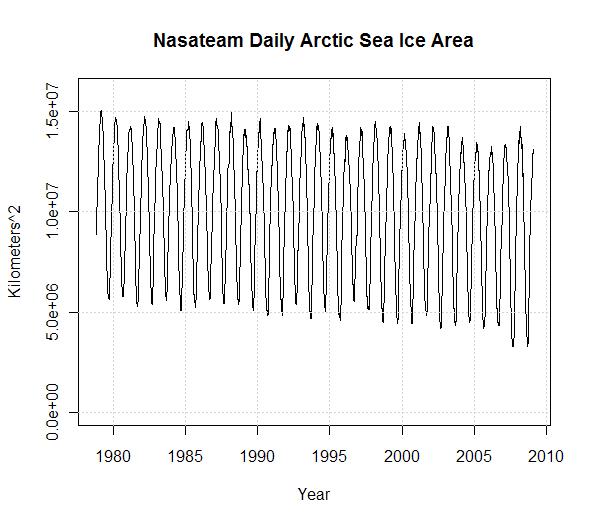
If you’re like me you recall the claims of fastest melt rate ever were made about 2007 , I fully believed them, because the graphs showed a much more negative value than in the previous 30 years as shown in Figure 1 below.
This effort was originally intended to investigate how bad the melt rate was in comparison to the natural variation, I didn’t get that far yet. Accessing and processing the gridded data was critical to the analysis, so I spent the time reading the literature and writing code. Having full access to the NSIDC data allows some interesting analysis, they do an excellent job on their site.
There are two primary algorithms used for processing ice data NasaTeam and Bootstrap. The descriptions of the data state the difference between the two is very small and the sets are interchangeable except that bootstrap is recommended for trend analysis in research publications. Bootstrap is only provided in monthly data format while NasaTeam is provided in both monthly and daily provided you’re willing to download over 1G of data, write code to process it, refit the land and missing data mask and sum the results. I am. Also, NasaTeam provides a near real time version of the polar ice data which has a different land mask and hasn’t been processed for missing data. This data isn’t as clean but I wanted to use it. I applied the same land mask as the rest of the series to insure that there was a consistent baseline for trend analysis. The missing data from Jan 2008 onward created noise in the series which I simply filtered out using a 7 day sliding window filter.
The mask looks like this Figure 2

The brown is land, black edges on land are coastline and light blue is the satellite data not measured. This mask is applied consistently through the entire data series. There was some question about masking on one of my other posts at WUWT where visually the land area seemed to change size, in the case of the NSIDC data they apply masks consistently except for the satellite hole and the near real time data.
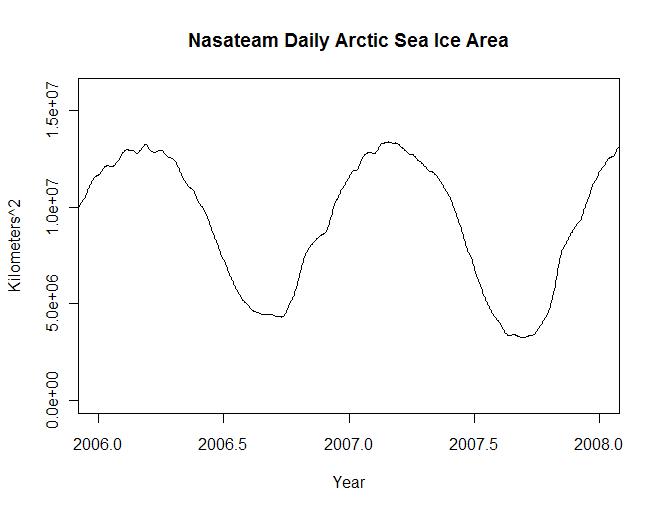
The NasaTeam version of the arctic ice data looks like the plot below for 2009 (note the small size of the satellite data hole). This graph was created in R using the actual Nasa Team masks and data. I used the worst case land and polar masks to adjust the entire dataset to eliminate problems with consistency. Figure 3


Of course it’s an interesting picture, but what I wanted to know when I started this post was how bad was the worst melt rate in history and what is the actual melt area. In the plot below the arctic is losing sea ice at a rate of only 56K km^2/year. Of course sea ice area went up in the Antarctic during the same time frame though. Note the strong recovery in 08 of Figures 1 and 4, which actually exceeds values of most of the record, matching data back to 1980. Much of this is first year ice so the melt in 08 was expected to be a new record.
If you recall, in 2007 and 08 we were treated to headlines like this, which most of us accepted with a shrug.
Scientists warn Arctic sea ice is melting at its fastest rate since records began
NASA data show Arctic saw fastest sea ice melt in August 2008
Arctic Just Witnessed Fastest August Ice Retreat in History
I processed and analyzed the NasaTeam land area and missing data masks spending hours understanding different variances they list on their own website. After nearly everything I could find (except satellite transitions errors) was corrected (a different post) and corrections for variance in the measured pixel size, the final result in 30 day trends of arctic sea ice looks like the graph below (Figure 5). This graph is a derivative of the ice area plot. The maximum peaks and valleys represent the maximum rates of change in 30 day periods through the ice record.

Looking at this plot of the 30 day slopes of actual NASA gridded data, the maximum ice melt rate occurs in 1999 and in 2004 not in 2007. Surprisingly the maximum ice growth rates occur in 2007 and 2008, I don’t remember those headlines for some reason. Don’t forget when looking at the 2008 – 09 peak, the data is preliminary and hasn’t been through the same processing as the other data. From looking at the unprocessed data I doubt it will change much.
Certainly the 30 year arctic trend in ice area is downward, even the most committed global warming scientist has to admit this happens regularly in climate along with regular 30 year uptrends. The questions are, did we cause it or not, and was CO2 the instigating factor. The rapid recovery of ice levels has to have some meaning regarding the severity of the problem. This goes directly in the face of accelerated global warming and the doom and gloom scenarios promoted by our politicians and polyscienticians.
Why are my conclusions different from the news reported records? I think it’s likely due to the fact that the scientists used the monthly data which is processed using a weighted filter of the daily data that incorporates a longer time frame than a single month. This means their use of the monthly data to establish a monthly trend was in error and the real record down trends were actually set in 1999, 2003 and 1984. While the record uptrends were in 2007, 2008 and 1996.
Sponsored IT training links:
If hankering after 642-591 preparation then CT0-101 online training is best answer to your problem. Just go through practice questions and pass your 1Y0-A23 exam on first try.
One of my colleagues, who has been recruited by IPCC for three years, says that though the polar ice area is apparently increasing the ice layer is thinner so that the ice mass itself is slowly decreasing in line with the AGW theory. Is his opinion reasonable or not ?
I would appreciate your thoughts on this graph and its source: http://www.ijis.iarc.uaf.edu/seaice/extent/AMSRE_Sea_Ice_Extent.png
With winter this cold, I cannot imagine the Arctic not freezing up big time.
Keep it up, the public is growing wary of these roasting & drowning stories.
WHAT!? You used RAW data?! You didn’t “adjust” it to account for the “consensus” impact of anthropogenic global warming?!
This is a perfect example of the danger of “kitchen” science: Using actual data to gain insight into how the real world behaves.
This clearly hasn’t been peer reviewed, or funded by an appropriate governmental agency. Therefore, it must have been paid for by an oil company.
Shame!
[/sarc]
This is a simple case of geography. Melt ice to a record low summertime extent and you then can freeze a record amount of ice in the subsequent fall. Of course, your replacing metres thick once permanent ice with very thin seasonal ice and as a result the volume is a fraction of what it was.
This change is exactly as expected under global warming and will continue for a period while the Arctic switches from a perennial ice regime to a seasonal ice regime.
A branch of the Gulf Stream flows into the Arctic via Norway’s North Cape. It has never been clear to me how variations in this stream affect the water temperature in the Arctic and, of course, the ice melt/freeze.
Craig Moore (18:01:39) :
I would appreciate your thoughts on this graph and its source: http://www.ijis.iarc.uaf.edu/seaice/extent/AMSRE_Sea_Ice_Extent.png
WRT, they seem to be providing accurate information on sea ice.
WRT the information, sea ice, in the Arctic, is behaving pretty much normally. However, one could observe that the growth trajectory seems to be heading for a ten year high.
Did you have a point you wanted to make?
“WRT, they seem to be providing accurate information on sea ice.”
SB: “WRT the source, they seem to be providing accurate information on sea ice.
since the various “software glitches” changes without explanation @ur momisugly cryosphere today
http://mikelm.blogspot.com/2007/09/left-image-was-downloaded-from.html
PLUS the masking of NH data (snow borders ect, posted here) PLUS changes at NOREX (again without explanation as I understand) (as posted on WUWT) it is becoming more obvious that the ice data may also have been or be in process of being “adjusted” to suit AGW. In the light of it all.. only the “sea ice index” data seems reasonably close.. beware of changes to this data soon!. Its clear that cryosphere today favours the AGW hypothesis see recent link to “clarifications”
http://arctic.atmos.uiuc.edu/cryosphere/global.sea.ice.area.pdf + all changes suit AGW
Al Gore gave a presentation at the Senate Committee on Foreign Relations on Jan 28. 2009, 10 AM. During that he showed graphs of the Arctic ice changing. He particularly noted a rapid change in old ice vs new ice. See:
ADDRESSING GLOBAL CLIMATE CHANGE: THE ROAD TO COPENHAGEN
Proof that you can statistically get your data to say what you want it to say (it’s the first law of publishing). If you want it to say warmer, it will, if you want it to say not warmer, it will. Knowing that, we should always look at peer reviewed journal articles with an eye to that law…and yes, as well as our own.
Melt ice to a record low summertime extent and you then can freeze a record amount of ice in the subsequent fall.
Or, you could not freeze a record amount and have a dropping maximum and dropping average every year, which is what global warming models predicted.
Of course, your replacing metres thick once permanent ice with very thin seasonal ice and as a result the volume is a fraction of what it was.
It seems unlikely “meters-thick” ice is melting every year. In any case, the volume wouldn’t affect sea level much, being sea ice.
This change is exactly as expected under global warming
Yes, everything that happens is predicted by global warming, even when it isn’t.
DJ If you look closely Ice is appearing thicker (concentration) on NH cryosphere today than previous so wrong again….
DJ (18:21:21) :
This is a simple case of geography. Melt ice to a record low summertime extent and you then can freeze a record amount of ice in the subsequent fall. Of course, your replacing metres thick once permanent ice with very thin seasonal ice and as a result the volume is a fraction of what it was.
This change is exactly as expected under global warming and will continue for a period while the Arctic switches from a perennial ice regime to a seasonal ice regime.
Unless, of course, the climate is emerging from a warming period. In which case we’ll see a regrowth of metres thick “permanent” ice.
Will that regrowth of “permanent” ice be “evidence” of global warming?
He particularly noted a rapid change in old ice vs new ice.
And we need old ice because…?
This is starting to remind me of people who oppose a lunar base because it could damage the delicate lunar ecosystem.
DJ,
Link, please?
Meanwhile, check out Arctic sea ice before and after the government’s “adjustment”: click
Excellent graphs. I think this recalculation of results by people not involved in the original project is very valuable. I appreciate that most of the data centers will allow you get you hands on the data.
I have been looking at the sunspot, optical thickness data, CO2 and MEI data in regards to the UAH and GISS temperature trends over the last 50 years. When I first started looking at sunspots I found little correlation with temperature but when I finished a three factor model of temperature using optical thickness, CO2 and MEI the resulting residual error with the GISS data had an 11-year cycle. I redid the model adding monthly sunspot data. It still has some issues and I’m sure I made a few mistakes along the way. anyone interested can see the results at http://web.me.com/wally/Site/Blog/Blog.html.
Would any of the statisticians please comment. When looking at the ASMR-E Sea Ice Extent, there is a tightening of the curves around June. It would appear that that data is more significant regarding normality than the maxima and minima. Also can anyone comment on the mechanism of the small, but obvious increase and then decrease in several if not all the curves early in June.
Smokey,
If you don’t mind who made these plots? Where is the data from?
I have never been able to get (what remains of) my mind around the sea-ice arguments.
There seem to be two distinct topics. One is: what is actually happening? The other is: how does what is actually happening fit in with Dr Hansen’s computer games? Somehow a third (and, it seems to me, irrelevant) issue intrudes, namely whether what is actually happening has been recorded by human beings before.
The problem with the third issue is that it makes no difference to anything other than emotion. If Dr Hansen’s computer games suggest Arctic sea ice will melt at an ever increasing rate in summer, the only test for that hypothesis is whether Arctic sea ice is melting at ever increasing rates in summer. Either it is or it isn’t. If he tells us global sea ice will melt at ever increasing rates, again measurements can be taken and compared to the limited historical data available. That such levels might not have been recorded before adds nothing to the argument.
My feeble brain suggests that talk of “record levels” merely distracts attention from the question whether what is actually happening is consistent or inconsistent with the AGW Armageddon theory. It encourages people to jump to conclusions that are not necessarily valid.
By the way, it’s still nice and white around FatBigot Towers. I’m expecting to find polar bears hiding behind the compost bin any day now.
rss for January 2009 is 0.322
http://www.remss.com/data/msu/monthly_time_series/RSS_Monthly_MSU_AMSU_Channel_TLT_Anomalies_Land_and_Ocean_v03_2.txt
John M Reynolds
It’s the combination of the Pacific Decadal Oscillation and the solar minimum.
We do know courtesy of the Royal Navy and its nuclear boats [submarines] that since they first started to measure it in the late 1970’s the thickness of the Arctic ice has been declining. Likewise our satellite data only dates back to 1979.
The Arctic ocean is a largely enclosed sea so ice formation and melting is subject to many different weather factors, and is highly variable from season to season.
The idea that there is old ice and new is misleading, vast amounts of ice melt and huge amounts of water freeze every year. The motions of the ice vary so much from season to season that it is hard to say when this or that bit of ice was formed.
Whilst there has been a retreat of Arctic ice in the past thirty years this is nothing unusual, we know from historical records going back five hundred years that this has happened before, most recently fifty years ago. We do not know why there are periods when the ice retreats and then grows in extent again. And we know nothing about how the thickness of the ice might have changed in those times.
In short these variations in the Arctic ice are nothing to get excited about, they have happened before and will probably happen again. To suggest they they somehow represent some sudden change in the Earth’s climate or even to read into them that such changes might be afoot, is to say the very least melodramatic.
Rather more speculative science fiction than fact.
Kindest Regards
Who is speaking for the plants?
By Dr. Tim Ball Monday, February 2, 2009
http://canadafreepress.com/index.php/article/8110
There is no evidence CO2 is causing global warming or climate change but that is the basis for the slur and the proposed actions. As usual little thought is given to the direct and collateral damage such as the economic impacts from increased taxes and cost of doing business. No thought is given to the damage to nature. So you have the paradox of environmentalists screaming to reduce CO2 to save the planet, while putting all life in jeopardy by killing the plants. It is blind faith. But this is not surprising because the great problem of environmentalism as a religion is the failure to do full and proper cost/benefit analyses. For example, all you ever hear about are the down sides to warming when there are actually more up sides. One major downside rarely mentioned is the impact on plants of reduced CO2 levels.
“your replacing metres thick once permanent ice ” –
Permanent ice. Hmm. . . . back in a minute:
“When I visited the North Pole in July 1996* (on board the Yamal, , the same icebreaker from which the photograph of the pole surrounded by open sea was taken), the captain had to sail six miles away from the pole to find ice thick enough to permit safe disembarkation. Small areas of open water were clearly visible at the pole, with larger areas nearby. It is to be expected that on some occasions, by chance, a large area of open sea will surround the pole. This has likely occurred a vast number of times over the millennia, even if it was photographed for the first time this year. ”
This is from a Dr. Leonard Evans, Bloomfield MI, phd in physics from Oxford U, who notes that the satellites don’t show the poles. I guess that is the “satellite hole” that is referred to above. I suppose I am trying to say that Artic ice has prolly always been in more or less a state of flux, of melting and remelting, as I understand it. Permanent seems inappropriate except as a general term. Perhaps somebody could shed some light on this . . .
I am also distrustful of the term “multi-year ice”. I perfectly understand the intended meaning, but doubt its importance, since I expect that Artic ice is never permanent. The experience of one expedition in deploying portable automated mesonet stations causes me to suspect thusly:”More than once we found a PAM station the victim of ice motions. In fact, one of the stations we deployed first, Cleveland, was engulfed in a pressure ridge and had to be removed from service for repairs. The same equipment, after repairs, was later redeployed at Seattle, where again it was threatened by leads and was moved to Maui. And that Maui site almost suffered total immersion twice as a consequence of the unpredictable ice pack.” Ice station Sheba was established 300 miles north of Barrow AL, and drifted 800 miles from Oct to May, 1998. Such movement suggests impermanence as was seen when much Artic Sea ice was “dumped out of the refrigerator” in 2007 by unusual polar winds. Other posters may actually have some factual comment on the subject of “permanence”. I’m just giving impressions I have built up over the past few years (since 2007 and the big ice melt story).
If there were really such a thing as permanent ice, we could build things up there, leave for the winter and come back and find them next fall. I bet you can’t.