From Steve Goddard: Thanks again to Dr. Meier from NSIDC for answering questions, and for offering to do a follow-up.
From Anthony: Responses from Dr. Meier are in italics. I’ve added a poll that you can answer after reading this. Note this poll only allows one vote per IP address. So shared IP systems at offices will only get one vote.
From Dr. Meier: Thank you to Mr. Goddard for presenting this and the previous set of questions. And thank you to Mr. Watts for providing the outlet to publish these. I don’t hope to change the opinion of every climate change skeptic who reads my responses, but hopefully I can provide some useful for information. My answers here and to the previous round of questions are my own and I am speaking for myself, not as a representative of the National Snow and Ice Data Center or the University of Colorado. Thanks to Stephanie Renfrow, Ted Scambos, Mark Serreze, and Oliver Frauenfeld of NSIDC for their input.
One thing I noticed in the comments on my previous answers was a desire for references to peer-reviewed journals. I originally chose not because I didn’t realize there might be an interest and also because a few journal articles doesn’t substantiate human-induced global warming (nor do one or a few articles refute it). It is the preponderance of evidence presented in thousands of articles that provides the foundation for the human-induced global warming theory. Nonetheless, below I provide a few selected references for those that might be interested.
There were lots of good questions from readers, and I have synthesized some of them into a few short ones here for the sake of brevity. There is no question that late-summer Arctic ice extent has declined considerably since the early 1980s, and if the current trend continues linearly – the sea ice will disappear completely at some point in the not too distant future. Most of the questions were along the lines of “how do we know the trend is non-cyclical, and how do we know what is causing it?”
1. Q: The image below shows the general GISS temperature distribution of the previous Arctic warming cycle in the 1920s and 1930s, for stations north of 60N. Turquoise dots had warming similar to the current warming. Red dots are significantly warmer now than they were 70 years ago. Looking at the map, it would be easy to come to the conclusion that the only difference between the current warming and the one 70 years ago, is that the PDO has been in it’s warm phase for the last 30 years – causing warmer temperatures around Alaska and Eastern Siberia. The PDO appears to have recently shifted to its cool phase, and temperatures across Alaska have dropped during the last two years. Why do you believe that the fundamentals of the current warming are so different? Perhaps the warming of the last 30 years was aggravated by a coincidental alignment of the PDO and AMO?
A: The warming of the last 30 years cannot be attributed primarily to the Pacific Decadal Oscillation (PDO) or the Atlantic Multidecadal Oscillation (AMO). The AMO does not have a significant influence on the Arctic. On the Atlantic, side, the North Atlantic Oscillation (NAO)-a regional expression of the Arctic Oscillation (AO)-is the most influential mode of variability in the Arctic. As I’ve mentioned previously, there are natural variations in climate that do indeed affect Arctic temperatures in the Arctic and the sea ice. The NAO/AO is a particularly prominent one and a substantial amount of the decline in the sea ice during the late 1980s and early 1990s could be attributed to a strong positive mode during winters because the positive mode favors the loss of thicker ice that is less likely to melt during summer. However, since about 1995, the AO has mainly been in a neutral or negative state. Under such conditions, the Arctic sea ice should have started to recover. Instead, sea ice extent has not only continued downward, but the decline rate has accelerated. The AO may have been a “trigger” for the precipitous decline, but we wouldn’t have the ongoing decline without the documented warming trend (Lindsay and Zhang, 2005).
The Pacific Decadal Oscillation (PDO) also can play role in temperatures in the Bering Sea region and to some extent in the Pacific side of the Arctic Ocean. The PDO was in a fairly persistent positive mode until the mid-1990s, but it also has shifted to a more neutral state and so cannot explain the decline of the Arctic sea ice since that time. (More details: Overland et al., 2004 and Overland and Wang, 2005).
Another important point is that these climate oscillations can themselves be affected by global warming. There are indications that the positive mode of the AO is more likely to be present under warmer conditions.
2. Q: Given that we don’t really understand what caused the earlier warming period, what evidence is there that the current warming is anthropogenic? How much of your viewpoint about the Arctic future is based on IPCC feedback predictions?
A: There is considerable evidence that the current warming is anthropogenic; this evidence is readily available in thousands of unrelated peer-reviewed scientific journals. You also ask how much of the evidence is “based on” IPCC predictions? In a way, the answer to that question is that none of the evidence is from the IPCC report-and yet all of it is. The reason is that the IPCC report isn’t a source of newly published information, but rather a compilation of evidence from a growing number of articles previously published in scientific journals. All of the information in the IPCC working group reports is referenced to original peer-reviewed journal articles citing researchers from around the world. Thus, the IPCC report is a convenient “one-stop shop” of the latest information, but the ultimate source is the thousands of individual international journal articles that are the basis of the report.
In the first part of your question, you suggest that a lack of understanding of earlier warming periods is a given, and that this casts doubt on our understanding of current warming. From this perspective, it might seem reasonable to assume that because previous change was natural, the current change must be too. Many natural explanations for the current observed warming have been suggested:”it’s just natural variability,” “it’s the sun,” “it’s cosmic rays,” etc. However, these have all been investigated and evidence is simply lacking.
On top of the lack of evidence for natural causes, such suggested explanations ignore the proverbial elephant in the room. Any natural-causes explanation must be accompanied by an argument for why and how human-caused greenhouse gases (GHGs) are not affecting climate in the same way that natural GHGs affect climate. This, again, has not been addressed in a reasonable way.
Here is what we know about greenhouse gases and their influence on climate:
1. Greenhouse gases absorb energy radiated by the earth that otherwise would escape to space, keeping the earth warmer than it would be without GHGs. This is a fact that has been well-known for over 100 years, described in a paper by Arrhenius (1896). GHGs are a necessary part of Earth’s natural “climate control.”
2. GHGs are increasing in the atmosphere. This is known from observations of carbon dioxide dating back to the 1950s from Mauna Loa and other stations, as well as paleo-records of GHG concentrations in ice cores.
3. The GHG increase is due to human-caused emissions. This is clear from the simple fact that we know we’re emitting GHGs through our use of fossil fuels. More scientifically, it is confirmed by a characteristic chemical signature of human-emitted GHGs found in the atmosphere.
4. GHG concentration and surface temperature are closely linked. This is clear from #1, but the relationship is confirmed in ice core records dating back several hundred thousand years. Some of your readers may have heard a suggestion that carbon dioxide lags temperature in the ice core records; that’s not relevant in this case. For more details, see here and here and here
5. The first studies of the effect of GHGs on Earth’s energy budget date back to the1950s (e.g., Revelle and Seuss, 1957). The increasing GHG emissions have already changed Earth’s energy balance. Human and natural changes have increased the radiative forcing (effectively increasing the energy, and thereby the temperature, of the Earth) by about 1.6 Watts per square meter. The largest factor by far is human GHG emissions. Changes in the sun play only a small role. This increased radiative forcing results in a warming of the planet. There is simply not enough uncertainty in these estimates to throw the overall conclusion into doubt: human-induced GHGs have changed Earth’s energy balance and increased temperatures.
FAQ 2.1 Figure 2 from IPCC Working Group I Fourth Assessment Report, 2007.
6. There are feedback mechanisms that can alter the impact of GHG emissions. These include: clouds, water vapor, ice/snow. Ice and snow are clearly positive feedbacks that will reinforce the GHG warming because as they melt, the average albedo (reflectivity) of the earth decreases and more energy is absorbed. The effect of other feedbacks is less certain-and may even counter the effects of GHG warming–but the evidence indicates that they nevertheless do not come close to offsetting the direct effect of GHG emissions.
So, before one can suggest that natural mechanisms explain everything, one has to first demonstrate that something in the above 6 points is wrong. Much of this evidence dates back to at least the 1950s; the theory of anthropogenic global warming is really nothing new. Also note that climate models only play a significant supporting role in the evidence for points 5 and 6. No serious scientific study has yet shown that any of the above 6 points are fundamentally wrong.
The only one of the 6 points still in play to any scientific extent whatsoever is the last point. There has been some interesting research in this area – Richard Lindzen’s Iris effect (a nice summary here) and more recently Roy Spencer’s “internal radiative forcing.”. Spencer’s work is quite new, and has therefore not yet been properly vetted through the peer-review process. (Some informal discussion: RealClimate.
3. Q: You mention the historical record of the Inuit. What do we know about the older historical record from the Vikings?
A: There is archaeological evidence, oral sagas, and some written records, none of which I’m an expert in. However, I can share with you what I know: The Vikings colonized Greenland during about 700-1300 AD, taking advantage of the medieval warm period (MWP). There was reduced ice cover compared to before and after that period that allowed easier sailing between Europe and Greenland. The warmer climate allowed enough farming and ranching to support the population. As climate cooled, crops failed and transport (trade) with Europe became difficult or impossible. There was clearly less sea ice during the MWP than the cool period that followed. It is not known how sea ice conditions compared to today, but ice extents comparable to the 1980s or 1990s would have been sufficient for the Vikings to have successfully sailed between Greenland, Iceland, and Scandinavia; ice would not have had to be at current low levels.
Greenland and northern Europe were clearly warm during the 700-1300 AD; much of the rest of the globe may have been as well. There is often quibbling about whether we’re warmer now than then-the Mann hockey stick plot, etc. But as I pointed out above, such “debate” is almost beside the point: it ignores the elephant in the room that is the GHG emissions produced by humans. We may not clearly know what caused the MWP, but we have a clear cause for the current warming: human-caused GHGs.
4. Q: Is there any hard data on permafrost losses during the last ten years?
A: There is clear evidence of increasing ground temperatures and thawing permafrost, consistent with the warming surface temperatures. Permafrost will respond more slowly to warming, but it is a potentially significant long-term feedback because large amounts of GHGs, particularly methane, are “locked” in the permafrost. As much GHGs are locked in the permafrost as currently resides in the atmosphere. At least some of these GHGs will be released as the permafrost thaws. There have been several papers discussing permafrost thaw and potential climate impacts (Zimov et al., 2006; Lawrence and Slater, 2005; Lawrence et al., 2008).
5. Q: Has there been a trend of the date of minimum Arctic sea ice coverage? Has there been a trend in the date of maximum Arctic sea ice coverage? If there has been warming over the ice (which is not sampled adequately), there should be an earlier maximum and later minimum.
A: There has been a trend toward later minimum dates, but there is substantial variability from year to year in the freeze-up date. A later freeze-up is not surprising because with lower summer ice extent, there is more ocean area to absorb heat that needs to be dissipated before freeze-up can begin. However, there is high variability because the timing of when the ice stops shrinking and begins growing has a lot to do with short-term weather. A late-season warm spell can extend melt, while a quick, early cold snap can cut melt short.
There is essentially no trend in the date of maximum extent. There is even greater variability from year to year in the maximum date than in the minimum date. This is also not surprising. At the time of maximum extent, the boundary of the ice edge is unconstrained and has extended into the north Atlantic and north Pacific. Ice at the ice edge is also thinner at the maximum. Most of it is less than 50 cm thick, because it is ice that has recently formed. This ice is prone to being broken up by winds, advected into warmer waters where it melts, or pushed northward. On the other hand, cold winds from the north can cool surface waters and allow more ice to form, at least temporarily, and extend the ice edge farther south. So, the ice edge location at the time of the maximum is fairly volatile and subject to sudden change. This variability can be seen in AMSR-E data graph, where you can see the bumpiness of the daily extent during the winter season. This is the ice edge “bouncing around” in response to winds, currents, storms, etc.

6. Q: Looking at the AMSR-E sea ice extent graph, I see an alternative description for recent behavior. Until the first week in August, 2008 extent was equal to or greater than 2005 – and NSIDC was even considering a possible return to normal as late as August 1. However, a series of strong storms broke up the ice and caused 2008 to drop below 2005 for a few weeks. As September ends, 2005 and 2008 appear to be converging again. Average daily ice extent in 2008 has been greater than 2005, and nearly every day in 2008 has been greater than 2007. What is wrong with this description?
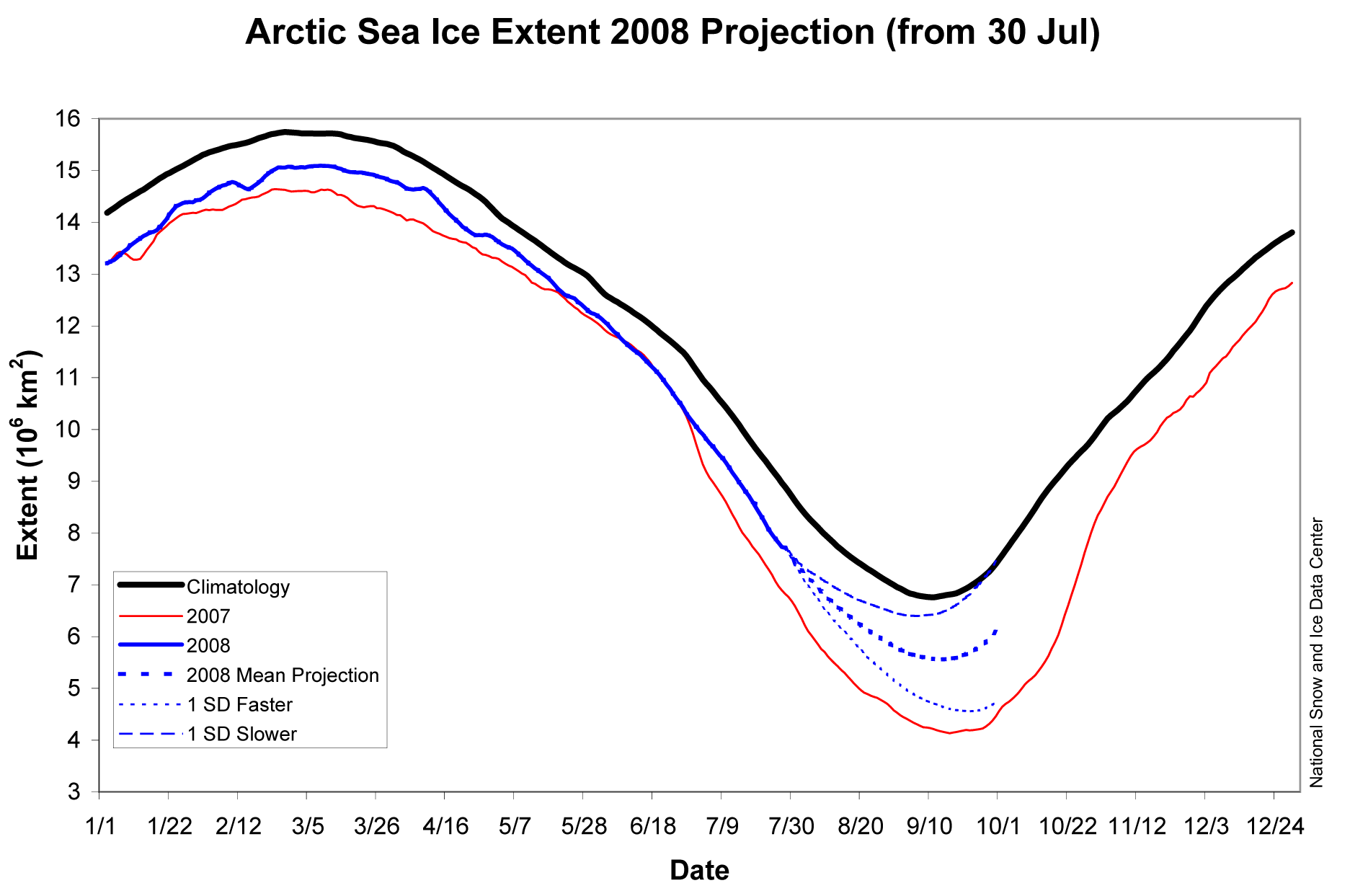
A: The description is incomplete and lacks relevant context. First, all the recent years in the AMSR-E record have had anomalously low maximum extents compared to the 1980s and 1990s. Even the largest winter extent, in 2002, was 250,000 square kilometers lower than the 1979-2000 average. The years 2005-2008 have been 700,000 to 1,000,000 square kilometers below the average. As described above, there is considerable variability during the time around the maximum extent, so the difference between 2005 and 2008 is within what might be expected from natural variations, but both are lower than maximum extents during the 1980s.
While there is a lot of variability in the timing of when the maximum occurs (as mentioned in #5), the actual maximum extent has relatively low variability. This is because in winter it is cold and dark, and ice grows under those conditions. So you always see ice growth, although there is now a significant downward trend at the maximum. In comparing winter ice conditions, ice thickness is much more relevant than ice extent. Data for thickness is not as complete as it is for extent, but it is quite clear that ice is thinning at a rate even faster than the extent decline. During winter 2008, the Arctic was dominated by seasonal ice (ice that has grown since the previous summer) that is much thinner than multiyear ice (ice that has been around for at least a year). Thus, in 2008 the ice has generally been thinner than 2007, and much thinner than earlier years.
We are now seeing some rapid growth of sea ice in the Arctic as the large expanse of exposed ocean cools, but this will all be thin first-year ice. It will thicken over the winter, but by the end of the winter it will only be a half to a third as thick as the ice used to be.
Sea ice also moves with the winds and currents – it doesn’t just grow and melt in place – and thinner ice is generally more easily pushed around. Last year a lot of ice got pushed by winds across the Arctic and even less of the region was covered by thicker old ice at the end of the winter than at the beginning of the winter.
Finally NSIDC did not say that the Arctic sea ice extent would return to “normal” in 2008. The figure referenced in the question, does show one scenario where ice returns to normal, but as stated in the text, that scenario was for a slower than normal melt through the rest of the summer and was deemed highly unlikely. As we say in our August 1 entry: “Thin ice is much more vulnerable to melting completely during the summer; it seems likely that we will see a faster-than-normal rate of decline through the rest of the summer.”
7. Q: Why does NSIDC say that the 2008 minimum sea ice extent “reinforces” the long-term trend when the 2008 extent was clearly higher than 2007?
A: 2008 is in no way a “recovery” relative to the thirty-year trend-and since GHGs act over long time periods, scientists favor looking at change over a long period to detect the GHG signal. From 1979 through last year, the September monthly average extent was declining at a rate of about 72,000 square kilometers per year based on a linear trend. Calculating a linear trend of the data from 1979 through 2008, the decline is now 78,000 square kilometers per year. This may seem counterintuitive, but what happens to the trend each time you add new data depends on where the new data falls relative to the trend line. If a data point falls below the trend line, it will “pull” the trend line downward; a data point above “pulls” the trend line upward. The September 2008 extent, although a bit higher than 2007, was still well below the trend line, so the downward trend line steepened. This is what I mean when I say the trend has been reinforced. Those who attempt to claim that we’ve seen “global cooling” since 1998 may wish to bear in mind that until scientists see a change over a long period, we are skeptical of claims concerning a trend.
The key thing, whether discussing sea ice, temperatures, or any other environmental measure, is to consider long-term trends, not short-term variability.
September monthly sea ice extent and trends for 1979-2007 and 1979-2008.
References:
Arrhenius, S., 1896. On the influence of carbonic acid in the air upon the temperature of the ground, Philos Mag, 41, 237-276.
Lawrence, D. M., A. G. Slater, 2005. A projection of severe near-surface permafrost degradation during the 21st century, Geophys. Res. Lett., 32, L24401, doi:10.1029/2005GL025080.
Lawrence, D. M., A. G. Slater, R. A. Tomas, M. M. Holland, C. Deser, 2008. Accelerated Arctic land warming and permafrost degradation during rapid sea ice loss, Geophys. Res. Lett., 35, L11506, doi:10.1029/2008GL033985.
Lindsay, R.W., and J. Zhang, 2005. The thinning of Arctic sea ice, 1988-2003: Have we passed a tipping point, J. Climate, 18(22), 4879-4894, doi:10.1175/JCL13587.1.
Overland, J. E., M. C. Spillane, D. B. Percival, M. Wang, and H. O. Mofjeld, 2004. Seasonal and regional variation of pan-Arctic surface air temperature over the instrumental record, J. Climate, 17, 3263-3282.
Overland, J. E., M. Wang, 2005. The third Arctic climate pattern: 1930s and early 2000s, Geophys. Res. Lett., 32, L23808, doi:10.1029/2005GL024254.
Revelle, R., Seuss H.E., 1957. Carbon dioxide exchange between atmosphere and ocean and the question of an increase of atmospheric CO2 during past decades, Tellus, 9, 18-27.
Zimov, S.A., E.A.G. Schuur, and F.S. Chapin III, 2006. Permafrost and the global carbon budget, Science, 312, 1612-1613, doi:10.1126/science.1128908.
Actually it only takes one fact to refute it, and there are many.
Oh, and the poll needs a fourth option: We don’t know enough to say if it’s natural or human induced.
Not really, but at any rate, 30 years is not long term.
So, this dude is a follower of the IPCC “consensus.”
Party line. Sorry.
Winston Smith has this, in the last couple of hours:
http://ap.google.com/article/ALeqM5jzJJOEuw2YD_XOO3w2wckTQGK2UwD93RNNVG2
And as I was typing this, breaking news of a “6.7” earthquake in “the gulf area” – as theM ministry of Truth even delay reports of quakes now-a-days it could have been a couple hours ago.
Has Dr Meier ever taken a course in Basic Logic?
Can I retract that last post? not nice, considering the effort Dr. Meier made.
re point #5:
We are just starting to see the effect of the diminished Solar output. The last century saw an increase in Solar activity to a “grand maximum” (probably not as grand as the MWP, but a maximum).
If CO2 is the true culprit, we should see a continuing rise in temperatures. If not, we will see globally averaged temperatures flatten and/or reduce.
cheers,
Robert
Word.
oops left out link to BBC article:
http://news.bbc.co.uk/2/hi/science/nature/7092655.stm
Dr Meier,
Thank you for taking the time to answer these questions. It is appreciated. Many of your answers are quite clear, I feel the ones regarding the CO2 lag in the ice core could use some further explanation.
The lag in CO2 in areas of high slope is the place I disagree with the standard explanation. The temperature in these areas clearly is well out of magnitude with the CO2 graph if the CO2 is to be believed is the causal factor. Claims that the CO2 was driving temperature seem highly flawed simply due to this portion of the graphs.
As far as Real Climate links, I recently have discovered that CPS methods deamplify historic trends in the proxy based hockey stick data, despite repeated polite attempts to post, which were on topic for the thread my posts are deleted. If they cannot discuss the flaws in their math how can we accept their discussions on these other issues? — I apologize for the tone in this but it’s the truth!
The HS math RC supports is flawed badly not just the PCA methods as demonstrated by CA but the CPS and after spending months studying the data I know we will soon discover the EIV method of M08 is equally flawed. RC refuses to even discuss the methods with the public. What’s more this means there are now three separate techniques which all “accidentally” find the same conclusion. After your third time it isn’t an accident any more.
I arrived at my own conclusions independently of McIntyre and then found he and Ross had done similar work themselves. I will trust no post from Real Climate until they come clean about this critical issue!
In that graph above, it shows water vapor as being far weaker than CO2 as a GHG. Water vapor is way more powerful than CO2 as a GHG (at least from every science source I’ve read).
Could putting in the GHG value of water vapor in the stratosphere instead of the atmosphere be a marketing move by the IPCC so that CO2 looks powerful? Or am I overlooking or missing something here?
As Dr. Keen points out, in 2007 Anarctica set a record most ice coverage while the Arctic set a record for least ice coverage (since 1979). This sea-saw temperature effect should not exist if CO2 were driving climate, but is consistent with Svensmark’s theory.
You state: “2. GHGs are increasing in the atmosphere.”
Recent evidence does show that the minor greenhouse gas CO2 is increasing. The most important greenhouse has H2O is commonly assumed to increase with increasing temperature due to CO2. I do not recall having seen quantitative evidence that H2O is increasing.
Miskolczi has developed a climate model with a more accurate “semitransparent” planetary atmosphere rather than the conventional semi-infinite model. See: Greenhouse effect in semitransparent planetary atmospheres, Ference M. Miskolczi, Quarterly Journal of the Hungarian Meteorological Service, Vol. 111, No. 1 Jan-Mar 2007, pp 1-40
Miskolczi’s model shows a constant optical depth as a result of energy minimization principles.
Roy Spencer notes that precipitation trends are little known compared to the assumed increase in relative humidity with increasing temperature. See Global Warming and Nature’s Thermostat He has found some H2O positive feedback assumptions to in fact be negative.
Do you know of any publications and methods that distinguish and quantify the trend in global H2O, and in the total optical depth of the atmosphere compared to just the CO2?
Meier:
Many natural explanations for the current observed warming have been suggested:”it’s just natural variability,” “it’s the sun,” “it’s cosmic rays,” etc. However, these have all been investigated and evidence is simply lacking.
Evidence can only be lacking for specific causes, like ‘the sun’ or ‘cosmic rays’, but not for unspecified ‘natural variability’.
Dr, Meir is a good salesman, but there is nothing new in this. It is obvious that he is an unconditional believer in AGW, to the point that all facts must bend to the AGW theory or be considered irrelevant because of the “elephant in the room”. As an example take this one citation from the interview:
“it is confirmed by a characteristic chemical signature of human-emitted GHGs found in the atmosphere”
Should we understand that scientists can ascertain that one carbon dioxide or methane molecule is natural and another is man-made?
How many times does he have to say there is an elephant in the room? I guess his elephant is right in front of him and he can’t see what is IN the room!!!
[snip, over the top ~ charles the moderator]… the earth is cooling down and we were not responsible for the last warming period, nor the next one.
I have to say that it’s nice having someone from “the other side” (and an actual scientist to boot) treating us politely & as intelligent people. Who knows, if there was more discussions like this, I might be less skeptical about AGW…
My comment didn’t go through?? Was something wrong?
The best Dr. Meier could come up with to explain the 800-year lag between temperature and C02 (with C02 always following temperature in the ice-core record) were three weak web links, typified by the following quote from RealClimate. It is from Jeff Severinghaus of Scripps Institution of Oceanography.
“The reason has to do with the fact that the warmings take about 5000 years to be complete. The lag is only 800 years. All that the lag shows is that CO2 did not cause the first 800 years of warming, out of the 5000 year trend. The other 4200 years of warming could in fact have been caused by CO2, as far as we can tell from this ice core data.”
That’s the science that Meier is standing on.
Do AGW-believing scientists really think that the tiny error bars for “long-lived greenhouse gasses” on the IPCC radiative forcing chart above are defensible? Given that the effect is more from feedbacks than from the direct impact of the gasses themselves, and that there is a laundry list of feedbacks both positive and negative, I do not find them credible. Reasonable, educated, intelligent people can debate AGW. I can’t imagine a reasonable, educated, intelligent person who would vouch for that chart.
I’d like to thank Dr Meier for taking the time and effort to participate in this dialogue and hope his example will be followed by other climate scientists.
One thing that immediately jumps out to me in his responses is the reply to question 2, part 6 where he says:-
6. There are feedback mechanisms that can alter the impact of GHG emissions. These include: clouds, water vapor, ice/snow. Ice and snow are clearly positive feedbacks that will reinforce the GHG warming because as they melt, the average albedo (reflectivity) of the earth decreases and more energy is absorbed. The effect of other feedbacks is less certain-and may even counter the effects of GHG warming–but the evidence indicates that they nevertheless do not come close to offsetting the direct effect of GHG emissions.
Note he says ice and snow are clearly positive feedbacks but does not includewater vapour in this category. But I thought the supposed positive feedback of water vapour was central to CO2 forcing. Is this still the case or has the message shifted to nothing can offset the direct effect of GHG emissions?
Has Dr Meier ever taken a course in Basic Logic? For example:
“The warming of the last 30 years cannot be attributed PRIMARILY to the Pacific Decadal Oscillation (PDO) or the Atlantic Multidecadal Oscillation (AMO). The AMO does not have a significant influence on the Arctic. [emphasis added]”
The first proposition, with that crucial qualifier ’primarily’ is not categorically negative; it would allow for the PDO and AMO being secondary ‘attributables’. But the second proposition IS categorical and does not follow; in fact, it contradicts the first, unless secondary attributes are always to be dismissed as automatically ‘insignificant’.
“The PDO was in a fairly persistent positive mode until the mid-1990s, ….”
So the PDO was in the negative mode during the Great El Nino of 1998?
‘There are indications that the positive mode of the AO is more likely to be present under warmer conditions’
Warmer conditions where? Doesn’t the positive AO lock in the coldest hemispheric air over the pole?
“You also ask how much of the evidence is “based on” IPCC predictions? In a way, the answer to that question is that none of the evidence is from the IPCC report-and yet all of it is.”
This is simply incoherent.
“Thus, the IPCC report is a convenient “one-stop shop” of the latest information,….”
Sort of like grabbing a bagel and with a shmear and the __Wall Street Journal at 7/11 .
“Any natural-causes explanation must be accompanied by an argument for why and how human-caused greenhouse gases (GHGs) are not affecting climate in the same way that natural GHGs affect climate. ‘
1. Human beings do not ‘cause’ greenhouse gasses; they are ‘caused’, or their attributes and effects are caused, by the laws of physics.
2. No one can prove a negative (outside of pure mathematics), and besides, the question was about past climate change. Must any account of, say, the Holocene Optimum demonstrate that it was not caused by
anthropogenically-produced GHG’s?
“The key thing, whether discussing sea ice, temperatures, or any other environmental measure, is to consider long-term trends, not short-term variability.”
What, in the time-frame that is relevant to geophysical processes, is a ‘long-term trend?’
How about a million years?
Anthony,
Assuming Dr. Meier will do this again, please ask him to address Dr. Stephen Schwartz’s (of BNL) “Heat Capacity…” report, published last December, which essentially says that dobling CO2 from current levels would likely increase global temps 1.5 Deg K.
Please reply if you need me to provide more info about it.
GW
“However, since about 1995, the AO has mainly been in a neutral or negative state. Under such conditions, the Arctic sea ice should have started to recover.”
Everything I can find about this contradicts this statement. Of course one needs to know what “mainly been in a neutral” and “mainly been in a negative” state at the same time might mean. It seems at best that there have been some neutral periods, some positive periods and some negative periods, but no “mainly” trend, so as to reinforce the concept that the Arctic should have “started to recover” as a result.
Here’s one example, although I don’t know where they got the graph from:
http://global-warming.accuweather.com/month_ao-thumb.gif
There sure looks like a lot of positive state AO from 1995 on, and a massive positive AO trend from 1988-1995, incidentally when the Arctic started down. That *would*, by Meir’s reckoning, mean that the Arctic “should have” started to *decline*.
The downplay of the PDO is also interesting to hear.