Back in 2023, Gov. Newsom was touting the development of this resource as part of his Net-Zero vision.
Posted by Leslie Eastman

Last week, I reported that federal officials were ordering the West to live within the limits of the Colorado River system.
As a result, the annual water allocations for California, Nevada, and Arizona will be reduced by a combined 1.25 million acre-feet for the next two years.
Interestingly, the water shortage is now affecting the state’s ability to create “Lithium Valley.” This development, which ties into a court order, may be a move to persuade officials to turn the spigot back on for the state.
After all, the Trump administration is robustly supporting the development of our nation’s critical mineral supplies.
A state appeals court ruled this week that Imperial County’s approval of the Hell’s Kitchen lithium and geothermal energy project failed to show it has enough water supply from the dwindling Colorado River to sustain its operation, or to address the potential air quality impacts of diverting more water from the polluted Salton Sea, which has been shrinking for years.
If the decision stands, it would clash with California and federal policies to amp up critical minerals production, potentially sparking intervention by state policymakers to try and obtain an adequate water supply, one expert said.
“Given the fact that California as a state has a vested interest in developing the mineral supply chain … and there’s these local challenges, I do think that this is going to come to a head,” said Beia Spiller, an energy economist with Resources for the Future, an environmental and economics research organization. “The only clear solution here is that the state is maybe going to try to step in.”
Often called the “Saudi Arabia of lithium,” the Salton Sea region where this mine would be placed could hold enough of the critical mineral to satisfy all projected U.S. demand and more than a third of anticipated global demand.
In fact, back in 2023, California Governor Gavin Newsom was touting the development of this resource as part of his Net-Zero vision, as lithium is an essential ingredient in electric vehicle (EV) batteries.
However, the eco-activists that Democrats pander to are also a substantial hindrance to the development of these resources.
In 2023, the governor visited the Salton Sea area to tout the Hell’s Kitchen project — portraying the future mining as not only an economic boon but also a way for California to combat carbon emissions.
“California is poised to become the world’s largest source of batteries, and it couldn’t come at a more crucial moment in our efforts to move away from fossil fuels,” Newsom said during his visit.
An appellate court ruled this August in favor of the environmentalists, sending the environmental review back to the company and county officials after years of legal back-and-forth.
…The legal setback means that the lithium projects have yet to start full operation. A spokesperson for Controlled Thermal Resources declined to comment on the ongoing litigation.
However, there are a few solutions to ensure a more robust water supply. Sacramento can revise its priorities and direct funding and support to water infrastructure projects.
Furthermore, more rain may be coming from the anticipated Super El Niño.
The National Oceanic and Atmospheric Administration (NOAA) is forecasting wetter-than-normal conditions across much of the Western US through mid-September as a strengthening El Niño develops, per KTLA.
Southern California could be among the areas seeing the greatest impact, with NOAA forecasting a 50% to 60% chance of above-average precipitation across Southern California and southwestern Arizona from Sept. 9 through Sept. 15.
“Tropical moisture may produce heavy rainfall for some areas, especially the Southwest,” NOAA’s Climate Prediction Center told the outlet.
However, California’s politicians have coddled environmental activists for years. I do not think there is a solution to this problem.
It’s always a case of:
Not in my back yard; Out of sight, out of mind.
Decaying DRC tin mining town finds new hope in lithium
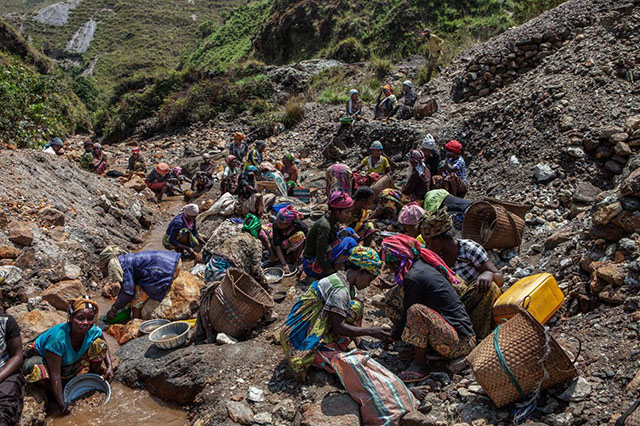
You have to read further down in the article to see why these things happen:
So-called “colonialism” brought prosperity. Once the “colonialists” were ousted, no more prosperity. Funny how that happens.
Sadly you forgot to mention the few millions of people killed by the Congo Colonists ( numbers range from 5 – 15 mio) .
Now that’s prosperty United Fruit Company style – isn’t it?
King Leo used a philanthropic (sounds familiar and so progressive) scheme and the region was always on the brink of ruin until the demand for rubber kicked in – Leo “nationalised” everything and foreign companies got the concessions –
and the rest got got next to nothing.
Pretty much the same happened in the french part of Congo during the rubber rush where the citizens were converted to slave-like status..after officially ending slavery.
Using Congo by picking the cherry out of big pile of civet poo is not the best way to advertise coffee.
While it is true that colonization can lead to improvement and usually does( the bigger the technical gap between those two, the more the natives can benefit ), exploitation and cheap labor were the main drivers and the improvements secondary results of building rail(roads) and other infrastructure.
Only when active development of commerce and economy were part of the agenda
things had a lasting effect where the positives significantly outweighed the negatives –
otherwise it was rob until there is nothing left to loot or you get kicked out – and then things fell soon apart .
You can ask the indians how much they benefitted from colonization,
and how much they paid for diabetes, alcoholism and casinos in return.
Or the Europeans,Chinese and Arabs after being overrun by turk and mongols tribes who were technically way behind and had not much to offer but exploitation,
You also think there’s a genocide in Gaza, so you’ll forgive me if I don’t believe a word of it.
… was bone dry, a Dead Sea (like Death Valley).
Then a canal (or levee) broke, and flooded, and so has it remained.
Returning it ‘to Nature’? Nevermind.
The Salton sea at one time was promoted as a resort area. There are a few hardy souls who remain living there but it stinks like rotting fish. I rode my bike out there to see the sea and was surprised anyone would persist living there. To extract lithium a company would need nice airconditioned housing with air purifiers. Winter in the area would bring the most comfortable temperatures for any work.
“California’s politicians have coddled environmental activists for years…” Most California politicians ARE environmental activists! They’re as similar as the Red-shafted and Yellow-shafted Flickers, especially when it comes to interbreeding; but one wears a (D) next to their name and the other sports a bright green badge with a red hammer and sickle upon it! I can never remember which is which.
I foresee “Lithium Valley” having all the success of the high-speed rail system that common Commifornians enjoy so much today!
The Colorado River basin is over consumed because the consumers are getting dishonest and unrealistic price signals.
That, of course, is the hallmark of socialistic and communistic pricing schemes – shortages.
Agricultural water (52%) is $50 to $200 per Acre Foot (43,560 cf)
Municipal & Industrial water (18%) is $500 to $1,000 per AF.
Evaporation and losses (30%)
Water at my house in July – $3,560 per AF. ($110/1,345 cf)
‘nuff said.
Yeah, it’s data & math. Give it a shot.
I’d say boost agricultural $/AF by 50% and watch the rebound send us sprinting for higher ground. Or BLM buys agricultural water rights at twice market and closes the valves and don’t sell more out than comes in. Duh!
Less water means less alfalfa, less cattle and then you useless MSM hacks can whine about the price of beef.
And don’t give me any grief about my blue grass lawn. I paid for it.
Fun factoid about water thirsty California alfalfa and the big dairy industry it supports there. Milk price supports were set in 1937 as a function of distance from Eau Claire, Wisconsin. California is farthest away, so has the biggest price supports, so has the biggest dairy industry. One way to save California water is just get rid of milk price supports. Would also solve the millions of pounds of surplus butter and cheese in US cold storage.
Activists always need a cause, any cause will do, and if they can’t find one they’ll make one up. These are people with nothing better to do and want to be part of a pack. Easy and willing
to be misinformed if it gains them access to the pack. They are usually socially inept and left leaning. The very definition of useful idiot.
The Delta Smelt is iconic for California water management. It is probably extinct, but water goes to the Delta to preserve it.
Plus, I have heard that the Delta smelt lives in other areas, as well. Just like the endangered “Northern Spotted Owl” that happens to be quite identical “Southern Spotted Owl” which is NOT “endangered”.
“Furthermore, more rain may be coming from the anticipated Super El Niño.”
The link goes to a NY Post story that also mentions tropical storm (TS) Marie. Marie had only a little effect. [“On September 4, 2026, Los Angeles recorded 0.6 inches of rain, making it the wettest September day since 2015.”]
The anticipated Super (sic) El Niño may or may not reach the noteriety of the 1998 event. Check back next March.
Regardless, these sorts of episodic events are not a solution to the Southwest water problems.
Newsome thought environmentalism only meant things HE didn’t want done. He’s been slapped in the face, and still probably will fail to realize what the globalists want done.
The Salton Sea might be the one place in the world where the environment would actually be improved by extracting lithium.
When you drive by Salton Sea you can see a white powder like substance lining both sides of the road and extending into the desert. It’s a manmade lake that is rapidly drying up with no water source other than little rain.
There’s water flowing into it. It’s called the New River that was formed when the levee broke. It sounds wonderful!
Where New River crosses the Mexico–U.S. border near Calexico, California, its channel contains a stew of about a hundred contaminants: volatile organic compounds, heavy metals including selenium, uranium, arsenic and mercury, pesticides (including DDT), and PCBs. The waterway also contains pathogens that cause tuberculosis, encephalitis, polio, cholera, hepatitis and typhoid; levels for many of these contaminants violate United States Environmental Protection Agency (EPA) and Cal/EPA standards by several hundredfold.
Why lithium? The new tech seems to involve sodium in its place.
I fear we are always pursuing obsolete tech.
Because Lithium is established. Once another technology comes along and can be established to be commercially viable, then Lithium will fall by the wayside. If Sodium is the next thing, I’m sure people are pursuing it. That could take decades.
California needs to build new reservoirs and to build submerged desalination plants. Both are needed to substitute for the over use of the Colorado River. Enviros have imposed huge, unjustified costs on all sorts of projects that would benefit the citizens. Legal interventions (including environmental justice suits) have delayed a rail yard near the port of Long Beach for over 20 years, as one example.
It may be comforting to have a reliable supply of raw crude oil, but Energy “REALITY” tells us that we need refineries to convert that useless black tar into usable transportation fuels and products:
· Planes, ships, trucks, and cars do not run on raw crude oil, they run on transportation fuels manufactured FROM crude oil by multi-billion-dollar refineries.
· Wind turbines and solar panels ONLY generate electricity but CANNOT make any products or transportation fuels for life as we know it.
· The world is not dependent on raw natural fossil fuels BUT has become dependent on the products and transportation fuels MADE FROM oil, the same products and transportation fuels that Wind and Solar CANNOT make!
The world needs MORE REFINERIES to process that useless black tar into usable transportation fuels and products for life as we know it.
California Governor Newsom, that clings to “green” , is BLATANTLY SUPPORTING the exploitations of people with yellow, brown and black skin, and environmental degradation in other countries that mine for the lithium and cobalt to build those 1,000-pound EV batteries, so that California can go “green”.
With California announcing $3,500 rebates to first-time buyer of new electric vehicles. Such rebates appear to be unethical and immoral, as the California Governor remains oblivious to the supply chain of minerals and metals to build those EV batteries.
· The Pulitzer Prize nominated book “Clean Energy Exploitations” (https://www.amazon.com/Clean-Energy-Exploitations-Understand-Environmental/dp/1665704977/ref=sr_1_1?dib=eyJ2IjoiMSJ9.r2Dr4U7S9Bbh1DCFPyyYUA.-caQ7UGypqsZ3b4qUMUm4KRiq_DvR6JU-xT3f9MYr3k&dib_tag=se&hvadid=695122576463&hvdev=c&hvexpln=0&hvlocphy=9194049&hvnet) describes the humanity atrocities among folks with yellow, brown, and black skin that are doing the mining for the lithium and cobalt to build those EV batteries, and the environmental degradation occurring in developing countries so that the wealthy countries can go green.
Chinese firms own or have stakes in over 80% of Africa’s forecast lithium supply projects, including major acquisitions in Zimbabwe, Mali, and Ghana
The Democratic Republic of Congo (DRC): Produces over 70% of the world’s cobalt, a mandatory metal for many EV batteries, with Chinese firms dominating extraction and sourcing more than 60% of the supply
The Salton Sea lithium play has been attracting dumb money investors for a long time now. It just needs a good excuse to pull the plug.
Stop wasting scarce resources on wasteful projects.
Or California could develop its own fossil fuel resources and fire up and build new nuclear power plants and its transportation and energy problems would be solved. They need to quit being so stupid.
It’s willful stupidity. They can rot for all I care.
Tax plan already in place.
https://cdtfa.ca.gov/taxes-and-fees/LithiumTaxStudy.pdf