Context matters. For a valid assessment of the potential influence of emissions of CO2 on the past and future energy states of the climate system, I hold that the dynamic performance of the fluid atmosphere is the proper context.
The massive atmosphere, about 10,300 kg/m^2 at sea level, is the compressible working fluid of its own circulation. It stores many hundreds of thousands of Watt-hours (see the Open Thread post on 7-26-26) of total energy per square meter in the four forms described within the meteorological discipline: internal energy, potential energy, kinetic energy (of bulk motion), and latent energy (of water vapor). For example, here is how the documentation for the ERA5 reanalysis model states it: https://codes.ecmwf.int/grib/param-db/162061
Within the full depth of the general circulation, the atmosphere’s physical processes operate at power intensities up to tens of thousands of Watts per square meter. For example, a one-inch-per-hour rate of rainfall, very common in thunderstorms and in strong weather systems, represents a 17,600 W/m^2 conversion of latent energy to internal energy and to the other forms. And more generally, energy conversion performs actively in a dynamic range exceeding +/- 10,000 W/m^2. More here about that. https://drive.google.com/drive/folders/1PDJP3F3rteoP99lR53YKp2fzuaza7Niz?usp=drive_link
The atmosphere is thus understood from the fundamentals of compressible flow to be characteristically insensitive to the minor single-digit-W/m^2 “warming” tendency computed for a rising concentration of CO2 within it.
That IR “warming” tendency from a static surface-to-space radiative transfer computation is not itself in dispute here. But does it end up suppressing the final time- and location-integrated full-spectrum longwave emission to space out the top of the circulating atmosphere? NO ONE KNOWS THAT. The valid null hypothesis of “no effect” has not been rejected, by any reliable means, in all the decades of observation and investigation.
Why do I put quotation marks around “warming”? Because the temperature relates only to internal energy, which does not persist uniquely as the only form of energy involved as the atmosphere handles the incremental IR absorbing power of a rising concentration of CO2. Professor David Brunt commented to Guy Callendar in 1938 “…that the effect of an increase in the absorbing power of the atmosphere would not be a simple change of temperature, but would modify the general circulation, and so yield a very complicated series of changes in conditions.” In my view, this physical concept needs to be more widely appreciated. More here about that. https://wattsupwiththat.com/2026/03/15/open-thread-181/#comment-4174555
Bottom line: In the proper context of the high-power-intensity processes within the general circulation, a rising concentration of CO2 is not known to be capable of exerting a perceptible influence on the climate system. The slightly improved IR coupling at the interface of the working fluid with the underlying land and ocean surfaces does not constrain the final energy output to space from high altitude as longwave radiation.
I realize this post repeats some earlier points. Please bear with me.
Thank you for patience in these things that matter.
“Because the temperature relates only to internal energy . . .”
In fact, water’s latent heat of vaporization/condensation and its latent heat of melting/freezing, both of which are integral to the thermodynamics of Earth’s hydrologic cycle, involve relatively massive inputs to/outputs from the internal energy of a given mass of water WITHOUT any accompanying change in the temperature of that matter during either phase change.
As a simple example, water vapor at 75 deg-F and 14.7 psia has an internal energy of 1036 Btu/lbm (2409 kJ/kg), compared to liquid water at 75 deg-F and 14.7 pisa having an internal energy of 43 Btu/lbm (100 kJ/kg), about a 24:1 difference at the same temperature.
Thank you for your reply.
“As a simple example, water vapor at 75 deg-F and 14.7 psia has an internal energy of 1036 Btu/lbm (2409 kJ/kg), compared to liquid water at 75 deg-F and 14.7 pisa having an internal energy of 43 Btu/lbm (100 kJ/kg), about a 24:1 difference at the same temperature.”
No kidding.
But within ERA5 this is counted as “latent energy” separate from “internal energy.”
Be well.
Since you focus on ERA5, here is a question I put to Google’s AI bot and the corresponding response:
Q: How does ERA5 reanalysis treat the latent heat of vaporization of water?
A: In the ERA5 reanalysis, the latent heat of vaporization of water (Lsub-v) is treated as a constant value within the core physics of the underlying Integrated Forecasting System (IFS). Rather than varying continuously with temperature, the model applies a fixed reference value at Tsub-0 = 273.16K (0.01C)
So, a model using a constant value, instead of a more proper variable value for latent heat as a function of absolute temperature . . . hmmm, what could possibly go wrong with such??? /sarc
Thank you for your further reply.
“In the ERA5 reanalysis, the latent heat of vaporization of water (Lsub-v) is treated as a constant value within the core physics of the underlying Integrated Forecasting System (IFS).”
Very interesting.
It is also irrelevant to the points I was making in my post.
Be well.
P.S. Perhaps you should write to the ECMWF to point out your dissatisfaction with this particular detail in their IFS model.
“So, a model using a constant value, instead of a more proper variable value for latent heat as a function of absolute temperature . . . hmmm, what could possibly go wrong with such??? /sarc”
If you don’t know the functional relationship then how do you determine the value of the “constant value”? The average of a sinusoid is different than a linear function is different than the average of an exponential function.
Once again, we see climate science parameterizing a physical phenomenon without actually understanding the phenomenon. In other words, a guess pulled from someone’s backside.
The latent heat is not measurable with a thermometer; therefore the “thermometer-readers” cannot properly handle it. So, they pick a number for their models and parameterize it.
As DD said, their models handle latent energy as part of a juggling act with three other energy forms, internal, potential, and bulk kinetic. But we know that condensations(clouds) have chaotic local variations in pressure, kinetic energy, and even electric energy, all of which are constrained by the isothermal process of condensation, and beyond the reach of the “thermometer-readers”! We also know that latent energy itself varies with both pressure (inversely) and temperature (directly), both of which generally decrease with altitude. Thus the “proper” conditions for cloud formation can occur anywhere from sea level (fog) to high altitude (ice). Pity the poor “thermometer-readers”!
“So, they pick a number for their models and parameterize it.”
Just like:
-CO2 is well-mixed. -Cloud cover is a constant everywhere all the time. -Mid-range temperature defines climate. -You can average intensive properties of different things. -all measurement uncertainty is random, Gaussian, and cancels. -sampling uncertainty is measurement uncertainty
“ We also know that latent energy itself varies with both pressure (inversely) and temperature (directly), both of which generally decrease with altitude
Makes you wonder if anyone in climate science has ever looked at a steam table!
“Pity the poor “thermometer-readers”!”
We’ve had sufficient data for 40 years to at least attempt to use enthalpy of moist air to develop an *extensive* property value that can actually be averaged. That’s long enough to fit climate science’s own metric of 30 years to establish a climate.
Yet they remain “thermometer-readers”.
And even then precipitation is a better metric for climate than is temperature. When is climate science going to start with using GAP (global average precip) instead of GAT? Admittedly GAP would be harder to summarize and explain as a climate metric but it would also be much more meaningful. It’s at least an extensive property instead of an intensive one and its average would be physically meaningful.
-Cloud cover is a constant everywhere all the time.
And because the specular reflectance varies with the time of day, because the reflectivity is a function of the angle of incidence, where those clouds are is very important at every time of the day. Clouds are approximately Lambertian diffuse reflectors. They prevent a lot of sunlight from reaching the surface of the ocean, particularly midday when absorption is high.
David,
Excellent work, thank you, but can you close the loop a little with these questions?
1. The Earth has a temperature that some experts say is relatively constant because it resists change, but it appears to have changed between for example, an ice age and a Holocene warm period. Do you accept that some mechanisms can lead to global temperature changes over periods like thousands of years?
2. If so, what mechanisms have caused or allowed such change?
3. In what way(s) is the greenhouse gas mechanism excluded or included among these mechanisms?
I have an open, logical mind that cannot yet accept that GHG like water vapour and CO2 have a special mechanism for long-term change of global temperature.
Geoff S
Thank you for this reply, Geoff.
“Do you accept that some mechanisms can lead to global temperature changes over periods like thousands of years?” and “…what mechanisms…” Sure, it makes good sense to me that orbital cycles, gravitational mechanisms like ocean tides, and the thermal mass aspects of ocean circulations should be expected to drive long-term changes such as the present recovery from the “Little Ice Age.” This includes secondary influence on cloud formation and dissipation, which then affects absorbed solar radiation. “In what way(s) is the greenhouse gas mechanism excluded or included among these mechanisms?” It makes sense to me from the powerful dynamics of the general circulation to conclude that changes in the concentration of non-condensing IR-active trace gases such as CO2 have at most a vanishingly weak potential to influence the trends. Water vapor may have greater influence, but as a secondary consequence of its latent energy transport effectiveness, driven by what the oceans are doing, perhaps more so than its IR absorption properties.
I hope this helps. No doubt there can be long-term influences I am missing. As you know, my main aim in recent times is to demonstrate why blaming emissions of CO2 for “warming” has been unjustified all along.
All the best to you.
Thank you, David.
I wish that there was less uncertainty in forecasts of effects that you mention, like “orbital cycles, gravitational mechanisms like ocean tides, and the thermal mass aspects of ocean circulations”. This lack of certainty provides room for miscellaneous hypotheses about global temperatures. It is good Science to continue with alternate hypotheses, that is one way to progress Science, but it is not so good when emotion, vague ideas, dogma, poor science is not adequately diminished. Here is an example of Australian historical daily temperatures, heavily used to project Australian futures and to inform quite expensive policies because there is no other suitable data set. This fundamental, important data set is represented as “raw and unadjusted” when on stringent analysis, it is heavily adjusted. This is an example of dogma over-riding correct, hard Science. https://www.geoffstuff.com/V14_fullBOM.pdf
strativarius
August 9, 2026 2:53 am
Sadistiq Khan aka the poison dwarf has a message for our Andy…
Khan should know that in his country of origin the summer temperature often exceeds 50C and people still manage to live there. The few days in England above 30C must feel almost chilly to him. Hardly deadly.
“In 1132 the rivers and springs disappeared in Alsace. The Rhine was dried up. In 1152 the heat was so great that eggs were cooked in the sand. In 1160, at the battle of Bela, a great number of soldiers died from the heat.”
“In 1440 the heat was excessive. In 1538, 1539, 1540, 1541, the rivers were almost entirely dried up. In 1556 there was a great drought all over Europe. In 1615 and 1616, the heat was overwhelming in France, Italy, and the Netherlands. In 1646 there were fifty-eight consecutive days of excessive heat.”
“In 1718 it did not rain once from the month of April to the month of October. The crops were burnt up; the rivers were dried up, and the theatres were closed by decree of the Lieutenant of Police. The thermometer marked 36 degrees Rhéamur…” (36°Ré (or °Re or °r) is 113F. 113F is 45C. In 1718.)
“In 1818 the theatres remained closed for nearly a month, owing to the heat. The maximum heat was 35 degrees” (again it’s °Ré and the equivalent is 110F or 43C.)
How to make a complete idiot of yourself.
(1) Repeatedly post the same thing and bore everyone to death.
(2) Not even realise you’re quoting it back at the person you plagiarised it from.
What does h/t Tony Heller even mean? Did he ask you to post it?
Do you mean that the excerpts you posted have been discovered by Tony in the records of the printed media of the day and correctly declare that any cause for the current state of the UK is in NO WAY UNPRECEDENTED and most of those other reported very warm periods were not part of the fossil fuel using Industrial Revolution.
It really is truly incredible how widespread the climate religion is.
Despite the glaringly obvious stupidity of net zero, a very large number of “feel gooders”, “headline readers”, fruitloops etc. are still convinced that it is necessary, despite the science which shows that it achieves zilch and breaks us financially in the process.
I despair!
“In Norway 76 blocks have been offered for exploration in the Barents and Norwegian seas and 57 new production licences have been issued for the Norwegian continental shelf”
He’s only interested in weakening the UK – for his brethren….
Ron Long
August 9, 2026 3:18 am
According to USA Today: Spokane fires…climate change ups wildfire risk. Here in west-central Argentina, a record 4 meter snowfall, and continuing follow-up almost daily snow fall, has closed the Cristo Redentor pass, over the Andes, to Chile, for 27 days, which is another record. At least 1,500 freight trucks are stranded, waiting to cross. Today starts a deep-freeze event for several days. The strategy to open the pass is complicated as the multiple snow falls greatly increases the avalanche risk. The open-the-pass strategy appears to be to wait for global warming to melt the snow. Here’s the problem with the global warming attributions, they don’t balance the reporting, and they don’t mention the area in between these types of events as continuing to be NORMAL.
Here’s the problem with the global warming attributions
The problem is that variance is never quoted with the figure. With a range of temperature of 50 to -50C, is the distribution normal? Does the mean adequately address the distribution? Who knows?
The last two months from the UAH in the SH show a significant decrease, the NH and SH out of sync, globally the NH and SH sum to near unity. It seems the Earth is still trying to reach equilibrium from whatever started the warming in early 2023 that lead to the record high in 2024.
Therefore, you are about the age of my students — and younger — when I was teaching college level science. During that decade, I saw students, coming from upper-crust schools like Palo Alto High School in ‘Silicon Valley,’ decline in aptitude so much that by the end of the decade many did not know that one can multiply or divide a number by a power of 10^n by simply moving the decimal point n digits for each power. That probably has a lot to do with why a lot of younger people are so quick to accept the claims of alarmists.
You should consider the smoke particulates that are accumulating in the Troposphere and Stratosphere, they could be a player this year on this summer’s energy budget.
Whilst these may reduce the full impact, I think they will be massively overshadowed by the enormous El Nino that has already commenced.
If you watch this website closely, you will soon notice articles pretending to anticipate the new global heat records as if they knew they were coming all along; as if they never promoted article after article saying we are on the brink of cooling.
It’s just what they do here. To cap it off, without a hint of irony they call themselves ‘skeptics’.
If you watch this website closely, you will soon notice articles pretending to anticipate the new global heat records
ENSO temperatures do not reflect “new global heat records”. The heat was already stored in the western Pacific and is just spread across a larger area due to trade wind variation. Temperature is NOT a good proxy for heat. Your preoccupation with temperature needs to be expanded.
The Earth is warming by most metrics. So that is a fairly safe prediction. However, unless you like eating other people’s socks, it is not a prudent bet.
The climate of Spokane hasn’t changed but it is the high sun season, also known as summer. What changed is that a man from Arizona, with a troubled history, killed his father and wounded himself, moved to Spokane. Aaron F. Farinacci, 37, was arrested on suspicion of first-degree arson in connection with the Old Trails Fire, the largest of three blazes burning in the area. Had Arizona kept him in jail there would not be this fire to attribute to global warming.
Let’s talk instead about forest management, practiced successfully for centuries (if not millennia) until sometime around Year Zero (Earth Day 1970), by all kinds of ‘primitive’ folks.
Yes, I got it right that Argentina is a southern hemisphere country that is currently in winter and sometimes it snows there in winter, especially at high altitudes.
Some interesting aspects of Earth’s orbit, geometry and relationship with the Sun.
Half of Earth’s surface is located between 30S and 30N.
If the orbit was circular; there was no axis tilt and the Sun zenith was 1362W/m^2 always over the Equator the average solar power from 30S to 30N would be 405W/m^2. That region would receive 59.5% of the available incoming solar energy.
In the present era, 30S to 30N absorbs 56.7% of the solar energy. But it is increasing at 3EJ per year due to reducing eccentricity; reducing obliquity and , precession of perihelion bringing the Sun closer to overhead of the Equator at perihelion.
An interesting observation is the increase in tropical sunlight aligns reasonably well with the increase in atmospheric water over the tropics since global measurements were available from 1988. Coincidence or does sunlight drive tropical moisture?
The increasing solar radiation at the equator increases the amount of water vapor at the equator, which causes the deserts to turn green again.
The statement is partially inaccurate. Increased solar radiation at the equator heats moist air and causes it to rise and drop heavy rain at the tropics, but the dry air then descends near 30 degrees latitude to create deserts. Deserts turn green due to shifting monsoon winds or moisture transport, not direct equatorial vapor.
Underground water reserves reviving and causing an agricultural renaissance.
After Decades of Drought, Water Is Rising in the African Sahel
But increased rainfall since the drought years of the 1970s and 1980s explains only some of the rewetting of the Sahel. It cannot fully account for the transformation, say researchers.
Much remains unclear in these remote lands on the edge of the Sahara Desert, but the trend seems set to be long-term, with climate scientists saying more — and more extreme — rainfall is on the way in the 21st century. As underground water reserves revive, some are forecasting an agricultural renaissance.
As you mentioned, the surface temperature of the open ocean does not exceed 31°C. I think this is due to the constant average atmospheric pressure in the tropics. Consequently, an increase in solar radiation automatically leads to increased evaporation in the tropics.
A large increase in water vapor in the troposphere can cause an increase in the total mass of the atmosphere and an increase in atmospheric pressure, which in turn can raise global ocean temperatures.
No, I mean what about the surface area of the oceanic / atmospheric interface being larger in area than the year before. Or after the Younger Dryas when sea level came up a few feet per year.
Many hundreds arrested for starting France’s worst fires since WWII; whilst reporting the fact, the BBC still does its best to downplay the problem and blame CC.
Efficiency policies have been linked to real savings. Energy Star, which certifies appliances that meet such standards, saves Americans some $40 billion on their energy bills annually.
..
A recent report from the American Council for an Energy-Efficient Economy (ACEEE), a nonprofit that works on efficiency policies, found that improving efficiency efforts across our buildings, transportation, and industrial behaviors could save about $4.8 trillion in energy and related costs by 2050—or about $31,000 per household.
I use natural gas for heating where I can because it is inexpensive and effective.
I have forced air natural gas heating as part of my HVAC system, two natural gas water heaters (my guest bathroom has a huge tub), a gas dryer and I installed a dual oven natural gas range this past year because its cooking performance is superior.
Trump’s policies are correct because they allow me to tell bureaucrats to mind their own business. Your situation may be different because you have stupid busy-body leaders. I prefer to do what is best for me and to have the freedom to do so.
Here’s a question for you. Why not use a question mark when composing a question?
Yet you believe in 15 minute cities, EVs, “efficiency” products that don’t work, pseudo-vaxxines that don’t work, wind and solar short-lived “throw-away” junk…. etc etc.
Seems you would rather get screwed by the government. !
This article is a good example of advocacy journalism dressed up as objective analysis.
First, it bundles together several separate issues – appliance efficiency standards, Energy Star, AI-driven electricity demand, climate change, and conflict in Iran – then implicitly attributes the resulting energy-cost pressures to Trump’s appliance policy. But even the article itself acknowledges that rising energy costs are being driven by factors such as data centre growth and geopolitical events. Those factors are largely unrelated to whether a dishwasher or water heater is required to meet a particular federal efficiency standard.
Second, the article cites Energy Star’s claim of $40 billion in annual savings and an ACEEE projection of $4.8 trillion by 2050. Both organisations are advocates of efficiency policy. That does not make the figures wrong, but it does mean they are not neutral sources. Forecasts extending decades into the future depend heavily on assumptions about energy prices, technology adoption, consumer behaviour, and regulatory compliance.
Third, the article largely ignores the trade-off that critics of efficiency mandates raise: consumer choice and upfront costs. It briefly concedes that more efficient appliances can cost more initially and that stricter standards can increase manufacturing costs. For some households, particularly lower-income households, a higher purchase price today may matter more than projected savings spread over many years.
Fourth, there’s an unexamined assumption that federal regulators always identify the optimal balance between efficiency, cost, performance, and consumer preference. Reasonable people can disagree on that. Supporting efficiency technology is not the same as supporting government mandates that require it.
Finally, the headline asks, “Why does Trump want our appliances to be even less efficient?” That framing assumes inefficiency is the goal. A more neutral question would be whether appliance standards should be determined by federal regulation or by consumers and manufacturers competing in the marketplace.
The strongest argument in favour of efficiency standards is that they can reduce energy consumption and operating costs over time. The strongest argument against them is that they can reduce consumer choice and raise upfront costs. The article focuses heavily on the first argument while largely dismissing the second, which is why it reads more like a policy brief than a balanced analysis.
Do you even read the articles you post, and if you do, do you understand them?
It’s just correctly pointing out all the things that make life already more expensive under trump.
Not being an unbiased source is correct – but I can’t help but wonder if you are as critical of sources and authors here.
To your forth point: You need a counter to cooperate greed. Else you end up with subpar stuff that brakes earlier, costs more and endangers your health.
Inefficiency is not the goal but the outcome. How much consumer choice does your free market offer? Having fun deciding between walmart or McD?
The endgame will always be monopolies. Products for the lowest production cost no matter the consequences for the consumer or environment as long as it makes enough money. If possible you want you consumers to be addicted and your workers be slaves. That’s the “free market” capitalism.
Consumers on their own will never have a counter for that – so they need to organize and put pressure on the government for regulations.
I think you’re overstating the case and treating one set of political preferences as unquestionable fact.
For example, “everything is more expensive under Trump” doesn’t by itself prove that stricter appliance regulations are the right solution. Inflation, energy prices, housing costs, labour costs, supply chains, tariffs, central-bank policy, global commodity markets, and government spending all affect prices. Blaming or crediting any one policy without disentangling those factors is too simplistic.
On corporate greed: greed exists in every economic system. The question is not whether corporations seek profit, because they do. The question is what combination of competition, regulation, consumer choice, and legal enforcement best channels that behaviour.
You say without regulation companies will produce inferior products that break sooner. Sometimes that’s true. But regulators are not omniscient either. Incumbent firms can capture regulatory benefits, raise barriers to entry, reduce innovation, and increase consumer costs. The existence of market failures does not automatically mean every regulation is beneficial.
Likewise, “the endgame will always be monopolies” is more an ideological claim than a fact. Many industries remain highly competitive for decades. Where monopolies do emerge, they often do so because of network effects, government-granted privileges, regulatory barriers, or extremely high capital requirements, not simply because markets naturally converge to a single firm.
The Walmart/McDonald’s example is also a bit of a straw man. Consumers routinely choose from hundreds of competing brands in categories such as electronics, vehicles, clothing, household goods, insurance, telecoms, banking, and online services. The real question is whether competition is sufficient in any given market, not whether competition exists at all.
On appliance efficiency specifically, I think there is a legitimate debate that the article largely ignores. The issue isn’t whether efficiency is good. Almost everyone agrees that using less energy for the same output is desirable. The disagreement is over who should decide the trade-offs:
Consumers buying products according to their own preferences.
Manufacturers competing to meet those preferences.
Government regulators setting minimum standards.
Reasonable people can support efficiency while still questioning whether federal agencies should continuously tighten mandates.
Finally, I’d challenge the implicit assumption that regulations and free markets are opposites. Every successful market economy combines both. The real debate is about where to draw the line, not whether one side should completely eliminate the other. The interesting question is not “markets or regulation?” but “which regulations produce more benefits than costs?” That’s an empirical question, not a moral one.
Or in some instances banning future sales of gasoline-powered cars, removing “Use By” dates from perishable foods, and removing possibly-carcinogenic, volatile hydrocarbons such as denatured alcohol and acetone from hardware shelves to protect us from ourselves. In a truly free society, government would protect us by advising what risks might be associated with consumer products, rather than telling us that we can’t use something until we reach a certain arbitrary age commonly ranging from 16-21.
To your forth point: You need a counter to cooperate greed. Else you end up with subpar stuff that brakes earlier, costs more and endangers your health.
This statement shows that you believe that government bureaucrats can make better choices than what a free market can. That alone means less freedom of choice and less freedom in general.
Do you ever wonder why elites rode in Mercedes and the proles rode in Trabants or Polonez cars? That is what happens when bureaucrats control what is available for purchase.
Far too many people today have never heard of the “Invisible Hand” – the regulation of the marketplace from the impact of numerous individuals chasing their own best interest in a free economy. Governments simply can’t substitute for the individual’s “best interest”. It always becomes the best interest of the government.
Or for that matter, Sears Roebuck sold a brand of tools, Craftsman, that came with lifetime replacement guarantees, not because of some government regulation, but because they rightly decided that it was a good marketing tool and affordable because of the rarity of actually breaking a tool. For years, I avoided cheap (literally and figuratively) Chinese tools, which broke frequently, by paying a little more and getting a Craftsman tool. The guarantee is no longer provided, but I doubt that it had anything to do with government regulations trying to improve the longevity of hand tools.
The best argument against is that it’s not increased efficiency if it comes by reducing effectiveness. I bought my new front loading washer to clean my clothes, not to see how my clothes will smell after 2 hours of “washing” in a tiny puddle of lukewarm water. (Thankfully I knew how to modify my washer so it now fills with an real amount of Honest-to-God Hot Water, and my clothes now come out clean. That’s efficiency!)
IQ test. Complete the following sentence:
Spending $10 to save $1 worth of energy
a) Saves $9
b) Saves $1
c) Costs nothing, but saves the planet
d) Costs $9
We’ll wait.
I had to replace an old propane furnace last year. Cost, including the labor and the house upgrades for the new efficient furnace was roughly $2000; it would have been under $1000 for just an identical replacement furnace which had lasted 20 years. I forget the details now and don’t feel inclined to check my records. The old furnace was 95% efficient, the new one is 98%, and I spent roughly $1000 on propane the last year. That comes to wasting $50 a year with the old furnace and $20 with the new one.
$30 a year savings vs $50 a year upgrade cost. Gee, why am I not excited? And why do I laugh at your $31,000/year in savings?
My understanding is that propane is more corrosive than natural gas and that a natural gas furnace would last longer, changing these calculations.
ETA: I did look it up, and my costs were much higher, but I also replaced the tankless water heater at the same time, and it needed simiilar upgrades and had similar efficiency “gains”. The $1000 upgrade cost should probably be more like $4000-5000, but it’s impossible to separate any more precisely.
Problem is that following these manic “efficiency” standards is extremely expensive in the first place, as well as forcing products that just don’t work very well.
Trump is trying to save people money and to get appliances that actually work.
Who wants to shower under a dribble of luke-warm water., and take 20 minutes to boil a kettle.
The Energy Star system does not consider the inefficiencies in delivering energy to your home from whatever the source is. Over half of the US electricity supply is generated by fossil fuel fired machines which operate with highly variable thermodynamic efficiencies ranging from 25% to occasionally over 50 %. That means that the fossil fuel electricity arriving at a home already wastes from half to 3/4 of the heat of combustion whereas say a modern gas home heater will deliver over 95% of the heat of combustion to the house. Line and electricity management losses must also be considered in delivering electricity. Gas delivery systems also have inefficiencies, the gas must be pumped for example, that reduce the amount of gas energy delivered to a home. Energy Star considers none of these inefficiencies and to do so would be nearly impossible because of large variations in electricity and gas production and distribution efficiencies throughout the country. The lesson – do not believe energy star estimates when comparing different kinds of home appliances such as gas vs electric dryers, stoves, furnaces and such nor when comparing different technologies such as ground source vs air source heat pumps, gas vs electric resistance cooking or induction cooking and such.
The lesson – do not believe energy star estimates when comparing different kinds …
Especially if those writing the specifications for high efficiency aren’t objective and write the spec’s to promote their personal view of efficiency, which is often cherry picked ‘facts.’
don k
August 9, 2026 6:18 am
The Farmers Almanac for 2027 has just come out. IIRC,they claim their predictions are based on some secret formula which I’ve long suspected involves consumption of copious amounts of alcoholic beverages and the use of darts. But maybe it’s more sophisticated than that. And in either case, it may well be every bit as accurate as the longer term forecasts (anything beyond 10 days) from official sources which are known to be pretty awful.
Anyway the summary for the Continental is United States is :
“Winter 2026–2027 is shaping up to be a season of sharp contrasts, with an active southern storm track, quick bursts of snow and bitter cold across the North, and a tricky mix of rain, sleet, ice, and heavy wet snow in the Northeast. Keep the shovel, rain boots, and ice scraper close—this winter may bring plenty of surprises.”
Where I live-a 55 county wide area that goes from prairie flat to seriously high hill country- NO forecast is good for even 3 days. Lucky you for being where a forecast is good 10 days out.
The USA National Weather Service has consolidated forecast areas into 122 regions. Search for:
” List of National Weather Service Weather Forecast Offices ”
Many sites, many maps.
Lots of the western areas are larger than most of the states east of the meridian that runs through New Orleans [W90°].
I’m at the NW fringe of PDT [Pendleton – green].
I’m at 93W m/l and while I find your comment interesting, it hasn’t calmed my intense irritation at why the local weather weenies try-uselessly- to forecast over flat ground to hill country. Completely different animals. My local station is owned by a media conglomerate located on the E coast (Jersey I think) and they micromanage the Hell out of the locals, and make mistakes…for example feeding NC weather to us, maps and all. I know its all about advert. $$$-but I’m tired of E coast news and while I do understand the power of modern tech, I don’t need adverts. for a store 300 mi. away or NC weather.. Grrrrrr. I do my own forecasting; I can read maps and I can access the local aiport’s radar…or I can walk outside and read my toy weather station-baro, humidity, wind etc. My wife for some reason is impressed with the fact that I’m usually right. Boy, such a rant, sorry.
Today, I decided to delete the advertiser-laden MSN weather application on my desktop, not just because of untrustworthy forecasts, but because different functions of the app’ are often contradictory. I don’t know what to believe. I can do about as well going outside and looking at the sky and smelling the air. The local TV stations interrupt the regular programming and show the local Doppler radar when there are tornado or flooding conditions. Those are the primary concerns that I have.
I’ve seen many, if not most, forecasts (particularly for precipitation) change in both amounts and timing over a 7-day forecast. It is not uncommon for the forecast to be wrong on the day of the forecast. I’m living in the relatively flat country of Ohio.
Good morning, Clyde. I agree with pretty much everything you say; I know as well as you do that weather is seemingly chaotic at times, but my major bitch is in the approach and methodology…and the corporate overreach. I’m from orig. Illinois and I too know flat land weather and as I’m now in serious hill country I know rough terrain weather. I find the weather weenies approach to local forecasting insane-same as say, forecasting for cropland and Chicago both-doesn’t always work well. My Dad taught me, like you, to also smell the air and look at the sky to back up my predictions.
I has a question more suited for sci-fi than anything practical. My understanding is that fossil fuels in general, but especially coal, are the result of things which happened several hundred million years ago and have not repeated since. How likely are these ancient processes to have happened on other planets around other stars? Suppose there are a billion planets in the Milky Way which have supported life. How many are likely to have had the conditions necessary to create fossil fuels?
I realize it’s a very speculative subject and depends on how “life” itself is defined. But I’m really just curious about whether fossil fuels are a freak of nature and might only exist on one of a thousand planets which support intelligent life, or so common that one could expect all intelligent life to find fossil fuels.
That leads naturally to a second puzzle; what would happen on a planet which supported intelligent life but had no fossil fuels? There’s still burning wood. Charcoal could still be used to process iron ore. Coal wasn’t used widely until the 1700s, I think, and oil a century later. How far would human society have gotten with nothing more than wood as an energy source?
I think ZPMs are a better source of energy. Plus, they are technically batteries! The Greens would love them!! 😎
(But the Ancients don’t make them anymore.) 8-(
Peat is being produced as we breath. We’ll just have to wait millions of years to see if it turns into a pseudo-lignite.
Without the blessing of fossil fuels we would likely still be bashing other folks heads with rocks. There wouldn’t be as many of us around and a few would live past their 30’s. Life would resemble camping in the wilderness each and every day.
Perhaps on a rudimentary scale wood is fine, but fossil fuels have several advantages. Wood is a natural for bows and arrows and even some refined devices.
Gaseous and liquid fuels, however, enable a greater variety of technologies. Coal has higher energy and physical density and is more abundant.
The processes that created fossil fuels are still ongoing. But they are quite slow. Coal is mostly the result of dead vegetable matter collecting in swamps where the bottom muds become Oxygen deficient. No Oxygen equals no decay. The plant debris continues to accumulate. You end up with peat. It is not uncommon for peat bogs to subsequently be buried under other sediments — maybe dirt, maybe sand, maybe volcanic ash, limestone perhaps if sea levels rise. When enough sediment accumulates, the bed of organic matter is subject to increased heat and pressure and is slowly cooked and pressed into lignite (“brown coal”), then bituminous coal, Maybe in extreme cases to anthracite coal.
There’s a similar process that has been around for even longer for organic matter in water — the oceans, some lakes. Under some conditions, the bottom muds become Oxygen deprived. Dead organic matter accumulates. Often it gets buried. Heat and pressure cook it to tar, then oil, and eventually, if there’s enough time, heat, and pressure, to natural gas.
The long term problem is that humanity is consuming fossil fuels far faster than nature is creating them. Eventually we’re going to run out. Won’t happen this year. Or next. But is will happen someday. It might be a really good idea to work out the details of how we will replace them before they start to become scarce.
I have read that the processes that created at least coal were specific to one age several hundred million years ago and have not repeated since. Thus, making up purely bogus ages, all coal fields are at least 300 million years old; there are none younger, and the conditions which created them are unlikely to ever repeat.
That rarity is behind my question. What would society be like if coal and oil and natural gas ad never been laid down and discovered?
The huge coal source, trees growing in the Carboniferous, pulled a huge amount of carbon out of an atmosphere high in carbon dioxide and piled up layer upon layer because at that time there did not exist organisms which degraded lignin and (hemi)cellulose.
It theoretically could have led to the extinction of much of the life on earth but just in time, new organisms which could break down the wood appeared. The Carboniferous can never happen again due to the presence of these microbes.
From Grok:”Titan has the only dense, substantial atmosphere among solar system moons (surface pressure ~1.5 times Earth’s). It is primarily nitrogen (N₂, ~95%), with methane making up about 5% near the surface (decreasing with altitude).”
https://youtu.be/3oXp9d6Mncs?is=S0vYqXuOlntdPVwN showed that the residence time of CO2 is 3.8 years by using the measurements after the atmospheric nuclear explosions creating C14. This is debunked by https://skepticalscience.com/co2-residence-time.htm saying that molecules of CO2 absorbed by the ocean are immediately replaced in the atmosphere giving a residence time of more than 100 years. If this were true then Henry’s Law would not apply.
Are Willy Soon and Jonathan Cohler correct, or are the debunkers correct?
To the dismay of those who think that “The science is settled,” various researchers have come up with different estimates for the residence time of CO2. There may not even be just one residence time. It probably varies with things like ocean temperatures and the abundance of vegetation.
Richard M
August 9, 2026 11:29 am
There appears to be a change coming, yes, climate change. The ~ 60 year cycle appears to be moving from its warm phase into the next cool phase. This will have major implications on the climate change debate going forward.
Many folks believe this cycle is driven by Atlantic Ocean currents because it is most often referred to using the AMO index. My belief is the cycle is internal to the Arctic Ocean but its effect spreads out into many places including the Atlantic Ocean. New information is showing up which could help settle this question.
The above cool summer in the high Arctic fits my view perfectly as I will explain later. In addition, my view also predicts one of the first external observations would be increases in the summer sea ice minimum. It could be happening right now.
If this current trend does lead to an increase in the summer minimum, it will be interesting to see how this is covered by the media.
So, exactly how does this cycle work? I have mentioned it a couple times in the past. Here’s the simple explanation.
1) Sea ice insulates the Arctic Ocean which allow the water underneath the ice to warmup over time.
2) As the water warms, it eventually starts to melt the sea ice.
3) Melting sea ice allows the Arctic Ocean radiate away this energy at the surface and deeper warm water to replace it. This energy also warms the air in the Arctic.
4) Eventually, the warm water runs out which leads to the formation of more sea ice.
5) The sea ice expands outward eventually covering a larger area and cooling the air above.
6) Cycle repeats.
This only works because the Arctic is geographically boxed in by land. Very little water enters and leaves the Arctic compare to that which resides within it.
We are currently at 4). This is when the warm phase of the cycle ends and the cool phase begins. Just like we saw a decrease in sea ice (1995-2007), I would expect to see an increase in sea ice going forward. It will take many years to fully get back to the quantities of 1995.
Finally, this change in sea ice has a very important feedback. The amount of cold air in the Arctic affects the polar jet stream. More sea ice and a colder Arctic expands the amount of cold air pushing the jet stream further south. Less sea ice has the opposite effect which allows the polar jet to move further north.
Since jet streams tend to be the place where air masses interact, they are almost always places with more clouds. When the jet stream is further south is covers more surface area which leads to increases in cloudiness. More clouds also means more solar energy is reflected. Hence, the cooling effect of the cycle is enhanced by this feedback (as is the warm phase).
As a result, I expect to see an increases in cloudiness over the next several years as the cool phase of the Arctic sea ice cycle grows stronger. This will clearly be tough to explain by the alarmists.
Svensmark and Zharcova suggest that the coming cooling (NOT AN ICE AGE) has already started and is driven by the solar magnetic field periodic decline allowing cosmic rays to enucleate much more cloud cover which reflect more sunshine back out into space.
Mario Barbafiera
August 9, 2026 3:09 pm
I read this contribution and would appreciate comment from those that know significantly more than I do on this matter
Nice looking article…just not on the right track..I will try to explain. The article focuses on the heat content of the component gases….which is how much heat (from outside sources) it takes to raise the mass of the components by …their specific heat times the temperature change.
This is not the issue. The issue is how absorptive of radiation that the gas molecule is. Thus how much heat it can provide to warming the mix. For the atmosphere, that radiation is provided by sunlight, both directly and indirectly from sun-warmed material. Water vapor and CO2 are fairly absorptive of IR, while oxygen and nitrogen are transparent, absorbing little.
We’ll pick on CO2. When struck by a photon of the proper frequency, it gains energy…mostly bumps into the 2500 other molecules around it and makes them vibrate faster, which is another way of saying increases their temperature. Water molecules work the same way.
To get an idea of the quantities involved, look in the second column of Fig. 1 of the following article. You will see that CO2 absorbs about 200 times as much IR as Niitrogen …and water vapor 600 times as much.
Best wishes to you in your study of the subject, Mario. I have left out a lot of stuff that does make a bit of difference… https://agupubs.onlinelibrary.wiley.com/doi/full/10.1029/2012GL051409
I should have added to the statement “You will see that CO2 absorbs about 200 times as much IR as Nitrogen …and water vapor 600 times as much” yet Nitrogen is 80% of the atmosphere….meaning that the statements in the tucoschild article regarding CO2 and atmospheric heating are simply not correct.
Ireneusz
August 10, 2026 12:35 am
A second Antarctic front will cause a significant drop in temperatures in southern Australia.
Copilot AI does a nice job of summarizing my position, but it is bottom line just a zero actual science huge appeal to the consensus authority with no consideration of all the times the consensus has been flat wrong and fought to defend its errors: plate tectonics, luminiferous ether, Mars water, phlogiston, caloric, medical humors, sanitary surgical practices, spontaneous generation, cold fusion……..
396 is supposedly a measurement. By whom with what? Are watts and area direct measures? Or is the S-B hocus pocus heat radiation factor applied to calibrated temperatures with zero comprehension of emissivity?
Clinton is in the southern part of the Caribou region, between Cache Creek and Quesnel on H97. Fires have just emerged in the Revelstoke area which is on H1 well east of Cache Creek in mountains west of the Rockies.
Raging hot fires create their own weather, including tornadoes. They spew embers ahead. Bid dumps from very large air tankers needed to quench them.
Years ago some people in Ontario Canada developed a vertical wind turbine, compact in diameter.
I forget how it worked, maybe File:Éole à Cap-Chat en 2010.JPG – Wikipedia.
Perhaps not as efficient as ones with big open blades. But fit on your roof. :-o)
Context matters. For a valid assessment of the potential influence of emissions of CO2 on the past and future energy states of the climate system, I hold that the dynamic performance of the fluid atmosphere is the proper context.
The massive atmosphere, about 10,300 kg/m^2 at sea level, is the compressible working fluid of its own circulation. It stores many hundreds of thousands of Watt-hours (see the Open Thread post on 7-26-26) of total energy per square meter in the four forms described within the meteorological discipline: internal energy, potential energy, kinetic energy (of bulk motion), and latent energy (of water vapor). For example, here is how the documentation for the ERA5 reanalysis model states it:
https://codes.ecmwf.int/grib/param-db/162061
Within the full depth of the general circulation, the atmosphere’s physical processes operate at power intensities up to tens of thousands of Watts per square meter. For example, a one-inch-per-hour rate of rainfall, very common in thunderstorms and in strong weather systems, represents a 17,600 W/m^2 conversion of latent energy to internal energy and to the other forms. And more generally, energy conversion performs actively in a dynamic range exceeding +/- 10,000 W/m^2. More here about that.
https://drive.google.com/drive/folders/1PDJP3F3rteoP99lR53YKp2fzuaza7Niz?usp=drive_link
The atmosphere is thus understood from the fundamentals of compressible flow to be characteristically insensitive to the minor single-digit-W/m^2 “warming” tendency computed for a rising concentration of CO2 within it.
That IR “warming” tendency from a static surface-to-space radiative transfer computation is not itself in dispute here. But does it end up suppressing the final time- and location-integrated full-spectrum longwave emission to space out the top of the circulating atmosphere? NO ONE KNOWS THAT. The valid null hypothesis of “no effect” has not been rejected, by any reliable means, in all the decades of observation and investigation.
Why do I put quotation marks around “warming”? Because the temperature relates only to internal energy, which does not persist uniquely as the only form of energy involved as the atmosphere handles the incremental IR absorbing power of a rising concentration of CO2. Professor David Brunt commented to Guy Callendar in 1938 “…that the effect of an increase in the absorbing power of the atmosphere would not be a simple change of temperature, but would modify the general circulation, and so yield a very complicated series of changes in conditions.” In my view, this physical concept needs to be more widely appreciated. More here about that.
https://wattsupwiththat.com/2026/03/15/open-thread-181/#comment-4174555
Bottom line: In the proper context of the high-power-intensity processes within the general circulation, a rising concentration of CO2 is not known to be capable of exerting a perceptible influence on the climate system. The slightly improved IR coupling at the interface of the working fluid with the underlying land and ocean surfaces does not constrain the final energy output to space from high altitude as longwave radiation.
I realize this post repeats some earlier points. Please bear with me.
Thank you for patience in these things that matter.
In fact, water’s latent heat of vaporization/condensation and its latent heat of melting/freezing, both of which are integral to the thermodynamics of Earth’s hydrologic cycle, involve relatively massive inputs to/outputs from the internal energy of a given mass of water WITHOUT any accompanying change in the temperature of that matter during either phase change.
As a simple example, water vapor at 75 deg-F and 14.7 psia has an internal energy of 1036 Btu/lbm (2409 kJ/kg), compared to liquid water at 75 deg-F and 14.7 pisa having an internal energy of 43 Btu/lbm (100 kJ/kg), about a 24:1 difference at the same temperature.
Yes, context matters.
Thank you for your reply.
“As a simple example, water vapor at 75 deg-F and 14.7 psia has an internal energy of 1036 Btu/lbm (2409 kJ/kg), compared to liquid water at 75 deg-F and 14.7 pisa having an internal energy of 43 Btu/lbm (100 kJ/kg), about a 24:1 difference at the same temperature.”
No kidding.
But within ERA5 this is counted as “latent energy” separate from “internal energy.”
Be well.
“No kidding.”
I tried coming up with an appropriate reply to TYS before I read your reply. I only hope that I could be so eloquent.
Since you focus on ERA5, here is a question I put to Google’s AI bot and the corresponding response:
Q: How does ERA5 reanalysis treat the latent heat of vaporization of water?
A: In the ERA5 reanalysis, the latent heat of vaporization of water (Lsub-v) is treated as a constant value within the core physics of the underlying Integrated Forecasting System (IFS). Rather than varying continuously with temperature, the model applies a fixed reference value at Tsub-0 = 273.16K (0.01C)
So, a model using a constant value, instead of a more proper variable value for latent heat as a function of absolute temperature . . . hmmm, what could possibly go wrong with such??? /sarc
Thank you for your further reply.
“In the ERA5 reanalysis, the latent heat of vaporization of water (Lsub-v) is treated as a constant value within the core physics of the underlying Integrated Forecasting System (IFS).”
Very interesting.
It is also irrelevant to the points I was making in my post.
Be well.
P.S. Perhaps you should write to the ECMWF to point out your dissatisfaction with this particular detail in their IFS model.
“So, a model using a constant value, instead of a more proper variable value for latent heat as a function of absolute temperature . . . hmmm, what could possibly go wrong with such??? /sarc”
If you don’t know the functional relationship then how do you determine the value of the “constant value”? The average of a sinusoid is different than a linear function is different than the average of an exponential function.
Once again, we see climate science parameterizing a physical phenomenon without actually understanding the phenomenon. In other words, a guess pulled from someone’s backside.
The latent heat is not measurable with a thermometer; therefore the “thermometer-readers” cannot properly handle it. So, they pick a number for their models and parameterize it.
As DD said, their models handle latent energy as part of a juggling act with three other energy forms, internal, potential, and bulk kinetic. But we know that condensations(clouds) have chaotic local variations in pressure, kinetic energy, and even electric energy, all of which are constrained by the isothermal process of condensation, and beyond the reach of the “thermometer-readers”! We also know that latent energy itself varies with both pressure (inversely) and temperature (directly), both of which generally decrease with altitude. Thus the “proper” conditions for cloud formation can occur anywhere from sea level (fog) to high altitude (ice). Pity the poor “thermometer-readers”!
Just like:
-CO2 is well-mixed.
-Cloud cover is a constant everywhere all the time.
-Mid-range temperature defines climate.
-You can average intensive properties of different things.
-all measurement uncertainty is random, Gaussian, and cancels.
-sampling uncertainty is measurement uncertainty
Makes you wonder if anyone in climate science has ever looked at a steam table!
We’ve had sufficient data for 40 years to at least attempt to use enthalpy of moist air to develop an *extensive* property value that can actually be averaged. That’s long enough to fit climate science’s own metric of 30 years to establish a climate.
Yet they remain “thermometer-readers”.
And even then precipitation is a better metric for climate than is temperature. When is climate science going to start with using GAP (global average precip) instead of GAT? Admittedly GAP would be harder to summarize and explain as a climate metric but it would also be much more meaningful. It’s at least an extensive property instead of an intensive one and its average would be physically meaningful.
And because the specular reflectance varies with the time of day, because the reflectivity is a function of the angle of incidence, where those clouds are is very important at every time of the day. Clouds are approximately Lambertian diffuse reflectors. They prevent a lot of sunlight from reaching the surface of the ocean, particularly midday when absorption is high.
David,
Excellent work, thank you, but can you close the loop a little with these questions?
1. The Earth has a temperature that some experts say is relatively constant because it resists change, but it appears to have changed between for example, an ice age and a Holocene warm period. Do you accept that some mechanisms can lead to global temperature changes over periods like thousands of years?
2. If so, what mechanisms have caused or allowed such change?
3. In what way(s) is the greenhouse gas mechanism excluded or included among these mechanisms?
I have an open, logical mind that cannot yet accept that GHG like water vapour and CO2 have a special mechanism for long-term change of global temperature.
Geoff S
Thank you for this reply, Geoff.
“Do you accept that some mechanisms can lead to global temperature changes over periods like thousands of years?” and “…what mechanisms…”
Sure, it makes good sense to me that orbital cycles, gravitational mechanisms like ocean tides, and the thermal mass aspects of ocean circulations should be expected to drive long-term changes such as the present recovery from the “Little Ice Age.” This includes secondary influence on cloud formation and dissipation, which then affects absorbed solar radiation.
“In what way(s) is the greenhouse gas mechanism excluded or included among these mechanisms?”
It makes sense to me from the powerful dynamics of the general circulation to conclude that changes in the concentration of non-condensing IR-active trace gases such as CO2 have at most a vanishingly weak potential to influence the trends. Water vapor may have greater influence, but as a secondary consequence of its latent energy transport effectiveness, driven by what the oceans are doing, perhaps more so than its IR absorption properties.
I hope this helps. No doubt there can be long-term influences I am missing. As you know, my main aim in recent times is to demonstrate why blaming emissions of CO2 for “warming” has been unjustified all along.
All the best to you.
Thank you, David.
I wish that there was less uncertainty in forecasts of effects that you mention, like “orbital cycles, gravitational mechanisms like ocean tides, and the thermal mass aspects of ocean circulations”.
This lack of certainty provides room for miscellaneous hypotheses about global temperatures. It is good Science to continue with alternate hypotheses, that is one way to progress Science, but it is not so good when emotion, vague ideas, dogma, poor science is not adequately diminished.
Here is an example of Australian historical daily temperatures, heavily used to project Australian futures and to inform quite expensive policies because there is no other suitable data set. This fundamental, important data set is represented as “raw and unadjusted” when on stringent analysis, it is heavily adjusted.
This is an example of dogma over-riding correct, hard Science.
https://www.geoffstuff.com/V14_fullBOM.pdf
Sadistiq Khan aka the poison dwarf has a message for our Andy…
Sadiq Khan calls on Andy Burnham to commit to climate action as pressure grows over North Sea oil
London mayor points to ‘terrifying scenes’ this summer amid speculation Burnham may back Jackdaw and Rosebank projects
Sadiq Khan: This burning summer is the proof: the voices of climate denial aren’t just delusional, they’re deadly
https://www.theguardian.com/environment/2026/aug/08/sadiq-khan-calls-on-andy-burnham-to-commit-to-climate-action-as-pressure-grows-over-north-sea-oil
Mental
Khan should know that in his country of origin the summer temperature often exceeds 50C and people still manage to live there. The few days in England above 30C must feel almost chilly to him. Hardly deadly.
33 days so far this year.
Incoming ‘fifth unprecedented heatwave’ [BBC News©] will soon top that up to a new record.
Learn to enjoy yourself
I’m having a party, you’re the one who clearly gets stressed by weather facts.
Learn to chill buddy.
you’re the one who clearly gets stressed by weather facts.
Au contraire, Nice try. You are the one who is constantly posting about this or that record – according to the Bent Office.
Must be that walled garden and class 5 junk thinking.
Unprecedented? Really?
from The Observer, July 18, 1852:
“In 1132 the rivers and springs disappeared in Alsace. The Rhine was dried up. In 1152 the heat was so great that eggs were cooked in the sand. In 1160, at the battle of Bela, a great number of soldiers died from the heat.”
“In 1440 the heat was excessive. In 1538, 1539, 1540, 1541, the rivers were almost entirely dried up. In 1556 there was a great drought all over Europe. In 1615 and 1616, the heat was overwhelming in France, Italy, and the Netherlands. In 1646 there were fifty-eight consecutive days of excessive heat.”
“In 1718 it did not rain once from the month of April to the month of October. The crops were burnt up; the rivers were dried up, and the theatres were closed by decree of the Lieutenant of Police. The thermometer marked 36 degrees Rhéamur…” (36°Ré (or °Re or °r) is 113F. 113F is 45C. In 1718.)
“In 1818 the theatres remained closed for nearly a month, owing to the heat. The maximum heat was 35 degrees” (again it’s °Ré and the equivalent is 110F or 43C.)
h/t Tony Heller
How to make a complete idiot of yourself.
(1) Repeatedly post the same thing and bore everyone to death.
(2) Not even realise you’re quoting it back at the person you plagiarised it from.
What does h/t Tony Heller even mean? Did he ask you to post it?
Do you mean that the excerpts you posted have been discovered by Tony in the records of the printed media of the day and correctly declare that any cause for the current state of the UK is in NO WAY UNPRECEDENTED and most of those other reported very warm periods were not part of the fossil fuel using Industrial Revolution.
Khan was born in Tooting, London, and has lived in London all his life.
https://en.wikipedia.org/wiki/Sadiq_Khan
That might explain his stink.
Careful…. He isn’t one of us.
Tooting on Elevator is really bad.
Bec or Broadway?
I’m older than Khan and I too have lived in London all my life
You are so brazenly gullible.
So he wasn’t? (born and raised in London).
So he wasn’t? (born and raised in London).
This is a measure of how dim you can be. Or maybe it was the most pathetic attempt at a strawman argument this century?
I’m older than Khan and I too have lived in London all my life.
Now, explain to me exactly where I said Sadistiq was not born in London….
Now, explain to me exactly where I said Sadistiq was not born in London….”
I didn’t say you did (notice the ?)
And you’re welcome to a comeback, as you seem to get a raise out of it ad hom and all.
Anthony Banton
Reply to
strativarius
August 9, 2026 8:40 am
So he wasn’t? (born and raised in London).
You, good sir, are an utter moron. Thanks for the confirmation.
“You, good sir, are an utter moron. Thanks for the confirmation”
NB: I am not the one using ad homs.
You fail therefore.
But TKS for the “good sir” at least.
“you seem to get a raise out of it ad hom and all”
Confirmed.
You are the one introducing spurious nonsense on birthplace – because, and let’s face it, that’s all you have.
And we know why you do it. You are a [firm] believer.
Take the hair shirt off, live a little.
It really is truly incredible how widespread the climate religion is.
Despite the glaringly obvious stupidity of net zero, a very large number of “feel gooders”, “headline readers”, fruitloops etc. are still convinced that it is necessary, despite the science which shows that it achieves zilch and breaks us financially in the process.
I despair!
‘It really is truly incredible how widespread the climate religion is.’
It’s one of the Left’s most potent weapons. If it wasn’t politically useful to them, you would have never heard of it.
You and me both.
This should throw Khan into a tailspin
“In Norway 76 blocks have been offered for exploration in the Barents and Norwegian seas and 57 new production licences have been issued for the Norwegian continental shelf”
IEA ‘World Energy Investment 2026’ (May 2026)
He’s only interested in weakening the UK – for his brethren….
According to USA Today: Spokane fires…climate change ups wildfire risk. Here in west-central Argentina, a record 4 meter snowfall, and continuing follow-up almost daily snow fall, has closed the Cristo Redentor pass, over the Andes, to Chile, for 27 days, which is another record. At least 1,500 freight trucks are stranded, waiting to cross. Today starts a deep-freeze event for several days. The strategy to open the pass is complicated as the multiple snow falls greatly increases the avalanche risk. The open-the-pass strategy appears to be to wait for global warming to melt the snow. Here’s the problem with the global warming attributions, they don’t balance the reporting, and they don’t mention the area in between these types of events as continuing to be NORMAL.
The problem is that variance is never quoted with the figure. With a range of temperature of 50 to -50C, is the distribution normal? Does the mean adequately address the distribution? Who knows?
The last two months from the UAH in the SH show a significant decrease, the NH and SH out of sync, globally the NH and SH sum to near unity. It seems the Earth is still trying to reach equilibrium from whatever started the warming in early 2023 that lead to the record high in 2024.
If 2027 doesn’t set a new warmest year record I’ll eat your socks and post the video on YouTube.
(I reserve the right to appeal this offer in the event of a major volcanic eruption or a meteor strike.)
I’ll eat your socks
What is it with you people? None of your predictions or scenarios to date have come to pass.
Is it, could it be headbanger syndrome? I think we should be told.
Apart from all of them.
We can all be selective, of course, but the evidence is right there.
Observed warming is pretty much in the middle of the multi-model mean.
(I grew up during ‘punk’, by the way. Headbangers are latecomers.)
Therefore, you are about the age of my students — and younger — when I was teaching college level science. During that decade, I saw students, coming from upper-crust schools like Palo Alto High School in ‘Silicon Valley,’ decline in aptitude so much that by the end of the decade many did not know that one can multiply or divide a number by a power of 10^n by simply moving the decimal point n digits for each power. That probably has a lot to do with why a lot of younger people are so quick to accept the claims of alarmists.
You should consider the smoke particulates that are accumulating in the Troposphere and Stratosphere, they could be a player this year on this summer’s energy budget.
Whilst these may reduce the full impact, I think they will be massively overshadowed by the enormous El Nino that has already commenced.
If you watch this website closely, you will soon notice articles pretending to anticipate the new global heat records as if they knew they were coming all along; as if they never promoted article after article saying we are on the brink of cooling.
It’s just what they do here. To cap it off, without a hint of irony they call themselves ‘skeptics’.
An endless font of amusement.
Are you suggesting that CO2 concentration in the atmosphere causes El Ninos?
Its called the “bump” function. The logarithm of something that increases monotonically can cause the dependent variable to bump upwards.
ENSO temperatures do not reflect “new global heat records”. The heat was already stored in the western Pacific and is just spread across a larger area due to trade wind variation. Temperature is NOT a good proxy for heat. Your preoccupation with temperature needs to be expanded.
Mark Twain famously said that he had been on the brink of being an angel his whole life, but never quite made it.
Are relying on another not-human-forced El Nino event occurring ?
The Earth is warming by most metrics. So that is a fairly safe prediction. However, unless you like eating other people’s socks, it is not a prudent bet.
The climate of Spokane hasn’t changed but it is the high sun season, also known as summer. What changed is that a man from Arizona, with a troubled history, killed his father and wounded himself, moved to Spokane. Aaron F. Farinacci, 37, was arrested on suspicion of first-degree arson in connection with the Old Trails Fire, the largest of three blazes burning in the area. Had Arizona kept him in jail there would not be this fire to attribute to global warming.
Let’s talk instead about forest management, practiced successfully for centuries (if not millennia) until sometime around Year Zero (Earth Day 1970), by all kinds of ‘primitive’ folks.
So, southern hemisphere. It’s winter there, right? Snow isn’t that unexpected then, really, is it?
Record Snow! DorfMeister! However, that is the closest you have ever come to getting something right.
Yes, I got it right that Argentina is a southern hemisphere country that is currently in winter and sometimes it snows there in winter, especially at high altitudes.
Cancel the global warming scam!
RECORD SNOW.. What is it you don’t understand.??
Record cold in NZ as well.
Record LOWS also occurring in New Zealand
Taumarunui, Rotorua plunge to record-breaking lows – MetService
Some interesting aspects of Earth’s orbit, geometry and relationship with the Sun.
Half of Earth’s surface is located between 30S and 30N.
If the orbit was circular; there was no axis tilt and the Sun zenith was 1362W/m^2 always over the Equator the average solar power from 30S to 30N would be 405W/m^2. That region would receive 59.5% of the available incoming solar energy.
In the present era, 30S to 30N absorbs 56.7% of the solar energy. But it is increasing at 3EJ per year due to reducing eccentricity; reducing obliquity and , precession of perihelion bringing the Sun closer to overhead of the Equator at perihelion.
An interesting observation is the increase in tropical sunlight aligns reasonably well with the increase in atmospheric water over the tropics since global measurements were available from 1988. Coincidence or does sunlight drive tropical moisture?
The increasing solar radiation at the equator increases the amount of water vapor at the equator, which causes the deserts to turn green again.
Underground water reserves reviving and causing an agricultural renaissance.
https://e360.yale.edu/features/sahel-groundwater-climate-monsoon
As you mentioned, the surface temperature of the open ocean does not exceed 31°C. I think this is due to the constant average atmospheric pressure in the tropics. Consequently, an increase in solar radiation automatically leads to increased evaporation in the tropics.
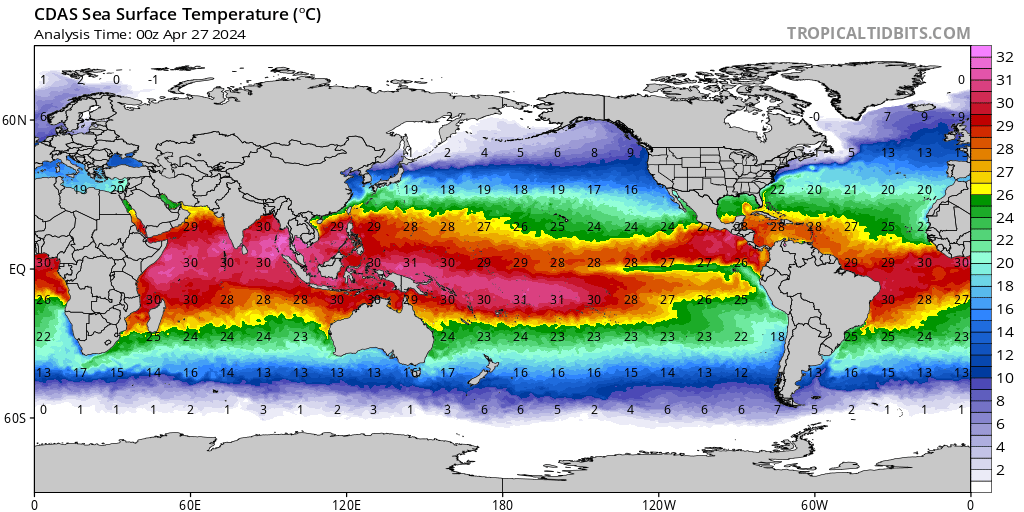
A large increase in water vapor in the troposphere can cause an increase in the total mass of the atmosphere and an increase in atmospheric pressure, which in turn can raise global ocean temperatures.
Hear is a question that I have often pondered, how does the atmosphere change when sea level rises 2 mm?
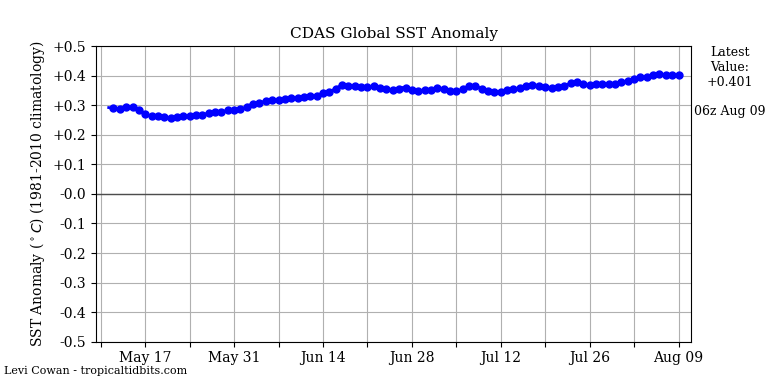
El Niño raises global sea surface temperatures, which may lead to heavier snowfall in the Northern Hemisphere during the winter.
No, I mean what about the surface area of the oceanic / atmospheric interface being larger in area than the year before. Or after the Younger Dryas when sea level came up a few feet per year.
Didn’t the rise in sea level result from the lowering of the (land-supported) ice level? Negligible change in air/surface interface, I expect.
El Niño causes a rise in global sea surface temperatures.
Great take on the UN climate funds:
https://www.climatedepot.com/2026/08/07/the-uns-green-climate-fund-ran-short-of-other-peoples-money/
I am investigating the $20 billion Green Climate Fund. First report out soon.
As I recall, it was set up to be opaque. Good luck.
“Opaque” is as transparent as they get.
Yes a deep dig.
Many hundreds arrested for starting France’s worst fires since WWII; whilst reporting the fact, the BBC still does its best to downplay the problem and blame CC.
https://www.bbc.co.uk/news/articles/cvgxjn92x9jo
Seems we forgot that kids shouldn’t play with matches.
Teachers don’t have time to teach such things. They have a full curriculum pr
teaching about the importance of diversity.Gosh! Wood does not spontaneously combust at 40C….
I wonder what China’s Bat Woman, Dr. Shi Zhengli, is up to. No good I imagine.
Scientists shouldn’t play with synthetic pathogens they can’t control.
Awful person
Home energy costs are soaring. Why does Trump want our appliances to be even less efficient?
https://www.fastcompany.com/91578887/trump-attacks-home-appliance-efficiency-energy-prices-soar
..
Who needs money anyways.
I use natural gas for heating where I can because it is inexpensive and effective.
I have forced air natural gas heating as part of my HVAC system, two natural gas water heaters (my guest bathroom has a huge tub), a gas dryer and I installed a dual oven natural gas range this past year because its cooking performance is superior.
Trump’s policies are correct because they allow me to tell bureaucrats to mind their own business. Your situation may be different because you have stupid busy-body leaders. I prefer to do what is best for me and to have the freedom to do so.
Here’s a question for you. Why not use a question mark when composing a question?
I just enjoy not getting screwed by cooperations. So have fund with your subpar non-repairable products for the same price.
Yet you believe in 15 minute cities, EVs, “efficiency” products that don’t work, pseudo-vaxxines that don’t work, wind and solar short-lived “throw-away” junk…. etc etc.
Seems you would rather get screwed by the government. !
Quite bizarre !
Beauty lies in the eyes of the beholder. MUR apparently prefers government ‘hoes.’ To each his own?
Hey, MUR, where do you live?
Like Roy Kent, he’s here, he’s there, he’s every-fucking-where.
I figured Duncity.
🙂
This article is a good example of advocacy journalism dressed up as objective analysis.
First, it bundles together several separate issues – appliance efficiency standards, Energy Star, AI-driven electricity demand, climate change, and conflict in Iran – then implicitly attributes the resulting energy-cost pressures to Trump’s appliance policy. But even the article itself acknowledges that rising energy costs are being driven by factors such as data centre growth and geopolitical events. Those factors are largely unrelated to whether a dishwasher or water heater is required to meet a particular federal efficiency standard.
Second, the article cites Energy Star’s claim of $40 billion in annual savings and an ACEEE projection of $4.8 trillion by 2050. Both organisations are advocates of efficiency policy. That does not make the figures wrong, but it does mean they are not neutral sources. Forecasts extending decades into the future depend heavily on assumptions about energy prices, technology adoption, consumer behaviour, and regulatory compliance.
Third, the article largely ignores the trade-off that critics of efficiency mandates raise: consumer choice and upfront costs. It briefly concedes that more efficient appliances can cost more initially and that stricter standards can increase manufacturing costs. For some households, particularly lower-income households, a higher purchase price today may matter more than projected savings spread over many years.
Fourth, there’s an unexamined assumption that federal regulators always identify the optimal balance between efficiency, cost, performance, and consumer preference. Reasonable people can disagree on that. Supporting efficiency technology is not the same as supporting government mandates that require it.
Finally, the headline asks, “Why does Trump want our appliances to be even less efficient?” That framing assumes inefficiency is the goal. A more neutral question would be whether appliance standards should be determined by federal regulation or by consumers and manufacturers competing in the marketplace.
The strongest argument in favour of efficiency standards is that they can reduce energy consumption and operating costs over time. The strongest argument against them is that they can reduce consumer choice and raise upfront costs. The article focuses heavily on the first argument while largely dismissing the second, which is why it reads more like a policy brief than a balanced analysis.
Do you even read the articles you post, and if you do, do you understand them?
And “more efficient” but you have to run two cycles to get the job done ?
Maybe
Flush twice and pray.
It’s just correctly pointing out all the things that make life already more expensive under trump.
Not being an unbiased source is correct – but I can’t help but wonder if you are as critical of sources and authors here.
To your forth point: You need a counter to cooperate greed. Else you end up with subpar stuff that brakes earlier, costs more and endangers your health.
Inefficiency is not the goal but the outcome. How much consumer choice does your free market offer? Having fun deciding between walmart or McD?
The endgame will always be monopolies. Products for the lowest production cost no matter the consequences for the consumer or environment as long as it makes enough money. If possible you want you consumers to be addicted and your workers be slaves. That’s the “free market” capitalism.
Consumers on their own will never have a counter for that – so they need to organize and put pressure on the government for regulations.
I think you’re overstating the case and treating one set of political preferences as unquestionable fact.
For example, “everything is more expensive under Trump” doesn’t by itself prove that stricter appliance regulations are the right solution. Inflation, energy prices, housing costs, labour costs, supply chains, tariffs, central-bank policy, global commodity markets, and government spending all affect prices. Blaming or crediting any one policy without disentangling those factors is too simplistic.
On corporate greed: greed exists in every economic system. The question is not whether corporations seek profit, because they do. The question is what combination of competition, regulation, consumer choice, and legal enforcement best channels that behaviour.
You say without regulation companies will produce inferior products that break sooner. Sometimes that’s true. But regulators are not omniscient either. Incumbent firms can capture regulatory benefits, raise barriers to entry, reduce innovation, and increase consumer costs. The existence of market failures does not automatically mean every regulation is beneficial.
Likewise, “the endgame will always be monopolies” is more an ideological claim than a fact. Many industries remain highly competitive for decades. Where monopolies do emerge, they often do so because of network effects, government-granted privileges, regulatory barriers, or extremely high capital requirements, not simply because markets naturally converge to a single firm.
The Walmart/McDonald’s example is also a bit of a straw man. Consumers routinely choose from hundreds of competing brands in categories such as electronics, vehicles, clothing, household goods, insurance, telecoms, banking, and online services. The real question is whether competition is sufficient in any given market, not whether competition exists at all.
On appliance efficiency specifically, I think there is a legitimate debate that the article largely ignores. The issue isn’t whether efficiency is good. Almost everyone agrees that using less energy for the same output is desirable. The disagreement is over who should decide the trade-offs:
Reasonable people can support efficiency while still questioning whether federal agencies should continuously tighten mandates.
Finally, I’d challenge the implicit assumption that regulations and free markets are opposites. Every successful market economy combines both. The real debate is about where to draw the line, not whether one side should completely eliminate the other. The interesting question is not “markets or regulation?” but “which regulations produce more benefits than costs?” That’s an empirical question, not a moral one.
Or in some instances banning future sales of gasoline-powered cars, removing “Use By” dates from perishable foods, and removing possibly-carcinogenic, volatile hydrocarbons such as denatured alcohol and acetone from hardware shelves to protect us from ourselves. In a truly free society, government would protect us by advising what risks might be associated with consumer products, rather than telling us that we can’t use something until we reach a certain arbitrary age commonly ranging from 16-21.
This statement shows that you believe that government bureaucrats can make better choices than what a free market can. That alone means less freedom of choice and less freedom in general.
Do you ever wonder why elites rode in Mercedes and the proles rode in Trabants or Polonez cars? That is what happens when bureaucrats control what is available for purchase.
Far too many people today have never heard of the “Invisible Hand” – the regulation of the marketplace from the impact of numerous individuals chasing their own best interest in a free economy. Governments simply can’t substitute for the individual’s “best interest”. It always becomes the best interest of the government.
“You need a counter to cooperate greed.”
The “climate change” agenda is the very epitome of “corporate greed”.
The funds being syphoned from taxpayers by wind and solar corporations are enormous.
People want, first up, appliances that actually do the job.
“Green” efficiency standards destroy that functionality, every time.
You need a counter to cooperate greed. Else you end up with subpar stuff that brakes earlier, costs more and endangers your health.
Explain Kershaw/Shun or Wusthof knives. Unregulated market and they make knives that last decades.
Or for that matter, Sears Roebuck sold a brand of tools, Craftsman, that came with lifetime replacement guarantees, not because of some government regulation, but because they rightly decided that it was a good marketing tool and affordable because of the rarity of actually breaking a tool. For years, I avoided cheap (literally and figuratively) Chinese tools, which broke frequently, by paying a little more and getting a Craftsman tool. The guarantee is no longer provided, but I doubt that it had anything to do with government regulations trying to improve the longevity of hand tools.
“Fourth,” not “forth.” Are you trying to prove my point above?
Consumers will never have free choice if the government bans some things.
The best argument against is that it’s not increased efficiency if it comes by reducing effectiveness. I bought my new front loading washer to clean my clothes, not to see how my clothes will smell after 2 hours of “washing” in a tiny puddle of lukewarm water. (Thankfully I knew how to modify my washer so it now fills with an real amount of Honest-to-God Hot Water, and my clothes now come out clean. That’s efficiency!)
IQ test. Complete the following sentence:
Spending $10 to save $1 worth of energy
a) Saves $9
b) Saves $1
c) Costs nothing, but saves the planet
d) Costs $9
We’ll wait.
If you wait long enough maybe you’ll find out this says more about you then you want people to know 😉
Score: 0.
Thought so.
I had to replace an old propane furnace last year. Cost, including the labor and the house upgrades for the new efficient furnace was roughly $2000; it would have been under $1000 for just an identical replacement furnace which had lasted 20 years. I forget the details now and don’t feel inclined to check my records. The old furnace was 95% efficient, the new one is 98%, and I spent roughly $1000 on propane the last year. That comes to wasting $50 a year with the old furnace and $20 with the new one.
$30 a year savings vs $50 a year upgrade cost. Gee, why am I not excited? And why do I laugh at your $31,000/year in savings?
My understanding is that propane is more corrosive than natural gas and that a natural gas furnace would last longer, changing these calculations.
ETA: I did look it up, and my costs were much higher, but I also replaced the tankless water heater at the same time, and it needed simiilar upgrades and had similar efficiency “gains”. The $1000 upgrade cost should probably be more like $4000-5000, but it’s impossible to separate any more precisely.
Home ELECTRIC energy costs are soaring. Home GAS energy costs are not soaring. What is the difference? Bet you won’t choose the correct cause.
“Why does Trump …?”
Perhaps he has read the USA Constitution where the beginning mentions the Blessings of Liberty.
😎
Amazing how blames he it all on Trump and forgets about what both of his predecessors (Obama and Otto Pen) put in place.
Right, because everything he does favors liberty.
He’s a politician. Some things good, some things bad, and liberty is far down the list of motives.
Problem is that following these manic “efficiency” standards is extremely expensive in the first place, as well as forcing products that just don’t work very well.
Trump is trying to save people money and to get appliances that actually work.
Who wants to shower under a dribble of luke-warm water., and take 20 minutes to boil a kettle.
The Energy Star system does not consider the inefficiencies in delivering energy to your home from whatever the source is. Over half of the US electricity supply is generated by fossil fuel fired machines which operate with highly variable thermodynamic efficiencies ranging from 25% to occasionally over 50 %. That means that the fossil fuel electricity arriving at a home already wastes from half to 3/4 of the heat of combustion whereas say a modern gas home heater will deliver over 95% of the heat of combustion to the house. Line and electricity management losses must also be considered in delivering electricity. Gas delivery systems also have inefficiencies, the gas must be pumped for example, that reduce the amount of gas energy delivered to a home. Energy Star considers none of these inefficiencies and to do so would be nearly impossible because of large variations in electricity and gas production and distribution efficiencies throughout the country. The lesson – do not believe energy star estimates when comparing different kinds of home appliances such as gas vs electric dryers, stoves, furnaces and such nor when comparing different technologies such as ground source vs air source heat pumps, gas vs electric resistance cooking or induction cooking and such.
Especially if those writing the specifications for high efficiency aren’t objective and write the spec’s to promote their personal view of efficiency, which is often cherry picked ‘facts.’
The Farmers Almanac for 2027 has just come out. IIRC,they claim their predictions are based on some secret formula which I’ve long suspected involves consumption of copious amounts of alcoholic beverages and the use of darts. But maybe it’s more sophisticated than that. And in either case, it may well be every bit as accurate as the longer term forecasts (anything beyond 10 days) from official sources which are known to be pretty awful.
Anyway the summary for the Continental is United States is :
“Winter 2026–2027 is shaping up to be a season of sharp contrasts, with an active southern storm track, quick bursts of snow and bitter cold across the North, and a tricky mix of rain, sleet, ice, and heavy wet snow in the Northeast. Keep the shovel, rain boots, and ice scraper close—this winter may bring plenty of surprises.”
https://www.farmersalmanac.com/farmers-almanac-2026-2027-winter-weather-forecast
I see slipping and rotating tires.
Where I live-a 55 county wide area that goes from prairie flat to seriously high hill country- NO forecast is good for even 3 days. Lucky you for being where a forecast is good 10 days out.
The USA National Weather Service has consolidated forecast areas into 122 regions. Search for:
” List of National Weather Service Weather Forecast Offices ”
Many sites, many maps.
Lots of the western areas are larger than most of the states east of the meridian that runs through New Orleans [W90°].
I’m at the NW fringe of PDT [Pendleton – green].
I’m at 93W m/l and while I find your comment interesting, it hasn’t calmed my intense irritation at why the local weather weenies try-uselessly- to forecast over flat ground to hill country. Completely different animals. My local station is owned by a media conglomerate located on the E coast (Jersey I think) and they micromanage the Hell out of the locals, and make mistakes…for example feeding NC weather to us, maps and all. I know its all about advert. $$$-but I’m tired of E coast news and while I do understand the power of modern tech, I don’t need adverts. for a store 300 mi. away or NC weather.. Grrrrrr. I do my own forecasting; I can read maps and I can access the local aiport’s radar…or I can walk outside and read my toy weather station-baro, humidity, wind etc. My wife for some reason is impressed with the fact that I’m usually right. Boy, such a rant, sorry.
Today, I decided to delete the advertiser-laden MSN weather application on my desktop, not just because of untrustworthy forecasts, but because different functions of the app’ are often contradictory. I don’t know what to believe. I can do about as well going outside and looking at the sky and smelling the air. The local TV stations interrupt the regular programming and show the local Doppler radar when there are tornado or flooding conditions. Those are the primary concerns that I have.
Ditto
I’ve seen many, if not most, forecasts (particularly for precipitation) change in both amounts and timing over a 7-day forecast. It is not uncommon for the forecast to be wrong on the day of the forecast. I’m living in the relatively flat country of Ohio.
Good morning, Clyde. I agree with pretty much everything you say; I know as well as you do that weather is seemingly chaotic at times, but my major bitch is in the approach and methodology…and the corporate overreach. I’m from orig. Illinois and I too know flat land weather and as I’m now in serious hill country I know rough terrain weather. I find the weather weenies approach to local forecasting insane-same as say, forecasting for cropland and Chicago both-doesn’t always work well. My Dad taught me, like you, to also smell the air and look at the sky to back up my predictions.
No it’s not – and long may it remain so.
I has a question more suited for sci-fi than anything practical. My understanding is that fossil fuels in general, but especially coal, are the result of things which happened several hundred million years ago and have not repeated since. How likely are these ancient processes to have happened on other planets around other stars? Suppose there are a billion planets in the Milky Way which have supported life. How many are likely to have had the conditions necessary to create fossil fuels?
I realize it’s a very speculative subject and depends on how “life” itself is defined. But I’m really just curious about whether fossil fuels are a freak of nature and might only exist on one of a thousand planets which support intelligent life, or so common that one could expect all intelligent life to find fossil fuels.
That leads naturally to a second puzzle; what would happen on a planet which supported intelligent life but had no fossil fuels? There’s still burning wood. Charcoal could still be used to process iron ore. Coal wasn’t used widely until the 1700s, I think, and oil a century later. How far would human society have gotten with nothing more than wood as an energy source?
Stop cosmic CO2 pollution…
‘That leads naturally to a second puzzle; what would happen on a planet which supported intelligent life but had no fossil fuels?’
That’s what dilithium crystals are for.
I think ZPMs are a better source of energy. Plus, they are technically batteries! The Greens would love them!! 😎
(But the Ancients don’t make them anymore.) 8-(
Peat is being produced as we breath. We’ll just have to wait millions of years to see if it turns into a pseudo-lignite.
Without the blessing of fossil fuels we would likely still be bashing other folks heads with rocks. There wouldn’t be as many of us around and a few would live past their 30’s. Life would resemble camping in the wilderness each and every day.
No, that’s clearly not true. Wood got us into the early steam engines.
Perhaps on a rudimentary scale wood is fine, but fossil fuels have several advantages. Wood is a natural for bows and arrows and even some refined devices.
Gaseous and liquid fuels, however, enable a greater variety of technologies. Coal has higher energy and physical density and is more abundant.
Yes, I know, thus my question. I was hoping for answers more realistic and interesting than “stone age”.
There’s a Star Trek episode or two.
The processes that created fossil fuels are still ongoing. But they are quite slow. Coal is mostly the result of dead vegetable matter collecting in swamps where the bottom muds become Oxygen deficient. No Oxygen equals no decay. The plant debris continues to accumulate. You end up with peat. It is not uncommon for peat bogs to subsequently be buried under other sediments — maybe dirt, maybe sand, maybe volcanic ash, limestone perhaps if sea levels rise. When enough sediment accumulates, the bed of organic matter is subject to increased heat and pressure and is slowly cooked and pressed into lignite (“brown coal”), then bituminous coal, Maybe in extreme cases to anthracite coal.
There’s a similar process that has been around for even longer for organic matter in water — the oceans, some lakes. Under some conditions, the bottom muds become Oxygen deprived. Dead organic matter accumulates. Often it gets buried. Heat and pressure cook it to tar, then oil, and eventually, if there’s enough time, heat, and pressure, to natural gas.
The long term problem is that humanity is consuming fossil fuels far faster than nature is creating them. Eventually we’re going to run out. Won’t happen this year. Or next. But is will happen someday. It might be a really good idea to work out the details of how we will replace them before they start to become scarce.
I have read that the processes that created at least coal were specific to one age several hundred million years ago and have not repeated since. Thus, making up purely bogus ages, all coal fields are at least 300 million years old; there are none younger, and the conditions which created them are unlikely to ever repeat.
That rarity is behind my question. What would society be like if coal and oil and natural gas ad never been laid down and discovered?
The huge coal source, trees growing in the Carboniferous, pulled a huge amount of carbon out of an atmosphere high in carbon dioxide and piled up layer upon layer because at that time there did not exist organisms which degraded lignin and (hemi)cellulose.
It theoretically could have led to the extinction of much of the life on earth but just in time, new organisms which could break down the wood appeared. The Carboniferous can never happen again due to the presence of these microbes.
Methane (natural gas) is common.
From Grok:”Titan has the only dense, substantial atmosphere among solar system moons (surface pressure ~1.5 times Earth’s). It is primarily nitrogen (N₂, ~95%), with methane making up about 5% near the surface (decreasing with altitude).”
If you have Dilithium crystals, why do you need other sources of energy?
To get the dilithium crystals, duh.
https://youtu.be/3oXp9d6Mncs?is=S0vYqXuOlntdPVwN showed that the residence time of CO2 is 3.8 years by using the measurements after the atmospheric nuclear explosions creating C14. This is debunked by https://skepticalscience.com/co2-residence-time.htm saying that molecules of CO2 absorbed by the ocean are immediately replaced in the atmosphere giving a residence time of more than 100 years. If this were true then Henry’s Law would not apply.
Are Willy Soon and Jonathan Cohler correct, or are the debunkers correct?
To the dismay of those who think that “The science is settled,” various researchers have come up with different estimates for the residence time of CO2. There may not even be just one residence time. It probably varies with things like ocean temperatures and the abundance of vegetation.
There appears to be a change coming, yes, climate change. The ~ 60 year cycle appears to be moving from its warm phase into the next cool phase. This will have major implications on the climate change debate going forward.
Many folks believe this cycle is driven by Atlantic Ocean currents because it is most often referred to using the AMO index. My belief is the cycle is internal to the Arctic Ocean but its effect spreads out into many places including the Atlantic Ocean. New information is showing up which could help settle this question.
The above cool summer in the high Arctic fits my view perfectly as I will explain later. In addition, my view also predicts one of the first external observations would be increases in the summer sea ice minimum. It could be happening right now.
If this current trend does lead to an increase in the summer minimum, it will be interesting to see how this is covered by the media.
So, exactly how does this cycle work? I have mentioned it a couple times in the past. Here’s the simple explanation.
1) Sea ice insulates the Arctic Ocean which allow the water underneath the ice to warmup over time.
2) As the water warms, it eventually starts to melt the sea ice.
3) Melting sea ice allows the Arctic Ocean radiate away this energy at the surface and deeper warm water to replace it. This energy also warms the air in the Arctic.
4) Eventually, the warm water runs out which leads to the formation of more sea ice.
5) The sea ice expands outward eventually covering a larger area and cooling the air above.
6) Cycle repeats.
This only works because the Arctic is geographically boxed in by land. Very little water enters and leaves the Arctic compare to that which resides within it.
We are currently at 4). This is when the warm phase of the cycle ends and the cool phase begins. Just like we saw a decrease in sea ice (1995-2007), I would expect to see an increase in sea ice going forward. It will take many years to fully get back to the quantities of 1995.
Finally, this change in sea ice has a very important feedback. The amount of cold air in the Arctic affects the polar jet stream. More sea ice and a colder Arctic expands the amount of cold air pushing the jet stream further south. Less sea ice has the opposite effect which allows the polar jet to move further north.
Since jet streams tend to be the place where air masses interact, they are almost always places with more clouds. When the jet stream is further south is covers more surface area which leads to increases in cloudiness. More clouds also means more solar energy is reflected. Hence, the cooling effect of the cycle is enhanced by this feedback (as is the warm phase).
As a result, I expect to see an increases in cloudiness over the next several years as the cool phase of the Arctic sea ice cycle grows stronger. This will clearly be tough to explain by the alarmists.
Svensmark and Zharcova suggest that the coming cooling (NOT AN ICE AGE) has already started and is driven by the solar magnetic field periodic decline allowing cosmic rays to enucleate much more cloud cover which reflect more sunshine back out into space.
I read this contribution and would appreciate comment from those that know significantly more than I do on this matter
https://tucoschild.substack.com/p/draft-co-cannot-warm-the-earth?utm_source=multiple-personal-recommendations-email&utm_medium=email&triedRedirect=true
Nice looking article…just not on the right track..I will try to explain. The article focuses on the heat content of the component gases….which is how much heat (from outside sources) it takes to raise the mass of the components by …their specific heat times the temperature change.
This is not the issue. The issue is how absorptive of radiation that the gas molecule is. Thus how much heat it can provide to warming the mix. For the atmosphere, that radiation is provided by sunlight, both directly and indirectly from sun-warmed material. Water vapor and CO2 are fairly absorptive of IR, while oxygen and nitrogen are transparent, absorbing little.
We’ll pick on CO2. When struck by a photon of the proper frequency, it gains energy…mostly bumps into the 2500 other molecules around it and makes them vibrate faster, which is another way of saying increases their temperature. Water molecules work the same way.
To get an idea of the quantities involved, look in the second column of Fig. 1 of the following article. You will see that CO2 absorbs about 200 times as much IR as Niitrogen …and water vapor 600 times as much.
Best wishes to you in your study of the subject, Mario. I have left out a lot of stuff that does make a bit of difference…
https://agupubs.onlinelibrary.wiley.com/doi/full/10.1029/2012GL051409
I should have added to the statement “You will see that CO2 absorbs about 200 times as much IR as Nitrogen …and water vapor 600 times as much” yet Nitrogen is 80% of the atmosphere….meaning that the statements in the tucoschild article regarding CO2 and atmospheric heating are simply not correct.
A second Antarctic front will cause a significant drop in temperatures in southern Australia.
Thanks.. I already know that !!! 🙁
That breeze outside is pretty darn chilly !
And I heard that it is snowing slightly again in higher parts of Queensland.
Copilot AI does a nice job of summarizing my position, but it is bottom line just a zero actual science huge appeal to the consensus authority with no consideration of all the times the consensus has been flat wrong and fought to defend its errors: plate tectonics, luminiferous ether, Mars water, phlogiston, caloric, medical humors, sanitary surgical practices, spontaneous generation, cold fusion……..
nick schroeder climate – Search
396 BB/333 “back”/33 duplicate net = 100% trash!
396 is supposedly a measurement. By whom with what? Are watts and area direct measures? Or is the S-B hocus pocus heat radiation factor applied to calibrated temperatures with zero comprehension of emissivity?
Fire weather:
https://www.timescolonist.com/national-news/nasa-aircraft-flies-high-over-bc-wildfires-to-study-pyrocumulonimbus-clouds-12648236
Clinton is in the southern part of the Caribou region, between Cache Creek and Quesnel on H97. Fires have just emerged in the Revelstoke area which is on H1 well east of Cache Creek in mountains west of the Rockies.
Raging hot fires create their own weather, including tornadoes. They spew embers ahead. Bid dumps from very large air tankers needed to quench them.
Windies still trying:
How Engineers Are Reinventing the Wind Turbine | OilPrice.com
Years ago some people in Ontario Canada developed a vertical wind turbine, compact in diameter.
I forget how it worked, maybe File:Éole à Cap-Chat en 2010.JPG – Wikipedia.
Perhaps not as efficient as ones with big open blades. But fit on your roof. :-o)