
In this in-depth conversational interview and discussion, Professor Henrik Svensmark (formerly of Danish National Space Center) explains his groundbreaking research on how galactic cosmic rays influence cloud formation and climate.
Joined by Dr. Willie Soon and Dr. Ronan Connolly (CERES), Svensmark discusses:
- The physical mechanism linking cosmic rays → ionization → aerosols → cloud condensation nuclei
- Laboratory experiments and natural experiments (Forbush decreases)
- Why IPCC climate models struggle with clouds (grid size & parameterization)
- The CERN CLOUD experiment and the challenges of independent research
- Longer-term galactic drivers as the Solar System passes through the Milky Way’s spiral arms
- Svensmark’s personal reflections on the challenges of independent research, including his recent firing from the Technical University of Denmark (DTU).
This is a rare, candid and in-depth conversation with one of the leading researchers in solar-climate science.
If this kind of open scientific discussion interests you, please like, subscribe, and share.
Recorded 26th June 2026, Halle an der Saale, Germany (at the 17th EIKE climate change and energy conference).
AI generated transcript below
Chapter 1: Introduction & Disclaimer
So we’re here at the EIKE conference, which is in Halle, Germany. Halle an der Saale. And we thought we would take the opportunity because Professor Henrik Svensmark is here and speaking and so we said let’s interview him about his research and his findings and his experience in looking at climate. Some of the scientific research discussed in this video doesn’t agree with the UN’s current positions on climate change. To find out more about the UN perspective we recommend viewing the IPCC reports at IPCC.ch.
Chapter 2: Ronan Connolly & Willie Soon on Total Solar Irradiance (TSI) in Climate Models
Willie and I, we’ve obviously been also looking at solar activity and the potential impacts on climate change. Most of our work has been relying on looking at, say, total solar irradiance, trying to identify the trends in the total solar irradiance. In the climate models this is typically the way that they model changes and we’ve been finding… The broad general effect of the sun and then excluding stuff that, let’s say, Henrik is working on. The problem is, so within the climate models that the UN Intergovernmental Panel on Climate Change, the IPCC, within their framework they’re relying on climate models, computer models, and they model the solar activity in terms of just direct changes in TSI, total solar irradiance.
We’ve been finding problems with that, but… The change that they are applying is also very, very small. Yes. Yes. So they’re putting in a modest change. No, no, that’s the reason. The reason is that they treat the sun as a problem of perturbation instead of the absolute unit. You know, that the sun is actually doing this whole seasonal cycle that is really large changes. But the signal in the system will be the seasonal cycle actually, in some sense. So I think, Henrik, you first started looking at solar activity and when you went to DSK, is it?
A bit of history. DMI, I think. DMI. Yeah, I started at the Danish Meteorological Institute and the reason was I wanted to do something that was interesting, and I was supposed to do something completely different.
Chapter 3: Henrik Svensmark’s Early Work at DMI & Investigation of the Cosmic Ray Link
So I did it in my spare time. And I had heard the work by Friis Christensen, where they looked at the solar cycle length, and there was a beautiful correlation, and I remember people saying that it was, you know, at the DMI, the Meteorological Institute, that that was completely crazy and so on. But I thought the correlation looked so fantastic that I started thinking about what could be the origin. And at that time, I think there was an idea that the solar irradiance was not changing so much. So my idea initially was, well, if it’s going to work, it could be that it clouds that are responding to solar activity somehow, and that, of course, the idea was to look at cosmic rays, to see, because cosmic rays are the variable in the atmosphere that changes the most over solar cycle.
So that was the initial idea. Have you ever heard of a name, Adam Paulson, P-O-U-L-S-O-N? His name appeared in a very famous journey to the north, the Kristen Birkeland. Birkeland, of course, is Norway, but this Paulson sounded like a Danish guy, who actually was already describing. This is in early 1900, of course, the expedition. I forget when, but I took out the book from the Harvard Widener Library. I looked into it. By the way, I put some of that into my semi-popular book. I talked a little bit about that.
And he was already, really was identified about something related to charge activity up there, and then appearance of cloud, by the way. I just want to illuminate that point, that of course, you have that insight independently, doesn’t matter, because history, and you found this thing. It’s very exciting, actually. I remember how excited I was, 1996, you guys were doing that DMI preprint, because I got the receiver, I received those things, and then I opened up, “What the? This is something new. Who’s this guy? I don’t know who Henrik is, but I know Eigil Friis Christensen obviously. Many, many years ago. I know.
I remember. I think around 1996, I remember. It’s 2026 now. Yeah, almost 30 years. 30 years, yeah. 30 years, yeah. 30 years. So, yeah. Give us a summary, yeah, exactly. That was my, you know, how I got baptized into the cosmic ray, and stuff. And it was, I mean, I had been, you know, working at the, you know, I was in Berkeley a number of years, and doing stuff there, and then I went to the Nordic Institute of the… That’s the physics department in Berkeley? Yeah, the physics department, yeah, and they are doing quantum fluctuations and stuff like that.
And then I went to the meteorological institute, and after we published, or that preprint came out, it made such a big fuss. And I remember coming back from a conference in Birmingham, where it was presented the first time. Oh, 1999. How was that? No, 1996. 1996 already. Oh, cool.
Chapter 4: Svensmark’s Discovery Was NOT Welcomed by the IPCC
So, it was, I know, I remember coming back, and the headline on one of the biggest newspaper was the strong UN critique of Danish researchers, and there was Bert Bolin saying that it was naive and irresponsible to say that the sun might be important. Yeah. So, on that a bit of context for people that are kind of watching is that, so Bert Bolin was the chair at the time, and one of the founders of the UN IPCC, the Intergovernmental Panel on Climate Change, so the UN in the 1980s had decided that human activity was causing unusual climate change, and in fact, the UN Framework Convention on Climate Change defined climate change as any change in the climate that could be related to human modification of the atmosphere.
Yeah, so there is a kind of a problem, because they have a political ideas, and maybe they believe that, and I think many people do, and many people still believe it, but the point is they were looking at this scientific problem, trying to understand climate change with the assumption that it was human caused, and even to this day, people will say climate change and they assume it’s human cause, whereas you were starting to find possible natural factors. Yes. I mean, I can add to that, that Eigil Friis Christensen who had been doing a lot of this solar work also.
He went with a delegation, I think, to China at some point, and he suggested that one of the IPCC, that one of the larger uncertainties should also be the sun, and they rejected. They rejected. Yeah. Okay. So it’s been from the very beginning that the sun was not viewed very favorably by the IPCC, simply because they do not want it to be even a relevant factor. That’s the question. They don’t want to say that, “How about the sun? Can we study that? ” If you want to know climate change, they kind of say, “No. ” So it’s very sad. Yeah.
Chapter 5: The Mechanism: Cosmic Rays → Ionization → Aerosols → Cloud Condensation Nuclei
And you find a unique way in which you think that the climate works that way, right? That is caused by incoming cosmic rays, things like that. Should I say shortly what it is about? Yeah, yeah. I think you should. So the idea is that, I mean, solar activity is modulating how much cosmic rays are entering into the atmosphere, and you can see a beautiful 11-year cycle in the ionization in the atmosphere. And then inversely related. And inversely related, so. And therefore, the idea is that the ionization, it helps stabilizing small molecular clusters.
And these small molecular clusters then can grow to become what we call cloud condensation nuclei. And in order for a cloud droplet to form with super saturation of the water vapour by only about 1% or less, you have to have a surface so that they can stick to… And these are the cloud condensation nuclei. And the idea is that if you can change the number of cloud condensation nuclei, you are changing cloud-microphysical properties and how much energy that the Earth is receiving from the sun. I see. Yeah. Can I ask one technical question? Because I think people are interested in a lot of some of the details.
During the time when you were doing this work, I know there was people when, as soon as they saw your work, I know that a guy named, I know him personally, Fan Quan Yu, at University of Albany. Now he was a student of Richard Turco at UCLA, they were doing that. But they were the chemistry people, right? They are trying to model how this thing. They immediately know that you have this electric charge, enhanced nucleation is factor, another million, much more efficient than actually neutral product.
I think that really immediately got a lot of excitement because that means you have a bit of a physical mechanism in which to have this… Exactly. Yeah. They did some modeling. Simulations. Yeah. Yeah. Simulations. Yes. Okay.
Chapter 6: Laboratory Experiments Confirming the Effect (2006)
So in that connection, what we did was we built a laboratory where we made these experiments where we simply tested. We had a huge chamber and then we put in some gases that mimic the real atmosphere. And then we could change the ionization slightly. So we had changes which are very, it corresponds to what you have, for instance, in the tropics over the oceans. And there we could see already in 2006, I think… Yeah, those experiments. Yeah. So if we increase the ionization, the number of small aerosols increased. Increases. Yeah.
So, I mean, without a doubt, there is a physical mechanism. Yeah. This thing works. Your ideas have been very controversial. Now, we touched on it, that why it might be controversial, in terms to the IPCC. But the other problem is that what we’re dealing with here is, first of all, I think, would you agree that there are many contributing factors to cloud formation?
Chapter 7: It’s NOT the Only Driver of Cloud Formation, But It Is a driver
And so you’re looking at one specific contribution. Yeah. And so the difficulty, when I did chemistry, we have a lot of people would look at what’s called the rate-determining step. And so in chemical reactions, there will be many steps. But oftentimes, depending on the conditions, one particular parameter will be the rate-determining step. So one of the ways that I have looked at your work has been that you are identifying that in certain circumstances, the rate-determining step might be the amount of galactic cosmic rays that are reaching the Earth.
And just a bit of, for those that are not familiar with it, the argument about galactic cosmic rays is why they’re inversely correlated to solar activity. Is that when the sun is in a highly active phase, then the solar activity leads to a very strong solar wind, which reduces the amount of galactic cosmic rays coming in. And so am I correct in saying that you are not saying all of the clouds, there’s no clouds when there’s no sun, you know, and then suddenly– No. It is a modulation of the cloud. And I mean, we have done a lot of experiments.
Chapter 8: Forbush Decreases: Natural Experiments with Real-World Data
And of course, experiments have their limitations also. And a lot of people, I mean, not a lot, but some people were saying that it might work in your experiments, but it doesn’t work in the real atmosphere. Because as you say, there are many, many processes. And that’s why we actually used what are called Forbush decreases. So when you have a coronal mass ejection on the sun, it throws out some plasma. And then over a week, it actually screens against the cosmic rays. So you can have, I mean, up to, I mean, maybe 30% change in the ionization in the atmosphere.
So that we have seen as a natural experiment with the whole Earth. And when these events are occurring, you can then see if anything is happening when you look from other satellites that are looking at clouds and even aerosols also. And we actually see a very nice response during these events. So that means that it looks as if this mechanism is working in the atmosphere, in spite of all the other processes at all. And we can see that it’s mainly in low liquid clouds. It’s mainly in remote areas over the oceans, which is exactly what you would expect.
So I mean, it looks as if this change in clouds are responding to changes in cosmic rays. So they’re very interesting papers that you’ve done on it. So I pronounce it Forbush, how do you pronounce it Forbush? It’s called Scott E. Forbush from Carnegie Institution in the 50s. So I guess to explain to the others, the significance of that is when you have a solar storm, and we had like a very unique one in 2024 in May, which Willie and I have written a couple of papers on. But when you have a major solar storm, that’s kind of expelling… Yeah, if it hits the Earth, that’s why you have this type of…
You end up with a very, but it only lasts, the effects only last a couple of days. Yes, it takes about a week for the plasma to move out. So what you typically have, you have a sort of a sharp decrease, and then it goes up again. Yeah. And you collected all the statistics, right, essentially. That’s basically the nature of your work, to parallel time with, let’s say, some available aerosol data, cloud data, and this and that, right? Remember, you have multiple papers on that one. In fact, you produce even more paper on that than the beginning, the topic, right? That paper a lot.
He done a lot of work on that one. Yeah, for good reason, because the Forbush decreases are good in the sense that things are happening on such a strong time scale. If you look at the cloud data over the solar cycle, you don’t have stability or… How to measure it? Yeah. So you cannot measure it. It’s the same with the solar irradiance, I guess. A lot of superposition kind of data, a lot of shots, they’re repeatable, yeah. Yeah. So essentially, what you’ve done, and this is something that’s kind of unique from the IPCC are looking at these computer models, predominantly, and I’m not…
There’s a lot of empirical work in there that is described in the reports, but a huge focus is on these computer models.
Chapter 9: Problems with IPCC Climate Models (Grid Size & Cloud Parameterization)
And then a bit of context is that in the global climate models, the average horizontal grid distances that, from latitude and longitude, even the latest models is about 100 kilometers North and south, east and west. And that’s why you can’t resolve clouds. Yeah. And not the aerosols, either. Yeah. But what they do instead is they do what’s called parameterization, because if you just look up into the sky and just try and estimate the size of the clouds, you see, no, these aren’t covering the whole of the country.
No. Essentially, there’s a cloud, it’s a cloud that is 100 kilometers by 100 kilometers. Yeah. It makes no sense. I mean, totally optically thick I mean, in Denmark, you might have one whole grid, one grid point. One point? But if you look up and look at the clouds, it looks slightly different. So the thing is, the IPCC openly acknowledged that the cloud, the modeling, even in the computer models and all of the global climate models, because of that logistical thing, is that their grid box is the size of Denmark.
Yeah. You have to parameterize. Yeah. That means you have to know the physics in detail, and you don’t. No. So you then, so what you have done is that you have done, you’ve built your own laboratory, you’ve built the things and you’ve carried out in situ, controlled experiments through your cloud system. And then now there was also, would you like to comment on, I understand that, is it Jasper Kirkby? Jasper.
Chapter 10: The CERN CLOUD Experiment & Scientific Politics
Jasper Kirkby, the CERN experiment, let’s not talk about any politics, but can you just summarize for us that what experiment they have done, right? And then what did they find? That’s all I want to say. It must be similar to yours. They built very clean chamber. I know it’s very clean. They can down to a number of particles, they can really control them well. Yeah. Yeah. Because a lot of aerosol people joined them, I think they need to… The thing is that they, what should I say, in 2011 they came out with their results.
And they showed that when you increase the ionization, you increase the number of aerosols, which was the same that we found in 2006. And they didn’t even reference our work for good reason. I was in the steering committee of the cloud project, and then I can’t remember, 2005 maybe, or something like that, and at that point in time I had a heart attack. I’ve had a number of heart attacks. I saw it on TV. Yeah, yeah. And so I was at home and they had a meeting in Finland, and then I got a call from Finland from Jasper Kirkby who was saying that I was thrown out of the CLOUD project.
Because the reason that they gave me was that they thought that the experiment I was doing in Denmark was in competition with theirs, which was completely… No, it’s terrible because I still remember the day you, me, Eugene Parker and Jasper Kirkby were sitting down in Tenerife. I don’t know if you remember that. They were lobbying Gene Parker. He was very encouraging, by the way. He really liked your work. I know that. Eugene Parker was very encouraging. He wrote the forward to the book. Maybe a context again.
Eugene Parker is one of the very distinguished physicists from the University of Chicago. He’s the only living person that NASA satellite named after a project, which is the Parker Solar Probe. They go very near, he passed away in 2023 and lived very old. The other thing is that he identified and coined this idea of the solar wind. So how would you predict it? Yes. I think that’s also why he liked, at least that’s what he said, he liked my work, because when he presented the solar wind, nobody believed that it could be true and he had so much resistance, and he was just a young… Correct, correct.
The paper was rejected and then, of course, Chandrasekhar published it. So on the solar wind, one of the things, when we’re looking at a longer time scale, a lot of people, because you have to go back the instrumental records of the observation.
Chapter 11: Cosmogenic Isotopes as Proxies for Solar Wind Strength
We’re limited to the satellite era, then if we want to go back, say, even using the sunspots, you’re going back to Galileo. But if people want to look at changes in the solar activity going back further, what they’re usually relying on are cosmogenic isotope records, that this is beryllium-10 carbon-14. And so the formation of these is due to… It’s not direct measurement of the sun, of the solar activity. It’s an indirect measurement of what they’re seeing is when the galactic cosmic rays reaching Earth is high, it’s indicating the solar wind is probably weak, and so it’s an inverse.
So it directly ties into your looking at this as a potential mechanism. Yes, I like the cosmic isotopes of course. Right, it’s an extra neutron that we need. So you’ve looked at, in your work, you’ve looking at very short time scales, you’ve looked at the laboratory and you’re doing in real time doing these experiments, but then people correctly argue, “Yeah, but that’s in a controlled experiment, what about in the real world? ” So then you’ve taken this other point where you’re saying, “Oh, but we have these natural experiments that you can’t control, but they do occur, and you can look particularly at the very strong ones and then see, does this have any impact at all on events?
” And you’re saying that you are finding results now. It seems very consistent now. So what you’re saying is that you’re identifying a mechanism for a climatically relevant factor, which is that you’re suggesting that it seems to increase in certain conditions, certain cloud formations are more likely to occur when the solar activity is weak versus when it’s strong. Now, if that was the only factor, then you would look and you would say, “Wow, it’ll solar activity, you’ll get massive amounts of clouds that will then lead to cooling.
Chapter 12: Evidence for the Effect Over the 11-Year Solar Cycle
” But what… And initially, I think in some of your early work, you were using other people’s satellite observations of cloud cover, and you found what initially seemed unbelievably like it was a very strong correlation. But then over time… Yeah, on the 11-year cycle, yes. Yeah. But over time… Yeah. I mean, when we discovered the first data, they had a very beautiful correlation. Then around ’94 and the data after that from what’s called the ISCCP data set, there, it was quite clear that something happened with the… Or what do you call the… Satellite. Satellite platform.
Yeah. Yeah. Calibration. Yeah. I mean, there was something with the calibration at that time. So we tried to modify it so we could get it up to 2006. But after that, it was clearly that something strange was happening. And then when you start comparing with other cloud data set, then they have all slightly different. .. Just like everything else that is difficult to measure. Yeah. Yes, it’s a problem of basically data product. They need to assimilate all the radiance thing into a model of some sense. Yeah. Actually, maybe just cut it short.
Chapter 13: IPCC’s Efforts to Dismiss Svensmark’s Inconvenient Findings
I do want to raise one very important point that I thought I will hear your opinion, but I want to summarize it first. It’s… You know, sometimes I think for skeptic who are not knowledgeable, it’s not correct to say that IPCC, IPCC will say that. It’s not correct to say that we haven’t included the Cosmic Ray clouds in the climate model. Yeah, yeah. They did. They did. No, they did. Sorry, they did. No, no, yeah. They say they included in the model. Yeah. But if you look carefully at the two, three papers that they have, that they tried to… They run some of the NCAR models. Yeah. The prioritization in which they put in is just laughable.
It’s not serious attempt of what you describe in your empirical data. That’s why I find it really troublesome. You see, it’s a bit of what you call pre-empting. They want to make sure that you cannot make that statement, that they don’t account for this effect. They actually are doing a fake attempt. They are not serious. Do you understand? When you want to reject hypothesis, you got to do the best you can, giving you maximum benefit of the doubt that, you know, you are right, for example. I really want to hear your perspective on that because I know it’s a hard problem. Cloud is indeed the unsolved problem of climate, I would say, right? Yeah.
I mean, it’s absolutely true that the argument that has been used to say that what I’m doing is not worthwhile, is based on these chemical transport models mainly. Yeah. When you look at the IPCC report and what they write about this, they are very dismissive… Dismissive, yeah, of what I’m doing. So the way they write it, I don’t know if you know, but you had the Climategate at some point. Correct. So in that, there was some discussion, who should be the new authors of this section? And then they were suggesting various people.
And then they said, this guy is qualified, because he’s – in brackets – Anti-Svensmark. And the guy that they got to do it, he was, you know, really, really against what I’m doing. The one that got selected. Do you remember the name of the guy? It was, I think it was Benjamin Laken. Oh, yeah. I know Benjamin Laken. Yeah, they are the one that published those kind of papers. They wrote a paper. English. I think they’re from England. He even published a paper called the Late Cosmic Ray Theory or something. Yeah.
So for people who are not familiar with the IPCC process, the IPCC, they like to pretend that they’re the definitive gospel. And also inclusive. They allow everyone. No, it’s not true. But if you actually read their remit, their remit is to identify, to describe for policymakers and people the climate information that would be of relevance to policymakers. So your information that you have found, your scientific information that you are finding was apparently not suitable for the goals. And still not is. Yeah.
So the so in the IPCC, they do cite your work, but they there is a lot of papers back there. There’s a lot of papers back and forth, though, because we’ve we find the same thing is that what they’ll do is they say, but you didn’t mention Professor Svensmark’s work. And then they say, oh, OK, we have to mention it. But if we don’t want people to be ticketed, so they say, has there been any study that is contradicting it? And then it’s like, oh, here. So now we they put that as being the definitive one. And then if you have a response, no, that’s not important.
We just go with the one that showed that Svensmark say anything negative. Yeah. Yeah. Yeah. Yeah. How science is going. I mean, you know, in some of these words and four books, I think it’s spent almost two years to get them out. And then the rebuttal, it took six weeks. The there have been others still that have been supporting your work, and I’d say like,
Chapter 14: Longer Timescales: Shaviv & Veizer on Galactic Spiral Arms
Willie, you’ve somewhat sometimes criticized some of the papers and others have been there’s been some papers that have said this is supporting your work and then others that are saying this supports some of it, but contradicts others and any of others that are criticizing it. So it is a bit of a mess. It’s a complex thing. But I think it might be worth mentioning those that Jan Veizer and Nir Shaviv, that they kind of I can you say a little bit about what they were they came from? Yeah. Yeah. I mean, then we start talking about some completely different timescales. Yes.
So we are on geological timescales and it has to do with astrophysics also, which is also your field. So the idea is that the cosmic rays, they come from actually when you have star formation and you have big stars, they explode and then they can accelerate these cosmic rays. So star formation, in some sense, is exploding stars is the source of cosmic rays. And then when the solar system is moving in our galaxy, it’s moving around the galactic center, it gets in and out of regions where there’s more or less star formations.
And when you have a lot of star formation, typically in the spiral arms, you will have a much higher. And it’s not just, you know, this 10, 10, 20 percent, it’s, you know, 300 percent changes. So it’s a big factor. And Jan Veizer and Nir Shaviv did some work in 2003, I think, where they showed that the large glaciations that we have had in the Earth’s history fits beautifully with the passage of spiral arms. Okay. Yeah. So you had this, I mean, completely fascinating explanation. So their theoretical framework for doing it is that, like, when you have periods of low, of higher galactic cosmic rays, then this shouldn’t necessarily influence the solar activity, but it should influence your effect because there will be an extra.
You can say it’s independent of solar activity as such. Yeah. Yeah. And so I think you also did some work on that longer timescale. Yeah. Is that correct? I also did a lot of work and I did it for a period because I thought by doing long timescales, I would get out of all this CO2 stuff. Oh, right. Yeah. But it doesn’t work that way because like Jan Veizer, he has been one of the top geologists in the world.
Chapter 15: How Your Career Suffers If You Actually Follow the Science
Yeah. Yeah. Yeah. And so, and everybody’s been using his isotope data. But after he made that paper saying that, you know, climate on Earth was not correlated on geological timescales with CO2, he was vilified in a way he wouldn’t believe. And I think he’s been suffering from it ever since. Well, what about yourself? Because you mentioned that you said, oh, maybe I can step away from the fire by looking at things on a longer timescale and you’re saying it doesn’t really work. But I thought that like that if you are disagreeing with the CO2 narrative, that you will be inundated with lots of cash from the fossil fuel industries who love your work.
Have you categorically denied that you have received money from fossil fuel oil company? I don’t think I ever received a dime. You only pay them because you put gas in your car, you only pay them. So has this been helpful to your career to follow what you believe the science is pointing to? It’s been very, very strange. It’s been, I mean, first of all, I should say I’m extremely happy that I’ve been able to do the science because the science is really, really interesting. But my situation has been horrible over the years and there’s been so many things and you have been through similar kind of thing, but maybe different level.
So in 2016, the director of the university, he demoted me from professor to a lower rank. Then I could be fired much, much more easily. So in 2021, they tried to fire me, but I got the help from Lindzen and Will Happer. So they wrote and also Nir and some other people from Princeton wrote some letters to the actor and so on. So they didn’t fire me, but they took away my salary. So you didn’t have any salary. So I had to find my salary, you know, most of my salary actually. And now in 2026, 14 days ago, I was fired. So I’m fired.
But I do want to ask questions, sorry, if I keep asking questions. If you don’t say anything, it’s okay. I see another Svensmark’s name. Is that your son? Yeah. Oh, cool. He’s still not scared. Terrible. I laugh because man, you know, he believe in science like you. But his problem is that he has the same surname. So he has not been able to get a job. So he’s now teaching in high school. Okay. If you had gone and said, hey, I’m now debunking the cosmic rays and it’s all due to carbon dioxide. What would have been the part? It wouldn’t be me, but I don’t know if they would take me serious.
But I mean, we have seen many people who have converted and they have been embraced to some extent. But I always find this a bit silly. It is very sad because Denmark is really, really the home of Niels Bohr. Besides news of, you know, Carlsberg. I mean, these guys are really, really serious people who fund science and really want science to be a priority. Yeah, yeah. There are some good traditions. But you know, and many people when they talk about science, I mean, no matter who they are, they say the right things, you know, we use the scientific principle and we should be open to new ideas and we should be critical and so on.
But then in reality, they are, you know, narrow minded and they censor any other subject that they don’t like. Can you believe that? So there’s nothing new. Sorry. Not laughing, but it’s bad. Yeah, no, I’m sorry to hear about that. It’s kind of what we’ve been the team that we have decided to go completely trying to see if we can do a very independent way of what you call nurturing science. We’re not able to fund science because this is not enough funding to the problem is funding. Yeah, of course, you know, because I mean, you know, one of the new signs you need funding. Yeah. Yeah. And that’s that’s the reality.
And then it’s like, but here’s it like. Do you think that if if people if if governments and the public were not so interested in climate
Chapter 16: Following the Science Instead of the Politics → Politically Incorrect
change and they were looking at something else and like you can see some people are, you know, like Bill Gates is now promoting …Geoengineering… and also looking at nuclear and trying because he’s he’s no longer concerned. He needs the data centers, Microsoft needs the AI data centers. But imagine if there was like this, the future if or if if in a parallel world, you had just started your thing, but the people were not concerned about climate change. What would have you you would have been interested in?
Would you have been interested in the subject? Yeah, I think it’s really interesting. I mean, well, one of the things I didn’t discuss here is my work on the long time scales, which has gone a lot on the long time scale, the geological time scale, because the climate changes are so large that I see beautiful collations with the conditions for life on Earth. And I’m going to just show you some of that tomorrow, but I’m not going to keep it done. OK, so yeah, so this is what you’re trying to do is trying to understand the context.
Yeah, I mean, if it is true, it means that, you know, processes that are completely remote from the Earth, which has to do with star formation, you know, is actually, you know, giving conditions for life here or here on Earth. I am well, so Professor Svensmark, thank you for taking the time. This has been very interesting. I think we covered a lot and I’m like, we’re really sorry for what you’ve just recently gone through. And we hope that like you can find something because… Thank you – I hope to continue my work somehow.
I think anybody that’s kind of anyone that is watching this or whatever and is thinking, hey, let’s do science. Why don’t we just investigate and make a discovery? I think hopefully you can kind of see why it’s not always so simple. And actually, if you want to do science and you want to follow science, well, here’s the problem that I’ve noticed, is if you are doing science that is in a politically charged topic and you are following the science, well, then your results will end up being politically incorrect because you’re not following the politics.
Exactly. But if you are interested in science, which you clearly are and we are as well, then you want to see the science. The thing is, if you are a real scientist, you follow the science where it leads. Okay. So well, thank you very much for taking the time. Thank you so much. Thank you.
FTA: “Not the only driver, but a driver.” True. Now quantify ‘but a’!
I commented previously here concerning Svensmark’s IGCR climate hypothesis—I found it unpersuasive. Some associated quantification data for that opinion just researched (again) per the above quoted Svensmark statement and my ‘but a’ challenge.
There are commonly thought to be five major cloud condensation nucleation (CCN) sources.
Over ‘land’, (1) volcanic sulfates from both felsic (Ring of Fire) and mafic (Hawaii, Iceland) eruptions, (2) biologic coniferous forest terpenes, and (3) biologic rain forest/deciduous forest isopenes (the source of Appalachian Great Smokey Mountain ‘smoke’).
Over oceans, (4) atmospheric molecular sea salt lofted from wave spray evaporation, and (5) biologic dimethyl sulfide.
Comparably, the IGCR CCN contribution is generally estimated to be 1% of the CCN total. If true, IGCR cannot have the climate impact Svensmark posits, no matter what the Sun and its magnetic field are doing, and despite correctly observed but short lived Forbush events.
The terpenes from pine trees react with ozone to form solid compounds called ozonides. These particles scatter mostly blue light and are the cause of the “smoke” in coniferous forests such as the Smokey Mountains.
Dimethyl sulfide from the oceans would react with ozone to form dimethylsulfoxide, which would not be a source of any sulfate particles. Since it miscible with water, it would be absorbed by the ocean.
The Blue Mountains in Australia are result of ozone reacting with the terpenes from pine and eucalyptus trees.
BTW: “isopenes” should be. “isoprenes”
Watch it again, take notice, you’ll get there if you pay attention.
Rud
You are listing the coalescing agents that act as cloud condensation nuclei, providing surfaces on which water vapor can condense. It is still not known what other factors that can enhance that process other than nuclei.
Atmospheric dynamics are probably the least understood component of earths climate and temperature movement and other phenomena. The dynamics that heavily influence the temperature anomalies, to the extent that we don’t know what caused those anomalies, here today gone tomorrow. And yet we treat those anomalies as gospel.
We do not know
Perhaps you are correct, but I consider that we don’t know enough to dismiss his theories at the moment. The knowledge is too narrow on most areas of atmospheric matters.
With best regards
Martin
With respect to the highly intelligent and highly educated gentlemen, this is just nonsense, if the implication is that a small change must have a small influence on final outcomes.
As Lorenz said “Chaos: When the present determines the future, but the approximate present does not approximately determine the future.”
Assuming the atmosphere (at least) acts chaotically, then any change at all is capable of producing completely unpredictable and unforeseen outcomes. There is no minimum external perturbation, and, in the absence of an external influence, a characteristic of chaotic systems is that no external influence may be needed for completely unforeseen outcomes to occur.
Not intuitive, I know, but true.
Richard Feynman, in one of his recorded lectures, points out that the uncertainty principle applied at the quantum level leads to a similar conclusion in regard to future states of the atmosphere. Completely unpredictable. Probabilities of future states can be calculated, but even a one in a trillion trillion chance might occur in the next ten seconds!
Randomness and chaos lead to the same conclusion – prediction of future climate states is not possible.
Everything affects everything else.
Who are you quoting and in what context?
We can conjecture that the earth system is highly tolerant of chaotic micro-weather events, a huge number of butterflies flapping for millions of years has not caused the explosive change that must result from a “positive feedback” or “amplification” influence.
Remember, every flow of fluid, gas and liquid, has the likelihood of turbulent flow which is currently not mathematically modelled successfully yet, and may never be due to the chaos aspect in random threshold and mass and velocity and direction components of transition from laminar to turbulent.
Nobody sensible will deny that there are patterns in the changes of the planetary climate stretching back into the far past and plausibly projected into the near future.
Near future being at best a week. Outside of that, we can confidently state with great accuracy that July will be hot and December will be cold over most of the Northern Hemisphere.
Started so long ago, so precise, such good authentic science.
No money from fossil fuel conspirators.
The sun the MAIN DRIVER, full stop!
What was discussed was the major mechanism in the atmosphere responding to changing influence of the sun on the galactic cosmic ray exposure.
Proof of concept in the laboratory.
Astute observation on natural phenomenon confirming phenomenon actually occurring in nature with precise measurements and correct timing.
Conspiracy of others against his work revealed in hacked email chains.
Deceptive flaw in the IPCC modelling with clouds 100 Km square – an absurd component.
Rich fare in such a brief discussion.
Thank you for reporting the same things I saw. Nice counter point to the IPCC parroting predominate in most of the other postings.
These three promote zombie theories of climate change that are already falsified, but they keep coming back acting like nothing has happened, just like the CO2 climate scientists do.
By now people should already know why the cosmic ray and ‘alternative TSI’ theories are wrong.
Oh, I’m so impressed…
If people were as smart as they make themselves out to be here on this subject they would have recognized a very simple contradiction in the cosmic ray theory.
If cosmic rays, which are inversely related to the sun’s magnetic field strength, were as strong in this solar cycle #25 as they were in solar cycle #23, which they were, then why did cloud cover diminish since 2000, especially since the cosmic ray strength was about the same during the last two solar minima? Why did cloud cover change so much when cosmic rays didn’t change much?
Why was the cloud cover trend negative under nearly equal cosmic ray extremes since 2000?
The cosmic ray theory of climate change is not ‘operational’ – it’s a teeny tiny effect, like CO2.
Changes in Earth’s magnetic field and solar activity are the cause of climate anomalies that may become apparent in the coming years.
The latest Swarm results highlight the dynamic nature of Earth’s magnetism. For example, in the southern hemisphere there is one point where the magnetic field is particularly strong, and in the northern hemisphere there are two—one around Canada and the other around Siberia.
“When you’re trying to understand Earth’s magnetic field, it’s important to remember that it’s not just a simple dipole, like a bar magnet. It’s only by having satellites like Swarm that we can fully map this structure and see it changing,” said Prof. Finlay.
However, since Swarm has been in orbit, the magnetic field over Siberia has strengthened, while it has weakened over Canada. The strong-field region over Canada has shrunk by 0.65% of Earth’s surface area—an area nearly the size of India—while the region over Siberia has grown by 0.42% of Earth’s surface area, an area comparable to the size of Greenland.
https://www.esa.int/Applications/Observing_the_Earth/FutureEO/Swarm/Swarm_reveals_growing_weak_spot_in_Earth_s_magnetic_field
Most scientifically curious persons should be familiar with the cloud chamber experiment that can be built using common items, dry ice, and a radioactive pin or source needle, typically Pb-210. In recent times, people building these have used Peltier coolers so they don’t have to deal with dry ice and can precisely control the temperature.
Using the led isotope Pb-210 gets alpha and beta decay particles, which as the move through air at the right temperature and moisture content will cause visible condensation trails.
It’s not at all crazy to understand that areas of the upper atmosphere will be at the right temperature and moisture saturation range where cosmic rays will cause condensation trails, and that condensed moisture can collect more moisture until large clouds form.
Is it also ‘not at all crazy’ to also assume without additional supporting evidence that lab experiments prove that man-made CO2 emissions causes warming of the real climate?
If you’re not a supporter of CO2 theory based on the CO2 lab experiments then why not?
It’s because there are other more important factors and interpretations. Same for cosmic rays.
During the current solar cycle, the level of galactic radiation has dropped significantly. Is this related to the decrease in global cloud cover? It is known that air ionization increases the number of water vapor condensation nuclei, which are essential for cloud formation. It is important to remember that secondary galactic radiation reaches the Earth’s surface, particularly at high latitudes.
Thread Bombing Warning: Here is a link to my latest Zenodo deposit that explores the relationship between Dr Svensmark’s Cloud Condensation Nucleii (CCN) ideas and my own Dew-Point Anchor Hypothesis (DPAH) work: DPAH-Svensmark: A Markov-Chain Exploration Tool for Solar-Ionization CCN Effects on the Tropical Ocean Hadley Cell (Runs 01–06)
A Comparison of Solar Cycle Data Since 1950.

Svensmark mentions Friis-Christensen as a motivation for understanding how the Sun influences climate, if not through variations in TSI.
Friis-Christensen and Lassen (1991) were on the right track with cycle period, but due to how solar activity is encoded in sunspot activity, their 12221 filter was doomed to fail–which it did.
Here’s a plot of the average sunspot cycle period using actual sunspot number data extended by a Usoskin reconstruction. It’s compared to a Loehle temperature reconstruction. There’s an obvious correlation with the Medieval Warm Period, the Little Ice Age and current warming.
You can predict temperature from sunspot data, using a filter. These filters are special in that they decode solar activity, but not from the Schwabe cycle. In fact, prediction accuracy is improved by further attenuating the 11-year cycle (second plot).
I don’t know if Svenmark’s ideas have merit, but I’d like to see anyone try to explain this near-complete 3560-year repetition in climate without involving the Sun’s influence. Paper: A 3560-Year Jovian Solar and Climate Cycle
“You can predict temperature from sunspot data, using a filter.”
Both your third and fourth graphic indicate your sunspot model decreasing for the years just before the 2023/24 temperature spike. That makes absolutely no sense for solar forcing.
How do sunspot numbers physically translate to temperature change? What is the mechanism?
The ocean actually responded to solar activity according to my decadal irradiance threshold.
“I’d like to see anyone try to explain this near-complete 3560-year repetition in climate without involving the Sun’s influence”
I’d like to see you try explaining that it does repeat with high statistical confidence by using cross-correlation analysis to give a lag and r-value. Otherwise your claim is just hand-waving.
Furthermore your last chart indicates in purple a projected negative climate excursion after 2000 when in fact it was a positive change since 2000. Why isn’t that a total failure of your model?
The 2016 temperature spike was expected, the 2023 spike was not. The later is likey the result of the Hunga-Tonga eruption putting water vapor into the stratosphere, possibly exacerbated by SC25. However, there’s another possible explanation that deserves further research. Major transitions from warming to cooling may be accompanied by a temperature spike as happened in 1877, the 1930s-40s, and even in 1997 preceding “the pause”. In other words, the spikes might be related to the derivative of climate change. What might we expect to observe before a transition to significant cooling? Who knows, this would be unprecedented in the modern era of global instrumentation.
You wrote: “Furthermore your last chart indicates in purple a projected negative climate excursion after 2000 when in fact it was a positive change since 2000. Why isn’t that a total failure of your model?”
Think, Bob. Climate is local as evidenced by the differences between the NGRIP and GISP2 cores which are only a few hundred kilometers apart. The post-2000 pattern is from ice-core data that’s more than 3500 years old, how much temporal perfection do you expect? Also, it’s not really a projection as there are cycles which are not harmonically related to 3560, such as the Bray cycle. That said, everything I’ve looked at suggests cooling began in 2016. Time will tell.
If you’d bothered to carefully read the paper, you’d have found this correlation plot which contains data from Greenland, Antarctica, a lake in China, and a solar activity reconstruction.
You asked: “How do sunspot numbers physically translate to temperature change? What is the mechanism?”
It’s not sunspot number amplitude; that’s Nature’s greatest head fake. The small variations in TSI associated with sunspots has little effect on climate. Think of sunspots, not as solar activity, but as a modulated carrier of information about solar activity. As I’ve already shown using the Usoskin reconstruction, one of the ways that information is encoded is through frequency modulation of the Schwabe cycle. It’s not the only way.
“The later is likely the result of the Hunga-Tonga eruption putting water vapor into the stratosphere, possibly exacerbated by SC25.”
The HT-HT water vapor was actually such a very small amount compared to all WV in the whole atmosphere, that is, it could have rained out on a typical rain day in China in the year 2022 in 3 minutes, 40 seconds. Not much to work with there.
The 2023 spike was caused by the solar cycle & clouds, not exacerbated by it.
“The post-2000 pattern is from ice-core data that’s more than 3500 years old, how much temporal perfection do you expect?”
This statement cuts both ways, yet you expect absolute belief in the rest of it.
No I haven’t bothered to read your paper – I read your comment.
“That said, everything I’ve looked at suggests cooling began in 2016. Time will tell.”
Time has already told us cooling did not begin in 2016 as it has warmed since 2016.
“If you’d bothered to carefully read the paper, you’d have found this correlation plot which contains data from Greenland, Antarctica, a lake in China, and a solar activity reconstruction.”
I wanted a lag and r-value, not more plots. Eye-balling alone is for beginners.
“It’s not sunspot number amplitude; that’s Nature’s greatest head fake. The small variations in TSI associated with sunspots has little effect on climate. Think of sunspots, not as solar activity, but as a modulated carrier of information about solar activity.”
What information is that? Sounds like you’ve head-faked yourself.
Svensmark’s idea that cosmic rays modulate low cloud cover was not necessary because of the tropical influence on cloud cover. I’ve shown since 2018 ENSO is coupled to solar activity, thus clouds couple to the sun too indirectly.
This opens up a whole new realm of science research that explains climate better.
This explains why TSI can make larger changes when coupled with cloud changes.
Sun-induced cloud change is the TSI force multiplier everyone has missed but me.
My posters since 2018 for AGU meetings and NASA Sun-Climate Symposiums I’ve attended included a discussion of this effect and it’s predictable consequences.
That’s all correct. There is no single cause for the global decline in cloud cover. However, it is important to remember that air ionization by GCRs is strongest at high latitudes and is effectively blocked by the geomagnetic field at the tropics. The second factor is the weakening of the jet stream at the tropopause. Weaker winds over the oceans may influence the formation of low-pressure systems. Look at what’s happening in the Atlantic right now. The weakening of the geomagnetic field over North and South America may affect ozone, which is diamagnetic, and circulation in the lower stratosphere, especially at high latitudes. This can be observed in North American winter weather.
If Jupiter and Saturn affect Earth’s orbit in cycles, you won’t see it on the TSI at 1AU graph.
You have to use the TSI at Earth distance graph to see the effect on Earth’s orbit.
No claim that Jupiter-Saturn conjunctions directly affect Earth’s orbit to the degree that climate is affected on a decadal scale. They may modulate solar activity, or they may be a proxy for solar-internal resonances. There’s much we don’t know about the Sun and how it affects climate.
I see small variations in TSI at Earth distance that are consistent with the orbits of the planets. The Earth’s orbit is like a curvy road through different gravitational fields.
The combined magnetospheres of Jupiter and Saturn (in conjunction with the Sun) may influence the Sun’s magnetic activity.
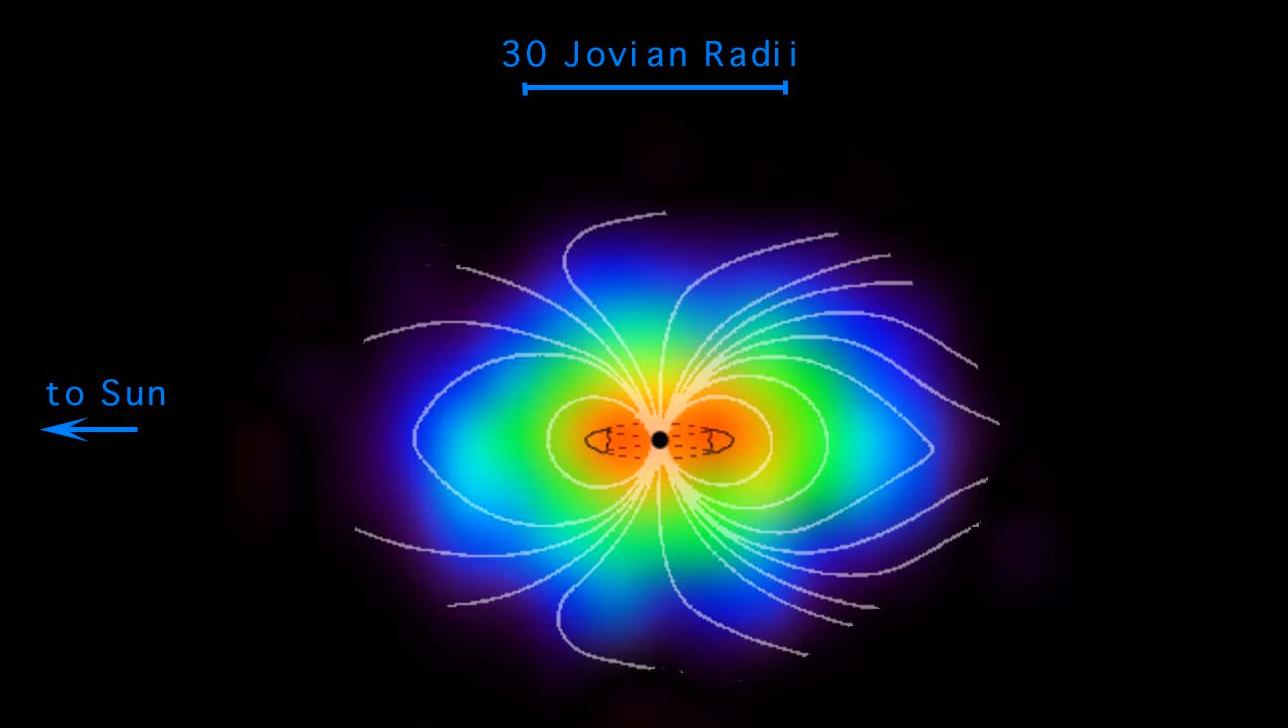
https://science.nasa.gov/photojournal/jupiters-magnetosphere-made-visible/
Possibly, but I’m finding many reasons to suspect that, like the sunspot cycle, the Jovian orbits and conjunctions are simply a proxy. In this case a proxy for solar internal resonances.
Total Solar Irradiance may need to be reweighted depending on land, sea, atmospheric composition and albedo etc.
The wavelength of solar radiation is also important. For example, strong solar flares emit more UV radiation at the shortest wavelengths, which promotes ozone formation. UVB breaks down ozone; it does not produce it. With lower ozone production at the top of the stratosphere, more UVB radiation can reach the troposphere, where it is also absorbed by water vapor.
This graph shows the periods during which ozone production increases and the periods during which it decreases.
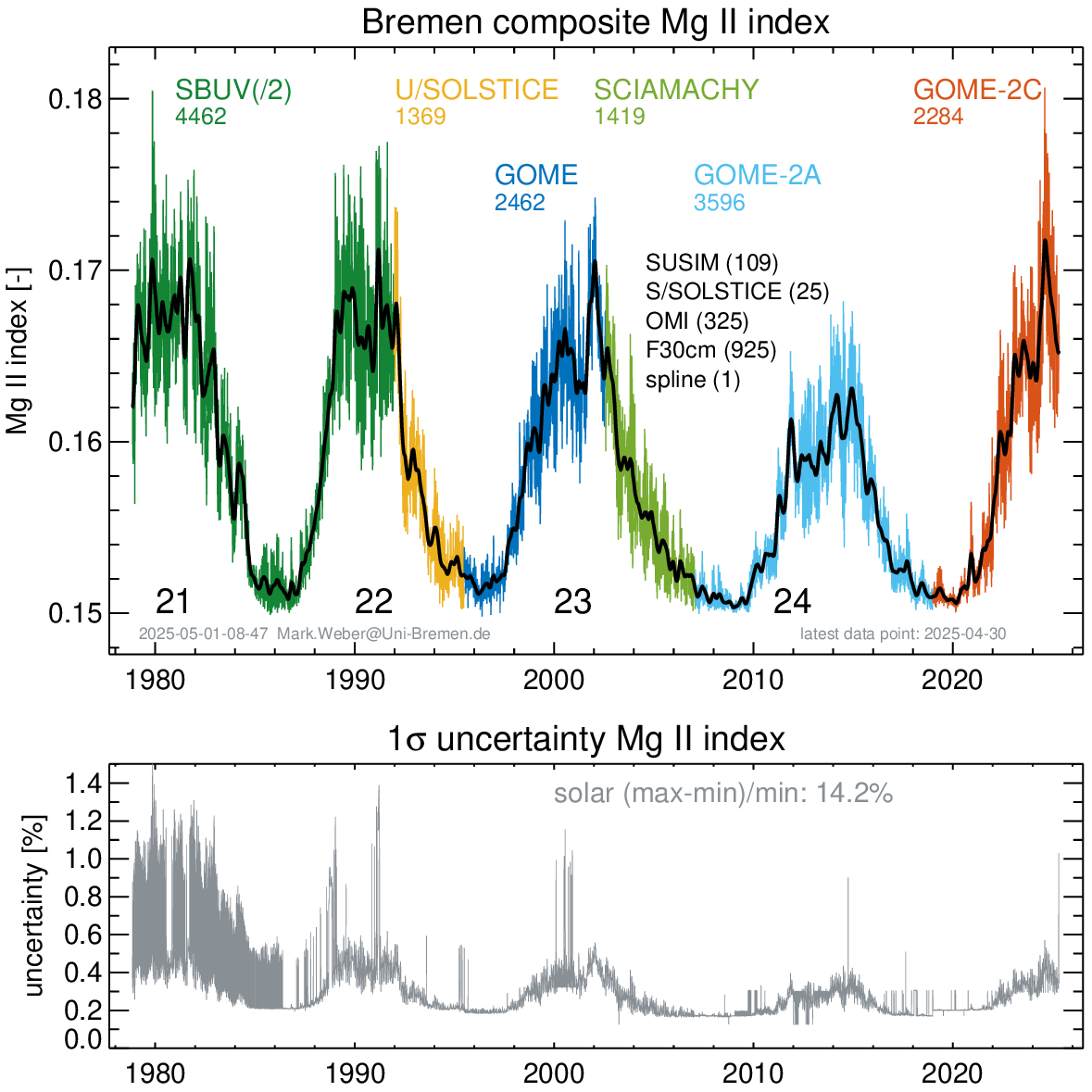
https://www.iup.uni-bremen.de/UVSAT/data/
Bert Bolin, chair and co-founder of the UN IPCC, says that “it was naive and irresponsible to say that the sun might be important.” How could any proper climate scientist say something so utterly stupid!
In response to his findings, the IPCC says “Yeah, but that’s in a controlled experiment, what about in the real world?” and “It might work in your experiments, but it doesn’t work in the real atmosphere because there are many, many processes.” This is a bit rich, coming from the IPCC, which:
Does no experiments of its own.Relies wholly on a very reductionist theoretical approach where everything is reduced to just one parameter – the CO2 concentration. The IPCC itself ignores all the complexity of the real world and then berates other for doing so!Starts with the very assumption that it simply claims is proven rather than test that assumption.Is obdurately close-minded and refuses to accept any contrary evidence.The IPCC is the epitome of anti-science.
P.S. This article should have be heavily edited to turn the verbatim script into something readable.