
This Phys.org article “Global rice production has nearly doubled over 50 years despite climate change” reports good news that is couched in incredulity. The authors are correct to highlight this remarkable success story and the data show that humanity has become dramatically better at feeding itself over the past half century, even as atmospheric carbon dioxide concentrations increased and the climate modestly warmed. What the authors miss, however, is the obvious conclusion staring them in the face: rising CO₂ and warmer temperatures have likely been part of the reason for that success.
For decades, the public has been told that climate change threatens global food production. Yet this new study from researchers at the University of Illinois reveals a striking reality: global rice production nearly doubled from the 1960s to the 2010s. That is not a story of agricultural collapse. It is a story of extraordinary human success.
The researchers conclude that improved management practices, including expanded irrigation, increased fertilizer use, and better farming techniques, were the primary drivers of rising rice production. They are almost certainly right. Modern agriculture has become vastly more productive thanks to advances in technology, genetics, infrastructure, and agronomy.
But there is another important factor highlighted in the study that deserves far more attention. The researchers acknowledge that rising atmospheric carbon dioxide was “the primary environmental factor contributing to increased rice production by enhancing photosynthesis and improving water-use efficiency.”
That finding should not be controversial. Carbon dioxide is not merely a greenhouse gas. It is also the fundamental building block of plant growth. Through photosynthesis, plants combine CO₂, water, and sunlight to create the sugars that fuel growth and food production.

Without carbon dioxide, there would be no crops, no forests, and no food chain.
For years, scientists have documented the CO₂ fertilization effect. Higher atmospheric CO₂ concentrations generally allow plants to grow faster and use water more efficiently. Satellite observations have shown significant global greening over recent decades, with expanding vegetation across many regions of the world. Crops are part of that story.
Curiously, the study emphasizes an estimated 7 percent reduction in rice production due to climate-related factors from 2006 to 2015, while giving comparatively little attention to the fact that global rice production still nearly doubled over the broader period examined.
If climate change were the overwhelming threat to food production often portrayed in media coverage, one would not expect rice production to have increased by nearly 100 percent over the same period. Instead, the world has seen rising yields, improved food security, and the ability to feed billions more people than in previous generations.
The study demonstrates that environmental changes are not uniformly negative. In fact, the authors explicitly note that rising atmospheric CO₂ increased rice production by boosting photosynthesis and water-use efficiency. That point deserves to be front and center, not a footnote to “despite climate change.”
The broader lesson is not that climate challenges should be ignored. Farmers have always adapted to changing conditions, whether those changes were driven by droughts, floods, temperature shifts, pests, or market demands. Human ingenuity remains the most important agricultural resource.
What this study actually shows is that adaptation works. Improved farming practices have increased productivity. Better irrigation has expanded yields. New technologies have made agriculture more resilient. And rising atmospheric CO₂ has provided measurable benefits to plant growth along the way.
Taken together, those factors have produced one of the greatest agricultural success stories in human history.
Unfortunately, much of the climate discussion focuses almost exclusively on potential future harms while overlooking measurable present-day benefits. The result is a public narrative that often sounds far more pessimistic than the evidence warrants.
Rice feeds more than half the world’s population. According to this study, global rice production nearly doubled over the past 50 years and this is clearly evident in the figure below.

That is not evidence of a food system in decline. It is evidence of a food system that has become dramatically more productive and resilient. The researchers deserve credit for documenting that achievement. But the larger takeaway is even more significant than they acknowledge.
The combination of human innovation, agricultural modernization, and the fertilization effect of rising atmospheric CO₂ has helped create a world that produces far more food than it did a half century ago.

Anthony Watts is a senior fellow for environment and climate at The Heartland Institute. Watts has been in the weather business both in front of, and behind the camera as an on-air television meteorologist since 1978, and currently does daily radio forecasts. He has created weather graphics presentation systems for television, specialized weather instrumentation, as well as co-authored peer-reviewed papers on climate issues. He operates the most viewed website in the world on climate, the award-winning website wattsupwiththat.com.
Originally posted at ClimateREALISM
__________________________________________________________________________________________
I can’t post this too many times:
1. More rain is not a problem.
2. Warmer weather is not a problem.
3. More arable land is not a problem.
4. Longer growing seasons is not a problem.
5. CO2 greening of the earth is not a problem.
6. There isn’t any Climate Crisis.
More rain can cause flooding resulting in property and damage, mud and rockslides and loss of human and animal lives.
More rain can end drought in areas of chronic drought, bringing crops and prosperity to humans and animals
No rain can kill people, animals and cause food shortages … which would you prefer?
It’s not an either or problem.
In the past 100 years, deaths attributable to climate related factors have decreased 97%!
In other words, proclaiming that more rain is never a problem is both wrong and dangerous.
Floods have not detectably worsened.
https://www.ncdc.noaa.gov/temp-and-precip/uspa/wet-dry/0
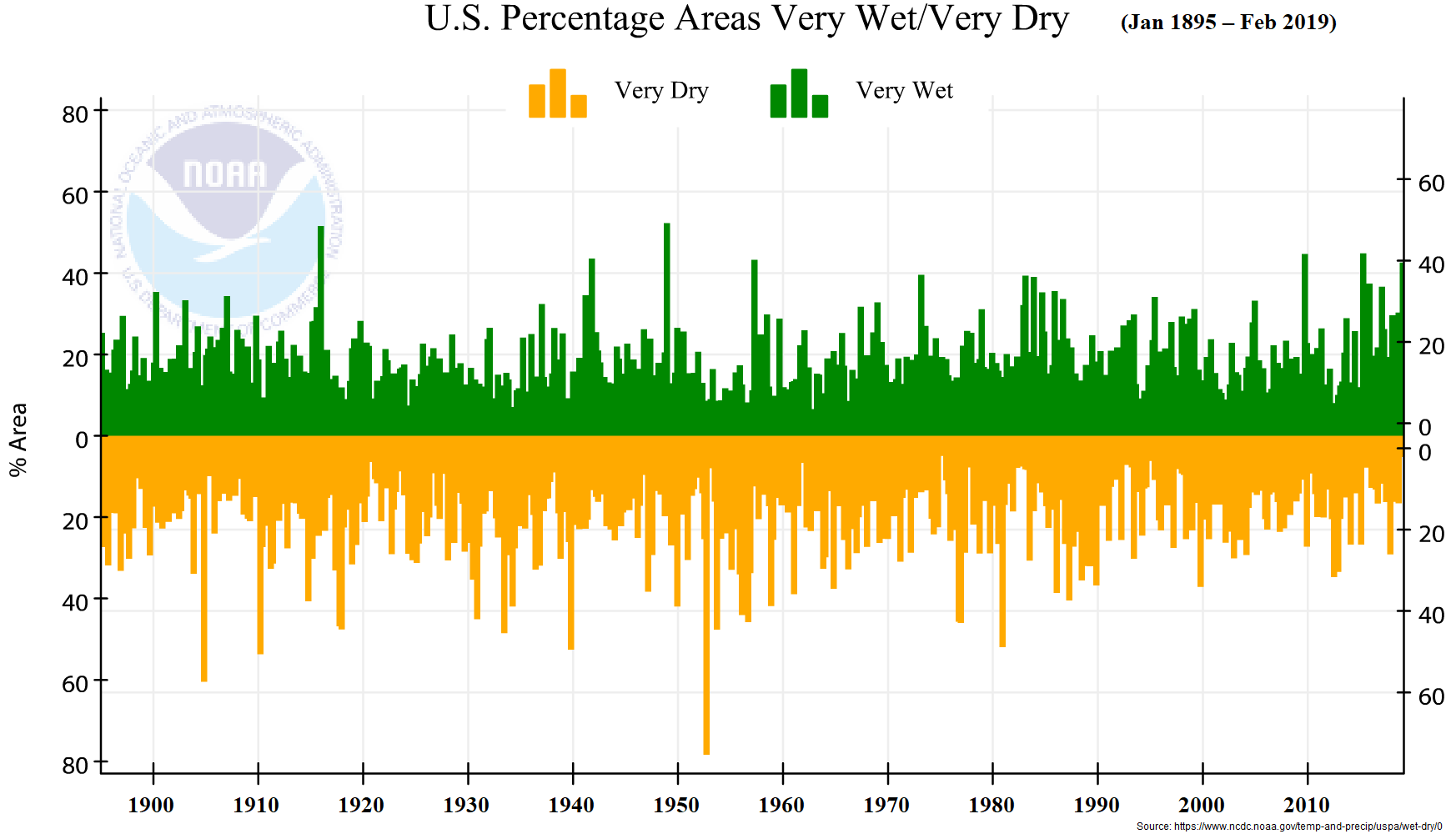
In fact, none of the major harms supposedly caused by climate change have actually come to pass.
https://sealevel.info/learnmore.html
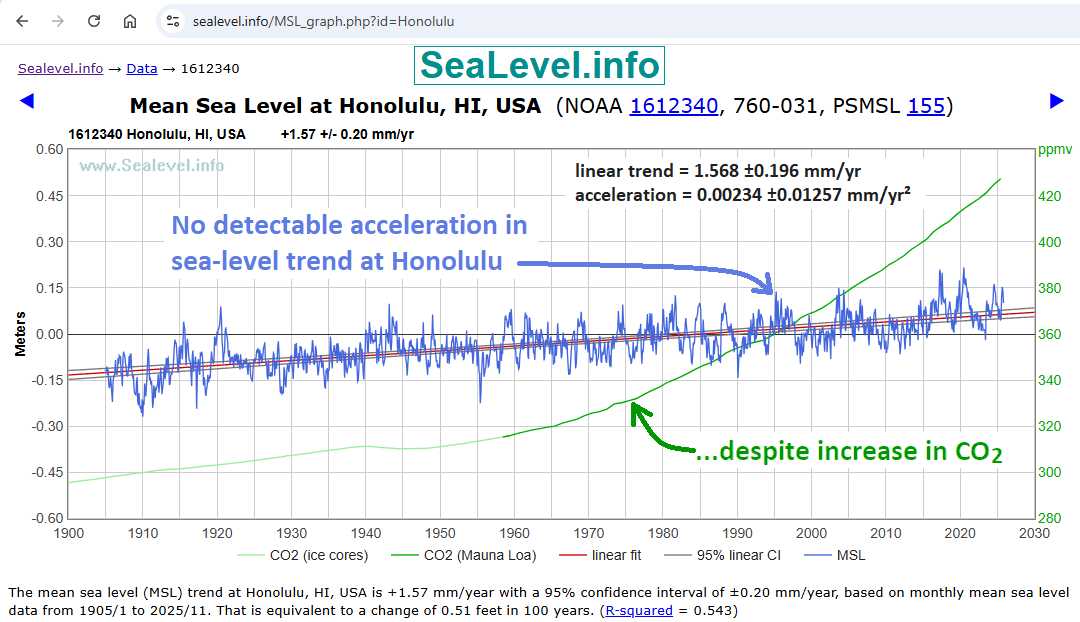
Even the IPCC’s AR6 report (WG1, section 11.5.2) says that no change is detectable in “the magnitude or frequency of floods at the global scale.”
“Rice, CO₂, and the Climate Story the Media Keep Missing”
They’re not missing it, they’re ignoring it.
“Let them eat (rice) cake!”
The Narrative has to be that all change is a
Bad Thing.
good news that is couched in incredulity.
Ed Miliband is building a better world.
You heathen scum.
Some people are automatons!
Mad Red ED builds nothing. He destroys everything he touches. He has the MADAss touch
“Carbon dioxide is not merely a greenhouse gas.”
Excuse me? CO2 is not a greenhouse gas.
Well it is used in greenhouses to boost plant growth!
Its proper description is a “radiatively active” gas.
It has basically zero effect in the atmosphere because any tiny theoretical radiative effect is swamped, by magnitudes, by energy moved by bulk air movement.
it contributes in a very small way to the overall effect on the surface of a planet that having an atmosphere does.
The attribution of “greenhouse gas” is a quaint 20th century pseudo-scientific tool of journalist to pretend they are scientifically knowledgeable.
It is useful to teach about it in Science 101 to get across the idea that the temperature at the surface of a planet in our solar system is influence by whether or not it has an atmosphere and what substances are in that atmosphere.
Rice is mostly CO2
Elemental Composition of Dry White Rice (by weight)
Element % by weight
Oxygen (O) 49.8%
Carbon (C) 43.9%
Hydrogen (H) 5.7%
Nitrogen (N) 1.0%
Phosphorus (P) 0.1%
Total 100.0%
WARNING: Rice contains carbon
Dry White Rice — Elemental Composition with Oxygen expressed as CO₂
Component % by weight
CO₂ 68.4%
Carbon (C) remaining 25.2%
Hydrogen (H) 5.7%
Nitrogen (N) 1.0%
Phosphorus (P) 0.1%
Total 100.0%
Just wondering: The statement …
“Rice feeds more than half the world’s population.”
. . . likely hides a lot of information. The web tells me: Wheat is 2 times richer in protein and over 10 times richer in dietary fiber. Wheat is also considerably higher in most minerals.
Each has about 71% carbohydrates. So, …
Over the last 50 years while rice production nearly doubled, has there been a lower per capita ingestion of rice in favor of higher nutritional alternatives.
One source says “Gambia ranked the highest in rice consumption per capita with 311 kg followed by Myanmar and Cambodia. On the other end of the scale was Belarus with 0.210 kg, …”
I eat bread and crackers made from wheat but have no idea of the total. Rice and corn might be 10 pounds (~3 Kilograms) each. Anyway, I don’t see per capita changes over the 50 years.
[311 Kilograms is 685 pounds, or about 30 ounces per day.]
the cultures which use rice as a staple consistently have a variety of lentils as part of their meals. It is amazing to analyse the traditional diets across the world and find that the combinations used very accurately combine to provide sufficient first class protein equivalent and vitamins and minerals to sustain humans optimally – and this has been arrived at long, long before there were any chemists on the face of the planet. Thank you to all the great-great grandmothers and their forebears!
Farming practices certainly have an effect on harvests but it isn’t the whole story. You can fertilize and water to your hearts content but there must be enough glucose to feed respiration, i.e., growth. Glucose has two primary components, CO2 and H2O. CO2 increases have increased the manufacture of glucose and the greening of the earth.
Imagine if CO2 was doubled!
photosynthesis produces sugars and carbohydrates are made of sugars. No soils need any glucose at all to allow plants to thrive, the plants make their own.
Nor will the media publicize the fact that rice continues to feed more than half the world’s population. In addition, production of food and animal feed crops —corn, wheat, rice, cassava and millet—not only have continued to increase but also have outpaced human population growth during the last 60-plus years according to OECD and FAO reports. Except according to the climate alarmists this type of growth shouldn’t be happening; instead, they’d prefer to be able to report on widespread starvation and population decreases.