From North Carolina State University and the “because our models say-so” department comes this press release that is far more predictable than the climate change it claims to predict – Anthony.
By evaluating historical climate records, observational and projection data, an international team of researchers found a “pushing and triggering” mechanism that has driven the Arctic climate system to a new state, which will likely see consistently increased frequency and intensity of extreme events across all system components – the atmosphere, ocean and cryosphere – this century.
“We know that mean temperatures are rising, and the Arctic is commonly considered an indicator of global changes due to its higher sensitivity to any perturbation of external and internal forcings,” says Xiangdong Zhang, research professor at North Carolina State University and senior scientist at the North Carolina Institute for Climate Studies.
“The annual mean warming rate of the Arctic is more than three times the global average – this is known as Arctic amplification,” Zhang says. “But no systematic review has been done about the interplay of warmer temperatures with the dynamics of atmosphere, ocean and sea ice in weather and climate extremes around the Arctic.” Zhang is the lead author of the study.
The team looked at historic temperature data and the records of extreme events in the Arctic system components, as well as CMIP6 model projections that covered a period from the present-day to the end of the century. Overall, they saw that extreme events – atmosphere and ocean heatwaves, heavy precipitation, sea ice loss and ice sheet melt – have consistently occurred across the Arctic climate system with an increased frequency and intensity since the year 2000. The CMIP6, or Coupled Model Intercomparison Project Phase 6, is an international project consisting of modeling centers and groups worldwide.
“We usually think about warming as a gradual, quasi-linear change of temperature over time – it slowly gets warmer everywhere,” Zhang says. “But nonlinear changes occur across the entire system. The interplay between warming and the changes in atmospheric, oceanic and sea ice dynamics creates ‘pushing and triggering’ mechanisms that result in a tipping point for the climate system.”
According to the researchers, since the year 2000 these pushing and triggering mechanisms have forced a step change, or sudden shift, in the baseline of the Arctic climate system.
The mechanisms in question include changes in large-scale atmosphere and ocean circulation that enhance poleward atmospheric heat and moisture transport and ocean heat transport into the Arctic. Intense cyclones and blocking high-pressure systems that obstruct the movement of other systems through the upper atmosphere further enhance warming, increasing sea ice and ice sheet temperatures and pushing the Arctic climate system to a tipping point, triggering more extremes.
“Once there is a baseline state change in climate, we also see a change in extreme events,” Zhang says.
According to the researchers’ analysis, since the year 2000 the probability of atmospheric heatwaves has increased by 20%; Atlantic Ocean layer warm events have increased by 76%; sea ice loss events have increased by 83%; and Greenland Ice Sheet melt extent has increased by 68%.
“Prior to the 21st century, these events were rare,” Zhang says. “But with continued warming they will become the new norm, and we could see ice-free summers in the Arctic by mid-century. More work must be done to understanding the interplay of multiscale climate drivers in the Arctic, so that we can predict and plan for the future.”
The study appears in Nature Reviews Earth & Environment. Zhang is supported in part by the U.S. Department of Energy and the National Oceanic and Atmospheric Administration. The work was done by leading and early-career scientists from the U.S., Australia, Canada, China, Finland, Germany, Norway, Sweden, Switzerland and the United Kingdom.
They go on about the warming of the Arctic. No mention of the Antarctic. The UAH data shows more warming in the north. The North pole region is warming at almost 10 times the warming rate of the South pole region.
The warming of the north polar region is more than in the northern extra tropics, which is more than in the tropics etc.
North pole is 60N to 90 N
North extra tropics is 20N to 90 N
Tropics is 20S to 20N
South extra tropics is 90S to 20 S
South pole is 90S to 20S.
The graph below is using the data from https://www.nsstc.uah.edu/data/msu/v6.1/tlt/uahncdc_lt_6.1.txt
Again, as someone aptly points out above, in Celsius when such comparisons should use degrees Kelvin, which renders the differences relatively trivial.
But that wouldn’t feed alarmist headlines, now would it?
Meanwhile 2025’s minimum Arctic ice extent was 1.3 million km^2 above the 2012 low.
Tipping points are something to monitor because they lead to state changes but the boogeyman they make up to scare the uniformed doesn’t exist in the real world.
When I see scenes of the Arctic on the TV, I see a lot of brown and black snow and ice. Where does all this “black carbon” come from? It probably comes from the many coal-fired power plants in China and from the burning of agricultural waste in southeast Asia.
We all knew more pseudo-scientific gibberish/propaganda would hit the proverbial fan in the lead-up to COP30 !! 🙂
Oh noes! Remember the dreaded”Arctic Death Spiral”? It’s baaaaaack!
Over on RealClimate S. Rahmstorf made two posts about CMIP6 models and an artic sea water detail:
Rahmstorf’s statement Oct 12
“””A recent paper by van Westen et al. (2025) has shown that the much-feared tipping point where the AMOC breaks down (first demonstrated in a simple box model in 1961) is also found in a high-resolution (eddy resolving) ocean model – destroying any hope that it might be an artifact of too coarse and simple models”””
Can be contrasted to his post on Jan 26 2025
“””Of the 24 CMIP6 models, a full 23 underestimate the sea surface cooling in the ‘cold blob’. And most of the CMIP6 models even show a strengthening of the AMOC in the historic period, which past studies have shown to be linked to strong aerosol forcing in many of these models”””
While I can certainly understand that the later post is more alarming, it seems noteworthy that there seems no difference in science between the older and newer models.
The resolution and physics is the same.
It seems to me that the only difference might be a different tuning of the models (I suspect all within the measured accuracy of those parameters in the real world)
If true, it means you can produce almost any behavior in the artic just by tuning the parameters.
On May 31 G. Schmidt made a RealClimate post stating this
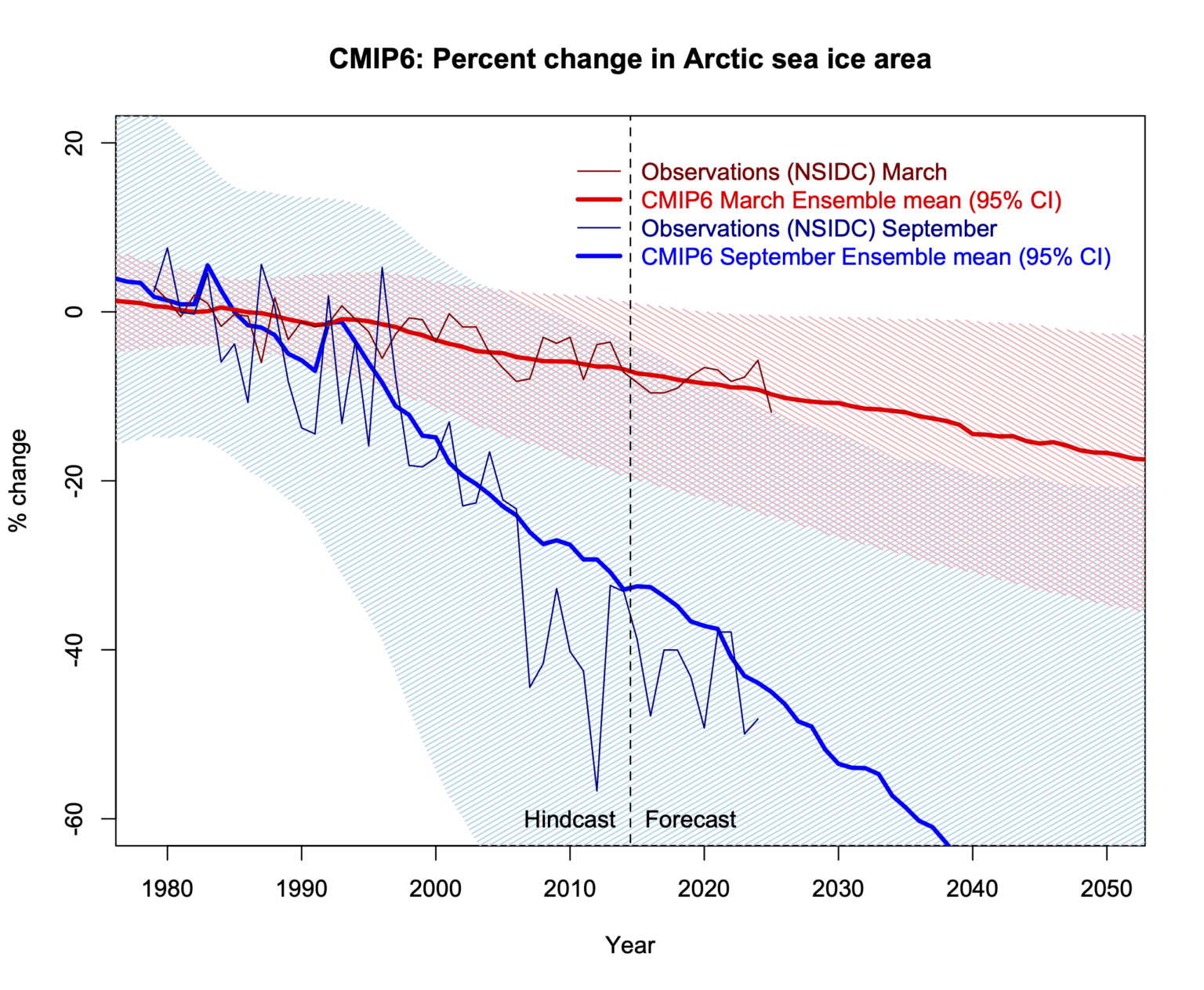
“”‘The CMIP6 ensemble mean for September area trends is now -11 %/decade (observed 13 %/decade) and the March trends are spot on.””” about the following data:
Which seems wrong to me as the assemble mean seems to be plaques with very high uncertainty in the diagram making his statement untrue.. more like -11 %/decade plusminus 10% ..
Taken these three posts together, CMIP6 models models seem very worthless to describe Artic sea ice trends or water phenomena reliable, I don’t see how they could contribute anything meaningful to artic temperature trends, apart from the believe of the experts tuning those models.
There is nothing here that you couldn’t find in any high school news paper. Same old rehashed indoctrination we have been fed for going on a half a century. All of the people at the Department of Energy and NOAA who approved grants for this study should immediately be fired. I’m tired of my money being squandered on crap like this.
The assumption to be revisited is this: ‘According to the climate blob, natural climate variability should be the same at all latitudes, same at all longitudes.’
Is there any evidence whatsoever that this is true?
Is ‘normal climate variability’ the same at 70N as it is at the equator?
Meanwhile, back on planet Earth, Arctic ice extent has averaged the same since 2007.
Notice how now they’re talking about “Arctic amplification” and not “polar amplification.” Must be “regional” warming. 😆😅🤣😂
Yes, because one Pole is at sea level and the other one is over 9000′ above sea level, it makes a difference!
“we could see ice-free summers in the Arctic by mid-century.” I thought that was supposed to happen fifteen years ago. Pigs could fly too.