Steve Milloy
Contributor
Cynical, disaster-seeking climate change hysterics have been pushing, for decades now, a narrative that global warming, especially warming ocean temperatures, increase the risk of hurricane activity. Every year, they seem to be eagerly awaiting devastating superstorms to prove them right. And the 2025 hurricane season looked ripe.
In May, the National Oceanic and Atmospheric Administration predicted a more-active-than-average season (which runs from June 1 to Dec. 1). The Washington Post hyped this prediction into: “The forecast underscored the dangers of a historically active stretch of Atlantic hurricane activity.”
And, indeed, the stage was set for the perfect storm to cause catastrophic impact on the American Southeast: NOAA fretted hurricane-fueling warm ocean waters; the South had just come off of a record year of domestic net migration raising the potential human cost; and climate change-denying President Trump had scaled back the Federal Emergency Management Agency (FEMA) which, alarmists claimed, would significantly hinder disaster response. (RELATED: What Happened To Climate Change, The Existential Threat Of Our Time?)
There was an ominous anniversary, too. Late summer 2025 marked exactly 20 years since the catastrophic Hurricane Katrina hit the Gulf Coast. “Now more than ever, NOAA is prepared for what the hurricane season may bring,” said Laura Grimm, NOAA’s acting administrator, at an event announcing the forecast in Jefferson Parish, La., to mark the 20th anniversary of Hurricane Katrina.”
Yep, the narrative of a disastrous 2025 hurricane season fueled by man-made climate change wrote itself; all the alarmists had to do was wait.
June and July passed quickly and quietly without a single U.S. landfall. August showed promise as Hurricane Erin swelled into a threatening category 5 hurricane. The alarmists manned their stations, and the media began sowing panic over this climate-induced superstorm. Unfortunately for the catastrophists, the storm never got closer than 200 miles from the U.S. coastline.
By early September, the Atlantic was still pitching a shutout. Sept. 10, the day at the center of the peak hurricane window, saw zero hurricane landfalls and no storms on the horizon. No devastating storm has yet hit, and time is running out for the season. There are six weeks remaining. Sure, anything could happen in that time. But so far nothing has.
Instead of just admitting the error of their ways, the climate activists at the Washington Post doubled down this week and claimed that the lack of storms is actually evidence of manmade climate change. This never-admit-error mindset underscores the climate movement’s willingness to twist any outcome into proof of their radical worldview. With them, it’s always: “Heads I win; tails you lose.”
When ideology is put aside and actual scientific principles are followed, the picture is crystal clear: there is no relationship between man-made emissions and increased hurricane frequency, intensity or any other aspect of hurricanes. All hurricane activity remains within the bounds of natural variability, according to NOAA.
Hurricane tracking reveals that there have been no changes in trends, even though man-made emissions have steadily risen during the same period. And while promoters of climate change narratives like to highlight the increased costs in storm damage, they ignore the fact that population growth in coastal regions is the main driver in this phenomenon – not increased storm strength. This is so obvious. Even the Washington Post has had to admit this.
The superstorms that weren’t, serve as a stark reminder: the climate agenda thrives on fear. Rain or shine, the alarmists’ forecast of planetary doom remained the same. In doing so, they show their hand – prioritizing political agenda over evidence. It’s time to separate rhetoric from reality and liberate ourselves from climate hysteria.
Steve Milloy is a biostatistician and lawyer. He posts on X at @JunkScience.
The views and opinions expressed in this commentary are those of the author and do not reflect the official position of the Daily Caller News Foundation.
All content created by the Daily Caller News Foundation, an independent and nonpartisan newswire service, is available without charge to any legitimate news publisher that can provide a large audience. All republished articles must include our logo, our reporter’s byline and their DCNF affiliation. For any questions about our guidelines or partnering with us, please contact licensing@dailycallernewsfoundation.org.
Eftersom uppvärmningen är störst längst i norr av jordklotet minskar temperaturskillnaderna och därmed drivkrafterna för stormar och orkaner! Men det begriper inte de obildade klimathysterikerna!
Please translate!!
my sister was bitten by a moose
Hahaha .. . MP will always make an appearance.
Mind you, moose bites can be pretty nasty.
Shouldn’t that be “mouse?”
After one tornado my hovercraft was full of eels.
Since the warming is greatest in the far north of the globe, temperature differences are decreasing and thus the driving forces for storms and hurricanes! But the uneducated climate hysterics don’t understand that!
Google translate
Swedish to English:
“Since the warming is greatest in the far north of the globe, the temperature differences and thus the driving forces for storms and hurricanes are reduced! But the uneducated climate hysterics don’t understand that!“
Trans: My postilion has been swept from his horse by strong winds.
Because warming stops for a long time in the north of the globe, the temperature decreases in the place of the driving forces of the storm or hurricane! But the uneducated climate hysterics don’t understand that!
Translation:
“Since the heating is greatest in the far north of the globe, the temperature differences and thus the driving forces for storms and hurricanes are reduced! But the uneducated climate hysterics don’t understand that!”
Exactly why despite large increases in wind turbines the UK in 2024 only matched 2022 in making electricity from wind. The gentle warming is slowing average wind speeds.
Per Google translator Swedish to English
“Since the warming is greatest in the far north of the globe, temperature differences are decreasing and thus the driving forces for storms and hurricanes! But the uneducated climate hysterics don’t understand that.”
You’re welcome.
I used Danish to English. Same translation.
From long term records, hurricanes might be declining. The artifacts of more complete detection might be obscuring a decline.
As storms seem to be driven by temperature differences, warming higher latitudes should lead to fewer and/or less intense storms.
The overall temperature of a planet does not matter for same reason altitude does not matter for drop height – It’s about the height difference.
That’s why Jupiter with a temperature of -110 degrees Celsius has an eternal earth sized storm with speeds of 400 mph +.
In fact more climate gas should lead to less storms.
Deserts are very hot during day but very cold during night.
But with a cloudcover the days are significantly cooler and nights significantly warmer.
Seems climate gases are homogenizing temperature and the less temperature extremes the less likely that storms will happen (of course one should not expect anything relevant from an irrelevant 0.01% co2 increase.
Hah . . . it looks like you are referencing the average temperature of Jupiter’s cloud tops, nothing near its famous Great Red Spot!
In fact, according to Google’s AI:
“The atmospheric temperature directly above Jupiter’s Great Red Spot is significantly hotter than the surrounding atmosphere, reaching about 1,300 °C (2,400 °F). This is much warmer than Jupiter’s general atmospheric temperatures, which are around 930 °C (1,700 °F). The Great Red Spot’s storm turbulence and the resulting sound and gravity waves are believed to be the source of this heat.”
Well, there need to be some reference point to begin with
and I used Wikipedia (“hot” jupiter) as starting point,
Btw – I find the gravity wave claim a little bit odd.
If we already have this something causing “waves” with no opposite/equal reaction (+making waves inside something that is supposed to not have any properties on top)
– and then calling this the ” source of energy?
That’s some poor wording.
Even poorer than me using a gas planet and not a solid one as example(but legit in the AGW realm as they also use a gas (atmosphere) and pretend it to have solid properties – those of a greenhouse)
As regards gravity waves and your comment about “no opposite/equal reaction”, you clearly don’t understand the scientific definition of gravity waves in terms of atmospheric phenomena. This reference will help you: https://en.wikipedia.org/wiki/Gravity_wave
The “greenhouse effect” as properly and scientifically used by climate scientists to describe gaseous absorption of LWIR off Earth’s surface and its re-radiation from the atmosphere back toward Earth’s surface is CORRECT. This, from Google’s AI (my bold emphasis added):
“Yes, greenhouse glass absorbs and re-emits infrared (IR) radiation, but the primary reason a greenhouse gets hot is that the glass blocks the outgoing IR radiation from escaping. Visible light enters, warms the interior, and the interior objects then emit heat as long-wave IR. This long-wave IR is effectively blocked by the glass, causing heat to build up inside the structure, while some of the IR that is absorbed by the glass is re-emitted back into the greenhouse.
“This long-wave IR is effectively blocked by the glass, causing heat to build up inside the structure,”
Heat buildup in the atmosphere causes convection. Greenhouse glass blocks the convective transfer of heat.
Hmmm . . . so, no convective heat transfer (must be because there’s no temperature difference!) from the ground level to the top inside height of an everyday greenhouse, eh? Who knew??? /sarc
And of course, as everyone knows, the single-layer pane glass (or even plastic) as used in most private and commercial greenhouses is a perfect insulator that prevents (“blocks” is your word) any heat being transferred off the sides and roof of said structure by means of convection to the outside atmosphere. /sarc
Also it’s funny that you say that heat buildup in the atmosphere causes convection because many others—including top-notch atmospheric physicists—assert that atmospheric convection minimizes heat buildup in the atmosphere. Which is it??? /sarc
Whatever you use to define the volume of a greenhouse, be it glass/plastic/wood/etc, creates a PHYSICAL boundary that limits the transfer of heat via conduction. The atmosphere has no such physical boundary till you reach the vacuum of space.
Convection is caused by a heat from a source creating a temperature gradient. Convection is just a physical symptom of the existence of a heat gradient. The operative word appears to be “buildup”. Heating a metal bar with a torch creates a rise in temperature but it doesn’t cause a “buildup” of heat that remains once the torch is extinguished. It’s the same with the earth. The heat in the metal bar conducts to the surrounding air which initiates convection (ever see heat waves above a campfire?) in addition to the heat loss from radiation. The volume of the air in the workshop is pretty much physically infinite compared to the metal bar just like the atmosphere is pretty much physically infinite to the earth. A greenhouse on the earth would be similar to wrapping the metal bar in asbestos.
It’s always seemed to me that most climate scientists have never spent a single hour actually observing nature. They’ve never once had a “Newton moment”.
The heck you say! You have totally confused the thermal properties of a gas (radiation, conduction and convection) with those of a solid (asbestos).
But please do carry on for the humor involved.
Temperature gradients occur everywhere in nature. Greenhouses “trap” heat by imposing a physical barrier to convection. That is EXACTLY the same as wrapping a metal rod in a physical barrier. You will still have a temperature gradient due to conduction. And the metal rod will still radiate, only the intercepting media of the radiation is different.
“ All hurricane activity remains within the bounds of natural variability, according to NOAA.”
We don’t even know the full bounds of natural variability. We only know the teeny tiny window that we’ve been keeping track of such things.
“…climate change-denying President Trump …. ”
I didn’t think that Mr. Trump “denied” that climate change was happening, just that homo sapiens wasn’t causing it.
Climate Change = Winter changing to Summer and back again.
That is what is happening. No more, no less.
Occasionally, there are hurricane droughts. It’s perfectly normal. Not unprecedented. There was a hurricane drought in the late 1800’s (a warm period), and from 2005 to 2017 (No Cat 3, 4, or 5 hurricanes hit the United States mainland). It’s all part of the natural Earth weather cycle. CO2 has nothing to do with it.
https://www.hometownforecastservice.com/hurricane-drought-hits-a-decade-how-much-longer-will-it-continue/
“In the 10 years since Wilma’s landfall, no hurricanes have struck Florida, and no major hurricanes have struck the United States as a whole. This 10-year lull in major hurricane landfalls is unprecedented since hurricane record-keeping began in 1851. The longest lull on record before this was a 9-year lull between August, 1860 and September, 1869. For Florida, the 10-year drought smashed the previous record of 6 years, set between 1979 and 1985.”
On the little island of Great Britain, the climate changes two to three times an hour. We used to call it weather.
Even the Romans complained about it when they occupied our island.
That’s pretty much everywhere. Everywhere I’ve ever visited, people say “Don’t like the weather? Wait 5 minutes”.
Oh no! The children aren’t going to know what hurricanes are. Think of the children!
Aaah, but by blaming every hurricane on Climate Change you begin to convert the youth (who haven’t experienced past storms) into true believers and acolytes of the Climate Brigade
A few days ago I promised to provide a link to this one:
The U.S. coast is in an unprecedented hurricane drought – why this is terrifying –
The Washington Post August 4th 2016
Hmm link crashed try HERE
The 2005 to 2017 hurricane drought (no Cat 3, 4, or 5 hurricanes hitting the U.S. mainland) is not the first hurricane drought in history. The Washington Post writers should see my link above to previous hurricane droughts.
Weather History Refutes “Unprecedented” in almost every case. Weather events that happen today, also happened in the past and CO2 has no connection.
“the Washington Post doubled down this week and claimed that the lack of storms is actually evidence of manmade climate change”
Yikes, real nut jobs!
It’s all in the name-change…
I wonder how namechange-deniers will respond.
Maybe Hurricanes don’t come around no more because they can no longer use pronouns and are now migrating to Europe and Canada.
Dave, wish I had thought of that. Clever and true.
I found it on Facebook…
Yeh, that’s good but we need rain in the northwest Gulf for the heat and drought. Something screwy here, too many fronts in August, is the allotment gone? Must be changing names causes trouble.
I love it! 🙂
At this point, it would take a hurricane here in the northeast US to get rid of the drought. Fat chance of that happening though.
Hmmm . . . I heard it was a nor’easter that did that for you quite recently. Lots of TV news of flooding there last week, from South Carolina up to Massachusetts.
Maybe I was misinformed . . . you know, NOAA desperately needing to rebrand it as a tropical storm.
It barely gave NH anything. I don’t know about Mass. Closer to the coast maybe.
Ummmm . . . New Hampshire is north of Massachusetts, and your OP only mentioned “the northeast US”.
New Hampshire has coastline along the Atlantic Ocean, as does Massachusetts.
Then there is this from Google’s AI:
“New Hampshire was impacted by flooding from a powerful nor’easter that hit the northeastern United States in mid-October 2025. The state experienced heavy rainfall and faced a flash flood threat during the storm.
“Key impacts in New Hampshire included:
— Flash flood threat: During the storm, parts of New Hampshire were placed under a Level 1 out of 4 flash flood risk by the NOAA’s Weather Prediction Center . . .
—Coastal flooding: Other parts of New England experienced coastal flooding from the storm’s powerful winds and storm surge, which drove water onshore.”
Didn’t Vermont already get its 5-year allotment of rain around Ludlow?
Watch for it . . . coming soon: NOAA claiming that they could “get it right” if they just had more powerful supercomputers for modeling weather, in particular hurricanes.
This despite the following (apologies for reposting, but it bears repeating):
This current miss, despite the two multimillion dollar-per-year Weather and Climate Operational Supercomputing System (WCOSS) supercomputers used by NOAA, each operating at 14.5 petaflops, or 14.5e15 floating point operations per second. (source: https://www.noaa.gov/news-release/noaa-completes-upgrade-to-weather-and-climate-supercomputer-system ).
“The current government contract award to General Dynamics Information Technology for the WCOSS supercomputers and their designs, deployments, and management is stated to be $505 million over a potential 10-year period.” (ref: https://www.gdit.com/about-gdit/press-releases/noaa-awards-general-dynamics-high-performance-computing-contract ).
Of course, the quality of the output from supercomputers modeling weather or “climate”, particularly tropical storms, is only as good as the “science” that goes into programming them and the “data” they are fed. In this case, it appears the NOAA supercomputer outputs are pretty much equivalent in uncertainty to just predicting the expected number of storms (in each category listed) using statistical analysis (the mean and 2-sigma statistics) of the last four years of tropical storm data.
That is, the predictions might as well have been done using an Excel program on a $500 laptop computer.
You don’t even need a laptop to declare it’s going to be a higher than normal hurricane season. They make this same claim every year.
When was the last time NOAA claimed there would be a lower than normal hurricane season?
NOAA is a stuck record (the Youts may have to google that one:).
I guess I ought to help them out. Here’s the meaning:
“Origin
early 20th century: with reference to a scratched [circular, vinyl] record that sticks at a particular point when played and constantly repeats the same passage.”
Reduced Zonal winds = Reduced Hurricanes
https://ozonewatch.gsfc.nasa.gov/meteorology/figures/merra2/wind/u60s_100_2025_merra2.pdf
From my readings here and else where I learned that tropical cyclones are driven by sea surface temperatures. Also that air has a minuscule heat content versus water and therefore cannot drive sea surface temperatures.
Dry air has a
What is the heat capacity of dry air vs humid air?
where 1.005 kJ/kg°C is the heat capacity of dry air, 1.82 kJ/kg°C the heat capacity of water vapor. water has to absorb 4,184 Joules of heat (1 kilocalorie) for the temperature of one kilogram of water to increase 1°C.
BTW 1 kg of air = 820 liters
The sun puts the energy into the oceans.
Air temperature plays a large role in how fast that energy is removed from the oceans.
In contrast:-
‘The average Pacific hurricane season has an ACE index between 80 and 115, based on the 1991-2020 period. This average is for the combined activity of the eastern and western Pacific basins, and it corresponds to a season with roughly 15 named storms, 8 hurricanes, and 4 major hurricanes.’
Already above average.
https://en.wikipedia.org/wiki/2025_Pacific_hurricane_season
Last year, the Pacific was eerily quiet.
Apparently, CO2 molecules slosh back and forth between the Atlantic and the Pacific … or CO2 is NOT the control knob for hurricanes.
That doesn’t count. You only look at years that support the narrative.
I just went and looked up the ACE for 2025.
The North Atlantic is at 109% YTD, and is the only area in the northern hemisphere that is above the mean. The Bermuda High tossed several powerful storms into the northern latitudes instead of crashing them into the U.S.
Sounds like a good deal to me!
Yes, there’s this weird idea that’s included in the original post that hurricanes only count if they hit the US! Currently there’s a category 5 hurricane moving towards Jamaica and the ACE for the Northern Atlantic is above average. Three Cat 5 storms in a year is significant, the US has been fortunate that this year all the storms have moved offshore, the predicted storm surge of about 10′ in Jamaica and Cuba would have made a mess of Florida.
Busy hurricane season -“climate change, climate change, climate change!”
Quiet hurricane season – ::crickets::
Yeah, we haven’t heard much out of the Climate Alarmists this hurricane season.
Nothing to alarm people about. This must be difficult for the Climate Alarmists. They had such high hopes.
The Katrina reference sure took me back, to a time before I began to visit this site. Back in 2006, I did not understand the science well enough to grasp the scam, but it seemed like just another enviro bollox. Al Gore lost in 2000 when he tried to avoid his AGW past, and he spent the next several years going extra hard on tying hurricanes to AGW. As I recall, when Karina hit, Gore was getting full throated with the claim, “this is what global warming looks like.” This PR campaign was ready to pounce when …….. a hurricane drought happened! Dammit said the enviros. Gore was pushing for EPA to tie CO2 to hurricanes, by 2009 it had fallen apart. The whole scam could have toppled over back then if Obama hadn’t imposed a CO2 finding on an unsuspecting public.
How can this be happening when the career alarmists have been virtually guaranteeing that extreme violent weather will be becoming not only annual affairs but also increasing in number? These events would include not just tropical storms in the hurricane, cyclone, typhoon category but also tornadoes, thunderstorms, waterspouts, torrential rains, blizzards and anything in between. The reality is that these are still occurring but no more than as regularly as before the climate hysteria began. They may seem more frequent because as populations grow and and land areas become more built up, the likelihood of people and structures being adversely impacted grows along with it and damage/rebuilding costs rise accordingly. Yet the climate crisis club members will continue to insist such weather extremes have become the new normal as well as more frequent, and if they don’t occur in one year or region, it’s only a matter of time before they do.
Consider also that there is much more media “coverage” of any such incidents. The narrative must be supported at any cost, so any little CCW circulating thunder-bumper in the tropical Atlantic gets blown out of proportion, and breathlessly “tracked” as the next Cat Six or Seven or Eight (or even ’42’) hurricane to cause unimaginable devastation to … … … … … someplace … … … … …
As someone who until a few weeks ago lived permanently on the ocean in Fort Lauderdale, I have over the years paid special attention to hurricane forecasts and hurricanes themselves.
Both NHC and Colorado forecast an above average hurricane season based on warmer than normal SST and neutral ENSO. Both were true. BUT this year there was a confounding factor. There was way above average Saharan dust blowing all the way across the Atlantic. Resulted in some unusual ‘reddish skies’ and spectacular sunsets on the beach in Fort Lauderdale. I knew then the hurricane forecasts would be wrong, because that dust indicates strong upper level wind shear that ‘kills’ hurricane development.
non-linear, chaotic comes to mind.
The Harmattan must be out of phase. Carbon Dioxide is the can-do anything molecule.
Even after downgrading the initial forecasts, they were still too high.
Very nice Steve, always nice to see you here at WUWT.
Isn’t “climate change” rather than natural variation the default explanation for deviations from the mean?
It is for Climate Alarmists. By “climate change” Climate Alarmists mean Human-caused Climate Change.
There is no evidence that climate change is anything other than natural variation.
I see what you did there with the dooming-
Sea levels are rising faster than at any time in the last 4,000 years. Here’s why
COP30 kneesup coming.
LOL.. Coastal geomorphology on many coast around the world shows that sea levels were a couple of metres higher than now only a couple of thousand years ago.
The sea level has only been rising since the LIA… and at pretty much a constant rate.
And there is ABSOLUTELY NOTHING anyone can do about it. !!
Thanks bnice2000 for the timely reminder of the obvious evidence from physical geology.
Commonplace (worldwide) wave-cut terraces in coastal limestone deposits that consistently produce C14 ages in the 3000-6000 year range are located several meters ABOVE the modern shoreline.
Mountain glaciers were also smaller (or non-existent) during the same time period – referred to as the Holocene Climactic Optimum.
The world overall has been cooling since that time to the middle 1800s (Little Ice Age), from which every living thing has benefitted from a little itty-bitty warming.
Changes in atmospheric CO2 FOLLOW these naturally-caused temperature changes, providing further evidence that CO2 has no influence on global climactic variation. This trace gas is an indicator, not a precursor, to climate change – always has been, always will be.
No single hypothesis has been adequately tested against paleoclimate data to explain these changes in global temperature trends (warming vs cooling), although combined influences of orbital changes and solar power output are most promising change-makers.
However, we can categorically say that the “CO2 Control Knob” hypothesis has utterly failed to explain millennial climate variations. Despite wasting over a trillion dollars in human productivity in all attempts to “prove” it.
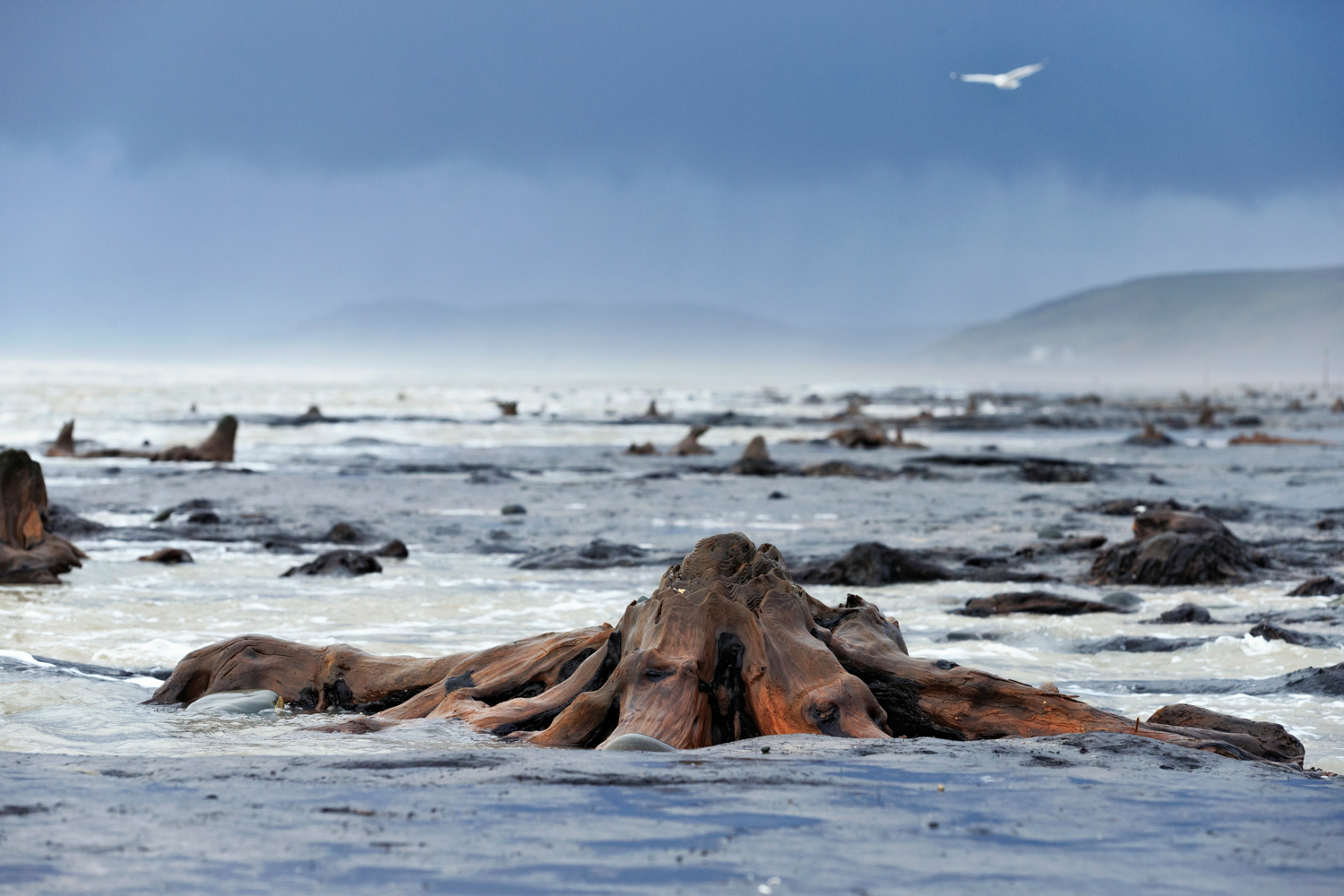
The Welsh legend, Cantre’r Gwaelod, refers to the flooding of land between the Welsh coast and Ireland. Recent storms uncovered the remains of a forest off that coast which has been dated as from 1500BCE so the sea level off Wales was a few metres lower 4000 years ago.
 ?width=929&height=619&mode=max