
Abstract
Rivers and streams are an important pathway in the global carbon cycle, releasing carbon dioxide (CO2) and methane (CH4) from their water surfaces to the atmosphere1,2. Until now, CO2 and CH4 emitted from rivers were thought to be predominantly derived from recent (sub-decadal) biomass production and, thus, part of ecosystem respiration3,4,5,6. Here we combine new and published measurements to create a global database of the radiocarbon content of river dissolved inorganic carbon (DIC), CO2 and CH4. Isotopic mass balance of our database suggests that 59 ± 17% of global river CO2 emissions are derived from old carbon (millennial or older), the release of which is linked to river catchment lithology and biome. This previously unrecognized release of old, pre-industrial-aged carbon to the atmosphere from long-term soil, sediment and geologic carbon stores through lateral hydrological routing equates to 1.2 ± 0.3 Pg C year−1, similar in magnitude to terrestrial net ecosystem exchange. A consequence of this flux is a greater than expected net loss of carbon from aged organic matter stores on land. This requires a reassessment of the fate of anthropogenic carbon in terrestrial systems and in global carbon cycle budgets and models.
The recent Nature study titled “Old carbon routed from land to the atmosphere by global river systems” is not only a rigorous piece of scientific work—it’s also a spectacular indictment of the so-called “settled science” of climate change. This 2025 paper is a flaming arrow into the heart of carbon cycle certainty, unearthing yet another inconvenient truth: over half of the CO2 emitted from rivers comes from carbon sources that are hundreds to thousands of years old—not from recent fossil fuel emissions or current biological activity.
Let that sink in. Climate models and carbon budgets, paraded as settled science by every bureaucrat, green politician, and eco-apocalyptic influencer on Earth, have been built on the foundational assumption that riverine CO2 is part of a contemporary, short-term biosphere loop. Turns out, they’ve been routing old ghosts through a new story.
According to the authors:
“The largest proportion (52 ± 16%) of river CO2 emissions is sourced from millennial-aged carbon…” and “7 ± 1%…from petrogenic carbon” .
That’s right. Over half of these emissions are from old carbon stores—carbon that, until now, was presumed stable, buried, and irrelevant to modern emission tallies. In other words, nature has its own deeply entrenched carbon leaks, and our modern instruments are just now getting around to noticing them.
The implications are vast and devastating—to the credibility of those who have weaponized science to promote radical climate policy. Here are a few of the most laughable consequences of this study for the “settled science” narrative:
1. The Carbon Budget Is a Fantasy
The entire idea of a “carbon budget” depends on the assumption that we can accurately track all natural and anthropogenic carbon sources and sinks. The paper’s authors explicitly state:
“This previously unrecognized release…equates to 1.2 ± 0.3 Pg C yr⁻¹, similar in magnitude to terrestrial net ecosystem exchange”.
Translation: We were missing a carbon leak as big as the net carbon uptake of all land-based ecosystems. That’s like losing a financial ledger entry equivalent to your annual revenue and still claiming your books balance.
2. Climate Models Can’t Model What They Didn’t Know Existed
This isn’t a rounding error. This is a previously invisible carbon flux at a planetary scale—entirely omitted from mainstream Earth system models. The authors even note:
“Current numerical models of river carbon transport and emission also fail to account for inputs from old carbon sources”.
For those of us who have long argued that climate models are glorified curve-fitting exercises based on selectively tuned assumptions, this study is pure vindication. It’s an outright admission that the models are not merely imperfect—they’re structurally blind to major natural processes.
3. Climate Science Is Still in Diapers
If 59% of riverine CO2 emissions come from millennial or older carbon pools, then just how settled can the science be? The authors describe this as a “planetary-scale release” of old carbon and conclude:
“We provide evidence for a previously unrecognized, planetary-scale release of old, pre-industrial-aged carbon from land to the atmosphere through rivers”.
Imagine building a trillion-dollar global policy framework on a dataset that left out half the equation. It would be funny if it weren’t tragic.
4. Anthropogenic Carbon Attribution Is Now a Shell Game
One of the central talking points of climate activists is that CO2 in the atmosphere is traceable and largely caused by human emissions. This study kicks that stool out from under them. After adjusting the models to include this new understanding, the study finds that only:
“41 ± 16% of river CO2 emissions…could contain recent anthropogenic-derived carbon”.
That means nearly 60% of river-based CO2 emissions are from carbon predating modern industrial activity. This calls into question the accuracy of anthropogenic attribution models—models which governments use to justify taxes, regulations, and top-down restructurings of energy and agriculture.
5. So Much for Predicting the Future
The authors admit they don’t know whether the increase in old carbon emissions is from natural variability or anthropogenic disturbance. In their own words:
“Whether or not anthropogenic perturbation has increased the leak of old carbon…remains a notable knowledge gap”.
Yet we’re told with absolute certainty that the Earth will warm by 1.5°C unless we ban gas stoves, eat bugs, and shut down reliable energy. This study exposes just how deeply uncertain and unresolved the feedbacks in the carbon cycle remain.
6. Rivers: Nature’s Carbon Cheaters
The new conceptual model developed in this paper (see Fig. 3b on page 13) is a quiet revolution. It admits that the traditional model of river emissions—where CO2 was thought to be recent and local—is deeply flawed. Instead, rivers act as carbon transport systems, redistributing ancient carbon from soils, rocks, and geologic layers into the atmosphere. That’s not just a different magnitude—it’s an entirely different mechanism.

7. Policy Has Left Science Behind
The study’s authors call for a reexamination of the terrestrial carbon sink and the role of rivers, noting:
“This fundamentally changes our inference of where anthropogenic carbon resides within the main Earth system carbon reservoirs”.
But don’t expect the IPCC, Net Zero campaigners, or ESG investors to acknowledge this. Their policy steamrollers are already in motion, powered by inertia and political leverage rather than scientific humility.
This study is a torpedo below the waterline of climate orthodoxy. It makes it painfully clear that we don’t understand the Earth’s carbon system nearly well enough to justify radical economic and societal upheaval. The confidence of climate alarmists—built on the brittle scaffolding of incomplete data and overconfident models—has once again been exposed for what it is: performative certainty.
To call climate science “settled” in the wake of this paper is not just intellectually lazy—it’s laughable. It’s the scientific equivalent of declaring victory halfway through a chess match while ignoring that your queen is missing and half your pawns are spies. The river CO2 study is not a minor correction. It’s a flashing red light that we’re still flying blind.
So the next time someone tells you the science is settled, ask them if they’ve heard of F¹⁴C. Then sit back and enjoy the silence.
Discover more from Watts Up With That?
Subscribe to get the latest posts sent to your email.

Oops?
Rivers and rain erode carbonate rock? Who knew?
Put the geologists on trial to find what they knew and when they knew it.!
Second abstract sentence. Must be the result of Affirmative Action (Equal Stupidity) training. Sorry but they need more decimal places. “Until now, CO2 and CH4 emitted from rivers were thought to be predominantly derived from recent (sub-decadal) biomass production and, thus, part of ecosystem respiration3,4,5,6.”
Seriously, how many of these (adjective?) ‘scientists’ get all their training in the office? “…greater than expected…” Every (?) paper with these ‘ad hoc’ conclusions are worthless?
This is a swing and a miss. Strike 3. You’re out.
The question all climate scientists must now ask is: “Is it worse than we thought?”
Hi, Charles. I really appreciate your explanation of the importance of this paper and what it means to the larger issues. Thank you.
Kenneth, this paper has no impact on the larger issues. Charles was right all along, and the “anthropogenic carbon skeptics” are wrong.
This study does not imply that we’ve misunderstood the evidence that the ongoing rise in CO2 is anthropogenic. It just adds some details to our understanding of natural carbon fluxes. It has no impact on how we know that the ongoing rise in CO2 level IS due to human CO2 emissions.
The evolution of the 12C:13C:14C isotope ratio is not what tells us that the current CO2 increase is of human origin (mostly from “fossil CO2”). That fact is known from mass balance calculations. The evolving isotope ratios are consistent with that fact, but not how we know it.
The 12C:13C:14C isotope data gives us clues about the workings of the carbon cycle: i.e., where natural CO2 emissions come from, where CO2 leaving the atmosphere goes, how fast carbon is exchanged between “carbon reservoirs,” what the various “lifetimes” of carbon in the atmosphere are, etc. But the isotope data is merely a “consistency check” w/r/t the fact that mankind gets the credit for the ongoing rise in CO2 level. That fact is known from mass balance arithmetic.
All carbon fluxes, both natural and anthropogenic, have the potential to affect isotope ratios. For example, CO2/carbon from fossil fuels is slightly depleted in 13C, and almost completely depleted in 14C. In contrast, although CO2 from recent biomass decay is likewise slightly depleted in 13C, it is not depleted in 14C.
So CO2 from different sources affects the isotope ratios of CO2 in the atmosphere differently. But those effects do not call into question the fact that the ongoing rise in atmospheric CO2 concentration is due to human CO2 emissions. Were it not for those human emissions, the atmospheric CO2 level would be falling, initially at a rate of roughly 2.5 ppmv/year, rather than rising. (Unlike the ongoing rise in CO2 levels, that would be a real problem!)
WoW!
Failure to understand the system you are modeling extends to other factors as well. Just one example is Clouds where they don’t know the sign of the impact let alone the magnitude, and Clouds are the No. 2 most important variable in GCM’s.
How do you model something that has things like summer on half the globe and winter on the other half with different variances?
It would be like modeling an automobile engine horsepower average using old Ford 289 engines and Chrysler 426 hemi engines.
I owned a ’66 426 Hemi Belvedere and can assure you that that engine was highly underrated for HP!
We really don’t know clouds at all.
“For those of us who have long argued that climate models are glorified curve-fitting exercises based on selectively tuned assumptions, this study is pure vindication.”
Calling “climate science” science is a canard of monstrous proportion. Curve fitting is *NOT* science. Curve fitting does nothing to identify functional relationships. Without functional relationships there can be no objective attribution for any factor.
Well said.
I’ve always said that “climate science” is an oxymoron.
“Climate” is to science as “witch” is to doctor
I’ve always asked where one could go to university to get a degree in “climate science.”
Given the vast number of science and engineering specialties needed, it would take more than a lifetime to master them all.
You do what most ‘climate scientists’ have done. You train for a discipline such as geophysics, declare yourself to be a climatologist, and then look for someone to hire you who will give you that job title.
The best “climate scientists” are English majors.
A study about atmospheric river bombs delivering blue energy to the existential crisis would force excess funding.
While the petagram (Pg) is an unfamiliar unit, it is equivalent to a gigatonne (1 billion metric tonnes) commonly used to measure anthropogenic CO2 emissions from fossil fuel combustion, which have been running at about 37 Gt/yr of CO2 in recent years (2022 figures).
According to the article, about 1.1 Pg/yr (or Gt/yr) of carbon (not CO2) comes from “millenial” (old) organic sources in rivers, and 0.9 Pg/yr comes from “decadal” (new) organic sources.
The referenced article states: “Here we combine new and published measurements to create a global database of the radiocarbon content of river dissolved inorganic carbon (DIC), CO2 and CH4.”
It would be important to know how much of this “carbon” was emitted as either CO2 or CH4 (methane). The “millenial” carbon of 1.1 Gt/yr would correspond to 4.03 Gt/yr of CO2 or 1.47 Gt/yr of methane, although methane absorbs more IR radiation than CO2 per kg in the atmosphere.
As CO2, emissions from rivers would represent about 11% of world anthropogenic CO2 emissions, which is significant, but not an overwhelming natural source of CO2.
As methane, the 1.47 Gt/yr would probably be more than total methane emissions from livestock flatulence that some alarmists are worried about. Why should we do away with raising cattle for food when more methane gets into the air from anaerobic rotting of centuries-old organic matter from swamps, which environmentalists call “protected wetlands”?
Wait for the tundras to emit CH4, which converts to CO2 in the atmosphere.
All it takes is a bit of lightning.
Climate model understanding and representation of the hydrological cycle is elementary. Where the models elect to start, stop and timestamp their hydrological metrics is full of holes. A continuum of processs that do no obey grid world framework in space or time. Postulate that Warmer temps = hydrological intensification? ….more likely more water in atmosphere for solar radiation to activate = warmer temps registered.
Always found it fascinating that they could model molecular interactions on a 25 km grid.
Excuse me if my cynicism shows but after decades of AGW I see this important work totally ignored, attacked for some spurious reason, and denied the light of day in the MSM/Marxists.
Clearly climate researchers have never walked on the beach in Ventura or Santa Barbara where “ancient carbon” gets all over your feet. Seriously I used to think things like erosion or seepage were just examined and discarded as significant factors. Of course these are the same people who don’t bother with clouds.
They are too busy sitting in front of computer screens to get up and look at the real world.
I recall weather reports given followed by people calling in suggestion the announcer look out the window.
Some meteorologists actually go outside and look at the weather.
Meteorologists are more practically oriented than self-named Climate scientists.
After all if they get the 3 day forecast wrong, they will hear about it, loudly.
WE recently described a very important emergent phenomenon on a seasonal hemispheric basis that from first principles cannot be modeled—so is ignored.
This new paper that CR highlights describes something major in the carbon cycle that could have been modeled—but wasn’t.
Little wonder EVERY major climate model ‘prediction’ has turned out wrong.
Bonkers.
“This is because since regional, they run on 2-4km grid scales that can actually model important phenomena like convection cells.”
They’re also updated with new observational data every 2-4 hrs. Absent that, model projections quickly diverge from the developing weather.
And even with the updates, they often get the regional rain predictions wrong right up to the time it is supposed to rain.
Regional versus local. Local is a crapshoot. Regional is covered with the 90% (or whatever) probability of rain, meaning there is a 90% probability that somewhere in the region it will likely rain.
Has this study gone through the ‘official’ peer review processes and been accepted, or is it a ‘non-conformant’ document, that will be blocked by the Jones/Mann process?
I sure hope it’s the former.
Have you considered clicking on links?
It says it in the 1st part where the authors are listed
Nature vol 642
Did you not read the article and check the links in the Nature paper?
Peer Review File
The interesting aspect of this study is their claim that much of the CO2 outgassed from rivers is “old” carbon (which is somewhat depleted in 14C). Their estimate for the total flux is only a little higher than most other estimates.
I don’t like this apples-to-oranges comparison in the abstract:
“This previously unrecognized release of old, pre-industrial-aged carbon to the atmosphere from long-term soil, sediment and geologic carbon stores through lateral hydrological routing equates to 1.2 ± 0.3 Pg C year−1, similar in magnitude to terrestrial net ecosystem exchange.”
The problem is that that comparison ignores CO2 uptake by rivers. It compares a ONE-WAY flux of CO2 (from rivers) to NET flux (net uptake) by the terrestrial biosphere & soils. That makes it sound like this represents a major departure from current carbon accounting, which might have a significant effect on CO2 “adjustment time” (effective atmospheric lifetime) estimates. But it doesn’t.
The main text of the paper says:
“Globally, rivers and streams emit an estimated 2.0 (1.6–2.2) Pg C year−1 to the atmosphere as CO2, …. These carbon emissions are equivalent to 59% of net terrestrial carbon uptake (net ecosystem exchange) or about 1.8% of terrestrial gross primary production (GPP).”
Those percentages are a bit too high, and I’d say that calling it “similar in magnitude” is a stretch. Here’s how they compare:
1.2 ±0.3 PgC/yr = the authors’ estimate for “old” CO2 from rivers (this paper)
2.0 (1.6–2.2) PgC/yr = the authors’ estimate for total CO2 from rivers (this paper)
1.0 PgC/yr = AR5’s estimate for freshwater outgassing (lower than this paper)
118.7 PgC/yr = AR5’s estimate for CO2 from the terrestrial biosphere (respiration & fire)
123 PgC/yr = AR5’s estimate for CO2 uptake by the terrestrial biosphere (photosynthesis)
(123 – 118.7) = 4.3 PgC/yr = AR5’s estimate for net uptake by the terrestrial biosphere
Here’s the AR5 diagram:
https://sealevel.info/WGI_AR5_Fig6-1_errata_with_caption_50pct.html
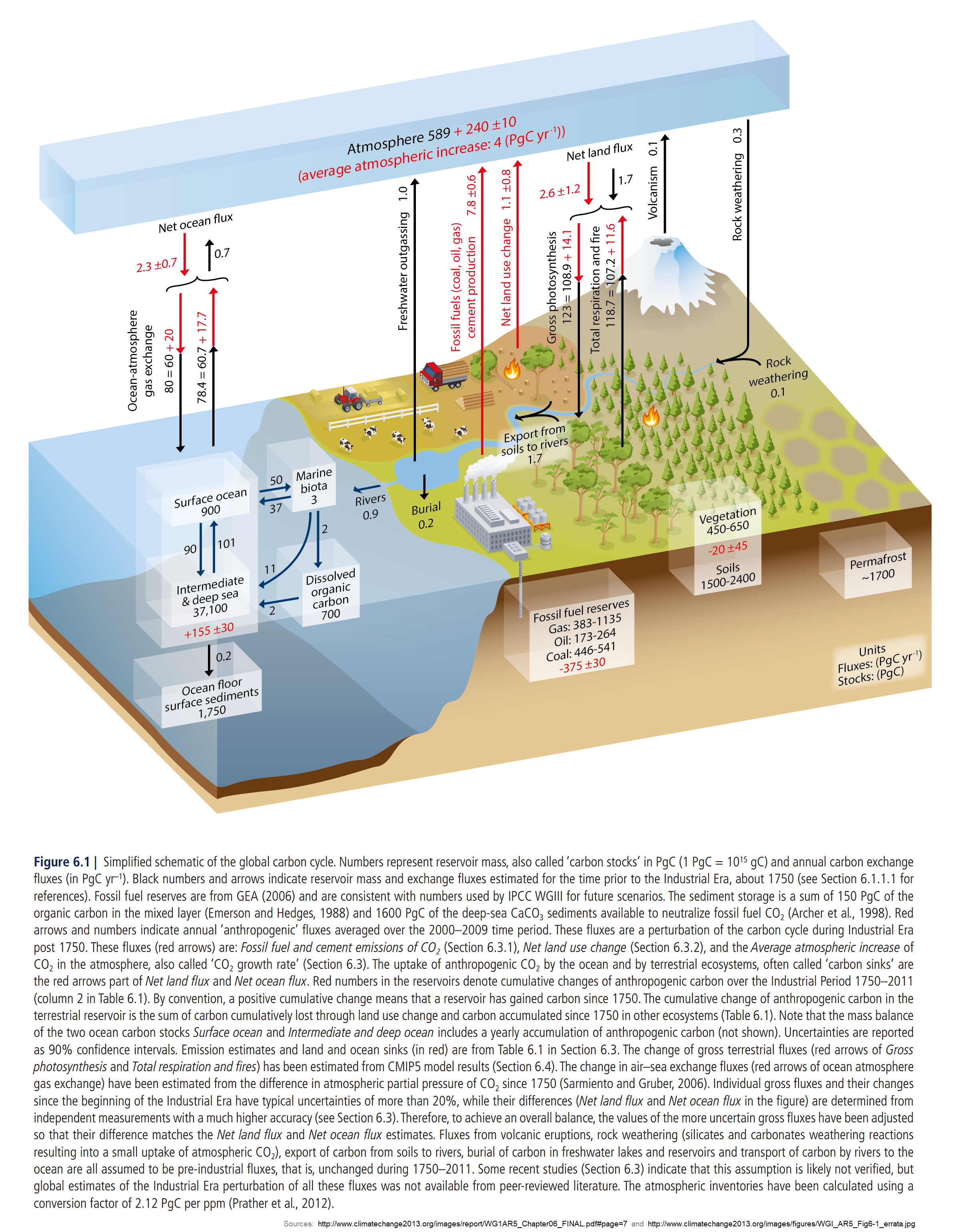
AR6 reports somewhat higher figures (Fig. 5-12), but IMO the diagram is less clear:
https://www.ipcc.ch/report/ar6/wg1/figures/chapter-5/figure-5-12

That diagram shows:
1.5 PgC/yr = AR6’s estimate for freshwater outgassing (a bit lower than this paper)
(111.1+25.6) = 136.7 PgC/yr = AR6’s estimate of CO2 from terrestrial biosphere (respiration & fire)
(113+29) = 142 PgC/yr = AR6’s estimate of CO2 uptake by terrestrial biosphere (photosynthesis)
(142 – 136.7) = 5.3 ±0.9 PgC/yr = AR6’s estimate for net uptake by the terrestrial biosphere
AR6 table 5.1 estimates net terrestrial carbon uptake (all sources & sinks) at 3.4 PgC/yr:
If GPP is 142 PgC/yr (per AR6), then 2.0 PgC/yr = 1.4% of GPP, not 1.8%.
(If they used AR5’s figure of 123 PgC/yr, then 2.0 PgC/yr = 1.6% of GPP.)
(Also, 2.0 PgC/yr is only 38% of 5.3 PgC/yr, not 59%.)
Old carbon v, new carbon. Have posted this before, worth in my opinion a repeat. There are three carbon isotopes, 12, 13, and 14. This used 14C, a very well known radioactiave decay time proxy. But the atmosphere is actually mostly stable isotopes12C/13C. Because 13C is heavier, it accumulates slower in photosynthesis, so as carbon is geologically sequestered the atmospheric 13C ration increases. But now it is decreasing. Meaning geologically stored 12C carbon (via fossil fuel combustion) must be increasing.
But on these time scales, given this new carbon cycle uncertainty, nobody really knows. So I retract my previous post ‘certainty’ on the 12C/13C recently changed anthropogenic ratio “certainty”. Dunno is where I started here 24 years ago. Since these now measured river mechanisms mess the whole calculation up by half.
Not necessarily. That is only one possible interpretation. Every time carbon-compounds participate in endothermic phase changes or chemical reactions, the lighter 12C will be favored for isotopic fractionation because it will take less energy for the 12C to participate. That is, the lighter carbon dioxide containing 12C will be favored for out-gassing in warm water, increasing the 12C/13C ratio in the atmosphere.
Dormant boreal trees in the Actic respire CO2 from their roots when there isn’t sufficient light for photosynthesis. One can expect that the CO2 is going to look a lot, isotope wise, like the CO2 acquired through photosynthesis, if not further enriched in 12C by the respiration. If the ground and sugar-rich sap freeze, the respiration will stop. One can expect that because the Arctic is warming, the boreal trees will be contributing more respired CO2 than they did a century ago.
That is, the two above processes will be shifting the atmospheric carbon isotope ratios to look more like the combustion product of fossil fuels.
I suspect that what is happening is a mixture of Henry’s Law, CO2 greening, and warming increasing the rate of biogenic production of CO2, all contributing to a shift in isotope ratios. However, with the focus on anthropogenic emissions, it may be a while before we know the relative contributions from all the possible contributors.
We needn’t rely on isotopic analysis to know that human emissions are the cause of the ongoing (beneficial!) increase in atmospheric CO2. Simple “mass balance” arithmetic proves it:
tl;dr:
Mankind is adding CO2 to the atmosphere.
Nature (the net sum of all natural “carbon fluxes,” positive & negative) is removing CO2 from the atmosphere.
Mankind is currently adding CO2 faster than Nature is removing it, so the amount of CO2 in the air increasing.
tl;dr + numbers:
Mankind is currently adding CO2 faster than Nature is removing it, so the amount of CO2 in the air increasing. Measurements show that it is increasing by about 2.5 ±0.1 ppmv/year.
Mankind is adding 4.7 ± 0.5 ppmv/year of fossil CO2 to the atmosphere, plus 0.5 ±0.3 ppmv/year CO2 from “land use changes” (clearing forests and draining swamps). That increases the amount of CO2 in the air by 4.4 to 6.0 ppmv/year. (The fossil CO2 figures are calculated from economic data: the amount of coal, oil & natural gas produced and burned.)
The difference between those two numbers is the rate at which nature is removing CO2 from the atmosphere: (5.2 ±0.8 ppmv/year) – (2.5 ±0.1 ppmv/year) = 2.7±0.9 ppmv/year.
The isotope data is consistent with that. To learn the details see:
Engelbeen F, Hannon R, Burton D (2024). The Human Contribution to Atmospheric Carbon Dioxide. CO2 Coalition. https://doi.org/10.31219/osf.io/het6n
The unstated, and therefore unexamined assumption is that we are certain that there are no natural sources of carbon dioxide that are increasing. The mass balance argument fails if there is a contribution that isn’t accounted for. I have made the case that the seasonal variations are biogenic in origin. Therefore, if warming is contributing to a longer growing season, which appears to be the case, then there will be a larger food source for bacteria and fungi to turn into CO2. Similarly, if there are more days in the year that boreal trees can respire because it is warming, then the trees will produce more CO2. Those sources are not addressed.
You also did not address my logical argument that isotopic fractionation drives the atmospheric concentration to resemble fossil fuel dilution.
https://wattsupwiththat.com/2021/06/11/contribution-of-anthropogenic-co2-emissions-to-changes-in-atmospheric-concentrations/
Clyde, there is no “assumption is that we are certain that there are no natural sources of carbon dioxide that are increasing.”
That would be a very silly thing to believe. I’ve never heard anyone claim or assume that. I doubt you have, either! Can you cite ANYONE claiming that?
No, there is only the proven fact that the net sum of ALL natural sources and sinks of CO2 is negative. In other words, nature (= the net sum of all natural sources and sinks) is removing CO2 from the atmosphere, not adding it.
I could name several natural CO2 sources which I’m confident have increased. So what? There’s nothing remarkable about that. Natural CO2 sinks have increased faster.
Nature is removing CO2 from the atmosphere, and mankind is adding it.
If nature were not removing CO2 from the atmosphere, or even if nature were merely removing CO2 from the atmosphere more slowly than mankind is adding it, then the CO2 level in the atmosphere would be falling, rather than rising.
None of those facts depend on isotopic analyses. We know those facts from straightforward mass balance arithmetic:
A. Calculations of human CO2 emissions start with economic data on production & use of coal, oil & natural gas. For example, CO2 is (12.0107/44.0095) = 27.29115% carbon by weight, so if you fully burn 1 tonne of 94% carbon anthracite coal, 0.94×44.0095/12.0107 = 3.444 tonnes of CO2 are emitted.
B. The calculations of how much the amount of CO2 in the atmosphere changes are even simpler. We know the mass and composition of the atmosphere quite precisely, from which we can determine that 1 ppmv CO2 = 7.8024 Gt CO2 = 2.12940 PgC. We have had very precise measurements of atmospheric CO2 since 1958. From that we can determine the rate at which the CO2 level is rising.
The net rate of natural CO2 removals is A minus B.
The fact that A > B means that that nature is removing CO2 from the air,
Removing CO2 from the air cannot increase the amount of CO2 in the air.
∴ Nature cannot claim the credit for the ongoing (beneficial) rise in atmospheric CO2.
There are many natural sources and sinks of CO2, with varying 12C:13C:14C isotope ratios. Papers like this one, about the isotopic composition of one of the natural CO2 sources, and its precursors (the “sources of the source”), are mildly interesting, but they do not cast doubt on the proven fact that the reason the CO2 level in the atmosphere is rising is that:
Mankind is adding CO2 to the atmosphere.Nature is removing CO2 from the atmosphere.Mankind is currently adding CO2 faster than Nature is removing it.So the amount of CO2 in the air increasing.
The C12/13 ratio was used to prove that the current CO2 increase was due solely to fossil fuel use. However, the out-gassing of CO2 also has the same C12/13 signature. So they can’t differentiate between the two cases.
Jim, the 12C:13C ratio is not how we know that the current CO2 increase is due to human CO2 emissions (mostly “fossil CO2”). That fact is known from mass balance calculations. The evolving isotope ratios are consistent with that, but they’re not how we know it.
The 12C:13C:14C isotope data gives us clues about the dynamics of the carbon cycle: where natural CO2 emissions come from, where CO2 leaving the atmosphere goes, how fast carbon is exchanged between various “carbon reservoirs,” what the various “lifetimes” of carbon in the atmosphere are, etc. But they’re merely a “consistency check” w/r/t the fact that mankind gets the credit for the ongoing rise in CO2 level. That fact is determined conclusively from mass balance arithmetic.
For example, CO2/carbon from fossil fuels is slightly depleted in 13C, and almost completely depleted in 14C. In contrast, CO2 from recent biomass decay is likewise slightly depleted in 13C, but it is not depleted in 14C.
So CO2 from different sources affects the isotope ratios in the atmosphere differently. But those effects do not call into question the fact that the ongoing rise in atmospheric CO2 concentration is due to human CO2 emissions. Were it not for those human emissions, the atmospheric CO2 level would be falling (initially at a rate of 2-3 ppmv per year), rather than rising.
Nice article and well explained.
Your description that says;
is a great description of not just the carbon cycle, but clouds, water, enthalpy, etc.
Quelle surprise, yet another fact yelling out to us that CO2 ‘forcing’ does not regulate the Earth’s climate. If only we could just get past the alarmist assumption that Schwarzschild’s equation for radiative transfer has any applicability in the lower troposphere, we could finally be done with this alarmist nonsense.
performative certainty … hmm … I also like “Opience” … opinion dress up as science …
Hmm. It seems that what they are saying is not so much that C^14-free CO2 comes from rivers but that it comes from the erosion of old rocks and soils that rain falls on. Much of the rain eventually finds its way to rivers but surely the it must give up some of its ancient CO2, acquired by dissolving it from the rocks and soils it falls on, along with the water vapor some of it becomes before it gets to rivers. I cannot see in the summary above where such an additional source has been included.
But regardless and sadly, the 97%, or is it 99%, have ignored the now three year old findings of Happer and Wijngaarden (both atmospheric radiation physics experts) that increasing CO2 in our atmosphere can only have a tiny effect on temperature because its infrared radiation interception capability is nearly saturated at present. Adding more does very little. I am sure the 97% will ignore these new findings as well and continue on their meddlesome and expensive way because political power and personal income of so many is dependent on the fiction. Mr. Trump is trying to block it. Pray he succeeds.
” the 97%, or is it 99% “
I guess this refers to the “X% of scientists agree” reports. In the sense that there is no such percentage of actual scientists, it is the high number of politicians, activists, and celebrities that have internalized the CO2 is evil theory. We need to poke fun at them.
There’s a real consensus of scientists that so-called (albeit, poorly named) “greenhouse gases” like CO2 have a warming effect, so when we add them to the atmosphere it at least contributes to the slight warming trend observed over the last fifty years.
But the “97% consensus” claim for CAGW is a plain lie. It’s a propaganda talking point used by the parasitic climate industry to sell their products. There’s IS a scientific consensus that CO2 emissions warm the planet, at least a little. But there’s NO consensus that it’s harmful. The best evidence is that it’s modest and benign, and the extra CO2 is beneficial rather than harmful.
Among scientists, the “consensus” that human activity contributes to warming, at least a little, is probably on the order of 90%, though some of them think the human contribution is negligible. There are some scientists who disagree with it, but most alarmists and most skeptics of climate alarmism agree with it. So when climate industry propagandists poll scientists, that’s the question they ask:
But even before Climategate, when Harris polled (src) 500 leading American Meteorological and Geophysical scientists (details here), there wasn’t much of a consensus for anything more. Harris found that:
I suspect that since then there’s been an increase in the level of agreement that much or most of the observed warming is anthropogenic. However, Harris didn’t ask the important question, which is whether or not the warming is harmful.
It’s clear that there’s no consensus among scientists that global warming is harmful. In fact, there used to be a consensus that warming is beneficial, and that’s still what the best evidence shows.
Scientists call the warmest climate periods “climate optimums,” and that includes periods which were almost certainly warmer than now, like the Eemian Optimum. Here’s a literature search which finds many scholarly papers that use that terminology:
https://scholar.google.com/scholar?hl=en&as_sdt=0%2C34&q=%28%22Eemian+Optimum%22+%7C+%22climate+optimum%22%29
I wrote about this on Quora, roughly five years ago:
https://quora.com/Did-30-000-scientists-declare-that-climate-change-is-a-hoax/answer/Dave-Burton-2/
Excerpt:
Here’re some articles on the extent of “consensus” about climate change:
https://sealevel.info/97pct/
In 2013 President Obama tweeted that, “Ninety-seven percent of scientists agree: #climate change is real, man-made and dangerous.”
That’s false. He should have said, “most scientists agree that man-made climate change is real, but the scientific community is deeply divided on whether it’s harmful.”
Supposedly, the most dangerous effect of man-made climate change is sea-level rise. But President Obama doesn’t seem very worried about it. Here’s a photo of his seaside villa on Martha’s Vineyard:
Nice digs, eh? (More photos here.)
His mansion is largely protected from heavy surf, but it wouldn’t take much sea-level rise or storm surge to flood it.
The bottom line is that most scientists agree that human GHG emissions (esp. CO2) contribute to the observed slight warming trend. But there’s no consensus that that warming trend is harmful.
“We need to poke fun at them. ”
Ridiculed would be a more appropriate “poke.”
Nothing is ever truly “settled” in science. In science the best available explanation is accepted only until a better one comes along.
If it’s “settled”, it ain’t science!
Skeptics are not doubters/deniers. Skeptics refuse to accept on belief/consensus alone.
“… were thought to be predominantly derived from recent (sub-decadal) biomass …”
Why would any earth-scientist think so? The Büyük Menderes River (Meander River) has been carving soil and dumping it in the water near Miletus on the western coast of Anatolia. There is about about 615 kilometers (382 miles) of cut & fill. This is an ancient landscape. See this paper with maps:
https://earthjay.com/earthquakes/20201030_greece/kazanci_etal_2009_quaternary_deposits_buyuk_menderes_graben.pdf
Earth Scientists do not sit in front of computers playing games (erm, building models).
Unfortunately, some of the younger ones do. Models have their place, but it seems that a lot of the newly minted PhDs think that models are everything.
Interesting.
Let us keep this in perspective. The estimated contribution of human sources (absent this paper) is about 10 Pg C / year. So this paper calls into question 1.2 of those 10, or one-eighth. This is significant but must be combined with other noted inaccuracies to deal a death blow to the AGW theory. It does not refute it al by itself.
Pouring gasoline on the carbon-source fire: Peter Pollard just published “Freshwater CO2 Emissions Impact on Climate” showing that, globally, freshwater bacterial respiration produce large CO2 inputs to the atmosphere.
This would be in addition to the riverine flows Charles discussed above.
From the Abstract: “Freshwater emits CO2 at a rate seven times higher than fossil fuel combustion, at 242.7 Pg C y−1 compared to 34.6 Pg C y−1, respectively.”
Jennifer Marohasy will be interviewing Peter this Thursday, 19 June; 9 am Eastern US (11 pm Australia).
She says, “If you would like to listen into this discussion, you will need to register. It is free – just two hours of your time. In the second hour there should be opportunity for discussion.
“In order, to register, click this link.”
The flaming crash of settled science burns even brighter.
Well, since The Enemy is the entire biosphere… I mean, don’t give them the ideas.
Now I’m wondering how much CO2 is released from ocean wave coastal erosion, Google’s AI bot suggests nobody has a clue, viz:
River vs. Coastal Erosion: Previously, river discharge was thought to contribute the largest amount of sediment to the ocean, around 11-21 Gt/a, with coastal erosion accounting for only 2-4% or 0.4 Gt/a. However, the newer estimate for European rock coast erosion alone (111 ± 65 Mt/a) suggests that coastal erosion is a much larger contributor than previously believed.
Another way of stating that is 111 Mt/a ±58%. That is, it is not known precisely, and even the implied accuracy is questionable with a range that wide. It should probably be stated as 110 Mt/a ±60%.
Oops?
I think it would have been better to quantify the CO2 and CH4 rather than carbon.
(1.2 ± 0.3 Pg C.year−1).