Guest “Bravo Sierra!” by David Middleton

During President Trump’s inauguration speech, he promised to unlock the “liquid gold” beneath Americans’ feet and ramp up fossil fuel production. Doing so, he suggested, would lower gas prices and lead to cascading American wealth. In his executive order declaring a “national energy emergency,” he directed the Department of Energy to resume processing LNG export authorizations and prioritizing the development of LNG in Alaska.
There is no actual “energy emergency”—at least not in the sense Trump means. Under former president Joe Biden, the United States was already pumping out record amounts of oil and gas. And growing evidence suggests that Trump’s plan to maximize LNG exports will actually achieve the opposite of his stated goal: Two January reports show that increased US LNG exports will drive up domestic gas prices, with most of those LNG profits winding up overseas in the coffers of foreign investment firms, with particular advantages for China.
Money from LNG goes to foreign investors
The first report, from the Private Equity Stakeholder Project, found that a startling proportion of US LNG profits go to foreign investment firms. Researchers found that 14 investment firms, from eight foreign countries, have financed 11.5 billion cubic feet per day in US LNG export capacity—about 78 percent of peak US LNG export capacity in 2023.
[…]
Note to Ms. Nolan: That’s how private equity works. I don’t have the time or inclination to verify exactly who financed the construction of the seven currently operational LNG export facilities or the five that are currently under construction. However, whoever financed the construction usually reaps much of the profits until the financing note is paid off. Irrespective of the Bravo Sierra Club’s misinformed opinions, North American LNG export capacity will more than double during President Trump’s second term in office.
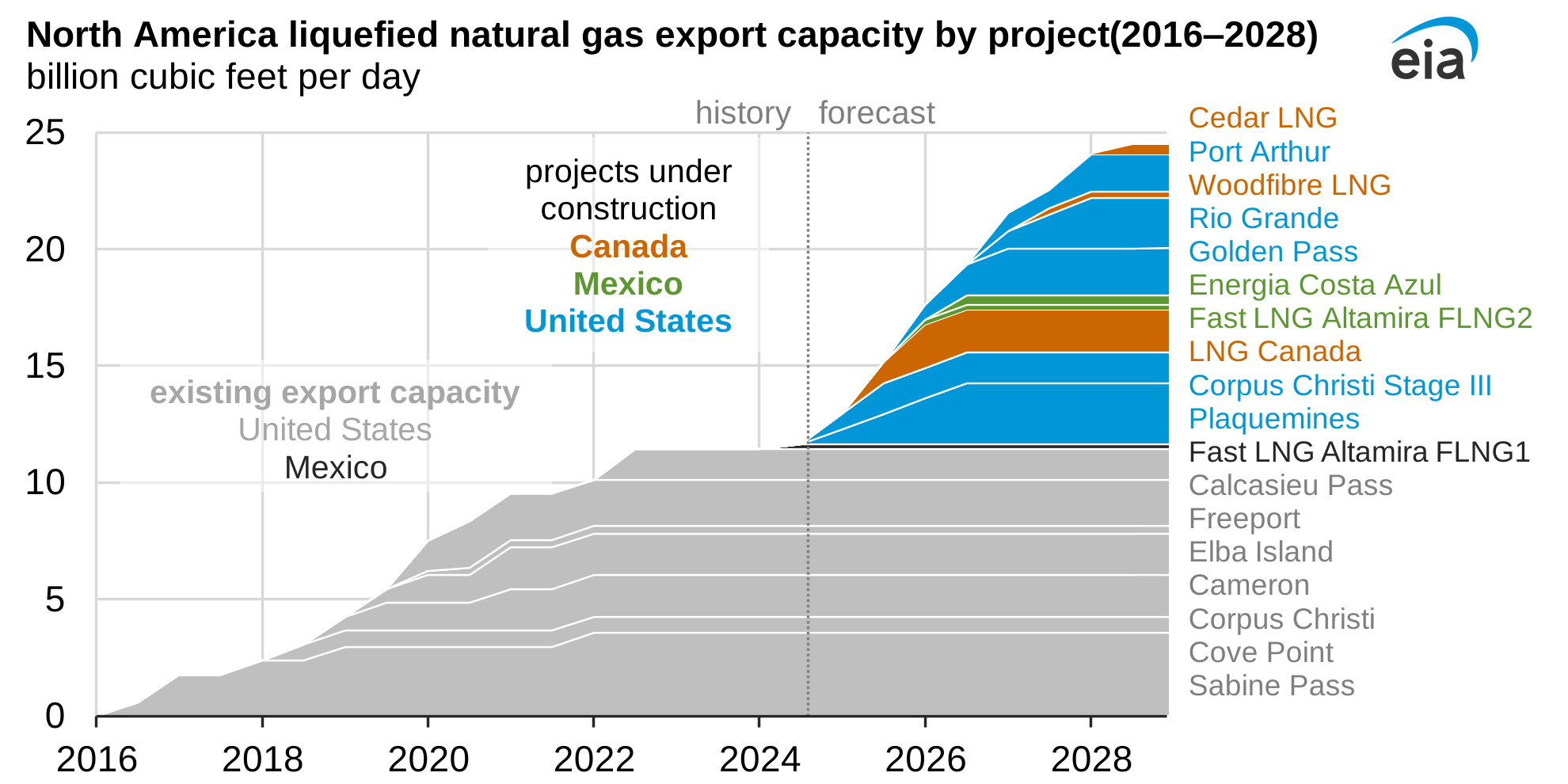
The vast majority of this export capacity will be along the US Gulf Coast and will be exporting natural gas produced from oil & gas fields located in the United States and Gulf of America. If LNG exports drove up prices, it would have already done so.
From 1997-2012, the US consumed more natural gas than we produced and the average price was $4.76 per thousand cubic feet (mcf). Since 2013, we’ve produced more natural gas than we consumed and the price averaged $3.35/mcf. If we take out the anomalously high prices in 2022, it would have averaged about $3.00/mcf.

The US can afford to be a net exporter of natural gas because we produce more than we consume. This works to keep prices lower. If LNG exports were restricted or prohibited, it would temporarily crash natural gas prices. Drilling would be curtailed, production would decline and prices would rise again.
What makes natural gas prices go up? It’s not increased production or consumption.

Imported natural gas drives up prices – Because we are a net importer when we produce less than we consume.

But we’ll use up all our reserves!

U.S. Crude Oil and Natural Gas Proved Reserves, Year-end 2022
With Data for 2022 | Release Date: April 29, 2024 | Next Release Date: April 2025
Oil highlights
- U.S. crude oil and lease condensate proved reserves increased 9% from 44.4 billion barrels to 48.3 billion barrels at year-end 2022 (Table 1).
- U.S. crude oil and lease condensate production increased 6% in 2022.
- In Texas, which has more proved reserves of crude oil and lease condensate than any other state, proved reserves increased 9% in 2022 (1.7 billion barrels), the largest net increase in any state (Table 6).
- In New Mexico, crude oil and lease condensate proved reserves increased 26%, the second-largest net increase (1.3 billion barrels). In North Dakota proved reserves increased 14%, the third-largest increase (0.6 billion barrels).
- The largest net decrease, 13%, in proved reserves of crude oil and lease condensate in 2022 was in California (225 million barrels) (Table 6).
- The 12-month, first-day-of-the-month average spot price for West Texas Intermediate (WTI) crude oil at Cushing, Oklahoma, increased by 43%, from $66.26 per barrel in 2021 to $94.54 per barrel in 2022.
Natural gas highlights
- Proved reserves of U.S. natural gas increased 10%, from 625.4 Tcf at year-end 2021 to 691.0 Tcf at year-end 2022, establishing a new record for natural gas proved reserves in the United States for a second consecutive year (Table 8).
- Natural gas proved reserves in Alaska increased 25% in 2022, raising that state’s total from 99.8 Tcf to 125.2 Tcf—the largest increase of all states in 2022.
- Texas had the second-largest increase in proved reserves of natural gas in 2022 (21.2 Tcf, or 14%), and New Mexico had the third-largest increase (9.9 Tcf, or 27%).
- The 12-month, first day-of-the-month average spot price for natural gas at the Louisiana Henry Hub increased by 71% in 2022, from $3.67 per million British thermal units (MMBtu) in 2021 to $6.29/MMBtu in 2022, which was the highest annual average price since 2008.
- Operators in Pennsylvania reported the largest net decrease in proved reserves of natural gas in 2022 (652 billion cubic feet, or 0.6%).
- In 2022, U.S. natural gas exports were 6.9 Tcf, the highest volume on record.
Proved reserves are estimated volumes of hydrocarbon resources that analysis of geologic and engineering data demonstrates with reasonable certainty are recoverable under existing economic and operating conditions. Reserves estimates change from year to year because of:
- Price and cost changes
- New discoveries
- Thorough appraisals of existing fields
- Existing reserves production
- New and improved techniques and technologies
To prepare this report, we collect independently developed estimates of proved reserves with Form EIA-23L from a sample of U.S. operators of oil and natural gas fields. We use this sample to further estimate the portion of proved reserves from operators who do not report. This year, we received responses from 397 of 404 sampled operators, which provided coverage of about 90% of proved reserves of oil and 93% of proved reserves of natural gas at the national level. We develop estimates for reserves located in the United States, each state individually, and some state subdivisions. States and regions with subdivisions are:
- California
- Louisiana
- New Mexico
- Texas
- Federal Offshore Gulf of Mexico

Discover more from Watts Up With That?
Subscribe to get the latest posts sent to your email.
I expected king crab to be less expensive in Alaska when I visited there.
If I recall my grade school economics lessons increasing supply results in lower prices. Decreasing supply results in higher prices. It’s not just a suggestion it’s a law.
And OPEC does just that – reduce output to bump up prices.
OPECs problem is that not even all OPEC producers honor OPECs production ceilings.
And then there are the non-OPEC producers, they have no reason not to increase their production every time OPEC cuts theirs.
The only way the price of any commodity can stay low and stable is by having a supply that is well-matched to demand, and low total costs of production. The long-term average price is inevitably, necessarily above the total costs of production and distribution.
Domestic production cannot sustainably lower global oil prices below the costs of domestic production. Those who claim that you cannot drill your way to lower oil prices base their conclusion on that accurate fact. But they assume costs can only go up, which is wrong.
New technology can lower the cost without lowering profit margin.
Onerous regulation is an unnecessary cost of production. Only being allowed to explore in areas where the probability of success is low is an obvious way that government negatively impacts the cost of domestic production.
It’s well known that wells can remain profitably in production at oil prices well below the price that justifies new exploration. This is because exploration is costly and risks producing no return on investment. So it follows that opening areas where it is more likely to pay off will reduce the total costs of domestic production.
In short, DRILL BABY, DRILL which requires stopping the bureaucrats from gumming up the works.
And then we have California. Which is an oil producing state, but is ruled by Greens. The ability of politicians to bugger production is at a near high in that state, only competing with New York State natural gas nonproduction.
Dealing with the legacy of people like Jerry Brown and Andrew Cuomo would possibly have a larger effect than export rules.
California Tidewater oil reserves are held in trust for the benefit of California residents. It’s the law.
Jerry Brown and Gavin Newsom decided that not pumping California Tidewater Trust oil was the proper fiscal decision for that trust.
Both benefit from exclusive importation control of Indonesian Oil and Ecuadorian oil through the Brown Family and the Getty Family oil businesses.
Californians were all told that they were “Saving the Earth” by doing this because some seagulls died in 1969.
The Sierra Club used all of their same stale mendacity in their failed effort to stop the Cove Point LNG terminal and pipeline.
Now years later the Terminal and pipeline are both a tremendous success with none of the fossil fuel crusader lies coming true.
Quite the contrary. The environment in the terminal area flourishes and the 186 mile pipeline scar has fully healed. Sierra lied then and is lying now.
Cove Point LNG was awarded the National Environmental Excellence Award by the National Association of Environmental Professionals and the “Hero of the Chesapeake Bay” by the Maryland Legislative Sportsmen’s Foundation
https://www.williams.com/2018/10/06/atlantic-sunrise-project-placed-into-full-service/
‘Gulf of America’ For us old geezers it will always be The Gulf of Mexico.
Hey, how did you become the spokesman for “us old geezers”? I’m an old geezer and it’s the Gulf of America now. You may object but I suspect any polling of geezers would be split but not align with your opinion.
The name Gulf of Mexico has been applied to the body of water since at least the late 16th century. English geographer Richard Hakluyt referred to the “Gulfe of Mexico” in The Principall Navigations, Voiages and Discoveries of the English Nation (1589).
That same year, Italian cartographer Baptista Boazio produced a map of Sir Francis Drake’s 1585–86 naval campaign against Spanish colonial holdings in the Americas. Boazio depicted Drake’s fleet skirting the edge of the “Baye of Mexico.” Other names, including the “Gulf of New Spain” and the “Florida Sea,” appeared on maps and in publications over subsequent centuries.
https://www.britannica.com/place/Gulf-of-Mexico-Gulf-of-America
I can appreciate the history lesson but fail to grasp the relevancy to the Gulf of America.
After all, history also tells us that when the United States was under British rule, it was collectively referred to as British America or the Thirteen Colonies.
We have a new name now. So does the Gulf. History is full of changes. I can’t fathom how history can somehow invalidate the Gulf of America.
Additional history- Before Mexico was named Mexico, the region was known as New Spain during the colonial era from 1521 to 1821. The name Mexico itself is derived from the Nahuatl word Mēxihco, which referred to the heartland of the Aztec Empire, namely the Valley of Mexico and surrounding territories. The term “Mexico” was adopted for the new country after it gained independence from Spain in 1821.
Also – Before the name “Mexico” was associated with the region, the Gulf of Mexico was known by various names. Early Spanish explorers called it the “Sea of the North” (Mare de Nort) or the “Gulf of Florida” (Golfo de Florida). Hernán Cortés also referred to it as the “Gulf of Mexico” (Golfo de México) in his dispatches, but other early European maps labeled it as the “Gulf of St. Michael” (Sinus S. Michaelis), “Gulf of Yucatán” (Golfo de Iucatan), or “Gulf of Cortés” (Golfo de Cortés)[6]. The indigenous peoples, such as the Aztecs, had their own names for the body of water, including “Chalchiuhtlicueyecatl,” meaning “House of Chalchiuhtlicue,” the deity of the seas[6].
Well it was “Constantinople” from the time of Emperor Constantine (330) until the pesky Turks insisted we call it “Istanbul” in 1930. For roughly 1,000 years before Constantine it was called “Byzantium”. Maybe the name change will go down easier if someone comes up with a catchy song about it.
Personally I think if we’re going to rename it, it should have been “Gulf of The Americas”, but President Trump did not consult me and I think he did it just to give the progressives a taste of their own medicine after years of insisting we change every name they didn’t like.
I just hope we don’t have to deal with the name changing every 4 to 8 years.
Yes isn’t it awesome? I was always a Denali Denier
Re “Baye of Mexico …”
Please distinguish this from the Bay of Campeche (Spanish: Bahía de Campeche), which covers just about every part of the Gulf that is proximal to the Estados Unidos Mexicanos.
P.S. Having lived in that region and traveled all around the Gulf / Bay, I wanna assure y’all that no self-respecting Anglophone refers to that body of water as ‘the Gulf of Mexico’, they simply say ‘The Gulf’. [Only a Yankee would say what’s written on the maps.]
Also not irrelevant is that — as any Mexican could tell you — the term México historically refers only to the volcanic highlands around that great imperial City (Mexico-Tenochtitlan ):
“Mēxihco is the Nahuatl term for the heartland of the Aztec Empire, namely the Valley of Mexico and surrounding territories, with its people being known as the Mexica.”
For three (3) long centuries (A. D.1521 – 1821 ) the territory now called ‘Mexico’ was known as ‘New Spain’. Problematic, doncha think?
In most cases, their carbon will be carbon dioxide to me. Progressive is communist.
What about Yugoslavia, Holland and Persia? Do you feel the same way about those name changes?
St Petersburg became Leningrad, the changed back to St. Petersburg.
Holland still exists, it’s a province in the Netherlands. Well, two provinces actually (North and South Holland). Much like Flanders is still a region in Belgium.
The region was called the Netherlands going back at least to the 15th century. Under Napoleon, the French called it the Kingdom of Holland, but basically, both under Spanish domination and when independent, it has always been the Netherlands. What other countries called it is different from what they themselves called it, of course.
No, it won’t.
If reserves are 700Tcf and we increase our exports to 14Tcf per year. This plus about 32Tcf domestic use.
Let’s see 46Tcf total per year divided into 700Tcf that’s only 15 years until we run out!!!
A disaster in the near future please tell me I’m wrong.
You’re wrong. Reserves don’t work that way.
https://www.eia.gov/tools/faqs/faq.php?id=38&t=6#:~:text=Proved%20reserves%20are%20an%20accounting,as%20new%20projects%20are%20developed.
Thomas. It is not April 1st. Run this joke by us in another 6 weeks! 🤠
You were joking right?
Before anyone drilled any wells, proven reserves were zero. So we had already run out according to your ‘logic’.
Yep. Proved reserves start out at zero. Proved reserves are the volume of oil and/or gas that will (>90% probability) be economically produced from an existing developed field. Prices and well performance can push reserves up or down.
And the Utica underlying the Marcellus is essentially untapped except at its shallow western edge in Ohio. And neither the Marcellus nor the Utica is yet tapped in New York. And since the recovery factors for fracked natgas shales are now over 20% (compared to oil at 3%), we have a long run ahead.
Respectfully, there is no long run ahead unless and until New York finally allows frac’ing.
Thanks, David, I always like to have some humorous takes on Green stupidity to read while I’m finishing my morning coffee! Fossil fuel reserves are starting sound like tribbles, not tribulations!
By the way, isn’t park ranger type wear a legal requirement for geologists? That don’t mean it ain’t sharp dressin’!
I recommended the Sierra Club article on my blog this morning because it made a few good points not found elsewhere. IT ALSO MADE A STRANGE LNG PRICE PREDICTION THAT MADE NO SENSE TO ME. BUT NO ARTICLE IS PERFECT. I would have deleted the prediction if I wrote a short a summary of the article
They correctly stated there is no energy emergency in the US — there should be an energy celebration for the production and exports under Biden despite his efforts to slow the industry.
After agreeing with those two points, I have no idea what this article is trying to say. A lot of data but what is the conclusion?
It would be prudent to check the USA’s total fossil fuel resource (NB. Resource, not reserve) to see how long it can sustain the new high production rate. I suspect that planning for a future declining production rate needs to start now. [I am not saying the declining rate starts now]
The estimated technically recoverable resource is pretty fracking YUGE…
https://www.eia.gov/energyexplained/natural-gas/how-much-gas-is-left.php
The American Gas Association estimates the total resourse to be 3,978 Tcf.
https://www.aga.org/news/news-releases/u-s-supplies-of-natural-gas-remain-as-strong-as-ever/
O/T to David:
I’ve just seen the first two episodes, but I *LOVE* “Landman”. Your opinion?
I only watched the first episode… Entertaining. About as realistic as Armageddon.
Just finished watching 1st season again.
Yep, and yet it explains the basic mechanics of the oil/gas industry. Something the vast majority of people have no clue about.
Read this Sierra Club article on Real Clear Energy this morning. It boggles the mind that the author could be so completely retarded.
Those Just Stop Oil people don’t have any idea what they are up against. Our need for hydrocarbons will not diminish until something cheaper and easier to use appears. In the meantime the hard working and innovative people in the hydrocarbon world will continue underpinning global civilisation.
LNG is not storable. It is a cryogenic fluid. LNG boil-off is used to power the ships carrying it, minimizing fugitive CH4. NG is used in near real time. Storage is limited. If we ship more LNG, we could divert that product to American users,. First, we must build more pipelines to carry more gas to consumers if you want to increase consumption at times of high demand (and, of course, prevent idiots from destroying them). The CH4 production rates of wells is also limited. That is one very good reason coal is so desirable. Coal is storable and coal-fired plants can be ramped up to 120% of nominal capacity or more.
It is a good idea to keep a ton of anthracite for heating emergency (if you have fireplaces).
Wood is also storable, to a lesser degree, but produces more aerosols than coal and yields about 1/2 the energy per kg.
Hydrocarbon rich shale is an abundant rock type, all around the planet. Shale basins in Europe are plotted in the image attached. If the EU ‘leaders’ were not such morons, they could have indigenous supplies of NG. Perhaps the US should NOT send gas to them so they will have to utilize the gifts nature has provided them, rather than being stiff-necked deniers.
It is typical of the EU ‘leaders’ to want the Russians bombed while buying NG from those very same Russians. That is what happens when you have a pussy-cat, not a lion, as your leader.