Guest Post by Willis Eschenbach
This is a two-part post. The first part is to correct an oversight in my recent post entitled Rainergy.
The second part is to use that new information to analyze the effect of clouds on the El Nino region.
So, to the first part. In my post Rainergy, I noted that it takes ~ 80 watts per square meter (W/m2) over a year to evaporate a cubic meter of seawater. Thus, the evaporation that creates the ~1 meter of annual rain cools the surface by – 80 W/m2.
Then the other day I thought “Dang! I forgot virga!”
Virga is rain that falls from a cloud but evaporates completely before it hits the ground.

Figure 1. Virga diagram
Here’s the thing. When the virga evaporates, it’s just like evaporation from the surface. It cools both the raindrops and the surrounding air.
That’s what leads to the cold storm winds entrained by the rain that hit the ground vertically and spread out around the base of the storm. You can see all of that happening in this amazing time-lapse video, with the vertical entrained wind striking the surface, spreading out across the lake, and finally agitating the trees in the foreground. On the left of the video you can also see virga falling and evaporating before it hits the ground.
And it’s not just the virga. The raindrops are all evaporating as they fall, which is why rain is almost always so cold.
So I set out to see how much rain evaporates completely before hitting the ground. I couldn’t find a whole lot on the subject, but a few papers said 50% to 85% of the rain evaporates. See e.g. Sub-cloud Rain Evaporation in the North Atlantic Ocean which says 65%
This makes sense, because the huge surface area of the hundreds of thousands of tiny droplets of water allows for large amounts of evaporation.
And here’s the reason why all of this is important. I had estimated the evaporative cooling associated with a meter of rain to be -80W/m2 per year. That’s the energy it takes to evaporate that meter of seawater.
But I had overlooked the additional cooling from the evaporation of the rain itself. Given that something on the order of half of the rain evaporates, it would provide an additional 40W/m2 of cooling. And more to the point, it’s not included in the rainfall data—it can’t be, it has evaporated.
Now as I said, there are not a lot of studies, and the evaporation rate depends on a host of variables. So what I’ve done is take the estimate that not half, but a quarter of the rain evaporates before hitting the ground. That gives a conservative value for the evaporative cooling of the rain before hitting the ground, although it is likely higher.
This gives a revised estimate of the evaporative cooling associated with a meter of rain as not -80 W/m2 for a year per meter of rain as I’d thought, but -100 W/m2 per meter of rain.
Thus endeth Part The First.
With my new estimate of the relationship between rainfall and evaporative cooling, and mulling over some ideas of Ramanathan, I decided to look at the variations in total cloud cooling of the sea surface in the area of the El Nino/La Nina phenomenon. To start with, blue box below shows the location of what’s called the “NINO34” area—5°N to 5°S, and 170°W to 120°W. The sea surface temperature in this area indicates the state of the Nino/Nina alteration.

Figure 2. Average surface temperatures and the location of the NINO34 area. Average from Mar 2000 to Feb 2023
And here is the temperature of the NINO34 area over the CERES satellite period. Note that the phenomenon is known as “El Nino”, a reference to the Christ child, because it peaks around December or November. And when there is a full Nino/Nina alteration, it hits the bottom around December/November one year later (blue areas). I discuss this further in my post “The La Nina Pump“.

Figure 3. Monthly sea surface temperatures in the NINO34 area. Note the large swings from ~25°C to 30°C, which make this area valuable for investigating the relationships between sea surface temperature (SST) and various cloud parameters.
Now, those familiar with my work know that my theory is that clouds act as a strong thermoregulator of the surface temperature. When the ocean warms, my theory is that cumulus fields form earlier in the day and cover more of the surface, reflecting more of the sunlight back into space.
And when the ocean warms further, thunderstorms form that cool the surface in a host of ways. This keeps the earth from overheating.
Let me start with the issue of the increase in the strength and duration of the cumulus fields. This is reflected in the cloud area expressed as a percentage of the surface area. Here’s that chart.

Figure 4. NINO34 monthly cloud coverage percentages and sea surface temperatures.
Now, this is most interesting. As the temperature rises from about 26°C to its maximum just under 30°C, the total cloud area doubles, from 40% to 80%. This greatly affects the amount of sunshine reaching the surface, as we’ll see in a graph below of the net cloud radiative effect. And as is clear from the close correspondence of temperature and cloud coverage shown in Figure 4, the amount and strength of the cloud cover is clearly a function of temperature and little else.
Next, cloud top altitude. This is an indirect measure of the number of thunderstorms in the area. Here’s the graph showing the change in the number of thunderstorms with the changing sea surface temperature.

Figure 5. NINO34 monthly cloud top altitudes and sea surface temperatures.
Again we see a very large change. As sea surface temperatures go from ~26°C up to just below 30°C, the altitude of the cloud tops almost triples, from 5 km up to almost 15 km. And again, the number of thunderstorms is also clearly a function of the temperature and little else.
With these changes in mind, we can look at the cooling effects of these cloud changes. Figure 6 below shows the changes in the net surface cloud radiative effect. The net surface cloud radiative effect is the full effect of the clouds on the radiation reaching the surface. Clouds cool the surface by reflecting the sunshine back out to space and by absorbing solar radiation. They also warm the surface by increasing the downwelling longwave radiation. The net surface cloud radiative effect is the sum of these different phenomena.

Figure 6. NINO34 monthly net surface cloud radiative effect and sea surface temperatures.
Note that at all sea surface temperatures, the clouds cool the NINO34 sea surface. And as the temperature goes up the radiative cooling increases, and not by just a little—cooling goes from -10 watts per square meter (W/m2) to almost -60 W/m2 of cooling.
It’s also worth noting that the effect is not linear—small deviations in temperature don’t cause the amount of increase in surface net radiative cooling that is caused by large temperature increases. This is shown by the large peaks in the blue line extending higher than the peaks in the black line.
Then we can also look at the cooling effects of the rain. As discussed above, one meter of rain involves evaporative cooling of the surface on the order of 100 W/m2. This allows us to convert rainfall figures to evaporative cooling figures, as shown in Figure 7 below.

Figure 7. NINO34 monthly rainfall evaporative cooling effect and sea surface temperatures. Note that the dataset is a year shorter, because the rainfall data ends in 2021
Here we see the same fivefold increase in cooling with the increasing temperature, but on a larger scale. The rainfall evaporative cooling goes from -50 W/m2 when the NINO34 area is cool to -350 W/m2 when the area heats up. And this effect is non-linear as well, as shown by the peaks in the blue line.
And finally, we can combine the separate effects of the net surface cloud radiative changes and the rainfall evaporative cooling to get the total cooling effect of the clouds on the NINO34 area, as shown in Figure 8 below.

Figure 9. NINO34 monthly total cooling due to clouds. This is the total of rainfall evaporative cooling effect and surface cloud radiative cooling. Again the dataset is a year shorter because the rainfall data ends in 2021
As this shows, the clouds have a very strong cooling effect on the NINO34 area. At the peak temperatures, the clouds are cooling the surface at the rate of -400 W/m2. In addition, the cooling increases faster and faster as the temperature rises, putting a hard ceiling on how hot the NINO34 area can get.
… and the alarmists are concerned about a change in CO2 forcing over the same period of 0.7 W/m2?
That’s lost in the noise compared to the 400 W/m2 peak cloud cooling.
Finally, please be clear that this huge increase in cloud-related cooling is not just happening in the NINO34 zone. It occurs anywhere in the ocean where the temperature exceeds about 25°C. Looking at the NINO34 zone is valuable because the temperature changes so much there, revealing the close connection between temperature and total cloud cooling. For the larger view, here’s a scatterplot of average gridcell sea surface temperatures from 2000 to 2021, versus average gridcell total cloud cooling. Note that in addition to the rapidly increasing cooling at temperatures warmer than ~25°C, the effect of the clouds is cooling over all parts of the ocean.

Figure 10. Scatterplot, total cloud cooling versus sea surface temperature. Blue dots are 1° latitude by 1° longitude gridcells.
And that’s the sum total of what I learned today …
My very best regards to all,
w.
AS ALWAYS, I ask that when you comment you quote the exact words you are discussing. This avoids endless misunderstandings.
Willis,
Fascinating overview.
Question: while the effect you note is something well documented for equatorial water regions, is it not fundamentally different over land?
In particular, the ITCT zone around the equator is mostly water vs the more predominantly land in the temperate zones (? on this second part, based entirely on a cursory visual examination of different zones).
Yes, there are certainly some types of phenomenon equivalent to thunderstorms over land like a dust devil – but it seems highly likely that these phenomenon cannot cool anywhere as much as a tropical thunderstorm.
I guess the question is: is it not possible that there can be fundamental imbalance between overland and oversea cooling systems such that the overall temperatures can skew over time, in either direction, depending on the relative activity of said disparate systems?
It seems that ENSO cycles regulate the climate primarily by perturbing the amount of water vapor in the stratosphere.
The image below is Aqua H2O (Lower Stratosphere 121 hPa, in which it is very clear the oscillations of drying and hydration of the stratosphere in lock step with ENSO.
h2o_MLS_vLAT_qbo_75S-75N_121hPa.png (1926×1394) (nasa.gov)
This is not the stratosphere but the tropopause.
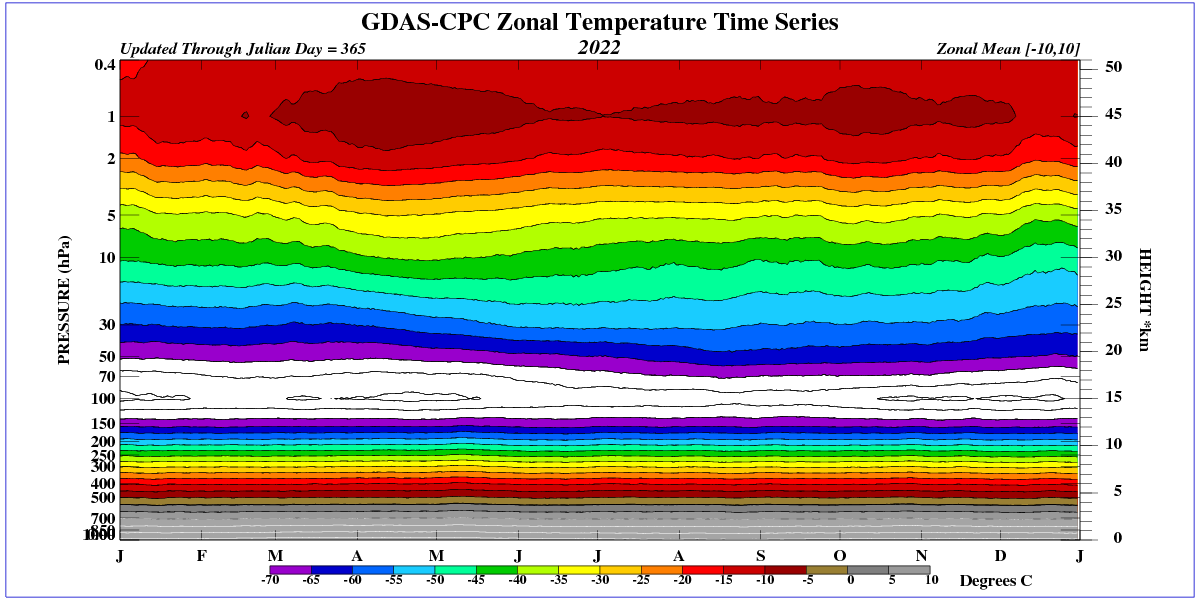
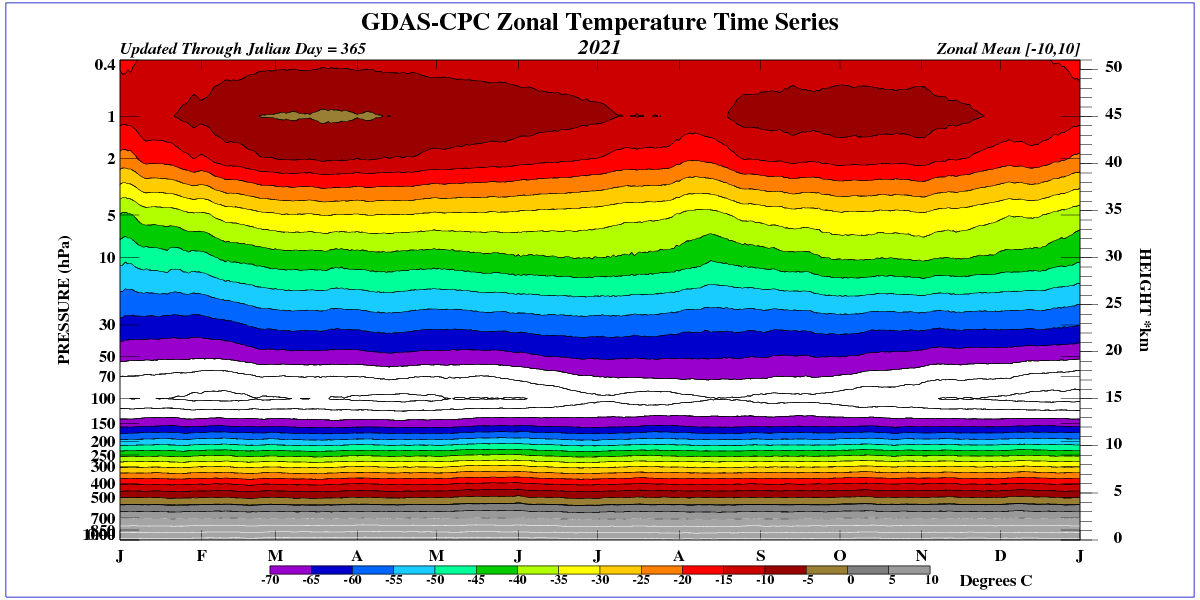
The lowest average temperature is recorded consistently at 100 hPa above the equator.
The peaks of the strongest hurricanes radiate at -80 C and this is the lowest kinetic energy in particles in the atmosphere.
There is no doubt that thunderstorms breach the stratosphere and emit a certain amount of water vapor into the Stratosphere every year. Even pyro cumulous clouds from forest fires breach the Stratosphere.
A hurricane reaching the stratosphere actually raises the tropopause locally, which means that a vertical temperature gradient is still operating in the hurricane region. Therefore, the temperature in the hurricane will continue to drop below -80 C and the hurricane’s energy will be depleted. However, the average tropopause level of 100 hPa will be maintained.
Very interesting, however a small percentage of water vapor from each convective plume makes it into the Stratosphere, and then the dynamics change quite a bit for that water vapor, it becomes a positive forcing for 3+ years.
You lost me somewhere, or you have an arithmetic error… You start with:
…and with your initial assumptions, 1 m³ evaporated seawater = 1 m³ rainfall. Sounds logical, what goes up must come down. But then you say, “I forgot virga…” wherein 1 m³ evaporated sea water, turns into 1 m³ of rainfall, but not all of it reaches the ground. Then you finish with:
Now from this standpoint, if you use the measurements of rainfall, then what comes out of the cloud is what’s measured on the ground plus what evaporates on the way down. So using these figures of 25% evaporation, then what’s measure as rainfall (R) = what falls (R’) minus evaporation (R’*0.25). Solving for R’ = R/(1-0.25) which then produces that -80W/m² becomes -106.67W/m² Or did I misunderstand what “rainfall” you were talking about? A database of rainfall will not include the amount of rainfall that evaporates before reaching the ground, as you already pointed out.
Willis:
In your discussion, you wrote “Note that the phenomenon known as El Nino……….peaks around Dec or Nov. And when there us a full Nino/Nina alteration it hits bottom around one year later.”
I also read your earlier articles “The La Nina Pump” and “The Tao of El Nino”
Since La Ninas and El Ninos are such important, and recurrent, features of Earth’s climate, I need to point out that your (and most others) understanding of their cause is TOTALLY wrong.
Essentially ALL La Ninas are caused by increased levels of Sulfur Dioxide aerosols in the atmosphere from random VEI4 or larger volcanic eruption, although a few may have been man-made. .
ALL El Ninos are caused by decreased levels of SO2 aerosol pollution in the atmosphere
which causes temperatures to rise because of the cleaner air.
Between 1850 and 2016, 23 were volcanic-induced, 33 were due to American business recessions (reduced industrial activity), 2 were due to “Clean Air” reductions, and at least 7 were due to volcanic “droughts”-periods of 3-4 years or more with no VEI4 or larger eruptions.
See my article “The definitive cause of La Nina and El Nino events”
https://doi.org/10.30574/wjarr.2023.17.1.0124
Willis, this seems to be a negative feedback on any temperature rise. Are you able to make any comments of ECS versus TCR as a result of this work?
….comments on ECS…
Willis, first, nice article and the video is fascinating. Your observations about the cubic meter of H2O evaporating make sense.
But your statement “Here’s the thing. When the virga evaporates, it’s just like evaporation from the surface. It cools both the raindrops and the surrounding air.” is confusing. Because when the H2O evaporates, to do so it acquires energy (latent heat of fusion, something like 530 cal/gm, that’s a LOT), but from where? Seems like it gets the energy from the raindrop; thereby cooling it. That energy is therefore in the vapor (internal energy). Clearly the vapor aquired some of the drop’s energy, leaving it cooler. How can that same vapor also cool the air? Because it already acquired its heat of vaporization. So if the air is cooled, it must be by the cooler raindrop. Therefore the raindrop must have acquired energy from the air.
But now, since the vapor is part of the air, it would seem to be cooled by itself. It’s sort of like a perpetual motion machine, no?
If you simply place water somewhere where there is dry air, evaporation will occur. No need for additional energy to make it happen.
w.
Granted, if one places liquid water in dry air, evaporation will occur. But the laws of physics, specifically of thermodynamics, require the latent energy of vaporization (~535 cal/gm) to come from somewhere. Clearly, this somewhere is almost 100% the liquid water – therefore it cools. (A thought experiment will show that, other than negligible energy quantities from the air – consider the very high thermal resistance and low heat capacity of air – it must come from the liquid: Remove the air, and let it evap in a vacuum. (Of course it will much more vigorously evaporate, since there will not be opposing partial pressures from gasses in the air.)
One cannot ignore phase transitions from precipitation. From vapor to solid – snow – the latent heat is about 535+80 (heat of fusion) = 615 cal/gm (ignore the 0C to 100C = 100 cal/gn, as not germane here). To me, this explains why, esp here in Alaska, it ALWAYS warms as it snows, sometimes so much the snow turns into rain. All that latent heat must go somewhere, and the atmosphere appears to be the only place.
Basically, a thunderstorm is identical to a cooling tower. Or vice versa.