News Brief by Kip Hansen — 3 July 2024 – 700 words
With the news channels banging on about hot hot hot water – Atlantic water, Gulf of Mexico water, the Caribbean water, Western Pacific water off of Australia — I mean, one would think the seas are boiling.
In the last couple of weeks, the another side of the story has emerged:
California Water Temperatures Drop to Dangerous Levels — Jun 21, 2024
“A recent temperature reading off the coast of Crescent City [California] revealed that water temperatures were 47.3 degrees Fahrenheit, more than 3 degrees below normal for this time of year and 4 degrees below winter water temperatures in January.
Meteorologists and weather experts are blaming the temperature plunge on an “intense marine cold spell.””

“”An intense marine cold spell is gripping the Northern and Central California coast, with water temperatures up to 5°F below normal,” storm chaser Colin McCarthy posted on X (formerly Twitter).
He continued: “A buoy near Crescent City reported a water temperature of 46°F yesterday. In waters that cold, hypothermia can occur in as little as 30 minutes. These well below normal water temperatures due to strong upwelling of cold ocean water are enhancing the marine layer or ‘natural AC,’ keeping coastal areas cool while inland areas experience intense heat (100-108°F in the Central Valley Saturday).” [ Newsweek ]
Meanwhile, in the middle of the country:
Lake Michigan water temperature drops nearly 20 degrees since yesterday, NWS says
“The U.S. National Weather Service saw nearly 20-degree water temperature drops offshore from Port Sheldon and South Haven since yesterday.”
“”Until the water warms back up, beware of cold water shock (don’t dive into the water… your body may involuntarily inhale), and hypothermia after just 1 hour,” the NWS warned in their Facebook post.”

—
Hypothermia:
“Hypothermia, defined as a core body temperature lower than 35 C (95 F), may be classified as acute, sub-acute, or chronic. Acute hypothermia is caused by a rapid loss of body heat, usually from immersion in cold water. Sub-acute hypothermia often occurs from exposure to cool weather (below 10 C (50 F)) outdoors, in combination with wind chill, wet or inadequate clothing, fatigue, and/or inadequate nutrition. Chronic hypothermia in predisposed persons generally occurs from exposure to cold temperatures (below 16 C (60 F)) indoors over a prolonged period. Predisposed persons have an impaired perception of cold; decreased mobility; and inadequate nutrition, clothing, and heating systems.” [ CDC ]
Bottom Line:
Even in sunny southern California, sea water can be cold enough to cause dangerous hypothermia in the unprepared, the old, the very young and those especially susceptible to cold. The same is true of lake water.
Know the water temperature before you swim or let your children enter the water. Surfers and other water sports enthusiasts should wear thermal protection — wet suits — appropriate to the temperature. Thin “skins” ( 1 mm) are not enough protection for water as cold as in these two weather alerts.
Many representations of sea surface temperature report “skin temperature” down to a whopping 1 mm. . Don’t be fooled by the constant drumbeat of “boiling seas” – the temperature of the sea water and lake water is a very local phenomena.
# # # # #
Author’s Comment:
In the spirit of full disclosure, as a teen, I was a “Southern California Surfer Boy” — right out of a Beach Boys’ song. One calendar year, I calculated that I had spent at least some part of 200 (out of 365) days on the beach — in all weathers — despite attending high school and living more than 5 miles from the beach. But, I was a small, skinny kid and had to have a custom surfboard made short enough for me to handle. Today, that 8’6” board would be considered a “long board”. With no body fat to speak of, I would get hypothermic fairly rapidly and retreat to the sand to warm up in the Sun.
During our decade+ living on our sailing catamaran in the Caribbean, my wife and I discovered that the sea water temperature was wildly variable, horizontally and vertically. Warm, almost hot, at the surface, and quite cold at 20 feet. Cold here but warm 50 feet away in a errant current.
Thanks for reading.
# # # # #
You’re kidding me!
Apparently that’s a downvotable comment. Not sure why. So here’s a +1 from me.
Another upvote from me.
….. and from me, along with a question: These relatively short-term and large swings in temperature across these many thousands of acre feet (to use our quaint reservoir measurement system on this day celebrating our independence) must entail very, very large energy swings. Has anyone done any hard calculations on how these energy swings are related to atmospheric carbon dioxide and its radiative properties? Or is ALL of this science done by the nod, nod, wink, wink method?
Jim Hansen’s boiling oceans might have been the most wrong calculation in the history of science, so I won’t be looking for any of his calculations on ResearchGate.
Oh, and by the way:
https://cdec.water.ca.gov/reportapp/javareports?name=rescond.pdf
It’s not so much that the water got colder, but the warm water moved out and cold water replaced it.
Actually, my question was related to more global temperature changes including up and down, but more up, for example the first sentence “With the news channels banging on about hot hot hot water – Atlantic water, Gulf of Mexico water, the Caribbean water, Western Pacific water off of Australia“.
phil ==> The seas/oceans are incredibly huge chaotic dynamical systems which contain, move, dissipate and take up massive amounts of energy. They are subject to all the same types of forces and movements as the atmosphere, except instead of a gas, they are a liquid….
Thanks for responding and yes, on the subject of taking up massive amounts of energy, of course this is much more energy than associated with the atmosphere so, how can this be mathematically possible from changing CO2 levels as “the news channels bang on about ….” to paraphrase you? We all know that pesky downwelling LWIR doesn’t penetrate into the ocean beyond a few microns, so to be more succinct – are the wailers’ bangings on supported by any mathematics from “climate science”?
If the answer is no, well then it is what it is.
See what I mean, from a few days ago, from the unfortunately and ironically nicknamed stain that won’t go away Seth Goebbelstein:
https://apnews.com/article/hurricane-beryl-hot-water-strong-climate-change-ddfb68c646e811e6f8b53e7451d1f6a6
Corbosiero said scientists are debating what exactly climate change does to hurricanes, but have come to an agreement that it makes them more prone to rapidly intensifying, as Beryl did, and increases the strongest storms, like Beryl.
Emanuel said the slowing of Atlantic ocean currents, likely caused by climate change, may also be a factor in the warm water.
CO2 going from 280 to 425 ppm likely slows Atlantic ocean currents? Could someone connect the dots for me please …… even if they lead to an asylum.
Your point is well taken, but a caveat is necessary. Having grown up in northern Minnesota, it was occasionally necessary to tip a toe into Lake Superior. The deep waters of Superior never get enough warming to achieve the 39 F thermal inversion temperature, so they always stay that cold. The shorelines, though, occasionally get enough warming to actually immerse into, at least for a few foolish children, and even a few adults. The “few microns” of solar heated water surface quickly transfer their heat at least a meter or so by conductive heat transfer and wave mixing, even though the heat transfer coefficient of water is quite low.
No, I was careful to point out that I was talking about the downwelling LWIR from CO2. It’s pretty well known that solar penetrates deeply and then, as you say, there’s further convection. What you’re describing is what actually does happen. I’m suggesting that there’s a large mathematical discrepancy in trying to pin the blame for hurricane changes due to warmer water on CO2.
An intense marine cold spell is gripping the Northern and Central California coast, with water temperatures up to 5°F below normal,” – Obviously Glowball Warming duh
Yes, but no one knows what “normal” is, they just know the recent average.
Jim,
And since the start of the Global Warming fear mongering, the formal publications to the most gossipy news have, by choice of the authors, used the word “warming” more than “cooling” by some big ratio that feels like 5:1 or so. This indicates a mind set with a bias in science that is not natural. Some authors feel that warming is happening without requiring proof.
Since when did winds stop moving cold water around?
Have you read of any “marine cool waves”?
Kip would have felt times standing near the shore when the waist water was lukewarm and the feet quite cold. Given that type of sudden gradient, one has to recognise that measurements to define an average have large problems of representative sampling and need proper understanding of uncertainty.
Geoff S
We call that the “farm dam effect” from decades of swimming in them.
iPad related finger trouble there, my + was taken as a – , sorry about that.
But Kip, according to climate “science” methods, if you jumped in to 20 ft deep water that was 20 C at the surface and 4 C at the bottom, you’d be backstroking in average 8 C water.
And then later, looking at the pics your wife took of you backstroking, you’d have to say –
“I didn’t realize it was that cold that day”
(h/t Ron White)
Kip – summer is here. Expect business as usual.
Is that from local upwelling along the Pacific Coast? Also, I’ve noticed that the SOI index and Niño 1+2 SSTs have not been transitioning into LA Niña as predicted by this summer. Everything’s still pretty neutral.
johnesm ==> I don’t know — anyone here have an answer?
I visited L.A. Calif. in September 2001 and waded in the surf at Santa Monica, WOO! the water was colder than Lake Michigan, no wonder they wear those wet suits when surfing. Earlier in the day I visited Rocketdyne in Canoga Park and when I got back to the car I was nearly burned by the steering wheel it was so hot.
That’s LA…
Yep, the Chamber of Commerce pictures of those broad sandy beaches with few or no swimmers are typical of the area. Difficult as it may be to believe, the water offshore in Southern California is usually even colder than the water near the beach. It’s not impossible to swim at, for example, Catalina Island. And the underwater kelp bed scenery there is spectacular. But overall, I never found swimming there to be all that much fun.
Boles ==> Welcome to the Hotel California…..
On Lake Michigan, the prevailing winds are from the west. They blow the warm surface water over to Michigan, and cold deep water up wells on Chicagoland beaches. There is usually about a 15F July difference. Why so many Chicago summer vacation homes are over on the Michigan side two+ hours away.
I live maybe 5-6 miles from Lake Michigan, Holland MI. I just may have to go and dip my toe iin the water to check the temperature.
When flying submarine patrols off the waters of Iceland we were often told that in the event of the plane going down we had less than 30 minutes if we failed to get our dry suits on.
Later when flying over other waters we had fitted wet suits that depending on locale gave us a few hours.
That darn specific heat of water sucks the warmth right out of you.
The coast guard used to advise boaters off Southern California that in the event of someone falling overboard, they had 40 minutes to get them out of the water and warming up. Maybe they still advise that.
When I was young and living in Northern California, I went diving for abalone a lot. The Winter water temperatures were usually about 53-55 deg F. Even with a wet suit, despite the vigorous physical activity, after about 45 minutes I would start shivering and lose control of my lips for sealing my snorkel to remove the water to breath. When I could no longer easily clear my snorkel, I knew it was time to head for shore whether I was shivering or not. I’d have a couple cups of hot, honey-sweetened tea from my thermos, and if I was lucky, lay out in the sun on the beach like a big black seal thermoregulating. If there was no sun, which was common in the Winter, I’d wrap myself in a blanket until I stopped shivering.
However, worse than that, when diving for gold in the Mother Lode on Memorial Day weekends, the water was commonly in the low-40s and I would frequently get a severe headache despite being encased in a wet suit with hood. Even in mid-Summer, with river temperatures in the 70s, every couple of hours I’d have to haul out on a rock and make like a seal to bring my core temperature back up to where it belonged. Yes, water just sucks the heat out of one.
Ah, the origin of the “brain freeze.”
Clyde, were you ever tempted to seek a diagnosis for masochism?
Heat is building in the PNW interior. Washington’s Tri-Cities Airport (KPSC) may be 110°F in a week. Expect doom reports. It is called summer.
— Lewis Carroll
50 years ago Billy Connolly had a song feature snow in July.
So much for summer…Scotland hit with snow and heavy rain as gale force winds cause rail disruption
https://www.dailymail.co.uk/news/article-13601437/So-summer-Scotland-hit-snow-heavy-rain-gale-force-winds-cause-rail-disruption.html
The time has come, the Walrus said,
To talk of many things:
Of shoes — and ships — and sealing-wax —
Of cabbages — and kings —
And why the sea is boiling hot —
And whether pigs have wings.
— Lewis Carroll (a better source of truth than woke “climate scientists”)
Great minds think alike. 😉
I bet if a PB sees that guy in the water- it would be licking its chops!
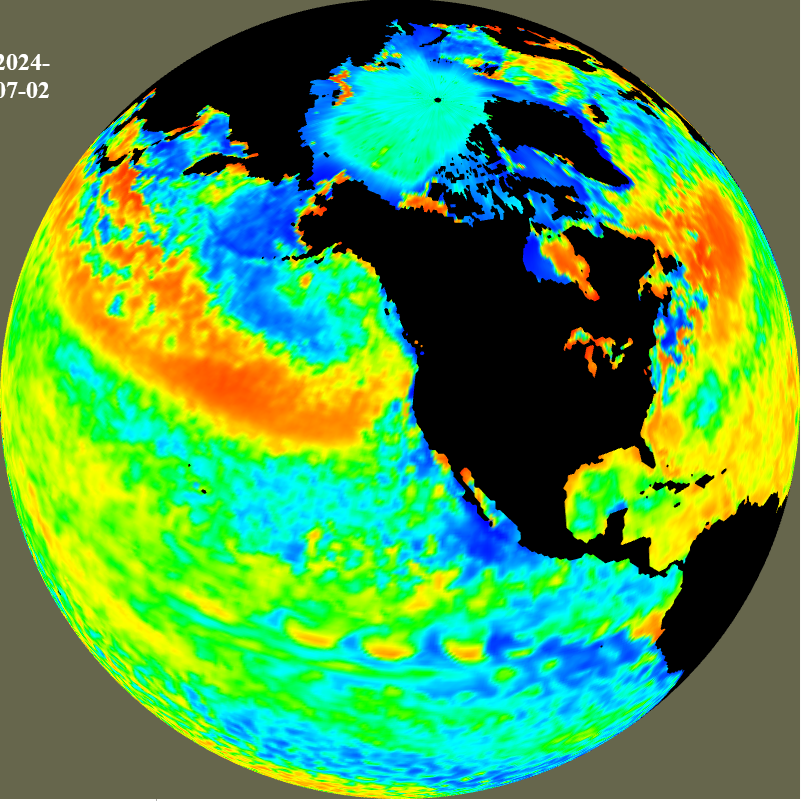
Yes, as often, there has been cold water on the coast of California. Here is a broader view on 2 July (my most recent)
And here is how it was on the solstice:
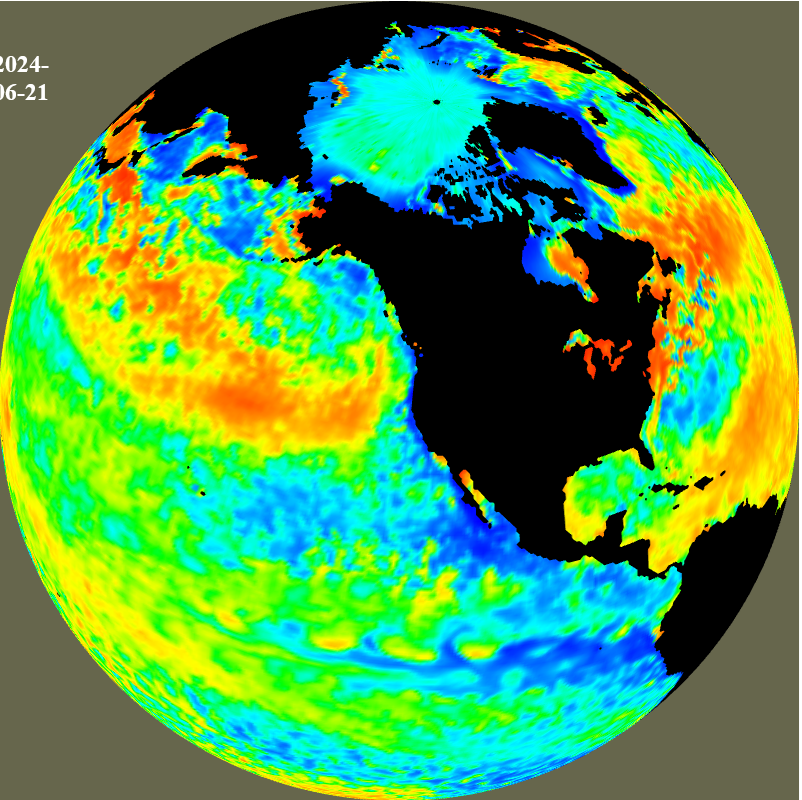
Nick ==> Yes,exactly — warm spots,cold spots, medium spots. These are sea surface skin temperatures? Pretty changeable too.
Skin? Yes, it’s AVHRR satellite – anomalies.
Nick ==> As I thought, Just checking.
Very nice Kip.
Bob ==> Thanks…appreciate it.
Thanks Kip, most interesting and informative.
NOAA temperature reporting buoys are nowhere near were people surf or swim. If you fall overboard off a fishing vessel then hypothermia is an issue if you don’t sink first from your boots filling with water. You are being gaslighted again by reporters paid to gaslight you.
Station 46027 (LLNR 562) – ST GEORGES – 8 NM NW of Crescent City, CA
doonman ==> Individual buoy reports do not the surf zone water temperature make. Where I grew up in Los Angeles, the Life Guard service was responsible for measuring and reporting water temperature…some beaches had blackboards with wave height, wind direction, and water temperature posted several time a day.
Local papers include each water temperature in the weather reports. Specialized outlets like this do as well.