From Dr. Roy Spencer’s Global Warming Blog
Roy W. Spencer, Ph. D
Some commenters on my previous blog post, Net Zero CO2 Emissions: A Damaging and Totally Unnecessary Goal, were dubious of my claim that nature will continue to remove CO2 from the atmosphere at about the same rate even if anthropogenic emissions decrease…or even if they were suddenly eliminated.
Rather than appeal to the simple CO2 budget model I created for that blog post, let’s look at the published data from the 123 (!) authors the IPCC relies upon to provide their best estimate of CO2 flows in and out of the atmosphere, the Global Carbon Project team. I created the following chart from their data spreadsheet available here. Updated yearly, the 2023 report shows that their best estimate of the net removal of CO2 from the atmosphere by land and ocean processes has increased along with the rise in atmospheric CO2. This plot is from their yearly estimates, 1850-2022.

The two regression line fits to the data are important, because they imply what will happen in the future as CO2 in the atmosphere continues to rise. In the case of the nonlinear fit, which has a slightly better fit to the data (R2 = 89.3% vs. 88.8%) the carbon cycle is becoming somewhat less able to remove excess CO2 from the atmosphere. This is what carbon cycle modelers expect to happen, and there is some weak evidence that is beginning to occur. So, let’s conservatively assume that nonlinear rate of removal (a gradual decrease in nature’s ability to sequester excess atmospheric CO2) will exist in the coming decades as a function of atmospheric CO2 content.
A Modest CO2 Reduction Scenario
Now, let’s assume a 1% per year cut in emissions (both fossil fuel burning and deforestation) in each year starting in 2024. That 1% per year cut is nowhere near the Net Zero goal of eliminating CO2 emissions by 2050 or 2060, which at this point seems delusional since humanity remains so dependent upon fossil fuels. The resulting future trajectory of atmospheric CO2 looks like this:

This shows that rather modest cuts in global CO2 emissions (33% by 2063) would cause CO2 concentrations to stabilize in about 40 years, with a peak CO2 value of 460 ppm. This is only 2/3 of the way to “2XCO2” (a doubling of estimated pre-Industrial CO2 levels).
How Much Global Warming Would be Caused Under This Scenario?
Assuming all of the atmospheric CO2 rise is due to human activities, and further assuming all climate warming is due to that CO2 rise, the resulting eventual equilibrium warming (delayed by the time it takes for mixing to warm the deep oceans) would be about 1.2 deg.C assuming the observations-based Effective Climate Sensitivity (EffCS) value of 1.9 deg. C we published last year (Spencer & Christy, 2023). Using the Lewis and Curry (2018) value around 1.6-1.7 deg. C would result in even less future warming.
And that’s if no further cuts in emissions are made beyond the 33% cuts vs. 2023 emissions. If the 1% per year cuts continue past the 2060s, as is shown in the 2nd graph above, the CO2 content of the atmosphere would then decline, and future warming would not be in response to 460 ppm, which was reached only briefly in the early 2060s. It would be a still lower value than 1.2 deg. C. Note these are below the 1.5 deg. C maximum warming target of the 2015 Paris Agreement, which is the basis for Net Zero policies.
Net Zero is Based Upon a Faulty View of Nature
Net Zero assumes that human CO2 emissions must stop to halt the rise in atmospheric CO2. This is false. The first plot above shows that nature removes atmospheric CO2 at a rate based upon the CO2 content of the atmosphere, and as long as that remains elevated, nature continues to remove CO2 at a rapid rate. Satellite-observed “global greening” is evidence of that over land. Over the ocean, sea water absorbs CO2 from the atmosphere in proportion to the difference in CO2 partial pressures between the atmosphere and ocean, that is, the higher the atmospheric CO2 content is, the faster the ocean absorbs CO2.
Neither land nor ocean “knows” how much CO2 we emit in any given year. They only “know” how much CO2 is in the atmosphere.
All that is needed to stop the rise of atmospheric CO2 is for yearly anthropogenic emissions to be reduced to the point where they match the yearly removal rate by nature. The Global Carbon Project data suggest that reduction is about 33% below 2023 emissions. And that is based upon the conservative assumption that future CO2 removal will follow the nonlinear curve in the first plot, above, rather than the linear relationship.
Finally, the 1.5 deg. C maximum warming goal of the 2015 Paris Agreement would be easily met under the scenario proposed here, a 1% per year cut in global net emissions (fossil fuel burning plus land use changes), with a total 33% reduction in emissions vs. 2023 by the early 2060s.
I continue to be perplexed why Net Zero is a goal, because it is not based upon the science. I can only assume that the scientific community’s silence on the subject is because politically driven energy policy goals are driving the science, rather than vice versa.
The Earth is greening from increased CO2, probably from the sun-warmed oceans, and more plants mean more animals and that means more CO2 in the air
No
Hans – The detailed logic in your reply was a bit difficult to follow.
NASA doesn’t agree with you.
Carbon Dioxide Fertilization Greening Earth, Study Finds
LINK
Sure, CO2 fertilization is greening earth. I doubt that was Hans’ disagreement. I had no difficulty following his logic. The howling error is in two parts:
1)
A small amount, maybe 15-20 ppm comes from warmer oceans vs Little Ice Age conditions. Around 125ppm of the rise since 1850 is from cumulative fossil fuel emissions and land use.
2)
https://youtu.be/rf71YotfykQ
You’ve nailed it
If increasing CO2 is predominately manmade then Keeling data should be closely coupled to population. Although currently at 8Billion people, according to Worldometer and Wikipedia, between 2050 and 2100, world population will plateau at 10Billion people. Plotting 1960-2020 Keeling data to population and extrapolating to 2100, a least sq curve fit shows atmospheric CO2 will plateau around 650ppm.
“If increasing CO2 is predominately manmade ..”
And what if it is not? Oceans contain the amount of CO2 that dwarfs atmospheric content. As it it gets warmer, they exhale it. With human emissions being only 4% of the total, even small changes in other 96% should be considered first.
When humans cut their CO2 output by 6 percent due to COVID-19 shutdowns etc. in 2020 the decrease wasn’t even noticeable.
https://gml.noaa.gov/ccgg/trends/
Again ?
cut human CO2 by 6% from the approximate 4% of total… you get 3.76% of total.
Well with the range of the “approximate” value.
Of course it made no noticeable difference.
So now natural causes account for 96% of the CO2 increases?
It is all +/- a bit anyway. Rather than give very rubbery numbers..
… might be anywhere between 3 – 6% at different times. No-one can possible keep track of the variability.
I think the best way of phrasing it is “nearly all” of the CO2 flux is natural.
Someone thinks around 96% natural, isn’t “almost all”.
That is bizarre and can only come from complete numerical illiteracy.
It is indeed “almost all”, but as I mentioned above, that is also IRRELEVANT. You have to look at both sides of the balance sheet. Your bank account could go up because you got a raise and didn’t increase spending proportionately or it could go up if your pay stayed flat but you cut spending. It could also go up if your pay went down but your spending went down more.
The whole error you make is to focus on the flux into the atmosphere while ignoring the flux out of the atmosphere.
“The whole error you make is to focus on the flux into the atmosphere while ignoring the flux out of the atmosphere.”
The error you make is that you ignore the flux out of the atmosphere.
Nature does not decide to leave those extra 4% immune to “spending” to accumulate.
If the differential from Henry’s law is increasing, oceans are absorbing more. Or, if the differential was to start with in the direction of CO2 desorption, human contributions will slow down the desorption rates or completely stop it. Le Chatelier’s principle works either way to oppose changes and stabilize the system.
Greening of the Earth is another example of increased CO2 rates removal.
Greening is not limited to land, it is quite possible that most of extra biomass is created in the oceans. What is important, a lot of ocean biomass is falling to the ocean bottom, removing carbon from circulation.
Of course not. Why would you say that I think that? There is no significant distinction between one CO2 molecule that came from fossil fuel burning and another that outgassed from the ocean. (Ignoring potentially different ratios of isotopes)
The average residence time of any CO2 molecule in the atmosphere is very low and they are all essentially interchangeable. For every molecule added by emissions there’s a 96:4 chance that if it is scrubbed out it will be replaced by a “natural” CO2 molecule.
It is not that fossil emissions accumulate, it is just that the total number of CO2 molecules in the atmosphere is steadily rising. Because of the very high natural flux in and out of the atmosphere, and because of the huge mismatch between the amount of CO2 in oceans vs in the atmosphere, most of the CO2 in the atmosphere at any given time was last found in a natural source rather than in a fossil fuel emission.
This does NOT mean that the increase in total CO2 molecules is due to nature. Fossil fuel emissions increase the total number of CO2 molecules in the atmosphere and then the high natural fluxes swap out most of the emission-sourced CO2 molecules with nature-sourced CO2 molecules. But there are still more CO2 molecules than there would have been if it had not been for the emissions.
There is no climate emergency. CO2 is a blessing and anyone attempting to deny the reality that fossil fuel burning increases CO2 concentration is buying into the lie that CO2 is harmful.
Such people have their heart in the right place. They get that there’s no crisis but they are unwittingly undermining the credibility of all skeptics by making these erroneous claims.
“Someone thinks around 96% natural, isn’t “almost all”.
That is bizarre and can only come from complete numerical illiteracy.”
Fittingly, these are the same people who preach 97% consensus.
A climate buffoon explains CO2
“A climate buffoon explains CO2″
What?? You didn’t explain anything ??
Or provide any evidence.. You never do.
How do you go from exactly right to exactly wrong in one breath?
You can’t talk about only one side of the ledger. You need to look at both the flux into AND out of the atmosphere. It’s irrelevant what the ratio is between our emissions and seasonal outgassing. What is relevant is the net flux. The net flux is into the atmosphere but only half of the flux due to fossil fuel emissions. Therefore nature is a net sink. It cannot be a net sink and a net source at the same time.
No, alphabet. The cumulative effect of hundreds of years of trickling in slightly more CO2 than nature can absorb is the source of nearly all of the rise in CO2 concentration.
CO2 is NOT a problem. There is no reason to twist ourselves into tortured arguments denying that fossil fuel emissions increase atmospheric CO2 concentration.
Furthermore, although CO2 is a weak greenhouse gas (compared with water vapor), it isn’t a foregone conclusion that increased CO2 concentration must raise temperature. It is a dynamic and complex system that might be compensated for completely by changes in cloud cover. To the extent that CO2 is responsible for ‘global milding’ – warmer nights, mostly in winter, that has been entirely beneficial to human flourishing.
“human CO2 by 6% from the approximate 4% of total”
We have another CO2 is 96% Natural Nutter … who is also an El Nino Butter and Volcano Nutter and There is no AGW Nutter
A four star Nutter
You are the only climate buffoon around here.
Still no evidence of CO2 warming?/
Still the DENIAL that even your beloved IPCC says about CO2 emissions being 96% natural
You really have to catch up with the science…
…. and forget all the AGW-lukewarmer mantra you carry-on with.
Still in ignorant denial of El Nino warming of the atmosphere.
Still in ignorant denial that water heats best from below.
Please show us where the AGW is.. remember, the G stands for “global”
Provide evidence…. or just rant !
You’re not helping RG
And yet another insult. Zero credibility when posed this way.
Thank you bnice2000, exactly right.
Only a 30% cut wil be noticeable in Mauna loa, because the sink flow is 20 GtCO2 per year.
You should read the article again. The clue is in the word ‘IF’. Obviously the author does not believe so.
The author was properly listing his assumptions.
“human emissions being only 4% of the total,”
Step right up we have a CO2 is 96% natural Nutter here, with up votes from many fellow Nutters, who completely ignore the seasonal natural absorption of CO2 and ONLY consider the seasonal natural CO2 emissions
The increase of atmospheric CO2 year over year is entirely from manmade CO2 emissions that are roughly twice the net atmospheric CO2 increase.
That so many conservatives are deaf, dumb and blind on this subject is an amazing fact. The leftists are laughing hysterically at such ignorance — it is their gift to the leftists.
Facts really don’t matter to you do they RS.
You are stuck with your brain-washed AGW-lukewarmer mantra, and you cannot escape.
This will excite you…
3 Physicists Use Experimental Evidence To Show CO2’s Capacity To Absorb Radiation Has Saturated (notrickszone.com)
Three real scientists vs a low-level evidence -free ranter.. who to believe. ! 😉
Only it has not saturated yet as infrared spectral observations show clearly.
More nonsense. These ignorant comments discredit sound climate realism.
There is a very strong case to be made that elevated atmospheric CO2 is a wholly-beneficial side effect of fossil fuel burning. It is largely responsible for ever-expanding agricultural output. If —IF— there is a net warming effect, it is so far entirely beneficial, extending growing seasons and reducing cold weather deaths.
There is NO CLIMATE CRISIS! It doesn’t help to make a ridiculous claim that fossil fuel burning has no effect on atmospheric CO2 concentration, it only discredits us as anti-scientific ignoramuses.
The problem with the ‘argument’ is that while perhaps 4% of the CO2 flux into the atmosphere is from our emissions, 0% of the CO2 flux out of the atmosphere is due to our actions. While we emit 4% of the total flux, atmospheric CO2 is only rising at half that rate because nature is extracting all of what it puts into the atmosphere plus about half of our excess.
It’s mathematically impossible for nature to be the source of rising CO2 emissions while concentration is going up by less than the amount we are emitting.
Using predictions to make additional predictions is baloney.
CO2 correlates better with Real GDP growth
The Grand Solar minimum which started in 2020, and should last around 35 years, is forecasted to drop temperatures by 1 Celsius because of lower solar output and a reduced magnetic field which will let more cosmic rays reach the Earth causing more high-level clouds that will reflect more sunlight, cooling the Earth.
https://www.tandfonline.com/doi/pdf/10.1080/23328940.2020.1796243?needAccess=true
NOAA also forecasts the Sunspot Number will start dropping next year until it reaches single-digits in 2031 and zero in 2040 when their forecast ends.
https://www.swpc.noaa.gov/products/predicted-sunspot-number-and-radio-flux
You are misinterpreting the SWPC product. The SWPC prediction makes no effort (to forecast) beyond the current SC25, hence zero (null) values from about 2031onwards for SC26..
There are predictions of single-digit Sunspot Number from 2031 until 2040 when their prediction reaches zero.
On a quick read, that appears to be in line with Valentina Zharkova’s analysis (your tandfonline link).
As I said elsewhere, I really hope they are wrong.
With so many countries in the NH having disabled a lot of their reliable electricity supply, if we drop into a cold period, there could be a lot of real problems with people keeping warm.
I don’t have a problem where I am, just throw an extra blanket on the bed. (not a CO2 one 😉 )… and drag the old lumber jacket out for storage. We rarely get down to freezing overnight around here.
When an actual climate emergency happens, that is the end of this interglacial, and it gets colder, the northern countries WILL do what is needed to heat the homes.
OR just take over the mid latitudes militarily. You know, colonize.
That may be why the liberals of the world don’t want Africa and other equatorial areas as in South America to have insufficient industry and be ruled by dictators. Easier to conquer that way.
Valentina Zharkova has been predicting a new Little Ice Age since 2015 and is still serving the same baloney sandwich
Russians have been forecasting a new Little Ice Age since the early 2000s. Obviously wrong.
Sunspot counts are worthless as a proxy for TOA TSI
The Russians are the only ones that have come close to observational reality with their climate models. I would take more notice of their climate forecasts than any of the other climate alarmists involved with the IPCC.
There is approximately as much CO2 in the ocean surface waters as there is in the entire atmosphere, and 40 times as much more in the deep ocean. After a decade or two of constant man-made emissions (should we achieve that someday) man-made CO2 will just level out to become part of a somewhat higher constant cycle.
“will just level out to become part of a somewhat higher constant cycle..”
Would be good if that “level” got to around 700ppm or somewhat higher… and stayed there.
And of course ” all this moronic “Net Zero” waste of time and money by western countries, will have absolutely no effect on CO2…
… but will greatly degrade the living standards of those countries that don’t wake the **** up really soon !
“I can only assume that the scientific community’s silence on the subject is because politically driven energy policy goals are driving the science, rather than vice versa“.
Eisenhower mentioned 2 threats in his 1961 farewell address. The first one virtually everyone knows – the threat of a military industrial complex. The second is not so well known – “The prospect of domination of the nation’s scholars by Federal employment, project allocations, and the power of money is ever present and is gravely to be regarded. Yet, in holding scientific research and discovery in respect, as we should, we must also be alert to the equal and opposite danger that public policy could itself become the captive of a scientific-technological elite.”
Climate “science” has indeed become “captive of a scientific-technological elite.”, and IMO is being used to increase the wealth of the likes of Al Gore, Gates, Bloomberg and others.
The drive to nut zero is frankly a threat to national security. It limits freedoms, weakens our grid, destroys our economy, and as makes us vulnerable to Sun Tzu’s 1st art of war “The supreme art of war is to subdue your enemy without fighting”. We are being subdued by an evil internal enemy known as the democratic party with their open borders policy, freedom robbing mandates, and their drive to nut zero.
Not just to “national” security. (Particularly for someone like me from across the pond!) But to the lives and prosperity of everyone in the world.
Roy Spencer is absolutely spot on with his last sentence. But the previous paragraph, I think, is weak. Where is the evidence that a moderately warmer world (say, 3 or 4 degrees C warmer than now) would not be a better world?
Perhaps it would be a better world, but at 3-4 deg C above current temps a lot of now coastal areas would be submerged, including a lot of cities.
However, such discussion assumes that
higher CO2 content is predominantly anthropogenic (mostly likely false) and that
that these CO2 content changes result in strong GHE climate forcing (completely false),
while most likely, CO2 content is whatever it is just because nature has it this way, and extra CO2 does not do anything worth mentioning to GHE.
I used to live in the Netherlands, 6 metres below sea level. The Dutch have adapted to the changing climate. Why not everyone else?
Oh, but the Dutch are now leaders in climate change measures. And by that i mean agenda 2030, net zero 2050 etc. Leaders in their own downfall. Dont know if you are able to read dutch but this article appeared today on the official state broadcaster NOS:
https://nos.nl/l/2517932
Fully Net Zero push.
Everytime the weather changes it triggers the alarm bells. We had 2 good, sunny days in western Europe. Immediately alarm articles started to appear (‘new studies show…!) probably waiting on the shelf, ready to be launched.
Oh pouring cold water on my optimistic outlook vis à vis New York City I see!
Not necessarily. It is one of several possible outcomes.
And it will not happen overnight so coastal areas can incrementally adjust.
The fear factor of oceans rising is created by failing to identify it will not happen quickly.
We are NOT at a precipice and there is nothing in the climate that resembles a “tipping point.”
You’re totally incoherent. First you assert that a 3-4°C temperature rise would submerge coastal areas. Then you assert that CO2 content changes do not result in any warming.
Well, first of all, if coastal areas were submerged, we’d be rid of New York City, so I fail to see how that would be a bad thing. But I digress. Your consistent theme is to try to deny that fossil fuel emissions raise CO2 concentration because you buy into the lie that CO2 is harmful.
Let’s not tarnish the true science.
It is pseudo-science driven by greed and politics, and quasi-religious pseudo-scientific community.
I continue to be perplexed why Net Zero is a goal, because it is not based upon the science.
It’s Based on “What they are getting Paid to Say”
One thing you have to give them credit for (/sarc)…. in this age of diminished religious beliefs, they have provided a new religion for the masses, especially the young.
Yes, climate alarmism is all that. But denying what you imagine to be inconvenient facts (that fossil fuel emissions raise CO2 concentration) is just as much tarnishing true science. CO2 has gone up due to fossil fuel burning and that’s an entirely positive outcome, not an inconvenient fact to be denied.
Two-thirds of Republicans under the age of 30 support the so-called “climate” agenda.
Yeah, all 12 of them.
2 of them turned 30. Only 10 left.
The part 2 math also says there is still no problem even if CO2 emissions are not reduced at all, the likeliest scenario since India and China won’t quit coal generation.
Nailed part 1.
Nailed part 2.
Net Zero is a ‘nice’ slogan, but impossible. It will contribute to the eventual alarmist hard crash against reality.
But Rud, when an alarmist pilot crashes his plane, the passengers crash too. Even the ones who didn’t want to be on it in the first place.
“Net Zero is a ‘nice’ slogan”
No, it is a totally idiotic and dangerous slogan.
It will cause great harm to future generations… starting with the ones that currently supports it.
What’s the saying….
“Do not judge them for they know not what they do.” ?? (Based on their ignorance….)
or.. is it…. ” be very careful what you wish for” !
The consequences are totally foreseeable… and totally intended…
Hopefully enough people will soon see that, and start to fight back.
‘nice’ was in quotes. There is implicit sarcasm when presented that way.
The issue is being cast by moralists/liability lawyers, so it is good v EVIL, with no subtle distinctions. The Prop 65 notion of not paying attention to dose is the sort of meatheaded argument that is made, playing off innumeracy.
Nearly all of the recent increase in CO2 is natural and the result of the mild warming we have experienced since the little ice age. Correctly detrended analysis of emission rates and atmospheric growth show there is no correlation. The anthropogenic portion is lost in the thermally generated natural signal. Dr. Spencer is certainly correct that the currant rate of CO2 rise is not dangerous and the rush to net zero is misguided but CO2 concentration in the atmosphere is controlled by nature. I do not think removing all human emissions or doubling them would make a noticeable difference in the concentration. Natural emissions and sinks are dynamic and influenced by many factors but almost all those factors are thermally controlled. If Dr. Scharkova is right the rate of CO2 increase will be reduced as the solar minimum proceeds and we experience some global cooling.
Agree on all counts.
One has to go long length justifying how human emissions, 4% of total global emissions, make such a big difference in overall CO2 content, particularly, when the emissions due to natural causes are likely to be increasing.
“If Dr. Scharkova is right the rate of CO2 increase will be reduced as the solar minimum proceeds and we experience some global cooling.”
With global cooling, not only the rate of increase will be reduced, but the CO2 content will once again go down to dangerously low levels. During glaciation colder oceans will absorb CO2 until it drops below 200 ppm to ca 150 ppm by the end of each glaciation. Global desertification and low productivity of crops will be the result. These will be the real problems that our descendants will have to deal with. I doubt that even by burning all of mineral fuels available to them they would be able to keep CO2 high enough as oceans would continue to suck it. Perhaps they would just have to resort to agriculture in greenhouses with elevated CO2 content.
At the CO2 level of 150 ppm photosynthesis stops and the land plants die and go extinct taking the land animals with them
https://pioga.org/just-the-facts-more-co2-is-good-less-is-bad
For a lot of plants, yes, but there are species that continue to grow down to 10-20 ppm.
You are correct, it does not go to 150. In Vostok ice core data it goes below 200, down to 180-190. This is sufficient to cause Earth desertification.
Only more CO2 is going into the ocean than coming out of it.
When water warms less CO2 can dissolve in it, when it cools more CO2 can dissolve in it. That is why soda pop is served cool, to keep the CO2 dissolved.
Sure but only 16 ppm CO2 per degree
The problem Hans is that a little knowledge can deceive. There are many situations where something is true but not significant. We can readily grasp the concept of a warm soda bottle overflowing. But who does the math to say that 145ppm/16ppm/°C would require the oceans to have warmed by 9°C?
We are encouraged to panic because a certain number of gigatons (omg! Billions of tons!!!) of ice melt on Greenland in the summer, but nobody does the calculation that at that rate it will take many millennia to melt all the ice. Nor do they acknowledge that gigatons also accumulate in winter.
You are very confused about why the atmospheric CO2 level is rising.
And you are the very last person to unconfuse anyone.
Do you really DENY that warming of the oceans and land produces more CO2 emissions ?
Really ???
It only takes a small change in natural CO2 emissions to swamp the 4% or so that comes from humans.
Nearly all of the recent rise in CO2 is from fossil fuels
That’s a big assumption. Remember CO2 follows temperature in the ice cores. It lags by 800 years.
So the Medieval Warm Period should be kicking out CO2 from the deep oceans around now.
We can be fairly certain most of the Keeling curve CO2 rise is anthropogenic from burning fossil fuels. Fossil fuels originally formed via photosynthesis, which favors lighter 12C over heavier 13C. Sequestering them enriched the proportion of 13C to 12C in the atmosphere over the past about 400 million years. Burning them reduces the proportion of 13C. That proportion has been steadily declining over the Keeling curve era. There are many places on line you can look up plots of the 13C/12C ratio change over time.
When human CO2 output dropped by 6 percent in 2020, due to COVID-19, CO2 levels kept rising at the same rate.
Yes because the current emission of 35 GtCO2 per yeer exceeds the current sink of 20 GtCO2 , only a drop of 15 GTCO2 per year will stabilize atmospheric co2 levels. But that is also the reason why Net Zero is not needed, as is beautifully explained by Roy Soencer.
Hermann Harde. What Humans Contribute to Atmospheric CO2: Comparison of Carbon Cycle Models with Observations. Earth Sciences.
Vol. 8, No. 3, 2019, pp. 139-159. doi: 10.11648/j.earth.20190803.13
at section 5.7.2. Lower 13C/12C Isotope Ratio in Fossil Fuels
adequately refutes the premise that changing isotope ratios prove anthropogenic sources of recent rising concentrations.
Harde, Berry and Salby are The Three Stooges of climate science
Yes, but since 13C and 12C are stable isotopes, and therefore must match mass balance principles, we can do much better that simply look at gross directional changes.
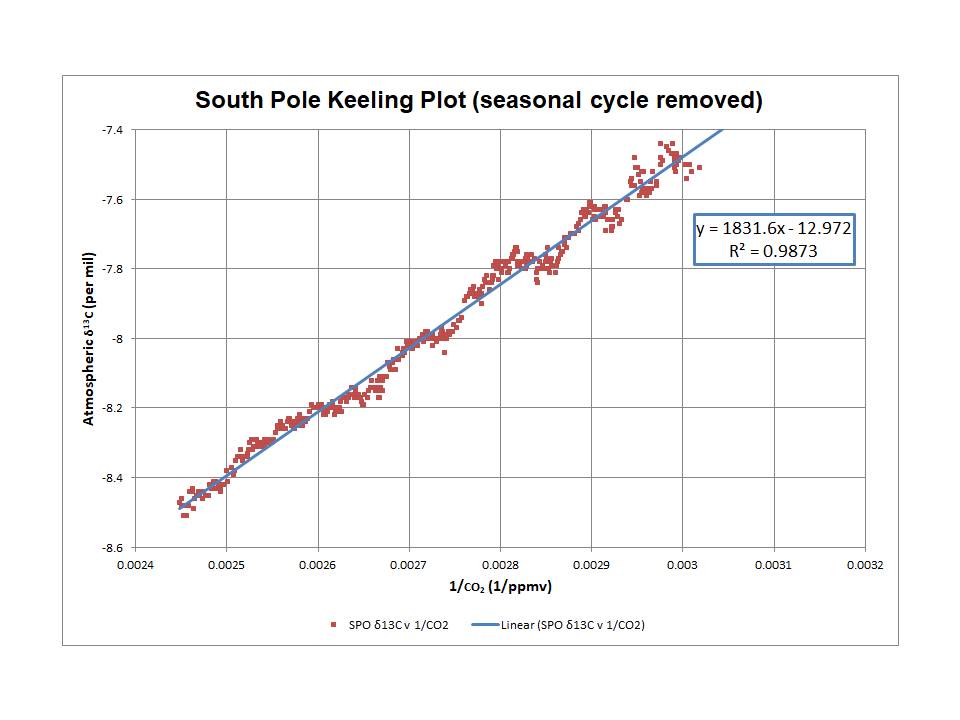 .
.
Here is a Keeling plot of the South Pole data (data source: Scripps CO2 program). The linearity reflects the constant value (on average) of the δ13C of the incremental CO2 (13C/12C ratio) and the value itself is given by the intercept of the line (-13.0‰, R^2 0.99).
You do not need to know anything about the sources and sinks to see that the net 13C/12C
ratio of the additional atmospheric CO2 has not changed over the period of direct observations other than short term fluctuations which do not change the longer term trend. Before you can even consider any potentially valid hypothesis as to the material changes in the CO2 balance, you can rule out any hypothesis that would inevitably have led to changes in the 13C/12C ratio in the incremental CO2 over time.
Incidentally, if you are interested in δ13C changes over the longer term, the Law Dome data show that the incremental CO2 has maintained this value of -13‰ since 1760 or thereabouts (ref. Figure 1B in Kőhler et al (2006)).
I look forward to your model (or a link) for this, especially the inter-annual variations in δ13C for which no published model currently appears to exist. The most recent analysis of which I am aware is here: van der Velde, I. R., J. B. Miller, K. Schaefer, K. A. Masarie, S. Denning, J. W. C. White, P. P. Tans, M. C. Krol, and W. Peters (2013), Biosphere model simulations of interannual variability in terrestrial 13C/12C exchange, Global Biogeochem. Cycles, 27, 637–649, doi:10.1002/gbc.20048.
I am well aware of Keeling et al (2017) as well as the recent paper by Demetris Koutsoyiannis discussed here at WUWT (with not a single reference to the value of δ13C in the comments).
No, mass balance is not needed for tracer isotopes.
I’ll just point out that there is more 13CO2 in the atmosphere than there is CH4. Not what I would call a “tracer”.
Rud Istvan, this is a good argument that has been put forward by Ferdinand Engelbeen in the past. It persuaded me for a long time.
And then it didn’t.
The assumption it makes, that I also made, is that CO2 is dissolved in the oceans and thus decays differently to, or can be distinguished from, readily replenished carbon in the biosphere.
That’s wrong. It must be wrong.
Carbon is stored in the oceans where… the deeper you go… the less nutrients there are. So all of it is scavenged by whatever life actually is there.
And near the surface (which for an 800 year lag may not be that important, in my opinion) the CO2 is definitely part of the the plankton, algae et al. There’s light there.
So the isotope argument to distinguish between ancient and modern CO2 is wrong.
I see that whole argument in regards to the difference between C12 and C13 as changes in behaviour to variable physical environments. The way i look at it is by using a metafor: i like steak but if i cant get it i eat chicken. Or if it costs too much.
So, the inferences made about C12/C13 are just hypothetical and not based on any science as far as i can tell. And usually conjured up by Greens as ‘proof’ of whatever their target is.
It is not that simple.
In a warming world, all of it cannot be due to human activities.
Yes indeed.
Ice cores show us atmospheric gases present before human activity put more than 280ppm of CO2 into the atmosphere.
So the natural carbon cycle was undisturbed.
The natural way of things is indeed for CO2 to follow temp.
However CO2 is a GHG and as such it can also lead temperature.
IE it absorbs/thermalises/re-emits LWIR.
Hence in the steady rise to above 400 ppm and beyond the CC’s ability to absorb, it now does just that.
Leads.
In short it both leads AND lags, depending on which comes first – a rise in temp or a pulse of CO2.
An off topic question for Roy, if I may.
In your UAH reports, what percentage of the globe does each of the columns represent.
eg, I would think that “Globe”, missing only a tiny area at the North and south poles, would be around 98-99%, each of the “hemisphere” columns would be a bit less than 50%.
Tropics ??? etc.. and how do the land/oceans work out
Thanks. 🙂
This WUWT post is simply a re-post from Roy’s own website. You should query him on his own site if you really would like a response from him.
Roy generally reads comments on this re-posts… Seems it worked 🙂
Good question. We would have to calculate those numbers.
Thanks Roy,
Maybe add it to the bottom of next month’s report… or something. ?
Thanks 🙂
“I continue to be perplexed why Net Zero is a goal”
So do I. I think it is the most stupid thing humans have ever put their minds too.
For a start, the whole planet survives because of CO2, and there is still a “plant deficit”
There is no climate crisis, barely a degree or so warming from probably the coldest period in 10,000 years
Extra warming, as if CO2 caused any anyway, would open up vast tracts of land that is now too cold for plant growth.
There is absolutely zero “bad” effect from enhanced atmospheric CO2.
It is too cold to live outside of the tropics without lots of technology in the form of heating, warm clothes, and warm shoes.
Just watch what this revelation does to the IPCC’s “best estimate” in the next several years – not next year’s, because when changes in a “Clime Syndicate” metric are necessary for political reasons, their modus operandi is to pause the process while they fashion a “fix for the problem”.
When the T° anomaly forecasts for the 1st decade of the new millennium turned out to be 300% too high (that was for the average of the model output, the upper bound was 600% too high compared to observations!), they moved the goalposts back to 1850 from 1950 for the beginning of significant effect of CO2 levels, and made a 1.5°C limit before serious damage was caused to the planet (prior to this the consensus was airily bandying about +5° and even +7°C by 2100 for business as usual “with a high degree of confidence”)
At the zenith of hype about sealevel acceleration, sealevel suddenly began to decline for a few years. The sealevel charts were likewise discontinued for several years and the data fiddlers came back with an add-on correction for “crustal rebound – ocean basins were increasing in volume that’s why sealevel was pausing!! Unfortunately mixing a volume into a linear function had an idiotic effect. New sealevel was now up above the actual sea surface!!!. The old sealevel graph was scrapped and he ‘crustal rebound’ factor quietly forgotten. They sent up a satellite for measuring S.L. that had an error of +/- 2.5cm, about 20 x the annual rate of rise. Their last act was to report an acceleration of SLR at the junction of the old data with the new satellite data ..sigh!
” I can only assume that the scientific community’s silence on the subject is because politically driven energy policy goals are driving the science, rather than vice versa.”
It’s been clear since 1995 IPPC SAR that politically driven interests are driving science. And Not just climate but as we saw with COVID, Pandemics of infectious diseases as well.
Other politically driven goals for the unwashed masses of humanity:
Corrolary: This is the CO2 sink flow out of the atmosphere for a given atmospheric CO2 concentration. At an annual emiion of 20 GtCO2, the sink flow equals the emion and CO2 will no longer increase in the atmosphere.
Story tip.
Well that’s not good, I really hope she is wrong.
“New Ice Age Has Begun,” Astrophysicist Warns…Due To Reduced Solar Activity (notrickszone.com)
Many western countries have disabled the reliability of their energy supply and the colder ones could be in for a really tough time.
Let’s see what happens as the El Nino subsides.
And hope people wake up to the complete stupidity of “Net Zero” before it is not too late.
Story tip.
Well that’s not good, I really hope she is wrong.
“New Ice Age Has Begun,” Astrophysicist Warns…Due To Reduced Solar Activity (notrickszone.com)
Many western countries have disabled the reliability of their energy supply and the colder ones could be in for a really tough time.
Let’s see what happens as the El Nino subsides.
And hope people wake up to the complete stupidity of “Net Zero” before it is not too late.
She was very wrong in her predictions about SC25. She is almost certainly wrong then in follow-on predictions downstream of a failed prediction.
As I said… I hope she is wrong. ! Time will tell.
If not, then a lot of the colder NH countries could be in deep trouble.
She is already wrong since we are already in an ice age has been for around 2.6 million years.
She is exaggerating the future cooling 2–3-decade trend as it will just be a standard cycle that showed up three times since 1880 then will be a 2-3 decade warming trend after it.
Glaciation phase isn’t coming for at least another 250-500 years from now.
Sorry for the double post.. don’t know why that happened.
No one should really be concerned about reaching Net Zero by 2050 or even much later for a number of reasons. First, as Spencer implies, no technology is on the horizon which will supplant fossil fuels for decades at least. Secondly, consumers, businesses and industries don’t consider it attainable in the first place and certainly don’t intend to accept higher taxes and government environmental restrictions to reach that point. Thirdly, few of the above feel it’s any great priority as poll after poll consistently shows> People generally consider the whole concept to be like a steadily receding mirage whose image is only evident in the minds of the eco-alarmists.
The 1982 observational study of global CO2 termite emissions. Science 05 Nov 1982: Vol. 218, Issue 4572, pp. 563-565 DOI: 10.1126/science.218.4572.563 It shows that termites emit 10x the CO2 that humans do.
The solution for Net Zero? Kill 10% of all termites. Provide jobs worldwide, Reduce insurance payments for termite damage and save the earth from boiling at the same time. Whats not to like?
Note: Termites don’t live above the treeline, in the ocean or under glaciers, so the task is where humans live anyway.
______________________________________________
There is no reason to stop the rise of atmospheric CO2.
Dr. Spencer is in effect saying, “Here’s how you can solve
your imaginary CO2 Climate Change problem.
“There is no reason to stop the rise of atmospheric CO2.”
And EVERY reason to continue it. !!
CO2 leads to better prosperity for plant life, animal life…
… and certainly, the fossil fuels that release CO2 add massively to human life.
This article contains at least two predictions
Slower rise of CO2 emissions and CO2 will not increase pst 460 ppm
Given the previous poor record of climate predictions, it is safe to assume these predictions will fail.
I have no idea why Mr. Spencer would publish such speculation. Predictions are never based on data. There are no data for the future.
Past data show nature has been a CO2 absorber, most likely for 4.5 billion years … the very long term decline of atmospheric CO2 ended after manmade CO2 was added to the small natural emissions from volcanoes and fires.
My rating of these new predictions is
the same as my rating for all climate predictions: Baloney Sandwich
.
n
You really think natural emissions come only from volcanoes and fires..? WOW !!!
Explains your utter confusion about CO2.
My rating of your comment… unscientific and totally worthless. !
I can only assume that the scientific community’s silence on the subject is because politically driven energy policy goals are driving the science AND FUNDING, rather than vice versa.
Fixed it.
So we have a prediction. Unfortunately my lifespan will not allow me to witness if the prediction is validated.
A common mistake that climate alarmists make is to assume that the deep ocean can be ignored as a carbon sink. In fact, for modeling purposes, the ocean can be approximated by a bottomless CO2 sink.
There’s about 39,000 PgC / 900 PgC ≅ 43× as much carbon in the oceans as there is in the air. So, although the anthropogenic pulse has increased the amount of carbon in the air by 50%, it has increased the amount of carbon in the oceans by less 0.5%.
Have you heard of “marine snow?” That’s carbon transport, in the oceans! Air ⇄ ocean exchanges of CO2 are not limited to the surface layer of the ocean, because biological processes are continually transporting carbon from the surface to the depths—and they do so much faster than water circulation does.
Consequently, for modeling purposes, as long as the atmospheric CO2 level is well above 300 ppmv, the ocean sink can be approximated as infinite, and the rate of marine uptake of CO2 is, very closely, simply a linear function of the atmospheric CO2 level:
The higher CO2 levels rise, the faster those natural CO2 sinks remove CO2 from the air. Even the IPCC has noticed:
For each 40-50 ppmv rise in CO2 level, net natural CO2 removals accelerate by another 1 ppmv/year. Since anthropogenic emissions of CO2 are currently outpacing natural emissions of CO2 by about 2.5 ppmv per year, that means if anthropogenic emissions were to remain the same indefinitely (or until the coal runs out) then the atmospheric CO2 level could rise by just 2.5 × (40 to 50) = 100 to 125 ppmv, before plateauing. (It would actually just asymptotically approach that level, of course.)
That would be approximately a rise from the current 422 ppmv to 535 ppmv, a 27% increase, yielding 34% of the radiative forcing which we would get from a full doubling of CO2.
Compare that to the approximately 59% of a doubling’s forcing which we’ve already had, which, in combination with other GHGs, has yielded global warming of only a little over 1°C, disproportionately at chilly high latitudes (which are much too cold anyhow). The consequences have been entirely benign, with major benefits for agriculture, and no significant negative effects.
Typo correction:
I wrote, “Since anthropogenic emissions of CO2 are currently outpacing natural emissions of CO2 by about 2.5 ppmv per year,”
I intended, “Since anthropogenic emissions of CO2 are currently outpacing natural removals of CO2 by about 2.5 ppmv per year,”
Sorry about that!
A mass balance over the atmosphere shows that an imbalance of 8.004 Gt/yr results in a 1 ppm increase in average CO2 concentration over the entire atmosphere.
If the concentrations measured at Mauna Loa are assumed to be uniformly distributed throughout the atmosphere, then the net accumulation of CO2 during year y is equal to 8 * [C(y+1) – C(y)], where C(y+1) = Mauna Loa concentration in January of year y+1, and C(y) = Mauna Loa concentration in January of year y.
If E(y) represents the global anthropogenic CO2 emissions in Gt/yr in year y, then the net removal rate in Gt/yr by natural sinks is equal to
S(y) = 8.004 * [C(y+1) – C(y)] – E(y) (Eq, 1)
Using the records of yearly anthropogenic CO2 emissions and concentrations measured at Mauna Loa from 1959 through 2022, a linear regression of the 5-year averages of the net natural sink rate S(y) (in Gt/yr) as a function of the 5-year average concentration resulted in
S(y) = 0.1400 * C(y) – 39.92 R^2 = 0.8711 (Eq. 2)
An attempt at a quadratic regression did not improve the R^2 value, so that the linear regression was considered correct. In terms of concentration (dividing by 8.004 Gt/yr-ppm), this would be
dC/dy (natural sink) = 0.0175 * C(y) – 4.99 (Eq. 3)
The first term in Equation 2 can be considered as a first-order reaction for the natural removal rate of CO2 from the atmosphere. Photosynthesis is a chemical reaction, so the rate of consumption of CO2 could be proportional to its concentration in the atmosphere. The dissolution of CO2 in the oceans follows Henry’s law, which is proportional to the partial pressure of CO2 in the atmosphere, which is also proportional to the mole fraction of CO2 in the atmosphere.
The term -39.92 Gt/yr in Equation 2 can be considered the emission rate of CO2 by natural sources (animal and human respiration, etc.) into the atmosphere, which would not depend on the concentration of CO2 already in the atmosphere. The expression for CO2 concentration as a function of time can then be written
dC/dy = 4.99 + E(y)/8.004 – 0.0175 C(y) (Eq. 4)
where E(y) is the anthropogenic emission rate of CO2 in Gt/yr in year y.
If there were no anthropogenic CO2 emissions from burning of fossil fuels, setting E(y) = 0 and dC/dy = 0 would result in an equilibrium concentration of 4.99 / 0.0175 = 285 ppm, which is close to what IPCC has estimated for the “pre-industrial” CO2 concentration.
Equation 4 can be solved for any hypothetical scenario of future anthropogenic emission rates as a function of time, using an initial condition of C(y) ~ 422 ppm at the present.
One interesting scenario would be if global anthropogenic CO2 emissions were held steady at the current rate (in 2022) of 37.2 Gt/yr. Setting E(y) = 37.2 and dC/dy = 0 in Equation 4 results in a future equilibrium concentration of [4.99 + 37.2/8.004] / 0.0175 = 551 ppm.
This means that, if anthropogenic CO2 emission rates do not increase in the future, the CO2 concentration will level off at about 551 ppm, and will never double from the current value, and will not even reach double the “pre-industrial” concentration. We do not need to strive for “net zero emissions”, but simply “net zero increase in emissions”.
According to the other article from the CO2 Project, the temperature sensitivity for doubling the CO2 concentration is about 0.8 C per doubling, based on absorption of IR radiation alone. Assuming a logarithmic relationship (per Arrhenius), the temperature rise up to 551 ppm would be
dT = 0.8 * ln(551/422) / ln(2) = 0.31 C = 0.55 F.
Do we really need to fear an increase of 0.31 C in the global average temperature, which most people would never even notice, and is difficult to measure? This would be the result of keeping CO2 emission rates constant, and essentially doing nothing. If future temperatures rise by more than this amount, it would be due to natural forces beyond human control.