From Dr. Roy Spencer’s Global Warming Blog
by Roy W. Spencer, Ph. D.
The Version 6 global average lower tropospheric temperature (LT) anomaly for February, 2024 was +0.93 deg. C departure from the 1991-2020 mean, up from the January, 2024 anomaly of +0.86 deg. C, and equaling the record high monthly anomaly of +0.93 deg. C set in October, 2023.

The linear warming trend since January, 1979 remains at +0.15 C/decade (+0.13 C/decade over the global-averaged oceans, and +0.20 C/decade over global-averaged land).
A new monthly record high temperature was set in February for the global-average ocean, +0.91 deg. C.
The following table lists various regional LT departures from the 30-year (1991-2020) average for the last 14 months (record highs are in red):
| YEAR | MO | GLOBE | NHEM. | SHEM. | TROPIC | USA48 | ARCTIC | AUST |
| 2023 | Jan | -0.04 | +0.05 | -0.13 | -0.38 | +0.12 | -0.12 | -0.50 |
| 2023 | Feb | +0.09 | +0.17 | +0.00 | -0.10 | +0.68 | -0.24 | -0.11 |
| 2023 | Mar | +0.20 | +0.24 | +0.17 | -0.13 | -1.43 | +0.17 | +0.40 |
| 2023 | Apr | +0.18 | +0.11 | +0.26 | -0.03 | -0.37 | +0.53 | +0.21 |
| 2023 | May | +0.37 | +0.30 | +0.44 | +0.40 | +0.57 | +0.66 | -0.09 |
| 2023 | June | +0.38 | +0.47 | +0.29 | +0.55 | -0.35 | +0.45 | +0.07 |
| 2023 | July | +0.64 | +0.73 | +0.56 | +0.88 | +0.53 | +0.91 | +1.44 |
| 2023 | Aug | +0.70 | +0.88 | +0.51 | +0.86 | +0.94 | +1.54 | +1.25 |
| 2023 | Sep | +0.90 | +0.94 | +0.86 | +0.93 | +0.40 | +1.13 | +1.17 |
| 2023 | Oct | +0.93 | +1.02 | +0.83 | +1.00 | +0.99 | +0.92 | +0.63 |
| 2023 | Nov | +0.91 | +1.01 | +0.82 | +1.03 | +0.65 | +1.16 | +0.42 |
| 2023 | Dec | +0.83 | +0.93 | +0.73 | +1.08 | +1.26 | +0.26 | +0.85 |
| 2024 | Jan | +0.86 | +1.06 | +0.66 | +1.27 | -0.05 | +0.40 | +1.18 |
| 2024 | Feb | +0.93 | +1.03 | +0.83 | +1.24 | +1.36 | +0.88 | +1.07 |
The full UAH Global Temperature Report, along with the LT global gridpoint anomaly image for February, 2024, and a more detailed analysis by John Christy, should be available within the next several days here.
The monthly anomalies for various regions for the four deep layers we monitor from satellites will be available in the next several days:
Lower Troposphere:
http://vortex.nsstc.uah.edu/data/msu/v6.0/tlt/uahncdc_lt_6.0.txt
Mid-Troposphere:
http://vortex.nsstc.uah.edu/data/msu/v6.0/tmt/uahncdc_mt_6.0.txt
Tropopause:
http://vortex.nsstc.uah.edu/data/msu/v6.0/ttp/uahncdc_tp_6.0.txt
Lower Stratosphere:
/vortex.nsstc.uah.edu/data/msu/v6.0/tls/uahncdc_ls_6.0.txt
Warmer IS better !
This marks 9 months in a row, where the monthly record has been broken. In this case the record for February was broken by more than 0.2°C.
The top ten warmest Februaries are now
2018, and 2023 are tied with 2003 for tenth place.
Before 2023, February 2016 was the highest anomaly of all months. March 2016 was the second highest at 0.65C. Now February 2016 is only the 7th highest anomaly.
Of the top ten highest anomalies, 8 where made in the last year.
I don’t think record breakers are the best way to assess warming, but it’s pretty clear it has been unusually warm in the last 8 months.
Still looking like a slow recovery from the Little Ice Age.
Solar activity has not yet been low enough for long enough to reverse the trend.
No sign of the sort of acceleration relied upon by proponents of the CO2 theory of climate.
We still haven’t broken the October record despite the ever-strengthening El Niño. This is good evidence that the mid-2023 spike was unrelated to El Niño; the record highs of the last 7 months have been this mysterious spike event, now likely waning in influence, superimposed on the El Niño.
Don’t rule out the return to the Monckton pause.
The peak length of the Monckton pause reached 107 months starting in 2014/06 on the 2023/04 update. The trend using the Monckton method from 2014/06 to 2024/02 is now +0.26 C/decade. That is an awfully high rate of warming for a period and method that was used to suggest that the warming had come to end.
Hello,
The late 2023-early 2024 values represent significant departures from the prior portrayal of a gradual overall warming trend, at least to my eyes. Will you be offering, following the update of the 4 indices that you referred to in this post, your interpretation of why these recent values in the time series are as to be expected, and why?
Thank-you. I enjoy reading, and appreciate, your contributions.
Here is the customary Australian data update of our “pause”.
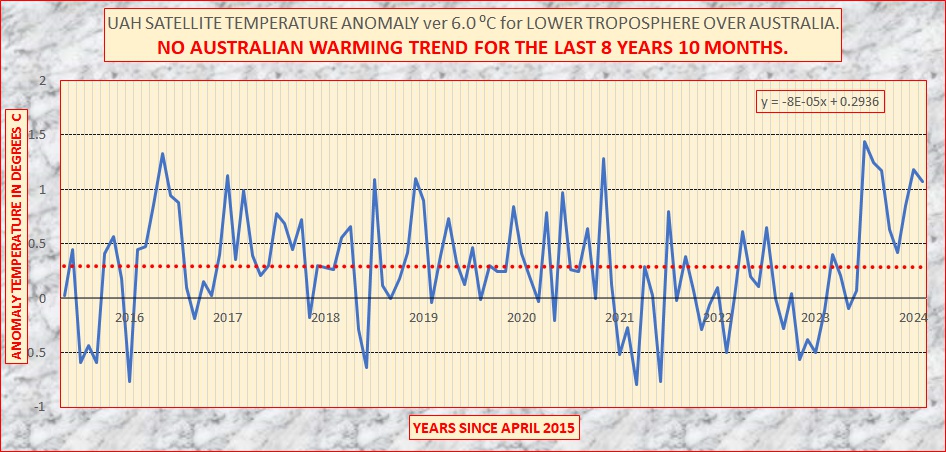
Geoff S
Yawn
I do hope the Rusty Nail is ok. I don’t see any hyperventilating here.
This is looking like an untypical El Nino, compared to other recent peaks.
On February 27Spencer announced the February data would be late
It showed up on March 2
The El Nino Nutters will be thrilled.
We’re having the warmest winter with the least snow since I moved to Michigan in 1977. And we love it.
I doubt if an El Nino affects us here but …
Does anyone out there prefer colder winters over warmer winters (other than ski bums)?
This is the best climate in my lifetime, and that is a long trime. We have been getting less snow and warmer winters since the early 1980s Especially the past three years.
And every year we listen to scientists predict climate doom as our actual climate improves.
The Thames is boiling@ur momisugly!@ur momisugly!@ur momisugly!@ur momisugly!!!
I spy El Nino. Nice and warm.
Patience. The higher the peak, the deeper the drop. This heat is leaving the earth system by radiation.
I find it amusing that warmist/alarmists flock to posts like this because they stare at any thermometer showing a warming in its heck, they probably reach peak panic feeling faint by 5-6 pm every day when it stops warming while not posting in other science-based threads because there are no thermometers in them.
Daily panic seems to be a daily habit.
With this new heat, shouldn’t we be seeing the assorted catastrophes predicted by the “climate experts”? Are the ice caps melting and sea levels rising uncontrollably yet? Where are the mass extinctions? Where are the millions of climate refugees? Were are the boiling oceans?
Wasn’t there an underwater volcano that erupted a while back and released enormous amounts of warm water into the atmosphere?