As we navigate through another winter season, it’s hard not to notice the ever-pervasive narrative of climate change influencing public perception. A recent Rasmussen Poll reveals a fascinating, albeit concerning, trend: while the majority of Americans report this winter being no worse than usual, a significant portion still believe climate change is exacerbating extreme weather. This finding, coupled with the shifting attitudes toward electric vehicles, paints a complex picture of public opinion and media influence.

“The survey of 1,125 American Adults was conducted on January 15-17, 2024 by Rasmussen Reports. The margin of sampling error is +/- 3 percentage points with a 95% level of confidence. Field work for all Rasmussen Reports surveys is conducted by Pulse Opinion Research, LLC. See methodology.”
https://www.rasmussenreports.com/public_content/lifestyle/general_lifestyle/january_2024/most_believe_climate_change_makes_winter_worse
The poll indicates that 38% of Americans feel this winter has been harsher compared to previous years, a slight increase from 30% in 2022. However, a noteworthy 50% don’t see any difference, and 12% remain unsure. Despite these figures, a staggering 59% believe climate change is likely causing more extreme weather, including severe snow storms.
It’s essential to approach these findings with a critical eye. The correlation between personal experience and belief in climate change’s impact raises questions about the influence of media and societal narratives. Among those convinced of climate change’s role in extreme weather, nearly half report a worse winter experience, contrasting sharply with those skeptical of this connection.
The poll also sheds light on demographic differences. More women (63%) than men (55%) lean towards believing in climate change’s impact on weather severity. Younger adults, particularly women under 40, show a higher tendency to attribute extreme weather to climate change, compared to their older counterparts.
Interestingly, perceptions vary across economic and racial lines. Higher-income individuals appear more likely to believe in climate change’s role in extreme weather. In contrast, less than half of those earning under $30,000 a year share this belief. Racial differences also emerge, with varying degrees of belief across different groups.
“Forty percent (40%) of whites, 33% of blacks and 37% of other minorities say this winter has been worse where they live than it has been in past years. Fifty-seven percent (57%) of whites, 71% of blacks and 61% of other minorities think it’s at least somewhat likely that climate change is causing more extreme weather.”
https://www.rasmussenreports.com/public_content/lifestyle/general_lifestyle/january_2024/most_believe_climate_change_makes_winter_worse
Another intriguing aspect of the survey relates to electric vehicles (EVs). Despite significant promotion and investment in EVs, public enthusiasm seems to be waning. Only 29% of Americans consider an EV for their next vehicle, a notable decrease from 40% last year. This shift could reflect a growing recognition of the practical limitations and economic implications of EVs, contrary to the idealistic portrayal often seen in media and political discourse.
This brings us to a critical point: the gap between perceived and actual climate realities. The consistent belief in worsening winters, despite contradictory personal experiences and historical data, suggests a powerful narrative at play. One must question the role of media, education, and political rhetoric in shaping these perceptions.
Furthermore, the decline in interest in electric vehicles might indicate a growing skepticism towards solutions presented as panaceas for climate change. The public seems to be recognizing the complexities and trade-offs involved in such technologies, moving beyond the initial enthusiasm driven by idealistic portrayals.
Discover more from Watts Up With That?
Subscribe to get the latest posts sent to your email.
Even if they’re right and their local winters have been harsher than previous ones, local weather is not climate.
In my local area, we’ve had very mild winters for the past few years in comparison to the almost 30 years I’ve lived here. We used to get one or two decent snows a year with temps dipping into the teens at night. In the past four years, I think we’ve gotten one decent snow (more than a dusting) and the lows at night barely break freezing if they do at all.
But we’re in a sort of oasis. They’ll get snow north south and west (the only thing East is the Atlantic) but we won’t get a flake. Some weird gyration of the jetstream I suppose.
But the point is, just because our local winters have been mild lately doesn’t reflect the weather of even this general region, let alone the entire world, and has nothing at all to do with “climate”.
That is not newsworthy. How can you hype pleasant weather?
The Australian press has been all over the Arctic Blasting over North America.
Australia is set for another Extreme Weather Event™ that can be hyped as unprecedented in a day or two as a tropical low approaches the Queensland coast.
The Davos mob locked onto Extreme Weather Events™ as the #1 priority this year.
Trying telling a Tesla driver freezing at a charging station with his car not willing to accept charge that he is not in extreme weather. The new deefinition of an Extreme Weather Event™ is anything that stops a Tesla. A road with 4 inches of water coursing over it is a serious threat to a Tesla driver – just more evidence of extreme weather.
Climate is weather over an extended period of time. A smaller area definitely has a more specific climate than a larger one, your statement is 180 degrees off. The climate of Duluth, Minnesota is dramatically different than that of International Falls, Minnesota, only 140 miles apart.
Very nice Charles. We are facing two problems here. One is an extension of the other.
Number one we are not fighting science, we are fighting propaganda. In other words I believe if our scientists squared off against the CAGW scientists we would win convincingly.
Number two brings us to propaganda. If the mainstream media were on our side it wouldn’t even be a contest. It is nearly impossible to get your message out if the media is working against you. I am amazed we are doing as well as we are considering this huge hurdle.
Number three is language. We have passively sat back and allowed the CAGW criminals to set the tone of language. This is a big mistake. There should be no more talk of climate change, global warming, climate disruption or any other variation.
Catastrophic Anthropogenic Global Warming is the only language we should discuss. If anyone uses other words we need to stop them and insist they speak in terms of CAGW. There is one simple reason for this, if what the other side is talking about is catastrophic then they need to say so in plain English or what is the point? If man is causing the catastrophe then they need to say that in plain English or what is the point?
There is a reason the CAGW crowd want to talk about climate change or climate disruption or whatever. Those expressions can mean anything. That is how anything can be attributed to man adding CO2 to the atmosphere.
They have coasted long enough it is past time we hold their feet to the fire.
Skeptics are not setting the climate agenda.
The Davos mob placed Extreme Weather Events™ at the top of their list this year. CAGW is long dead. Trying to resuscitate it is a waste of effort. October 2023 probably breached the precious 1.5C tipping point and there has been no tipping so please move on.
Attached shows Google trend for last 5 years on the words “extreme weather events”
So climate is no longer the issue. It is whatever the press term to be “extreme” weather. If the road gets 4 inches of water over it and the Tesla battery gets soaked and blows up that could be now classified as extreme weather. All the EVs that got stranded, unable to recharge was caused by – drum roll please – an Extreme Weather Event™.
Adverse weather occurs on a daily basis somewhere on this big ball we live on. Bringing the focus to weather rather than climate is a climate botherers salvation after the failure to tip at 1.5C.
Yes I understand that what I am saying is we need to not accept their language. Keep their feet to the fire and throw on more wood.
As far as the extreme weather goes, all skeptics have to do is hit the climate alarmists with the facts, and the facts are available.
There has always been extreme weather. The data numbers and history say the extreme weather of today is not unprecedented, and in fact is less extreme today than it was in the past.
For example: This year’s hurricane season didn’t amount to anything like what climate alarmists predicted. The U.S. hurricane season this year was below normal. Where are all the extreme hurricanes? I thought the oceans were boiling? Don’t boiling oceans create more hurricanes? Not this year.
Yes, the weather is not a good subject for climate alarmists because we have actual data that refutes their claims about extreme weather.
But, the climate alarmist do have the Megaphone when it comes to spreading their alarmist propagada, and propagada is effective. Repeat the lie often enough and some people are going to buy it.
“Bringing the focus to weather rather than climate is a climate botherers salvation after the failure to tip at 1.5C.”
Yeah, but all the statistics say the weather is no more extreme today than it was in the past.
So claiming the weather is more extreme today is not based on the facts. Those promoting such ideas are either misinformed, or they are lying, because the numbers don’t lie and the numbers say the weather is no more extreme today than it was in the past.
Excellent comment, Bob. Many good points.
The climate botherers have shifted the focus from Global Warming to Climate Change to Climate Weirding and now Extreme Weather Events. Skeptics play catch-up so are always behind on the game.
There is an abundance of Luke-warmers who accept the BS on the Greenhouse Effect and CO2 contributing to it. This is unscientific claptrap but still gets lots of support.
However the climate is changing. It always has and always will. Nothing humans can do will alter that because the forces of change are global and powerful. Just the combination of the sun and Earth’s curious orbit.
Compared to previous interglacials, the current one has to close to its use-by date. The question that any real climate scientist should be asking is – What does the termination of an interglacial look like?
My response to the question starts with the basic thermodynamics of snow creation. Water has to be liberated from oceans, carried aloft through high heat uptake and then deposited over land cooler than 0C. Liberating more water from the oceans requires warmer ocean surface. Now ocean surface is limited by convective instability to 30C. So the best indicator of ocean surface warming is the change in surface area reaching 30C. The Northern Hemisphere warm pool extent reaches its maximum in August or September each year and is increasing at 2.5% per decade. Current level at 10% At that trend, 50% of the ocean surface will reach 30C by 2200.
Based on the rate of NH ocean warming, it is certain that the current trends in NH fall and winter precipitation will continue upward:
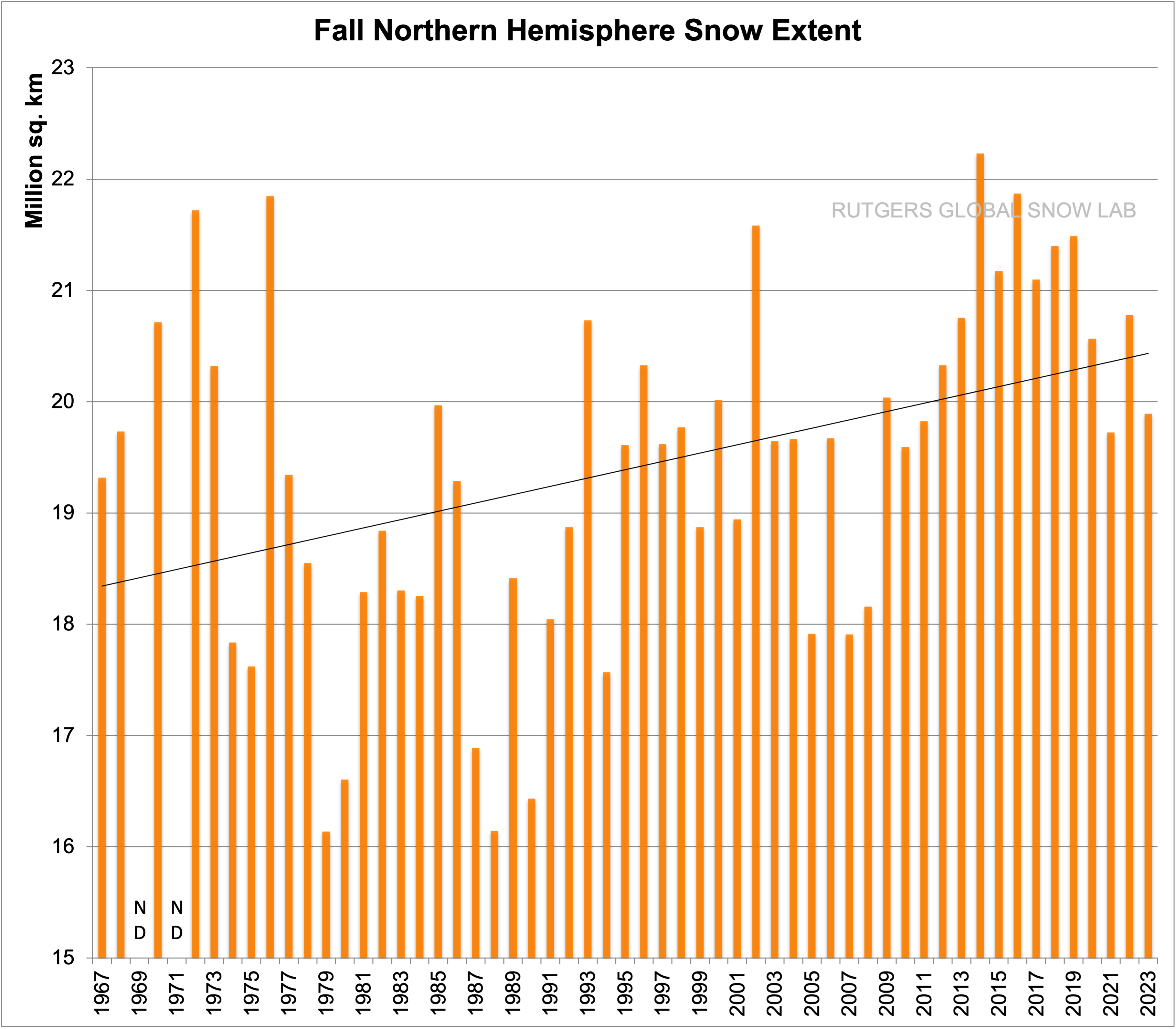
My best guesstimate for permafrost advancing south again is around 2175. My prediction for the NH is warmer and drier summers and mostly wetter/snowier winters with cooler temperatures inland, away from the influence of warmer oceans.
There were numerous new snowfall and cold records set this year so people’s perception is supported by the evidence.
Climate modellers are now claiming they have always forecast more snowfall because it is quite obvious that the trend is upward. The notion of Extreme Weather Events when it comes to snowfall is easily supported by the evidence. The question is – What will snowfall look like when it inevitably overtakes snow melt to begin the journey into glaciation? Think about how much more moisture will be in the atmosphere when 50% of the NH ocean surface hits the 30C limit in 160 years or so.
During previous cycles of glaciation, the sea level fall has averaged 4mm per year. To achieve that, there has to be a lot more snowfall than now.
It certainly takes a lot of precipitation (water liberated from the oceans) to build a Canadian ice sheet over a mile thick
Love it more snow longer! A little solar induced gladiation wouldn’t hurt. Minnesotans love ice fishing.
TIP
North Carolina city spent millions on electric buses that don’t run | Fox Business
3 of 5 not working
A door broke on one and there is no replacement from bankrupt Proterra.
The costs are astounding.
Three buses are out of action needing parts no longer available, but here’s what should really hit home: “the two electric buses that are still in operation can only travel around 78 miles in the wintertime before needing to return to the shop and charge for hours.” Even if they were all high-quality, running buses they would still have severe range limitations in the winter.
I have now seen the same or similar stories reported from Oslo, Chicago, Edmonton Canada, and now Asheville North Carolina.
Don’t forget Albuquerque. They’ve actually taken two runs at it and failed both times. Objective reality refusing to conform with politico/theological aspirations.
Report Examines BYD’s Failed Electric Bus Rollout in Albuquerque – Alliance for American Manufacturing
I have to question the validity of a poll gauging the perceptive harshness of Winter when polling ends less than 4 weeks into Winter. It also suffers from timing bias. Take Kansas City as a reference location. If a respondent was polled on 1/17/24, KC was suffering through 14 straight days of below normal temps and had a 4 day stretch where the airport registered double digits below zero (-16F lowest, and one day of -3F for a high temp). Notably, the Chiefs played the coldest game in their history, and temps were at least -8F at the conclusion. As of this writing, KCI has had avg temps for the month 9.7F below normal.
Had polling been done on 12/31/23, barely into Winter (but a month into Meteorological Winter) responses would have been much different. KCI had an avg high of 48F and avg temps 7.1F above normal for the month, and began the first day of Winter amidst a 6-day stretch of days with an avg high over 54F. Just goes to show that if you want a valid poll (and not just wanting to reinforce a narrative with timing bias), wait until March 20, at Winter’s conclusion, so the ups and downs have a chance to balance out.
By the way, the 30-year reference normal temps now (1991-2020) vs those from 30 years ago when I lived there (1961-1990) are notably warmer. Avg temps for KC are similar to those from Springfield, MO (148 miles SSE in straight-line distance) from 30 years ago. I have family still living there, and nobody is complaining about the “harsher Winters”.
As another aside, the coldest month I ever experienced was 12/1983 (when we were emerging from the global cooling scare. At KCI, Temps fell below -15F 6 times, peaking at -21F, and 4 days for the month, including 3 in a row, the high temp did not exceed -4F. For the month, avg temps for KCI were 19.9F below normal. Imagine going through a whole month with expectations that a typical day would be about 20F below normal.
The IPCC says weather events are caused by Mother Nature because they can’t prove otherwise:
https://rogerpielkejr.substack.com/p/what-the-ipcc-actually-says-about
What the IPCC Actually Says About Extreme Weather
I promise, you’ll be utterly shocked
Roger Pielke Jr.
Jul 19, 2023
People are going absolutely nuts these days about extreme weather. Every event, anywhere is now readily associated with climate change and a portent of a climate out of control, apocalyptic even. I’ve long given up hope that the actual science of climate and extreme weather will be fairly reported or discussed in policy — nowadays, climate change is just too seductive and politically expedient.
But for those who want to know what research actually says on the relationship of extreme weather and climate change, that information is readily available. Today I’ll share the excellent work of the Intergovernmental Panel on Climate Change (IPCC) summarizing what its most recent assessment says about various types of extreme weather and climate change.
When you read the below you will realize that the difference between what you see in the news (including statements from leading scientists) and what the IPCC has concluded could not be more different. One day PhD dissertations will be written about our current moment of apocalyptic panic. . .
The IPCC has concluded that a signal of [Human-caused] climate change has not yet emerged beyond natural variability for the following phenomena:
River floods
Heavy precipitation and pluvial floods
Landslides
Drought (all types)
Severe wind storms
Tropical cyclones
Sand and dust storms
Heavy snowfall and ice storms
Hail
Snow avalanche
Coastal flooding
Marine heat waves”
end excerpts
People who make claims that a particular severe weather event is caused by CO2 are not backed up by the facts. Even the IPCC says so.
Here in PA I was hoping for another 1977, 1986, 1993, 2010,2011,or 2013 like winter or something truly throw back like 1936 or even winter in Summer:1816. People would have so much more fun if they just stopped looking at weather media and embrace actual reality and deal with it as it comes.
Life is short so we should all get a life.
Oh I forgot the 3 foot dump of snow in Feb 1996. How I wish every year was a snocalypse and every summer was like 1977 1992 or 1999. And Dec 1967 and he winter of 1966.
Sadly we mostly just get mediocre average weather….darn.