Guest Essay by Kip Hansen – 4 November 2020

The image used here is of the charcoal-burning kilns in the Adirondacks, much of which were clear-cut in the late-1700s and early 1800s to provide timber and charcoal for the big cities of the Northeastern U.S. – particularly for New York City.
Quoting from Joel T. Headley’s “The Adirondack: or Life in the Woods” written in 1849:
“The first harvesting of the Adirondack forests began shortly after the English replaced the Dutch as the landlords of New Netherlands and changed its name to New York [September 8th, 1664] . Logging operations generated wealth, opened up land for farming, and removed the cover that provided a haven for Indians.”
“After the Revolutionary War, the Crown lands passed to the people of New York State. Needing money to discharge war debts, the new government sold nearly all the original public acreage – some 7 million acres – for pennies an acre. Lumbermen were welcomed to the interior, with few restraints: “You have no conception of the quantity of lumber that is taken every winter… A great deal of land is bought of government solely for the pine on it, and after that is cut down, it is allowed to revert back to the State to pay its taxes.”
Why “16th Century”?
In England, there was an Energy Crisis caused by widespread deforestation through the cutting of wood for building materials and for fuel for heating and cooking. This led to a gradual shift from wood burning to coal burning in the century following 1550 or so. Coal burning also supplied the fuel, the energy, for Britain’s early Industrial Revolution.

We all know that humans have been “burning stuff” for the heat energy available from the rapid oxidation of wood and other plant material (grasses, straw, dung, etc.) since early man “discovered” and harnessed fire – “perhaps as early as 1.5 million years ago in Africa” – and subsequently learned how to keep a fire going through saving hot coal in ashes and how to start fires through friction and later using flints and, eventually, chemical matches
And we have been doing so ever since. We burn firewood, we burn peat blocks, we burn wood pellets and wood chips, we burn petroleum products and natural gas, we burn trash and municipal waste. All for the heat produced. We heat our homes and our factories, we use the heat to make electricity in huge power plants. Our transportation systems depend on internal combustion and jet engines that burn gasolines and diesel fuel.
After all these years, despite all of our scientific advances, all but a small fraction of the world’s energy supply comes from “burning stuff”:

There is hope — we can and should do better than this.
In this essay, I will look at Geothermal Energy. [ Lots of illustrations, not too much text. ]
A recent headline declares:
Geothermal energy is poised for a big breakout
David Roberts at VOX writes an excellent informative, well-worth-reading, article [link just above] on the advances made in the geothermal energy arena:
“After many years of failure to launch, new companies and technologies have brought geothermal out of its doldrums, to the point that it may finally be ready to scale up and become a major player in clean energy. In fact, if its more enthusiastic backers are correct, geothermal may hold the key to making 100 percent clean electricity available to everyone in the world.“
Iceland’s National Energy Authority explains:
“Iceland is a pioneer in the use of geothermal energy for space heating. Generating electricity with geothermal energy has increased significantly in recent years. Geothermal power facilities currently generate 25% of the country’s total electricity production.”
“During the course of the 20th century, Iceland went from what was one of Europe’s poorest countries, dependent upon peat and imported coal for its energy, to a country with a high standard of living where practically all stationary energy is derived from renewable resources. In 2014, roughly 85% of primary energy use in Iceland came from indigenous renewable resources. Geothermal sources accounts for 66% of Iceland’s primary energy use.”
In the United States, the federal Department of Energy [DOE] issued a major report on geothermal energy in May of 2019. [Various versions and chapters of the report are available at the link.] One of the featured images is this:

[GHP = Geothermal Heat Pump EGS = Enhanced Geothermal Systems]

Why is the core of the Earth hot?
“There are three main sources of heat in the deep earth: (1) heat from when the planet formed and accreted, which has not yet been lost; (2) frictional heating, caused by denser core material sinking to the center of the planet; and (3) heat from the decay of radioactive elements.
You or your neighbor may already be using geothermal energy to heat (and cool) your home. Residential heat pump systems are already very popular in many areas of the United States. These systems use the relative warmth of ground water (well water) and a heat pump. A Heat Pump is just like an air conditioner, but, in this case, instead of pumping heat out of a residence, it “concentrates” the heat from the well water and pumps that heat into the house. It can also work in the `opposite direction, and pump heat out of your house into the well water.
Here is a good description:
“Open Loop Low Temperature Systems

Since open loop geothermal projects involve the direct use of low temperature groundwater from wells, this category will be the primary topic. In a typical open loop system, geothermal water is brought up from a well and circulated through a heat exchanger (heat pump). After heat is extracted from or added to the water, the water is then either returned to the underground aquifer or original well by injection or discharged onto the ground or into or under a surface water source.”
Closed Loop Low Temperature Systems

The closed loop method uses a contained fluid (often an environmentally friendly antifreeze/water solution) that circulates through a series of pipes (called a loop) under the ground or beneath the water of a pond or lake and into a building. In the winter, an electric compressor and heat exchanger pulls the heat from the pipes and sends the warmed air via a duct system throughout the building. In the summer, the process is reversed as the pipes draw heat away from the building and carry it back to the ground or water outside where it is absorbed. – Water Well Journal
Geothermal for Utility Scale Electrical Production
For the electrical production sector, the current high-end systems, labelled Binary Power Plants in the DOE Geothermal Diversity diagram above, are currently in use around the world:
Here’s a description from Ormat Technologies, Inc. (NYSE: ORA) which has operating geothermal plants in 25 countries:
“Binary Technology
Binary plants are ideal for geothermal reservoirs to maximize sustainability and return on investment. Binary plants maximize sustainability by reinjecting 100% of the geothermal fluid, maintaining reservoir pressures. Return on Investment (ROI) is maximized due to much lower operating costs and higher resilience to changing reservoir conditions thereby maintaining higher efficiency over the long term. Binary technology can be utilized on a wide range of resources from low enthalpy to high. Multiple high enthalpy binary facilities are in service around the world.
How It Works
The fluid is extracted from an underground reservoir and flows from the wellhead through pipelines to heat exchangers in the Ormat Energy Converter (OEC).
Inside the heat exchangers, the geothermal fluid heats and vaporizes a secondary working fluid which is organic, with a low boiling point. The organic vapors drive the turbine [much like the steam in a steam turbine – kh] and then are condensed in a condenser, which is cooled by either air or water. The turbine rotates the generator. Condensed fluid is recycled back into the heat exchangers by a pump, completing the cycle in a closed system. The cooled geothermal fluid is re-injected into the reservoir.” — Ormat, Binary Technology.”
An example of an operating plant is Ormat’s McGinness Hills Complex in Nevada, which produces 143 MW or 3,400 MWh a day. The larger Geysers complex in California produces about 21,600 MWh . This is comparable to the average coal-fired power plant, which at about 600 MW, produces 14,400 MWh. A very large coal-fired complex, like the Gibson Generating Station in Indiana, produces approximately 74,000 MWh.

The United States has lots and lots of geothermal potential.
Global Geothermal Production
“The installed capacity of geothermal energy has gradually increased worldwide over the last decade, reaching 13.93 gigawatts in 2019. Geothermal technologies are among the growing renewable energy trend occurring across the world, as environmentally friendly technologies are sought after due to lower emissions and the use of a renewable source.”
“After the United States, Indonesia and the Philippines lead the world in terms of cumulative installed nameplate geothermal power capacity installed. These three countries still have plenty of geothermal projects under development and are also home to some of the largest geothermal plants in the world. However, in 2018, Turkey installed the most geothermal capacity additions at 219 megawatts, after completing several new projects.”

While geothermal still represents a small fraction of the world’s energy infrastructure, geothermal is on the rise and hopefully will continue to take a larger and larger share of electrical production in the United States and around the world. The source of the energy, the heat of the core of the Earth, will not diminish in any time frame relevant to Mankind.
# # # # #
Author’s Comment:
I awoke one morning a couple of years ago, went down and threw a few logs in the woodstove that we use to supply most of the heat for our home. I realized that my grandfather and his grandfather had done the same in their day. Looking back down the timeline, I realized that mankind had been doing this – or something similar – for thousands of years: Burning Stuff for Energy.
We know that nuclear would supply all the base load electricity that the world needs if the nambies and NIMBYs would just let the industry get on with it. I’ll cover that topic in another essay.
The only other truly modern electrical power source is solar. Photovoltaic cells are wonderful for supplying electrical power when and where the Sun shines and there are no other alternatives – such as on an expedition to the Sahara where there are no power lines. But for homes and cities and factories, these all require 24/7 dependable full electrical service. Solar always requires base-load backup for the majority of the day when the sunshine is not sufficient or non-existent. And solar farms, as they are sometimes called, take up a lot of real estate. So, Solar is not a end-all solution for supplying the electrical energy needs of the modern world.
Starting each comment with the name of the person to whom you are speaking is always good manners. Address your comments to “Kip…” if speaking to me in particular. Thanks.
# # # # #
Discover more from Watts Up With That?
Subscribe to get the latest posts sent to your email.
Brilliant Light Power and its predecessors have been claiming great success, and new patents, for quite some time now. Has a single commercial produce appeared? It just seems to go on and on, without visible results, like a scam.
Okay – not completely convinced to be honest here, Kip.
First up I am not against the concept of geo and the principle of it sounds wonderful. However I find your article a bit inconsistent in direction.
Iceland is discussed and used as a prime example of geo-thermal energy, with the important word being ‘energy’. Most of this ‘energy’ seems to be claimed via heating, not actually electricity production. Yes I understand that a useful percent of Iceland electricity is from geo-thermal (25% ?), but using G-T to warm your bathwater is not the same as running major industry.
Next point is that Geo-Thermal, like wind and solar, is not free, because while the earth always (in context of our discussion, not life cycle of the solar system) has ‘hot rocks’ it does not always have 4km long drill shafts. Those aren’t free. You have to make those yourself. While I do have a small professional history in hard rock mining deep in the dusty depths of my working career, it is both small and dusty so I would not like to stake my rep on the costs involved in drilling and maintaining such shafts, but I would suggest that anything that requires a 4km hole to be dug first is not going to break even in the short term.
Lastly I would like to put a bit of context into the success of Ormat Technologies. From their website they seem to have built small plants out in the countryside in many countries. They claim 2,100MW over 150 sites. Using my fingers and toes this works out to 14MW per site on average.
In comparison the reactor in an LA class submarine seems to be rated at 165MW.
So… colour my cynical at the moment I am afraid.
I have tried to purchase geothermal systems for my house three times.
Each time they came back with cost estimates that begin at $20,000 and didn’t have the actual maximum cost identified. Well, one came back with a $20,000 bottom cost, the other two came back with $25,000 and $30,000.
Plus they informed that in the acidic clays of Virginia, the life of the system was extremely short.
I also inquired about geothermal home heating systems in New Orleans and Pennsylvania. Contractors at those locations wouldn’t even consider the concept.
Wow!… That sounds so un-environmental of them, so vast an area reduced to charcoal…
Only the Adirondacks are not so vast an area…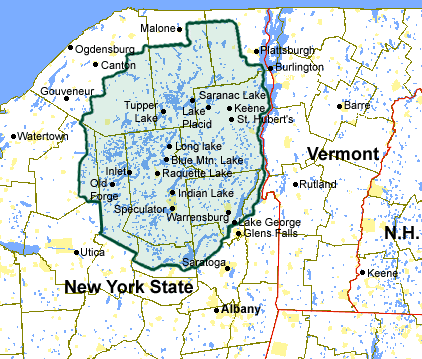
Even in colonial times, miners and smelters quickly realized the value of coal in their furnaces. With plentiful anthracite coal in Pennsylvania.
Yes, some ironworks still used charcoal in their furnaces. Cost and ease of acquiring the wood.
Except, all woods do not make good charcoal, or efficiently convert to charcoal.
At Hopewell Village National Historic Site they conduct at least one charcoal making event every year.
The preferred wood to make charcoal is Hickory.
Ideally the hickory is 20 to 40 years old. Thick enough to have good heartwood, small enough that men can handle the cut logs easily.
Instead of clear cutting the entire area, Hopewell Furnace operated from 1771 through to 1883 by harvesting sections of their land.
Just as the paper and pellet making companies do today.
One must remember these stories of vast clearcut Eastern forests conflict with well known disasters of the Chestnut blight or the harvest of red spruce for airplane struts in the late nineteenth and early twentieth centuries.
Both species were old growth trees when the blight struck or the need for airplane parts began.
I helped harvest maple sap when the harvest was by buckets hung on maple trees.
Young trees under twenty years old are not viable maple sap producers.
There were maple trees that I collected buckets from that were massive trees with many buckets around their perimeter. I guess those trees missed the clearcutting since that maple sap collection was in Vermont very near the Adirondacks.

Owners of land plots with large trees frequently sell their excess trees for good money. Not clear cutting by any description.
Please be careful of writers using colorful descriptions for what they personally believe they see.
There are more than enough true examples of rampant greed in operation; e.g. people using the new train in Colorado using dynamite to kill and harvest trout that then sold in the cities. e.g. 2, buffalo slaughterers killing buffalo solely to harvest the tongue for curing and sale in Eastern cities, leaving the rest of the carcass to rot. e.g. 3, Market gunners killing every migratory bird they can for sale in the large cities.
There are market fishermen still doing the same on the oceans.
Selfish people who have zero reason to maintain and improve a source often do their best to leave nothing of that source for anyone else.
Chuckle. What’s in a name?
https://www.msn.com/en-au/news/us/adani-s-australia-coal-unit-back-in-the-spotlight-after-name-change/ar-BB1aHRjJ
Dear Kip,
I made a couple of posts earlier which eventually made it past the moderator.
I am surprised at the amount of opposition to geothermal on this forum from people who I would have thought would support expansion of a power source that gives base load, is low carbon, almost competitive with wind and solar; and whilst not technically renewable, will certainly outlast the likely span of human existence on the planet.
Here are some links, including a fairly dramatic account of drilling down to magma:
The UN IPCC recommends expansion of geothermal.
https://www.ipcc.ch/report/renewable-energy-sources-and-climate-change-mitigation/geothermal-energy/
A study on the environmental impact of geothermal plants:
https://irp-cdn.multiscreensite.com/fdff31ae/files/uploaded/The%20environmental%20impacts%20and%20the%20carbon%20intensity%20of%20geothermal%20energy.%20%20A%20case%20study%20on%20the%20Hellisheidi%20plant.pdf
Drilling down to magma in Iceland
https://irp-cdn.multiscreensite.com/fdff31ae/files/uploaded/WorldsFirstMagmaGeothermalPlant.pdf
The International Renewable Energy association report on geothermal:
https://www.irena.org/publications/2017/Aug/Geothermal-power-Technology-brief
—–
I was a sceptic (or basically ignorant) of geothermal until the beginning of this year when, as a small venture capital firm, I was approached by an Icelandic firm wanting to raise some more money for their geothermal plants which they already operate or installed in Iceland and Kenya.
I then also found by chance that a neighbor had been part of the Halliburton deep drilling research team that put a probe 26,000 feet down – a record then.
Good news for US readers – Californians at least – there are about 5,000 deep drilled holes that were originally for oil but which could be repurposed for geothermal as the technology and knowledge increases.
Geothermal is still in its infancy – it is a “missionary sale” which is why I tend to direct people to the UN and IRENA websites.
I did set up one of my own too – https://www.geothermal.online/#OurStory
Oil companies should really be pushing this as they have the deep drilling knowledge but it will be expensive and they probably need a huge foundation to fund it rather than shareholders money because the solutions need to be shared rather than kept proprietary.
Good luck
David Tallboys
They were given $90 million of taxpayer dough to start with out of $144 million allocation and went bye byes like a couple of wave generators sunk and rusting off our coasts- https://reneweconomy.com.au/geodynamics-changes-focus-solar-storage-hybrid-energy-56661/
David – the opposition comes from one word: COST. Can you recover it except under special circumstances?
Funny concept, that. Define “infancy”?
Apparently your concept of “infancy” is not my concept of “infancy”.
California’s tectonics makes position and size of geothermal installations critically important as even moderate earthquakes can destroy parts of the installation. Nor does the existence of oil wells make them an obvious solution to installing geothermal.
That you have recently been converted to a geothermal religion does not increase geothermal viability, effectiveness or financially logical.
I related just above about hw I tried to install geothermal each time I had to replace my heat pump system.
The last time I tried, the geothermal company flat out told me that I would not get a long lived system as my region’s acidity forced complete new installations at approximately the frequency of heat pump life cycles.
Hmmm. $25,000 to $30,000 minimum versus $6,000 for a new heat pump…
That expert also told me that they’ve installed multiple geothermals as “virtue signals” to rich customers. Average total cost per installation? $50,000.
Business installations of geothermal are common, where applicable. Their installations utilize artificial ponds or lakes.
That is, geothermal lays out a grid of piping underneath the pond/lake to take advantage of the water’s thermal mass and stable temperature range of the water.
Cost for these systems is far above that $50,000 average.
A geothermal plant in Utah named after exSenator Orrin Hatch failed to be profitable forcing the manufacturer and operator to seek bankruptcy.
In 2017, the geothermal company restructured from that bankruptcy was in default of payments to a Chinese company for a geothermal plant built in New Mexico.
Lightning Dock geothermal plant and it’s participants also filed for bankruptcy.
So much for geothermal being ‘the‘ energy solution. For most installations it is just so much virtue signalling.
Nuclear plants are much longer lived efficient producers of electricity. Natural gas and even coal or oil electricity generators are far cheaper, extremely efficient and effective.
It’s in its infancy because it hasn’t been widely adopted even in areas where there is lots of potential.
As the UN IPCC, World Bank, International Renewable Energy Association and the US Depaertment of Energy have all produced papers supporting the expansion of geothermal I am more inclined to believe them than your personal tales.
“The levelised cost of electricity (LCOE) of geothermal power plants is about USD 0.04—0.14 per kilowatt-hour. This is comparable with all fossil fuel power generation costs and with most renewable power sources e.g. solar and wind.” Per IRENA report.
This is the US Department of Energy site:
https://www.energy.gov/science-innovation/energy-sources/renewable-energy/geothermal
I don’t think I said geothermal was “the” energy solution. Perhaps you could point out to me where I said that.
David ==> I agree with you — nobody hs said geothermal is THE solution to anything — it is just a good resource that should be developed where appropriate –and is coming of age. It has lots of successful installations and there should be a lot more of it.
Its biggest advantage is that it is “renewable” and supplies base-load.
The Department of Energy is not a reliable source. For a glowing review of a failed project, see
https://www.energy.gov/lpo/crescent-dunes
They are so proud of having wasted $737,000,000. Believe them at your own peril.
Curious George ==> Tonopah was built to satisfy the Al Gore’s of the Obama administration.
The project is a fail. DOE is trying to look good but new private owner is blowing smoke “online by end of year”. From 2008 to now : it never really worked. The jobs program part of the pitch to DOE = wink wink.
https://pv-magazine-usa.com/2020/08/03/post-bankruptcy-and-doe-loan-owner-of-crescent-dunes-wants-csp-plant-online-by-years-end/
Folks ==> I don;t think anyone considers the Concentrated Solar Power a success. Not sure it wasn’t a valid, if insanely expensive, experiment.
Thousands of years of burning stuff for energy? Some might call that a proven technology. 😉