News Brief by Kip Hansen — 10 October 2020

The brilliant zoologist and “bone whisperer” Susan J. Crockford has a new paper just published in the Journal of Anthropological Archaeology. The new paper is titled: “Domestic dogs and wild canids on the Northwest Coast of North America: Animal husbandry in a region without agriculture?”. The other authors are: Iain McKechnie of the University of Victoria and the Hakai Institute as lead author and Madonna Moss of the University of Oregon. The paper is about dogs [and not polar bears].
Dr. Crockford is one of the world’s leading experts “… on the evolutionary history of dogs, especially in regards to their domestication and speciation. In 2007, she was called upon as the scientific consultant for the PBS documentary, Dogs that Changed the World, focused upon the domestication of dogs. In the two-part documentary, she was called upon multiple times to give insight into the process of domestication and the emergence of dogs as a separate species from wolves.” [ Wiki ]
The abstract of the paper:
“Domestic dogs (Canis familiaris) occur in the archaeological record throughout North America but few zooarchaeological studies have examined the extent of wild and domestic canids using multi-site observations across regions. Here, we present a meta-analysis of 172,310 mammal specimens identified from 210 archaeological sites along the Northwest Coast focusing on canid abundance, distribution, and osteological identifications. We show that canids have a ubiquitous geographic distribution and a high relative abundance in particular Northwest Coast sub-regions and that species-level identifications are overwhelmingly of domestic dogs in contrast to ~1% of non-domestic canids (wolf, coyote, and fox). Along with geochemical and genetic data, these zooarchaeological observations indicate a variety of roles for dogs including hunting, companionship, and wool production in a region lacking terrestrial agriculture and domestic livestock. We suggest the frequently applied taxonomic status of ‘indeterminate canid’ underestimates the extent to which domestic dogs played key roles in regional economies and cultural practices. Increased attention to resolving taxonomic ambiguity of canids through improving comparative collections and osteometric datasets will help clarify the non-conventional domestication pathways practiced by Northwest Coast peoples.”
And further on:
“We survey the Holocene zooarchaeological record of mammalian assemblages from across the Northwest Coast to identify geographic patterns of canid abundance and distribution. Using frequencies of species-specific identifications across a large range of archaeological observations in combination with ethnographic, ancient DNA and isotopic information, we argue that most canid bones on the Northwest Coast are likely domestic dogs. Canids were especially significant in southern British Columbia, where two sizes of dogs occur, and the smaller ‘wool’ dogs were particularly abundant.”
The New York Times reported on the paper, focusing on the seeming strange aspect of dogs being breed and kept for their “wool” – their shaggy coats which could be sheared and used as supplemental fiber for blanket making.

This image, from the Smithsonian Institute, is believed to be “The pelt of a Coast Salish woolly-dog, collected in 1859.”
It is this dog that Iain McKechnie, Madonna L. Moss, and Susan J. Crockford discuss, among others, in their paper.
“On the Northwest Coast, various ethnohistorical sources describe domestic dogs in Indigenous communities and the use of wool from dogs in the Coast Salish and Makah regions (Allen, 1920; Howay, 1918; Kane, 1859; Swan, 1870; Vancouver, 1801). Dog and mountain goat wool blankets created with plant materials were common in the region before imported European trade goods flooded the market in the mid-19th century (Gustafson, 1980; Howay, 1918: 91). Textiles such as blankets made with dog wool were worn regularly as well as during rituals such as naming ceremonies, weddings, and dance performances and were given as gifts and traded as items with prestige value (Olsen, 2010; Suttles, 1960:302). Anthropologist Suttles (1983:70) remarked that: “Probably the most important form of wealth [among the Coast Salish] was the blanket of woven mountain goat and/or dog wool. These blankets had several advantages as wealth; they were made of materials of practical value and available in large but finite amounts and they were divisible and re-combinable, since they could be cut up or unravelled and the material rewoven into new items.”
I suspect that dog wool is not going to make a comeback in the modern world – it certainly will not replace cashmere for sweaters. But, readers interested in ancient North American cultures and/or the history of the domestication of the dog will find the paper [repeating the link] an interesting read.
# # # # #
Author’s Comment:
I found the idea of breeding dogs for wool odd enough bring it to the attention of readers here – always good to shake up our fixed ideas of the purposes of things. I recently read a blog post rabidly ranting about the fact that in some Asian cultures some people consider domestic cats to be a food item [not a popular idea in the United States]. I have a nearby neighbor who raises American Buffaloes for the meat and sells Buffalo Steaks.
This study adds this domestic dog – the “wool dog”– to the list of “wool bearing animals”: Sheep (several types of wool from various breeds), goats (mohair and cashmere) , rabbits (angora), the llamas, alpacas, vicunas and guanacos (the softest being alpaca wool), camels, and musk oxen (qiviut).
# # # # #
As an aside, and in no way being critical of Dr Crockford’s work, can anyone tell me if there is a scientific definition of abundance? In my University geology courses, when estimating mineral content of sample rocks, one had to say if a particular rock was in abundance but there was nothing to say what the threshold was when a mineral (or anything in fact) became ‘abundant’. Was it 40%, 50%, the majority of content, more, less? Has vexed me for ages!
Little has been recorded about the Northwest Coast Indians’ dogs.. According to reports of early travelers, the dogs had the appearance of coyotes. They were highly trained by their masters, who called them by their name, treated them like respected members of the family, and according to tales old Indians tell, even sang to them. The dogs were trained to enter the woods and chase the game out to the hunter. The Coast Salish used them particularly for driving mountain goats into ambush and for herding deer and elk into lakes, where they could be attacked and slain by men in canoes.
What breed were these dogs? They have mixed long since with the pets of white settlers and reliable identification is no longer possible. Perhaps students interested in dog history will one day attempt to unravel the mystery of their origins… Coast Salish women, utilizing a simple loom, wove in wool–a practice uncommon in North America since the continent was not well-supplied with wool-bearing animals until after the introduction of sheep by white men. In addition, the Puget Sound women had their own little wool-bearing animal–a tame dog, quite small, but with a thick coat of creamy wool which could be shorn at regular intervals. When the wool was hacked off with a mussel shell knife, the fleece was so thick that according to one historian you could lift it up by one corner, like a mat. The Coast Salish also utilized the wool of the mountain goat. The Salish Indians along the Fraser River sometimes hunted the goats and traded the hides to the Coast. They also searched over the hillsides in spring and summer, when the goats were shedding, and gathered the tufts of fur which rubbed off on the bushes as the animals passed by. Perhaps it was this gift of wool which inspired Salish women to begin weaving cloth. Early explorers describe the dogs as having the appearance of Pomeranians, usually white in color, but sometimes varying to a brownish black. They were usually kept on tiny islands in Puget Sound and the Straits of Juan de Fuca and were not found among the more northerly Indians of the Northwest Coast. The women would paddle out daily from the village with food and drink for the dogs and always took them along with them during prolonged absences from the village on food gathering trips and other necessary excursions. A woman’s wealth was said to have been judged by the number of dogs she owned. Captain George Vancouver reported meeting a group of two hundred Indians, most of them in canoes, but a few walking along with a drove of about forty dogs, which were sheared close to the skin like sheep.
The opening of the Hudson’s Bay trading posts and the subsequent appearance of the easily obtainable Hudson’s Bay blankets spelled the death knell for the weaving of these beautiful Salish blankets and mantles, only a few of which survive today in museums and private collections.
With the coming of the gold rush in 1858 and the resultant drastic changes in Coast Salish life styles, the dogs were no longer a valuable commodity and soon became extinct. Today there is not an Indian living who even remembers how they looked.
The wool of the dogs was much finer than that of the goats, and the yarns produced from it were very much like those of a fine grade commercial wool. The shearing was sometimes repeated two or three times in a summer and even then it was hard to get wool enough for many blankets. Women would mix the dog wool with mountain goat wool and together with goose down or duck down and the cotton from the fireweed and other plants, in any proportions available. Clay beaten into the wool with a flat, sword-like piece of wood helped remove the grease from the wool and also whitened it, for dog wool was not so white as the wool of the mountain goat. Next the weaver combed the fibers out with her fingers or hand carders and then rolled them on her leg. The wool was then ready for spinning. The spindle used was a smooth stick three of four feet long. At is lower end was a whorl of carved wood (often beautifully decorated), to keep the strands from slipping.
The loom for weaving the yarn consisted of two horizontal rollers supported in slots cut in wooden uprights set in the ground. Although not always used, the alternate strands of the warp were often keep apart by a simple heddle of thin wood to allow the hand to pass through. The warp was run around these rollers in a series of continuous cords so that the web could frequently be pulled around to a convenient position for the weaver, who always wove from the top downward. (Reg Ashwell, Coast Salish, Their Art, Culture and Legends, Hancock House, Surrey, 1978:50-62, emphases supplied).
Until European contact and the introduction of knitting, Coast Salish women primarily used mountain goat wool for their textile production. Sheep were not introduced to Vancouver Island until the 1850’s, shortly before the Cowichans learned to knit. Since then sheep’s wool has been used exclusively for knitting Cowichan sweaters.
Cowichan knitters spin wool three different ways: with a Salish spindle and whorl, with a converted sewing machine, and with a homemade spinning machine. The spindle and whorl are rarely used today: There are five known types of Salish spindles (Marr 1979:67). The version used exclusively by the Cowichan people was very large and was used for spinning two ply mountain goat wool and dog hair for weaving. The spindle was a tapered shaft approximately four feet long. The whorl, which rested one-half to two-thirds of the way down the shaft, was about eight inches in diameter. Coast Salish spindle whorls were often highly decorated, and many fine examples can be found in museum collections… Neither the large mountain goat wool spindle nor the smaller sheep’s wool spindle are much-used today; the majority of spinners prefer to use machines. After missionary teachers instructed their pupils in the use of a European spinning wheel, it was adapted to produce the large quantities of thicker yarn needed for knitting and for much of the Salish weaving. (Margaret Meikle, Cowichan Indian Knitting, Museum Note No. 21, UBC Museum of Anthropology, Vancouver, 1986:1-11;emphases supplied).
Leaving the south-west in early Indian days, you might have traveled for thousands of miles in any direction, except south, without seeing any weaving. Weaving was a northwestern specialty, for weaving was very unusual in America north of Mexico. You would not find a real loom anywhere until you got to the Puget Sound country. Students of Indian history find that one of their most interesting problems is this one of loom weaving among a few northwestern groups. They are all Salish and they are gathered on two sides of the present Canadian border. They wove in wool. Ruth Underhill, Ph.D. in her “Indians of the Pacific NorthWest, 1945” refers to the Salish blanket – “only a few of which are left anywhere in the country. There was not much use of colour until the Whites brought yarn in trade. Then a few women in Canada began making colour ed designs and our Klallam and Cowlitz tried it also. A few really beautiful blankets were made in fine yarn and magnificent colour. However, there was no one to encourage them to make these for sale, as Indians are encouraged in the south west.
They found that they could get Hudson Bay blankets with far less trouble and so they gave up the art some seventy-five years ago.
If that had not happened, Salish blankets might have been as famous as those of the Navajo.”(Oliver N. Wells, SALISH WEAVING: PRIMITIVE AND MODERN, As Practiced by the Salish Indians of Southwest British Columbia, Frank T. Coan, Sardis, 1969:3).
The Loom – Two basic types of loom were used by the early Salish Weavers and are still in use. The two-roller loom – as illustrated by Paul Kane in the well-known picture, and the single bar loom, commonly referred to as a three piece loom. Each of the types have had variations noted in their construction, both in the past and as used today.
The two-bar loom was developed by the Pueblo Indians between 1100 and 1300 (P. 47. Pueblo Crafts). Whether the Salish tribes were using the loom at that time is not known.
Some believe the single bar loom was in use prior to the two bar loom, which developed from it.
It is known, however, that both types were in use among the Salish and other North West tribes when the Europeans first came to the NorthWest.
(Oliver N. Wells, SALISH WEAVING: PRIMITIVE AND MODERN, 1969:12;emphases supplied).
Donna, some editing needed.
I think mountain goats were only in the Olympic mountains, having been introduced there, perhaps some in the Cascades, so their hair There are many in the Rockies well to the east.
You should also be clear to distinguish between dog ‘wool’ and sheep wool, quite different.
And check ‘Cowichan sweaters’, sounds like a later thing to me. Certainly was a substantive local industry at one time including in the 1960s. One woman managed to get a mechanized machine, IIRC for ‘carding’ sheep wool, at substantial expense for her, shipped from England.
Keep in mind that blankets were used as outer clothing, the HBC blanket was sized to cover much of the body of a tall man, half of it would wrap a papoose well. Much tighter weave than hand-woven blankets.
Tribal people were not locked to tradition – contrary to claims today, they dumped the dogs when sheep wool became available, stopped weaving blankets when HBC ones became available. They could trade their labour for blankets.
BTW, some stories are wrong – a renowned painter showed a poodle near a woman weaving a blanket, he made sketches in the field and painted when back home.
Indian Journal of Traditional Knowledge Vol. .7(1), January 2008, pp. 188-196 Coast Salish weaving−Preserving traditional knowledge with new technology Leslie Tepper Canadian Museum of Civilization, 100 LaurierSt, PO Box 3100, Station B, Gatineau, Quebec J8H 4H2, Canada E:mail: leslie.tepper@civilization.ca Received 31 July 2007; Revised 25 October 2007 Hand made textiles are an important source of traditional knowledge. Infused with symbolic and ritual meaning they can serve as a conduit of cultural information. During times of rapid social change, transmission of both the technology and symbolic content of these textiles is difficult to maintain. Among the Coast Salish weavers of Canada’s Northwest Coast, efforts to preserve their weaving heritage have now incorporated multimedia technology for the teaching of traditional knowledge. The paper explores the recent partnership of the Canadian Museum of Civilization and Coast Salish weavers to develop a new working tool. Keywords: Weaving heritage, Traditional weaving, Coast Salish weavers, Canada IPC Int. Cl.8: D01
http://nopr.niscair.res.in/bitstream/123456789/606/1/IJTK%207(1)%20(2008)%20188-196.pdf
In 1997 Dr. Crockford published a book on the Salish Wool Dog, for which the paper edition sells for $(CAN)30.00, while the DRM-Free PDF eBook edition is free to download. I highly recommend this book to the readers of this forum
”Osteometry of Makah and Coast Salish Dogs” by Susan J. Crockford
http://archpress.lib.sfu.ca/index.php/archpress/catalog/book/52
I was amazed to read that the Salish Wool Dog breed went extinct sometime in the Mid-twentieth Century, because of the lack of human interest in its continuance. With the understanding that extinct species have a track record of sometimes returning from the dead, has anyone considered the possibility of un-extinting the Salish Wool Dog? Unlike extinct ice age megafauna, the cloning of dogs is now a for-profit industry, provided viable DNA is available.
Dr. Crockford has a number of fiction and non-fiction DRM-Free eBooks available for purchase which I have acquired and downloaded to my eBook library, as a show of support for her research. Please consider doing the same. The eBooks are published by Smashwords.com and sold by Kobo.com.
Michael Ronayne
I presume a few were adopted as pets, perhaps sold to outsiders, but may have inter-bred by now.
Given the number of people who fawn over specific dog breeds, and even create them, perhaps someone will recreate the breed if practical. That style of tail is common in Japa, I gather.
A bonus for Ms. Crockford:
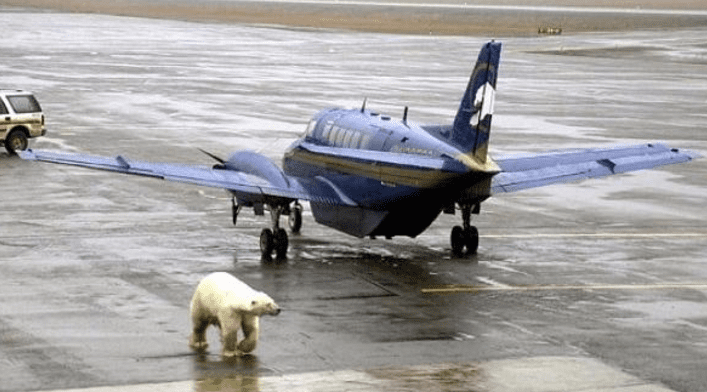
Polar bear on airport ramp
Yes, it looks real – see footprints in slush behind the bear.
(The airplane may be a Beech 99 (turboprop, square windows).
Small airports may not have fences.
An airplane hit a moose at 4am on Astoria OR’s runway.
(It was a legitimate flight.)
I advised pilots of a 737 charter that the good runway at a tour location was not fenced, so betware of possibility of animals. I was there at arrival, neat sight to see the airplane circle to check the runway before landing
Even with fences…. An airport in AK found a moose inside its new impressive security fence.
And two-legged animals:
A 737 crew initiated a go-around at Victoria BC, telling tower someoe was on the runway with what might be a gun.
A private pilot had let his father through security to help load the small airplane for a cross-country trip. The stooopid father walked out on the runway to photograph his son taking off.
A fly on the wall of security would have had a good experience of police ‘having words’ with the bleep.
Also here: https://oddstuffmagazine.com/funny-pictures-march-13-2016.html REF
As well they roam the North Slope area of AK:
https://www.cbsnews.com/news/hungry-polar-bears-look-for-food-at-alaska-airport/ REF
With polar bears roaming around the freinges at least of Iqualuit https://www.youtube.com/watch?v=_LNf-EDXx-Q REF
not to be confused with https://www.munich-airport.com/on-the-taxiway-with-the-polar-bear-1421773 REF actually a nickname for de-icing machine, no polar bears near Munich Germany.
Also here: https://oddstuffmagazine.com/funny-pictures-march-13-2016.html REF
As well they roam the North Slope area of AK:
https://www.cbsnews.com/news/hungry-polar-bears-look-for-food-at-alaska-airport/ REF
With polar bears roaming around the freinges at least of Iqualuit https://www.youtube.com/watch?v=_LNf-EDXx-Q REF
not to be confused with https://www.munich-airport.com/on-the-taxiway-with-the-polar-bear-1421773 REF actually a nickname for de-icing machine, no polar bears near Munich Germany.