
Guest “Du kan ikke fikse dumt“ by David Middleton
I couldn’t make this sort of schist up if I was trying…
Very little money is actually spent on climate research
Researchers have looked at where USD 1.3 trillion in research funding is spent across the globe. Less than 5 per cent of this money has gone to climate research. Studies that examine how society can cope with the climate of the future are given a very small share of this pot.Ulla Gjeset Schjølberg
JOURNALISTNancy Bazilchuk
ENGLISH VERSIONPUBLISHED Friday 07. February 2020
In a recent study, researchers at the Norwegian Institute of International Affairs (NUPI) and the University of Sussex reviewed how much of US 1.3 trillion (NOK 11.4 trillion) in research funding is dedicated to climate research.
[…]
Climate change research received just under 4.6 per cent of the research funding allocated between 1990 and 2018, researchers found.
And while research in the natural sciences and technology received about USD 40 billion, social science and humanities research received just USD 4.6 billion during the same period.
An analysis of 1500 grants for social science research aimed at curbing climate change showed that this type of research is being awarded USD 393 million.
[…]
“The one-sided emphasis on the natural sciences leaves one wondering whether funding for climate research is managed by climate sceptics. It’s as if they don’t quite believe in climate change, so they keep trying to find out how it really works, rather than trying to work out how to stop it,” researcher Indra Øverland said in a NUPI press release.
Social science should play an important role
[…]
Reference:
Øverland, I. and Sovacool, B.K: «The misallocation of climate research funding». Energy Research & Social Science (2020)
sciencenorway
This bears repeating…
“The one-sided emphasis on the natural sciences leaves one wondering whether funding for climate research is managed by climate sceptics. It’s as if they don’t quite believe in climate change, so they keep trying to find out how it really works, rather than trying to work out how to stop it,” researcher Indra Øverland said in a NUPI press release.

Clearly, in the minds of fake scientists (social sciences), we shouldn’t be spending money on natural sciences, trying to understand how climate change works… We should be giving that money to people like John Cook and Stephan Lewandowsky to fund Enviromarxist propaganda…
The researchers write in their study that social science research plays an important role in understanding how climate change can be slowed.
“One of the most urgent unsolved puzzles is how to get people to act on what they know, that is to say, how to alter society to curb climate change,” they write.
sciencenorway
Obviously, it’s a waste of research money to determine if this is anomalous…

Relative to this…

Or this…

The money would be better spent on Enviromarxist propaganda, like this…

The “funny thing” is that it didn’t cost me a dime to refute everything they wrote… Oh wait, I think I did spend $10 “renting” a 1963 JGR paper.
“The misallocation of climate research funding”
The full text of the paper (Øverland & Sovacool, 2020) is available. The journal title tells you all you need to know:
Energy Research & Social Science
Editor-in-Chief: Benjamin Sovacool
Peer reviewed international journal that examines the relationship between energy systems and society
Energy Research & Social Science (ERSS) is a peer-reviewed international journal that publishes original research and review articles examining the relationship between energy systems and society. ERSS covers a range of topics revolving around the intersection of energy technologies, fuels, and resources on one side; and social processes and influences – including communities of energy users, people affected by energy production, social institutions, customs, traditions, behaviors, and policies – on the other. Put another way, ERSS investigates the social system surrounding energy technology and hardware. ERSS is of relevance for energy practitioners, researchers interested in the social aspects of energy production or use, and policymakers.
[…]
Energy Research & Social Science
Basically: Energy and Society
When I was in college, my recollection is that the “science” textbooks for non-science majors had similar titles:
| Subject | Science Majors | Non-Science Majors |
| Physics | College Physics | Physics and Society |
| Chemistry | General Chemistry | Chemistry and Society |
| Biology | Principles of Zoology | Animals and Society |
| Geology | Earth | Too Difficult for Society |
Only one of the above titles is an actual textbook. Earth by Press & Siever was my freshman physical geology textbook. It’s sitting on my desk in my office. However, the science major textbooks are my closest recollections of my other freshman textbooks. The non-science major textbooks are my vague recollections, except the geology one… That’s a wise @$$ remark.
The main gist of is that people must be brainwashed…
Limiting global warming to 1.5°C will require reaching 80% zero-emission energy by 2030 and 100% by 2050 [10].
Øverland & Sovacool, 2020
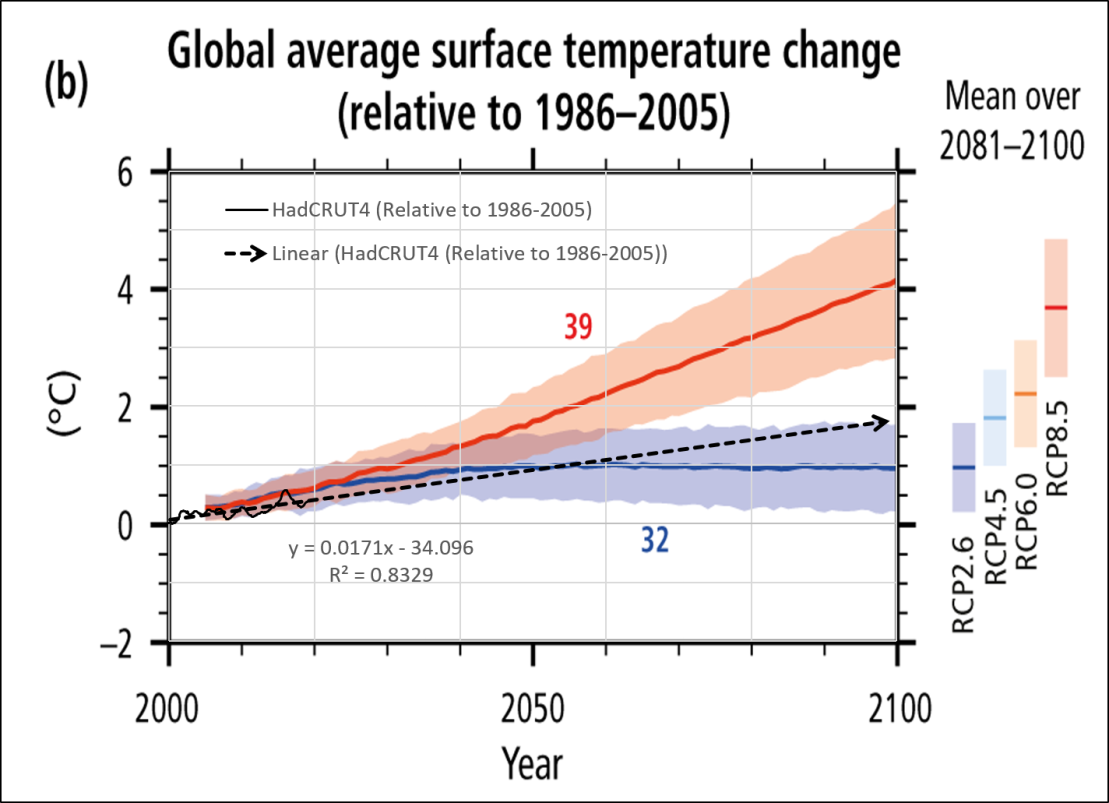
Without decarbonizing much of anything, the observations at airports (HadCRUT4) are tracking the high-end of RCP2.6 and mid-range of RCP4.5. Both of these are strong mitigation scenarios. If we look at the observations in the atmosphere (UAH v6.0), we’re barely tracking above 1.5 °C

There’s nothing special about limiting warming to 1.5 °C relative to the late Little Ice Age. Being a little warmer than the coldest climate of the Holocene Epoch is a very good thing.
RCP2.6 and RCP4.5 are innocuous scenarios.

Obviously, to the math- and science-challenged world of social science, that’s not good enough.
Despite progress in some areas, ongoing changes are too shallow and too slow to reach such targets. Solar, wind, geothermal, and modern bioenergy combined still make up only 6.7% of the world’s total final energy consumption [13]. Meanwhile, in the decade from 2007 to 2017, oil, gas, and coal production grew by 13%, 25% and 8%, respectively and, consequently, CO2 emissions grew by almost 11% [14]. During the same period, three times more money was spent on oil, gas, and coal facilities than on all forms of renewable energy infrastructure, including hydropower and biofuels [15]. Deforestation and population growth also continue at a high pace [16].
Human habits are difficult to change; doing so requires altering attitudes, norms, incentives, ethics, and politics at the personal, community, and national levels [17]. Therefore, some of the key climate-change puzzles are in the realm of the social sciences broadly defined: anthropology, economics, education, international relations, human geography, development studies, legal studies, media studies, political science, psychology, and sociology [18]. Yet, as we find here, these are precisely the fields that receive least funding for climate research.
Øverland & Sovacool, 2020
Physics is a b!tch… ain’t it?
From 2007-2017 “three times more money was spent on oil, gas, and coal facilities than on all forms of renewable energy infrastructure”… and?
In 2017 fossil fuels delivered nearly eight times as much energy as “all forms of renewable energy infrastructure, including hydropower and biofuels” combined.

Spend $3x to get 8x(Energy) = No brainer.
So, clearly we need an army of fake scientists to say…
And convince us that we should all gladly freeze in the dark to save the planet. Who’s up for some George Carlin?
WARNING: Lot’s of profanity! Don’t watch if you have sensitive ears.
References
Cook, J., Supran, G., Lewandowsky, S., Oreskes, N., & Maibach, E., (2019). “America Misled: How the fossil fuel industry deliberately misled Americans about climate change”. Fairfax, VA: George Mason University Center for Climate Change Communication. Available at https://www.climatechangecommunication.org/america-misled/
Kobashi, T., Menviel, L., Jeltsch-Thömmes, A. et al. “Volcanic influence on centennial to millennial Holocene Greenland temperature change”. Scientific Reports 7, 1441 (2017). https://doi.org/10.1038/s41598-017-01451-7
McKay, N., Kaufman, D. “An extended Arctic proxy temperature database for the past 2,000 years”. Scientific Data 1. 140026 (2014). https://doi.org/10.1038/sdata.2014.26
Øverland, I. and Sovacool, B.K: “The misallocation of climate research funding”. Energy Research & Social Science (2020)
David,
Geology text for Non-science Majors:
European version:
Prehistoric rock art in Scandinavia: Agency and Environmental Change (Swedish Rock Art Research Series)
https://www.amazon.com/Prehistoric-rock-art-Scandinavia-Environmental/dp/1785701193
or US version:
Rock Art: The Meanings and Myths Behind Ancient Ruins in the Southwest and Beyond
https://www.amazon.com/Rock-Art-Meanings-Ancient-Southwest/dp/1493017071
or Australia:
Rock Art of the Dreamtime: Images of Ancient Australia
https://www.amazon.com/Rock-Art-Dreamtime-Ancient-Australia/dp/0207189080
They want more free government money to spend.
How much of other people’s (taxpayer’s) money is your fair share?
If you want a well focused propaganda campaign, you can’t waste resources doing actual science and gathering facts.
[Social Science Research?? What the heck is that? It must involve the persuasion of the masses towards enlightened goals…AKA Propaganda]
Who volunteered my tax money to be spent on this indefensible crap? $Trillions sounds like real money.
“Human habits are difficult to change; doing so requires altering attitudes, norms, incentives, ethics, and politics at the personal, community, and national levels [17]. “So what is called for then is a Mao-like Cultural Revolution, led by brainwashed kids, worshipping Pop Science, fearing the apocalypse prophesized by the Truth-bound scientific priesthood, and secretly dreaming utopia. Can we just call warmism pop-science? Even skeptics seem to find it necessary to make a few remarks in obeisance to science. We need to do a general deconstruction of the science-concept. Big Pharma is also science, after all.
It is time to defund the humanities.
Who, besides the grant recipients, benefits from those old worn out pseudo-sciences? “Humanity” does not lend itself to rigorous scientific inquiry…there is almost nothing empirical to study that hasn’t already been beaten to death 50 years ago.
If the output says “global warming” or “climate change” then every penny was too much.
NONE of the science the IPCC approves survives the test of the ‘law of thermodynamics’ and convection.
I’d like to suggest cutting funding to scientists who won’t defend/debate their work in public:
We were told some time ago that climate change was settled science. So why is it still being funded?
I would reduce the level of funding by 90% and use the money saved to research into more interesting and relevant areas of science.
I love the ‘human caused climate change, which had long been predicted’ bit- Predicted by whom other than a few eco nutters who are always predicting something terrible?
Let’s just kill everybody. That will settle all the argument.
What’s up here –
“Very little money is actually spent on climate research”
____________________________________
:: Researchers have looked at where USD 1.3 trillion in research funding is spent across the globe. Less than 5 per cent of this money has gone to climate research. Studies that examine how society can cope with the climate of the future are given a very small share of this pot.
Ulla Gjeset Schjølberg JOURNALIST
Nancy Bazilchuk ENGLISH VERSION
PUBLISHED Friday 07. February 2020
In a recent study, researchers at the Norwegian Institute of International Affairs (NUPI) and the University of Sussex reviewed how much of US 1.3 trillion (NOK 11.4 trillion) in research funding is dedicated to climate research.
[…]
Climate change research received just under 4.6 per cent of the research funding allocated between 1990 and 2018, researchers found.
And while research in the natural sciences and technology received about USD 40 billion, social science and humanities research received just USD 4.6 billion during the same period.
An analysis of 1500 grants for social science research aimed at curbing climate change showed that this type of research is being awarded USD 393 million.
[…]
“The one-sided emphasis on the natural sciences leaves one wondering whether funding for climate research is managed by climate sceptics. It’s as if they don’t quite believe in climate change, so they keep trying to find out how it really works, rather than trying to work out how to stop it,” researcher Indra Øverland said in a NUPI press release.
Social science should play an important role
[…]
Reference:
Øverland, I. and Sovacool, B.K: «The misallocation of climate research funding». Energy Research & Social Science (2020)
sciencenorway
“The one-sided emphasis on the natural sciences leaves one wondering whether funding for climate research is managed by climate sceptics. It’s as if they don’t quite believe in climate change, so they keep trying to find out how it really works, rather than trying to work out how to stop it,” researcher Indra Øverland said in a NUPI press release.
____________________________________
Thei’re lucky, compare
https://www.google.com/search?q=temporary+employment+contracts+statistics&oq=temporary+employment+contracts+statistics+&aqs=chrome.
https://www.google.com/search?client=ms-android-huawei&sxsrf=ALeKk01aKRCIXugns0_OQyUY-xNndoHkFA%3A1582617649029&ei=MdRUXrKvAZqHwPAPvcei0AY&q=temporary+employment+contracts+statistics+usa+2018&oq=temporary+employment+contracts+statistics+usa+2018&gs_l=mobile-gws-wiz-serp.
including nursing staffers, Maintenance / medical staff, technicians, construction workers, drivers / suppliers
….
____________________________________
— that’s up here!
The long version:
Very little money is actually spent on climate research
Researchers have looked at where USD 1.3 trillion in research funding is spent across the globe. Less than 5 per cent of this money has gone to climate research. Studies that examine how society can cope with the climate of the future are given a very small share of this pot.
Ulla Gjeset Schjølberg JOURNALIST
Nancy Bazilchuk ENGLISH VERSION
PUBLISHED Friday 07. February 2020
In a recent study, researchers at the Norwegian Institute of International Affairs (NUPI) and the University of Sussex reviewed how much of US 1.3 trillion (NOK 11.4 trillion) in research funding is dedicated to climate research.
[…]
Climate change research received just under 4.6 per cent of the research funding allocated between 1990 and 2018, researchers found.
And while research in the natural sciences and technology received about USD 40 billion, social science and humanities research received just USD 4.6 billion during the same period.
An analysis of 1500 grants for social science research aimed at curbing climate change showed that this type of research is being awarded USD 393 million.
[…]
“The one-sided emphasis on the natural sciences leaves one wondering whether funding for climate research is managed by climate sceptics. It’s as if they don’t quite believe in climate change, so they keep trying to find out how it really works, rather than trying to work out how to stop it,” researcher Indra Øverland said in a NUPI press release.
Social science should play an important role
[…]
Reference:
Øverland, I. and Sovacool, B.K: «The misallocation of climate research funding». Energy Research & Social Science (2020)
sciencenorway
“The one-sided emphasis on the natural sciences leaves one wondering whether funding for climate research is managed by climate sceptics. It’s as if they don’t quite believe in climate change, so they keep trying to find out how it really works, rather than trying to work out how to stop it,” researcher Indra Øverland said in a NUPI press release.
https://www.indeed.com/career-advice/careers/what-does-a-nursing-assistant-do
My fault –
That’s a good one:
They have opted for decibels, not debate, simulated not stimulated analysis.
These are the hallmarks of those who claim belief in AG climate change, but they will believe more firmly when there is some solid proof of it.
Let’s ease them up –
they will believe more firmly when there is some solid proof of it –> they will believe more firmly with stopping all dissent.
Failing reply they’d take as solid proof of victory, so they can stumble further unheeded.