Feb 21st is the day we’ll know if the puzzling dimming of Betelgeuse is just an alignment of dimming cycles in a highly variable star, or a prelude to a supernova we’ll be able to witness with our bare eyes. If it happens, the dying star will be visible in the daytime and shine as bright as the moon.
From Spaceweather.com :
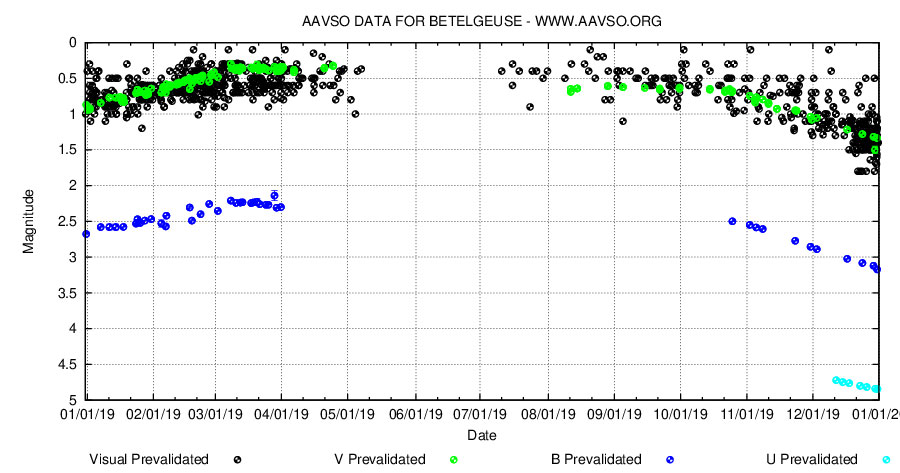
For months, astronomers have been keeping a wary eye on Betelgeuse, the bright red star in Orion’s shoulder. What’s attracting their attention? All of a sudden, Betelgeuse isn’t bright anymore. Its luminosity has “fallen off a cliff”–a sign that the star could be on the verge of going supernova.
“The most recent measurements put the visual magnitude of Betelgeuse at about +1.66, the dimmest its been in our 25 years of photometry,” says Edward Guinan of Villanova University.

Betelgeuse is a highly evolved red supergiant–the type of star that could collapse and explode at any moment. Indeed, the dimming of Betelgeuse could be explained if the star has suddenly contracted to about 92% of its previous radius. But that’s not the only possibility. Betelgeuse might be dimmed by a giant starspot–or maybe it is shrouded by an outburst of stardust from its own cool outer layers–or something else entirely. No one knows.
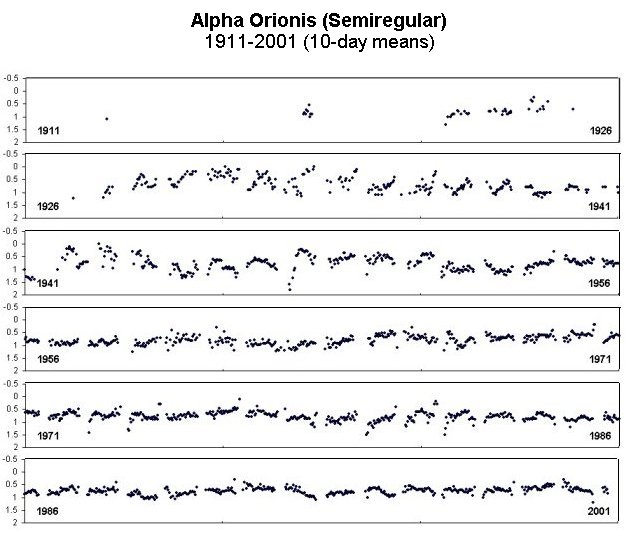
Answers might be forthcoming on Feb. 21st. Astronomers have long known that Betelgeuse is a variable star. It pulsates with many periods, as shown in this Fourier analysis of Betelgeuse’s light curve:

“This shows a dominant (probable pulsation) period of P = 430 days,” note Guinan and colleague Richard Wasatonic in a recent Astronomical Telegram. Given this result, “the minimum brightness is expected on 21 (+/-7d) February 2020.”
If Betelegeuse starts to bounce back on Feb. 21st, this whole episode might just be a deeper-than-average pulsation, and perhaps the supernova watch can be called off. However, notes Guinan, “even if the 430-day period is still working, this would indicate a minimum brightness near 0.9 mag–much brighter than the current value near 1.6 mag. So something very unusual is going on.”
Stay tuned for updates as Feb. 21st approaches.
From Astronomy Picture of the Day:



It seems there is a light in the night sky, may be incorrect, however, it seems, after measurements, in the position of betelgeuse and has been confirmed to not be the moon. And is showing abnormality. First thought to be UFO (Unidentified Flying Object). Now seeming to be a Supernova.
I’d like to see an official update/followup on this. Thanks!