From the “summer colds are the worst” department
Guest essay by Vijay Jayaraj
A surprising late-June chill broke records for lowest temperatures and made life miserable for many across the world. From Denver, Colorado, in the United States, to Melbourne in Australia, the mercury dropped precipitously.
Many people in Colorado woke up to what would be the state’s coldest first day of summer in 90 years. Up to two feet of snow fell in some places, making authorities issue a winter weather advisory on the first day of summer. Denver especially has been at the center of focus. Record cold caught city dwellers off guard. This year has been the “city’s coldest start to a calendar year since 1983.”

The National Weather Service reported the coldest maximum temperature during the second half of June since 1992 at Chicago’s O’Hare Airport, and news outlets reported that it was unusual for the windy city to experience such low temperatures in the beginning of summer.
On the other side of the world, Australia saw many cities record their coldest first few weeks of winter. Melbourne, on June 23, recorded its lowest maximum for the date since 1985.
And back in the Northern Hemisphere, central England experienced similar historic lows in June, although the temperature was forecasted to pick up the following week due to a heatwave.
But the cooling observed is not just limited to the surface temperatures.
There has been a remarkable cooling in the global oceans, especially the Atlantic and the Pacific. This was totally unexpected, as scientists had forecast a strong warming in the oceans for this month, a weather condition called El Niño.
Experts are divided on what this cold phase actually points to. It might be just a one-off, localized, short-term weather phenomenon, or it might reflect a longer, global-scale climate shift.
Either way it contradicts alarmists’ claims of a warming world. If it were a mere weather phenomenon, then it would mean global warming would result in cold phases (like those in June, May, and earlier months this year), not warmer phases, as claimed by the alarmists. That means climate change will result in cold phases like the ones we’ve been observing in the past two years.
In contrast, if these cold phases are an indicator of a longer climatic shift, then there is no drastic warming but a global cooling.
We might be headed to what NASA describes as a period of “solar minimum,” with temperatures akin to the Little Ice Age that froze Northern Europe in the 16th century.
In its official June 12 communication, NASA stated, “The Sun’s activity rises and falls in an 11-year cycle. The forecast for the next solar cycle says it will be the weakest of the last 200 years. The maximum of this next cycle – measured in terms of sunspot number, a standard measure of solar activity level – could be 30 to 50% lower than the most recent one.”
Regardless of whether these cold phases are precursors to a longer cooling period or not, late-June cooling (like similar cooling periods in the past two years) certainly runs contrary to the claim that the world is getting hotter or warmer every year.
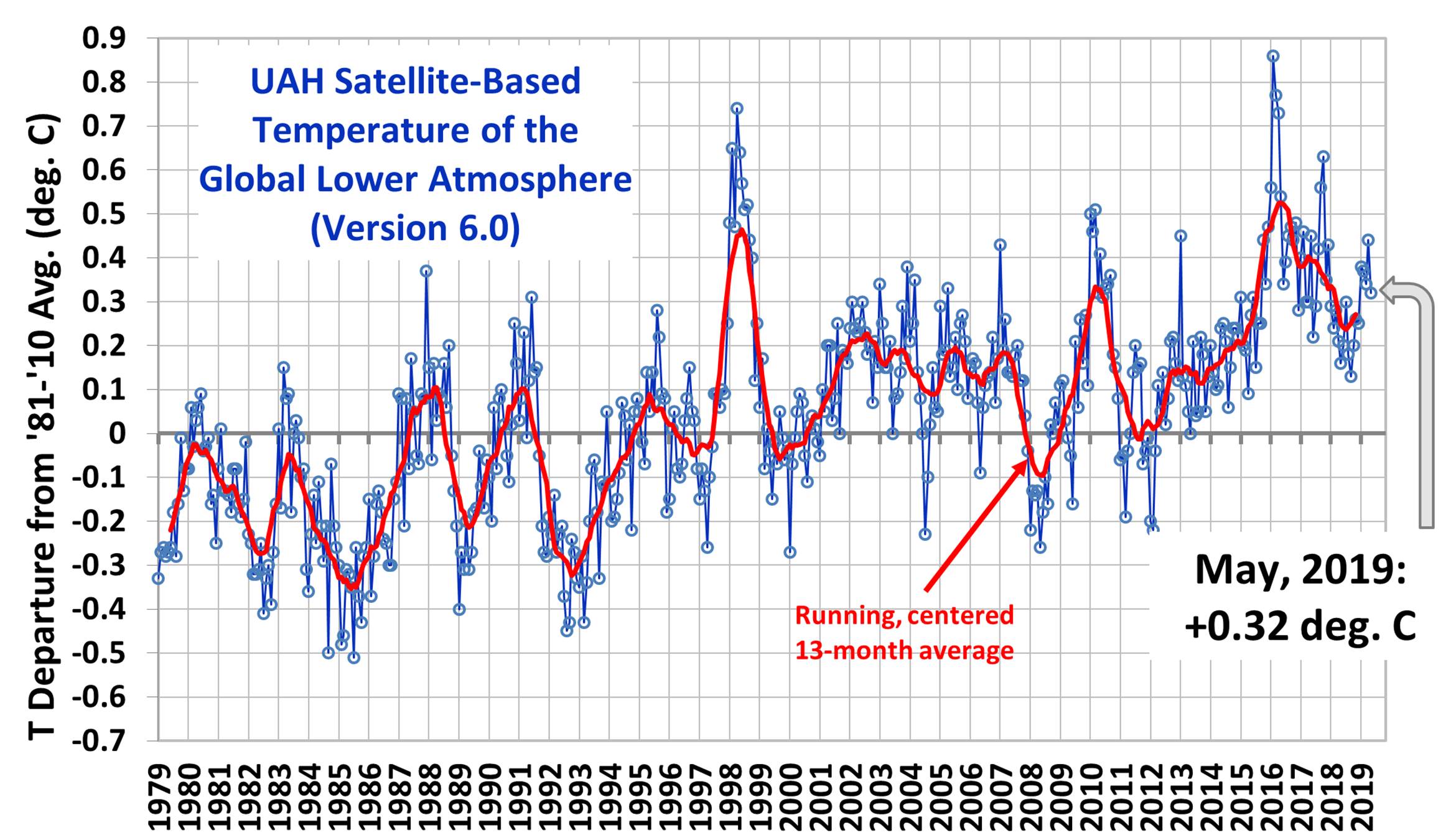
After the brief spike in temperatures during the El Niño-driven warmth of 2016, temperatures have fallen globally. This post-2016 two-year cooling resonates and coheres with the overall lull in the warming that scientists have observed during the past two decades, in which spikes in global temperature occurred only when El Niño was active.
It will be interesting to observe how the summer plays out and whether the solar inactivity predicted by NASA will make the 2019–20 winter colder than the ones before.
Vijay Jayaraj (M.Sc., Environmental Science, University of East Anglia, England), Research Associate for Developing Countries for the Cornwall Alliance for the Stewardship of Creation, lives in Bangalore, India.
“…central England experienced similar historic lows in June, although the temperature was forecasted to pick up the following week due to a heatwave.”
Having lived in England for three years, I know that a temperature of 80 degrees F is considered a HEATWAVE.
I did not know Australia had “Summer” in June – it seems like people around here don’t even know there is a Southern Hemisphere in the world.
Together with the warm wave in the stratosphere, another wave of cold air will reach Australia.
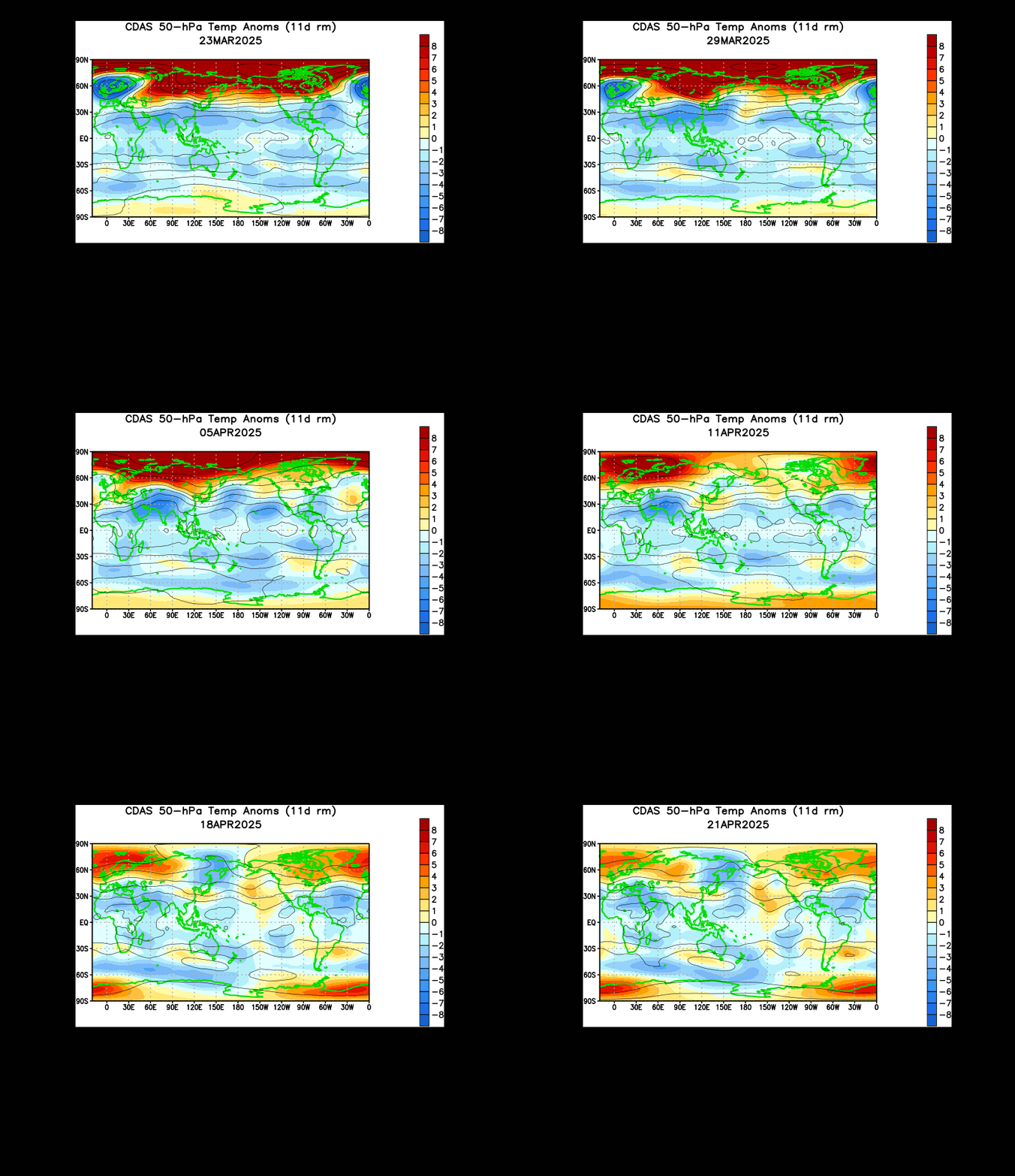
https://www.cpc.ncep.noaa.gov/products/intraseasonal/temp50anim.shtml
You mean an SSW? (Sudden stratospheric warming)
These are the “stains” of heat associated with the increase of ionization by the GCR. Galactic radiation always works in the background of solar radiation. In periods of low solar activity, GCR grows strongly in the lower stratosphere. Ionization in the geomagnetic field leads to “heat stains” in the stratosphere.
https://www.cpc.ncep.noaa.gov/products/intraseasonal/temp50anim.shtml
The blocking of circulation at high latitudes is typical in periods of low solar activity, as the ionization of the lower stratosphere by the GCR increases, while the UV with the shortest wave decreases.
http://geo.phys.spbu.ru/materials_of_a_conference_2010/STP2010/Veretenenko_Ogurtsov_2010.pdf
Thanks.
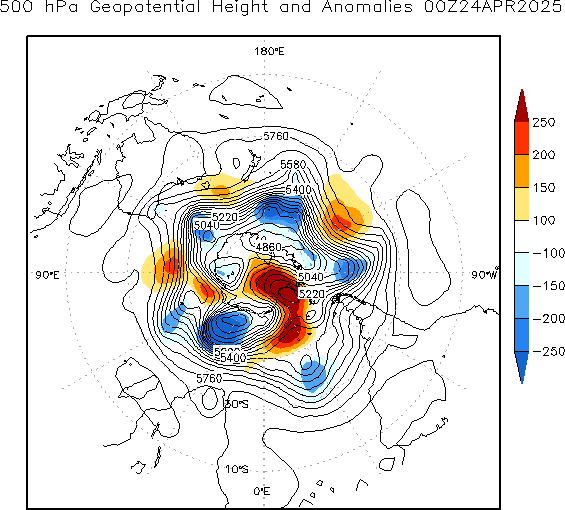
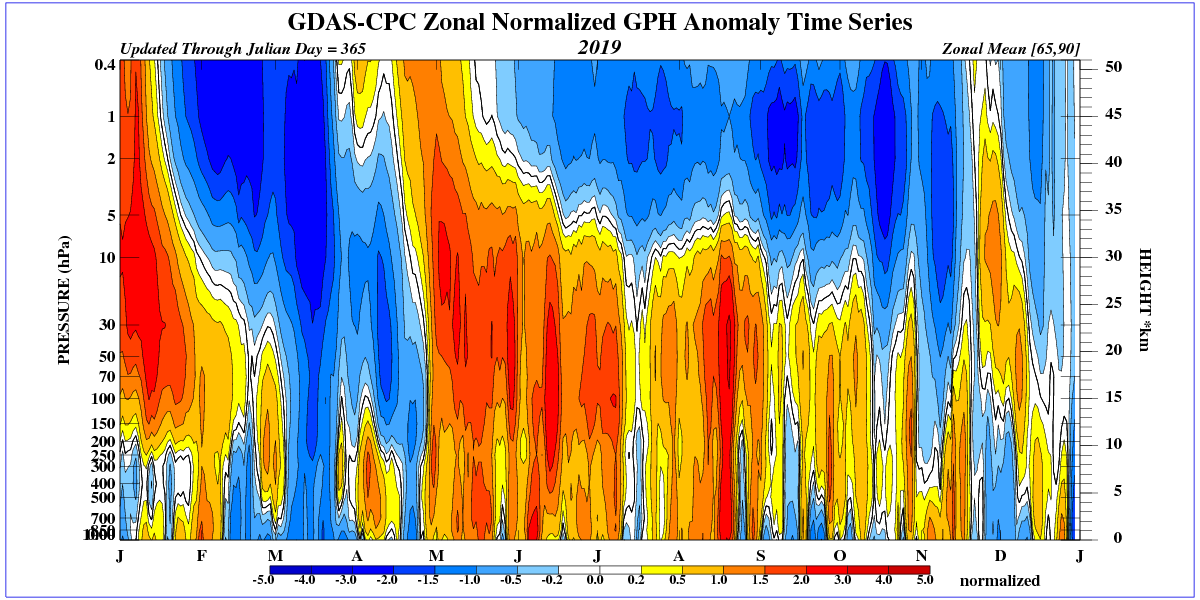
We’re the SSWs in the Arctic in January, that caused the anomalous polar vortex cold in North America, caused by the same GCR ionisation?
See the geopotential anomalies in January 2019.
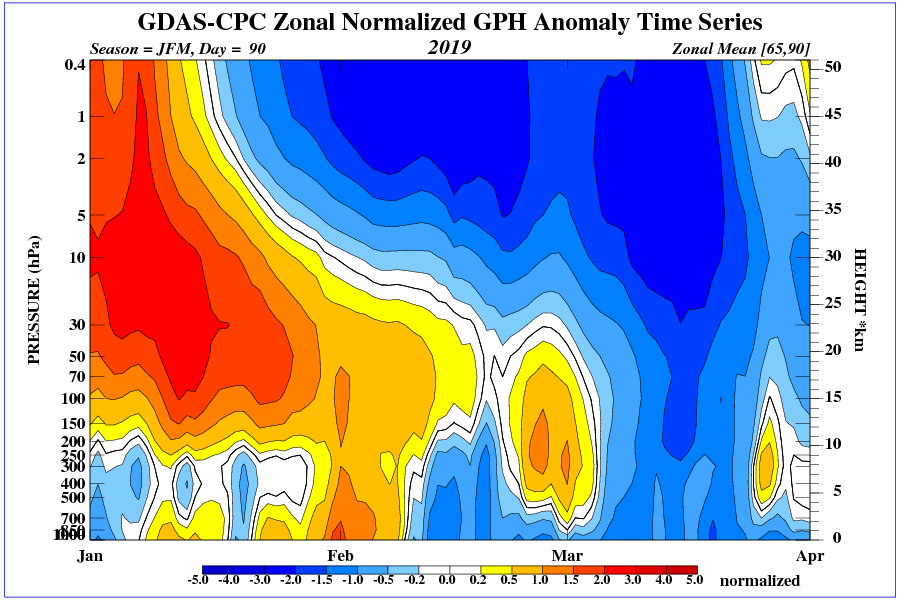
The biggest changes are visible in the lower stratosphere.
A cold lash.
In the very late 80’s, living south of Durango, along the Piedra river, we woke up on the first day of summer and found our entire sprinkler/irrigation
system frozen solid, it happened again the next night, and then temps returned to normal.
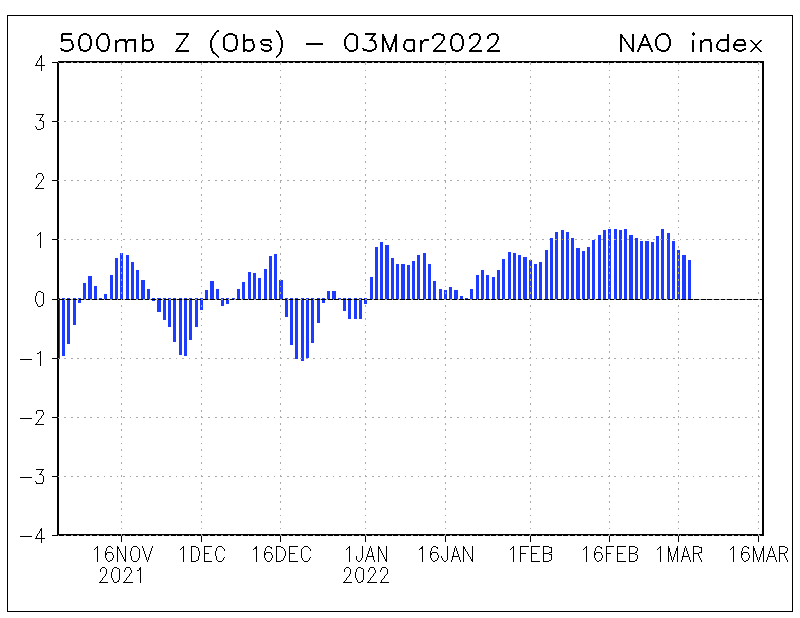
The NAO Index is negative continuously from the end of April.
BBC, UK latest:
top temperature 34C (no records broken) at Heathrow (that is one of the busiest international airports), I think that the S-box is adjacent to the northern runway, but not sure.
Heatwaves in Europe are short. Tomorrow the temperature drops in France and England.
Since last year, I’ve expected an ENSO downturn like the one experienced during the last solar minimum years.
The last big sunspot TSI action created first a CDAS global SST downtrend that lasted until May 11, then an uptrend over several solar rotations until that finally ended with a large TSI drop, represented by TSIS in red, on June 15.
That TSI downtrend had the effect of shutting down the previous warming period in the equatorial ocean until TSI rebounded again, driving a temporary warmup in the central Pacific, now shut down again by the fall in TSI last week.
The surface flux from those old sunspots in turning into earth-facing position again now, so we’ll see what’s left in terms of the TSI bump the remaining flux produces.
By watching this for some time I have discerned that larger and longer duration TSI spikes are absorbed into heat deeper into the ocean, energy that takes 10-14 days to upwell, compared to half the time for smaller TSI spikes.
Until the new cycle perks up I predict cooling and hard winters with more ice & snow records. I expect our Great Lakes to really freeze up again like last winter in an early and long cold winter.
Would love to tell you what the temp here is in my backyard. However, I am trying to find a reliable accurate and not insanely expensive thermometer. Any idea where to find one: specifically what brand or model? Perhaps a good website and recommendation. Thanks. Oh, and preferably not made in the PRC. Thanks again.
The NAO Index is negative continuously from the end of April.

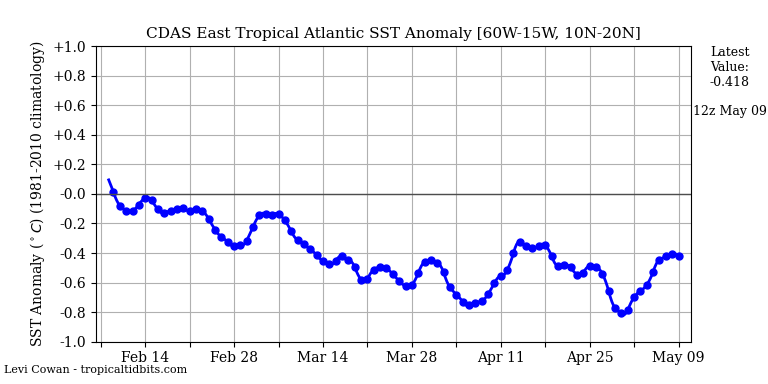
The geopotential anomalies in the stratosphere will persist due to stronger ionization during the solar minimum.


I’m very impressed by all these temp drops at so many places, even if it is winter in Australia.
But am I a warmist just because the temps in my corner in Europe are unusually warm?
https://drive.google.com/file/d/1vS6rHGveEZdgMpfIhXuVVEyRLMwPX3qf/view
It’s amusing to read Bob Weber predicting “cooling and hard winters with more ice & snow records” and expecting “our Great Lakes to really freeze up again like last winter in an early and long cold winter”.
Because here in Northeastern Germany, we experienced in 2017/18 and 2018/19 two non-winters in sequence, nearly no snow at all, and with an incredibly warm summer inbetween. We never spent so many water to keep the garden alive in the 20 years before!
I therefore suppose that Bob’s predictions and expectations are restricted to Northern America. But that is no more than 6% of Earth’s land surfaces.
Bindidon all the snow shovelling and the long unbroken cold duration in NA last winter were not amusing. As a general rule of thumb, warming or cooling is generally not universal, ie, one-sided extremes are rarely seen everywhere simultaneously. Germany probably won’t be so warm this winter – your luck will eventually run out – we can talk about that again in 6-8 months.
I won’t restrict next winter’s forecast to just NA as parts of Asia also had a hard winter last time, meanwhile the solar output hasn’t changed much since last winter.
“After the brief spike in temperatures during the El Niño-driven warmth of 2016, temperatures have fallen globally. This post-2016 two-year cooling resonates and coheres with the overall lull in the warming that scientists have observed during the past two decades, in which spikes in global temperature occurred only when El Niño was active.”
Well before writing that, I would prefer to await Roy Spencer’s data for the next 6 months.
Here is a comparison of UAH6.0 LT for the periods 1997-2001 and 2015-2019:
https://drive.google.com/file/d/1y1zmzMt_1gD5jxCOH13UVYvbocYulbNz/view
Did anybody notice on this site the nearly invisible switch from
to
Amazing!
Is Climate God dead?
I suddenly detect where the ‘sudden snow cover’ picture was made:
Rabbit Ears Pass
https://tinyurl.com/y576bhfs
Altitude: 2931 m… Oh Noes.
For a fair comparison, you quickly move to the German Alps at the Zugspitze (2962 m).
Actual temperature at 01:30 AM UTC+2: 14 °C.
Yeah it’s pretty good warm in good old Germany. No no no: I don’t complain!
And now, for something completely different…
1 metre+ hail in Guadalajara…
https://www.bbc.com/news/world-latin-america-48821306
I swear, humans are some of the most fragile creatures when it comes to short and long term weather pattern variations. It’s as if the Chicken Little book is now fact and natural weather cycles are fiction.
Meanwhile, UAH has June at 0.47°C above the 1981-2010 average. The second warmest June in its record, and the warmest monthly anomaly since 2017.
This week the Azores high is in the Mediterranean Sea – over Sicily.
The Iceland low is over the Baltic Sea.
Never seen before.
This week the Azores high is in the Mediterranean Sea – over Sicily.
The Iceland low is over the Baltic Sea.
Never seen before.
https://www.google.com/search?q=wetterkarte+europa&oq=wetterkarte&aqs=chrome.