Note: Dr. Schmidt argues points he doesn’t seem to fully grasp, perhaps purposely, then again, Schmidt is no stranger to pettiness. – Anthony
Guest essay by Steve Koonin
Gavin Schmidt has posted a commentary on the video of a talk I gave recently at Purdue University. I’m grateful for his attention and comments, as I’m always trying to improve my presentations. It seems that I failed to get my points across in some crucial places, so I’ve got work to do.
As part of that work, I offer below some responses to Schmidt’s comments . I have reformatted his original text as block quotes and removed figures to improve the readability of this response. I’ve also, without changing meaning, removed some of his snark, which has no place in a serious discussion.
Steve Koonin, June 17, 2019
*******************************************************
In the seemingly endless deliberations on whether there should be a ‘red team’ exercise to review various climate science reports, Scott Waldman reported last week that the original architect of the idea, Steve Koonin, had given a talk on touching on the topic at Purdue University in Indiana last month. Since the talk is online, I thought it might be worth a viewing.
…
The red team issue came up a few times. Notably Koonin says at one point in the Q and A:
The reports are right. But obviously I would not be pushing a red team exercise unless I thought there were misleading crucial aspects of the reports.
55:55
Schmidt doesn’t get my wording quite right, and truncates an important follow-on statement. The full quotation as transcribed from the video is:
A lot of the reports are right. But obviously I would not be urging a red team exercise unless I thought that there are misleading crucial aspects of the reports. What I like to say is I believe, to be determined, that they are written more to persuade than to inform. And, you know, having thirty years’ experience in providing advice to policy makers about science, that’s not where we want to be. It’s OK to write an advocacy document, but not one bearing the mantle of science. I believe the reports have that problem.
But in over an hour of talking, he doesn’t ever really say what they are.
Instead, there are more than a few fallacious arguments, some outright errors, some secondhand misdirection, a scattering of dubious assumptions and a couple of very odd contradictions. I cannot find a single instance of him disagreeing with an actual statement in the reports.
I said up front (at 4:00) that my focus was to point out the disconnect between what the reports actually say and the public/political dialog. It would be a different talk to point out exactly how the reports promote that disconnect (such as by burying the lede or failing to provide historical or quantitative context); that would be the focus of a red team exercise. However, the economic impact discussion (at 36:40 and below), where Schmidt seems to agree that NCA4 has a problem, is an example of the kind of thing I’d expect that a red team would highlight.
First, the fallacies
Three examples:
“Until you explain variability on all the scales relevant to the alleged human warming, you haven’t really nailed it down.”
21:10
Nope. This is basically claiming that until you know everything (an impossible task), you know nothing.
Having quoted me explicitly, Schmidt then provides his own interpretation of what I “basically” said. I did not say “until you know everything”, but rather said “on all scales relevant.” Nor did I say “you know nothing”, but rather said “you haven’t really nailed it down”; there are big differences in both cases.
The basis for the thought should be obvious. Unless you understand natural variability on the relevant scales, you’re in danger of misattributing observed changes to anthropogenic influences and so, for example, misjudging sensitivity.
I try to be careful with my words (even in an unscripted talk) and am disappointed that they’re not read with comparable care. I’m also disappointed that Schmidt didn’t address the point I made, rather than just dismissing what he thinks I said.
33:00. Apparently, Koonin “doesn’t think” rapid sea level rise is going to happen in the future because it hasn’t happened over the last 100 years at the Battery in NYC.
Again, Schmidt is criticizing an “interpretive” quotation. The transcript from the video is:
I don’t think that’s going to happen [a one meter rise by 2100]. I’m not certain, but it sure looks discordant with what we’ve seen for the last 150 years.
For sea level to rise 1 meter by 2100 would require an average rate of 12 mm/yr through the end of this century. That’s about six times the rate we’ve seen for the past 150 years and four times the rate we’ve seen in recent decades (and likely also in the 1940’s). So I don’t see much reason to change my quote.
35:40. Koonin skips his slide on why Arctic sea ice trends aren’t anything to worry about, but his point was going to be that people noticed warming in the Arctic in 1923. This is of course another fallacious argument (and we’ve dealt with it before).
I’ll pass on responding to this one. Since I didn’t talk to the charts, Schmidt doesn’t know what I would have said.
Contradiction Central
There are two glaring sets of contradictions in the talk, first, involving attribution of past change and secondly, his stance on normative judgements in discussing science. Starting around 7:29 he discusses attribution of recent trends and states:
“You had better have [natural influences] under control before you can attribute what you see to human influences.”
This is fair enough (assuming he means that one should have a good handle on natural variability rather than ‘controlling’ it), and one might read this as a statement that attribution is complex and deserves careful attention – an opinion with which I fully concur. But this is illustrated with the most useless kind of pop attribution. He makes a blanket statement that any changes prior to 1950 must be purely ‘natural’ without any analysis at all (a stance completely at odds with the literature, for instance, Hegerl et al., 2018), and supports it with an uncredited graph from, of all people, Bob Tisdale, a frequent blogger at WUWT, showing running 30 year trends of the (now obsolete) HadCRUT3 data. That’s an interesting choice of metric because it is the longest trend period you can use that allows the ~1940 rise to almost match the more recent decades. With 35 year, or 40 year, or 50 year or 60 year trends, the exceptional nature of the recent change is obvious.
The data shown in the left panel at 8:00 are indeed an accurate representation of HadCRUT3. I appreciate the suggestion that I use more up-to-date data in future presentations. However, the quantitative 30-year trends shown in the right hand panel are those I determined from GISS’s own LOTI data (recently downloaded); they make the point even more powerfully.
Yes, I should not entirely dismiss the role of human influences in the first half of the 20th century, although the anthropogenic forcing used in the GISS CMIP5 simulations pre-1950 was no more than about 25% of what it is today. I do show (at 13:11) quantitatively the evolution of forcings over the past 250 years and at 20:50 do discuss the IPCC statement that includes anthropogenic forcing as one of the contributors to the early 20th century warming. The Hegerl et al. paper Schmidt cites does not appear to warrant changing that statement.
WMO defines climate as a 30 year average, which is what I used. It’s poor practice to be changing one’s definition a posteriori. The problem with longer averaging intervals is that there are then fewer independent periods upon which to base the claim of recent “unusualness” and whatever response there is to human influences in the recent decades is also diluted.
His second contradiction concerns his statements about normative values. He, of course, claims to make no normative statements, while implying others (unnamed) are perverting their science to do so. And yet, not only is his talk filled with his opinions, he has a remarkably different approach to the climate science results than to the results from economic modeling. For the former, he is hyper-critical (mostly without any valid cited reasons), while for the latter he appears naively credulous. This, at best, is incoherent, since the economic projections are rife with embedded normative values.
For instance, he uses a standard contrarian argument that future damages associated climate change will be a small fraction of the expected economic growth and therefore do not need to be mitigated. But the models that produce that result simply assume that no amount of damage from climate change can effect the exogenous growth rate. Additionally, they assume that damages themselves are simply proportional to the square of the temperature anomaly. You can judge how credible these assumptions really are. Of course, if we are to be ridiculously better off in the future without any effort, then the estimated costs of mitigation (also a few % of GDP) are also irrelevant.
Yes, the economic modeling is at least as uncertain as the climate modeling and compounding the two is even worse, as I noted in my Wall Street Journal OpEd on the subject. I’m glad Schmidt now agrees, since he seemed quite taken with the economic modeling when Volume II of NCA4 was officially released. Perhaps he now shares my opinion that this should not have appeared in NCA4? (How did it survive peer review?)
However, my point in the talk was that these economic projections did appear in NCA4 (the alleged “gold standard” of the science) and were highlighted in headlines by the media and politicians. But NCA4 failed to provide proper quantitative context, which would have shown that the impacts (as projected) are minimal. How did that get past peer review?
Koonin gives his summary around 47:00, after spending a fair bit of time correctly describing the size of the challenge involved in stabilizing climate. But then he just shrugs and assumes that it is too big to ever be dealt with. This is not a conclusion that “just comes from the numbers”. He clearly has a normative preference for adaptation (seemingly oblivious to the point that it is very hard and very costly to adapt to a continuously changing, and even accelerating situation). Whether or not mitigation will be too hard, it is undoubtedly a normative decision to give up trying.
I used the word normative in the sense of prescriptive- “the world should …”, which necessarily involves tradeoffs based upon values. That’s very different from giving an opinion on what “will” happen, which is necessarily a judgement.
In the talk, I’m careful to avoid any “should”, but have no hesitation in making judgements about “will.” Only with apologies do I reluctantly stray into normative language in my last slide (48:00).
But even there I do not advocate that we “give up trying’; perhaps my failing in Schmidt’s view is that I do not advocate for urgent mitigation. Of course, Schmidt might have a different opinion about what will happen (his judgements) or about what should happen (his values), and I’d be happy to engage on those. But that shouldn’t be confused with a science discussion.
Errors galore
Some of these are trivial, some are more consequential, but all are illustrative of someone who is not well-versed in the topic.
At 14:40, he claims that climate models take time steps of 6 hours. It would be a little hard to resolve the diurnal cycle with that. The correct value is more like 15 to 30 min for the column physics, and more like 2 or 3 minutes for the advection routines. Curiously, even the slide he is talking to says this.
Mea culpa. My point was that many timesteps are needed for a useful model run. Citing the smaller time step makes the point even more powerfully (1.8 million 30-minute steps over a century).
18:45. he says that Figure 9.8 in IPCC AR4 (2013) was ‘misleading’ because it showed anomaly temperatures alongside the range of absolute mean global values. This is odd. If the sensitivity of the model is not dependent on the base state, this is a good result.
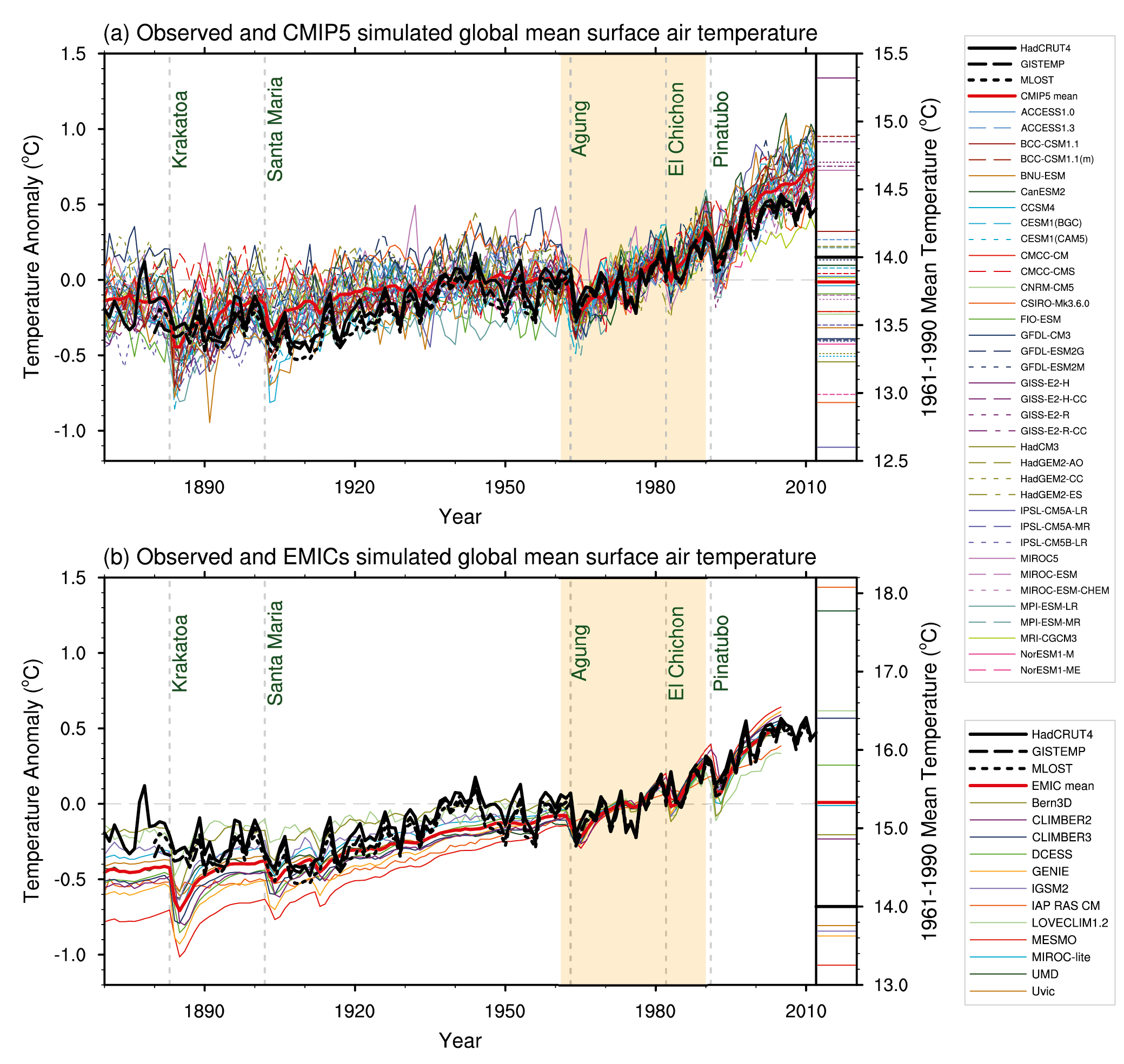
That’s a pretty big “if” in the last sentence. Schmidt explored the issue some years back, likely stimulated by a discussion he and I had had a month or two earlier. The results presented there are far from persuasive – indeed, on average the 2011-2070 trend of the CMIP5 models under RCP4.5 decreases about 20% for every degree C increase in 1951-1990 absolute GMST. Perhaps there has been further work on this subject?
20:34. he claims that the CMIP5 models were tuned to 20th Century trends, which is why without anthropogenic forcings they show no trend. This makes no sense at all. First, it is just untrue that all the models were tuned on the trends. And second, if there is no big trend in the natural forcings, you just aren’t going to get a big long term trend in the response. Nothing to do with tuning.
21:06 Another graphic borrowed from Bob Tisdale. This one makes the classic error of confusing the forced trend (as estimated from the mean of model ensemble) with the actual trend (which includes the actual forced trend and internal variability). For someone who claims to be interested in how internal variability is represented in models, that’s an odd lacuna.
It’s good to see acknowledgment that the models under-represent multidecadal variability. But it is stunning for Schmidt to say that it is “a classic error” to compare the forced ensemble-mean trend with the actual trend. Schmidt first tried to justify ignoring model absolute temperatures and paying attention only to model anomalies. And now he’s saying it’s an error to compare trends in those model anomalies to the observations. If that’s the case, what’s left if we want to compare simulations with the real world GMST?
26:00. His slide 25 is just BS from start to finish. Note there are no actual quotes from any specific case – everything is a strawman argument.
No doubt I’d be accused of cherry picking were I to cite specifics. However, I invite interested parties to reread the NCA4 or AR5 extremes sections with my refrain in mind to judge for themselves whether I’m spouting “BS from start to finish”.
28:05. He quotes me! This is not an actual error, but I find it funny that my views on how the media treats extremes (at least in 2013) are worthy of inclusion, but not, say, my views on climate modeling or attribution (you know, my job).
I’ve no problem acknowledging when Schmidt (or anyone else) is right. Note, however, I use a literal quotation, not an interpretive one, since the latter can create confusion, as some of Schmidt’s criticisms demonstrate.
31:00. Satellite records of sea level rise (since 1992) “are commensurate” with the tide gauge estimates (roughly 2mm/yr). Sure, but Koonin mysteriously neglects to mention they are 50% higher than the long term trend from those gauges. Also missing from his commentary on longer term records is that even the modern tide gauge-derived rate is more than twice the Holocene trends since 6000 BP (see for instance, Ashe et al., 2018).
My chart at 32:20 displays the tide gauge trends over the past century (from the NCA4 primary reference on this topic, although not shown in NCA4). It clearly shows recent decades (and the satellite record) rising faster than the long-term average trend, and I remark on that fact. With regard to the past 6000 years, I do cover the geological context a bit, but it’s only a 50 minute talk. And as I remark, what really matters for attribution is what’s happened over the past 150 years as human influences set it.
34:10 “If you get all your climate information from watching CNN or reading the New York Times or Washington Post [the data on hurricanes] is a surprising statement”. Apparently, these outlets report on hurricane trends so frequently and so erroneously that no reference to them actually doing so is needed. Ok then.
I’m not sure what’s the gripe here. Even a casual search of the media shows that statements like “there has been no detectable human influence on hurricanes” occur far less often, if at all, than does coverage indicting “climate change” for every hurricane misfortune.
50:02. “I would do more when the signal has come out of the noise, which it has not yet”. This is complete rubbish. The signals of temperature change, sea level, sea ice loss, intense precipitation, heat waves, phenology, permafrost loss, Greenland melt, ocean heat content etc. have all clearly ‘come out of the noise’. What is he really waiting for?
I do mention some of these other indicators of warming at 6:50. Per my discussion at 33:05, there’s only about a ½ σ indication that sea level has come out of the prior multidecadal variability. Further, the AR5 quotes at 26:50 do not inspire confidence in significant changes in the majority of weather extremes. And certainly let us not confuse detection with attribution.
Is there anything new here?
This is what I don’t really understand: There is absolutely nothing new here. Every argument, point, and even some graphics, are old, stale, and previously rebunked. These points could have been made (and undoubtedly were) in official reviews of assessment reports going back years. The people making these points have undoubtedly been told this and shown responses. In Koonin’s case, I know this for a fact (for instance). And yet, they persist. There is no development of the arguments, no counter-points, no constructive back and forth, just the same arguments that they appear to have thought up once and never examined.
Personally, I like taking on smart criticisms. They help hone the science, clarify the arguments and point to areas of needed research. But there isn’t a single thing here worth taking on.
This was a talk for non-experts meant to highlight the disconnect between the reports and the popular/political discussion of climate science. I made no claim to introduce any new science.
Schmidt’s comments correct some real nits (thanks for that!), and attempted to correct some others he imagined. But he’s not successfully challenged my larger points (for example, as expressed in the summary at 47:20). So I’m mystified as to what he thinks has been rebunked [sic]. Appropriate to the purpose of the talk, my discussions of modeling challenges and deficiencies, temperature extremes, sea level rise, hurricanes, economic impacts, and the challenge of effective mitigation were all based upon what’s in the reports themselves, the refereed literature, or widely acknowledged data (like LOTI). So I’m not surprised that he “sees absolutely nothing new here”. However, much of my audience was wide-eyed and, I hope, inspired to investigate further on their own.
The reports continue to paint a demonstrably deficient picture of the science. The scientific community needs to fix that, both to better inform the decision makers and also to bolster the integrity of the people and institutions that produce the reports. A red team exercise would go a long way toward that end.
Here is the talk being discussed.
The reason why there is disconnect between what the public believes and what the reports actually say, is because the climate team, including Schmidt, want it that way.
I hope you talk a lot better than you write, Mr Koonin.
This “article” is disjointed, hard to follow, and hard to read.
If you do talk better, then please learn to “write as you speak”.
.
My two cents:
.
SUMMARY:
Leftists do not debate.
They are science deniers.
They focus on wild guess predictions of the future climate, which can not be refuted without waiting 50 to 100 years to show they were wrong !
You could point out their predictions, based on a high ECS for CO2 developed in the 1970s, that never changes, have been wrong for 30 years.
They don’t care.
Nothing can falsify any climate change claim they make !
Climate alarmism is a secular religion, not real science.
Sure, there are people involved who have science degrees, but consistently wrong wild guesses of the future climate are not real science.
.
.
.
DETAILS:
On climate science, there can be no debate because real climate science involves the present and past climate.
No matter what you say about the past climate, the climate alarmists will claim the future climate will be VERY different.
You could point out that the PAST 300 years of intermittent global warming was 100% good news … but the climate alarmists will claim the FUTURE global warming will be 100% bad news.
How can anyone debate an imaginary future climate change, that bears no relationship to the past climate change ?
And how about a debate over natural causes of climate change?
You can’t debate that either !
You can point out that we have had 4.5 billion years of natural climate change, with no known change CAUSED by varying CO2 levels.
They will claim natural causes of climate change are just “noise” now, because CO2 levels control the global average temperature.
And their proof of that is: “BECAUSE WE SAY SO” !
Wild guess predictions of the future climate are not real science.
Not when the wild guesses have been so wrong for so long.
The always wrong predictions are just computer game climate astrology.
The climate models, on average, excluding the accurate, perhaps by accident, Russian model, predict a future warming rate that is QUADRUPLE the actual warming rate since 1940.
1940 is a good starting point because the ramp up of man made CO2 started as the Great Depression was ending.
There was a significant CO2 emissions decline during the Great Depression period (the beginning of the 1929 Recession, through the end of the 1937 Recession), with no obvious effect on the global average temperature, or sea level rise.
1940 is an appropriate starting point for observations of the global average temperature, while CO2 is rising — not 1975, or 1979, which are much more common.
Using 1975 or 1979 as the start point is data mining, in my opinion, ignoring the significant CO2 emissions from 1940 through 1975, or 1979.
“I hope you talk a lot better than you write, Mr Koonin.
This “article” is disjointed, hard to follow, and hard to read.
If you do talk better, then please learn to “write as you speak”.
That’s a bit rough Richard!
Make you case but the good guys here don’t get personal.
Thanks . . .
Thanks Steve for responding. I read the first part of Schmidt’s screed before concluding that it was mostly nitpicking, a classic example of consensus enforcement. I then watched your lecture and it seemed quite a good summary of the actual science.
Wrestling with PIGS!
Does anyone know what that means?
Sometimes … it means pork chops are on the menu …!
😉
– This is nature:
https://www.google.com/search?q=strong+force+weak+force+electromagnetic+force+gravity&oq=strong+force+weak&aqs=chrome.
THIS is justice, philosophy, metaphysics:
https://www.google.com/search?q=normative+meaning&oq=normative+meaning&aqs=chrome.
_________________________________________________________
If I am acting against nature’s laws, e.g. gravity, I’m dead. Or at least hurt.
– If I violate judiciary, philosophy or metaphysics I take a good lawyer and may get away without damage. It is unfortunate to engage in a discussion of normative values - so Gavin Schmidt can tell “as you like it”.
_________________________________________________________
https://www.google.com/search?q=Shakespeare+as+you+like+it&oq=Shakespeare+as+you+like+it&aqs=chrome.
– here we should adhere to real existing nature.
“Blasts the errors” or “Tickles the nuances”?
A Red Team needs to combat the fundamental weaknesses of the Establishment suppositions. Matters like these –
The fundamental hypothesis that CO2 exerts a dangerous influence on atmospheric temperatures is DISPROVEN. What more evidence is needed?
Reliable tide gauge measurements show no acceleration of change in the last 100 years. There is no plausible mechanism to expect an acceleration in the next 50 years. so why the drama? More, the lack of acceleration corresponding to the alleged increase of anthro CO2 circa 1950 has to be explained. Does the ocean act like a thermometer, or not?
The effect of Urban Heat Islands has not been quantified adequately for correction of near-surface global temperature estimates of the popular kind. It remains that UHI might contribute half of the claimed T rise of 1 deg C over the last century.
The actual contribution of anthropogenic CO2 to the measured atmospheric concentration remains in doubt. There is too much remaining uncertainty about quantitative measures of sinks and sources of CO2, so there can only be low confidence in current attribution schemes.
There are many more major uncertainties. Some would be clarified by proper use of error analysis applied to measurements, climate science being particularly deficient in proper analysis of error and uncertainty. A major case is estimation of radiation balance at top of atmosphere, another is Argo float accuracy, a third is the useless range of ECS estimates.
The point is that any one of the above, properly understood, is capable of sinking the Establishment argument. While this possibility remains, the Science is not settled. Humanity is dealt a disservice if the current arguments prevail in the face of demonstrably poor and incomplete Science. Geoff
Jack Dale – did you even read that guest blog –
or were you already in the start holes for some show runs.
I read the guest blog, watched the video and read Gavin Schmidt’s blog.
And you?
Dieser Gavin Schmidt ist ganz einfach unehrlich, er schwindelt sich durch. Ein schmieriger Kleinkrimineller – NORMATIV ?!?
[This Gavin Schmidt is simply dishonest, he dodges through. A greasy petty criminal – NORMATIVE .mod]
Nailed it.
I love an honest assessment.
Bad enough that Gavin has basically run Real Climate on taxpayer time and $$$.
But we all know him for his ethics as the International Man of Mystery.
https://climateaudit.org/2009/02/04/gavins-mystery-man-revealed/
“Mea culpa. My point was that many timesteps are needed for a useful model run. ”
funny. what you meant to say was
“I was wrong”
is that really that hard?
me·a cul·pa
[ˌmāə ˈko͝olpə]
EXCLAMATION
an acknowledgment of one’s fault or error.
““Well, whose fault was that?” “Mea culpa!” Frank said”
At least he can admit he is wrong. Schmidt so far as I know is not strong in this department.
He is Climate Fonzie!
https://youtu.be/uwkU8-d1gIk
You can’t even get your major (English) right?
Latin is not English.
Yeah, obviously — point is an English major should be familiar w/commonly used phrases from other languages that English speakers use. Capeesh?
Doyeeeeee
¿qué?
whoop whoop whoop
Mosher, how’s Best model doing?
Eh?
What exactly did you think “mea culpa” meant, mosh?
You were wrong…how hard is it for you to admit it?
Tick tock tick tock…
Applause! Applause!
Authot! Author!
Slap Gavin around some more!
Why Gavin Schmidt has been invited into this country, given a job, a salary, research funding, and a soapbox are beyond belief. His actions can only be explained as though his goal is to destroy the country. His government employment should be terminated and his visa not renewed.
Gavin and the entire ‘climate science’ consensus do not properly account for the WV increase.
In the period 1988-2002 water vapor molecules increased more than 5 times as fast as CO2 molecules and about twice as fast as calculated from the average global temperature increase.
A red/blue team approach assumes both sides are honestly looking for the truth. Sorry, nothing could be further from the truth. The only way to handle the climate scam is to show it is a scam. This requires solid funding and work by skeptics. It then requires a forum for showing the results. I don’t see it happening even with Trump in charge.
It’s always bugged me that GS makes clearly political opinion tweets during work hours.
Also, where is it in his job description that says, on the public dime, he must refute presentations with which he finds fault? If his job description says that he should, how does he pick and choose which ones? Surely Koonan’s isn’t the only one out there.
He’s director of what? (sarc)
I think his display of political bias makes for an extremely lousy role model for young scientists, and is completely inappropriate for the position he holds.
The IPCC states that “… the approaches used in detection and attribution research described above cannot fully account for all uncertainties, and thus ultimately expert judgement is required to give a calibrated assessment of whether a specific cause is responsible for a given climate change …” (AR4).
Gavin Schmidt agrees:
http://www.realclimate.org/index.php/archives/2014/08/ipcc-attribution-statements-redux-a-response-to-judith-curry/comment-page-4/#comments
And Gavin Schmidt is such and expert, he admits it himself: “… climate modeling or attribution (you know, my job)”.
“Guest essay by Steve Koonin”
Never thought I’d see the day.
Now, if you can get Stephen McIntyre to do a ‘guest essay’ I’ll eat my hat whilst hitting the donate button.
Charles why don’t you push him for a WUWT essay on Antarctic Proxies . . .
1 Feb 2019 he posted an amazing new lengthy analysis on Climate Audit that deserves a wider audience:
“Antarctic d18O is one of the few proxies which can be accurately date in both very recent measurements and in Holocene and deep time. However, rather against message, Antarctic d18O over the past two millennia (as for example the PAGES2K 2013 compilation) has mostly gone the “wrong” way, somewhat diluting the IPCC message – to borrow a phrase.”
The climate cult is going to steadily fall apart over the next couple of decades. And unlike many people who fell for the cult, Schmidt CANNOT ARGUE he wasn’t in a place to know he was wrong.
He will end his days as a sad rejected individual knowing that his whole life’s “work” was completely wrong.
Indeed, as a leader of the cult, he may well end his days in jail.
Koonin: having thirty years’ experience in providing advice to policy makers
Doc: means that you are a lobbyist. Lobbyists are generally unqualified with regard to climate science. Given that your arguments lack any merit, I’d say that you are a typical lobbyist.
You mistake a lobbyist for science advisers. A lobbyist generally works for private industry and specifically advocates for the industry by which they are employed. The government accesses a wide range of science advisers to assist in obtaining information needed to consider policies. Typically science advisers are either employed directly by the government, or accessed on a short term basis via a contract. Also typically, they are employed by universities. Examples of science advisers are the Jasons, the National Academy of Sciences and Engineering, and also the many panels the EPA uses to evaluate various scientific issues. The latter has come under scrutiny for evolving into a private preserve for a few favored scientists, but generally the participants do not work for an industry (as a lobbyist would), in fact that situation would be precluded by the EPAs stringent rules on protection of proprietary information provided to the EPA for review of proposed new uses of materials. The vast majority of EPA science advisers are in the field of toxicology. While science advisers may not work to bring contracts to industrial concerns, they have from time to time been accused of providing advice that would favor certain lines of research, in which they might participate as grantees. But that is a very different beast from lobbying for the next big missile, or the next big cyber security contract.
IPCC
Mann
Schmidt
Hansen
Gore
Holdren
Jones
Etc.
Which of them has not attempted to provide “advice” to policy makers?
“(seemingly oblivious to the point that it is very hard and very costly to adapt to a continuously changing, and even accelerating situation).”
I think the good doctor Gavin, should try having kids. For humans, adapting to continous and accelerating change, it’s our speciality. He really should get out of the office and live a little. It would propably be really good for him.
“it is stunning for Schmidt to say that it is “a classic error” to compare the forced ensemble-mean trend with the actual trend“. Surely every model-generated trend should be compared with actual trend at the first available opportunity. Shouldn’t it?
But Schmidt also says “it is just untrue that all the models were tuned on the trends“. My understanding is that the models were all tuned directly or indirectly on the trends.
From the video —
At about 10:28
“And the basic argument is that pinning it all on humans over the last 40 years, is that there is no other cause we can think of that is responsible for the warming we see.”
And then at about 11:30
“we got to look at energy flows in the climate system, this is a picture again from one of the [IPCC] reports [showing a picture of K&T type energy balance diagrams], and the thing to take away from this first of all, it complicated. There are lots of arrows of flows of energy going on here. The big ones are that the solar energy comes in, about a third of it gets reflected, the rest of it gets absorbed by the surface … ”
And during that whole video at no point has life — the totally of life on this planet — been assigned any solar energy value to keep going. Why does this theoretical idea not have the ‘miracle ‘ of photosynthesis requiring a solar energy input?
Do not plants at their very essence sequester and use solar energy to make those HIGH energy sugars, starches, cellulose polymer, proteins, etc., by taking biologically useful but structurally useless CO2, water, nitrogen, and a few minerals and CONTINUOUSLY make high energy biological molecules. Solar energy that life continuously attempts to sequesters away in long lived chemical structures (some store away for centuries in soils, peat, etc.) Coal is the last vestiges of solar energy from millions of years ago bound up in its chemistry.
Also note that the totality of life on this planet is not a constant, therefore the required amount of solar energy to maintain this life is not a constant . Generally during the cooler periods life recedes as the carbon cycle slows, and usually during the warm periods it expands and the carbon cycle speeds-up. Adding CO2 to the atmosphere of the currently only moderately warm atmosphere should ensure that the carbon cycle expands — that life becomes more abundant to transform solar energy into biologically useful compounds and materials. And as life moves into previously deserted areas it will change the weather patterns and eventually the climate, in a manner similar to the way our land use changes affect the climate. As this video shows marginal and desertified areas can be changed https://youtu.be/vpTHi7O66pI and the solar energy used in those locations increases to a new and expanding level.
Life on this planet is not a static entity and it takes and uses solar energy continuously.
Thank you for that link to that video. It is amazing to find a completely new way of thinking.
The population since 1800 to the present has (approximately) doubled 3 times to reach our present level. All during that time humans have been consuming food. Food that holds solar energy (solar energy + CO2 + nitrogen + water + some minerals converted to useful biological chemicals by plants). In essence we, like the plants and animals we cultivate, are storehouses of solar energy — solar energy that is stored in the chemical bonds of biological molecules.
If you were to take the total number of people that have lived from 1800 to the present, and render them all down to the elements from what the plants started the process from, subtract all thermal energy of the environment (over 200 years), then what you have left is the solar energy required in 200 years to grow the human population from 1 billion to 8 billion.
Life not just human life, the carbon cycle, uses, stores, and recycles solar energy continuously. Is the solar energy continuously taken and used by life so small, is it so insignificant that all these climate
worriersscientists can just ignore it? IMO no they shouldn’t. After all when it comes to the theoretical values for what CO2 and solar energy are said to do, aren’t those too very small numbers?“And the basic argument is that pinning it all on humans over the last 40 years, is that there is no other cause we can think of …”
No one denies that vast majority of the Earth’s energy come from the sun. This issue is the solar constant; solar activity varies 0.1%. That is insufficient to be a factor in climate change.
Milankovitch cycles, which were the dominant factor in climate change, do not produce changes in solar output. They change the amount of solar energy received by the Earth.
According to Milankovitch cycles we should be be in a period of long term cooling. For the most of the past 6000 years since the Holocene Optimum we were cooling. That abruptly reversed with the increased use of fossil fuels during the Industrial Revolution. Since then 1.5 trillion tonnes of anthropogenic CO2 have been dumped into the atmosphere, resulting in a nearly 50% increase in CO2 levels. The current levels have not been recorded in 3-5 million years.
For the most of the past 6000 years since the Holocene Optimum we were cooling. That abruptly reversed with the increased use of fossil fuels during the Industrial Revolution.
If so, thank the heavens!
Jack Dale
More distraction …
Why are you blathering on about Milankovitch cycles?
What I have written has nothing to do with them.
Jack Dale
I’ve missed the point entirely with your blather about Milankovitch cycles.
Just about all the energy for life on the surface of this planet comes from the sun.
What is the total solar energy required by all life on this planet (it is not zero, and no doubt will not be a constant!). Life that transforms elementary chemical + solar energy to chemical energy to make biological compounds.
Although IR energy is not a major requirement for plants, warmth is required for the enzyme process of photosynthesis. Plant leaves consists for the most part of water which will quickly absorbs and is warmed up by infrared radiation, this gets them quickly productive, especially after cold nights, and in the cooler temperate areas of the globe.
I both applaud and take issue with Koonin’s civility towards Gavin Schmidt. Gavin is not a moral, ethical or reasonable person and certainly not a credible scientist, so different rules apply.
A never ending barrage of wealth redistribution schemes masquerading as eco-catastrophes are a major threat to every rational civic minded citizen of earth. Because if we force authoritarian socialism on everyone, we will end up with a lot less resource and motivation to solve real catastrophes and the third world will suffer the most.
People like Schmidt must be stopped at all costs. Hopefully there are more Climategate like whistleblowers who will come forward to expose Schmidt et. al. for the huge fraud they have imposed upon all humankind.
All the models have been wrong which suggests the assumptions plugged into the models are wrong.
https://www.carbonbrief.org/analysis-how-well-have-climate-models-projected-global-warming
I’ll acknowledge there are many models, but snow is not a “thing of the past”.
And model after model projected such warming.
Global Climate Models have successfully forecast:
That the troposphere would warm and the stratosphere would cool.
That nighttime temperatures would increase more than daytime temperatures.
That winter temperatures would increase more than summer temperatures.
Polar amplification (greater temperature increase as you move toward the poles).
That the Arctic would warm faster than the Antarctic.
The magnitude (0.3 K) and duration (two years) of the cooling from the Mt. Pinatubo eruption.
They made a retrodiction for Last Glacial Maximum sea surface temperatures which was inconsistent with the paleo evidence, and better paleo evidence showed the models were right.
They predicted a trend significantly different and differently signed from UAH satellite temperatures, and then a bug was found in the satellite data.
The amount of water vapor feedback due to ENSO.
The response of southern ocean winds to the ozone hole.
The expansion of the Hadley cells.
The poleward movement of storm tracks.
The rising of the tropopause and the effective radiating altitude.
The clear sky super greenhouse effect from increased water vapor in the tropics.
The near constancy of relative humidity on global average.
That coastal upwelling of ocean water would increase.
Jack Dale,
As for your dim-wit models
It is nice to see the work from honest scientist occasionally gets through …
From https://www.sciencedirect.c…
Physica C. Essex, A.A. Tsonis, Model falsifiability and climate slow modes,
https://doi.org/10.1016/j.p…
So the climate models are not a way to verify the actuality.
Be careful how you cut and paste.
“DOI Not Found”
I’m sure you can google (or whatever you use) for it.
It still exists, I’m reading it at
hŧtps://www·sciencedirect·com/science/article/pii/S0378437118301766
You may have to correct that too as I typo quite a lot these days.
From https://www.hoover.org/research/flawed-climate-models
“The Intergovernmental Panel on Climate Change (IPCC), the established global authority on climate change, acknowledges this in its most recent Assessment report, from 2013:
[bold and italics in original]
What is the net effect of cloudiness? Clouds lead to a cooler atmosphere by reducing the sun’s net energy by approximately 28 Wm–2. Without clouds, more energy would reach the ground and our atmosphere would be much warmer. Why are clouds hard to model? They are amorphous; they reside at different altitudes and are layered on top of each other, making them hard to discern; they aren’t solid; they come in many different types; and scientists don’t fully understand how they form. As a result, clouds are modeled poorly. This contributes an average uncertainty of ±4.0 Wm–2 to the atmospheric thermal energy budget of a simulated atmosphere during a projection of global temperature. This thermal uncertainty is 110 times as large as the estimated annual extra energy from excess CO2.”
You left one out:
https://thehill.com/homenews/media/448339-nationals-announcer-says-global-warming-may-be-leading-to-record-home-run-pace
Jack Dale –
It is nice to see someone from the alarmist side defending the models with some statements that can be examined in detail. I would caution that many, perhaps most, of those ‘true’ predictions would follow from any warming, however caused, and doubtless others will be jumped on by the resident neighbourhood watch in fairly short order.
Nevertheless it seems to me that you have sufficient knowledge of the way the models work to educate us with regard to the statements you make and open each in turn up to a debate from which we all may learn something. Don’t be deterred by the offhand responses you will surely get. I’m a sceptic but I’m open to be converted.
Please don’t do it on this thread. If Anthony and his people will allow it, please ask to put it up as a guest post in its own right. I, and I suspect, most of the commenters here have only a very vague idea of how the models work, and I’d be really interested to have your take on it.
The first is a clear signature of the GHE. If the solar variability was a factor, the stratosphere and troposphere would warm and cool in synch with each other. They do not do so.
Warming troposphere
http://images.remss.com/data/msu/graphics/TLT_v40/plots/RSS_TS_channel_TLT_Global_Land_And_Sea_v04_0.png
Cooling stratosphere
http://images.remss.com/data/msu/graphics/C25/plots/RSS_TS_channel_C25_Global_Land_And_Sea_v03_3.png
Jack – only a few here dispute the GHE, but that’s a very different question as to whether carbon dioxide can modulate the GHE sufficiently for it to be regarded as a ‘control knob’ for the temperature, and whether the models describe that behaviour sufficiently well for us to trust the predictions they make enough to inform policy. The provisional answer is, no, they don’t. But I guess they might, over a longer period [I don’t regard Gavin Schmidt’s suggestion that anthro CO2 could be responsible for 120percent of the observed warming as being unreasonable, though if it were true it would indicate that models do not adequately capture other important climate drivers, of course!]
It’s a pity they didn’t predict what they were supposed to predict: global temperature. Nor have any of the numerous predictions of increasing severe weather proved correct. Indeed, the only way the climate models “work” is by adjusting the ground data to fit the models.
But keep trying to defend the indefensible.
I gather you missed this link.
https://www.carbonbrief.org/analysis-how-well-have-climate-models-projected-global-warming
Observed vs modeled (RSS V4.0 MSU/AMSU):
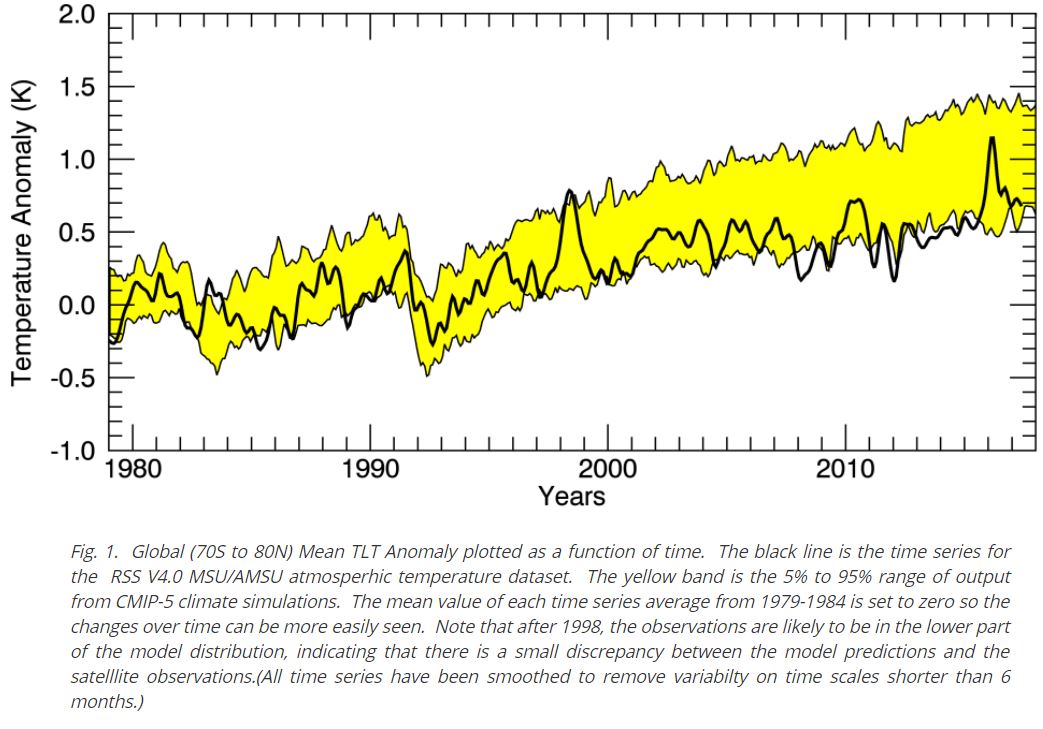
Observed vs modeled 20oN and 20oS since 1979 (HadAT and HadCRUT4);
http://www.climate4you.com/images/EquatorSurface300hPa200hPaDecadalTempChange%20BARCHART.gif
Jack,
An expected result. If you start with a very large list of possible effects then you expect to get a tiny list of successes.
Proper science, involving balance and full disclosure, requires a parallel list of forecast failures. It is rather longer than your list of successes. Indeed, it is so long that it becomes tiresome to create it for display here.
Why do you not show the failed forecasts as well? Geoff
Perhaps you could share some failures from the models. Please avoid “predictions” made by non climate scientists and those without some reference to the models.
F or a starter, I would also suggest that you not post John Christy’s bogus graph.
Remember that the claim is that NONE of the predictions have materialized. The list I posted refutes that claim.
JD
You said, “Perhaps you could share some failures from the models.”
How about this:
https://wattsupwiththat.com/2018/06/30/analysis-of-james-hansens-1988-prediction-of-global-temperatures-for-the-last-30-years/
Jack Dale,
And then there are the problems with the each variant of computer climate model such outlined here in Impact of Physics Parameterization Ordering in a Global Atmosphere Model by Aaron S. Donahue and Peter M. Caldwell… (From https://agupubs.onlinelibrary.wiley.com/doi/full/10.1002/2017MS001067)